 Скачать презентацию Composition of milk Check it Kossalieva G B
Composition of milk.pptx
- Количество слайдов: 15



Composition of milk Check it: Kossalieva G. B Fulfilled: Yusupov D. Group: Vs-218
The plan 1. Description of milk 2. Composition of milk 3. Appearance of milk Used literature
Milk is a white liquid produced by the mammary glands of mammals. It is the primary source of nutrition for young mammals before they are able to digest other types of food. Early-lactation milk contains colostrum, which carries the mother's antibodies to its young and can reduce the risk of many diseases. Milk contains many other nutrients and the carbohydrate lactose. As an agricultural product, milk is extracted from mammals during or soon after pregnancy and is used as food for humans. Worldwide, dairy farms produced about 730 million tonnes of milk in 2011, from 260 million dairy cows. India is the world's largest producer of milk, and is the leading exporter of skimmed milk powder, yet has little to no other milk product exports. The ever increasing rise in domestic demand for dairy products and a large demand-supply gap could lead to India being a net importer of dairy products in the future. [6] New Zealand, the European Union's 28 member states, Australia, and the United States are the world's largest exporters of milk and milk products. China and Russia are the world's largest importers of milk and milk products. Throughout the world, there are more than six billion consumers of milk and milk products. Over 750 million people live within dairy farming households
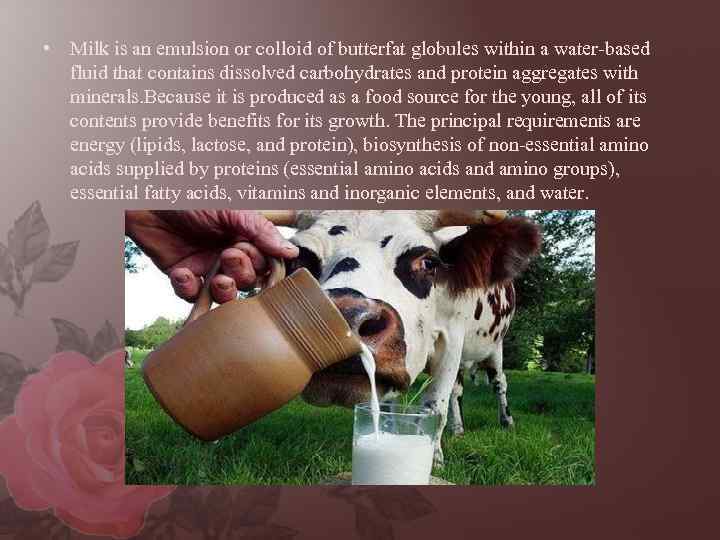
• Milk is an emulsion or colloid of butterfat globules within a water-based fluid that contains dissolved carbohydrates and protein aggregates with minerals. Because it is produced as a food source for the young, all of its contents provide benefits for its growth. The principal requirements are energy (lipids, lactose, and protein), biosynthesis of non-essential amino acids supplied by proteins (essential amino acids and amino groups), essential fatty acids, vitamins and inorganic elements, and water.
Lipids Initially milk fat is secreted in the form of a fat globule surrounded by a membrane. Each fat globule is composed almost entirely of triacylglycerols and is surrounded by a membrane consisting of complex lipids such as phospholipids, along with proteins. These act as emulsifiers which keep the individual globules from coalescing and protect the contents of these globules from various enzymes in the fluid portion of the milk. Although 97– 98% of lipids are triacylglycrols, small amounts of di- and monoacylglycerols, free cholesterol and cholesterol esters, free fatty acids, and phospholipids are also present. Unlike protein and carbohydrates, fat composition in milk varies widely in the composition due to genetic, lactational, and nutritional factor difference between different species. Like composition, fat globules vary in size from less than 0. 2 to about 15 micrometers in diameter between different species. Diameter may also vary between animals within a species and at different times within a milking of a single animal. In unhomogenized cow's milk, the fat globules have an average diameter of two to four micrometers and with homogenization, average around 0. 4 micrometers. The fat-soluble vitamins A, D, E, and K along with essential fatty acids such as linoleic and linolenic acid are found within the milk fat portion of the milk.
• Caseins The largest structures in the fluid portion of the milk are "casein micelles"aggregates of several thousand protein molecules with superficial resemblance to a surfactant micelle, bonded with the help of nanometer-scale particles of calcium phosphate. Each casein micelle is roughly spherical and about a tenth of a micrometer across. There are four different types of casein proteins: αs 1 -, αs 2 -, β-, and κ-caseins. Collectively, they make up around 76– 86% of the protein in milk, by weight. Most of the casein proteins are bound into the micelles. There are several competing theories regarding the precise structure of the micelles, but they share one important feature: the outermost layer consists of strands of one type of protein, k-casein, reaching out from the body of the micelle into the surrounding fluid. These kappa-casein molecules all have a negative electrical charge and therefore repel each other, keeping the micelles separated under normal conditions and in a stable colloidal suspension in the water-based surrounding fluid.
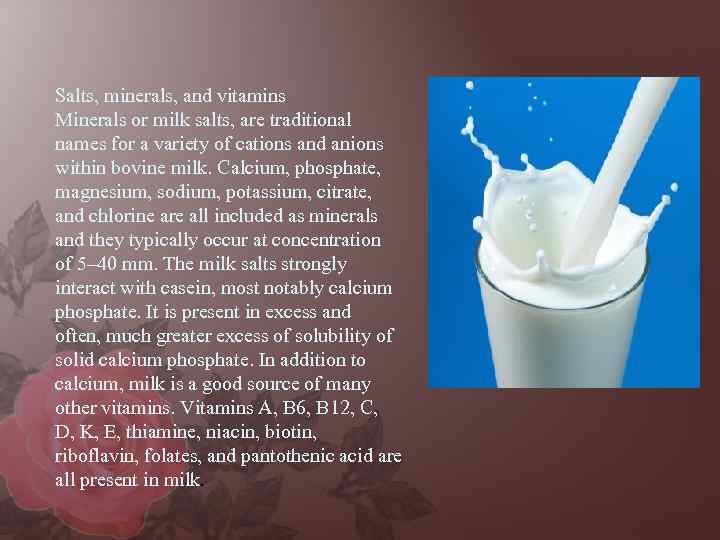
Salts, minerals, and vitamins Minerals or milk salts, are traditional names for a variety of cations and anions within bovine milk. Calcium, phosphate, magnesium, sodium, potassium, citrate, and chlorine are all included as minerals and they typically occur at concentration of 5– 40 mm. The milk salts strongly interact with casein, most notably calcium phosphate. It is present in excess and often, much greater excess of solubility of solid calcium phosphate. In addition to calcium, milk is a good source of many other vitamins. Vitamins A, B 6, B 12, C, D, K, E, thiamine, niacin, biotin, riboflavin, folates, and pantothenic acid are all present in milk.
• Calcium phosphate structure For many years the most accepted theory of the structure of a micelle was that it was composed of spherical casein aggregates, called submicelles, that were held together by calcium phosphate linkages. However, there are two recent models of the casein micelle that refute the distinct micellular structures within the micelle. The first theory attributed to de Kruif and Holt, proposes that nanoclusters of calcium phosphate and the phosphopeptide fraction of beta-casein are the centerpiece to micellular structure. Specifically in this view, unstructured proteins organize around the calcium phosphate giving rise to their structure and thus no specific structure is formed. The second theory proposed by Horne, the growth of calcium phosphate nanoclusters begins the process of micelle formation but is limited by binding phosphopeptide loop regions of the caseins. Once bound, protein-protein interactions are formed and polymerization occurs, in which K-casein is used as an end cap, to form micelles with trapped calcium phosphate nanoclusters. Some sources indicate that the trapped calcium phosphate is in the form of Ca 9(PO 4)6; whereas, others say it is similar to the structure of the mineral brushite Ca. HPO 4 -2 H 2 O
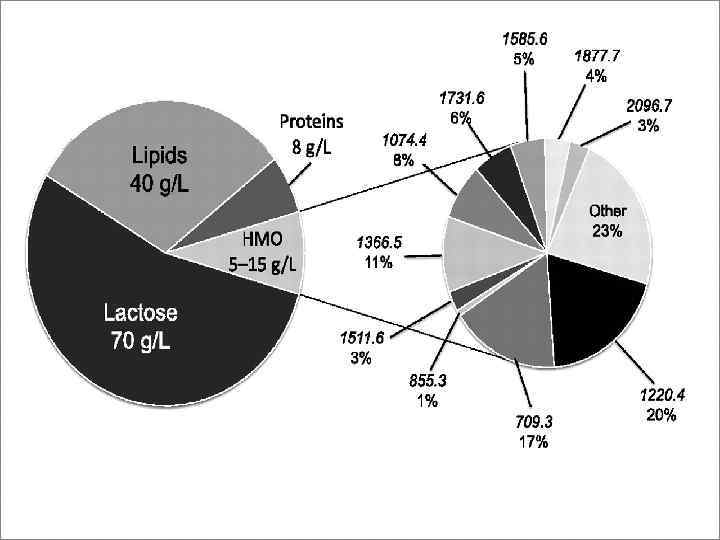
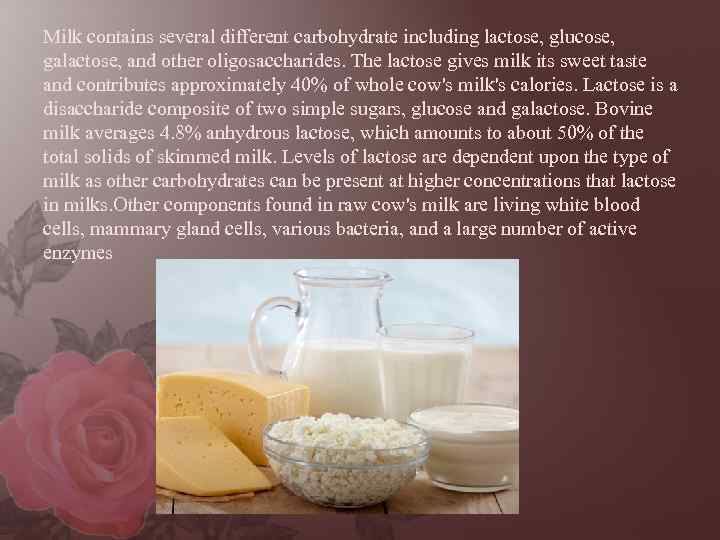
Milk contains several different carbohydrate including lactose, glucose, galactose, and other oligosaccharides. The lactose gives milk its sweet taste and contributes approximately 40% of whole cow's milk's calories. Lactose is a disaccharide composite of two simple sugars, glucose and galactose. Bovine milk averages 4. 8% anhydrous lactose, which amounts to about 50% of the total solids of skimmed milk. Levels of lactose are dependent upon the type of milk as other carbohydrates can be present at higher concentrations that lactose in milks. Other components found in raw cow's milk are living white blood cells, mammary gland cells, various bacteria, and a large number of active enzymes
Appearance Both the fat globules and the smaller casein micelles, which are just large enough to deflect light, contribute to the opaque white color of milk. The fat globules contain some yellow-orange carotene, enough in some breeds (such as Guernsey and Jersey cattle) to impart a golden or "creamy" hue to a glass of milk. The riboflavin in the whey portion of milk has a greenish color, which sometimes can be discerned in skimmed milk or whey products. [18] Fat-free skimmed milk has only the casein micelles to scatter light, and they tend to scatter shorter-wavelength blue light more than they do red, giving skimmed milk a bluish tint
Pasteurization is used to kill harmful microorganisms by heating the milk for a short time and then immediately cooling it. The standard high temperature short time (HTST) process produces a 99. 999% reduction in the number of bacteria in milk, rendering it safe to drink for up to three weeks if continually refrigerated. Dairies print expiration dates on each container, after which stores remove any unsold milk from their shelves. A side effect of the heating of pasteurization is that some vitamin and mineral content is lost. Soluble calcium and phosphorus decrease by 5%, thiamin and vitamin B 12 by 10%, and vitamin C by 20%. Because losses are small in comparison to the large amount of the two Bvitamins present, milk continues to provide significant amounts of thiamin and vitamin B 12. The loss of vitamin C is not nutritionally significant, as milk is not an important dietary source of vitamin C. A newer process, ultrapasteurization or ultra-high temperature treatment (UHT), heats the milk to a higher temperature for a shorter amount of time. This extends its shelf life and allows the milk to be stored unrefrigerated because of the longer lasting sterilization effect.
Lactose, the disaccharide sugar component of all milk, must be cleaved in the small intestine by the enzyme, lactase, in order for its constituents, galactose and glucose, to be absorbed. The production of the enzyme lactase declines significantly after weaning in all mammals. Consequently, many humans become unable to digest lactose properly as they mature. There is a great deal of variance, with some individuals reacting badly to even small amounts of lactose, some able to consume moderate quantities, and some able to consume large quantities of milk and other dairy products without problems. The gene in humans that controls lactase production, and hence lactose tolerance and intolerance, is labeled C/T-13910. An individual who consumes milk without producing sufficient lactase may suffer diarrhea, intestinal gas, cramps and bloating, as the undigested lactose travels through the gastrointestinal tract and serves as nourishment for intestinal microflora that excrete gas in processes known as fermentation and anaerobic respiration.
1. "Milk contains traces of ash". Chennai, India: Hindu. com. July 10, 2008. Retrieved August 28, 2010. 2. Jump up ^ "Milk From Cows and Other Animals, web page by Washington Dairy Products Commission". Havemilk. com. Retrieved August 28, 2010.
Скачать презентацию Composition of milk Check it Kossalieva G B
Composition of milk.pptx