


 Скачать презентацию COMPOSITE SENTENCE AS A POLYPREDICATIVE CONSTRUCTION Composite
composite sentence.pptx
- Количество слайдов: 9
 COMPOSITE SENTENCE AS A POLYPREDICATIVE CONSTRUCTION
 Composite sentence • a structural and semantic unity of two or more syntactic constructions each having a predicative centre of its own, built on the basis of a syntactic connection and used in speech communication as a unit of the same rank as the simple sentence.
 The characteristics: • the type of syntactic connection (coordination or subordination); • the rank of predicative constructions, i. e. the place occupied by the predicative construction in the hierarchy of clauses; • presence or absence of connections and their character.
 composite sentences are polypredicative syntactic constructions. Each predicative unit in a composite sentence forms a clause. complex and compound
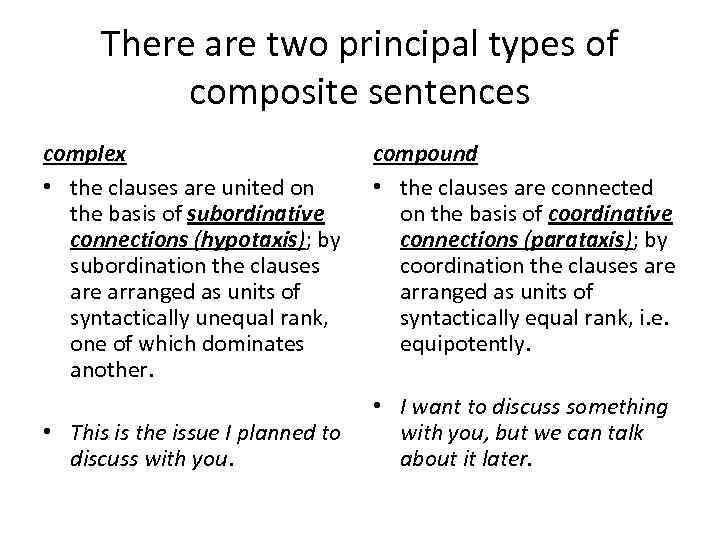 There are two principal types of composite sentences complex • the clauses are united on the basis of subordinative connections (hypotaxis); by subordination the clauses are arranged as units of syntactically unequal rank, one of which dominates another. • This is the issue I planned to discuss with you. compound • the clauses are connected on the basis of coordinative connections (parataxis); by coordination the clauses are arranged as units of syntactically equal rank, i. e. equipotently. • I want to discuss something with you, but we can talk about it later.
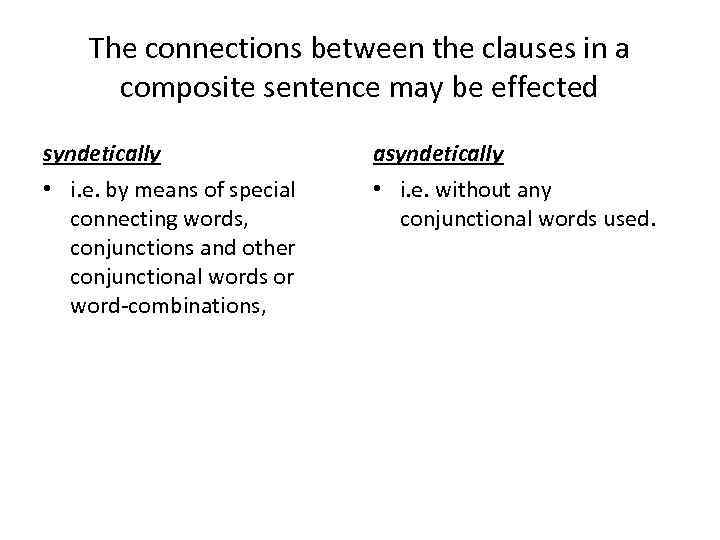 The connections between the clauses in a composite sentence may be effected syndetically asyndetically • i. e. by means of special connecting words, conjunctions and other conjunctional words or word-combinations, • i. e. without any conjunctional words used.
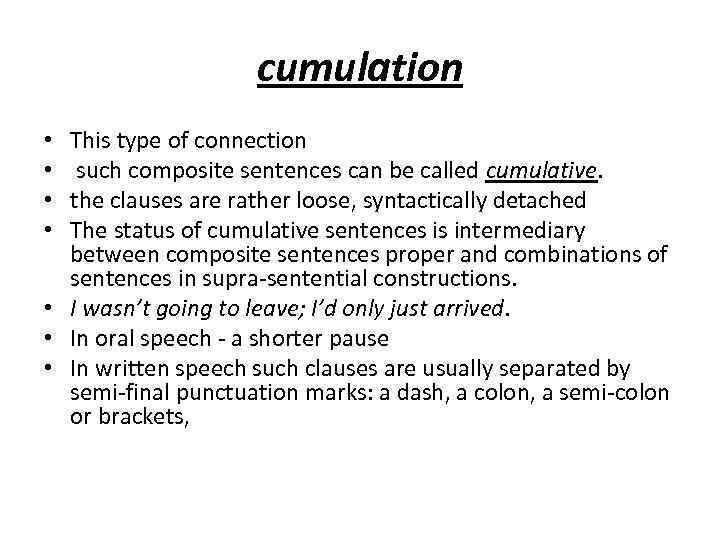 cumulation This type of connection such composite sentences can be called cumulative. the clauses are rather loose, syntactically detached The status of cumulative sentences is intermediary between composite sentences proper and combinations of sentences in supra-sentential constructions. • I wasn’t going to leave; I’d only just arrived. • In oral speech - a shorter pause • In written speech such clauses are usually separated by semi-final punctuation marks: a dash, a colon, a semi-colon or brackets, • •
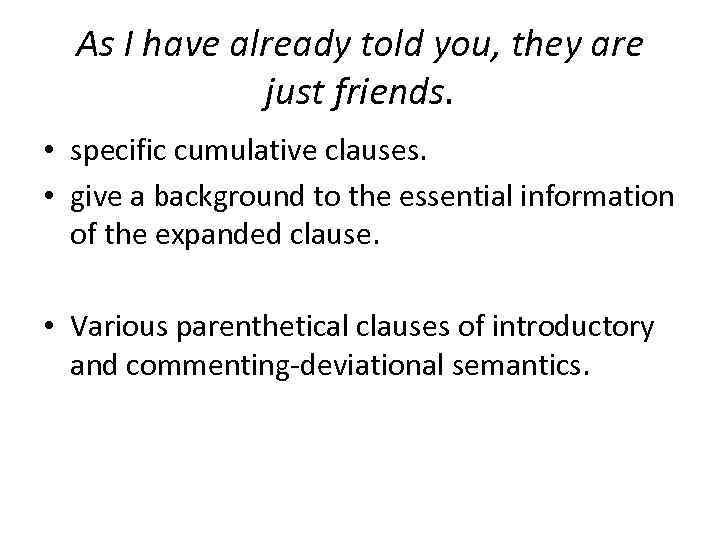 As I have already told you, they are just friends. • specific cumulative clauses. • give a background to the essential information of the expanded clause. • Various parenthetical clauses of introductory and commenting-deviational semantics.
 “semi-composite sentences” • I heard him, when he was singing in the backyard; • He was singing in the backyard and I heard him. • one predicative line may be partially predicative (potentially predicative, semi-predicative), as, for example, in sentences with various verbid complexes, e. g. : I heard him singing in the backyard. • Such sentences actually render two situations and present two predicative lines in fusion, or blended with each other.