


 Скачать презентацию Composing Process Part VI Plagiarism and Intellectual Property
Lecture3_1BC_Plagiarism.ppt
- Количество слайдов: 40
 Composing Process, Part VI: Plagiarism and Intellectual Property: summarizing, paraphrasing, and quoting sources
 What is plagiarism in the U. S. ? “Plagiarism is misrepresenting somebody else's intellectual work - ideas, information, writing, thinking - as your own. In other words, it is a misuse of source material. ” Cornell University http: //plagiarism. arts. cornell. edu/tutorial/principles. cfm
 UAlbany Plagiarism Policy Presenting as one's own work the work of another person (for example, the words, ideas, information, data, evidence, organizing principles, or style of presentation of someone else). Plagiarism includes paraphrasing or summarizing without acknowledgment, submission of another student's work as one's own, the purchase of prepared research or completed papers or projects, and the unacknowledged use of research sources gathered by someone else. http: //www. albany. edu/eas/104/penalty. htm
 UAlbany Plagiarism Policy Failure to indicate accurately the extent and precise nature of one's reliance on other sources is also a form of plagiarism. The student is responsible for understanding the legitimate use of sources, the appropriate ways of acknowledging academic, scholarly, or creative indebtedness, and the consequences for violating University regulations.
 UAlbany Plagiarism Policy (cont. ) Examples of plagiarism include: failure to acknowledge the source(s) of even a few phrases, sentences, or paragraphs; failure to acknowledge a quotation or paraphrase of paragraph-length sections of a paper; failure to acknowledge the source(s) of a major idea or the source(s) for an ordering principle central to the paper's or project's structure; failure to acknowledge the source (quoted, paraphrased, or summarized) of major sections or passages in the paper or project; the unacknowledged use of several major ideas or extensive reliance on another person's data, evidence, or critical method; submitting as one's own work, work borrowed, stolen, or purchased from someone else.
 WHY SUCH A SERIOUS ATTITUDE? CONCERN FOR STUDENT DEVELOPMENT: When students plagiarize, we believe it undermines their ability to learn to compose on their own the kind of work they plagiarize.
 WHY SUCH A SERIOUS ATTITUDE? (CONT. ) CONCERN FOR OUR MISSION: We believe that part of a university’s contractual obligation to its students is to sort and rank them. Students’ submission of plagiarised work—work that is better, in other words, than the students could produce on their own—it subverts that contract.
 WHY SUCH A SERIOUS ATTITUDE? CONCERN FOR INITIATIVE IN OUR SOCIETY: If inquiry in a given field does not reward individual initiative work from the very beginning—respect each person’s work as his or her’s—we believe that it will undermine the willingness of individuals to exercise such initiative, and eventually harm the society as a whole.
 A U. S. Version of Plagiarism’s Worst-Case Effects What if: • Your architect copied all his work from friends at university. Will your new home be safe? • Your lawyer bought a copy of the qualifying exam to gain an advantage in passing. Will the contract she wrote for you stand up in court? • The accountant who does your taxes hired someone to write his papers and paid a standin to take his major tests? Will he know enough to complete your tax forms properly? (Lathrop and Foss 87)
 To avoid plagiarizing as defined in the U. S. , then, • You should not use another person's written or spoken words without explicitly acknowledging that person’s work as your source; • should not use another person’s ideas without acknowledging that the ideas are his/hers; • should not use the results of another person’s investigations, whatever form they take, without explicitly acknowledging that person as the source of those ideas.
 How is this to be done? Let’s get specific What follow here and on your handouts are examples of how students have used a given source. Our task will be to determine which would be considered plagiarism in the U. S. , which would not, and—above all—why or why not. We will also discuss how these practices relate to those followed in Ukraine.
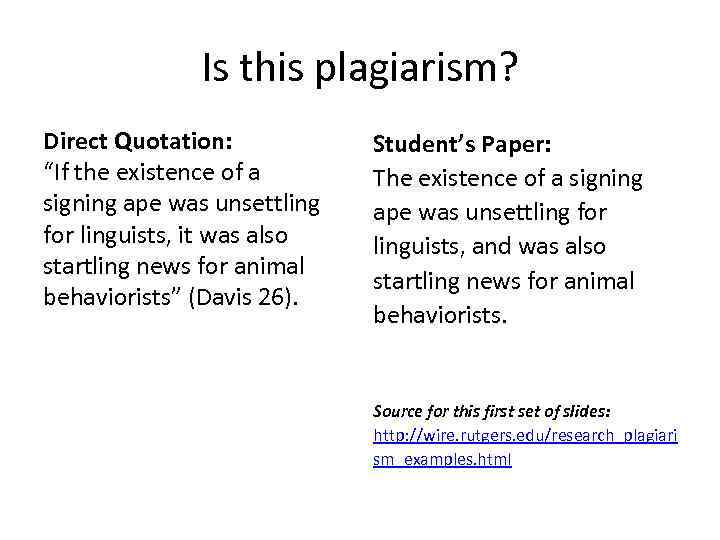 Is this plagiarism? Direct Quotation: “If the existence of a signing ape was unsettling for linguists, it was also startling news for animal behaviorists” (Davis 26). Student’s Paper: The existence of a signing ape was unsettling for linguists, and was also startling news for animal behaviorists. Source for this first set of slides: http: //wire. rutgers. edu/research_plagiari sm_examples. html
 Decision: YES Why? Certain words are copied directly and in order from the source, so the student should have indicated this with quotation marks around them. In addition, he/she should have indicated not only the name of the source, but the page number.
 Is this plagiarism? Direct Quotation “If the existence of a signing ape was unsettling for linguists, it was also startling news for animal behaviorists (Davis 26). ” Student’s Paper: The existence of a signing ape unsettled linguists and startled animal behaviorists (Davis, 26).
 Decision: YES Why? This time, the source is cited. But where the writer’s words are still taken rather directly from that source, there is still no indication of this debt. Note, e. g. , “unsettled linguists and startled animal behaviorists. ”
 Is this plagiarism? Direct Quotation: “If the existence of a signing ape was unsettling for linguists, it was also startling news for animal behaviorists (Davis 26). ” Student’s Paper: If the presence of a signlanguage-using chimp was disturbing for scientists studying language, it was also surprising to scientists studying animal behavior (Davis 26).
 Decision: STILL YES Why? Even though the writer has substituted synonyms and cited the source, the writer is plagiarizing because the source's sentence structure is unchanged.
 Is this plagiarism? Direct Quotation: “If the existence of a signing ape was unsettling for linguists, it was also startling news for animal behaviorists (Davis 26). ” Student’s Paper: According to Flora Davis, linguists and animal behaviorists were unprepared for the news that a chimp could communicate with its trainers through sign language (Davis, 26).
 Decision: NO Why? This is an appropriate use and acknowledgment of the original source material.
 So for U. S. purposes, do I have to cite everything? No. Facts that appear in a number of your sources, and that it seems clear your readers already know, probably can be classified as what is called “common knowledge”: • Taras Schevchenko is a Ukrainian national hero. • The Germans invaded Poland on September 1, 1939. But if you have any doubts, ask someone who knows. Or simply cite the source!
 Let’s try a few more The following slides are taken from Cornell University’s website http: //plagiarism. arts. cornell. edu/tutorial/exercises. cfm
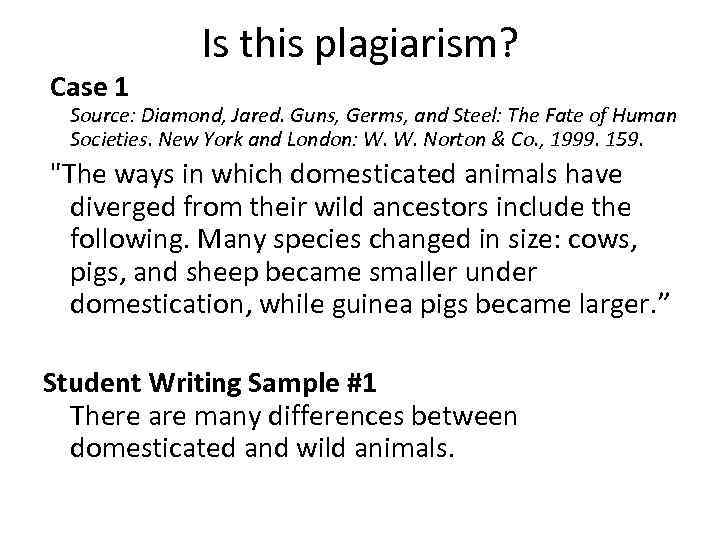 Case 1 Is this plagiarism? Source: Diamond, Jared. Guns, Germs, and Steel: The Fate of Human Societies. New York and London: W. W. Norton & Co. , 1999. 159. "The ways in which domesticated animals have diverged from their wild ancestors include the following. Many species changed in size: cows, pigs, and sheep became smaller under domestication, while guinea pigs became larger. ” Student Writing Sample #1 There are many differences between domesticated and wild animals.
 NO By definition, domesticated and wild animals are different; thus, the student has not reproduced an idea or piece of research unique to Diamond's work.
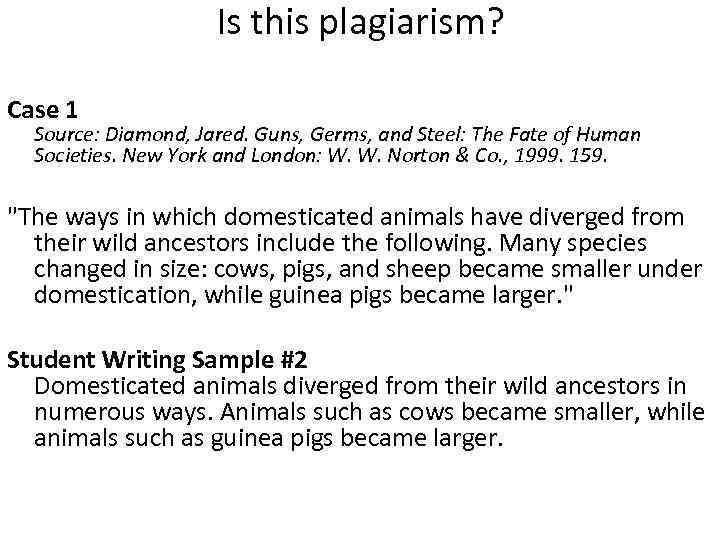 Is this plagiarism? Case 1 Source: Diamond, Jared. Guns, Germs, and Steel: The Fate of Human Societies. New York and London: W. W. Norton & Co. , 1999. 159. "The ways in which domesticated animals have diverged from their wild ancestors include the following. Many species changed in size: cows, pigs, and sheep became smaller under domestication, while guinea pigs became larger. " Student Writing Sample #2 Domesticated animals diverged from their wild ancestors in numerous ways. Animals such as cows became smaller, while animals such as guinea pigs became larger.
 YES This sample uses information and ideas from Diamond's passage that are not common knowledge. The writer simply rephrases each of Diamond's sentences in the original order. Since the student uses no documentation whatsoever, this sample involves plagiarism.
 Is this plagiarism? Case #1 Source: Diamond, Jared. Guns, Germs, and Steel: The Fate of Human Societies. New York and London: W. W. Norton & Co. , 1999. 159. "The ways in which domesticated animals have diverged from their wild ancestors include the following. Many species changed in size: cows, pigs, and sheep became smaller under domestication, while guinea pigs became larger. “ Student Writing Sample # 3 A careful examination of the ways in which domesticated animals have diverged from their wild ancestors shows that cows, pigs, and sheep became smaller under domestication, while guinea pigs became larger.
 YES This writing sample quotes two passages verbatim from Diamond: "the ways in which domesticated animals have diverged from their wild ancestors" and "cows, pigs, and sheep became smaller under domestication, while guinea pigs became larger. " Although the student strings these quotations together in his/her own sentence, both the ideas and phrasing belong to Diamond. Without quotation marks or an attribution to Diamond, this writing sample clearly constitutes plagiarism.
 Case 2: Is this plagiarism? Source: Moers, Ellen. "Female Gothic: The Monster's Mother. " Frankenstein. Ed. J. Paul Hunter. New York and London: W. W. Norton, 1996. 214 "In Gothic writings fantasy predominates over reality, the strange over the commonplace, and the supernatural over the natural, with one definite authorial intent: to scare. Not, that is, to reach down into the depths of the soul and purge it with pity and terror (as we say tragedy does), but to get to the body itself, its glands, epidermis, muscles, and circulatory system, quickly arousing and quickly allaying the physical reactions to fear. “ Student Writing Sample # 1 According to Ellen Moers, Gothic writings "get to the body itself, its glands, epidermis, muscles, and circulatory system, quickly arousing and quickly allaying the physical reactions to fear" (214).
 NO This writing sample introduces the quote with an attribution to Moers, then puts her words within quotation marks and gives the appropriate page number. The reader knows exactly which words belong to Moers and where to find the quote in her work. Following MLA format, the full bibliographic information for Moers's article then appears in a "Works Cited" list at the end of the essay; other citation methods may be used in different fields, so check with your instructor for the required format.
 Is this plagiarism? Case: 2 Source: Moers, Ellen. "Female Gothic: The Monster's Mother. " Frankenstein. Ed. J. Paul Hunter. New York and London: W. W. Norton, 1996. 214 "In Gothic writings fantasy predominates over reality, the strange over the commonplace, and the supernatural over the natural, with one definite authorial intent: to scare. Not, that is, to reach down into the depths of the soul and purge it with pity and terror (as we say tragedy does), but to get to the body itself, its glands, epidermis, muscles, and circulatory system, quickly arousing and quickly allaying the physical reactions to fear. “ Student Writing Sample # 2 Gothic novels such as Frankenstein were written with one definite authorial intent: to scare (Moers 214).
 YES This is a tricky case. Although the student cites Moers and the page number in parentheses, there is an unmarked direct quotation in the sentence (i. e. "with one definite authorial intent: to scare"). Without quotation marks to set off this phrase, the reader assumes that only the idea comes from Moers, not the actual words. Furthermore, verbatim use of a striking phrase may make readers who are familiar with the source suspicious of your integrity.
 Is this plagiarism? Case 2: Source: Moers, Ellen. "Female Gothic: The Monster's Mother. " Frankenstein. Ed. J. Paul Hunter. New York and London: W. W. Norton, 1996. 214 "In Gothic writings fantasy predominates over reality, the strange over the commonplace, and the supernatural over the natural, with one definite authorial intent: to scare. Not, that is, to reach down into the depths of the soul and purge it with pity and terror (as we say tragedy does), but to get to the body itself, its glands, epidermis, muscles, and circulatory system, quickly arousing and quickly allaying the physical reactions to fear. “ Student Writing Sample # 3 While tragedy affects the soul, Gothic writings affect the body.
 YES This writing sample summarizes Moers's opinion about the difference between tragic and Gothic writing. Her definitions of tragedy and Gothic are not common, dictionary definitions; instead, she proposes a specialized way of viewing both genres as part of her overall theory. In addition, the student borrows Moer's opposition between soul and body, tragedy and Gothic (i. e. why not Gothic and comedy? Gothic and satire? Gothic and epic? ). This writing sample thus needs to document its sources.
 Is this plagiarism? Case 3: Source: Shelley, Mary. Frankenstein. Ed. J. Paul Hunter. New York and London: W. W. Norton & Co. , 1996. 70. "I greedily devoured the remnants of the shepherd's breakfast, which consisted of bread, cheese, milk, and wine; the latter, however, I did not like. ” Student Writing Sample #1 In his tale, Frankenstein's monster recounts how he greedily devoured the remnants of the shepherd's breakfast, thus showing his extreme hunger.
 YES The student here is using a word-for-word quotation (i. e. "greedily devoured the remnants of the shepherd's breakfast") to support the claim that Frankenstein's monster suffered from extreme hunger. While the claim belongs to the student, the phrasing of the evidence belongs to Shelley; to avoid plagiarism, therefore, this direct quotation needs to be set off by quotation marks and properly documented.
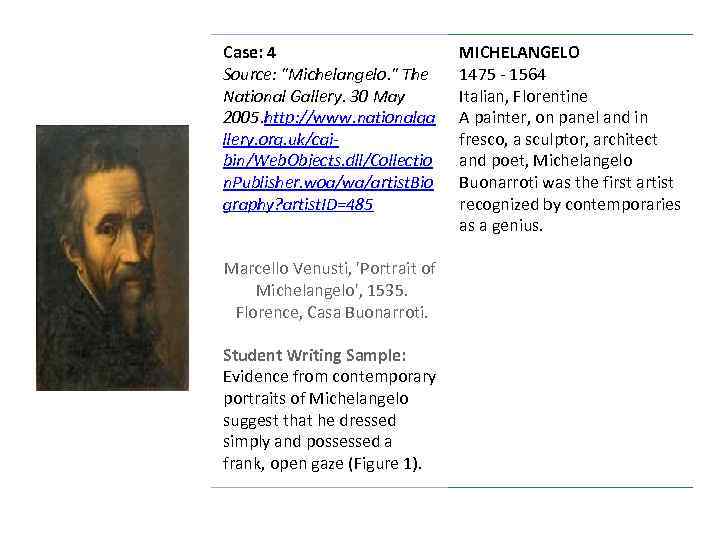 Case: 4 Source: "Michelangelo. " The National Gallery. 30 May 2005. http: //www. nationalga llery. org. uk/cgibin/Web. Objects. dll/Collectio n. Publisher. woa/wa/artist. Bio graphy? artist. ID=485 Marcello Venusti, 'Portrait of Michelangelo', 1535. Florence, Casa Buonarroti. Student Writing Sample: Evidence from contemporary portraits of Michelangelo suggest that he dressed simply and possessed a frank, open gaze (Figure 1). MICHELANGELO 1475 - 1564 Italian, Florentine A painter, on panel and in fresco, a sculptor, architect and poet, Michelangelo Buonarroti was the first artist recognized by contemporaries as a genius.
 YES
YES
 Case 5: Is this plagiarism? Source: Morisy, Michael. "'Extinct' Woodpecker Found. " Cornell Daily Sun 29, April 2005: 1, 4. The search for the woodpecker began earnestly after a Feb. 11, 2004 sighting by a kayaker in Cache River National Wildlife Refuge. A report of the sighting eventually worked its way to Tim Gallagher, the editor-in-chief of Living Bird, the Cornell Lab of Ornithology's quarterly magazine. Student Writing Sample #1 Occasionally, species once thought extinct resurface when researchers examine possible new habitats. The ivory-billed woodpecker, for example, has just been rediscovered in the wild by Cornell researchers, who launched a search after an amateur sighting in February of 2004 (Morisy 1). Works Cited Morisy, Michael. "'Extinct' Woodpecker Found. " Cornell Daily Sun 29 April 2005: 1, 4.
 Case: 7 Source: Morisy, Michael. "'Extinct' Woodpecker Found. " Cornell Daily Sun 29 April 2005: 1, 4. The search for the woodpecker began earnestly after a Feb. 11, 2004 sighting by a kayaker in Cache River National Wildlife Refuge. A report of the sighting eventually worked its way to Tim Gallagher, the editor-in-chief of Living Bird, the Cornell Lab of Ornithology's quarterly magazine. Student Writing Sample # 1 Occasionally, species once thought extinct resurface when researchers examine possible new habitats. The ivory-billed woodpecker, for example, has just been rediscovered in the wild by Cornell researchers, who launched a search after an amateur sighting in February of 2004 (Morisy 1). Works Cited Morisy, Michael. "'Extinct' Woodpecker Found. " Cornell Daily Sun 29 April 2005: 1, 4.
 NO Although many details from the original newspaper article have been omitted, the article should be cited as a source if the writer paraphrases its content or draws upon it for specific information. To acknowledge this indebtedness to the Cornell Sun article, the student uses a brief parenthetical citation within the text, supplemented by the full bibliographic entry in a "Works Cited" page at the end.