 Скачать презентацию Composable Mission Space Environments 101 Ms Phil Zimmerman
f736055d76378da24df9f36de538616a.ppt
- Количество слайдов: 14



Composable Mission Space Environments 101 Ms. Phil Zimmerman, Chris Turrell, Jim Heusmann, Doug Clark, Vic Dirienso, Kenn Atkinson “As long as all things are created from scratch, growth can at most be linear”
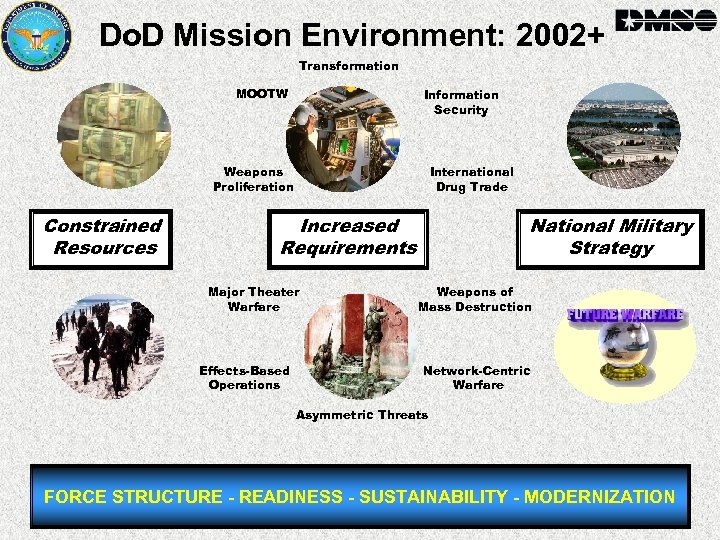
Do. D Mission Environment: 2002+ Transformation MOOTW Information Security Weapons Proliferation Constrained Resources International Drug Trade National Military Strategy Increased Requirements Major Theater Warfare Effects-Based Operations Weapons of Mass Destruction Network-Centric Warfare Asymmetric Threats FORCE STRUCTURE - READINESS - SUSTAINABILITY - MODERNIZATION
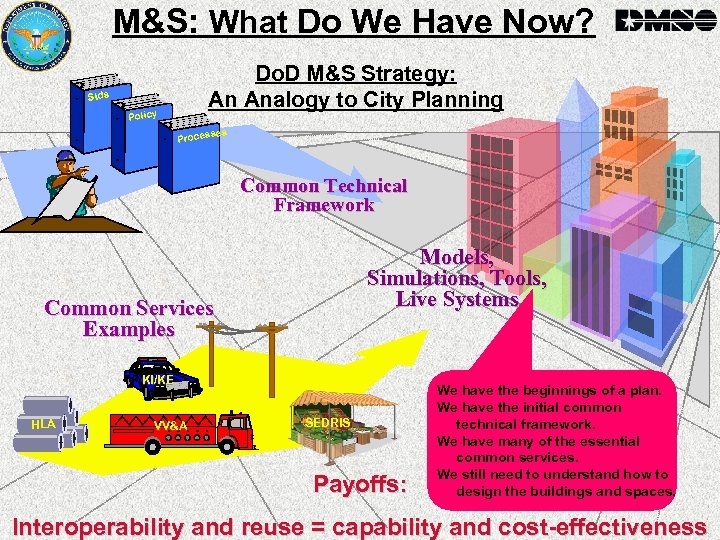
M&S: What Do We Have Now? Do. D M&S Strategy: An Analogy to City Planning Stds Policy ses Proces Common Technical Framework Models, Simulations, Tools, Live Systems Common Services Examples KI/KE HLA VV&A SEDRIS Payoffs: We have the beginnings of a plan. We have the initial common technical framework. We have many of the essential common services. We still need to understand how to design the buildings and spaces. Interoperability and reuse = capability and cost-effectiveness
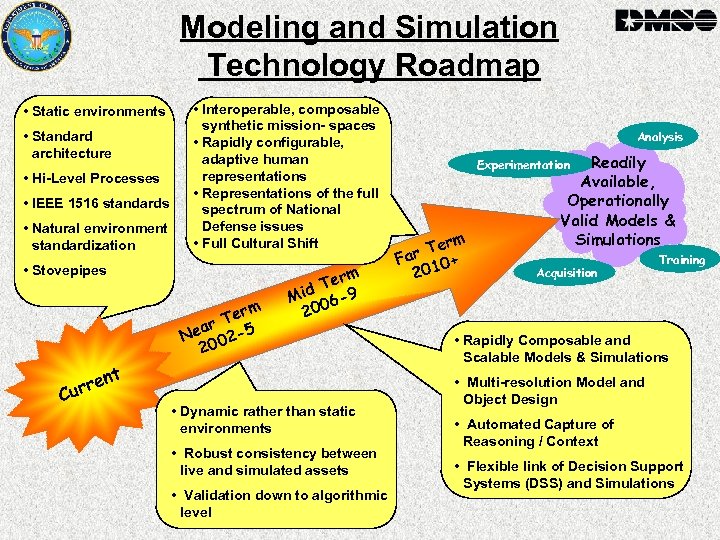
Modeling and Simulation Technology Roadmap • Static environments • Standard architecture • Hi-Level Processes • IEEE 1516 standards • Natural environment standardization • Interoperable, composable synthetic mission- spaces • Rapidly configurable, adaptive human representations • Representations of the full spectrum of National Defense issues • Full Cultural Shift • Stovepipes m Ter ar Ne 02 -5 20 m Ter Mid 06 -9 20 nt e urr C • Dynamic rather than static environments • Robust consistency between live and simulated assets • Validation down to algorithmic level Analysis Readily Available, Operationally Valid Models & Simulations Experimentation rm r Te Fa 0+ 201 Acquisition Training • Rapidly Composable and Scalable Models & Simulations • Multi-resolution Model and Object Design • Automated Capture of Reasoning / Context • Flexible link of Decision Support Systems (DSS) and Simulations
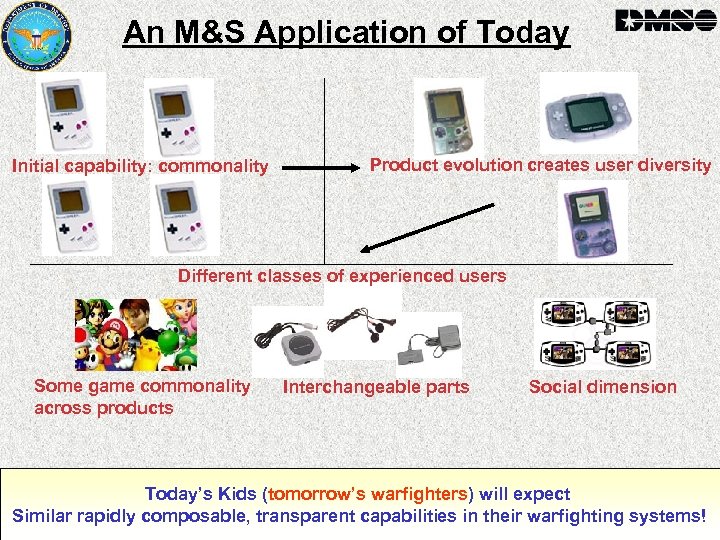
An M&S Application of Today Initial capability: commonality Product evolution creates user diversity Different classes of experienced users Some game commonality across products Interchangeable parts Social dimension Today’s Kids (tomorrow’s warfighters) will expect Similar rapidly composable, transparent capabilities in their warfighting systems!
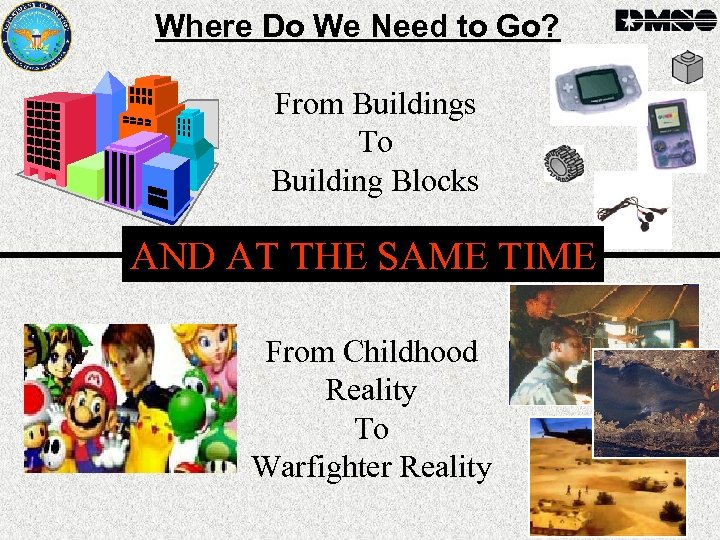
Where Do We Need to Go? From Buildings To Building Blocks AND AT THE SAME TIME From Childhood Reality To Warfighter Reality
And Just How are WE Supposed to Do ALL That? • CMSE – Take the best of what’s available in: • M&S • Related disciplines – Build only what is necessary – Marry theory with current practice – When possible, develop broad solutions to specific needs – Support composability with applicable policy – BE DOMAIN INDEPENDENT
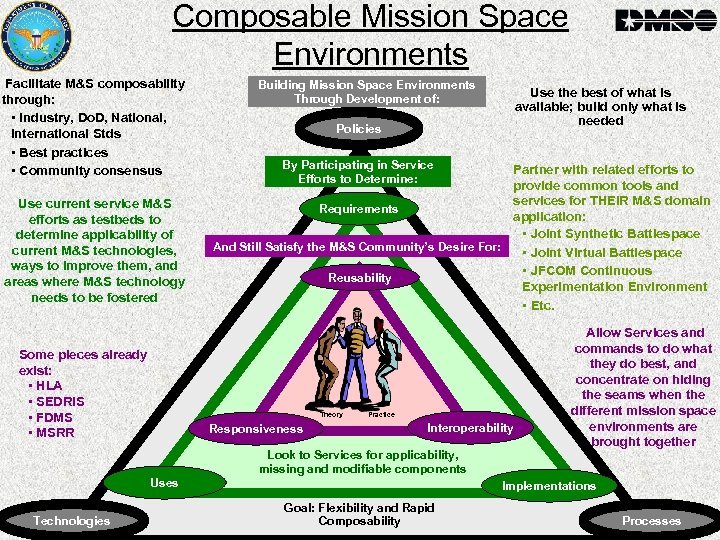
Composable Mission Space Environments Facilitate M&S composability through: • Industry, Do. D, National, International Stds • Best practices • Community consensus Use current service M&S efforts as testbeds to determine applicability of current M&S technologies, ways to improve them, and areas where M&S technology needs to be fostered Some pieces already exist: • HLA • SEDRIS • FDMS • MSRR Building Mission Space Environments Through Development of: Policies By Participating in Service Efforts to Determine: Partner with related efforts to provide common tools and services for THEIR M&S domain Requirements application: • Joint Synthetic Battlespace And Still Satisfy the M&S Community’s Desire For: • Joint Virtual Battlespace • JFCOM Continuous Reusability Experimentation Environment • Etc. Theory Responsiveness Practice Interoperability Look to Services for applicability, missing and modifiable components Uses Technologies Use the best of what is available; build only what is needed Allow Services and commands to do what they do best, and concentrate on hiding the seams when the different mission space environments are brought together Implementations Goal: Flexibility and Rapid Composability Processes
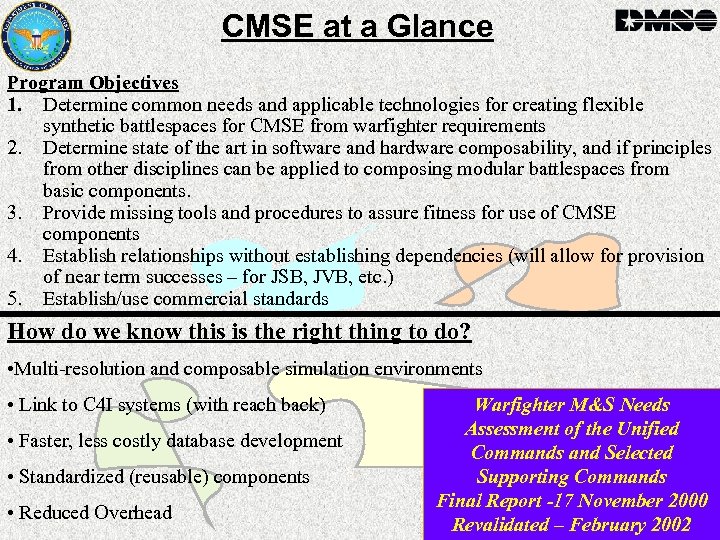
CMSE at a Glance Program Objectives 1. Determine common needs and applicable technologies for creating flexible synthetic battlespaces for CMSE from warfighter requirements 2. Determine state of the art in software and hardware composability, and if principles from other disciplines can be applied to composing modular battlespaces from basic components. 3. Provide missing tools and procedures to assure fitness for use of CMSE components 4. Establish relationships without establishing dependencies (will allow for provision of near term successes – for JSB, JVB, etc. ) 5. Establish/use commercial standards How do we know this is the right thing to do? • Multi-resolution and composable simulation environments • Link to C 4 I systems (with reach back) • Faster, less costly database development • Standardized (reusable) components • Reduced Overhead Warfighter M&S Needs Assessment of the Unified Commands and Selected Supporting Commands Final Report -17 November 2000 Revalidated – February 2002
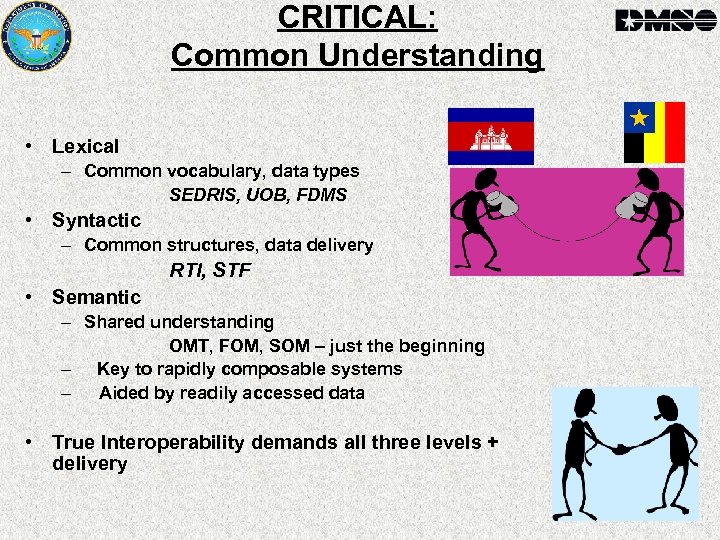
CRITICAL: Common Understanding • Lexical – Common vocabulary, data types SEDRIS, UOB, FDMS • Syntactic – Common structures, data delivery RTI, STF • Semantic – Shared understanding OMT, FOM, SOM – just the beginning – Key to rapidly composable systems – Aided by readily accessed data • True Interoperability demands all three levels + delivery
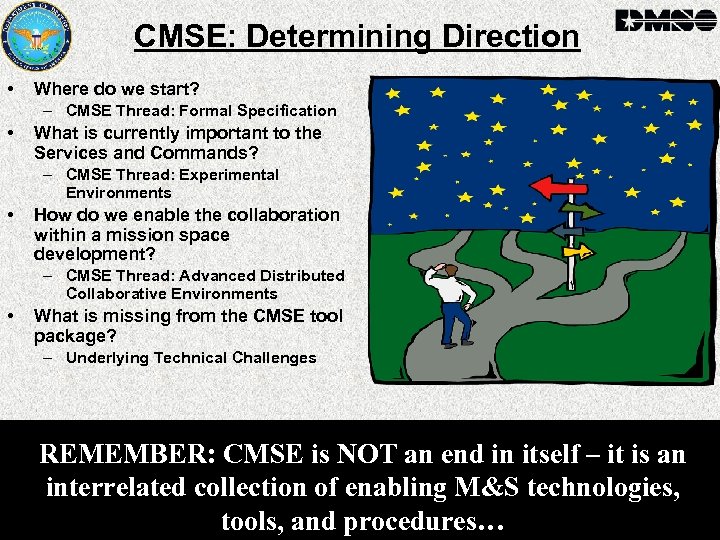
CMSE: Determining Direction • Where do we start? – CMSE Thread: Formal Specification • What is currently important to the Services and Commands? – CMSE Thread: Experimental Environments • How do we enable the collaboration within a mission space development? – CMSE Thread: Advanced Distributed Collaborative Environments • What is missing from the CMSE tool package? – Underlying Technical Challenges REMEMBER: CMSE is NOT an end in itself – it is an interrelated collection of enabling M&S technologies, tools, and procedures…
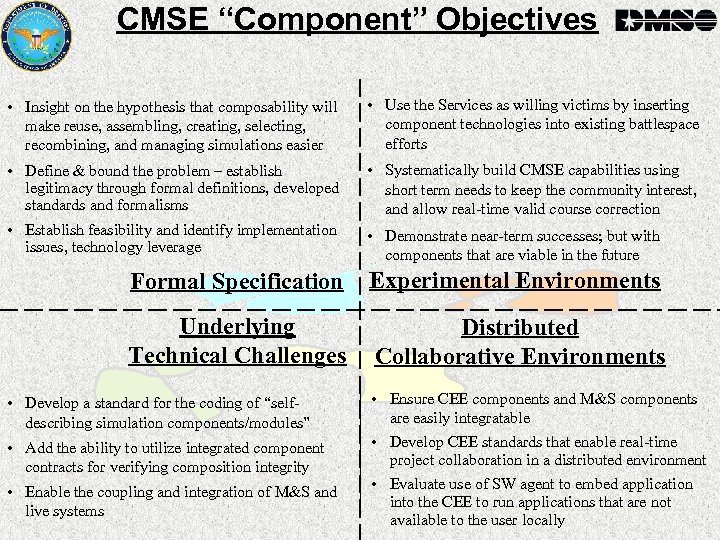
CMSE “Component” Objectives • Insight on the hypothesis that composability will make reuse, assembling, creating, selecting, recombining, and managing simulations easier • Use the Services as willing victims by inserting component technologies into existing battlespace efforts • Define & bound the problem – establish legitimacy through formal definitions, developed standards and formalisms • Systematically build CMSE capabilities using short term needs to keep the community interest, and allow real-time valid course correction • Establish feasibility and identify implementation issues, technology leverage • Demonstrate near-term successes; but with components that are viable in the future Formal Specification Experimental Environments Underlying Technical Challenges Distributed Collaborative Environments • Develop a standard for the coding of “selfdescribing simulation components/modules” • Add the ability to utilize integrated component contracts for verifying composition integrity • Enable the coupling and integration of M&S and live systems • Ensure CEE components and M&S components are easily integratable • Develop CEE standards that enable real-time project collaboration in a distributed environment • Evaluate use of SW agent to embed application into the CEE to run applications that are not available to the user locally
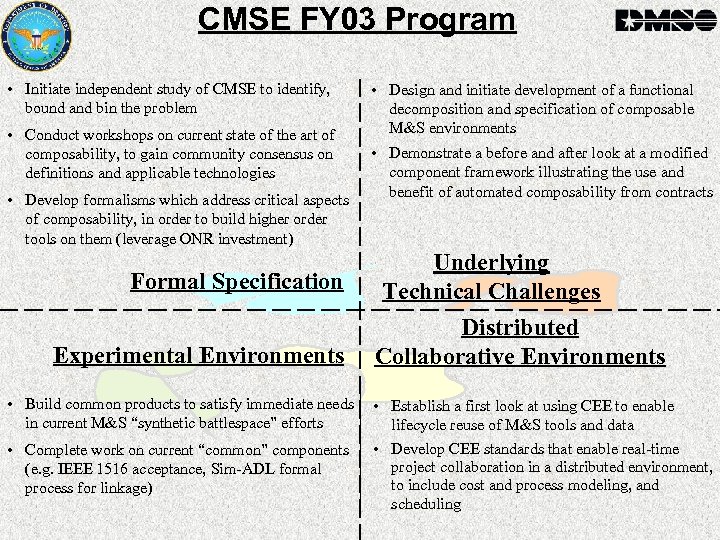
CMSE FY 03 Program • Initiate independent study of CMSE to identify, bound and bin the problem • Conduct workshops on current state of the art of composability, to gain community consensus on definitions and applicable technologies • Develop formalisms which address critical aspects of composability, in order to build higher order tools on them (leverage ONR investment) Formal Specification Experimental Environments • Build common products to satisfy immediate needs in current M&S “synthetic battlespace” efforts • Complete work on current “common” components (e. g. IEEE 1516 acceptance, Sim-ADL formal process for linkage) • Design and initiate development of a functional decomposition and specification of composable M&S environments • Demonstrate a before and after look at a modified component framework illustrating the use and benefit of automated composability from contracts Underlying Technical Challenges Distributed Collaborative Environments • Establish a first look at using CEE to enable lifecycle reuse of M&S tools and data • Develop CEE standards that enable real-time project collaboration in a distributed environment, to include cost and process modeling, and scheduling
Composable Mission Space Environments 101 QUESTIONS? “As long as all things are created from scratch, growth can at most be linear”
Скачать презентацию Composable Mission Space Environments 101 Ms Phil Zimmerman
f736055d76378da24df9f36de538616a.ppt