 Скачать презентацию Components of Corporate Credit Spreads Presented By
4a2ac7261a6c0de6e22d9c163ba6a134.ppt
- Количество слайдов: 27



Components of Corporate Credit Spreads Presented By Robert Geske Professor UCLA Universitat Karlsruhe December 2002 Components of Corporate Credit Spreads Robert Geske
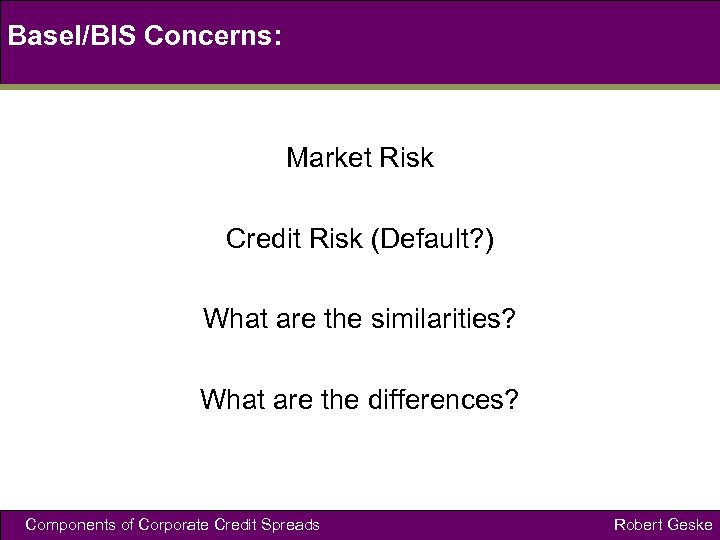
Basel/BIS Concerns: Market Risk Credit Risk (Default? ) What are the similarities? What are the differences? Components of Corporate Credit Spreads Robert Geske
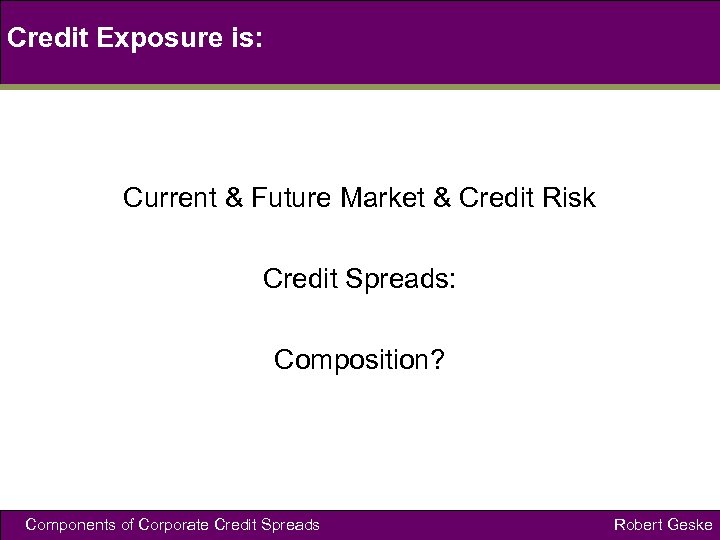
Credit Exposure is: Current & Future Market & Credit Risk Credit Spreads: Composition? Components of Corporate Credit Spreads Robert Geske
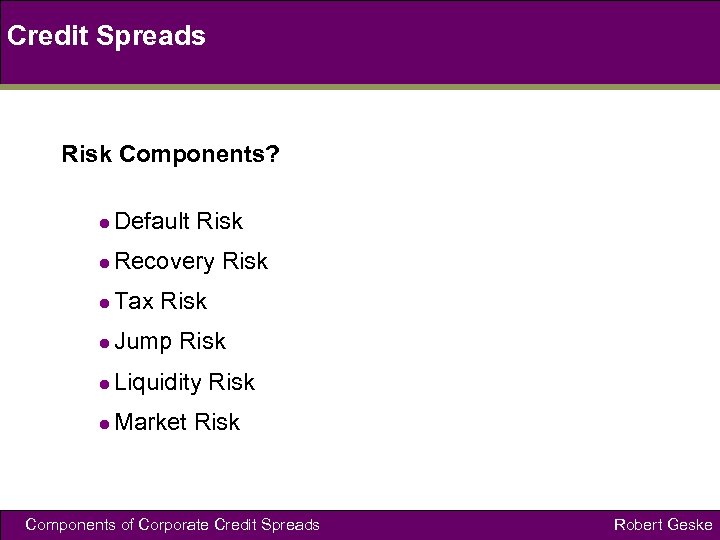
Credit Spreads Risk Components? l Default Risk l Recovery Risk l Tax Risk l Jump Risk l Liquidity Risk l Market Risk Components of Corporate Credit Spreads Robert Geske
Literature l l l l Merton (1974) Black & Cox (1976), Geske (1977) Longstaff Schwartz (1995), Leland Toft (1996) Colin-Dufresne, Goldstein, et al (2000) Eom, Helwege, Huang (2002) Huang & Huang (2002) Duffie & Lando (2001), Jarrow & Turnbull (1995) Delianedis & Geske (1998), KMV, Leland (2002) Components of Corporate Credit Spreads Robert Geske
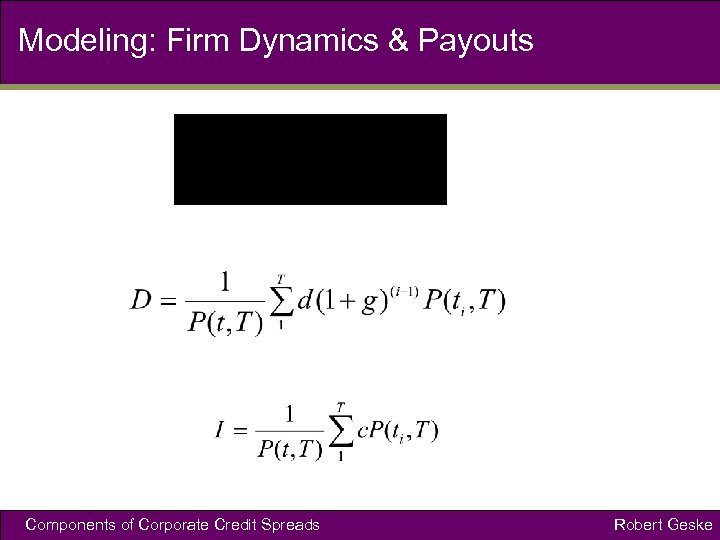
Modeling: Firm Dynamics & Payouts Components of Corporate Credit Spreads Robert Geske
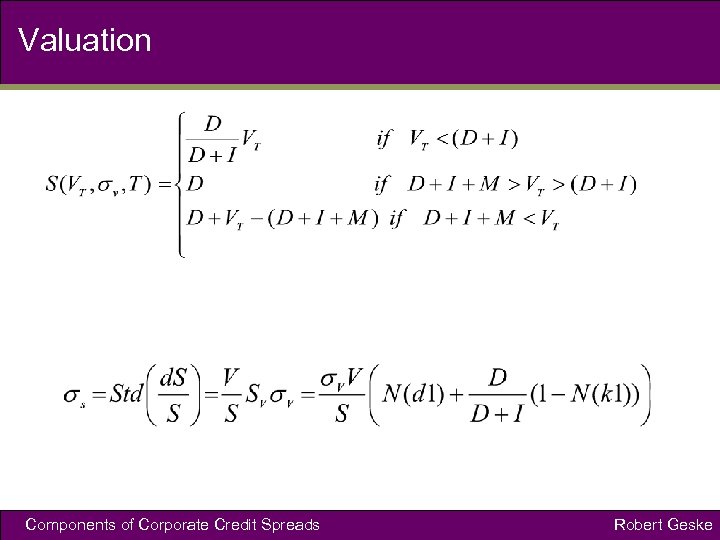
Valuation Components of Corporate Credit Spreads Robert Geske
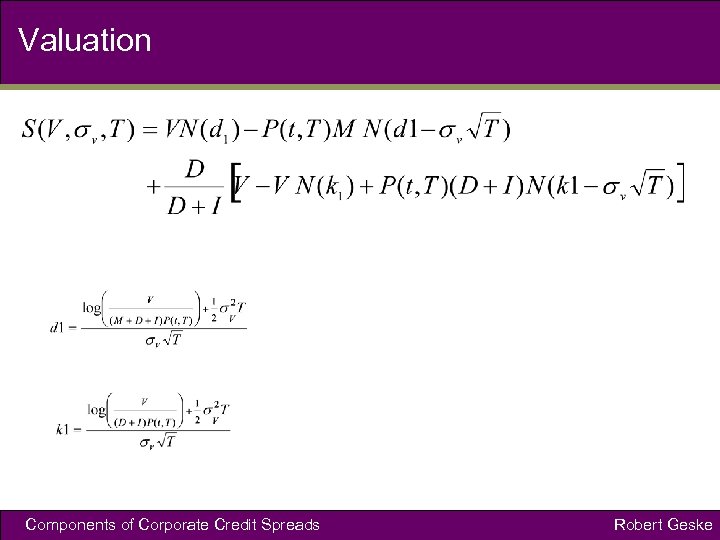
Valuation Components of Corporate Credit Spreads Robert Geske
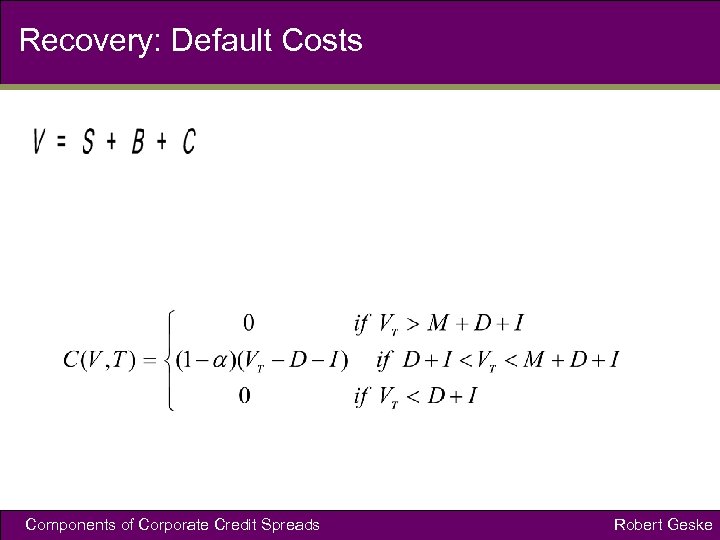
Recovery: Default Costs Components of Corporate Credit Spreads Robert Geske
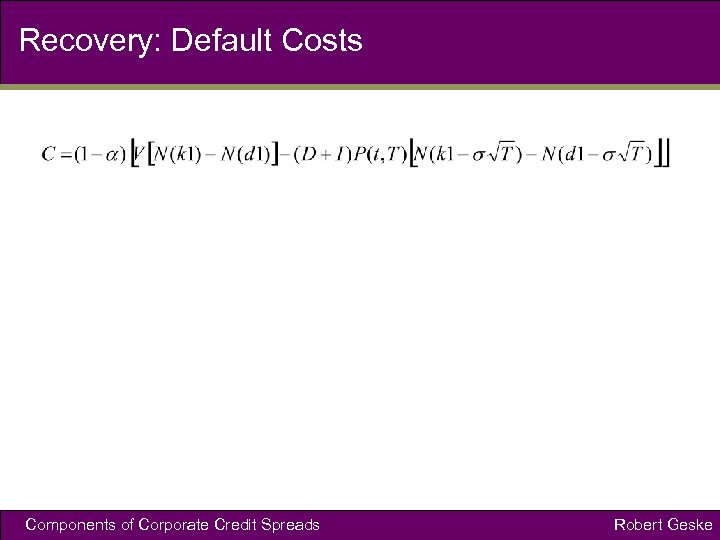
Recovery: Default Costs Components of Corporate Credit Spreads Robert Geske
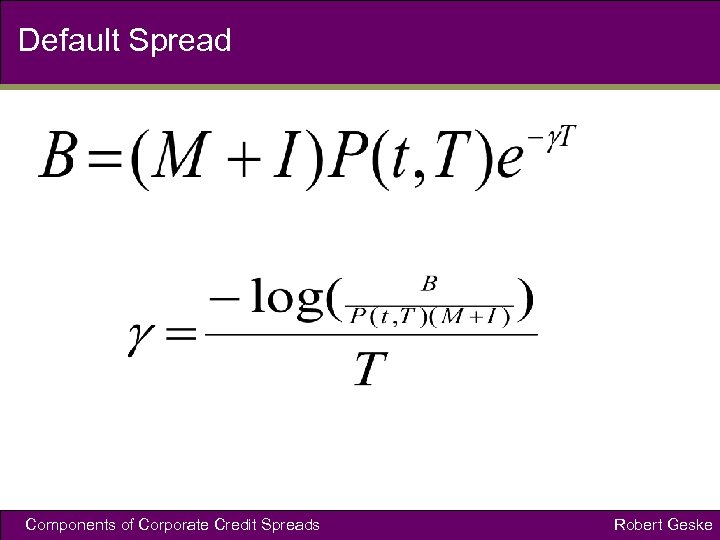
Default Spread Components of Corporate Credit Spreads Robert Geske
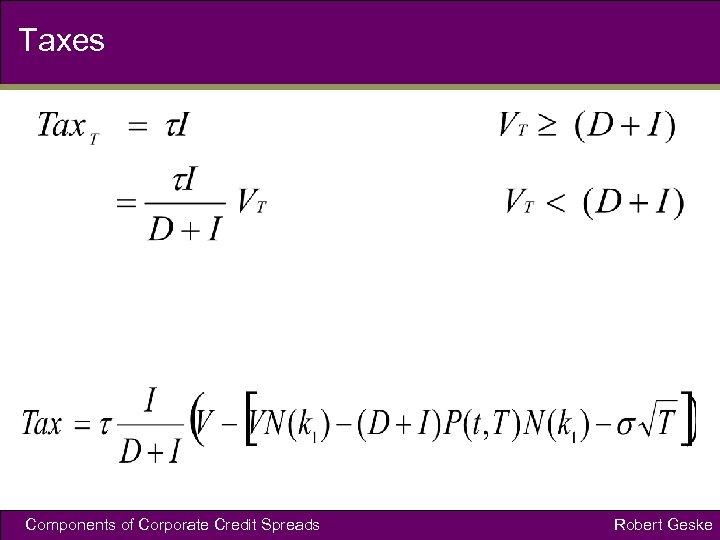
Taxes Components of Corporate Credit Spreads Robert Geske
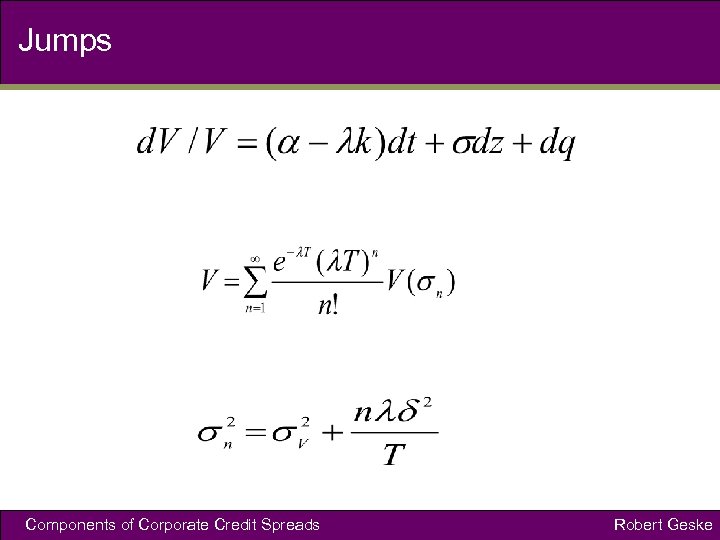
Jumps Components of Corporate Credit Spreads Robert Geske
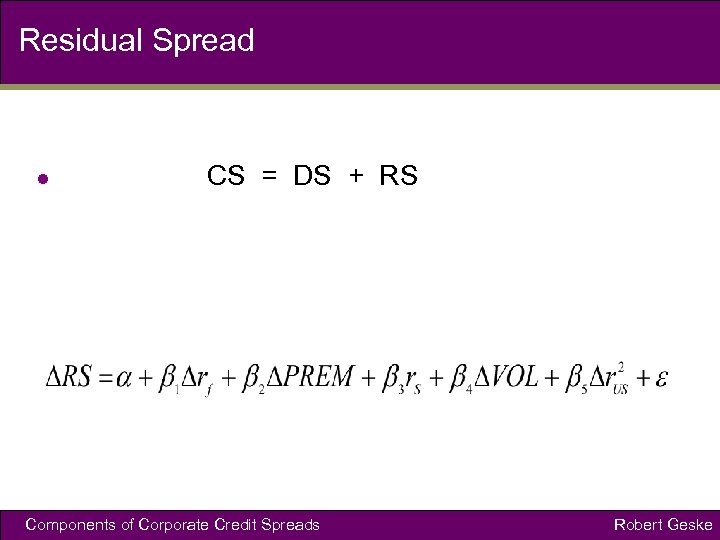
Residual Spread l CS = DS + RS Components of Corporate Credit Spreads Robert Geske
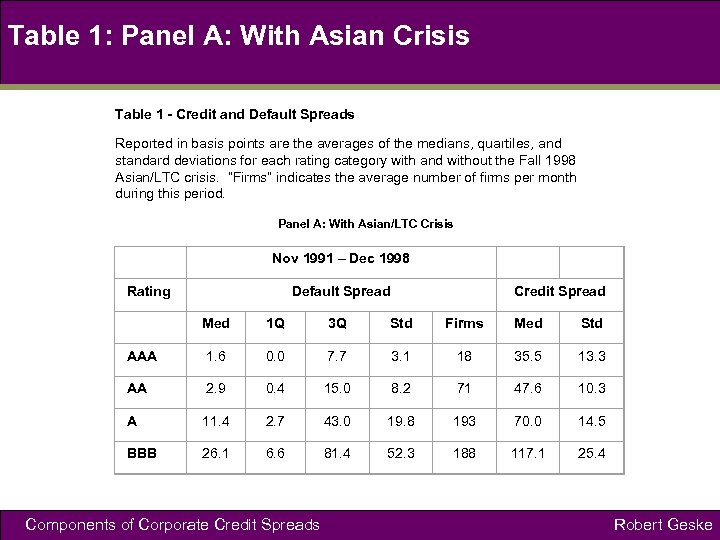
Table 1: Panel A: With Asian Crisis Table 1 - Credit and Default Spreads Reported in basis points are the averages of the medians, quartiles, and standard deviations for each rating category with and without the Fall 1998 Asian/LTC crisis. “Firms” indicates the average number of firms per month during this period. Panel A: With Asian/LTC Crisis Nov 1991 – Dec 1998 Rating Default Spread Credit Spread Med 1 Q 3 Q Std Firms Med Std AAA 1. 6 0. 0 7. 7 3. 1 18 35. 5 13. 3 AA 2. 9 0. 4 15. 0 8. 2 71 47. 6 10. 3 A 11. 4 2. 7 43. 0 19. 8 193 70. 0 14. 5 BBB 26. 1 6. 6 81. 4 52. 3 188 117. 1 25. 4 Components of Corporate Credit Spreads Robert Geske
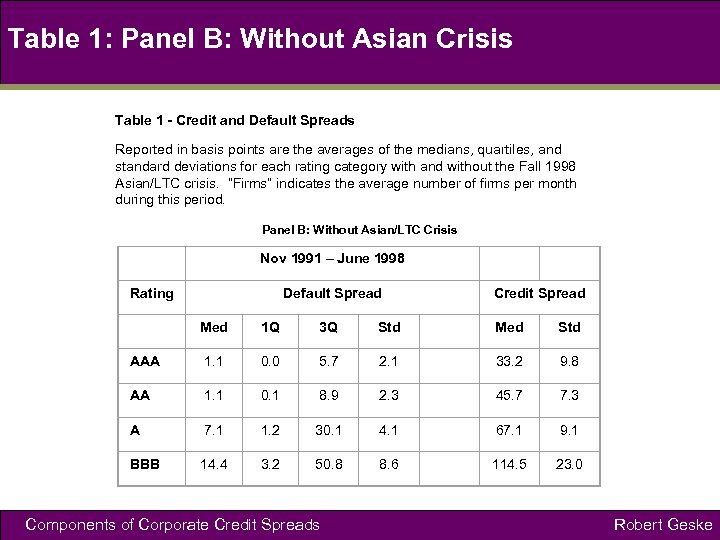
Table 1: Panel B: Without Asian Crisis Table 1 - Credit and Default Spreads Reported in basis points are the averages of the medians, quartiles, and standard deviations for each rating category with and without the Fall 1998 Asian/LTC crisis. “Firms” indicates the average number of firms per month during this period. Panel B: Without Asian/LTC Crisis Nov 1991 – June 1998 Rating Default Spread Credit Spread Med 1 Q 3 Q Std Med Std AAA 1. 1 0. 0 5. 7 2. 1 33. 2 9. 8 AA 1. 1 0. 1 8. 9 2. 3 45. 7 7. 3 A 7. 1 1. 2 30. 1 4. 1 67. 1 9. 1 BBB 14. 4 3. 2 50. 8 8. 6 114. 5 23. 0 Components of Corporate Credit Spreads Robert Geske
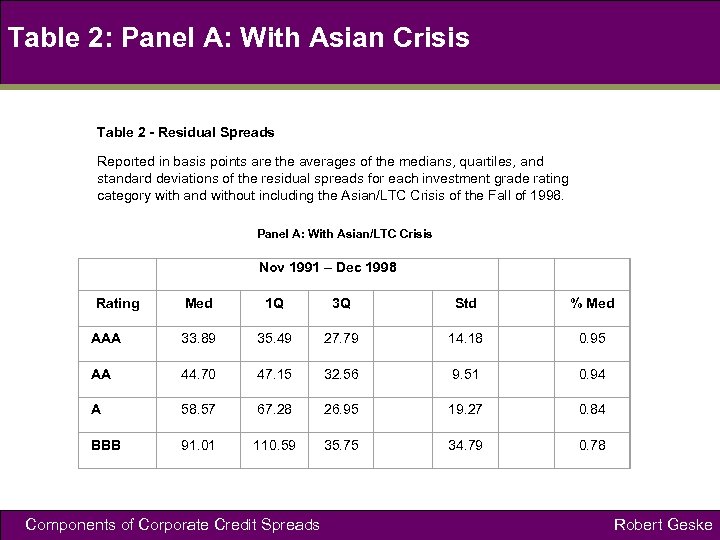
Table 2: Panel A: With Asian Crisis Table 2 - Residual Spreads Reported in basis points are the averages of the medians, quartiles, and standard deviations of the residual spreads for each investment grade rating category with and without including the Asian/LTC Crisis of the Fall of 1998. Panel A: With Asian/LTC Crisis Nov 1991 – Dec 1998 Med 1 Q 3 Q Std % Med AAA 33. 89 35. 49 27. 79 14. 18 0. 95 AA 44. 70 47. 15 32. 56 9. 51 0. 94 A 58. 57 67. 28 26. 95 19. 27 0. 84 BBB 91. 01 110. 59 35. 75 34. 79 0. 78 Rating Components of Corporate Credit Spreads Robert Geske
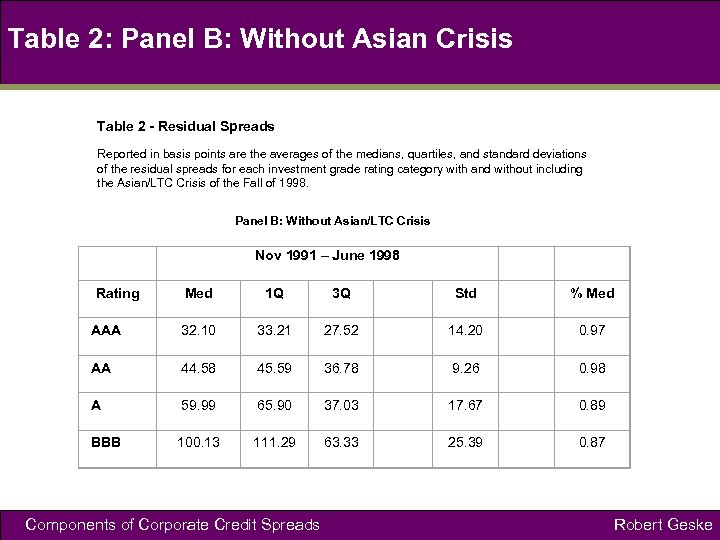
Table 2: Panel B: Without Asian Crisis Table 2 - Residual Spreads Reported in basis points are the averages of the medians, quartiles, and standard deviations of the residual spreads for each investment grade rating category with and without including the Asian/LTC Crisis of the Fall of 1998. Panel B: Without Asian/LTC Crisis Nov 1991 – June 1998 Med 1 Q 3 Q Std % Med AAA 32. 10 33. 21 27. 52 14. 20 0. 97 AA 44. 58 45. 59 36. 78 9. 26 0. 98 A 59. 99 65. 90 37. 03 17. 67 0. 89 BBB 100. 13 111. 29 63. 33 25. 39 0. 87 Rating Components of Corporate Credit Spreads Robert Geske
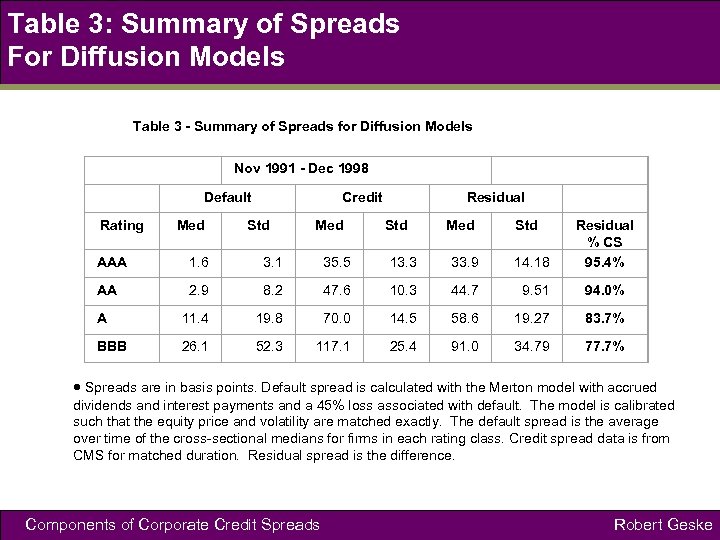
Table 3: Summary of Spreads For Diffusion Models Table 3 - Summary of Spreads for Diffusion Models Nov 1991 - Dec 1998 Rating Default Med Credit Std Med Residual Std Med Std AAA 1. 6 3. 1 35. 5 13. 3 33. 9 14. 18 Residual % CS 95. 4% AA 2. 9 8. 2 47. 6 10. 3 44. 7 9. 51 94. 0% A 11. 4 19. 8 70. 0 14. 5 58. 6 19. 27 83. 7% BBB 26. 1 52. 3 117. 1 25. 4 91. 0 34. 79 77. 7% Spreads are in basis points. Default spread is calculated with the Merton model with accrued dividends and interest payments and a 45% loss associated with default. The model is calibrated such that the equity price and volatility are matched exactly. The default spread is the average over time of the cross-sectional medians for firms in each rating class. Credit spread data is from CMS for matched duration. Residual spread is the difference. Components of Corporate Credit Spreads Robert Geske
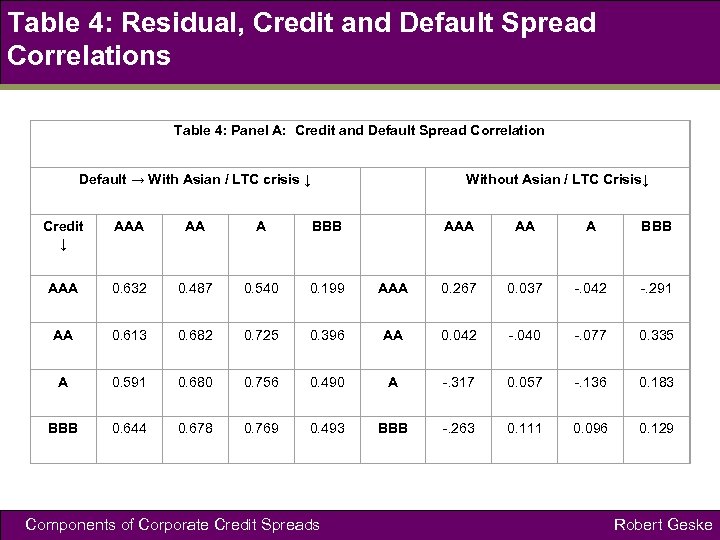
Table 4: Residual, Credit and Default Spread Correlations Table 4: Panel A: Credit and Default Spread Correlation Default → With Asian / LTC crisis ↓ Without Asian / LTC Crisis↓ Credit ↓ AAA AA A BBB AAA 0. 632 0. 487 0. 540 0. 199 AAA 0. 267 0. 037 -. 042 -. 291 AA 0. 613 0. 682 0. 725 0. 396 AA 0. 042 -. 040 -. 077 0. 335 A 0. 591 0. 680 0. 756 0. 490 A -. 317 0. 057 -. 136 0. 183 BBB 0. 644 0. 678 0. 769 0. 493 BBB -. 263 0. 111 0. 096 0. 129 Components of Corporate Credit Spreads Robert Geske
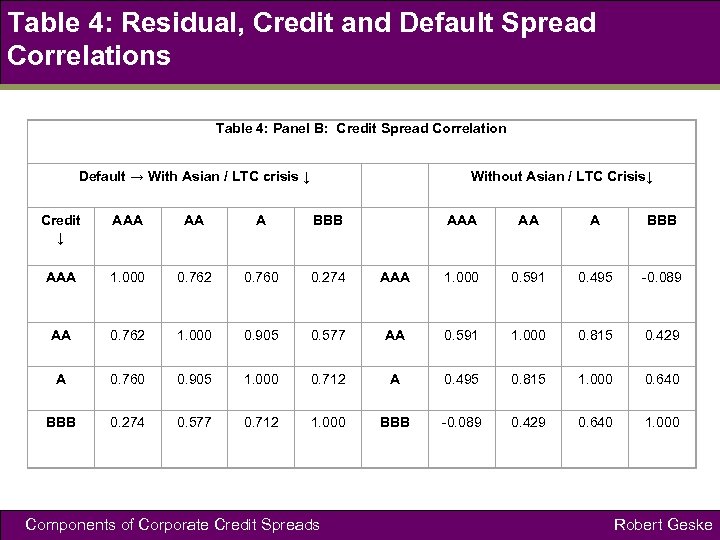
Table 4: Residual, Credit and Default Spread Correlations Table 4: Panel B: Credit Spread Correlation Default → With Asian / LTC crisis ↓ Without Asian / LTC Crisis↓ Credit ↓ AAA AA A BBB AAA 1. 000 0. 762 0. 760 0. 274 AAA 1. 000 0. 591 0. 495 -0. 089 AA 0. 762 1. 000 0. 905 0. 577 AA 0. 591 1. 000 0. 815 0. 429 A 0. 760 0. 905 1. 000 0. 712 A 0. 495 0. 815 1. 000 0. 640 BBB 0. 274 0. 577 0. 712 1. 000 BBB -0. 089 0. 429 0. 640 1. 000 Components of Corporate Credit Spreads Robert Geske
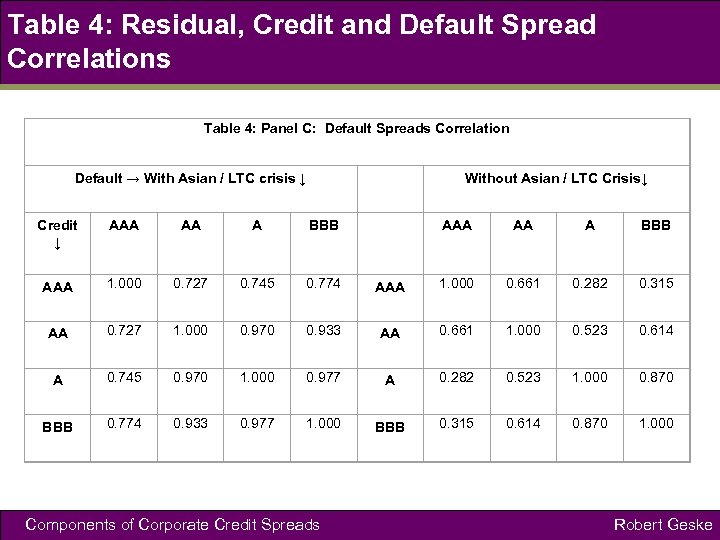
Table 4: Residual, Credit and Default Spread Correlations Table 4: Panel C: Default Spreads Correlation Default → With Asian / LTC crisis ↓ Without Asian / LTC Crisis↓ Credit ↓ AAA AA A BBB AAA 1. 000 0. 727 0. 745 0. 774 AAA 1. 000 0. 661 0. 282 0. 315 AA 0. 727 1. 000 0. 970 0. 933 AA 0. 661 1. 000 0. 523 0. 614 A 0. 745 0. 970 1. 000 0. 977 A 0. 282 0. 523 1. 000 0. 870 BBB 0. 774 0. 933 0. 977 1. 000 BBB 0. 315 0. 614 0. 870 1. 000 Components of Corporate Credit Spreads Robert Geske
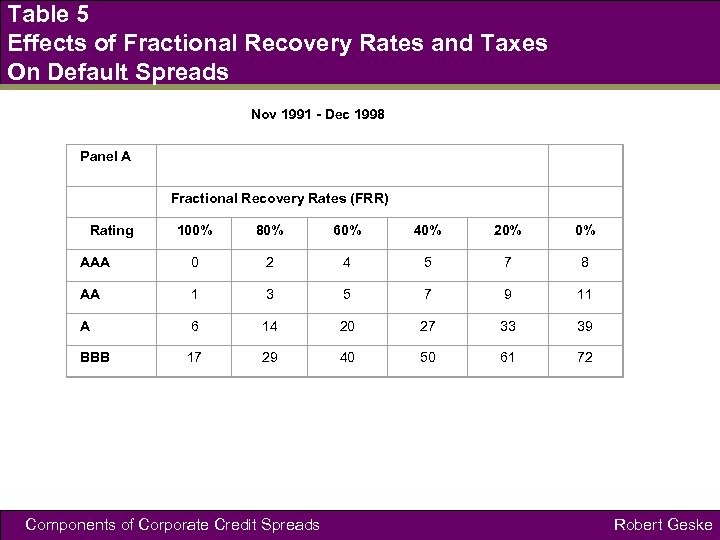
Table 5 Effects of Fractional Recovery Rates and Taxes On Default Spreads Nov 1991 - Dec 1998 Panel A Fractional Recovery Rates (FRR) Rating 100% 80% 60% 40% 20% 0% AAA 0 2 4 5 7 8 AA 1 3 5 7 9 11 A 6 14 20 27 33 39 BBB 17 29 40 50 61 72 Components of Corporate Credit Spreads Robert Geske
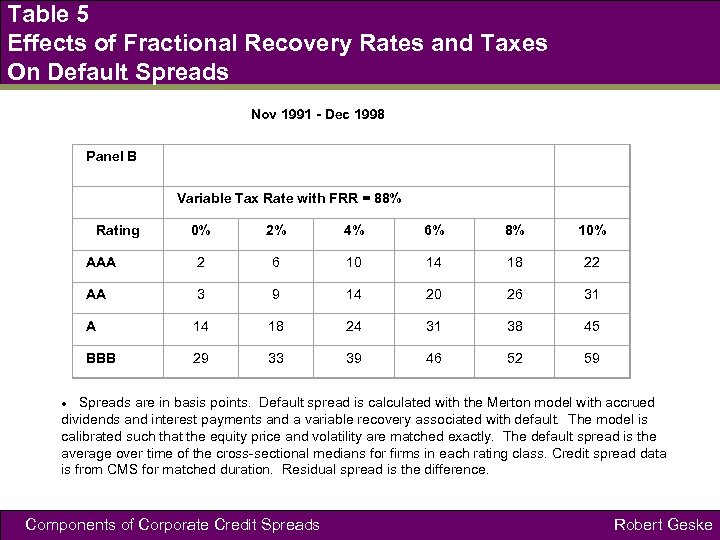
Table 5 Effects of Fractional Recovery Rates and Taxes On Default Spreads Nov 1991 - Dec 1998 Panel B Variable Tax Rate with FRR = 88% Rating 0% 2% 4% 6% 8% 10% AAA 2 6 10 14 18 22 AA 3 9 14 20 26 31 A 14 18 24 31 38 45 BBB 29 33 39 46 52 59 Spreads are in basis points. Default spread is calculated with the Merton model with accrued dividends and interest payments and a variable recovery associated with default. The model is calibrated such that the equity price and volatility are matched exactly. The default spread is the average over time of the cross-sectional medians for firms in each rating class. Credit spread data is from CMS for matched duration. Residual spread is the difference. Components of Corporate Credit Spreads Robert Geske
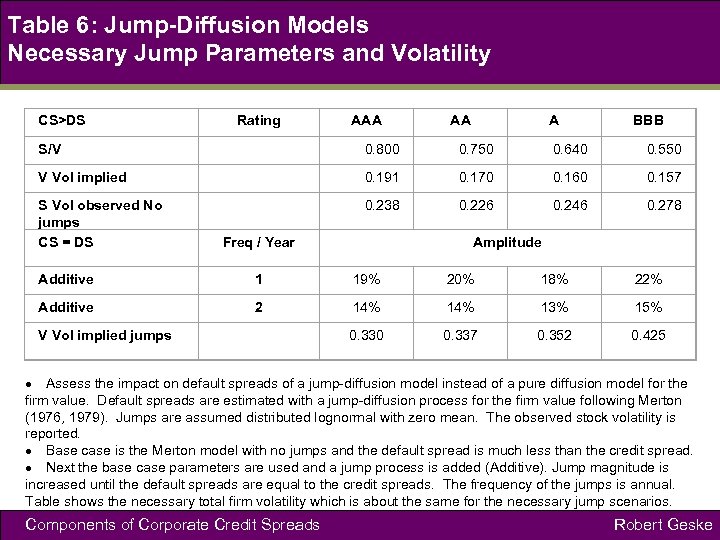
Table 6: Jump-Diffusion Models Necessary Jump Parameters and Volatility CS>DS Rating AAA AA A BBB S/V 0. 800 0. 750 0. 640 0. 550 V Vol implied 0. 191 0. 170 0. 160 0. 157 S Vol observed No jumps CS = DS 0. 238 0. 226 0. 246 0. 278 Freq / Year Amplitude Additive 1 19% 20% 18% 22% Additive 2 14% 13% 15% V Vol implied jumps 0. 330 0. 337 0. 352 0. 425 Assess the impact on default spreads of a jump-diffusion model instead of a pure diffusion model for the firm value. Default spreads are estimated with a jump-diffusion process for the firm value following Merton (1976, 1979). Jumps are assumed distributed lognormal with zero mean. The observed stock volatility is reported. Base case is the Merton model with no jumps and the default spread is much less than the credit spread. Next the base case parameters are used and a jump process is added (Additive). Jump magnitude is increased until the default spreads are equal to the credit spreads. The frequency of the jumps is annual. Table shows the necessary total firm volatility which is about the same for the necessary jump scenarios. Components of Corporate Credit Spreads Robert Geske
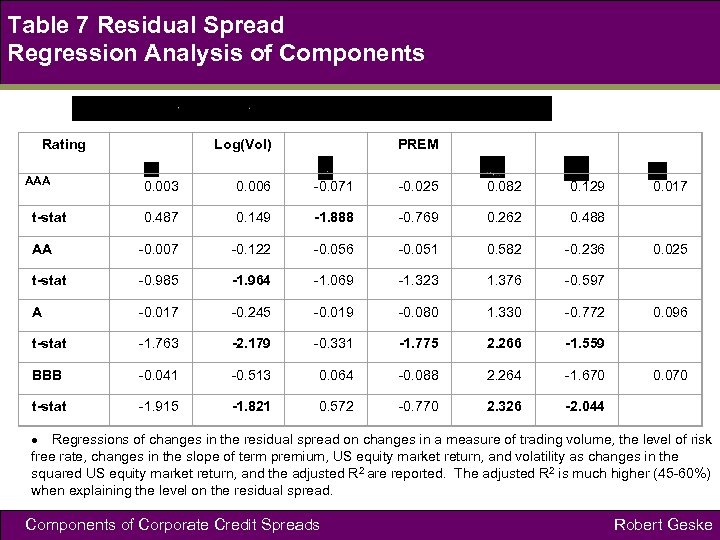
Table 7 Residual Spread Regression Analysis of Components Rating AAA Log(Vol) PREM 0. 003 0. 006 -0. 071 -0. 025 0. 082 0. 129 0. 017 0. 487 0. 149 -1. 888 -0. 769 0. 262 0. 488 AA -0. 007 -0. 122 -0. 056 -0. 051 0. 582 -0. 236 0. 025 t-stat -0. 985 -1. 964 -1. 069 -1. 323 1. 376 -0. 597 A -0. 017 -0. 245 -0. 019 -0. 080 1. 330 -0. 772 0. 096 t-stat -1. 763 -2. 179 -0. 331 -1. 775 2. 266 -1. 559 BBB -0. 041 -0. 513 0. 064 -0. 088 2. 264 -1. 670 0. 070 t-stat -1. 915 -1. 821 0. 572 -0. 770 2. 326 -2. 044 t-stat Regressions of changes in the residual spread on changes in a measure of trading volume, the level of risk free rate, changes in the slope of term premium, US equity market return, and volatility as changes in the squared US equity market return, and the adjusted R 2 are reported. The adjusted R 2 is much higher (45 -60%) when explaining the level on the residual spread. Components of Corporate Credit Spreads Robert Geske

Components of Corporate Credit Spreads Thank You Components of Corporate Credit Spreads Robert Geske
Скачать презентацию Components of Corporate Credit Spreads Presented By
4a2ac7261a6c0de6e22d9c163ba6a134.ppt