


 Скачать презентацию Component-resolved-diagnosis and validation of an allergen-microarray technology Romy
94604ec37aaadb2246bbb65620fc9a71.ppt
- Количество слайдов: 1
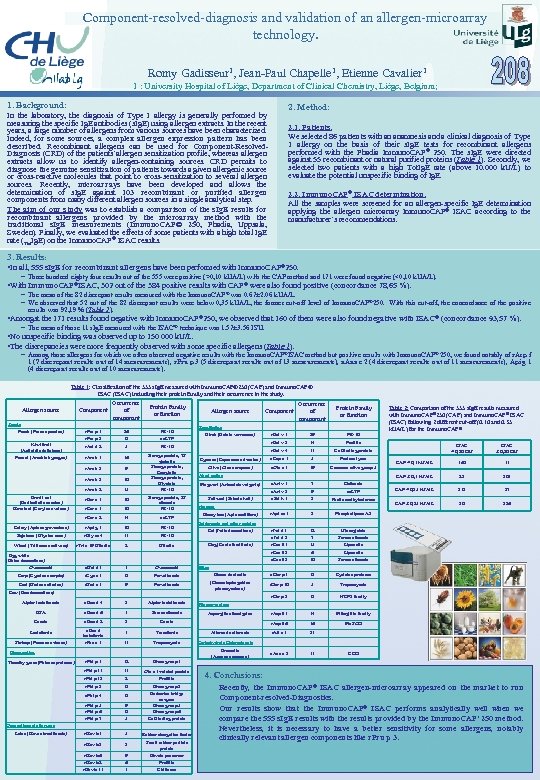 Component-resolved-diagnosis and validation of an allergen-microarray technology. Romy Gadisseur 1, Jean-Paul Chapelle 1, Etienne Cavalier 1 1 : University Hospital of Liège, Department of Clinical Chemistry, Liège, Belgium; 1. Background: 2. Method: In the laboratory, the diagnosis of Type I allergy is generally performed by measuring the specific Ig. E antibodies (s. Ig. E) using allergen extracts. In the recent years, a large number of allergens from various sources have been characterized. Indeed, for some sources, a complex allergen expression pattern has been described. Recombinant allergens can be used for Component-Resolved. Diagnosis (CRD) of the patients’allergen sensitization profile, whereas allergen extracts allow us to identify allergen-containing sources. CRD permits to diagnose the genuine sensitization of patients towards a given allergenic source or cross-reactive molecules that point to cross-sensitization to several allergen sources. Recently, microarrays have been developed and allows the determination of s. Ig. E against 103 recombinant or purified allergen components from many different allergen sources in a single analytical step. The aim of our study was to establish a comparison of the s. Ig. E results for recombinant allergens provided by the microarray method with the traditional s. Ig. E measurements (Immuno. CAP© 250, Phadia, Uppsala, Sweden). Finally, we evaluated the effects of some patients with a high total Ig. E rate (Tot. Ig. E) on the Immuno. CAP© ISAC results. 2. 1. Patients. We selected 86 patients with an anamnesis and a clinical diagnosis of Type 1 allergy on the basis of their s. Ig. E tests for recombinant allergens performed with the Phadia Immuno. CAP© 250. The s. Ig. E were directed against 55 recombinant or natural purified proteins (Table 1). Secondly, we selected two patients with a high Tot. Ig. E rate (above 10. 000 k. U/L) to evaluate the potential unspecific binding of Ig. E. 2. 2. Immuno. CAP© ISAC determination. All the samples were screened for an allergen-specific Ig. E determination applying the allergen microarray Immuno. CAP© ISAC according to the manufacturer’s recommendations. 3. Results: • In all, 555 s. Ig. E for recombinant allergens have been performed with Immuno. CAP© 250. – Three hundred eighty four results out of the 555 were positive (>0, 10 k. UA/L) with the CAP method and 171 were found negative (<0, 10 k. UA/L). • With Immuno. CAP©ISAC, 302 out of the 384 positive results with CAP© were also found positive (concordance 78, 65 %). – The mean of the 82 discrepant results measured with the Immuno. CAP © was 0. 67± 2. 06 k. UA/L. – We observed that 52 out of the 82 discrepant results were below 0, 35 k. UA/L, the former cut-off level of Immuno. CAP© 250. With this cut-off, the concordance of the positive results was 92, 19 % (Table 2). • Amongst the 171 results found negative with Immuno. CAP© 250, we observed that 160 of them were also found negative with ISAC© (concordance 93, 57 %). – The mean of those 11 s. Ig. E measured with the ISAC © technique was 1. 57± 3. 56 ISU. • No unspecific binding was observed up to 150 000 k. U/L. • The discrepancies were more frequently observed with some specific allergens (Table 1). – Among those allergens for which we often observed negative results with the Immuno. CAP©ISAC method but positive results with Immuno. CAP© 250, we found notably of r. Asp f 1 (7 discrepant results out of 14 measurements), r. Pru p 3 (5 discrepant results out of 13 measurements), n. Ana c 2 (4 discrepant results out of 11 measurements), Api g 1 (4 discrepant results out of 10 measurements). Allergen source Table 1: Classification of the 555 s. Ig. E measured with Immuno. CAP© 250 (CAP) and Immuno. CAP© ISAC (ISAC) including their protein family and their occurrence in the study. Occurrence Protein Family Component of Allergen source Component of or function componant Foods Peach (Prunus persica) Kiwi fruit (Actinidia deliciosa) Peanut (Arachis hypogea) r. Pru p 1 r. Pru p 3 26 13 PR-10 ns. LTP r. Act d 8 5 PR-10 r. Ara h 1 16 r. Ara h 2 9 r. Ara h 3 10 r. Ara h 8 15 Storage protein, 7 S globulin Storage protein, Conglutin Storage protein, Glycinin PR-10 Brazil nut r. Ber e 1 (Bertholletia excelsa) Hazelnut (Corylus avelana) r. Cor a 1 10 10 Storage protein, 2 S albumin PR-10 r. Cor a 8 14 Celery (Apium graveolens) r. Api g 1 10 PR-10 Sojabean (Glycine max) r. Gly m 4 11 PR-10 Wheat (Triticum aestivum) r. Tri a 19 Gliadin 8 29 PR-10 r. Bet v 2 14 Profilin r. Bet v 4 11 Ca Binding protein Cypress (Cupressus arizonica) n. Cup a 1 5 Pectase lyase Olive (Olea europaea) n. Ole e 1 19 Common olive group 5 Weed pollen Mugwort (Artemisia vulgaris) Saltwort (Salsola kali) n. Art v 1 7 Table 2: Comparison of the 555 s. Ig. E results measured with Immuno. CAP© 250 (CAP) and Immuno. CAP© ISAC (ISAC) following 2 different cut-off (0. 10 and 0. 35 k. UA/L) for the Immuno. CAP© CAP < 0, 1 k. UA/L ISAC < 0, 30 ISU ≥ 0, 30 ISU 160 11 Defensin CAP ≥ 0, 1 k. UA/L 82 302 212 27 30 286 n. Art v 3 n. Sal k 1 9 3 ns. LTP CAP < 0, 35 k. UA/L Pectin methylesterase CAP ≥ 0, 35 k. UA/L Honey bee (Apis mellifera) r. Api m 1 2 Phospholipase A 2 Epidermals and other poteins Cat (Felis domesticus) r. Fel d 1 n. Fel d 2 18 7 Uteroglobin Serum albumin r. Can f 1 r. Can f 2 n. Can f 3 15 6 10 Lipocalin Serum albumin n. Der p 1 13 Cysteine protease r. Der p 10 5 Tropomyosin r. Der p 2 12 NCP 2 family Aspergillus fumigatus r. Asp f 1 14 Mitogillin family Gliadin Egg white (Galus domesticus) Ovomucoid r. Bet v 1 Tree Pollen Birch (Betula verrucosa) ns. LTP Protein Family or function Venoms Dog (Canis familiaris) Mites n. Gal d 1 1 Ovomucoid Carp (Cyprinus carpio) r. Cyp c 1 12 Parvalbumin Cod (Gadus callarias) r. Gad c 1 9 Parvalbumin Alpha-lactalbumin n. Bos d 4 2 Alpha-lactalbumin BSA n. Bos d 6 1 Serum albumin Casein n. Bos d 8 3 Casein r. Asp f 6 16 Mn. SOD Lactoferrin n. Bos d lactoferrin r. Pen a 1 1 Transferrin Alternaria alternata r. Alt a 1 21 11 Tropomyosin 11 CCD Cow (Bos domesticus) Shrimp (Penaeus aztecus) Grass pollen r. Phl p 1 18 Grass group 1 r. Phl p 11 11 Ole e 1 -related protein r. Phl p 12 r. Phl p 2 8 13 Profilin Grass group 2 n. Phl p 4 12 Occupationnal allergens r. Phl p 5 r. Phl p 6 r. Phl p 7 9 12 5 Berberine bridge enzyme Grass group 5 Grass group 6 Ca Binding protein Latex (Hevea brasiliensis) r. Hev b 1 5 Rubber elongation factor r. Hev b 3 2 r. Hev b 6 9 Small rubber particle protein Hevein precursor r. Hev b 8 r. Hev b 11 6 1 Profilin Chitinase Timothy grass (Phleum pratense) House dust mite (Dermatophagoides pteronyssinus) Microorganism Carbohydrate Determinants Bromelin n. Ana c 2 (Ananas comosus) 4. Conclusions: Recently, the Immuno. CAP© ISAC allergen-microarray appeared on the market to run Component-resolved-Diagnostics. Our results show that the Immuno. CAP© ISAC performs analytically well when we compare the 555 s. Ig. E results with the results provided by the Immuno. CAP’ 250 method. Nevertheless, it is necessary to have a better sensitivity for some allergens, notably clinically relevant allergen components like r. Pru p 3.