 Скачать презентацию Component Frameworks Laxmikant Sanjay Kale Parallel Programming Laboratory
55eb97416c0b8056f56e4d7f008962f0.ppt
- Количество слайдов: 48



Component Frameworks: Laxmikant (Sanjay) Kale Parallel Programming Laboratory Department of Computer Science University of Illinois at Urbana-Champaign http: //charm. cs. uiuc. edu PPL-Dept of Computer Science, UIUC
Group Mission and Approach • To enhance Performance and Productivity in programming complex parallel applications – Performance: scalable to thousands of processors – Productivity: of human programmers – complex: irregular structure, dynamic variations • Approach: Application Oriented yet CS centered research – Develop enabling technology, for a wide collection of apps. – Develop, use and test it in the context of real applications – Optimal division of labor between “system” and programmer: • Decomposition done by programmer, everything else automated • Develop standard library of reusable parallel components PPL-Dept of Computer Science, UIUC
Motivation • Parallel Computing in Science and Engineering – Competitive advantage – Pain in the neck – Necessary evil • It is not so difficult – But tedious, and error-prone – New issues: race conditions, load imbalances, modularity in presence of concurrency, . . – Just have to bite the bullet, right? PPL-Dept of Computer Science, UIUC
But wait… • Parallel computation structures – The set of the parallel applications is diverse and complex – Yet, the underlying parallel data structures and communication structures are small in number • Structured and unstructured grids, trees (AMR, . . ), particles, interactions between these, space-time • One should be able to reuse those – Avoid doing the same parallel programming again and again PPL-Dept of Computer Science, UIUC
A second idea • Many problems require dynamic load balancing – We should be able to reuse load rebalancing strategies • It should be possible to separate load balancing code from application code • This strategy is embodied in Charm++ – Express the program as a collection of interacting entities (objects). – Let the system control mapping to processors PPL-Dept of Computer Science, UIUC
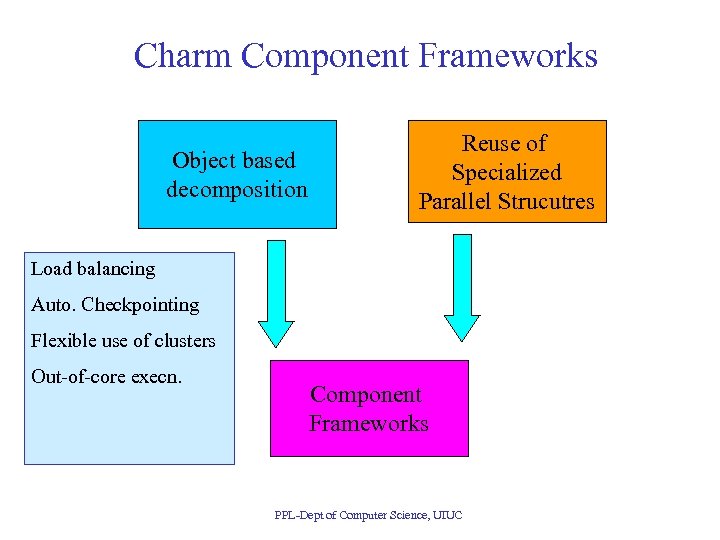
Charm Component Frameworks Object based decomposition Reuse of Specialized Parallel Strucutres Load balancing Auto. Checkpointing Flexible use of clusters Out-of-core execn. Component Frameworks PPL-Dept of Computer Science, UIUC
Current Set of Component Frameworks • FEM / unstructured meshes: – “Mature”, with several applications already • Multiblock: multiple structured grids – New, but very promising • AMR: – oct and quad trees PPL-Dept of Computer Science, UIUC

PPL-Dept of Computer Science, UIUC
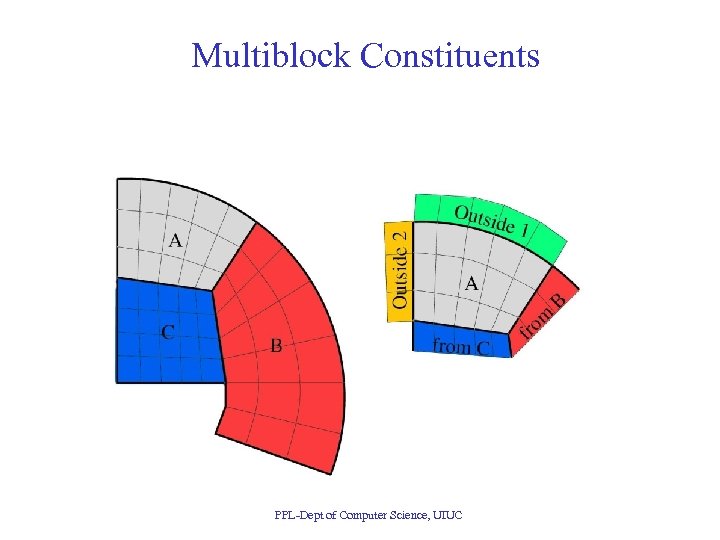
Multiblock Constituents PPL-Dept of Computer Science, UIUC
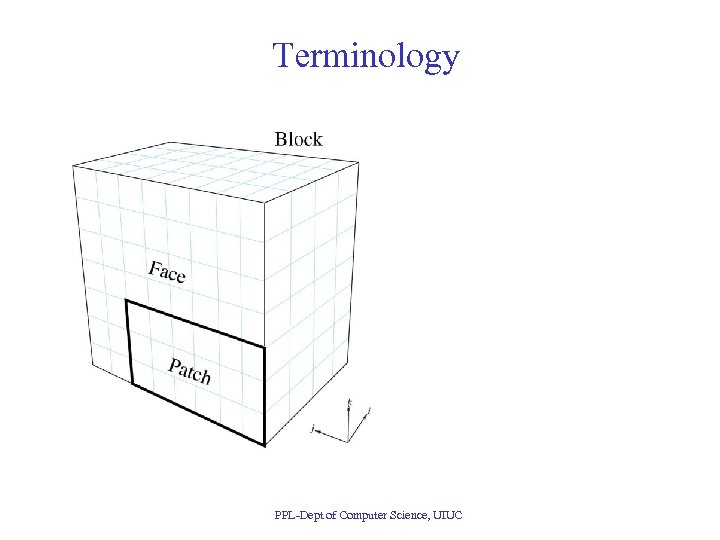
Terminology PPL-Dept of Computer Science, UIUC
Multi-partition decomposition • Idea: divide the computation into a large number of pieces – Independent of number of processors – typically larger than number of processors – Let the system map entities to processors PPL-Dept of Computer Science, UIUC
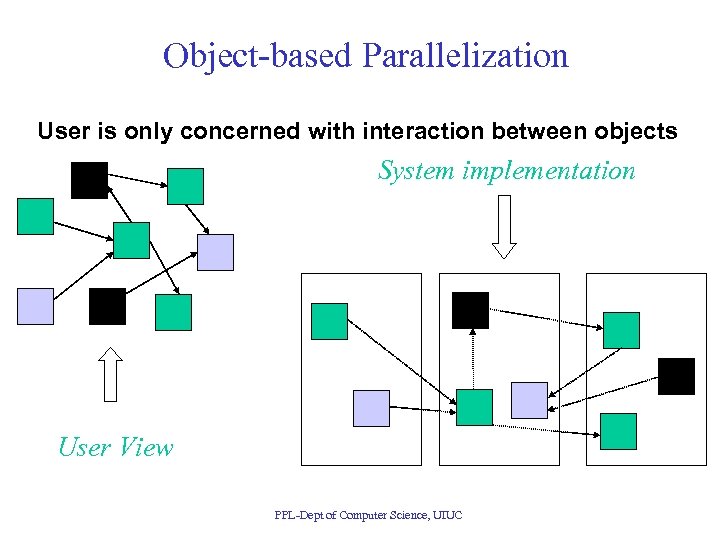
Object-based Parallelization User is only concerned with interaction between objects System implementation User View PPL-Dept of Computer Science, UIUC
Charm++ • Parallel C++ with Data Driven Objects • Object Arrays/ Object Collections • Object Groups: – Global object with a “representative” on each PE • • Asynchronous method invocation Prioritized scheduling Mature, robust, portable http: //charm. cs. uiuc. edu PPL-Dept of Computer Science, UIUC
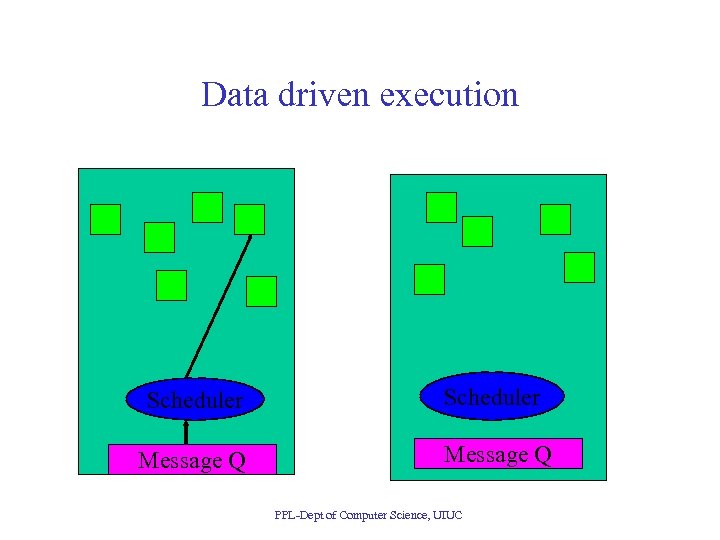
Data driven execution Scheduler Message Q PPL-Dept of Computer Science, UIUC
Load Balancing Framework • Based on object migration and measurement of load information • Partition problem more finely than the number of available processors • Partitions implemented as objects (or threads) and mapped to available processors by LB framework • Runtime system measures actual computation times of every partition, as well as communication patterns • Variety of “plug-in” LB strategies available PPL-Dept of Computer Science, UIUC
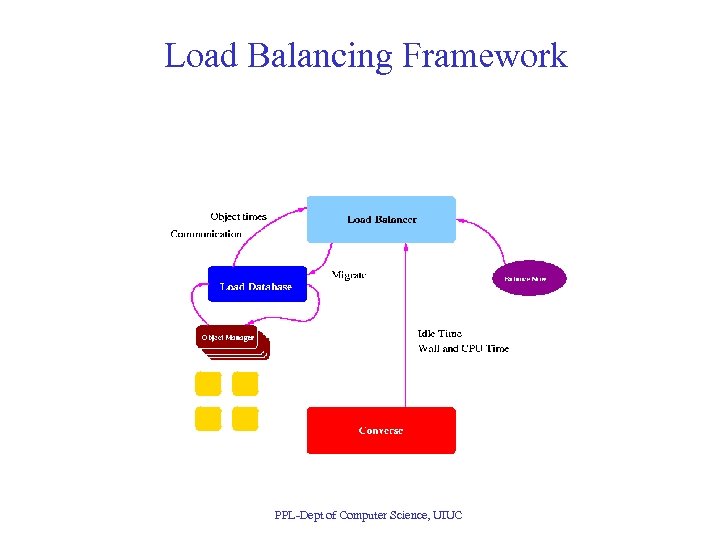
Load Balancing Framework PPL-Dept of Computer Science, UIUC
Building on Object-based Parallelism • Application induced load imbalances • Environment induced performance issues: – Dealing with extraneous loads on shared m/cs – Vacating workstations – Automatic checkpointing – Automatic prefetching for out-of-core execution – Heterogeneous clusters • Reuse: object based components • But: Must use Charm++! PPL-Dept of Computer Science, UIUC
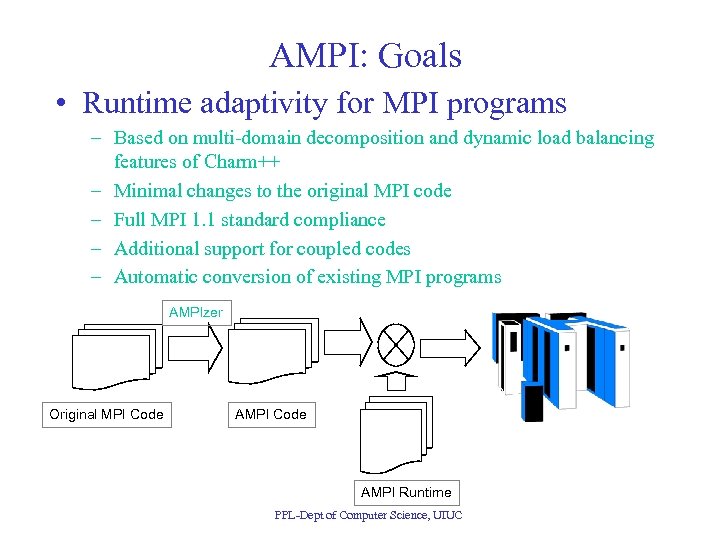
AMPI: Goals • Runtime adaptivity for MPI programs – Based on multi-domain decomposition and dynamic load balancing features of Charm++ – Minimal changes to the original MPI code – Full MPI 1. 1 standard compliance – Additional support for coupled codes – Automatic conversion of existing MPI programs AMPIzer Original MPI Code AMPI Runtime PPL-Dept of Computer Science, UIUC
Adaptive MPI • A bridge between legacy MPI codes and dynamic load balancing capabilities of Charm++ • AMPI = MPI + dynamic load balancing • Based on Charm++ object arrays and Converse’s migratable threads • Minimal modification needed to convert existing MPI programs (to be automated in future) • Bindings for C, C++, and Fortran 90 • Currently supports most of the MPI 1. 1 standard PPL-Dept of Computer Science, UIUC
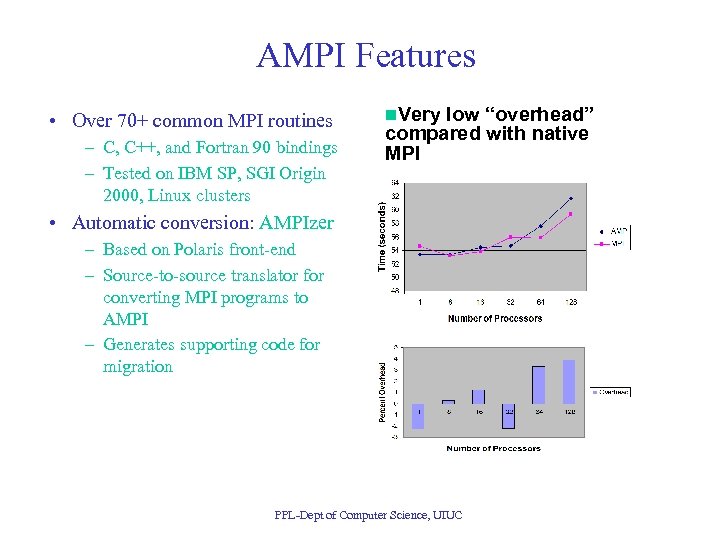
AMPI Features • Over 70+ common MPI routines – C, C++, and Fortran 90 bindings – Tested on IBM SP, SGI Origin 2000, Linux clusters n. Very low “overhead” compared with native MPI • Automatic conversion: AMPIzer – Based on Polaris front-end – Source-to-source translator for converting MPI programs to AMPI – Generates supporting code for migration PPL-Dept of Computer Science, UIUC
AMPI Extensions • Integration of multiple MPI-based modules – Example: integrated rocket simulation • ROCFLO, ROCSOLID, ROCBURN, ROCFACE • Each module gets its own MPI_COMM_WORLD – All COMM_WORLDs form MPI_COMM_UNIVERSE • Point-to-point communication among different MPI_COMM_WORLDs using the same AMPI functions • Communication across modules also considered for balancing load • Automatic checkpoint-and-restart – On different number of processors – Number of virtual processors remain the same, but can be mapped to different number of physical processors PPL-Dept of Computer Science, UIUC
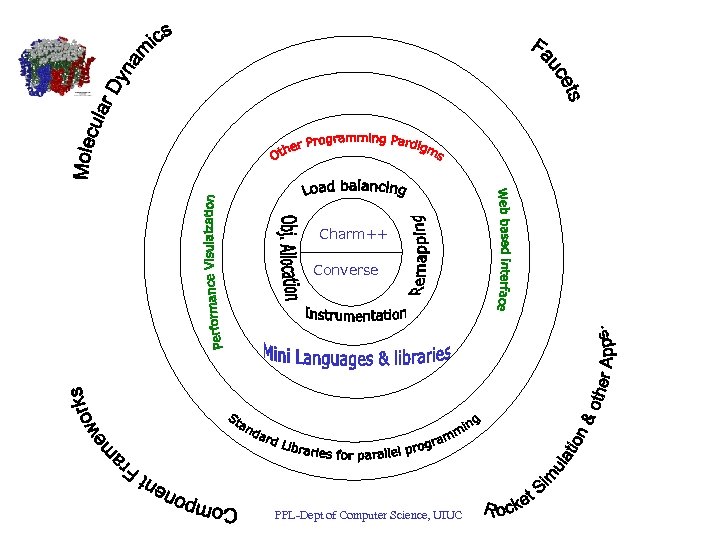
Charm++ Converse PPL-Dept of Computer Science, UIUC
Application Areas and Collaborations • Molecular Dynamics: – Simulation of biomolecules – Material properties and electronic structures • CSE applications: – Rocket Simulation – Industrial process simulation – Cosmology visualizer • Combinatorial Search: – State space search, game tree search, optimization PPL-Dept of Computer Science, UIUC
![Molecular Dynamics • Collection of [charged] atoms, with bonds • Newtonian mechanics • At](https://present5.com/presentation/55eb97416c0b8056f56e4d7f008962f0/image-24.jpg "Molecular Dynamics • Collection of [charged] atoms, with bonds • Newtonian mechanics • At")
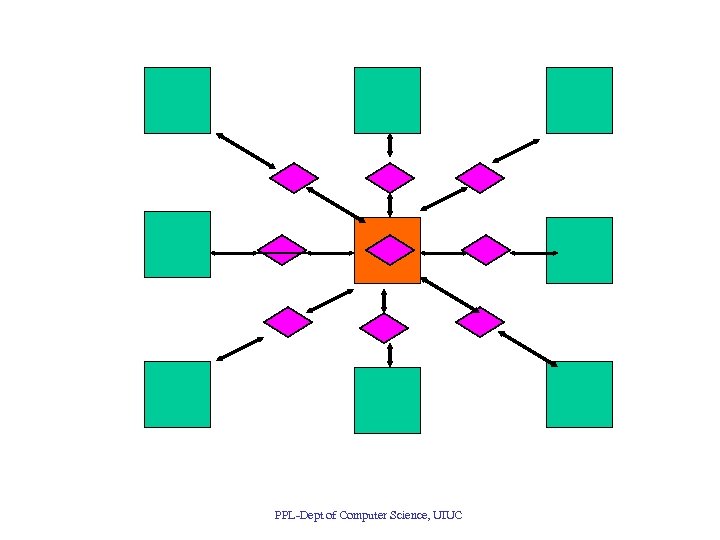
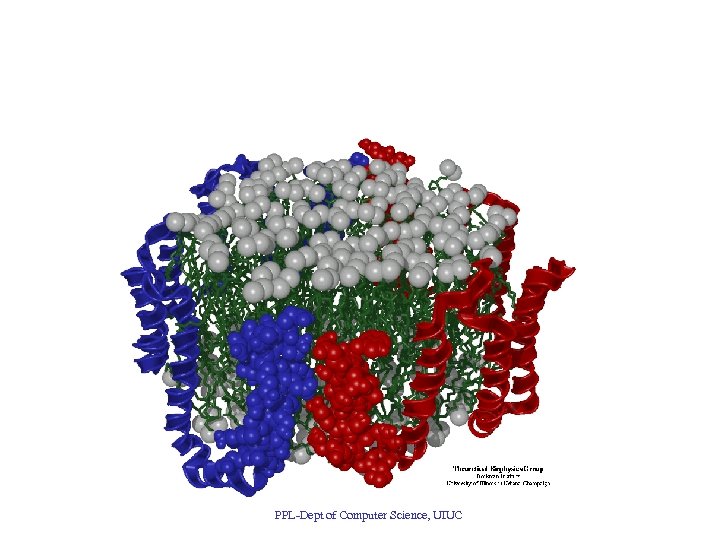
Molecular Dynamics • Collection of [charged] atoms, with bonds • Newtonian mechanics • At each time-step – Calculate forces on each atom • Bonds: • Non-bonded: electrostatic and van der Waal’s – Calculate velocities and advance positions • 1 femtosecond time-step, millions needed! • Thousands of atoms (1, 000 - 100, 000) PPL-Dept of Computer Science, UIUC
PPL-Dept of Computer Science, UIUC
PPL-Dept of Computer Science, UIUC
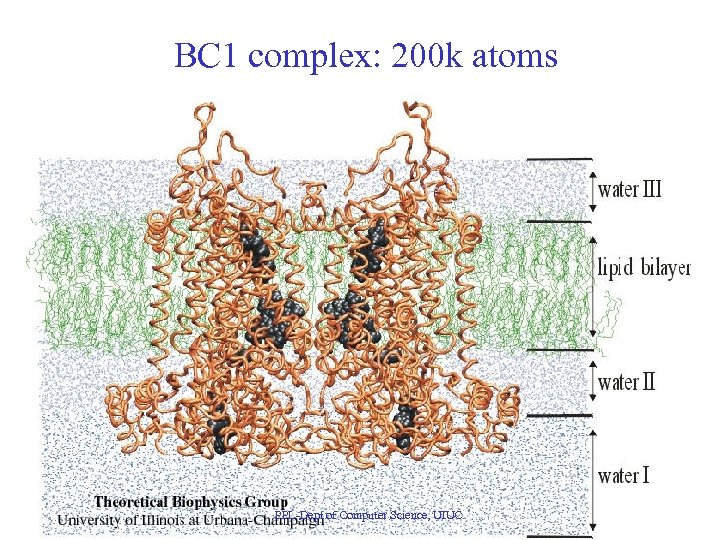
BC 1 complex: 200 k atoms PPL-Dept of Computer Science, UIUC
Performance Data: SC 2000 PPL-Dept of Computer Science, UIUC
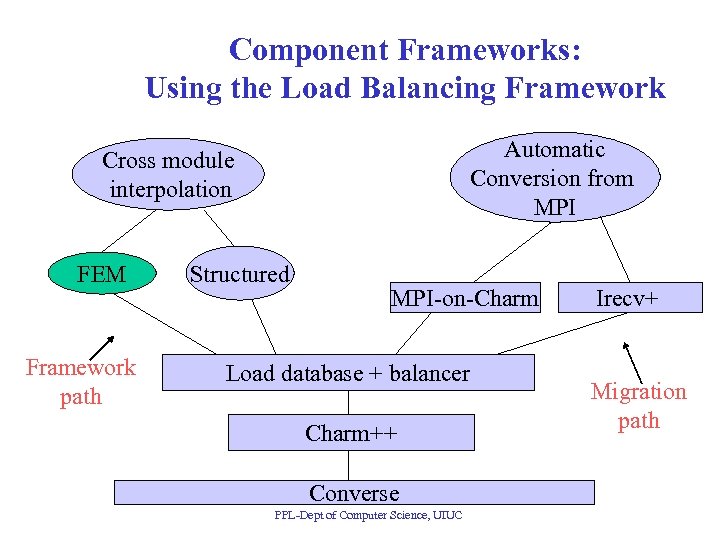
Component Frameworks: Using the Load Balancing Framework Automatic Conversion from MPI Cross module interpolation FEM Framework path Structured MPI-on-Charm Load database + balancer Charm++ Converse PPL-Dept of Computer Science, UIUC Irecv+ Migration path
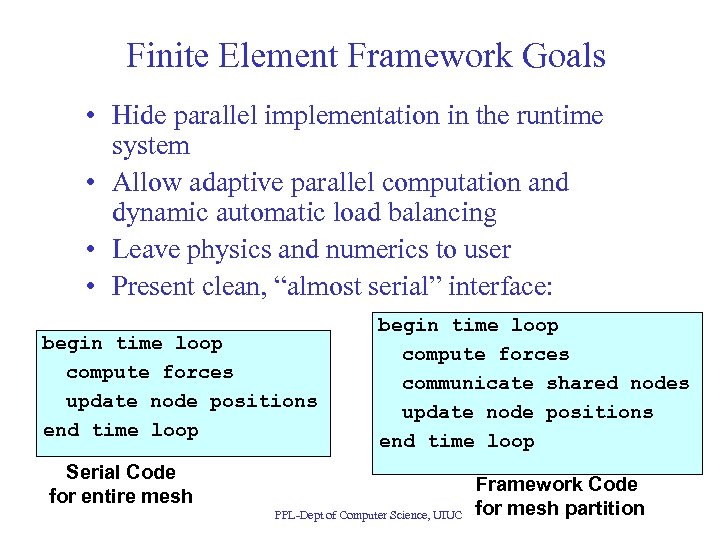
Finite Element Framework Goals • Hide parallel implementation in the runtime system • Allow adaptive parallel computation and dynamic automatic load balancing • Leave physics and numerics to user • Present clean, “almost serial” interface: begin time loop compute forces update node positions end time loop begin time loop compute forces communicate shared nodes update node positions end time loop Serial Code for entire mesh PPL-Dept of Computer Science, UIUC Framework Code for mesh partition
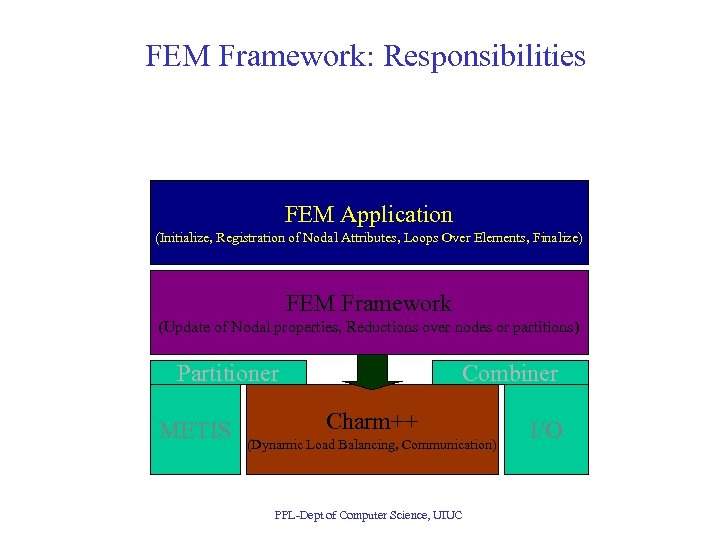
FEM Framework: Responsibilities FEM Application (Initialize, Registration of Nodal Attributes, Loops Over Elements, Finalize) FEM Framework (Update of Nodal properties, Reductions over nodes or partitions) Partitioner METIS Combiner Charm++ (Dynamic Load Balancing, Communication) PPL-Dept of Computer Science, UIUC I/O
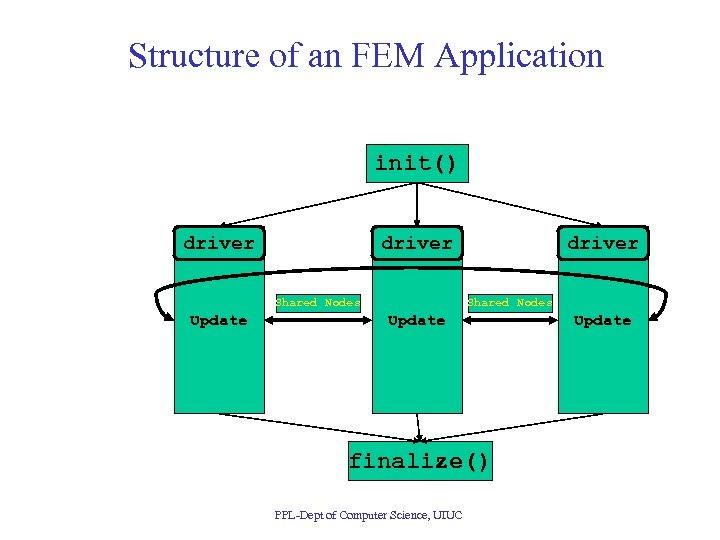
Structure of an FEM Application init() driver Shared Nodes Update finalize() PPL-Dept of Computer Science, UIUC Update
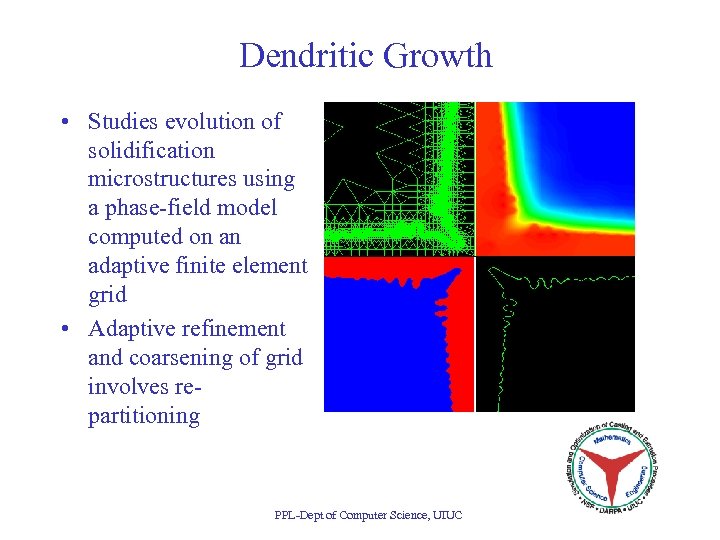
Dendritic Growth • Studies evolution of solidification microstructures using a phase-field model computed on an adaptive finite element grid • Adaptive refinement and coarsening of grid involves repartitioning PPL-Dept of Computer Science, UIUC
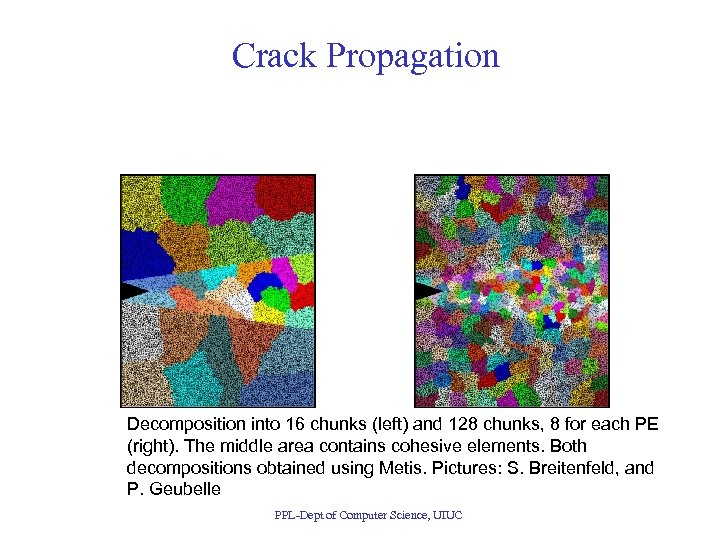
Crack Propagation Decomposition into 16 chunks (left) and 128 chunks, 8 for each PE (right). The middle area contains cohesive elements. Both decompositions obtained using Metis. Pictures: S. Breitenfeld, and P. Geubelle PPL-Dept of Computer Science, UIUC
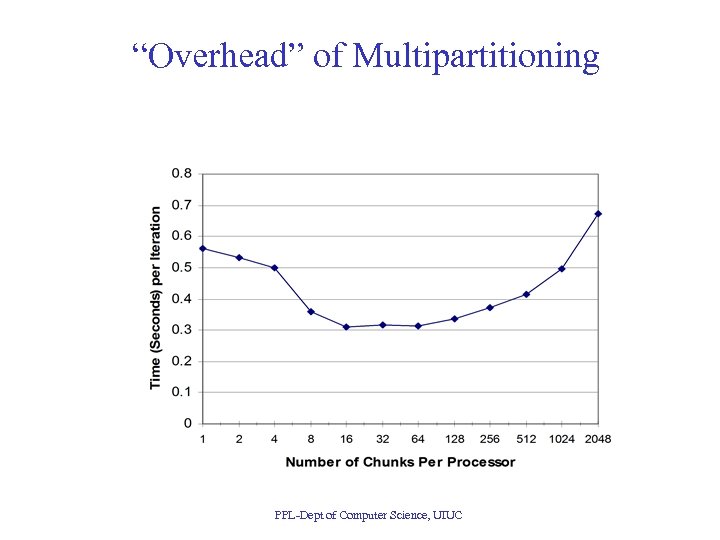
“Overhead” of Multipartitioning PPL-Dept of Computer Science, UIUC
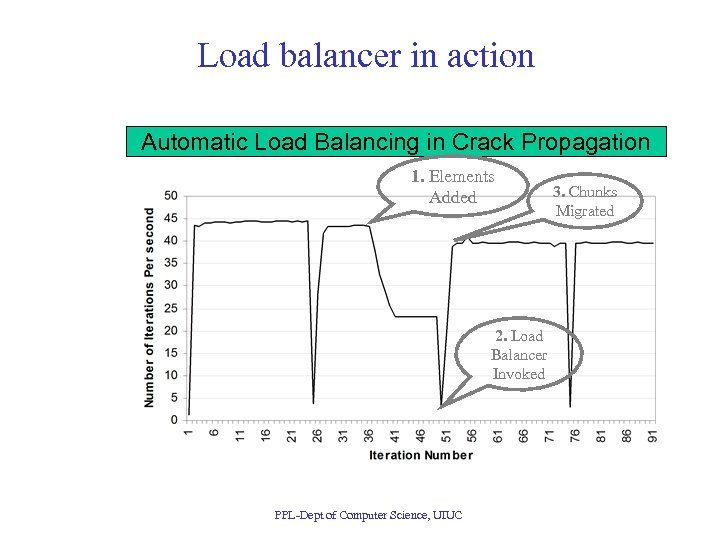
Load balancer in action Automatic Load Balancing in Crack Propagation 1. Elements Added 2. Load Balancer Invoked PPL-Dept of Computer Science, UIUC 3. Chunks Migrated
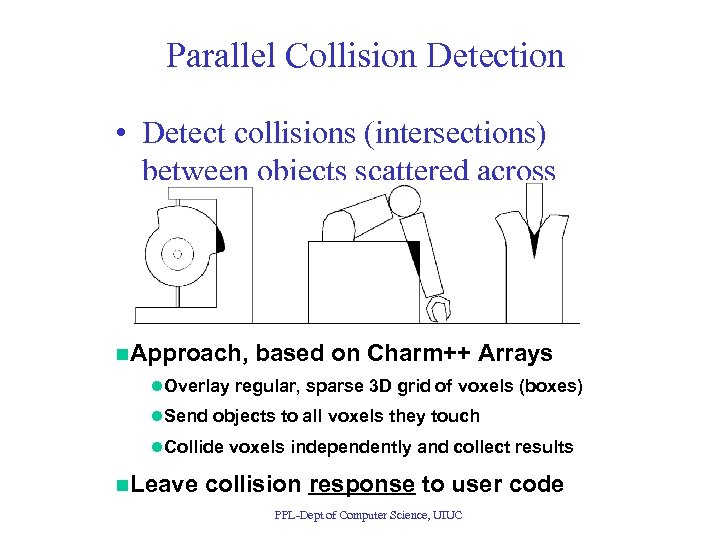
Parallel Collision Detection • Detect collisions (intersections) between objects scattered across processors n. Approach, based on Charm++ Arrays l. Overlay regular, sparse 3 D grid of voxels (boxes) l. Send objects to all voxels they touch l. Collide voxels independently and collect results n. Leave collision response to user code PPL-Dept of Computer Science, UIUC
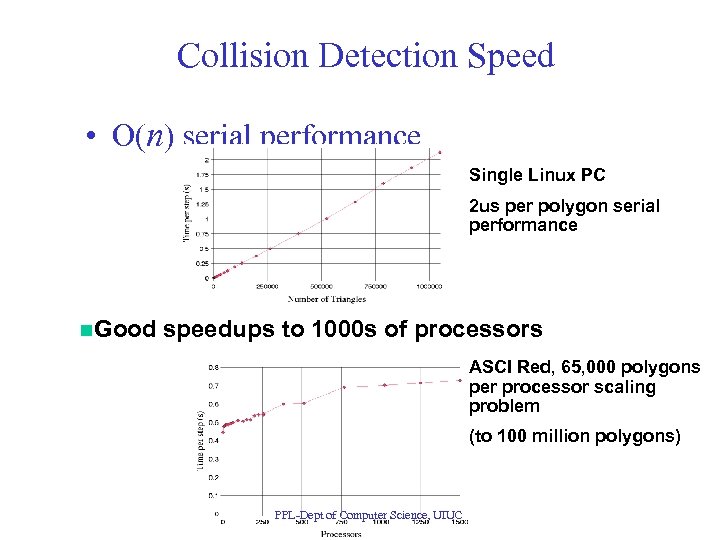
Collision Detection Speed • O(n) serial performance Single Linux PC 2 us per polygon serial performance n. Good speedups to 1000 s of processors ASCI Red, 65, 000 polygons per processor scaling problem (to 100 million polygons) PPL-Dept of Computer Science, UIUC
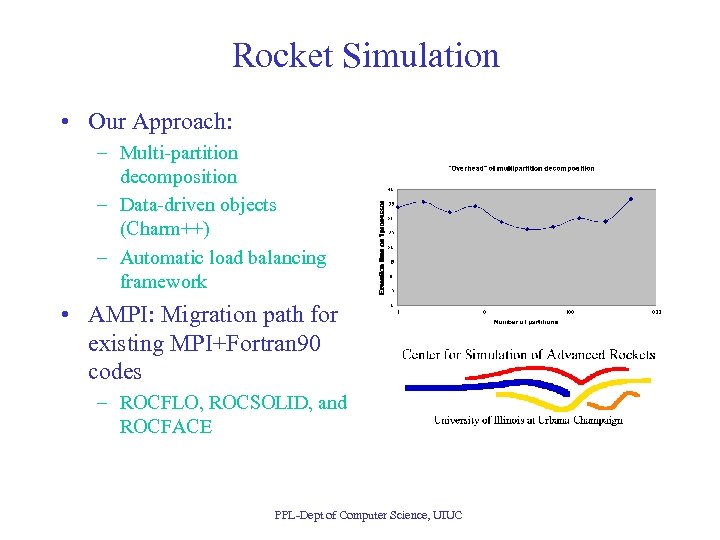
Rocket Simulation • Our Approach: – Multi-partition decomposition – Data-driven objects (Charm++) – Automatic load balancing framework • AMPI: Migration path for existing MPI+Fortran 90 codes – ROCFLO, ROCSOLID, and ROCFACE PPL-Dept of Computer Science, UIUC
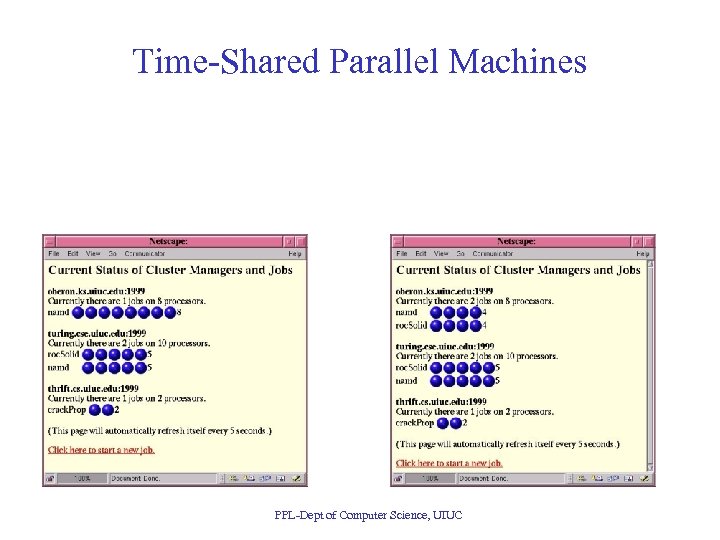
Timeshared parallel machines • How to use parallel machines effectively? • Need resource management – Shrink and expand individual jobs to available sets of processors – Example: Machine with 100 processors • Job 1 arrives, can use 20 -150 processors • Assign 100 processors to it • Job 2 arrives, can use 30 -70 processors, – and will pay more if we meet its deadline • We can do this with migratable objects! PPL-Dept of Computer Science, UIUC
Faucets: Multiple Parallel Machines • Faucet submits a request, with a Qo. S contract: – CPU seconds, min-max cpus, deadline, interacive? • Parallel machines submit bids: – A job for 100 cpu hours may get a lower price bid if: • It has less tight deadline, • more flexible PE range – A job that requires 15 cpu minutes and a deadline of 1 minute • Will generate a variety of bids • A machine with idle time on its hand: low bid PPL-Dept of Computer Science, UIUC
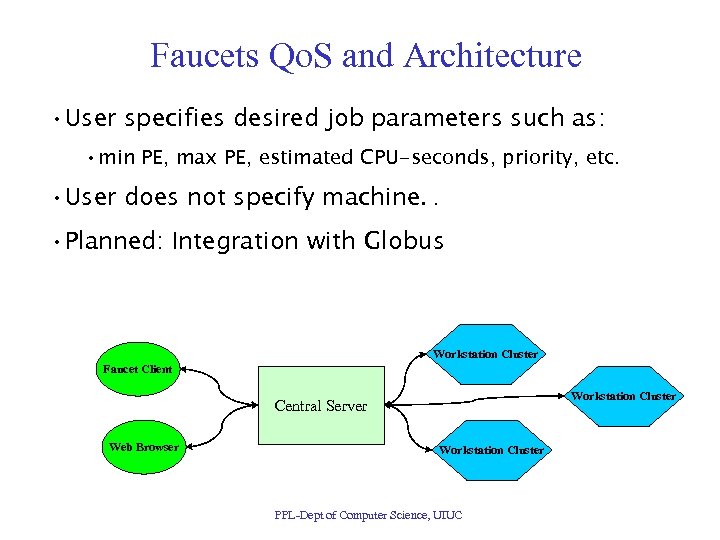
Faucets Qo. S and Architecture • User specifies desired job parameters such as: • min PE, max PE, estimated CPU-seconds, priority, etc. • User does not specify machine. . • Planned: Integration with Globus Workstation Cluster Faucet Client Workstation Cluster Central Server Web Browser Workstation Cluster PPL-Dept of Computer Science, UIUC
How to make all of this work? • The key: fine-grained resource management model – Work units are objects and threads • rather than processes – Data units are object data, thread stacks, . . • Rather than pages – Work/Data units can be migrated automatically • during a run PPL-Dept of Computer Science, UIUC
Time-Shared Parallel Machines PPL-Dept of Computer Science, UIUC

Appspector: Web-based Monitoring and Steering of Parallel Programs • Parallel Jobs submitted via a server – Server maintains database of running programs – Charm++ client-server interface • Allows one to inject messages into a running application • From any web browser: – You can attach to a job (if authenticated) – Monitor performance – Monitor behavior – Interact and steer job (send commands) PPL-Dept of Computer Science, UIUC
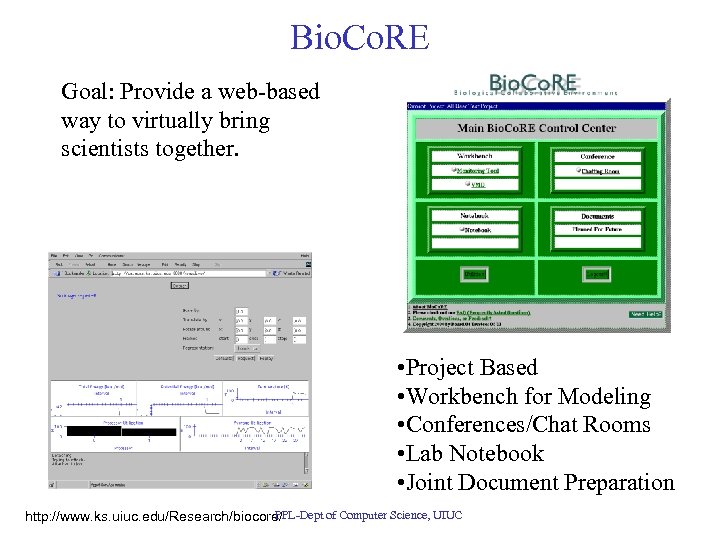
Bio. Co. RE Goal: Provide a web-based way to virtually bring scientists together. • Project Based • Workbench for Modeling • Conferences/Chat Rooms • Lab Notebook • Joint Document Preparation PPL-Dept of Computer Science, UIUC http: //www. ks. uiuc. edu/Research/biocore/
Some New Projects • Load Balancing for really large machines: – 30 k-128 k processors • Million-processor Petaflops class machines – Emulation for software development – Simulation for Performance Prediction • Operations Research – Combinatorial optiization • Parallel Discrete Event Simulation PPL-Dept of Computer Science, UIUC
Summary • Exciting times for parallel computing ahead • We are preparing an object based infrastructure – To exploit future apps on future machines • Charm++, AMPI, automatic load balancing • Application-oriented research that produces enabling CS technology • Rich set of collaborations • More information: http: //charm. cs. uiuc. edu PPL-Dept of Computer Science, UIUC
Скачать презентацию Component Frameworks Laxmikant Sanjay Kale Parallel Programming Laboratory
55eb97416c0b8056f56e4d7f008962f0.ppt