


 Скачать презентацию COMPLIANCE FOR STUDENT LOAN ASSISTANCE SERVICES Association for
1f298fb8dd50f72e1e68f38618ba5faa.ppt
- Количество слайдов: 42
 COMPLIANCE FOR STUDENT LOAN ASSISTANCE SERVICES Association for Student Loan Relief Presented by: Robby H. Birnbaum, Esq (954) 343 6959 Robby. Birnbaum@gmlaw. com
 No Legal Advice- Educational Only Legal advice may only be provided by an attorney licensed to practice law in your jurisdiction. This presentation is Copyright Protected and is for informational and educational purposes only. It is not intended to provide legal analysis or advice on any specific issues. No part of this presentation may be copied or displayed without the prior written consent of the presenter. No part of this presentation constitutes or is intended to be advertising for attorney representation or services. Please do not rely on any part of this presentation in making final decisions for your business and it is not intended to provide any specific or comprehensive analysis, or any analysis at all, of your specific business practices. This presentation is not designed to cover all issues in all jurisdictions and any examples herein are solely for illustration purposes. This presentation is for educational purposes only
 Robby H. Birnbaum Attorney and Partner at Greenspoon Marder Association for Student Loan Relief National Association of Credit Service Organizations Focus on Pro-Active Compliance For Companies and Relationship Building With Regulators
 Regulatory Compliance Proactive Federal and State Compliance Services for Companies State licensing and bonding Contract Creation, Policies You Need and Consumer Disclosures- Staying Ahead of the Game Advertising Review Prior to Use Television, Radio, Direct Mail, Internet, SMS/Text, Telephone Relationships with State and Federal Regulators Information Source- If you are struggling- call me! Business to Business Networking- Like this Conference! Lead Sources, Financial Processing and Investment, Affiliate Marketing
 Regulatory Compliance Reactive and Resolution Services Federal and State Relationships of Trust and Professionalism Resolving Concerns to Avoid Litigation Handled more matters with: FTC, CFPB, State AG’s, and State Banking Departments (explain) The point: Understand the regulators and their concerns so that your business can prevent problems before they occur. TODAY we are going to learn about those concerns so you can use them to PROTECT your business.
 Understand Student Loan Debt and Regulations Involved in Helping Consumers Businesses that assist consumers in the resolution of their student loans generally offer various services: Initial counseling or consultation Document and Information gathering from the consumer Identify and locate programs offered or sponsored by the U. S. Government through its Department of Education that may help the consumer. Application completion, submission and tracking. And for all of this, private companies charge fees.
 Triggers for Regulation You charge fees to consumers. -government wants to protect through disclosures and control over how much and when you charge. (and government needs something to do) You market to consumers for services that affect the financial well-being of consumers. - consumers are considered “more vulnerable. ” Government has to ‘clean up the mess’ or ‘get blamed’ in the event that consumers are not handled properly, or not suitable for the programs (i. e. , mortgage disaster in US). You offer services that are sold over the telephone. -automatic regulation, consumers considered more vulnerable. You receive, handle and transmit non-public consumer financial information. -data theft and privacy concerns. FSA Access issues.
 Federal Trade Commission Unsecured Debt Relief Rule An amendment passed in 2010 government all marketing and sales that begin or occur over the telephone where the consumer hears the material sales presentation by phone (even if the purchase decision is made later). Applies to Unsecured Debts. Difference between Unsecured v. Secured Debt Is Student Loan an Unsecured Debt? FTC position: What the offer is, “what the consumer perceives the offer is. ” CFPB: They tend to just lump everything into either “scam” or nonscam. ” Recent cases lay their position. State AG’s- Loan Brokering v. Debt Adjusting v. Credit Repair
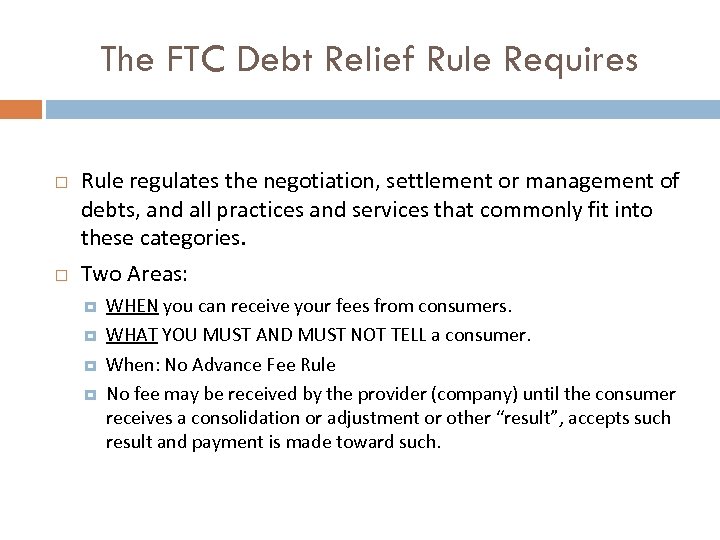 The FTC Debt Relief Rule Requires Rule regulates the negotiation, settlement or management of debts, and all practices and services that commonly fit into these categories. Two Areas: WHEN you can receive your fees from consumers. WHAT YOU MUST AND MUST NOT TELL a consumer. When: No Advance Fee Rule No fee may be received by the provider (company) until the consumer receives a consolidation or adjustment or other “result”, accepts such result and payment is made toward such.
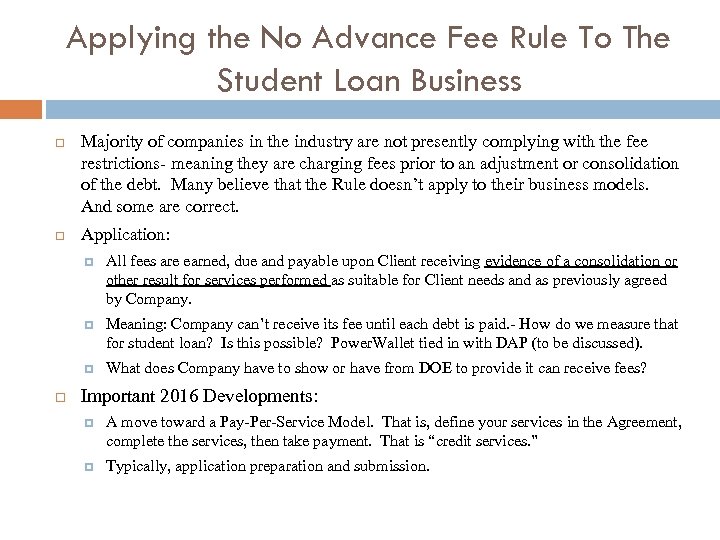 Applying the No Advance Fee Rule To The Student Loan Business Majority of companies in the industry are not presently complying with the fee restrictions- meaning they are charging fees prior to an adjustment or consolidation of the debt. Many believe that the Rule doesn’t apply to their business models. And some are correct. Application: Meaning: Company can’t receive its fee until each debt is paid. - How do we measure that for student loan? Is this possible? Power. Wallet tied in with DAP (to be discussed). All fees are earned, due and payable upon Client receiving evidence of a consolidation or other result for services performed as suitable for Client needs and as previously agreed by Company. What does Company have to show or have from DOE to provide it can receive fees? Important 2016 Developments: A move toward a Pay-Per-Service Model. That is, define your services in the Agreement, complete the services, then take payment. That is “credit services. ” Typically, application preparation and submission.
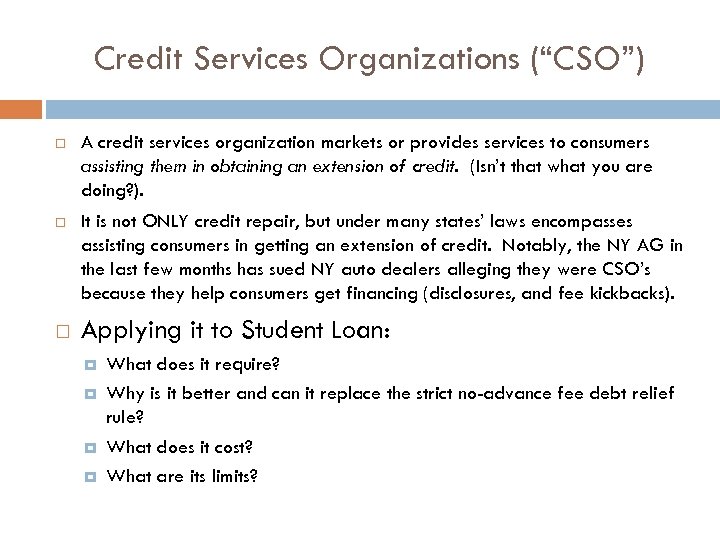 Credit Services Organizations (“CSO”) A credit services organization markets or provides services to consumers assisting them in obtaining an extension of credit. (Isn’t that what you are doing? ). It is not ONLY credit repair, but under many states’ laws encompasses assisting consumers in getting an extension of credit. Notably, the NY AG in the last few months has sued NY auto dealers alleging they were CSO’s because they help consumers get financing (disclosures, and fee kickbacks). Applying it to Student Loan: What does it require? Why is it better and can it replace the strict no-advance fee debt relief rule? What does it cost? What are its limits?
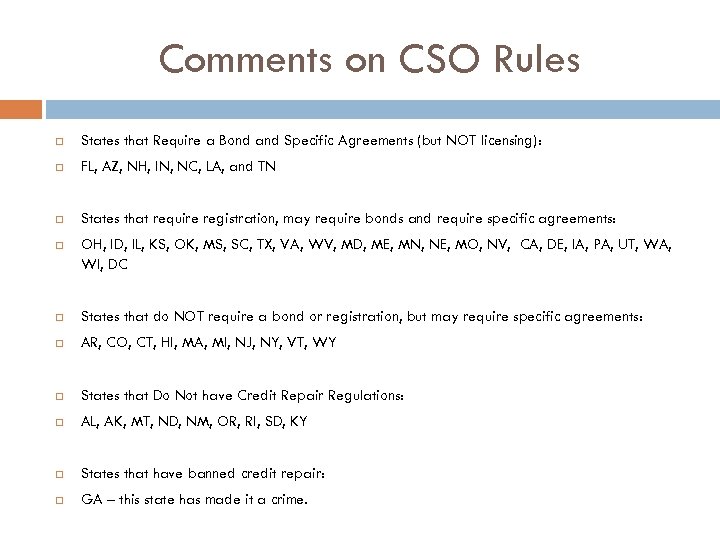 Comments on CSO Rules States that Require a Bond and Specific Agreements (but NOT licensing): FL, AZ, NH, IN, NC, LA, and TN States that require registration, may require bonds and require specific agreements: OH, ID, IL, KS, OK, MS, SC, TX, VA, WV, MD, ME, MN, NE, MO, NV, CA, DE, IA, PA, UT, WA, WI, DC States that do NOT require a bond or registration, but may require specific agreements: AR, CO, CT, HI, MA, MI, NJ, NY, VT, WY States that Do Not have Credit Repair Regulations: AL, AK, MT, ND, NM, OR, RI, SD, KY States that have banned credit repair: GA – this state has made it a crime.
 CSO Banking and Disclosures Important Rules: Does not allow advance fees prior to substantive work or services. But does allow a fee structure based on services performed and you completing services. (Such is less strict than the debt relief rule. ) Sample: Fee earned upon submission of all documents to DOE and confirmation of receipt and you are done. Fee earned upon consumer making submission and you are done.
 Banking is Critical to Both Models Example of Global Client Solutions and other DAP’s: Under both the TSR and CSO models, the fee can only be received by the company after services are performed. The Dedicated Account Provider allows the fee to move from the consumer’s account to the dedicated account from day 1. This merges nicely with the FTC’s more strict reading of the CSO and Credit Repair Organizations Act- providing proof that the consumer’s funds are safe. Regulators have directly stated they prefer this model, and the companies that use it report more effective management of the customers- because the consumer’s have mental ($) “skin” in the game, without risk of loss.
 As of May 2016 Moving to a DS-like compliance. No fee until confirmed result, and consumer makes payment. How do you confirm payment was made? Consumer confirmation through SL company? What about forbearance? Review recent discussions with FTC about $0 settlements. FTC first looks at consumer impression- what they are being told from complaints and what they are being told by sales reps and docs. What do my starting-point SL contracts say about this? Does it match your sales presentation? Are the terms of the debt being altered?
 Forbearance Issues If the rep clearly presents the terms of the debt as being “altered” – and lay off the debt consolidation promises (like a DMP company). If there is sufficient documentation in the consumer’s file. “If not for the SL company, the consumer would not receive the result. ” Then do you earn the fee on a $0 delay? Has the principal and interest or similar been altered? (positive or negative amount). Then: how do you demonstrate this to the DAP (Global) to match with receipt of a fee? Charles Connors great systems. Text messaging with consumer?
 Second Part: Disclosures In Your Contract Disclosures must be clearly presented prior to Client before or when engaging Company. Failure to timely pay debts will result in increase in amounts owed based on interest and fees. Failure to timely pay debts will result in a reduction of creditworthiness, increased collection activity. Estimate total program costs and time for client based on similar situations. Pricing, Explain Services and Limitations and Cancellation and Refund Rights Federal and State CSO disclosures- email me for the packet.
 2016 Enforcements and What to Plan For What we will continue to see from the CFPB, FTC and States. Pressure on them to generate press releases and pick on the “low hanging fruit. ” Review CFPB comments in packet. Steve Lamont Student Aid Institute IN DETAIL!! – What did the CFPB want in March 2016 - the panic call I received from them. New York Student Loan Task Force The Subpoenas The Ultimate Result (One settled, a lot pending but what I think will happen). ] Review what it has done, and what is expected. Not a ban- company can continue operating BUT: comply with CSO rules, and disclosures. Massachusetts 2 settled- 5 pending. The “out of money approach”. The “no response” approach. Illinois Lawsuits filed, settled. what is really happening? (PR) $20 k. What are the lawsuits about? Consistent theme: An assistant AG trying to make a case, make a name for themselves (the just hit the industry and move on). Utter lack of consumer complaints. Oregon, Washington, Mass. , Illinois. -out of the 14 most aggressive states.
 CFPB- How to Make It Work for Your Business Jeff Erhlich (CFPB): at a consumer protection conference stated: We first examine companies from a far, consistent with our goals. If a company is following the no-advance fee model, we view that as an initial “Safe Harbor” and we move to the next company. (They specifically are looking for a safer financial setup- like using a DAP and getting CSO licenses). Could not be clearer: Follow the some set of rules so you can show such, and then they will move on. Fee structure based on completion of your services. California will license you as a CSO- other states will also. Think about that from a revenue perspective and 90 days out? Why are companies not using this rule to protect themselves? Will the FTC “lighten up” and accept a monthly administration fee? Discussions underway.
 California and Pennsylvania CA DOJ (AG) confirmed that CSO would cover the business if you follow their CA CSO rules. Disclosures Cooling off period Pay per services (application prep, counseling) How does this apply to a “Prorater” in CA? Something you should give a lot of thought to. Licensing is a challenge. PA BANKING DEPT wants companies licensed as “loan brokers”. Define. Some states- not all, allow for unsecured debt consolidation registration under their loan broker statutes. Relatively inexpensive. Ask for the chart! Completed this for one company last week (Aug 2016).
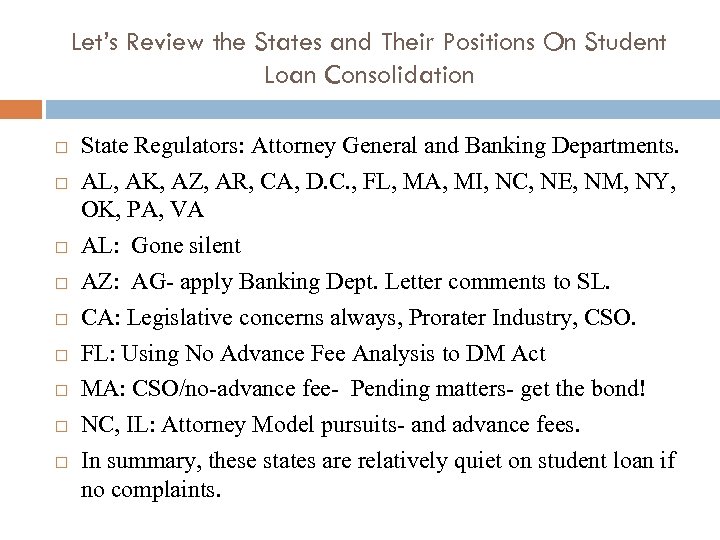 Let’s Review the States and Their Positions On Student Loan Consolidation State Regulators: Attorney General and Banking Departments. AL, AK, AZ, AR, CA, D. C. , FL, MA, MI, NC, NE, NM, NY, OK, PA, VA AL: Gone silent AZ: AG- apply Banking Dept. Letter comments to SL. CA: Legislative concerns always, Prorater Industry, CSO. FL: Using No Advance Fee Analysis to DM Act MA: CSO/no-advance fee- Pending matters- get the bond! NC, IL: Attorney Model pursuits- and advance fees. In summary, these states are relatively quiet on student loan if no complaints.
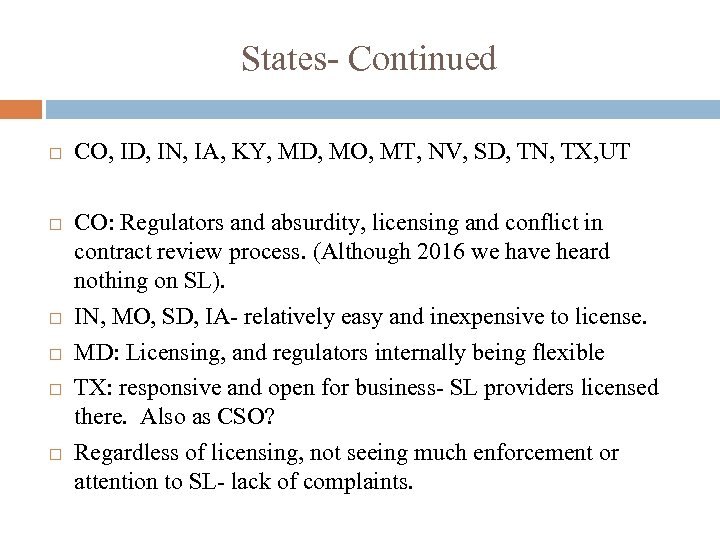 States- Continued CO, ID, IN, IA, KY, MD, MO, MT, NV, SD, TN, TX, UT CO: Regulators and absurdity, licensing and conflict in contract review process. (Although 2016 we have heard nothing on SL). IN, MO, SD, IA- relatively easy and inexpensive to license. MD: Licensing, and regulators internally being flexible TX: responsive and open for business- SL providers licensed there. Also as CSO? Regardless of licensing, not seeing much enforcement or attention to SL- lack of complaints.
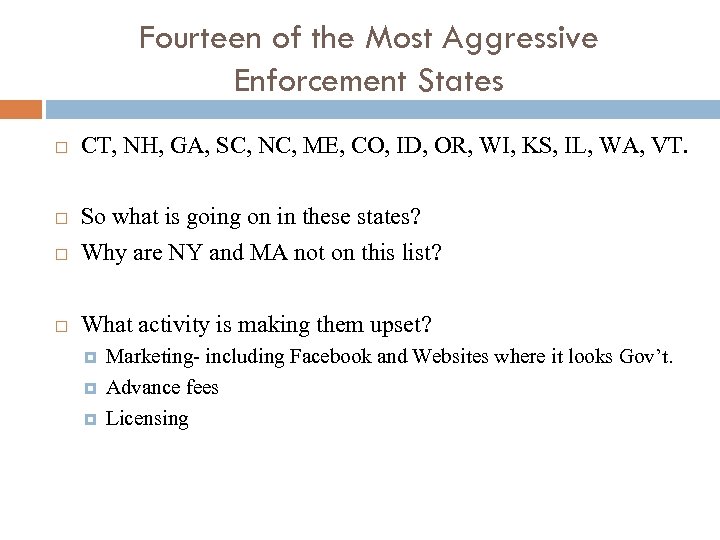 Fourteen of the Most Aggressive Enforcement States CT, NH, GA, SC, NC, ME, CO, ID, OR, WI, KS, IL, WA, VT. So what is going on in these states? Why are NY and MA not on this list? What activity is making them upset? Marketing- including Facebook and Websites where it looks Gov’t. Advance fees Licensing
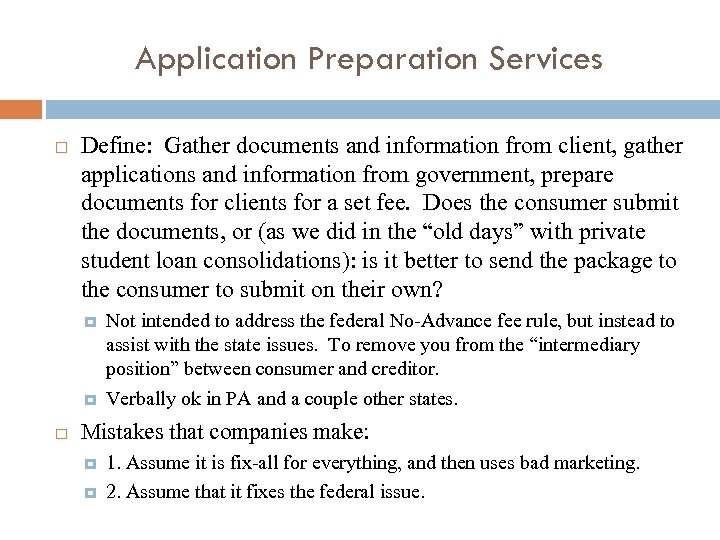 Application Preparation Services Define: Gather documents and information from client, gather applications and information from government, prepare documents for clients for a set fee. Does the consumer submit the documents, or (as we did in the “old days” with private student loan consolidations): is it better to send the package to the consumer to submit on their own? Not intended to address the federal No-Advance fee rule, but instead to assist with the state issues. To remove you from the “intermediary position” between consumer and creditor. Verbally ok in PA and a couple other states. Mistakes that companies make: 1. Assume it is fix-all for everything, and then uses bad marketing. 2. Assume that it fixes the federal issue.
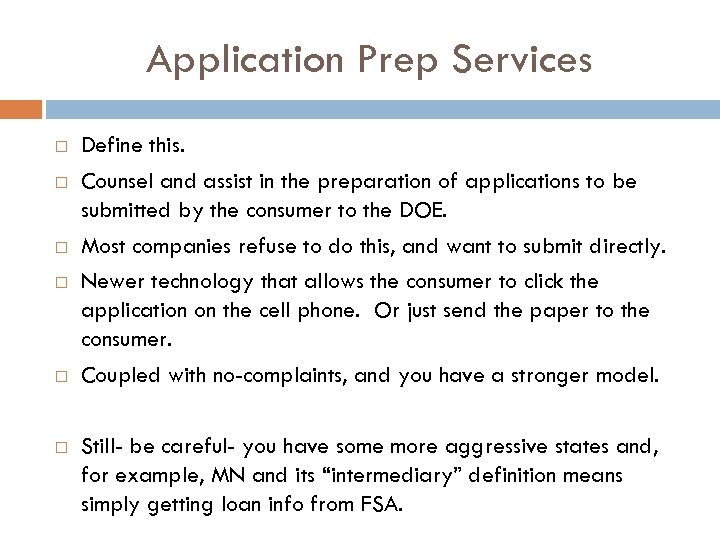 Application Prep Services Define this. Counsel and assist in the preparation of applications to be submitted by the consumer to the DOE. Most companies refuse to do this, and want to submit directly. Newer technology that allows the consumer to click the application on the cell phone. Or just send the paper to the consumer. Coupled with no-complaints, and you have a stronger model. Still- be careful- you have some more aggressive states and, for example, MN and its “intermediary” definition means simply getting loan info from FSA.
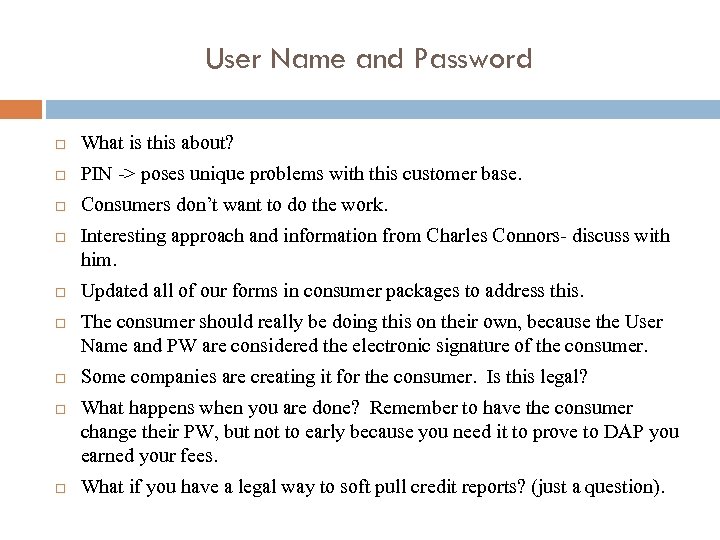 User Name and Password What is this about? PIN -> poses unique problems with this customer base. Consumers don’t want to do the work. Interesting approach and information from Charles Connors- discuss with him. Updated all of our forms in consumer packages to address this. The consumer should really be doing this on their own, because the User Name and PW are considered the electronic signature of the consumer. Some companies are creating it for the consumer. Is this legal? What happens when you are done? Remember to have the consumer change their PW, but not to early because you need it to prove to DAP you earned your fees. What if you have a legal way to soft pull credit reports? (just a question).
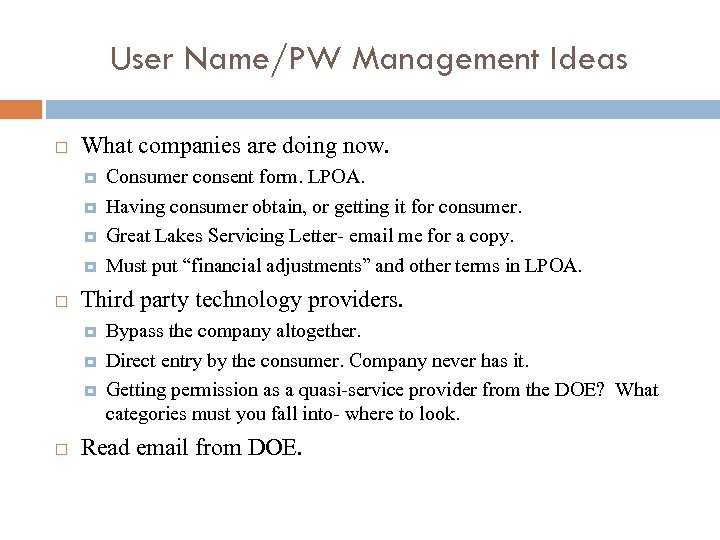 User Name/PW Management Ideas What companies are doing now. Third party technology providers. Consumer consent form. LPOA. Having consumer obtain, or getting it for consumer. Great Lakes Servicing Letter- email me for a copy. Must put “financial adjustments” and other terms in LPOA. Bypass the company altogether. Direct entry by the consumer. Company never has it. Getting permission as a quasi-service provider from the DOE? What categories must you fall into- where to look. Read email from DOE.
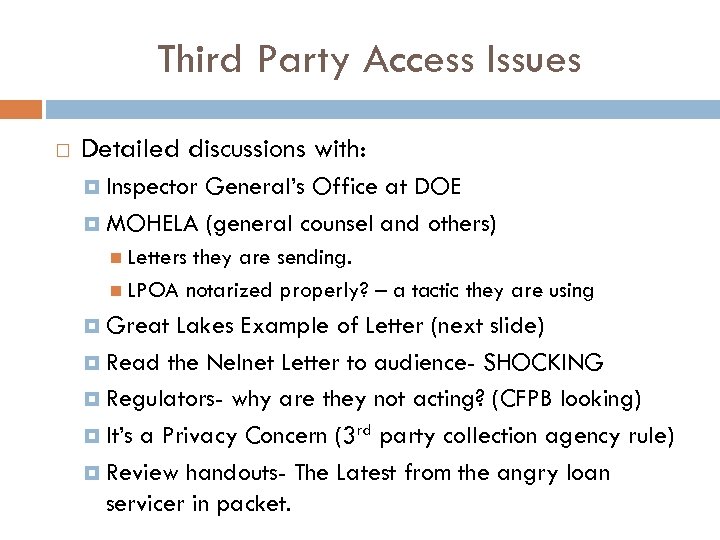 Third Party Access Issues Detailed discussions with: Inspector General’s Office at DOE MOHELA (general counsel and others) Letters they are sending. LPOA notarized properly? – a tactic they are using Great Lakes Example of Letter (next slide) Read the Nelnet Letter to audience- SHOCKING Regulators- why are they not acting? (CFPB looking) It’s a Privacy Concern (3 rd party collection agency rule) Review handouts- The Latest from the angry loan servicer in packet.
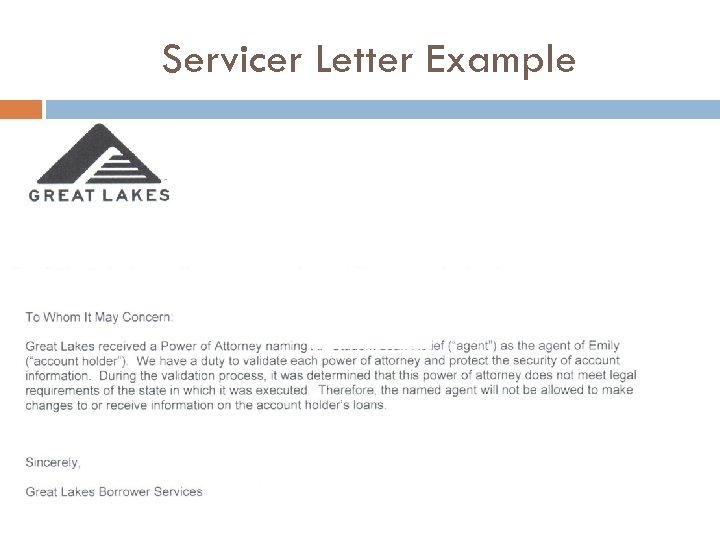 Servicer Letter Example
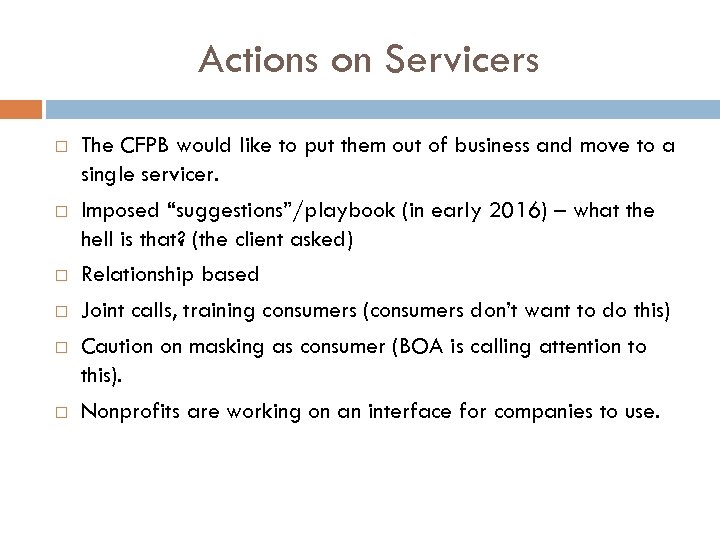 Actions on Servicers The CFPB would like to put them out of business and move to a single servicer. Imposed “suggestions”/playbook (in early 2016) – what the hell is that? (the client asked) Relationship based Joint calls, training consumers (consumers don’t want to do this) Caution on masking as consumer (BOA is calling attention to this). Nonprofits are working on an interface for companies to use.
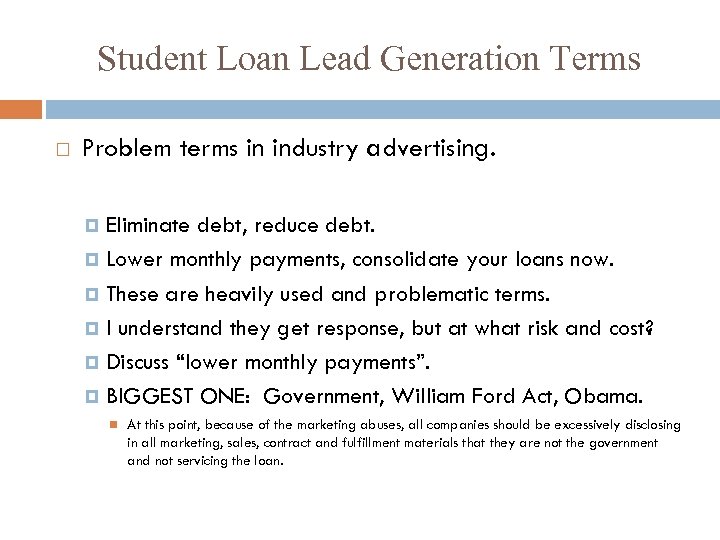 Student Loan Lead Generation Terms Problem terms in industry advertising. Eliminate debt, reduce debt. Lower monthly payments, consolidate your loans now. These are heavily used and problematic terms. I understand they get response, but at what risk and cost? Discuss “lower monthly payments”. BIGGEST ONE: Government, William Ford Act, Obama. At this point, because of the marketing abuses, all companies should be excessively disclosing in all marketing, sales, contract and fulfillment materials that they are not the government and not servicing the loan.
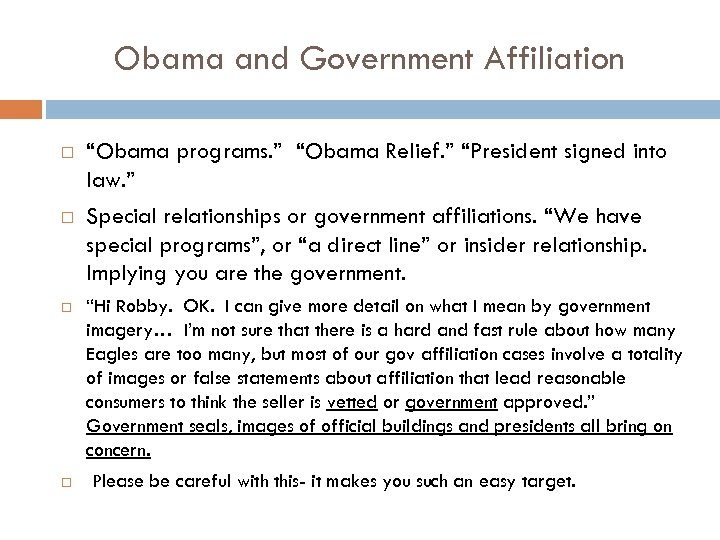 Obama and Government Affiliation “Obama programs. ” “Obama Relief. ” “President signed into law. ” Special relationships or government affiliations. “We have special programs”, or “a direct line” or insider relationship. Implying you are the government. “Hi Robby. OK. I can give more detail on what I mean by government imagery… I’m not sure that there is a hard and fast rule about how many Eagles are too many, but most of our gov affiliation cases involve a totality of images or false statements about affiliation that lead reasonable consumers to think the seller is vetted or government approved. ” Government seals, images of official buildings and presidents all bring on concern. Please be careful with this- it makes you such an easy target.
 Meeting with FTC- June 2016 Dallas office Assuming compliance with applicable laws, they want a 1 page simple form presented to every customer on the top of every package. Something else to understand like bullet points. Stating all of the risks and potential downsides. The consumer should know all the risks since the salespeople only tell them the positives. Interesting thought- could this be a potential safety net? Can’t be used to allow reps to misrepresent or contradict what it says, but if done properly will knock out many concerns.
 Servicer Updates Great Lakes Audit on 3 rd party consolidations is an audit on potentially “fraudulent information release” consent forms. The form that the consumer signs to give 3 rd party permission to call in for updates on their account. Great Lakes accepts a docusigned version. Companies are using the consumer’s USER NAME AND PW on their own instead of having the consumer do it. More advances to required information releases from servicers including 3 way calls with consumers. Privacy concerns or is it a money concern?
 Servicer Updates Call with MOHELA General Counsel Significant concerns about privacy concerns He can’t allow his staff to speak with third parties unless a reason such as overseas military Very concerned about protecting the consumer from identity theft, fraud. Had inquiries from CFPB and others Will continue to challenge POA’s and related
 Better Business Bureau A fixation on Access (FSA ID) issues coming from West Coast BBB offices. Letters inquiring about how and if company is using the SL ID. Responded to 5 of these inquiries so far for companies. Company must be able to show a process in place whereby company doesn’t access it, instead a consumer-tech login. Something to show company is not logging in for consumer. BBB is presently fixated on credit repair companies. Challenging time with accreditation category. Have moved a number of companies to “A’s”.
 NCLC to DOE/CFPB Servicer issues: Communicating with third parties. Requiring the term “financial adjustments” in the LPOA (as of April) March 2014 letter NCLC to DOE/CFPB: For-Profit Debt Relief Companies. The National Consumer Law Center released a report last year focusing on abuses in the for-profit student loan “debt relief” industry. New York Governor Cuomo’s new Student Protection Unit recently announced that it had sent subpoenas to thirteen of these “relief” companies. We found that the only “service” most of these companies perform, if they perform any service at all, is processing government loan consolidation applications on behalf of borrowers. This appears to be yet another area of potential abuse if these companies seek compensation to steer borrowers to particular servicers. Our investigation found that these companies generally do not provide reliable information to consumers. Therefore it would not be surprising if they selected servicers on behalf of borrowers without informing the borrowers about their right to choose servicers. Most of these companies seek powers of attorney to act on behalf of borrowers. This is total B. S. http: //www. studentloanborrowerassistance. org/wpcontent/uploads/2014/03/letter-consolidation-cfpb-march 2014. pdf Look at the author and what she is trying to do, and her history.
 Optional Services and Reoccurring Monthly Fees Revenue Generation- continuity programs Can’t include any portion of the SL work in the monthly. Put all SL work in base fee. No “gatekeeper sales”. Consumer must not be required to buy 1 to get the other. Must be truly optional. The monthly fee or other program must be independent & substantive services. Must be provided by an independent provider (not the SL company). Rep must disclose that the consumer may obtain the services elsewhere and should shop around. (like a RESPA disclosure). Substance, savings, real fees associated with value. Terms, disclosure of when they will be billed, how to cancel. IL AG v. Broadsword- can’t be used to price around FTC rule Tax and IUI examples. Riskier options: high cost consumer “educational” kits
 TCPA and DNC Hottest issue in 2016. FCC Since 2013: Dialer to Cell and Dialer to Text Message Must have written permission of the consumer including Consent to Receive Autodialed Calls to the Number Provided (by the consumer. ) Consent does not require purchase. DNC Scrub All Calls Internal DNC List and the “parent” must absorb all affiliates DNC requests and share with all other affiliates There is no such thing as an Opt-In Lead unless you have the consumer’s request to be contacted directly to your company by name and you maintain the IP Address and Date/Time Stamp, along with the original lead generation source info.
 BSA- something to be aware of. The Software Alliance Licenses on all of your software. Contacting disgruntled employees and monitoring your software. Big name law firms taking these cases on contingency. Make sure you have (or get) all of your purchase receipts for your software, and the licenses. (applies to second hand computers also).
 Professional Liability Insurance URGENT AND IMPORTANT E&O and D&O Insurance Only a few brokers are familiar, most will mess up the exclusions in the policy. Ask about “coverage for defense costs. ” None will pay for unlawful activity. Explain distinctions. Important to get the business definition correct. TCPA coverage. Price ranges. Email me for info! robby. birnbaum@gmlaw. com
 Association For Student Loan Relief Presented by: Robby H. Birnbaum, Esq (954) 343. 6959 (direct) Robby. Birnbaum@gmlaw. com