 Скачать презентацию Complexity Theory in Biological and Social Systems George
f7c73ceb47cf35233f4a48c68073ff88.ppt
- Количество слайдов: 48



Complexity Theory in Biological and Social Systems George Kampis Basler Chair, ETSU 2007 Spring
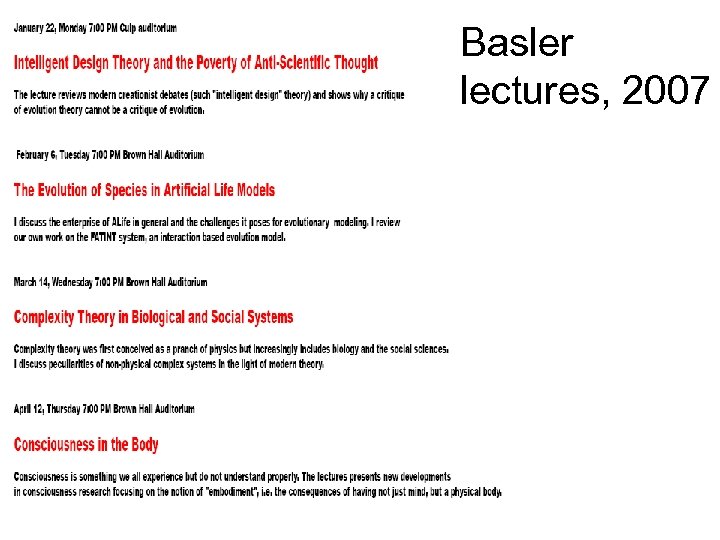
Basler lectures, 2007
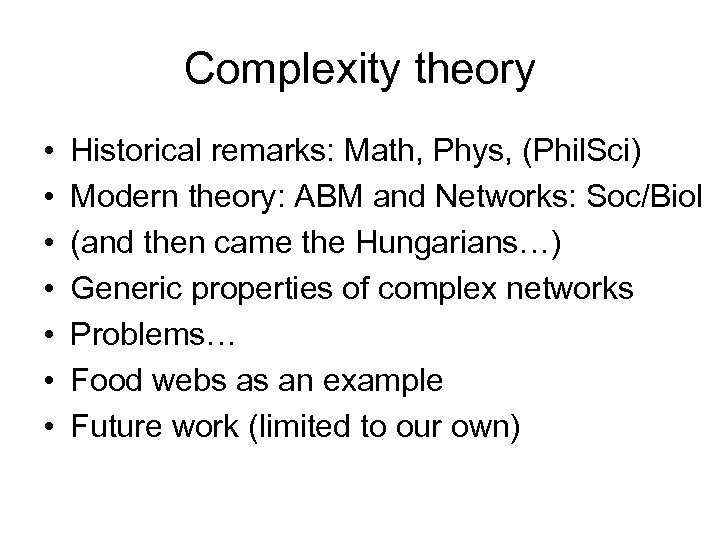
Complexity theory • • Historical remarks: Math, Phys, (Phil. Sci) Modern theory: ABM and Networks: Soc/Biol (and then came the Hungarians…) Generic properties of complex networks Problems… Food webs as an example Future work (limited to our own)
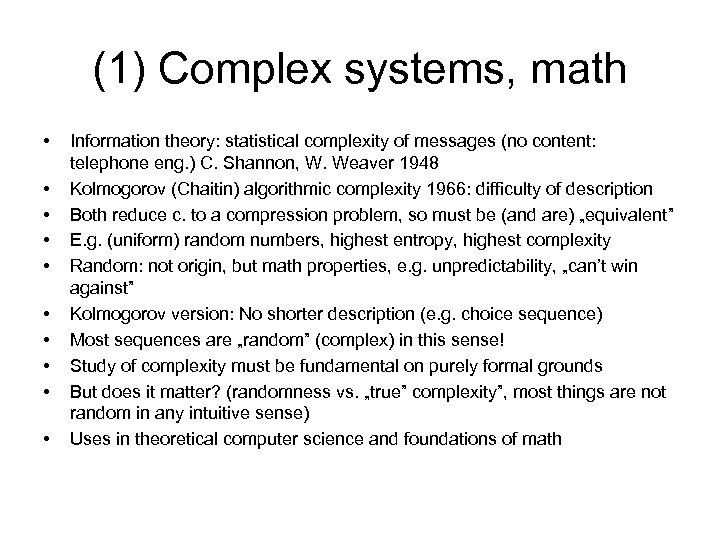
(1) Complex systems, math • • • Information theory: statistical complexity of messages (no content: telephone eng. ) C. Shannon, W. Weaver 1948 Kolmogorov (Chaitin) algorithmic complexity 1966: difficulty of description Both reduce c. to a compression problem, so must be (and are) „equivalent” E. g. (uniform) random numbers, highest entropy, highest complexity Random: not origin, but math properties, e. g. unpredictability, „can’t win against” Kolmogorov version: No shorter description (e. g. choice sequence) Most sequences are „random” (complex) in this sense! Study of complexity must be fundamental on purely formal grounds But does it matter? (randomness vs. „true” complexity”, most things are not random in any intuitive sense) Uses in theoretical computer science and foundations of math
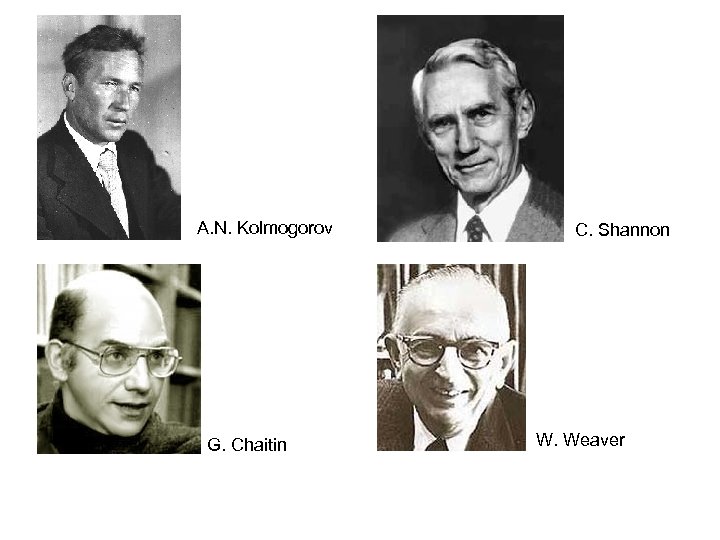
A. N. Kolmogorov G. Chaitin C. Shannon W. Weaver

Complexity and simplicity • Mandelbrot set: a very complex object • e. g. infinite zoom, infinite details • But, a simple algorithm… • Then, simple or complex? • Preservation of complexity from initial conditions
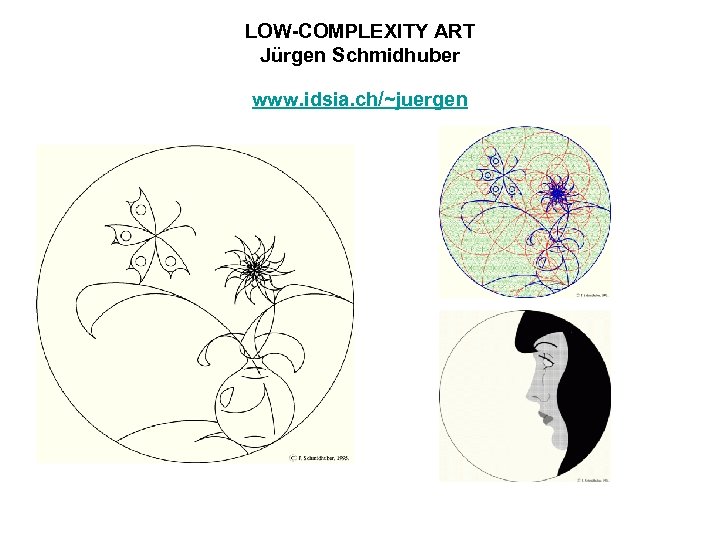
LOW-COMPLEXITY ART Jürgen Schmidhuber www. idsia. ch/~juergen
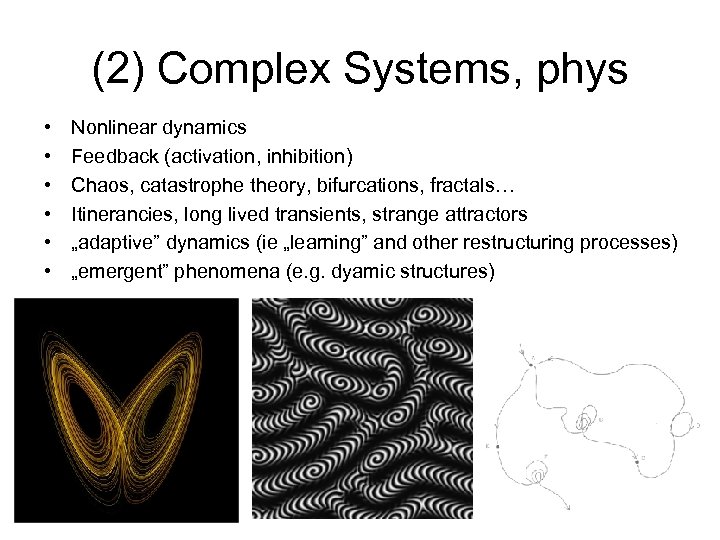
(2) Complex Systems, phys • • • Nonlinear dynamics Feedback (activation, inhibition) Chaos, catastrophe theory, bifurcations, fractals… Itinerancies, long lived transients, strange attractors „adaptive” dynamics (ie „learning” and other restructuring processes) „emergent” phenomena (e. g. dyamic structures)
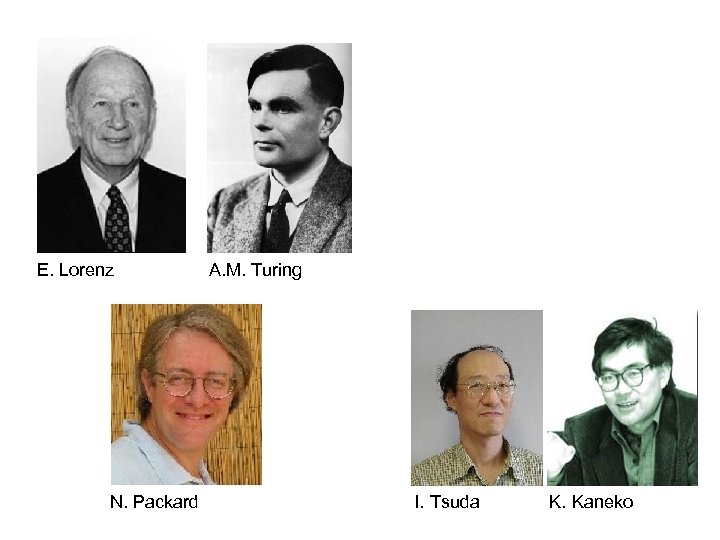
E. Lorenz N. Packard A. M. Turing I. Tsuda K. Kaneko
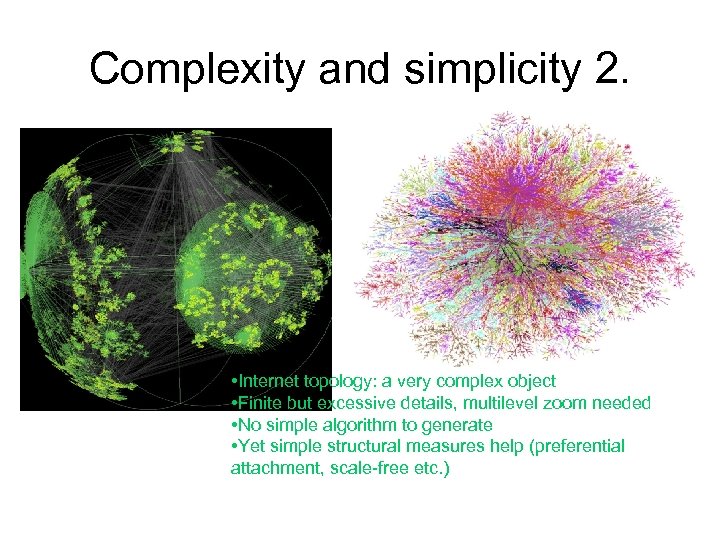
Complexity and simplicity 2. • Internet topology: a very complex object • Finite but excessive details, multilevel zoom needed • No simple algorithm to generate • Yet simple structural measures help (preferential attachment, scale-free etc. )
Common features of complex systems • • • Unpredictability (but let’s be precise about this!) Counter-intuitive nature (possible limits of understanding? ) Complicated behaviours, complex spatio-temporal phenomena Non-generalizability of behavior (details matter) Necessity of different approaches („complexity is complex”)
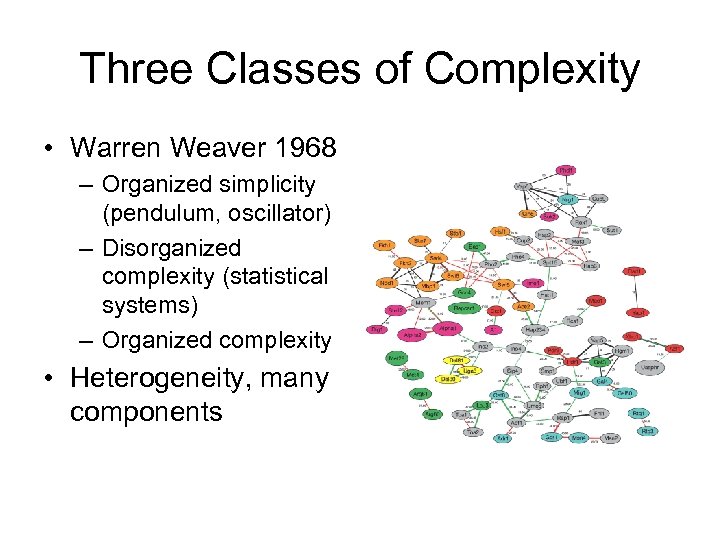
Three Classes of Complexity • Warren Weaver 1968 – Organized simplicity (pendulum, oscillator) – Disorganized complexity (statistical systems) – Organized complexity • Heterogeneity, many components
(3) Complex Systems, Biol/Soc • Weaver class 3 systems • Approaches: – Local: simulation (no analitic model may exist), ABM (upshot from 1. ) – Global: network theory (upshot from 2. )
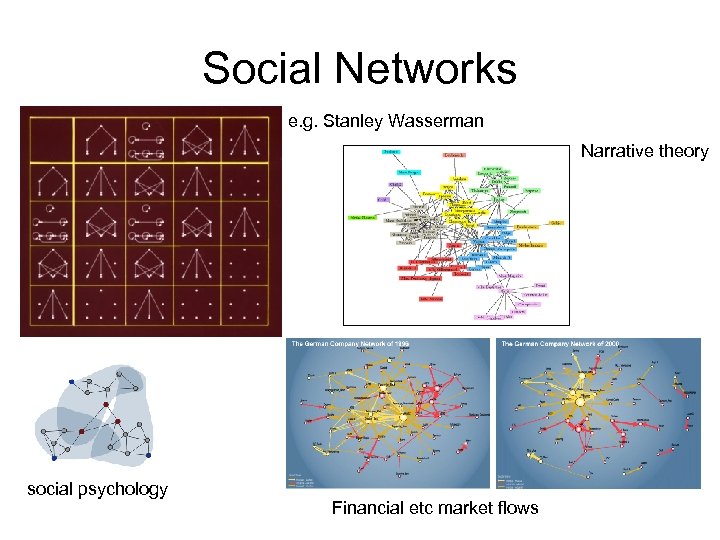
Social Networks e. g. Stanley Wasserman Narrative theory social psychology Financial etc market flows
Networks. A Hungarian Phenomenon Okay, who is this? Easy, and completely unrelated.
Networks. A Hungarian Phenomenon Okay, who is this?
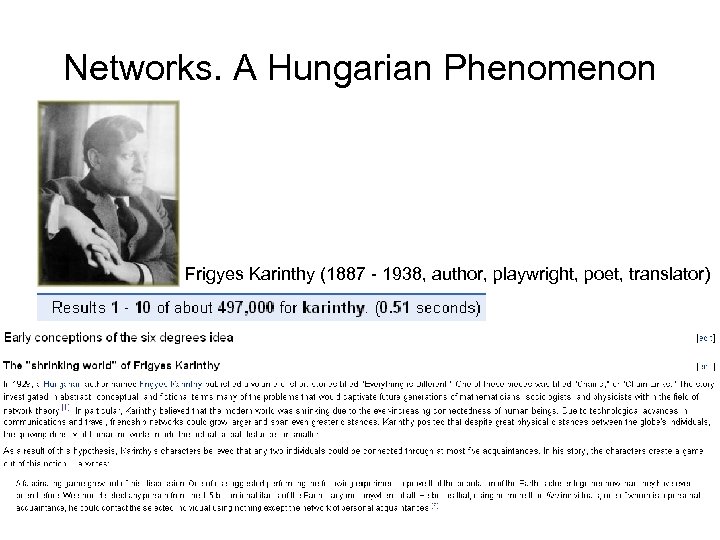
Networks. A Hungarian Phenomenon Frigyes Karinthy (1887 - 1938, author, playwright, poet, translator)
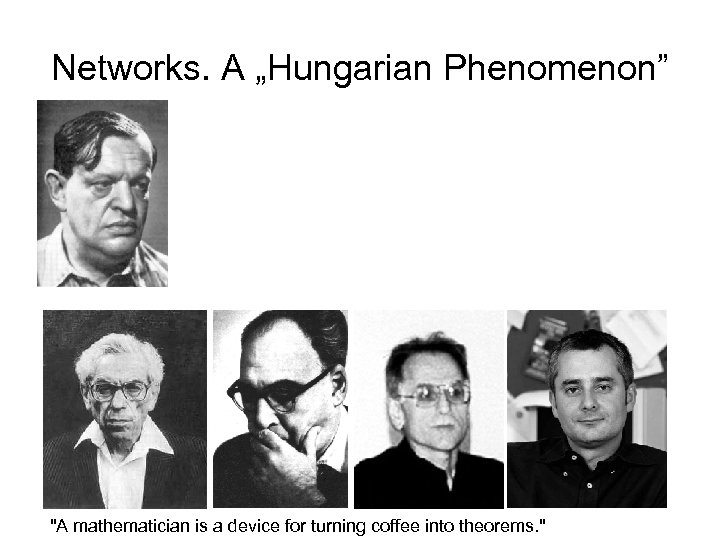
Networks. A „Hungarian Phenomenon” "A mathematician is a device for turning coffee into theorems. "
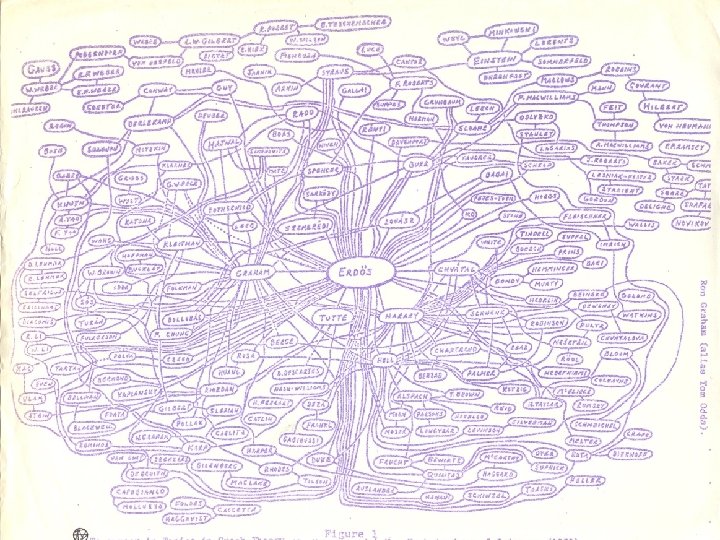
Erdős number project • • Erdős EN=0, co-author EN=1, co-author-of-coauthor EN=2 etc. http: //www. oakland. edu/enp/ Kevin Bacon numbers: http: //oracleofbacon. org/ „In fact, according to the Oracle of Bacon site, Paul Erdös himself has an official Bacon number of 4, by virtue of the N is a Number (a documentary about him), and lots of other mathematicians have finite Bacon number through this film. ” (CAVEAT: bogus? ) • Citation networks, friendship networks, sex, …
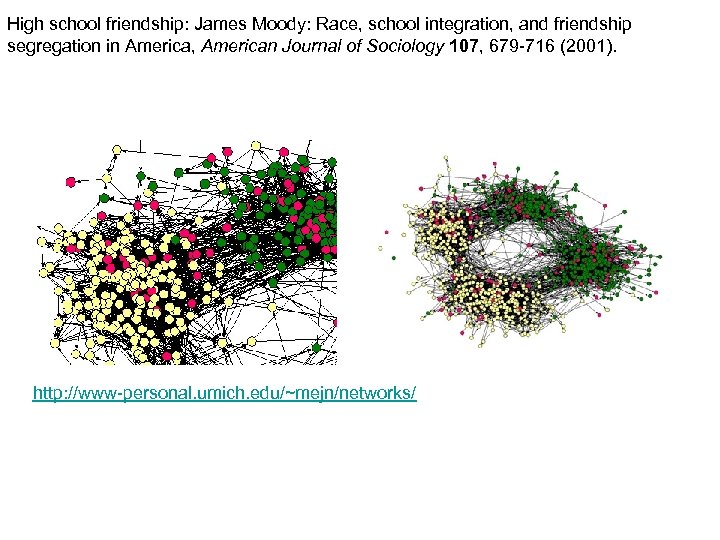
High school friendship: James Moody: Race, school integration, and friendship segregation in America, American Journal of Sociology 107, 679 -716 (2001). http: //www-personal. umich. edu/~mejn/networks/
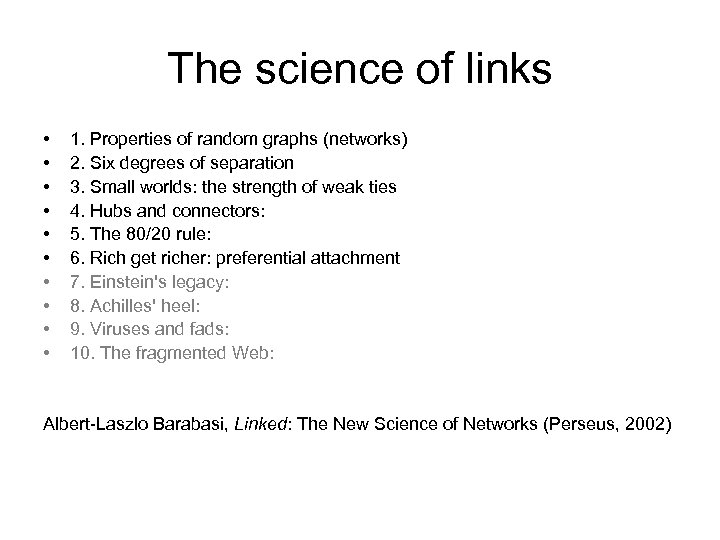
The science of links • • • 1. Properties of random graphs (networks) 2. Six degrees of separation 3. Small worlds: the strength of weak ties 4. Hubs and connectors: 5. The 80/20 rule: 6. Rich get richer: preferential attachment 7. Einstein's legacy: 8. Achilles' heel: 9. Viruses and fads: 10. The fragmented Web: Albert-Laszlo Barabasi, Linked: The New Science of Networks (Perseus, 2002)
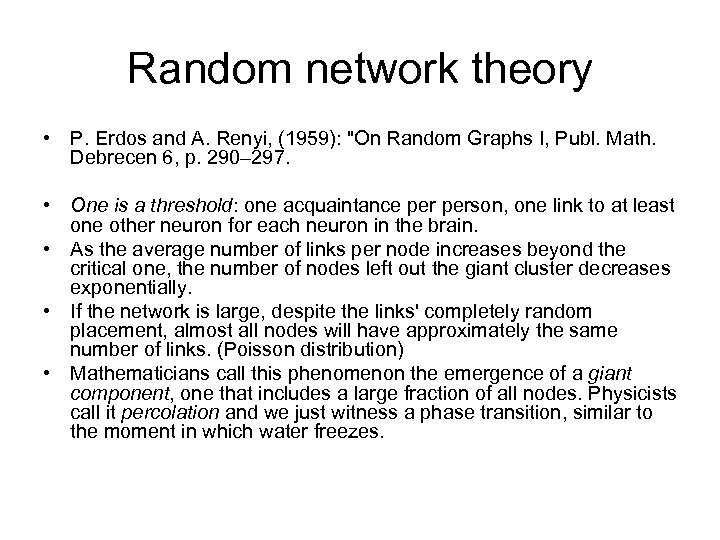
Random network theory • P. Erdos and A. Renyi, (1959): "On Random Graphs I, Publ. Math. Debrecen 6, p. 290– 297. • One is a threshold: one acquaintance person, one link to at least one other neuron for each neuron in the brain. • As the average number of links per node increases beyond the critical one, the number of nodes left out the giant cluster decreases exponentially. • If the network is large, despite the links' completely random placement, almost all nodes will have approximately the same number of links. (Poisson distribution) • Mathematicians call this phenomenon the emergence of a giant component, one that includes a large fraction of all nodes. Physicists call it percolation and we just witness a phase transition, similar to the moment in which water freezes.
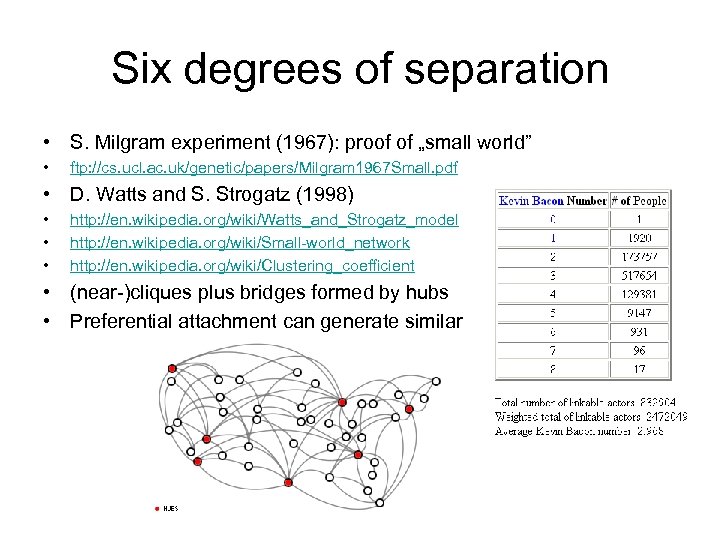
Six degrees of separation • S. Milgram experiment (1967): proof of „small world” • ftp: //cs. ucl. ac. uk/genetic/papers/Milgram 1967 Small. pdf • D. Watts and S. Strogatz (1998) • • • http: //en. wikipedia. org/wiki/Watts_and_Strogatz_model http: //en. wikipedia. org/wiki/Small-world_network http: //en. wikipedia. org/wiki/Clustering_coefficient • (near-)cliques plus bridges formed by hubs • Preferential attachment can generate similar
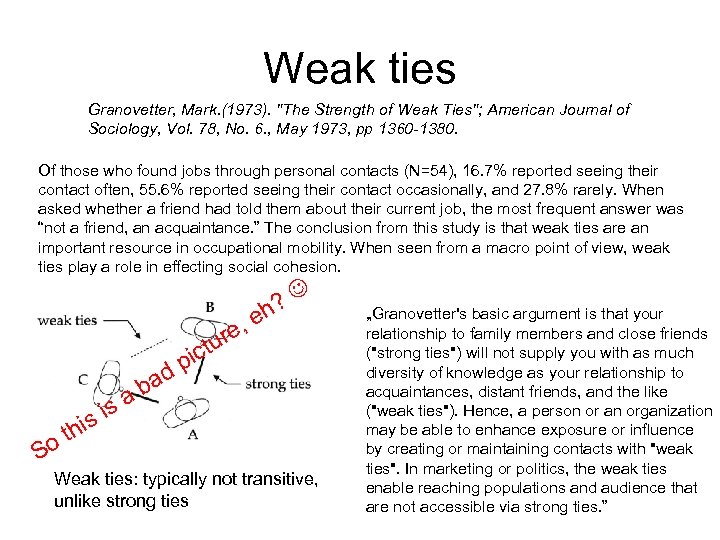
Weak ties Granovetter, Mark. (1973). "The Strength of Weak Ties"; American Journal of Sociology, Vol. 78, No. 6. , May 1973, pp 1360 -1380. Of those who found jobs through personal contacts (N=54), 16. 7% reported seeing their contact often, 55. 6% reported seeing their contact occasionally, and 27. 8% rarely. When asked whether a friend had told them about their current job, the most frequent answer was “not a friend, an acquaintance. ” The conclusion from this study is that weak ties are an important resource in occupational mobility. When seen from a macro point of view, weak ties play a role in effecting social cohesion. ure ct ? h , e pi d So i is th s ba a Weak ties: typically not transitive, unlike strong ties „Granovetter's basic argument is that your relationship to family members and close friends ("strong ties") will not supply you with as much diversity of knowledge as your relationship to acquaintances, distant friends, and the like ("weak ties"). Hence, a person or an organization may be able to enhance exposure or influence by creating or maintaining contacts with "weak ties". In marketing or politics, the weak ties enable reaching populations and audience that are not accessible via strong ties. ”
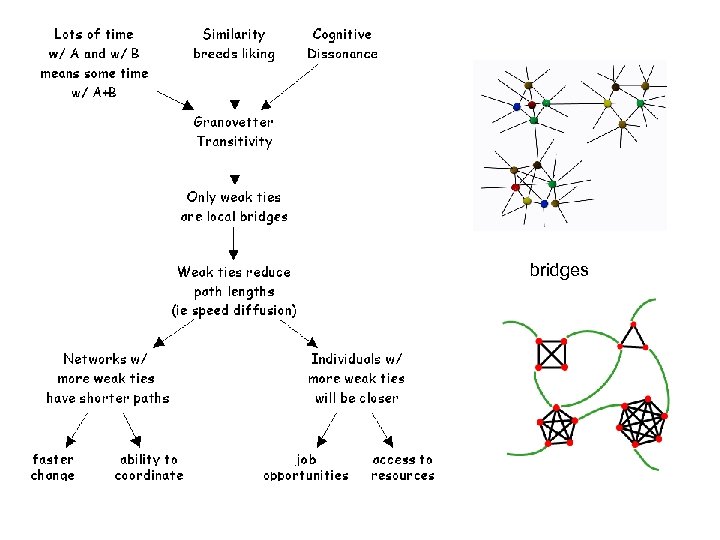
bridges
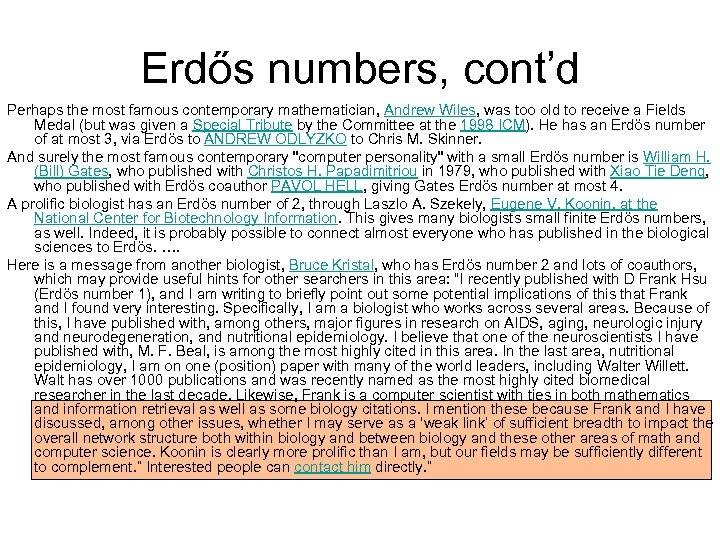
Erdős numbers, cont’d Perhaps the most famous contemporary mathematician, Andrew Wiles, was too old to receive a Fields Medal (but was given a Special Tribute by the Committee at the 1998 ICM). He has an Erdös number of at most 3, via Erdös to ANDREW ODLYZKO to Chris M. Skinner. And surely the most famous contemporary "computer personality" with a small Erdös number is William H. (Bill) Gates, who published with Christos H. Papadimitriou in 1979, who published with Xiao Tie Deng, who published with Erdös coauthor PAVOL HELL, giving Gates Erdös number at most 4. A prolific biologist has an Erdös number of 2, through Laszlo A. Szekely, Eugene V. Koonin, at the National Center for Biotechnology Information. This gives many biologists small finite Erdös numbers, as well. Indeed, it is probably possible to connect almost everyone who has published in the biological sciences to Erdös. …. Here is a message from another biologist, Bruce Kristal, who has Erdös number 2 and lots of coauthors, which may provide useful hints for other searchers in this area: “I recently published with D Frank Hsu (Erdös number 1), and I am writing to briefly point out some potential implications of this that Frank and I found very interesting. Specifically, I am a biologist who works across several areas. Because of this, I have published with, among others, major figures in research on AIDS, aging, neurologic injury and neurodegeneration, and nutritional epidemiology. I believe that one of the neuroscientists I have published with, M. F. Beal, is among the most highly cited in this area. In the last area, nutritional epidemiology, I am on one (position) paper with many of the world leaders, including Walter Willett. Walt has over 1000 publications and was recently named as the most highly cited biomedical researcher in the last decade. Likewise, Frank is a computer scientist with ties in both mathematics and information retrieval as well as some biology citations. I mention these because Frank and I have discussed, among other issues, whether I may serve as a ‘weak link’ of sufficient breadth to impact the overall network structure both within biology and between biology and these other areas of math and computer science. Koonin is clearly more prolific than I am, but our fields may be sufficiently different to complement. ” Interested people can contact him directly. ”
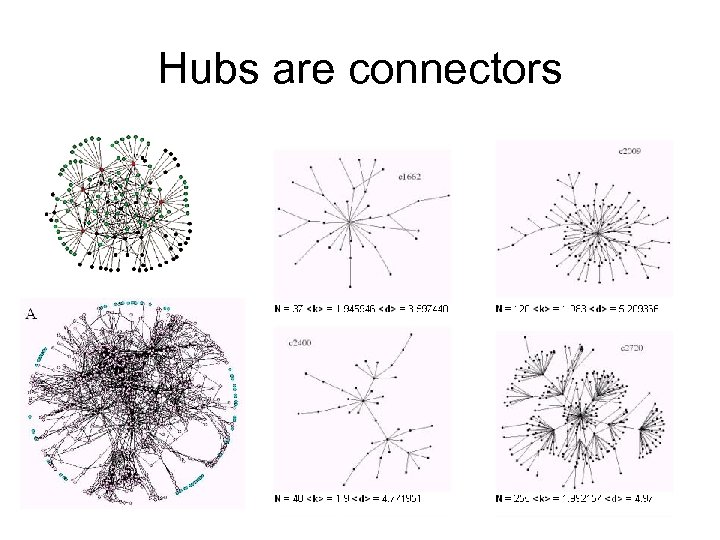
Hubs are connectors
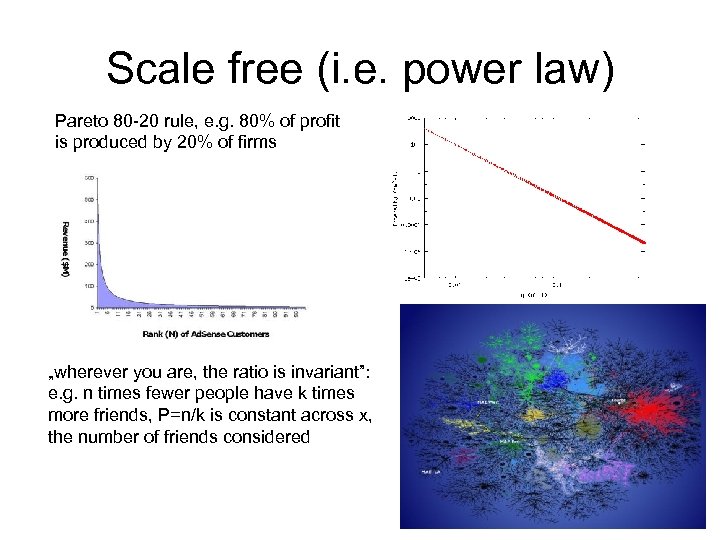
Scale free (i. e. power law) Pareto 80 -20 rule, e. g. 80% of profit is produced by 20% of firms „wherever you are, the ratio is invariant”: e. g. n times fewer people have k times more friends, P=n/k is constant across x, the number of friends considered
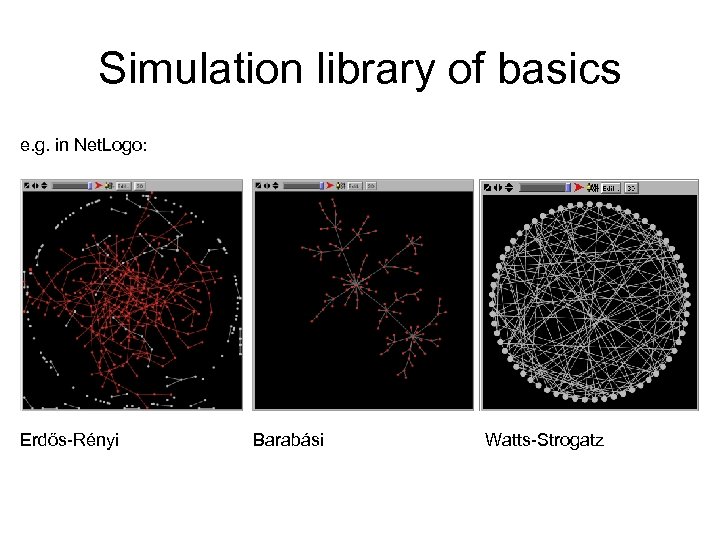
Simulation library of basics e. g. in Net. Logo: Erdős-Rényi Barabási Watts-Strogatz
Topics in network theory • • Fault tolerance and resilience Topological transitions (e. g. scale free - star) Modularity versus globality Evolvability Network optimization (a combination of these) Self-healing… etc. …
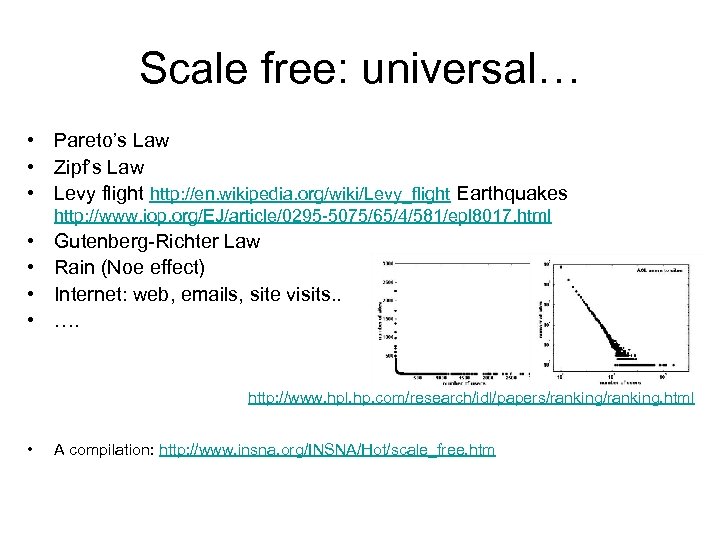
Scale free: universal… • Pareto’s Law • Zipf’s Law • Levy flight http: //en. wikipedia. org/wiki/Levy_flight Earthquakes http: //www. iop. org/EJ/article/0295 -5075/65/4/581/epl 8017. html • • Gutenberg-Richter Law Rain (Noe effect) Internet: web, emails, site visits. . …. http: //www. hpl. hp. com/research/idl/papers/ranking. html • A compilation: http: //www. insna. org/INSNA/Hot/scale_free. htm
Power and weakness of scale free • Scale-free networks are extremely tolerant of random failures. In a random network, a small number of random failures can collapse the network. A scalefree network can absorb random failures up to 80% of its nodes before it collapses. The reason for this is the inhomogeneity of the nodes on the network - failures are much more likely to occur on relatively small nodes. • • Scale-free networks are extremely vulnerable to attacks on their hubs. Scale-free networks are extremely vulnerable to epidemics. Same is true for purely random networks (Erdős-Rényi networks)
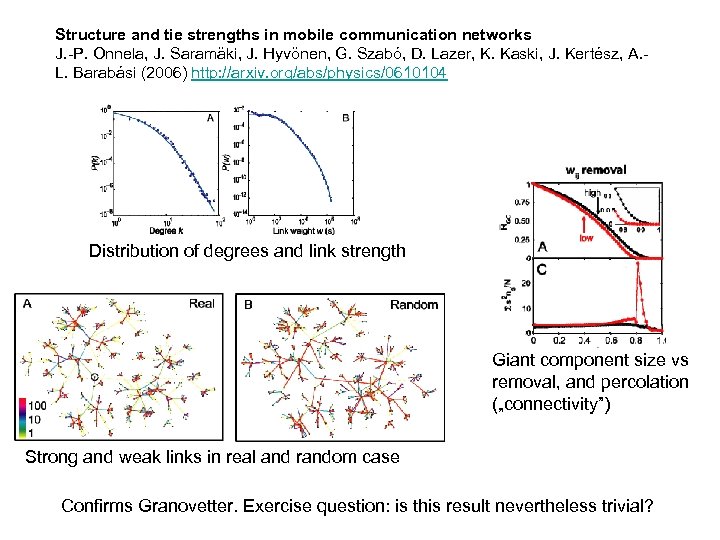
Structure and tie strengths in mobile communication networks J. -P. Onnela, J. Saramäki, J. Hyvönen, G. Szabó, D. Lazer, K. Kaski, J. Kertész, A. L. Barabási (2006) http: //arxiv. org/abs/physics/0610104 Distribution of degrees and link strength Giant component size vs removal, and percolation („connectivity”) Strong and weak links in real and random case Confirms Granovetter. Exercise question: is this result nevertheless trivial?
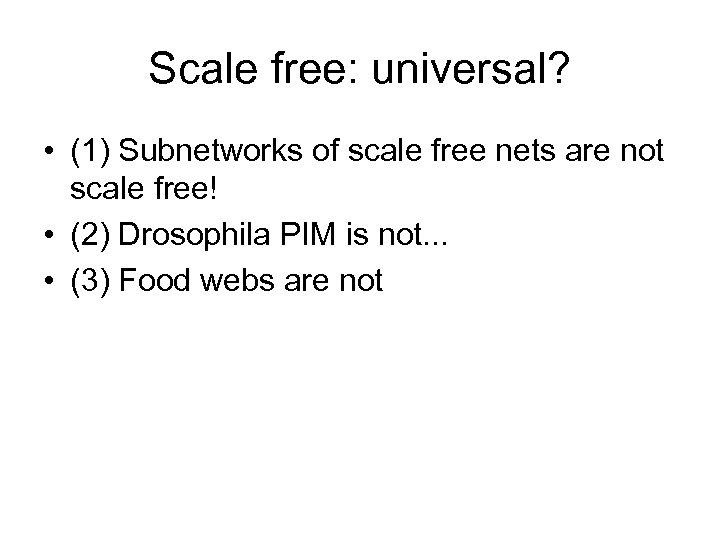
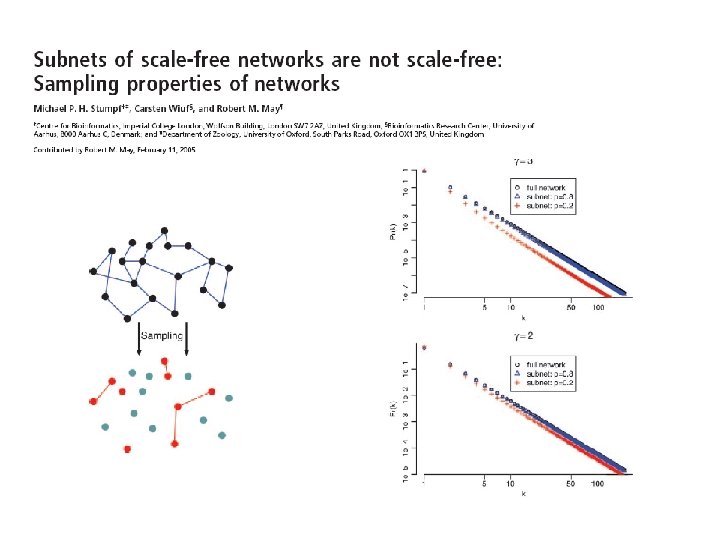
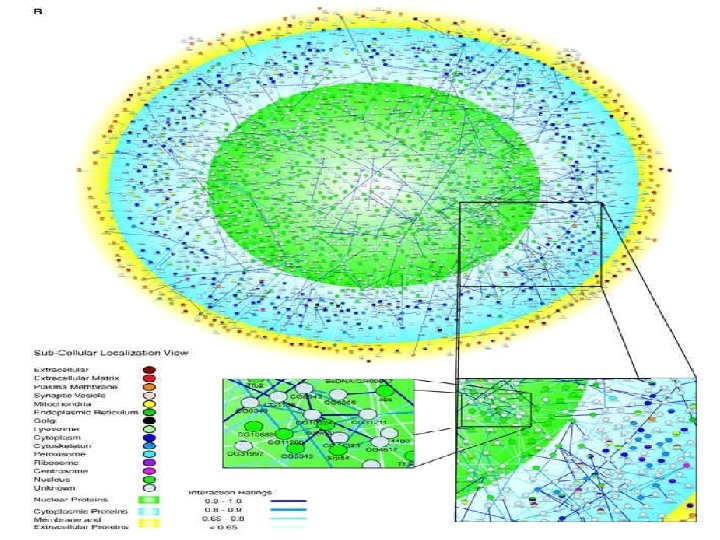
Scale free: universal? • (1) Subnetworks of scale free nets are not scale free! • (2) Drosophila PIM is not. . . • (3) Food webs are not
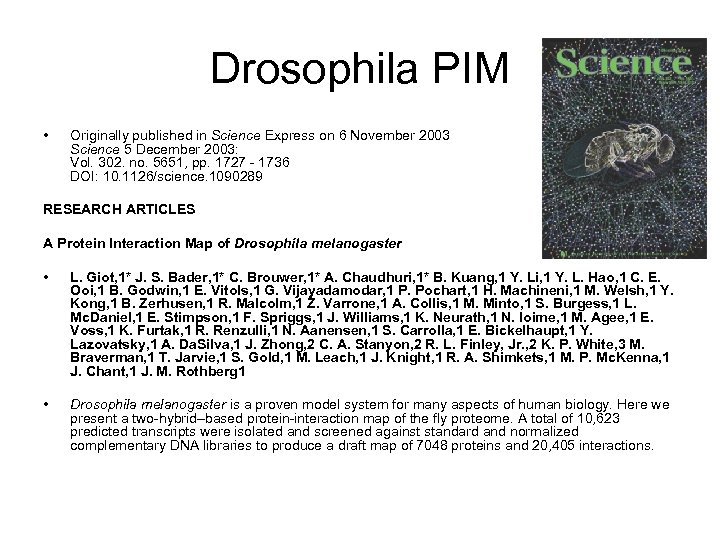
Drosophila PIM • Originally published in Science Express on 6 November 2003 Science 5 December 2003: Vol. 302. no. 5651, pp. 1727 - 1736 DOI: 10. 1126/science. 1090289 RESEARCH ARTICLES A Protein Interaction Map of Drosophila melanogaster • L. Giot, 1* J. S. Bader, 1* C. Brouwer, 1* A. Chaudhuri, 1* B. Kuang, 1 Y. Li, 1 Y. L. Hao, 1 C. E. Ooi, 1 B. Godwin, 1 E. Vitols, 1 G. Vijayadamodar, 1 P. Pochart, 1 H. Machineni, 1 M. Welsh, 1 Y. Kong, 1 B. Zerhusen, 1 R. Malcolm, 1 Z. Varrone, 1 A. Collis, 1 M. Minto, 1 S. Burgess, 1 L. Mc. Daniel, 1 E. Stimpson, 1 F. Spriggs, 1 J. Williams, 1 K. Neurath, 1 N. Ioime, 1 M. Agee, 1 E. Voss, 1 K. Furtak, 1 R. Renzulli, 1 N. Aanensen, 1 S. Carrolla, 1 E. Bickelhaupt, 1 Y. Lazovatsky, 1 A. Da. Silva, 1 J. Zhong, 2 C. A. Stanyon, 2 R. L. Finley, Jr. , 2 K. P. White, 3 M. Braverman, 1 T. Jarvie, 1 S. Gold, 1 M. Leach, 1 J. Knight, 1 R. A. Shimkets, 1 M. P. Mc. Kenna, 1 J. Chant, 1 J. M. Rothberg 1 • Drosophila melanogaster is a proven model system for many aspects of human biology. Here we present a two-hybrid–based protein-interaction map of the fly proteome. A total of 10, 623 predicted transcripts were isolated and screened against standard and normalized complementary DNA libraries to produce a draft map of 7048 proteins and 20, 405 interactions.
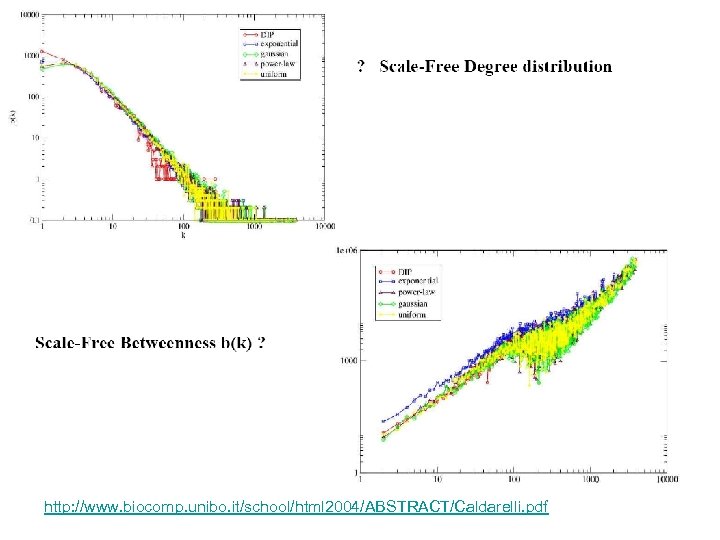
http: //www. biocomp. unibo. it/school/html 2004/ABSTRACT/Caldarelli. pdf
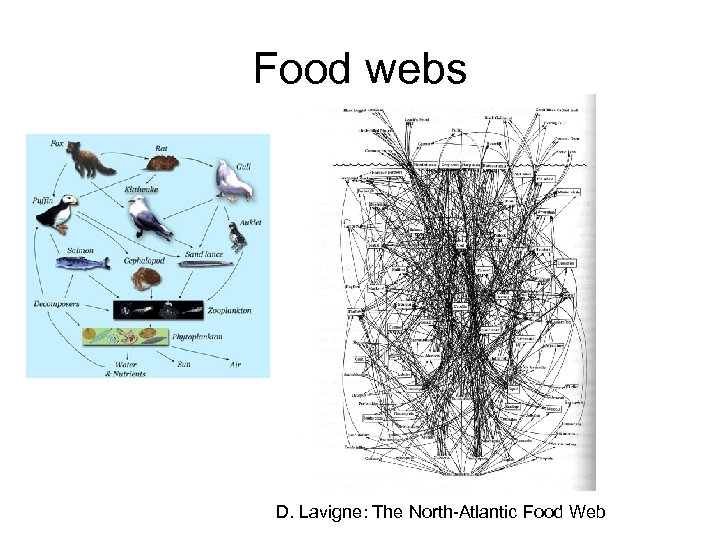
Food webs D. Lavigne: The North-Atlantic Food Web
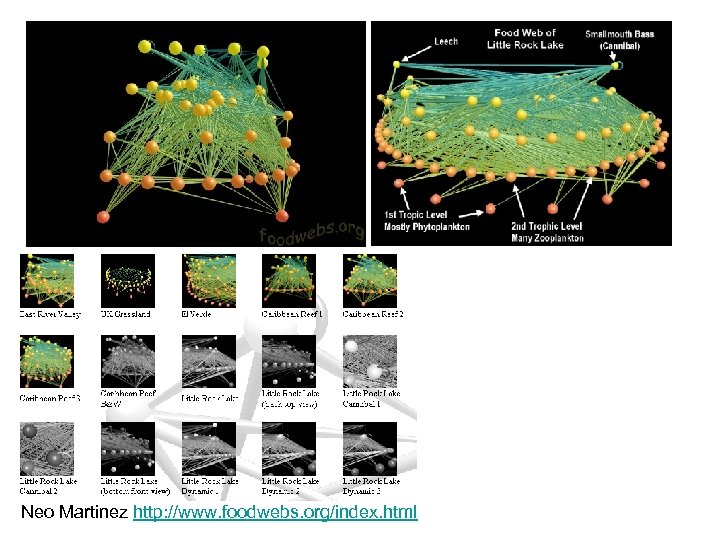
Neo Martinez http: //www. foodwebs. org/index. html
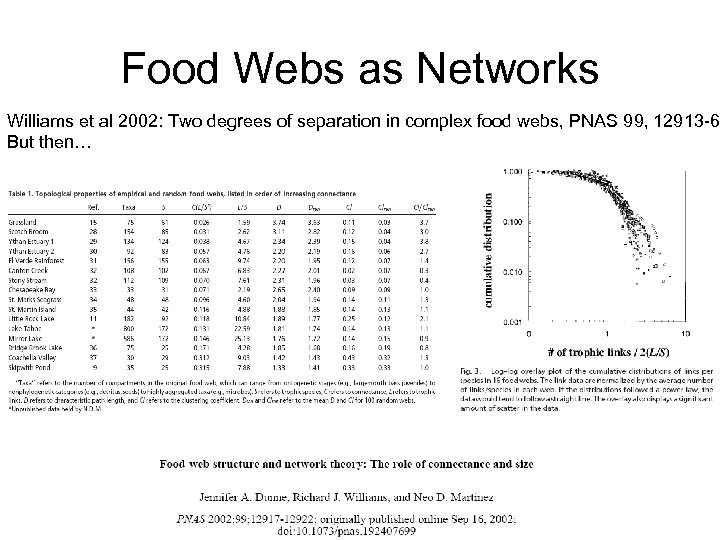
Food Webs as Networks Williams et al 2002: Two degrees of separation in complex food webs, PNAS 99, 12913 -6. But then…
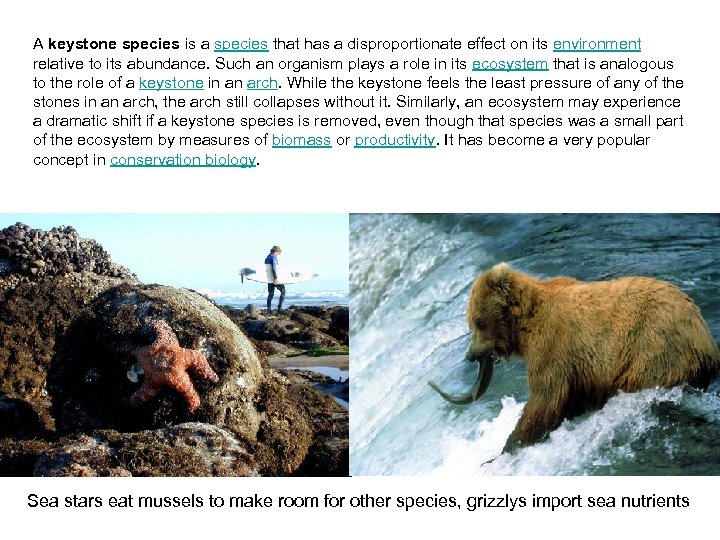
A keystone species is a species that has a disproportionate effect on its environment relative to its abundance. Such an organism plays a role in its ecosystem that is analogous to the role of a keystone in an arch. While the keystone feels the least pressure of any of the stones in an arch, the arch still collapses without it. Similarly, an ecosystem may experience a dramatic shift if a keystone species is removed, even though that species was a small part of the ecosystem by measures of biomass or productivity. It has become a very popular concept in conservation biology. Are keystone species weak links? Sea stars eat mussels to make room for other species, grizzlys import sea nutrients
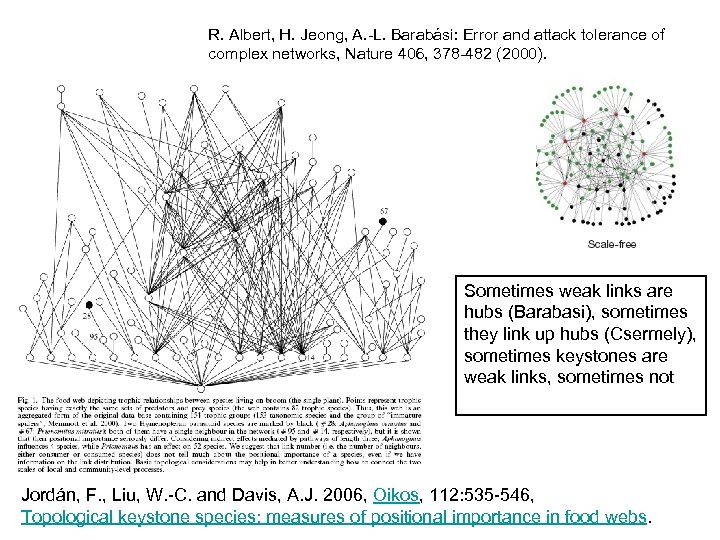
R. Albert, H. Jeong, A. -L. Barabási: Error and attack tolerance of complex networks, Nature 406, 378 -482 (2000). Sometimes weak links are Unresolved: hubs (Barabasi), sometimes they link up hubs (Csermely), the relation bw hubs, sometimes keystones are keystones, weak links… weak links, sometimes not Jordán, F. , Liu, W. -C. and Davis, A. J. 2006, Oikos, 112: 535 -546, Topological keystone species: measures of positional importance in food webs.
Connectivity/stability • Translates as a diversity/stability problem in ecology • May-Wigner theorem (1971): low connectivity stabilizes • Mc. Cann (2000): high diversity/generalist species stabilize • A mixing of methodologies: ABM study of the evolution of foodwebs modeled as phenotype interaction networks
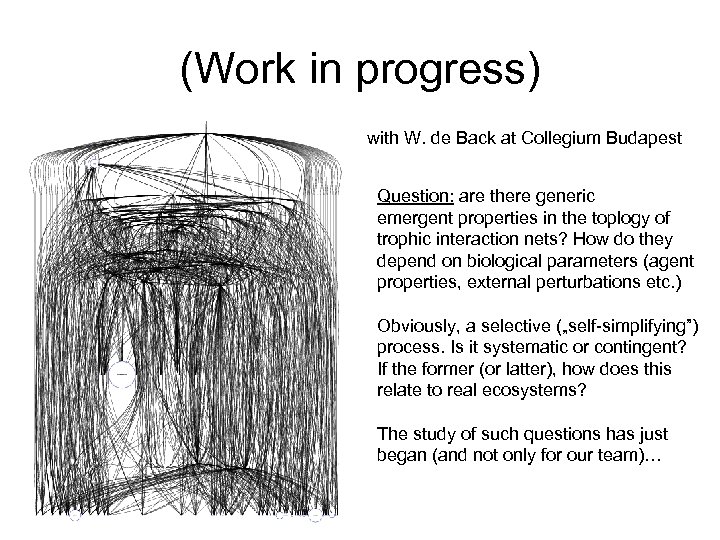
(Work in progress) with W. de Back at Collegium Budapest Question: are there generic emergent properties in the toplogy of trophic interaction nets? How do they depend on biological parameters (agent properties, external perturbations etc. ) Obviously, a selective („self-simplifying”) process. Is it systematic or contingent? If the former (or latter), how does this relate to real ecosystems? The study of such questions has just began (and not only for our team)…
Summary • • • Complexity not (just) Math and Phys ABM and networks provide two typical Biol/Soc paradigms Networks have „universal” properties… … which are not Study of real and „real” (i. e. ABM) networks • A final word: networks (and/or ABM) are fun!

THANK YOU
Скачать презентацию Complexity Theory in Biological and Social Systems George
f7c73ceb47cf35233f4a48c68073ff88.ppt