 Скачать презентацию Complexity in the Economy and Business IBM Almaden
cc491253c1442d81a1a453ccf70bf08b.ppt
- Количество слайдов: 29



Complexity in the Economy and Business IBM Almaden Institute April 12, 2007 W. Brian Arthur External Professor, Santa Fe Institute © 2007 W. Brian Arthur
A shift in how we look at the economy • Complexity economics, agent-based computational economics, “Radical Remaking of Economics, ” etc. -- What exactly is going on? © 2007 W. Brian Arthur 2
What is complexity? • Elements responding to the pattern their behavior co-creates – A concern with how things form from simpler elements © 2007 W. Brian Arthur 3
The economy is naturally complex © 2007 W. Brian Arthur 4
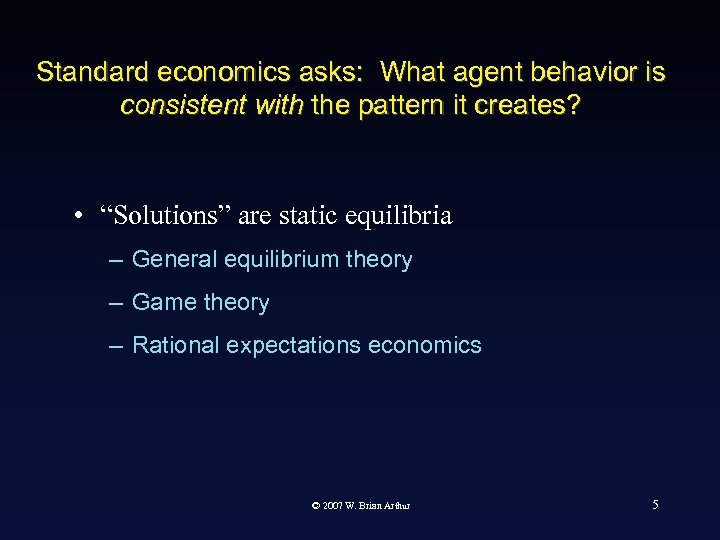
Standard economics asks: What agent behavior is consistent with the pattern it creates? • “Solutions” are static equilibria – General equilibrium theory – Game theory – Rational expectations economics © 2007 W. Brian Arthur 5
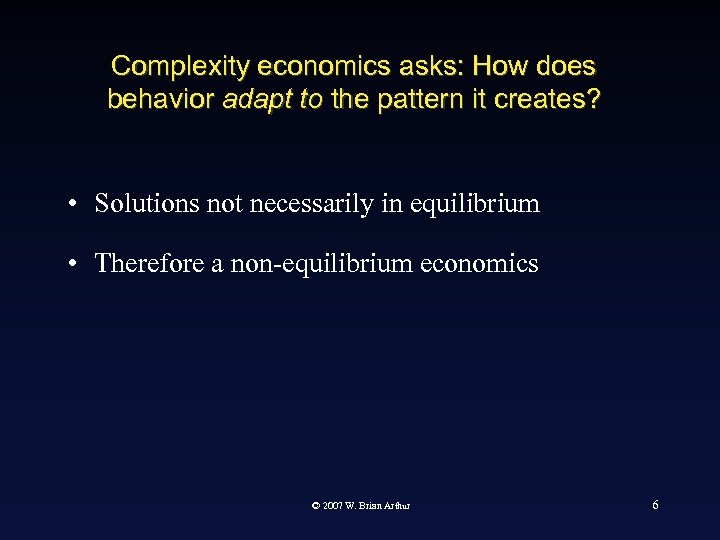
Complexity economics asks: How does behavior adapt to the pattern it creates? • Solutions not necessarily in equilibrium • Therefore a non-equilibrium economics © 2007 W. Brian Arthur 6
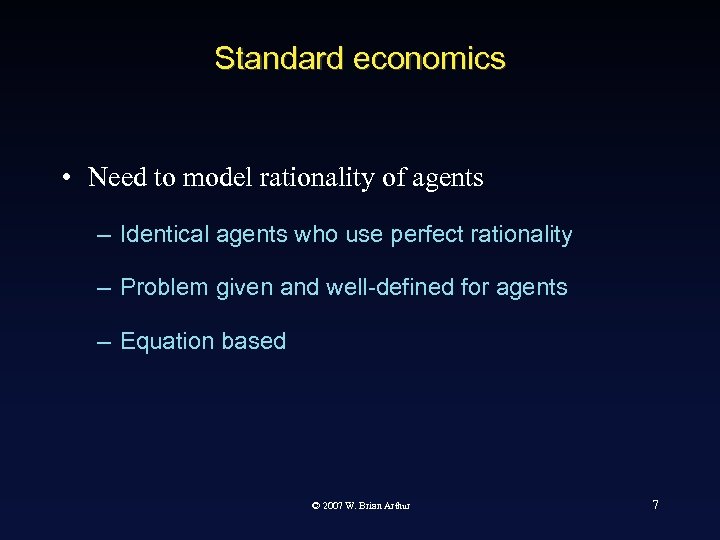
Standard economics • Need to model rationality of agents – Identical agents who use perfect rationality – Problem given and well-defined for agents – Equation based © 2007 W. Brian Arthur 7
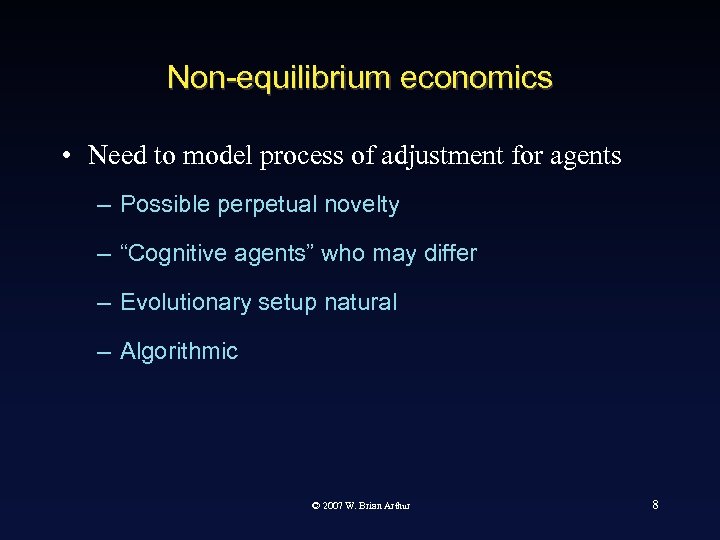
Non-equilibrium economics • Need to model process of adjustment for agents – Possible perpetual novelty – “Cognitive agents” who may differ – Evolutionary setup natural – Algorithmic © 2007 W. Brian Arthur 8
Standard economics based on diminishing returns (negative feedbacks) • Keeps equilibrium unique © 2007 W. Brian Arthur 9
Increasing returns problems difficult to deal with Example: N firms (or technologies, or regions) compete, and as one gets ahead it gains further advantage • What is the outcome? – Static approach doesn’t work © 2007 W. Brian Arthur 10
Dealing with increasing returns Redefine the problem as a stochastic process • Solution properties: – – – Multiple possible outcomes Not predictable which outcome History dependent Outcome locked in Outcome asymmetric © 2007 W. Brian Arthur 11
The Two Approaches: An Example SFI Artificial Stock Market Arthur, Holland, Le. Baron, Palmer, Tayler (1997) • How do stock markets work? – The Asset Pricing Problem © 2007 W. Brian Arthur 12
![Standard Theory of Asset Pricing p(t+1) Information I(t) Forecasting Machine: E[p(t+1)|I(t)] Buy/Sell Orders Market](https://present5.com/presentation/cc491253c1442d81a1a453ccf70bf08b/image-13.jpg "Standard Theory of Asset Pricing p(t+1) Information I(t) Forecasting Machine: E[p(t+1)|I(t)] Buy/Sell Orders Market")
Standard Theory of Asset Pricing p(t+1) Information I(t) Forecasting Machine: E[p(t+1)|I(t)] Buy/Sell Orders Market Maker Rational Expectations Equilibrium: What forecasting machine is on average validated by {p(t)}? © 2007 W. Brian Arthur 13
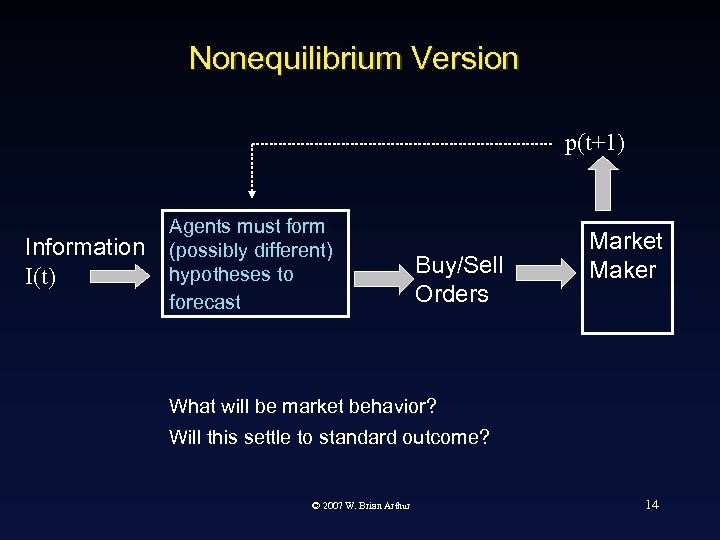
Nonequilibrium Version p(t+1) Information I(t) Agents must form (possibly different) hypotheses to forecast Buy/Sell Orders Market Maker What will be market behavior? Will this settle to standard outcome? © 2007 W. Brian Arthur 14
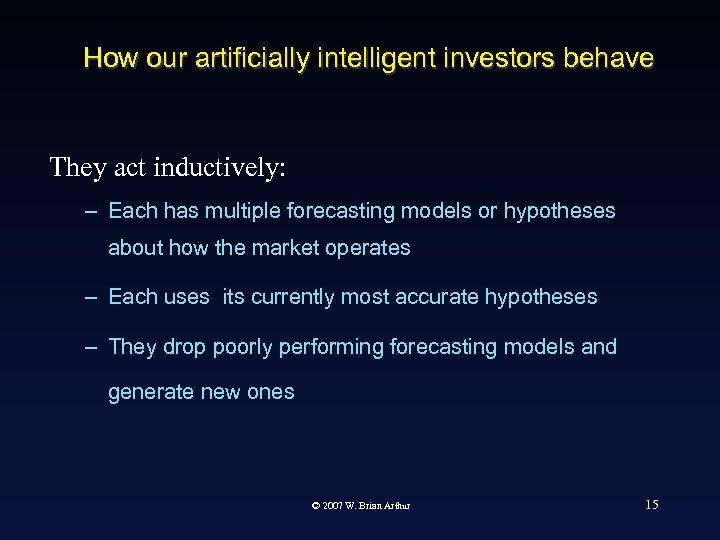
How our artificially intelligent investors behave They act inductively: – Each has multiple forecasting models or hypotheses about how the market operates – Each uses its currently most accurate hypotheses – They drop poorly performing forecasting models and generate new ones © 2007 W. Brian Arthur 15
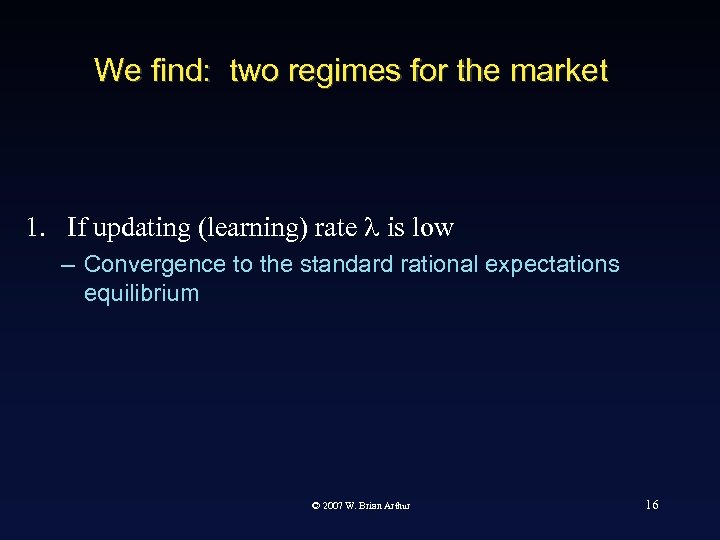
We find: two regimes for the market 1. If updating (learning) rate l is low – Convergence to the standard rational expectations equilibrium © 2007 W. Brian Arthur 16
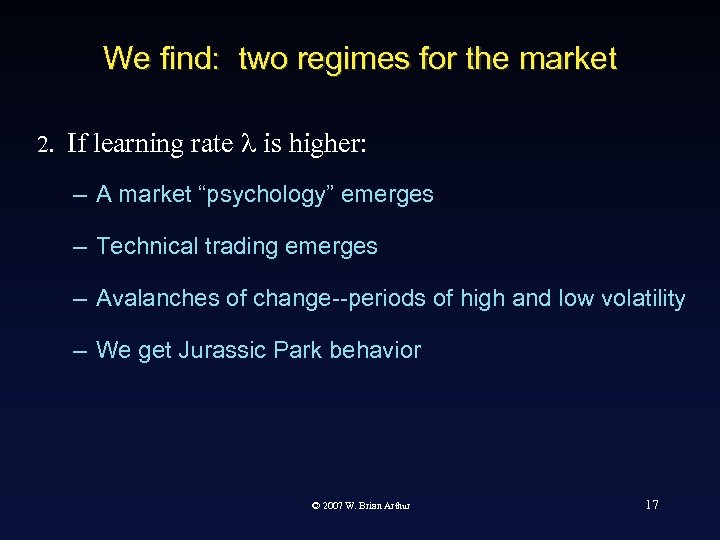
We find: two regimes for the market 2. If learning rate l is higher: – A market “psychology” emerges – Technical trading emerges – Avalanches of change--periods of high and low volatility – We get Jurassic Park behavior © 2007 W. Brian Arthur 17
Complexity economics: fad or paradigm shift? • Sometimes convergence to standard equilibrium outcomes. Equilibrium economics a special case • This is a generalization of standard economics © 2007 W. Brian Arthur 18
Implications for policy • Standard economics: Get conditions right, don’t intervene • Nonequilibrium economics: Multiple possible outcomes. A nudging hand. Become aware of adjustment problems – E. g. Russia’s big bang © 2007 W. Brian Arthur 19
How does this apply in business? • Seeing business from an ecological viewpoint • Awareness of defining problem as you go © 2007 W. Brian Arthur 20
How does this apply in business? • Planning. But allowing some structures to “emerge” • Providing “libraries” of solutions © 2007 W. Brian Arthur 21
© 2007 W. Brian Arthur 22

© 2007 W. Brian Arthur 23
Example: the El Farol problem One hundred people must decide independently each week whether to show up at their favorite bar. – Rule: if a person predicts that more than 60 will attend, he will avoid the crowds and stay home – if he predicts fewer than 60 he will go Q. How do you predict attendance? – Rational expectations fails © 2007 W. Brian Arthur 24
El Farol --how agents learn • The bar-goers form hypotheses about the problem and act on currently most accurate of these • An “ecology” of beliefs emerges. Changes over time I. e. a “psychology” of the market emerges © 2007 W. Brian Arthur 25
Standard vs Complexity Approach • Standard economics: what behavior is consistent with the pattern it creates? => Equilibrium economics • Complexity approach: how does behavior adapt to the pattern it creates? => Out-of-equilibrium economics © 2007 W. Brian Arthur 26
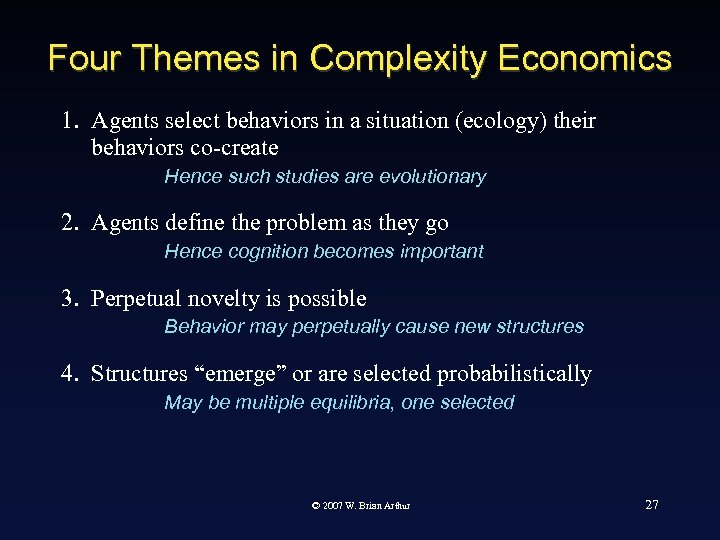
Four Themes in Complexity Economics 1. Agents select behaviors in a situation (ecology) their behaviors co-create Hence such studies are evolutionary 2. Agents define the problem as they go Hence cognition becomes important 3. Perpetual novelty is possible Behavior may perpetually cause new structures 4. Structures “emerge” or are selected probabilistically May be multiple equilibria, one selected © 2007 W. Brian Arthur 27

El Farol Bar attendance in the first 100 weeks © 2007 W. Brian Arthur 28
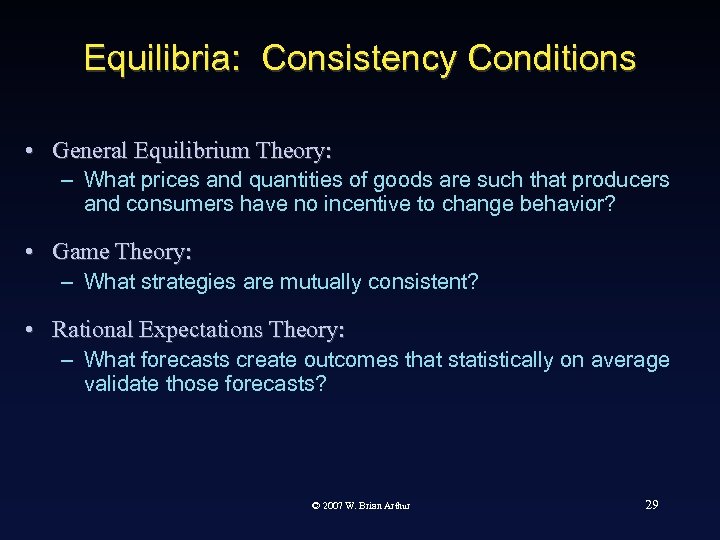
Equilibria: Consistency Conditions • General Equilibrium Theory: – What prices and quantities of goods are such that producers and consumers have no incentive to change behavior? • Game Theory: – What strategies are mutually consistent? • Rational Expectations Theory: – What forecasts create outcomes that statistically on average validate those forecasts? © 2007 W. Brian Arthur 29
Скачать презентацию Complexity in the Economy and Business IBM Almaden
cc491253c1442d81a1a453ccf70bf08b.ppt