 Скачать презентацию Complexity Across Boundaries Coupled Human and Natural Systems
07b700e870963841aca897edfb219131.ppt
- Количество слайдов: 1



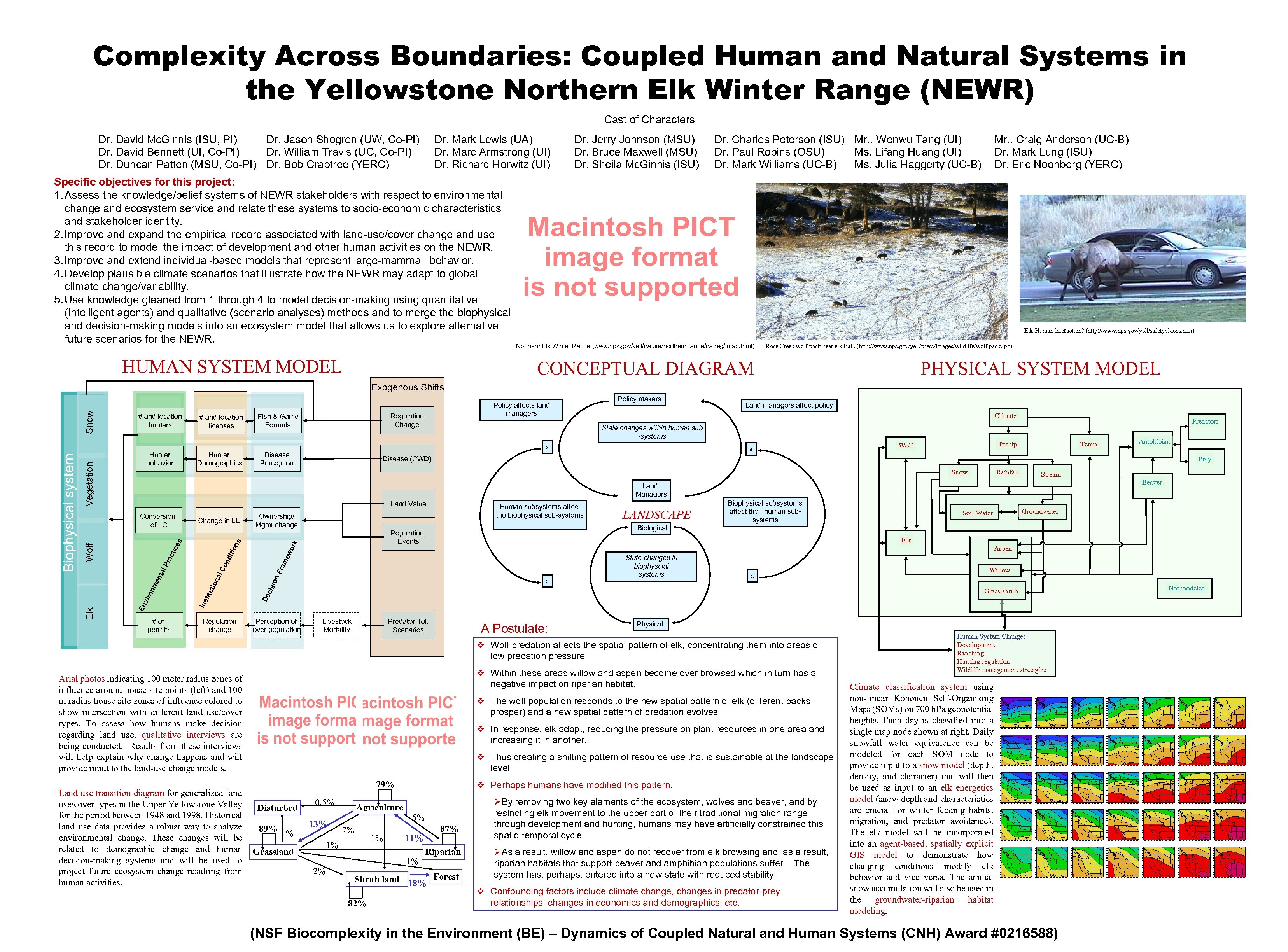
Complexity Across Boundaries: Coupled Human and Natural Systems in the Yellowstone Northern Elk Winter Range (NEWR) Cast of Characters Dr. David Mc. Ginnis (ISU, PI) Dr. Jason Shogren (UW, Co-PI) Dr. David Bennett (UI, Co-PI) Dr. William Travis (UC, Co-PI) Dr. Duncan Patten (MSU, Co-PI) Dr. Bob Crabtree (YERC) Dr. Mark Lewis (UA) Dr. Marc Armstrong (UI) Dr. Richard Horwitz (UI) Specific objectives for this project: 1. Assess the knowledge/belief systems of NEWR stakeholders with respect to environmental change and ecosystem service and relate these systems to socio-economic characteristics and stakeholder identity. 2. Improve and expand the empirical record associated with land-use/cover change and use this record to model the impact of development and other human activities on the NEWR. 3. Improve and extend individual-based models that represent large-mammal behavior. 4. Develop plausible climate scenarios that illustrate how the NEWR may adapt to global climate change/variability. 5. Use knowledge gleaned from 1 through 4 to model decision-making using quantitative (intelligent agents) and qualitative (scenario analyses) methods and to merge the biophysical and decision-making models into an ecosystem model that allows us to explore alternative future scenarios for the NEWR. HUMAN SYSTEM MODEL Dr. Jerry Johnson (MSU) Dr. Bruce Maxwell (MSU) Dr. Sheila Mc. Ginnis (ISU) Dr. Charles Peterson (ISU) Mr. . Wenwu Tang (UI) Dr. Paul Robins (OSU) Ms. Lifang Huang (UI) Dr. Mark Williams (UC-B) Ms. Julia Haggerty (UC-B) Mr. . Craig Anderson (UC-B) Dr. Mark Lung (ISU) Dr. Eric Noonberg (YERC) Elk-Human interaction? (http: //www. nps. gov/yell/safetyvideos. htm) Northern Elk Winter Range (www. nps. gov/yell/nature/northern range/natreg/ map. html) Rose Creek wolf pack near elk trail. (http: //www. nps. gov/yell/press/images/wildlife/wolf pack. jpg) CONCEPTUAL DIAGRAM PHYSICAL SYSTEM MODEL Snow Exogenous Shifts # and location hunters # and location licenses Policy affects land managers Regulation Change Fish & Game Formula Policy makers Climate Prey Rainfall Stream Beaver rk wo Aspen Fra ion a cis a State changes in biophyscial systems Perception of over-population Livestock Mortality Predator Tol. Scenarios A Postulate: Physical v Within these areas willow and aspen become over browsed which in turn has a negative impact on riparian habitat. Arial photos indicating 100 meter radius zones of influence around house site points (left) and 100 m radius house site zones of influence colored to show intersection with different land use/cover types. To assess how humans make decision regarding land use, qualitative interviews are being conducted. Results from these interviews will help explain why change happens and will provide input to the land-use change models. v The wolf population responds to the new spatial pattern of elk (different packs prosper) and a new spatial pattern of predation evolves. v In response, elk adapt, reducing the pressure on plant resources in one area and increasing it in another. v Thus creating a shifting pattern of resource use that is sustainable at the landscape level. 79% Disturbed 89% Willow Grass/shrub v Wolf predation affects the spatial pattern of elk, concentrating them into areas of low predation pressure Land use transition diagram for generalized land use/cover types in the Upper Yellowstone Valley for the period between 1948 and 1998. Historical land use data provides a robust way to analyze environmental change. These changes will be related to demographic change and human decision-making systems and will be used to project future ecosystem change resulting from human activities. Groundwater Soil Water Elk De na tio titu Ins Regulation change LANDSCAPE Biophysical subsystems affect the human subsystems Biological Population Events me on dit tic ac Pr nta l on me vir En # of permits Human subsystems affect the biophysical sub-systems Ownership/ Mgmt change ion s es Change in LU 1% Amphibian Disease (CWD) Land Value l. C Vegetation Temp. Land Managers Conversion of LC Elk Disease Perception a Precip Wolf Snow Wolf Biophysical system Hunter Demographics Predators State changes within human sub -systems a Hunter behavior Land managers affect policy 0. 5% 13% Agriculture 7% 1% 1% Grassland 2% v Perhaps humans have modified this pattern. 5% 11% 1% 87% Riparian Shrub land 18% Forest 82% ØBy removing two key elements of the ecosystem, wolves and beaver, and by restricting elk movement to the upper part of their traditional migration range through development and hunting, humans may have artificially constrained this spatio-temporal cycle. ØAs a result, willow and aspen do not recover from elk browsing and, as a result, riparian habitats that support beaver and amphibian populations suffer. The system has, perhaps, entered into a new state with reduced stability. v Confounding factors include climate change, changes in predator-prey relationships, changes in economics and demographics, etc. Human System Changes: Development Ranching Hunting regulation Wildlife management strategies Climate classification system using non-linear Kohonen Self-Organizing Maps (SOMs) on 700 h. Pa geopotential heights. Each day is classified into a single map node shown at right. Daily snowfall water equivalence can be modeled for each SOM node to provide input to a snow model (depth, density, and character) that will then be used as input to an elk energetics model (snow depth and characteristics are crucial for winter feeding habits, migration, and predator avoidance). The elk model will be incorporated into an agent-based, spatially explicit GIS model to demonstrate how changing conditions modify elk behavior and vice versa. The annual snow accumulation will also be used in the groundwater-riparian habitat modeling. (NSF Biocomplexity in the Environment (BE) – Dynamics of Coupled Natural and Human Systems (CNH) Award #0216588) Not modeled
Скачать презентацию Complexity Across Boundaries Coupled Human and Natural Systems
07b700e870963841aca897edfb219131.ppt