Скачать презентацию Complex sentences In a complex sentence there
Complex sentences.Id_72505.pptx
- Количество слайдов: 18
 Complex sentences
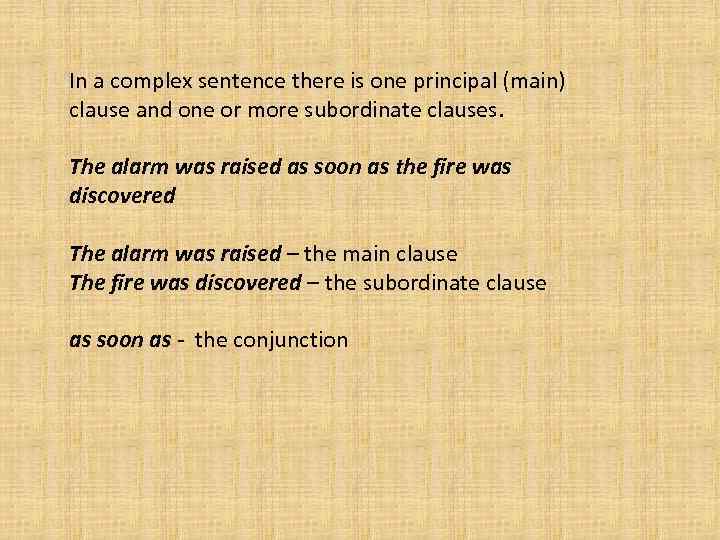 In a complex sentence there is one principal (main) clause and one or more subordinate clauses. The alarm was raised as soon as the fire was discovered The alarm was raised – the main clause The fire was discovered – the subordinate clause as soon as - the conjunction
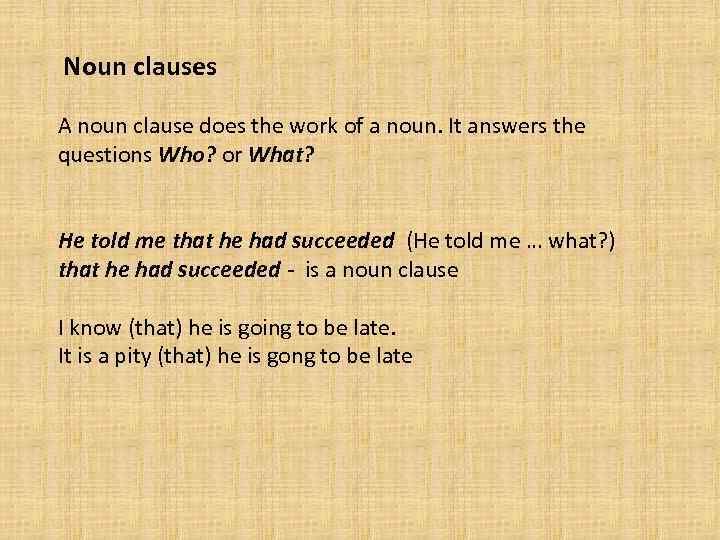 Noun clauses A noun clause does the work of a noun. It answers the questions Who? or What? He told me that he had succeeded (He told me … what? ) that he had succeeded - is a noun clause I know (that) he is going to be late. It is a pity (that) he is gong to be late
 Noun clauses derived from questions Has he signed the contract? Tell me if he has signed the contract. Ask him if (whether) he has signed the contract. When did you sign the contract? Tell me when you signed the contract.
 Relative clauses The house we moved into was absolutely beautiful. The people who lived here before us took very great care of it. I don’t think we will ever regret the decision we made. We use who or that to refer to people. She is the woman who/that lives here. We use which or that to refer to animals and things. That’s the cat which/that lives next door.
 He is the person to whom I wrote. He is the person I wrote to. This is the pan in which I boiled the milk. This is the pan I boiled the milk in. WHOSE She is the woman whose car was stolen.
 Adverbial clauses of time When we visited London we went to the Tower. We use conjunctions when, while, till, until, as soon as, before, after, by the time, as, once, since When the time clause refers to the future we use the present tense after the conjunction: As soon as I give him your message I will phone you.
 Past reference Things happening one after another: When I came back home my father went away. Things happening at the same time: When I came back home my father was leaving. When the second action finishes before the first action in the sentence: When I came back home my father had already left.
 Adverbial clauses of place To say where something happens we use conjunctions where, wherever That dog follows me wherever I go.
 Adverbial clauses of manner Type this again as I showed you a moment ago. Use conjunctions: (in) the way (that) as if/as though Type this again the way I showed you. I feel as though I am floating in the air.
 Adverbial clauses of reason answer the question why? Use conjunctions because, since, as, seeing that Since it’s a public holiday you won’t find many shops open.
 Adverbial clauses of contrast We introduce contrast with conjunctions Although, considering that, though, even if, much as, while, whereas Though I have had more than 20 lessons, I am still not ready to take my driving test. Although I try hard to play the piano I don’t seem to improve.
 We can also introduce contrast with however + adjective/adverb No matter I intend to buy a CD player however much it costs. I intend to buy a CD player no matter how much it costs.
 Adverbial clauses of purpose We can express purpose with so that and in order that I spent a year in Germany so that I could learn German. For + infinitive construction. Mr Jones bought a second car for his wife to learn to drive.
 Adverbial clauses of result We were so tired that we went to bed. He is such a fool that he believes anything.
 Adverbial clauses of comparison He plays the piano as well as I do. You didn’t finish the crossword puzzle as quickly as I did