



Complex Object
• Я видела, что он перешел улицу. • Они разрешили детям поспать подольше на выходных. В английском языке местоимение стоит в объектном падеже. Существительное – в общем.
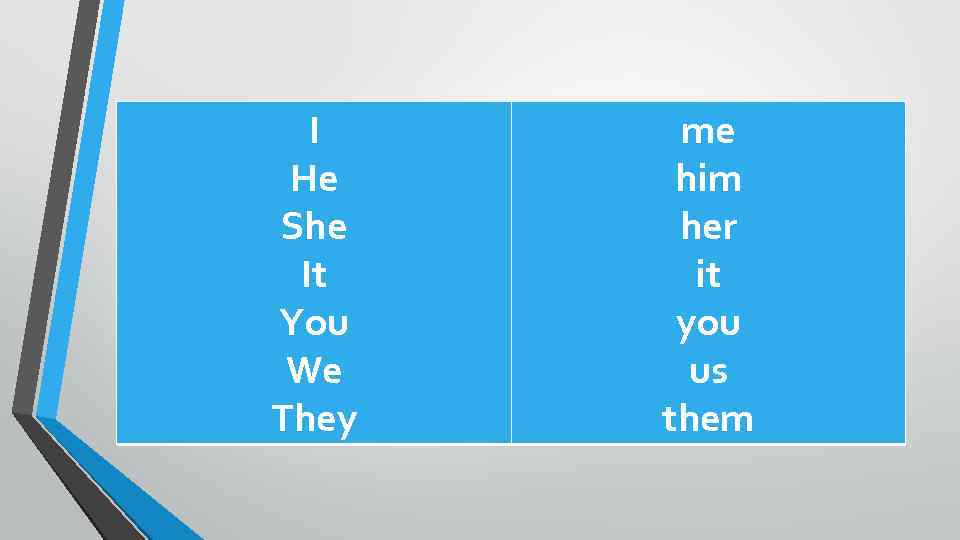
I He She It You We They me him her it you us them
The verbs of sense perception such as to see, to hear, to watch, to notice, to feel. The infinitive after these verbs is used without the particle “to”. • I saw him cross the street. – Я видела, что он перешел улицу • He noticed the car drive up. – Он заметил, что подъехал автомобиль
If the process is expressed we use Participle I instead of the infinitive • I heard Ann playing the piano in the next door room. – Я слышала, как Анна играет на пианино в соседней комнате • We watched the children showing their new toys to each other. – Мы наблюдали, как дети показывают другу новые игрушки
The verbs of mental activity to think, to consider, to expect (ожидать, рассчитывать) • He considered her to be a clever girl. – Он считал, что она умная девушка • I thought him to have done it. – Я думал, что он уже сделал это

The verbs of wish and intention to want, would like • We want him to answer this question. – Мы хотим, чтобы он ответил на этот вопрос • He would like you to write him more often. – Он бы хотел, чтобы вы писали ему чаще
The verbs of declaring to declare, to announce, to ask (просить) • He asked me to help him. – Он попросил, чтобы я помог ему • They declared her to have won. – Они объявили, что она победила
The verbs of compulsion to make, to have – without “to” to force, to cause – with “to” • Will you make him finish his lessons? – Ты заставишь его сделать уроки? • The noise made her awake. – От шума она проснулась (Шум заставил ее проснуться)
The verbs of permission to let – without “to” to allow – with “to” • They let their children stay up late at weekend. – Они разрешили детям поспать подольше на выходных • Will you allow me to use your camera? – ты разрешишь мне пользоваться твоим фотоаппаратом?
Закончите предложения, употребляя сложное дополнение. E. g. “Bring me a book, ” said my brother to me. My brother wanted me to bring him a book. 1. The teacher said to the pupils: “Learn the rule. ” — The teacher wanted. . . 2. “Be careful, or else you will spill the milk, ” said my mother to me. — My mother did not want. . . 3. “My daughter will go to a ballet school, ” said the woman. — The woman wanted. . . 4. The man said: “My son will study mathematics. ” —The man wanted. . . 5. “Oh, father, buy me this toy, please, ” said the little boy. — The little boy wanted … 6. “Wait for me after school, ” said Ann to me. — Ann wanted. . . 7. “Fix the shelf in the kitchen, ” my father said to me. — My father wanted. . . 8. “It will be very good if you study English, ” said my brother to me. —My brother wanted. . . 9. “Fetch me some water from the river, children, ” said our grandmother. — Our grandmother wanted. . . 10. “Come to my birthday party, ” said Kate to her classmates. — Kate want ed. . . 11. The biology teacher said to us: “Collect some insects in summer. ” — The biology teacher wanted. . . 12. “Don’t eat ice cream before dinner, ” said our aunt to us. Our aunt did not want. . . 13. “Come and live in St Petersburg with me, ” said my mother to me. My mother wanted. . .
Перепишите следующие предложения, употребляя сложное дополнение вместо придаточных дополни тельных предложений. E. g. I expect that she will send me a letter. I expect her to send me a letter. I know that he is a great scientist. I know him to be a great scientist. 1. I know that my friend is a just man. 2. I ex pect that he will understand your problem and help you to solve it. 3. I expected that she would behave quite differently. 4. I did not expect that my brother would forget to send her flowers. 5. He knows that my mother is a very kind woman. 6. She expected that her brother would bring her the book. 7. I know that your uncle is an excellent mathematician. 8. People expect that the 21 st century will bring peace on the Earth.
Перепишите следующие предложения, употребляя сложное дополнение вместо придаточных дополни тельных предложений. E. g. I expect that she will send me a letter. I expect her to send me a letter. I know that he is a great scientist. I know him to be a great scientist. 9. We know that it is true. 10. I never expected that he would be a politician. 11. No one expects that the President will resign. 12. We expect that the economy will grow by 2% next year. 13. I didn’t expect that he knew Russian so well. 14. I expect that it will take about an hour to get home. 15. The kids know that all her pies are delicious. 16. They expect that he will have a good working knowledge of computers. 17. No body expected that she would win the gold medal.
Перефразируйте следующие предложения, употреб ляя сложное дополнение с причастием. E. g. Не was reading in the garden. She saw him reading in the garden. 1. We noticed a man. The man was cleaning his shoes. 2. He saw two girls. They were dancing on the stage. 3. She watched the children. They were running and playing in the garden. 4. I saw her. She was arranging her hair. 5. We saw our neighbour. Не was listening to the latest news on the radio. 6. The cat was rubbing against my legs. I felt it. 7. They were fishing. We saw it. 8. The pupils were writing a paper. The teacher watched them. 9. A caterpillar was crawling on my arm. I felt it. 10. We heard our talented performer last night. She was singing a Russian folk song. 11. I watched the sun. It was rising. 12. I heard him. He was singing an English song. 13. John, heard his sister. She was talking loudly on the veranda.
Перефразируйте следующие предложения, употреб ляя сложное дополнение с причастием. E. g. Не was reading in the garden. She saw him reading in the garden. 14. We saw Ben. He was crossing the square. 15. They heard their father. He was playing the piano in the drawing room. 16. I can see the train. It is coming. 17. I watched the rain. It was beating down the flowers in the garden. 18. I saw a group of boys. They were eating ice cream. 19. We noticed a group of people. They were digging pota toes in the field. 20. Didn’t you see her? She was smiling at you. 21. The girl was singing. I heard her. 22. They were talking about computers. He heard them. 23. You and your friend were walking along the street yesterday. I saw you. 24. The little girls were playing on the grass. We watched them. 25. The ship was leaving the port. He stood and looked at it. 26. She was sleeping peacefully in her bed. Mother watched her.
Перефразируйте следующие предложения, употреб ляя сложное дополнение с инфинитивом. E. g. Не dropped his bag. I saw it. I saw him drop his bag. 1. The boy noticed a bird. It flew on to the bush near the window. 2. Jane saw her neighbour. He opened the door of his flat and went in. 3. I saw him. He pointed to a picture on the wall. 4. I heard him. He shut the door of the study. 5. We saw that the children climbed to the tops of the trees. 6. I no ticed that Henry went up and spoke to the stranger. 7. He slipped and fell. I saw it. 8. I heard that she suddenly cried out loudly. 9. She bent and picked up something from the floor. The policeman saw it. 10. I saw that he opened the door and left the room.
Перефразируйте следующие предложения, употреб ляя сложное дополнение с инфинитивом. E. g. Не dropped his bag. I saw it. I saw him drop his bag. 11. She dropped the cup on the floor and broke it. I saw it. 12. They turned the corner and disappeared. We watched them. 13. The doctor touched the boy’s leg. The boy felt it. 14. Pete bought some flowers. His friends saw it. 15. The wounded hunter felt that the bear touched him, but he did not move. 16. Shall we hear it if the telephone rings? 17. Tamara saw that the boat drifted down the river. 18. The ship sailed away from the shore. They saw it. 19. Have you heard how he sings the part of Hermann in Tchaikovsky’s “Queen of Spades”?
Переведите на английский язык, употребляя слож ное дополнение с причастием или инфинитивом в зависимости от смысла. 1. Я слышал, как он открывает дверь. 2. Я слы шал, как он открыл дверь. 3. Я почувствовал, как он коснулся моей руки. 4. Я чувствовал, что он касается моей руки. 5. Я видел, как птицы летят к лесу. 6. Я увидел, как птицы полетели к лесу. 7. Мы увидели, что она переплывает реку. 8. Мы видели, как она переплыла реку. 9. Я не заметила, как он положил письмо на стол. 10. Я видела, как он поставил свой чемодан у двери. 11. Мы видели, как она сошла с поезда и пошла по направлению к кассам. 12. Мы наблюдали, как он подошел к окну, остановился, открыл журнал и стал читать. 13. Я почувствовала, что кто то смотрит на меня справа.
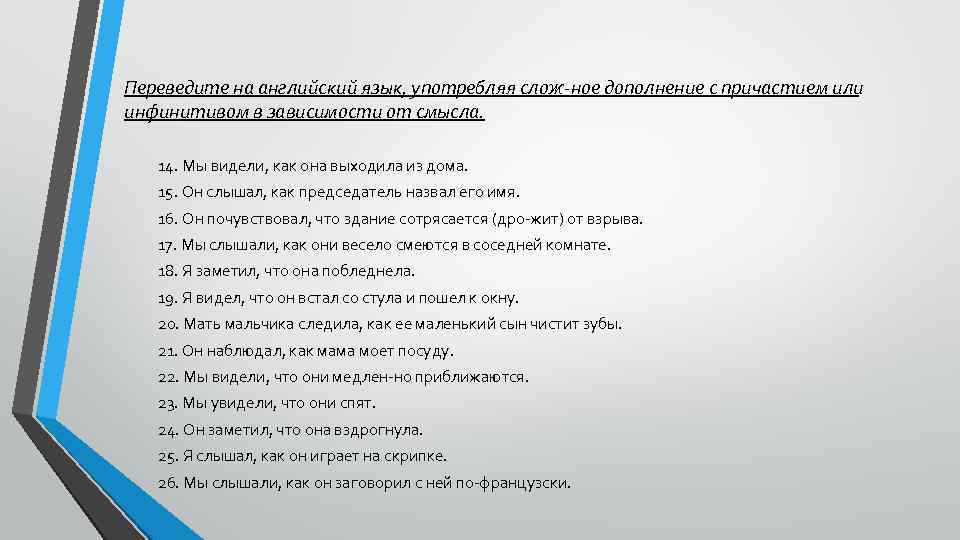
Переведите на английский язык, употребляя слож ное дополнение с причастием или инфинитивом в зависимости от смысла. 14. Мы видели, как она выходила из дома. 15. Он слышал, как председатель назвал его имя. 16. Он почувствовал, что здание сотрясается (дро жит) от взрыва. 17. Мы слышали, как они весело смеются в соседней комнате. 18. Я заметил, что она побледнела. 19. Я видел, что он встал со стула и пошел к окну. 20. Мать мальчика следила, как ее маленький сын чистит зубы. 21. Он наблюдал, как мама моет посуду. 22. Мы видели, что они медлен но приближаются. 23. Мы увидели, что они спят. 24. Он заметил, что она вздрогнула. 25. Я слышал, как он играет на скрипке. 26. Мы слышали, как он заговорил с ней по французски.
