 Скачать презентацию COMPLETE BUSINESS STATISTICS 7 7
6c8b0d76fe7ba4e8d6962ed8bb1cca06.ppt
- Количество слайдов: 67



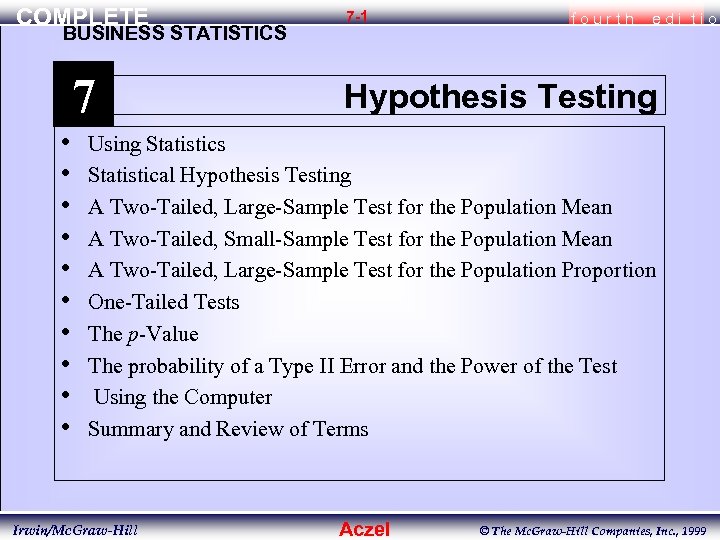
COMPLETE BUSINESS STATISTICS 7 • • • 7 -1 fourth edi tio Hypothesis Testing Using Statistics Statistical Hypothesis Testing A Two-Tailed, Large-Sample Test for the Population Mean A Two-Tailed, Small-Sample Test for the Population Mean A Two-Tailed, Large-Sample Test for the Population Proportion One-Tailed Tests The p-Value The probability of a Type II Error and the Power of the Test Using the Computer Summary and Review of Terms Irwin/Mc. Graw-Hill Aczel © The Mc. Graw-Hill Companies, Inc. , 1999
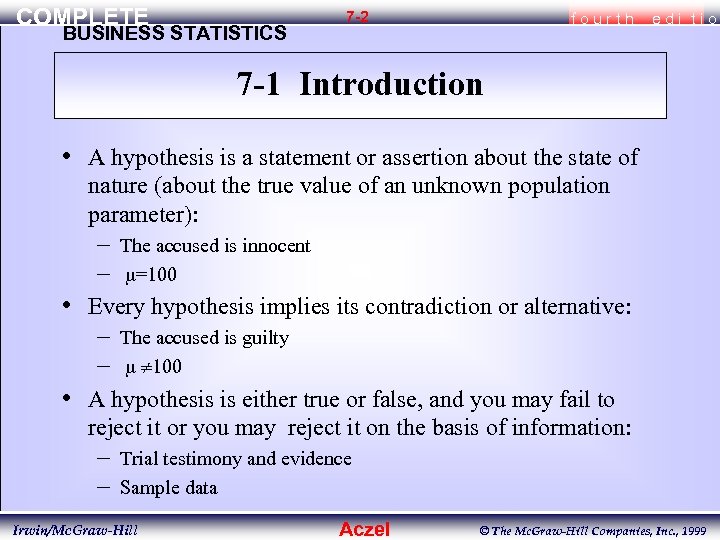
COMPLETE BUSINESS STATISTICS 7 -2 fourth edi tio 7 -1 Introduction • A hypothesis is a statement or assertion about the state of nature (about the true value of an unknown population parameter): – – • Every hypothesis implies its contradiction or alternative: – – • The accused is innocent =100 The accused is guilty 100 A hypothesis is either true or false, and you may fail to reject it or you may reject it on the basis of information: – – Trial testimony and evidence Sample data Irwin/Mc. Graw-Hill Aczel © The Mc. Graw-Hill Companies, Inc. , 1999
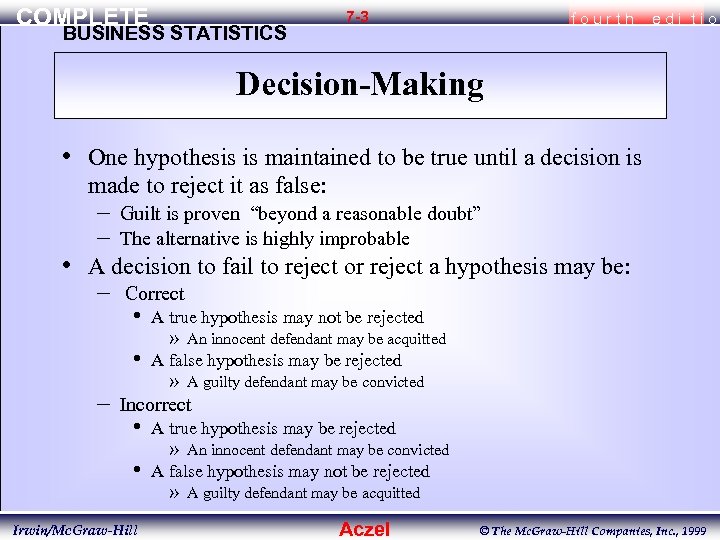
COMPLETE BUSINESS STATISTICS 7 -3 fourth edi tio Decision-Making • • One hypothesis is maintained to be true until a decision is made to reject it as false: – – Guilt is proven “beyond a reasonable doubt” The alternative is highly improbable A decision to fail to reject or reject a hypothesis may be: – Correct • A true hypothesis may not be rejected » An innocent defendant may be acquitted • – A false hypothesis may be rejected • A true hypothesis may be rejected » A guilty defendant may be convicted Incorrect • Irwin/Mc. Graw-Hill » An innocent defendant may be convicted A false hypothesis may not be rejected » A guilty defendant may be acquitted Aczel © The Mc. Graw-Hill Companies, Inc. , 1999
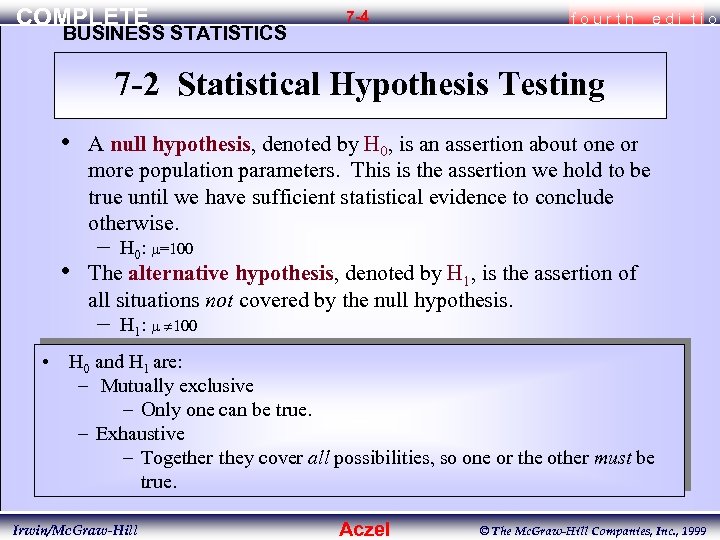
COMPLETE BUSINESS STATISTICS 7 -4 fourth edi tio 7 -2 Statistical Hypothesis Testing • • A null hypothesis, denoted by H 0, is an assertion about one or more population parameters. This is the assertion we hold to be true until we have sufficient statistical evidence to conclude otherwise. – H 0: =100 The alternative hypothesis, denoted by H 1, is the assertion of all situations not covered by the null hypothesis. – H 1: 100 • H 0 and H 1 are: – Mutually exclusive – Only one can be true. – Exhaustive – Together they cover all possibilities, so one or the other must be true. Irwin/Mc. Graw-Hill Aczel © The Mc. Graw-Hill Companies, Inc. , 1999
COMPLETE BUSINESS STATISTICS 7 -5 fourth edi tio The Null Hypothesis, H 0 • The null hypothesis: – Often represents the status quo situation or an existing belief. – Is maintained, or held to be true, until a test leads to its rejection in favor of the alternative hypothesis. – Is accepted as true or rejected as false on the basis of a consideration of a test statistic. Irwin/Mc. Graw-Hill Aczel © The Mc. Graw-Hill Companies, Inc. , 1999
COMPLETE BUSINESS STATISTICS 7 -6 fourth edi tio The Test Statistic and the Decision Rule • • A test statistic is a sample statistic computed from sample data. The value of the test statistic is used in determining whether or not we may reject the null hypothesis. The decision rule of a statistical hypothesis test is a rule that specifies the conditions under which the null hypothesis may be rejected. Consider H 0: =100. We may have a decision rule that says: “Reject H 0 if the sample mean is less than 95 or more than 105. ” In a courtroom we may say: “The accused is innocent until proven guilty beyond a reasonable doubt. ” Irwin/Mc. Graw-Hill Aczel © The Mc. Graw-Hill Companies, Inc. , 1999
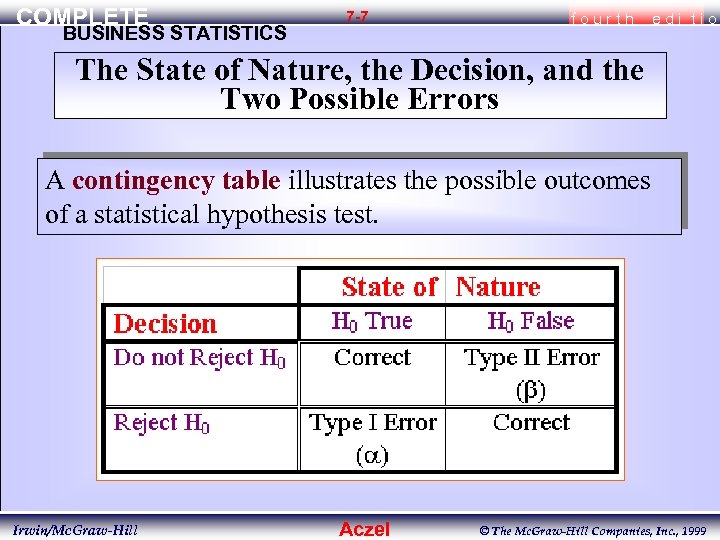
COMPLETE BUSINESS STATISTICS 7 -7 fourth edi tio The State of Nature, the Decision, and the Two Possible Errors A contingency table illustrates the possible outcomes of a statistical hypothesis test. Irwin/Mc. Graw-Hill Aczel © The Mc. Graw-Hill Companies, Inc. , 1999
COMPLETE BUSINESS STATISTICS 7 -8 fourth edi tio Decision Making • • There are two possible states of nature: – H 0 is true – H 0 is false There are two possible decisions: – Fail to reject H 0 as true – Reject H 0 as false Irwin/Mc. Graw-Hill Aczel © The Mc. Graw-Hill Companies, Inc. , 1999
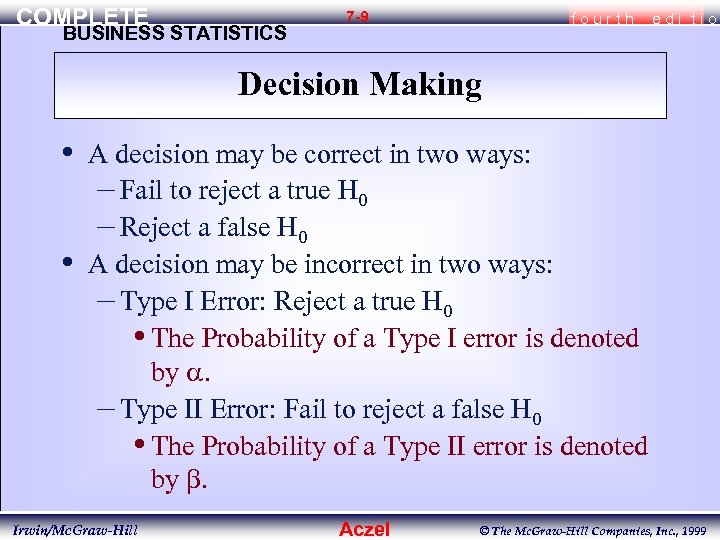
COMPLETE BUSINESS STATISTICS 7 -9 fourth edi tio Decision Making • • A decision may be correct in two ways: – Fail to reject a true H 0 – Reject a false H 0 A decision may be incorrect in two ways: – Type I Error: Reject a true H 0 • The Probability of a Type I error is denoted by . – Type II Error: Fail to reject a false H 0 • The Probability of a Type II error is denoted by . Irwin/Mc. Graw-Hill Aczel © The Mc. Graw-Hill Companies, Inc. , 1999
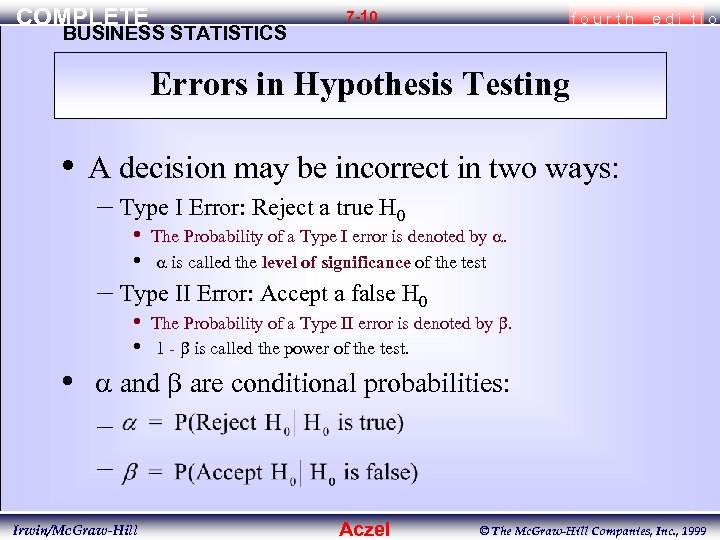
COMPLETE BUSINESS STATISTICS 7 -10 fourth edi tio Errors in Hypothesis Testing • A decision may be incorrect in two ways: – Type I Error: Reject a true H 0 – • • The Probability of a Type I error is denoted by . • is called the level of significance of the test Type II Error: Accept a false H 0 • The Probability of a Type II error is denoted by . • 1 - is called the power of the test. and are conditional probabilities: – – Irwin/Mc. Graw-Hill Aczel © The Mc. Graw-Hill Companies, Inc. , 1999
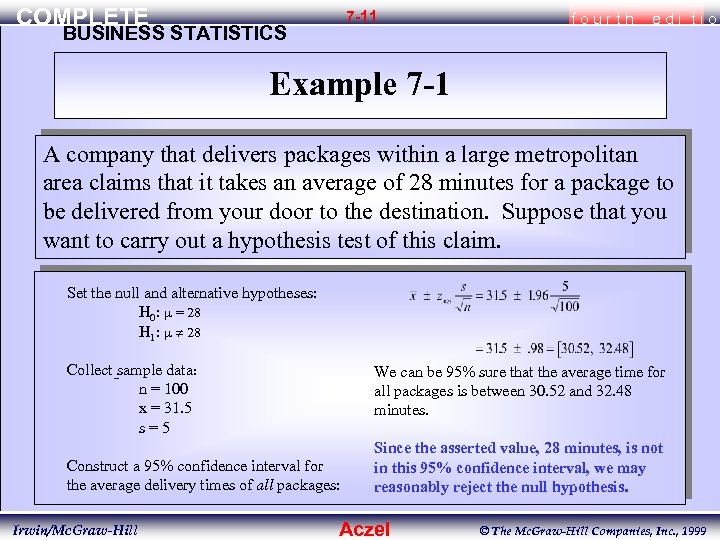
COMPLETE 7 -11 BUSINESS STATISTICS fourth edi tio Example 7 -1 A company that delivers packages within a large metropolitan area claims that it takes an average of 28 minutes for a package to be delivered from your door to the destination. Suppose that you want to carry out a hypothesis test of this claim. Set the null and alternative hypotheses: H 0: = 28 H 1: 28 Collect sample data: n = 100 x = 31. 5 s=5 We can be 95% sure that the average time for all packages is between 30. 52 and 32. 48 minutes. Construct a 95% confidence interval for the average delivery times of all packages: Irwin/Mc. Graw-Hill Since the asserted value, 28 minutes, is not in this 95% confidence interval, we may reasonably reject the null hypothesis. Aczel © The Mc. Graw-Hill Companies, Inc. , 1999
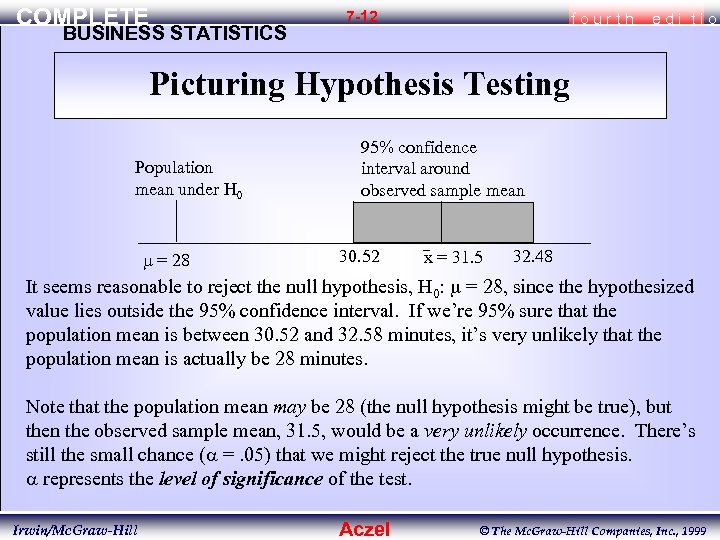
COMPLETE BUSINESS STATISTICS 7 -12 fourth edi tio Picturing Hypothesis Testing Population mean under H 0 = 28 95% confidence interval around observed sample mean 30. 52 x = 31. 5 32. 48 It seems reasonable to reject the null hypothesis, H 0: = 28, since the hypothesized value lies outside the 95% confidence interval. If we’re 95% sure that the population mean is between 30. 52 and 32. 58 minutes, it’s very unlikely that the population mean is actually be 28 minutes. Note that the population mean may be 28 (the null hypothesis might be true), but then the observed sample mean, 31. 5, would be a very unlikely occurrence. There’s still the small chance ( =. 05) that we might reject the true null hypothesis. represents the level of significance of the test. Irwin/Mc. Graw-Hill Aczel © The Mc. Graw-Hill Companies, Inc. , 1999
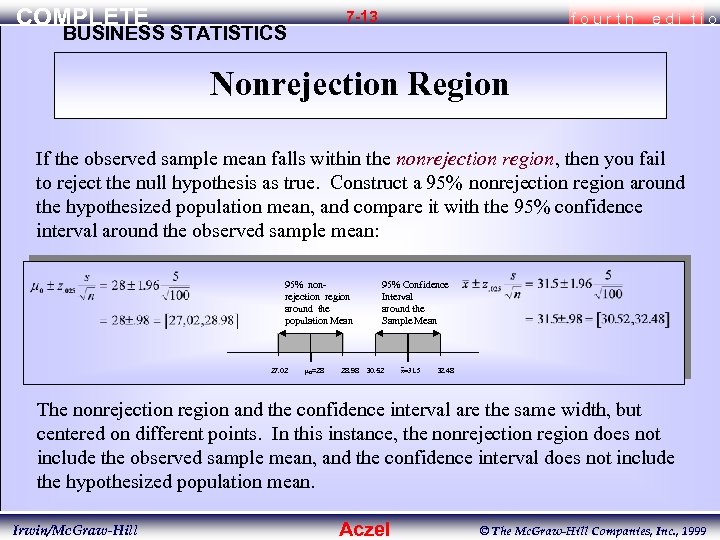
COMPLETE 7 -13 BUSINESS STATISTICS fourth edi tio Nonrejection Region If the observed sample mean falls within the nonrejection region, then you fail to reject the null hypothesis as true. Construct a 95% nonrejection region around the hypothesized population mean, and compare it with the 95% confidence interval around the observed sample mean: 95% nonrejection region around the population Mean 27. 02 0=28 28. 98 95% Confidence Interval around the Sample Mean 30. 52 x 32. 48 The nonrejection region and the confidence interval are the same width, but centered on different points. In this instance, the nonrejection region does not include the observed sample mean, and the confidence interval does not include the hypothesized population mean. Irwin/Mc. Graw-Hill Aczel © The Mc. Graw-Hill Companies, Inc. , 1999
COMPLETE BUSINESS STATISTICS 7 -14 fourth edi tio Rejection Region • The rejection region of a statistical hypothesis test is the range of numbers that will lead us to reject the null hypothesis in case the test statistic falls within this range. The rejection region, also called the critical region, is defined by the critical points. The rejection region is defined so that, before the sampling takes place, our test statistic will have a probability of falling within the rejection region if the null hypothesis is true. Irwin/Mc. Graw-Hill Aczel © The Mc. Graw-Hill Companies, Inc. , 1999
COMPLETE BUSINESS STATISTICS 7 -15 fourth edi tio Nonrejection Region • The nonrejection region is the range of values (also determined by the critical points) that will lead us not to reject the null hypothesis if the test statistic should fall within this region. The nonrejection region is designed so that, before the sampling takes place, our test statistic will have a probability 1 - of falling within the nonrejection region if the null hypothesis is true – In a two-tailed test, the rejection region consists of the values in both tails of the sampling distribution. Irwin/Mc. Graw-Hill Aczel © The Mc. Graw-Hill Companies, Inc. , 1999
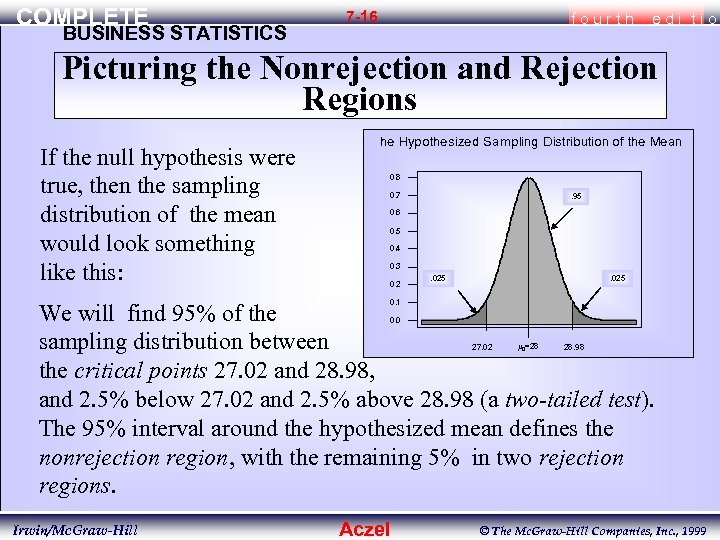
COMPLETE BUSINESS STATISTICS 7 -16 fourth edi tio Picturing the Nonrejection and Rejection Regions If the null hypothesis were true, then the sampling distribution of the mean would look something like this: T he Hypothesized Sampling Distribution of the Mean 0. 8 0. 7 . 95 0. 6 0. 5 0. 4 0. 3 0. 2 . 025 0. 1 We will find 95% of the sampling distribution between the critical points 27. 02 and 28. 98, and 2. 5% below 27. 02 and 2. 5% above 28. 98 (a two-tailed test). The 95% interval around the hypothesized mean defines the nonrejection region, with the remaining 5% in two rejection regions. 0. 0 27. 02 Irwin/Mc. Graw-Hill Aczel 0=28 28. 98 © The Mc. Graw-Hill Companies, Inc. , 1999
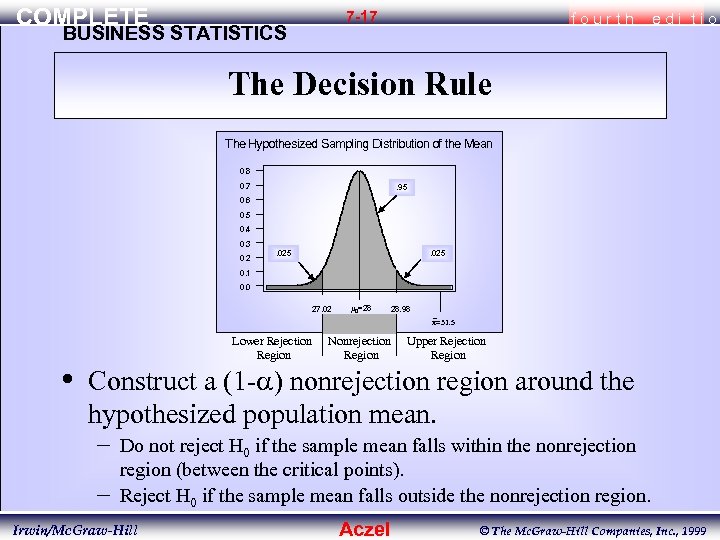
COMPLETE 7 -17 BUSINESS STATISTICS fourth edi tio The Decision Rule The Hypothesized Sampling Distribution of the Mean 0. 8 0. 7 . 95 0. 6 0. 5 0. 4 0. 3 0. 2 . 025 0. 1 0. 0 27. 02 0=28 28. 98 x • Lower Rejection Region Nonrejection Region Upper Rejection Region Construct a (1 - ) nonrejection region around the hypothesized population mean. – – Do not reject H 0 if the sample mean falls within the nonrejection region (between the critical points). Reject H 0 if the sample mean falls outside the nonrejection region. Irwin/Mc. Graw-Hill Aczel © The Mc. Graw-Hill Companies, Inc. , 1999
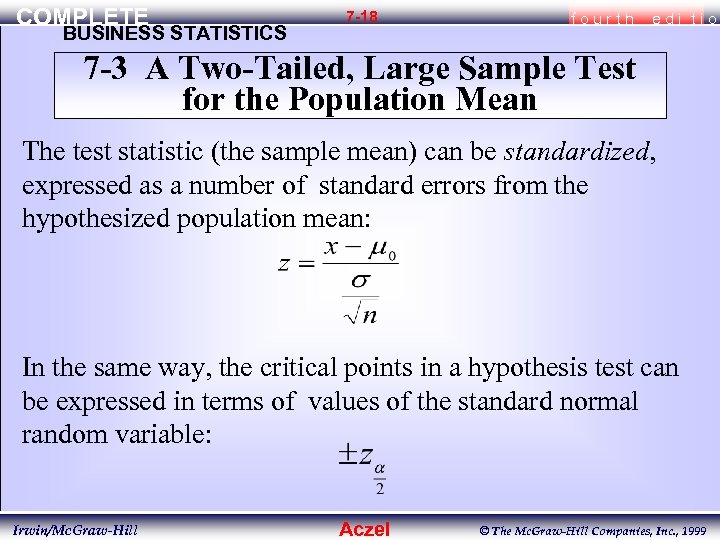
COMPLETE BUSINESS STATISTICS 7 -18 fourth edi tio 7 -3 A Two-Tailed, Large Sample Test for the Population Mean The test statistic (the sample mean) can be standardized, expressed as a number of standard errors from the hypothesized population mean: In the same way, the critical points in a hypothesis test can be expressed in terms of values of the standard normal random variable: Irwin/Mc. Graw-Hill Aczel © The Mc. Graw-Hill Companies, Inc. , 1999
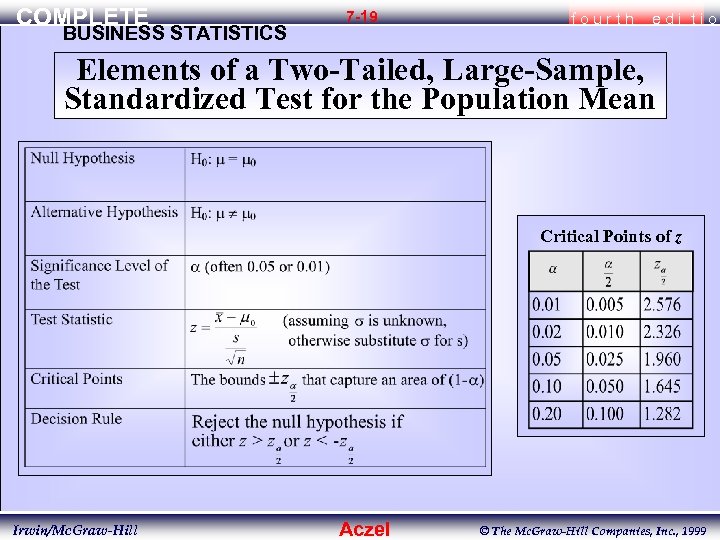
COMPLETE BUSINESS STATISTICS 7 -19 fourth edi tio Elements of a Two-Tailed, Large-Sample, Standardized Test for the Population Mean Critical Points of z Irwin/Mc. Graw-Hill Aczel © The Mc. Graw-Hill Companies, Inc. , 1999
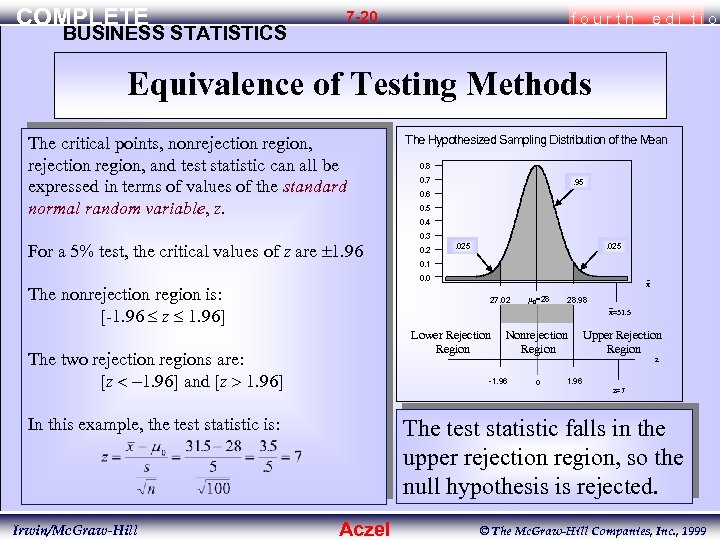
COMPLETE BUSINESS STATISTICS 7 -20 fourth edi tio Equivalence of Testing Methods The critical points, nonrejection region, and test statistic can all be expressed in terms of values of the standard normal random variable, z. For a 5% test, the critical values of z are 1. 96 The Hypothesized Sampling Distribution of the Mean 0. 8 0. 7 . 95 0. 6 0. 5 0. 4 0. 3 0. 2 . 025 0. 1 0. 0 The nonrejection region is: [-1. 96 z 1. 96] 27. 02 0=28 28. 98 x Lower Rejection Region The two rejection regions are: [z 1. 96] and [z 1. 96] Nonrejection Region -1. 96 In this example, the test statistic is: Irwin/Mc. Graw-Hill x Upper Rejection Region z 1. 96 z The test statistic falls in the upper rejection region, so the null hypothesis is rejected. Aczel © The Mc. Graw-Hill Companies, Inc. , 1999
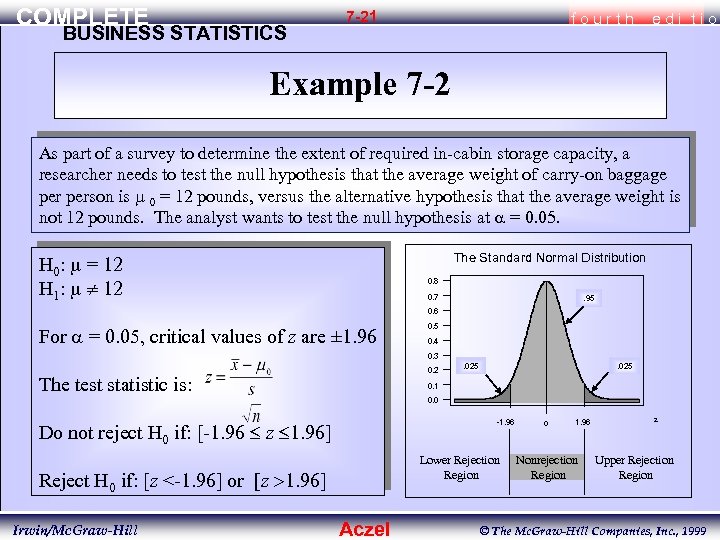
COMPLETE BUSINESS STATISTICS 7 -21 fourth edi tio Example 7 -2 As part of a survey to determine the extent of required in-cabin storage capacity, a researcher needs to test the null hypothesis that the average weight of carry-on baggage person is = 12 pounds, versus the alternative hypothesis that the average weight is not 12 pounds. The analyst wants to test the null hypothesis at = 0. 05. The Standard Normal Distribution H 0: = 12 H 1: 12 0. 8 0. 7 . 95 0. 6 For = 0. 05, critical values of z are ± 1. 96 0. 5 0. 4 0. 3 0. 2 The test statistic is: . 025 0. 1 0. 0 -1. 96 Do not reject H 0 if: [-1. 96 z 1. 96] Lower Rejection Region Reject H 0 if: [z <-1. 96] or z 1. 96] Irwin/Mc. Graw-Hill Aczel 1. 96 Nonrejection Region z Upper Rejection Region © The Mc. Graw-Hill Companies, Inc. , 1999
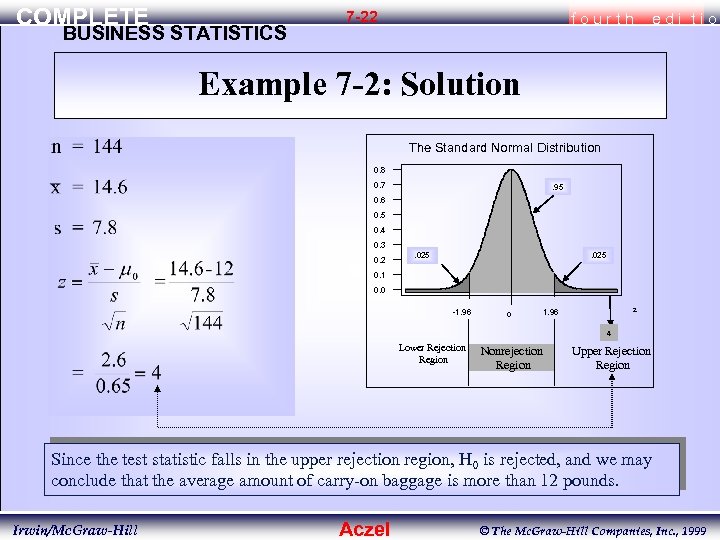
COMPLETE BUSINESS STATISTICS 7 -22 fourth edi tio Example 7 -2: Solution The Standard Normal Distribution 0. 8 0. 7 . 95 0. 6 0. 5 0. 4 0. 3 0. 2 . 025 0. 1 0. 0 -1. 96 z 1. 96 Lower Rejection Region Nonrejection Region Upper Rejection Region Since the test statistic falls in the upper rejection region, H 0 is rejected, and we may conclude that the average amount of carry-on baggage is more than 12 pounds. Irwin/Mc. Graw-Hill Aczel © The Mc. Graw-Hill Companies, Inc. , 1999
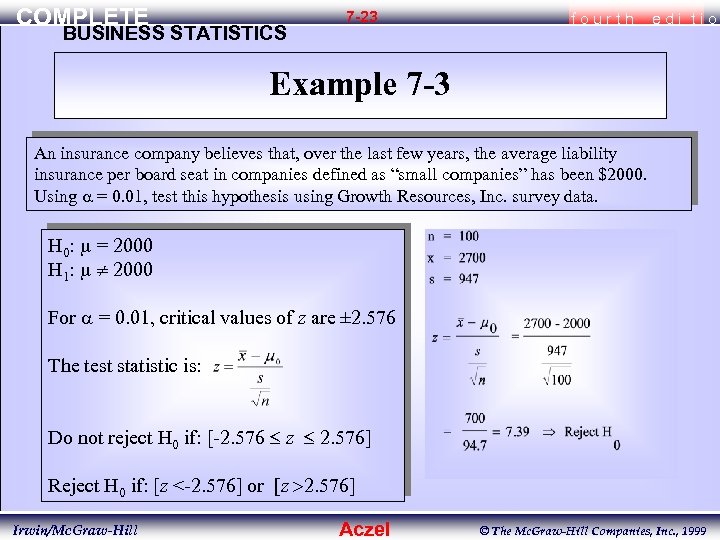
COMPLETE BUSINESS STATISTICS 7 -23 fourth edi tio Example 7 -3 An insurance company believes that, over the last few years, the average liability insurance per board seat in companies defined as “small companies” has been $2000. Using = 0. 01, test this hypothesis using Growth Resources, Inc. survey data. H 0: = 2000 H 1: 2000 For = 0. 01, critical values of z are ± 2. 576 The test statistic is: Do not reject H 0 if: [-2. 576 z 2. 576] Reject H 0 if: [z <-2. 576] or z 2. 576] Irwin/Mc. Graw-Hill Aczel © The Mc. Graw-Hill Companies, Inc. , 1999
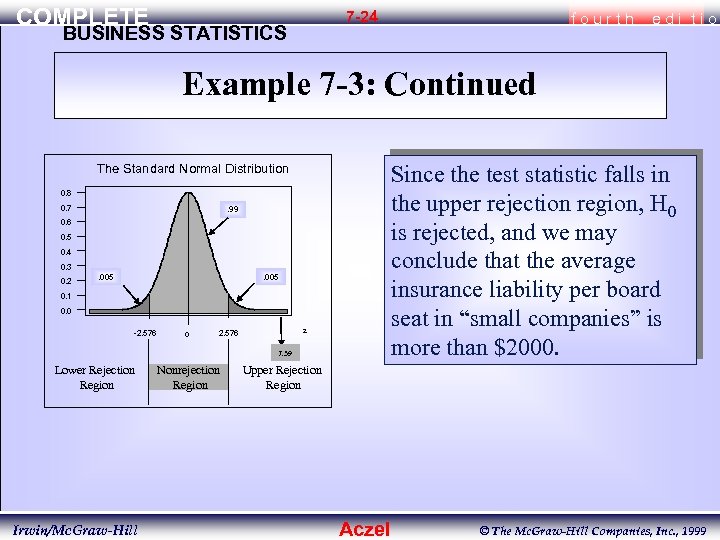
COMPLETE 7 -24 BUSINESS STATISTICS fourth edi tio Example 7 -3: Continued Since the test statistic falls in the upper rejection region, H 0 is rejected, and we may conclude that the average insurance liability per board seat in “small companies” is more than $2000. The Standard Normal Distribution 0. 8 0. 7 . 99 0. 6 0. 5 0. 4 0. 3 0. 2 . 005 0. 1 0. 0 -2. 576 z 2. 576 Lower Rejection Region Irwin/Mc. Graw-Hill Nonrejection Region Upper Rejection Region Aczel © The Mc. Graw-Hill Companies, Inc. , 1999
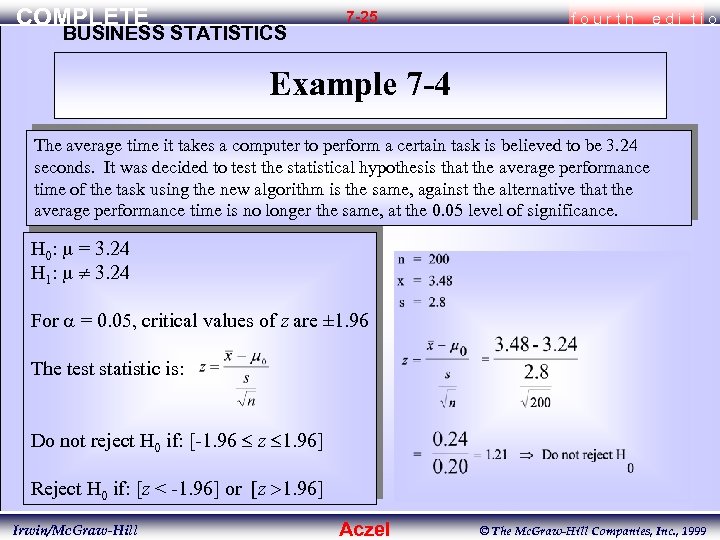
COMPLETE BUSINESS STATISTICS 7 -25 fourth edi tio Example 7 -4 The average time it takes a computer to perform a certain task is believed to be 3. 24 seconds. It was decided to test the statistical hypothesis that the average performance time of the task using the new algorithm is the same, against the alternative that the average performance time is no longer the same, at the 0. 05 level of significance. H 0: = 3. 24 H 1: 3. 24 For = 0. 05, critical values of z are ± 1. 96 The test statistic is: Do not reject H 0 if: [-1. 96 z 1. 96] Reject H 0 if: [z < -1. 96] or z 1. 96] Irwin/Mc. Graw-Hill Aczel © The Mc. Graw-Hill Companies, Inc. , 1999
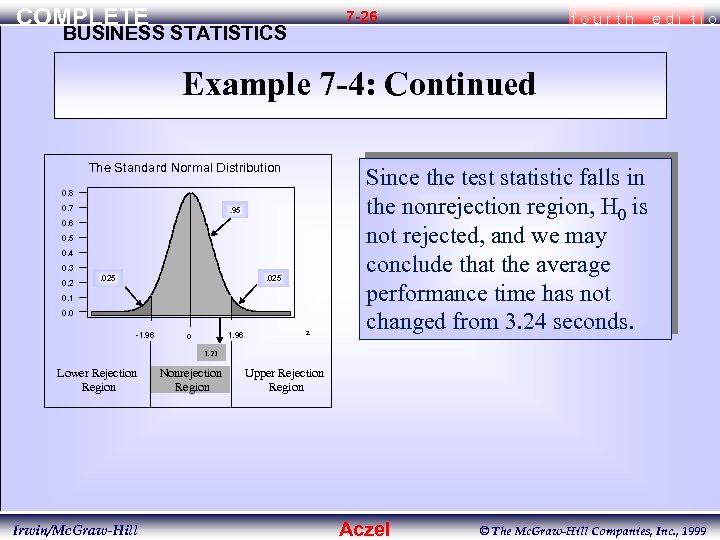
COMPLETE 7 -26 BUSINESS STATISTICS fourth edi tio Example 7 -4: Continued The Standard Normal Distribution 0. 8 0. 7 . 95 0. 6 0. 5 0. 4 0. 3 0. 2 . 025 0. 1 0. 0 -1. 96 z Since the test statistic falls in the nonrejection region, H 0 is not rejected, and we may conclude that the average performance time has not changed from 3. 24 seconds. Lower Rejection Region Irwin/Mc. Graw-Hill Nonrejection Region Upper Rejection Region Aczel © The Mc. Graw-Hill Companies, Inc. , 1999
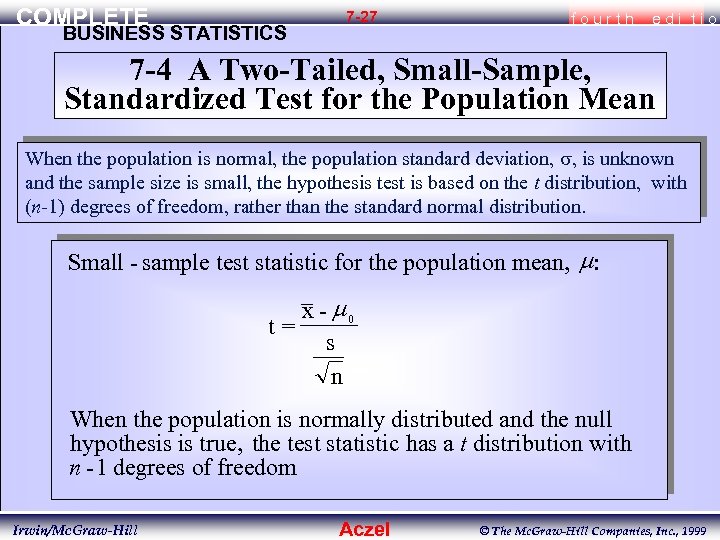
COMPLETE BUSINESS STATISTICS 7 -27 fourth edi tio 7 -4 A Two-Tailed, Small-Sample, Standardized Test for the Population Mean When the population is normal, the population standard deviation, , is unknown and the sample size is small, the hypothesis test is based on the t distribution, with (n-1) degrees of freedom, rather than the standard normal distribution. Small - sample test statistic for the population mean, : x - 0 t= s n When the population is normally distributed and the null hypothesis is true, the test statistic has a t distribution with n -1 degrees of freedom Irwin/Mc. Graw-Hill Aczel © The Mc. Graw-Hill Companies, Inc. , 1999
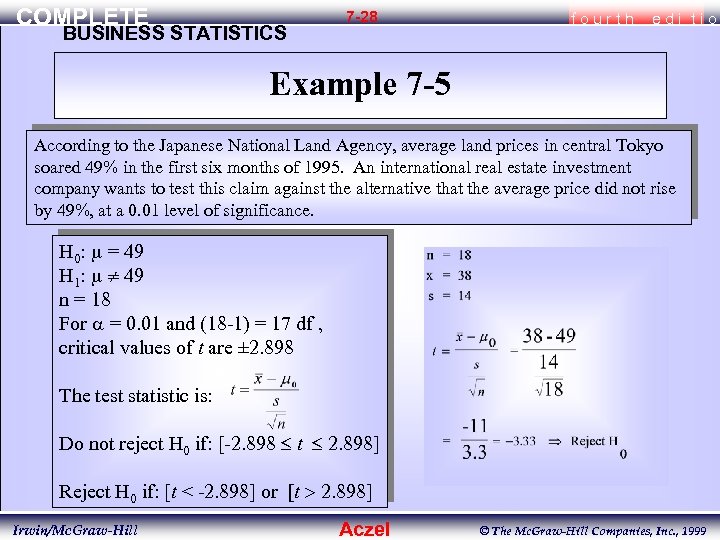
COMPLETE BUSINESS STATISTICS 7 -28 fourth edi tio Example 7 -5 According to the Japanese National Land Agency, average land prices in central Tokyo soared 49% in the first six months of 1995. An international real estate investment company wants to test this claim against the alternative that the average price did not rise by 49%, at a 0. 01 level of significance. H 0: = 49 H 1: 49 n = 18 For = 0. 01 and (18 -1) = 17 df , critical values of t are ± 2. 898 The test statistic is: Do not reject H 0 if: [-2. 898 t 2. 898] Reject H 0 if: [t < -2. 898] or t 2. 898] Irwin/Mc. Graw-Hill Aczel © The Mc. Graw-Hill Companies, Inc. , 1999
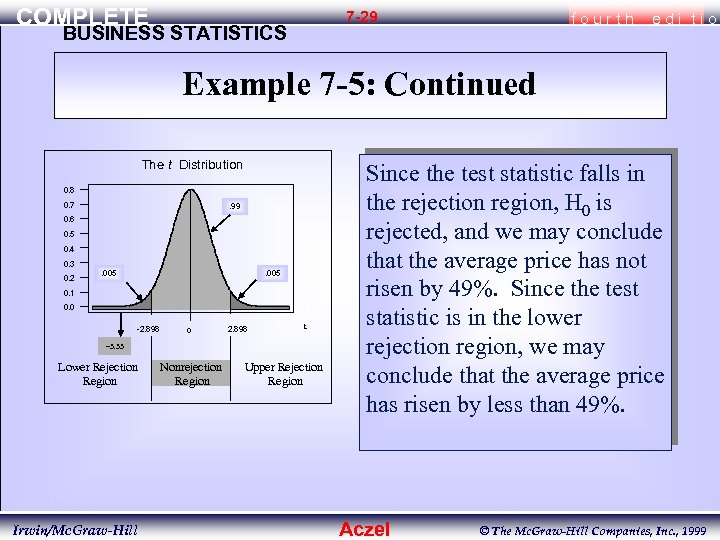
COMPLETE 7 -29 BUSINESS STATISTICS fourth edi tio Example 7 -5: Continued The t Distribution 0. 8 0. 7 . 99 0. 6 0. 5 0. 4 0. 3 0. 2 . 005 0. 1 0. 0 -2. 898 t Lower Rejection Region Irwin/Mc. Graw-Hill Nonrejection Region Upper Rejection Region Since the test statistic falls in the rejection region, H 0 is rejected, and we may conclude that the average price has not risen by 49%. Since the test statistic is in the lower rejection region, we may conclude that the average price has risen by less than 49%. Aczel © The Mc. Graw-Hill Companies, Inc. , 1999
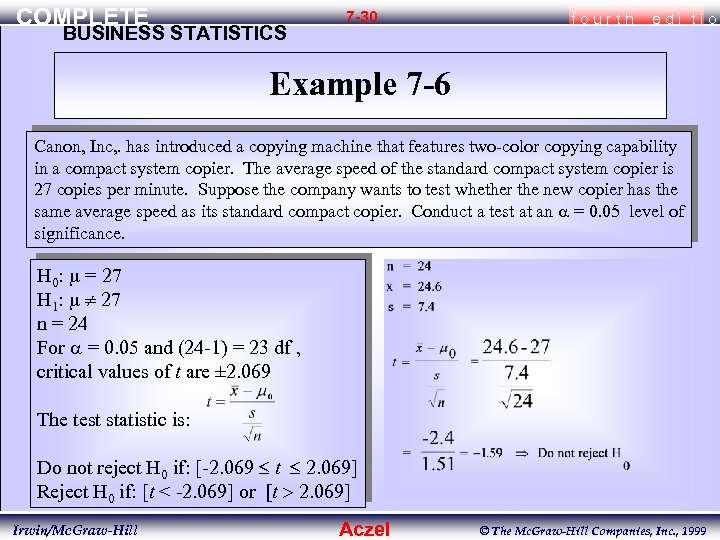
COMPLETE BUSINESS STATISTICS 7 -30 fourth edi tio Example 7 -6 Canon, Inc, . has introduced a copying machine that features two-color copying capability in a compact system copier. The average speed of the standard compact system copier is 27 copies per minute. Suppose the company wants to test whether the new copier has the same average speed as its standard compact copier. Conduct a test at an = 0. 05 level of significance. H 0: = 27 H 1: 27 n = 24 For = 0. 05 and (24 -1) = 23 df , critical values of t are ± 2. 069 The test statistic is: Do not reject H 0 if: [-2. 069 t 2. 069] Reject H 0 if: [t < -2. 069] or t 2. 069] Irwin/Mc. Graw-Hill Aczel © The Mc. Graw-Hill Companies, Inc. , 1999
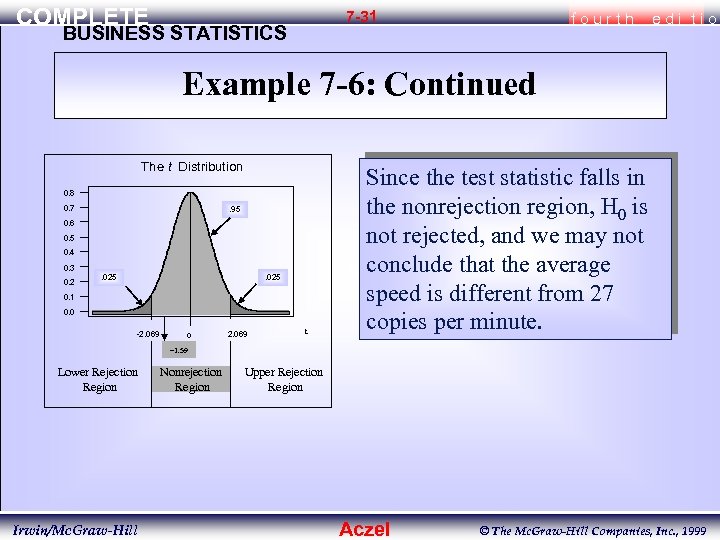
COMPLETE 7 -31 BUSINESS STATISTICS fourth edi tio Example 7 -6: Continued The t Distribution 0. 8 0. 7 . 95 0. 6 0. 5 0. 4 0. 3 0. 2 . 025 0. 1 0. 0 -2. 069 t Since the test statistic falls in the nonrejection region, H 0 is not rejected, and we may not conclude that the average speed is different from 27 copies per minute. Lower Rejection Region Irwin/Mc. Graw-Hill Nonrejection Region Upper Rejection Region Aczel © The Mc. Graw-Hill Companies, Inc. , 1999
COMPLETE BUSINESS STATISTICS 7 -32 fourth edi tio Statistical Significance While the null hypothesis is maintained to be true throughout a hypothesis test, until sample data lead to a rejection, the aim of a hypothesis test is often to disprove the null hypothesis in favor of the alternative hypothesis. This is because we can determine and regulate , the probability of a Type I error, making it as small as we desire, such as 0. 01 or 0. 05. Thus, when we reject a null hypothesis, we have a high level of confidence in our decision, since we know there is a small probability that we have made an error. A given sample mean will not lead to a rejection of a null hypothesis unless it lies in outside the nonrejection region of the test. That is, the nonrejection region includes all sample means that are not significantly different, in a statistical sense, from the hypothesized mean. The rejection regions, in turn, define the values of sample means that are significantly different, in a statistical sense, from the hypothesized mean. Irwin/Mc. Graw-Hill Aczel © The Mc. Graw-Hill Companies, Inc. , 1999
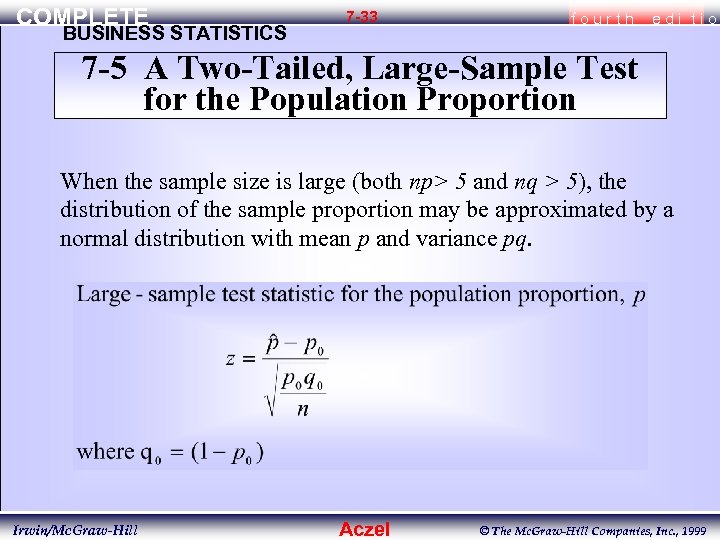
COMPLETE BUSINESS STATISTICS 7 -33 fourth edi tio 7 -5 A Two-Tailed, Large-Sample Test for the Population Proportion When the sample size is large (both np> 5 and nq > 5), the distribution of the sample proportion may be approximated by a normal distribution with mean p and variance pq. Irwin/Mc. Graw-Hill Aczel © The Mc. Graw-Hill Companies, Inc. , 1999
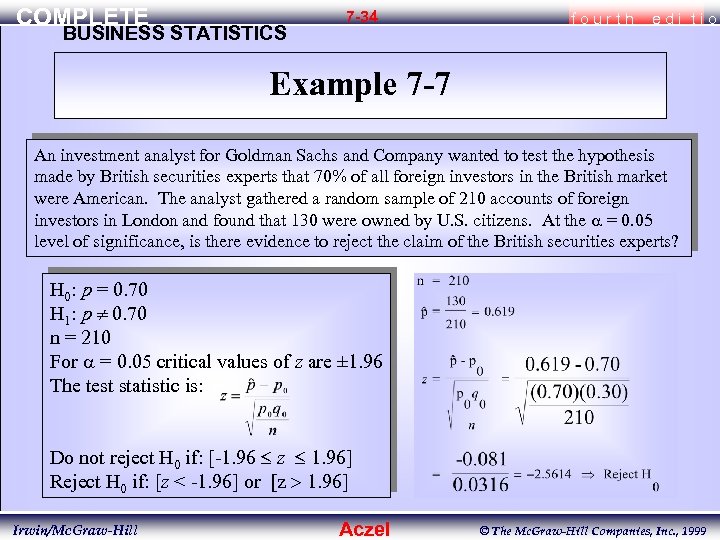
COMPLETE BUSINESS STATISTICS 7 -34 fourth edi tio Example 7 -7 An investment analyst for Goldman Sachs and Company wanted to test the hypothesis made by British securities experts that 70% of all foreign investors in the British market were American. The analyst gathered a random sample of 210 accounts of foreign investors in London and found that 130 were owned by U. S. citizens. At the = 0. 05 level of significance, is there evidence to reject the claim of the British securities experts? H 0: p = 0. 70 H 1: p 0. 70 n = 210 For = 0. 05 critical values of z are ± 1. 96 The test statistic is: Do not reject H 0 if: [-1. 96 z 1. 96] Reject H 0 if: [z < -1. 96] or z 1. 96] Irwin/Mc. Graw-Hill Aczel © The Mc. Graw-Hill Companies, Inc. , 1999
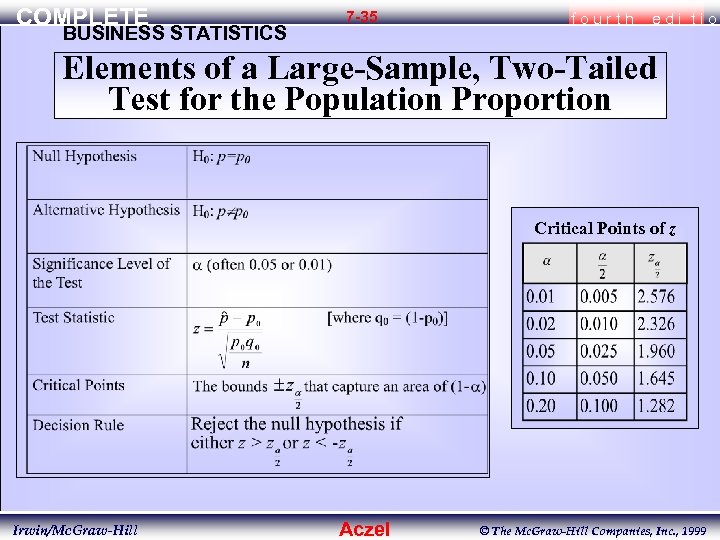
COMPLETE BUSINESS STATISTICS 7 -35 fourth edi tio Elements of a Large-Sample, Two-Tailed Test for the Population Proportion Critical Points of z Irwin/Mc. Graw-Hill Aczel © The Mc. Graw-Hill Companies, Inc. , 1999
COMPLETE BUSINESS STATISTICS 7 -36 fourth edi tio 7 -6 One-Tailed Tests In a one-tailed test, the question of interest is whether the population parameter is greater than (or less than) a hypothesized value. In quality control, it is more meaningful to test the null hypothesis that the proportion of defective items produced is less than or equal to 0. 10 versus the alternative that the proportion of defective items is more than 0. 10. H 0: p 0. 10 H 1: p 0. 10 This leads to a right-tailed test, since the entire rejection region is in the right tail of the distribution. Irwin/Mc. Graw-Hill Aczel © The Mc. Graw-Hill Companies, Inc. , 1999
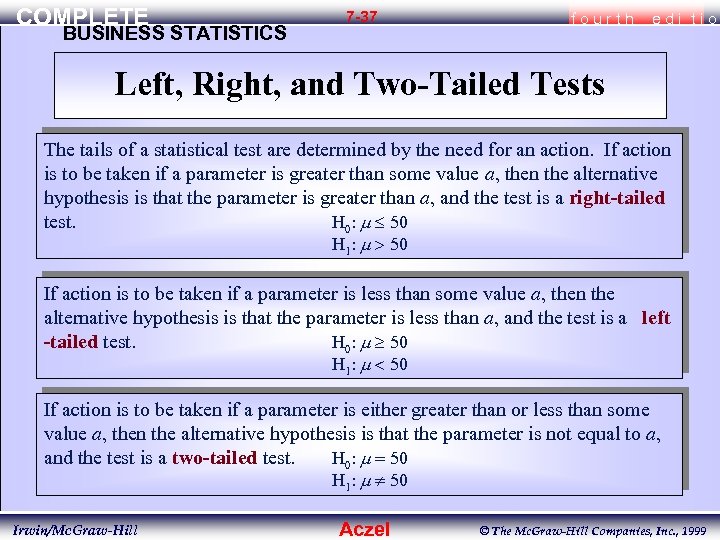
COMPLETE BUSINESS STATISTICS 7 -37 fourth edi tio Left, Right, and Two-Tailed Tests The tails of a statistical test are determined by the need for an action. If action is to be taken if a parameter is greater than some value a, then the alternative hypothesis is that the parameter is greater than a, and the test is a right-tailed test. H 0: 50 H 1: 50 If action is to be taken if a parameter is less than some value a, then the alternative hypothesis is that the parameter is less than a, and the test is a left -tailed test. H 0: 50 H 1: 50 If action is to be taken if a parameter is either greater than or less than some value a, then the alternative hypothesis is that the parameter is not equal to a, and the test is a two-tailed test. H 0: 50 H 1: 50 Irwin/Mc. Graw-Hill Aczel © The Mc. Graw-Hill Companies, Inc. , 1999
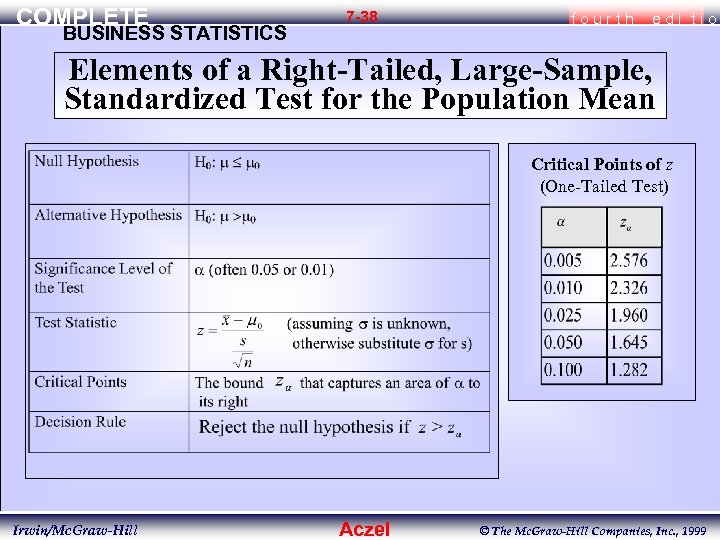
COMPLETE BUSINESS STATISTICS 7 -38 fourth edi tio Elements of a Right-Tailed, Large-Sample, Standardized Test for the Population Mean Critical Points of z (One-Tailed Test) Irwin/Mc. Graw-Hill Aczel © The Mc. Graw-Hill Companies, Inc. , 1999
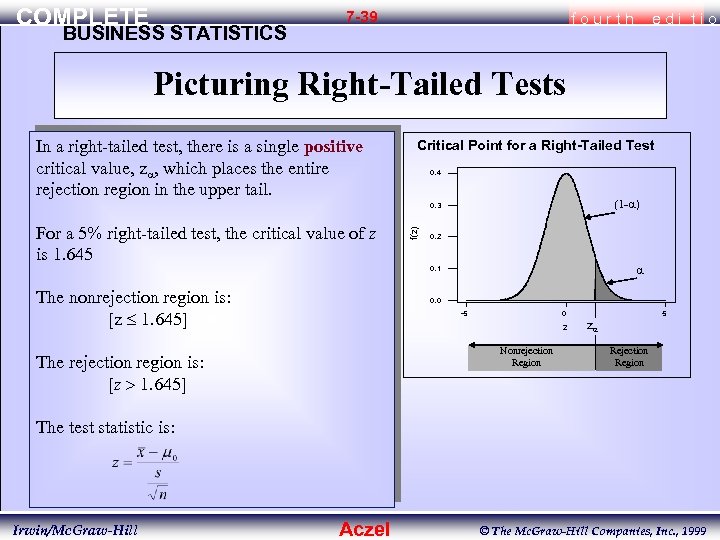
COMPLETE BUSINESS STATISTICS 7 -39 fourth edi tio Picturing Right-Tailed Tests In a right-tailed test, there is a single positive critical value, z , which places the entire rejection region in the upper tail. Critical Point for a Right-Tailed Test 0. 4 (1 - ) For a 5% right-tailed test, the critical value of z is f(z) 0. 3 0. 2 0. 1 The nonrejection region is: [z 1. 645] 0. 0 -5 0 z Nonrejection Region The rejection region is: [z 1. 645] 5 z Rejection Region The test statistic is: Irwin/Mc. Graw-Hill Aczel © The Mc. Graw-Hill Companies, Inc. , 1999
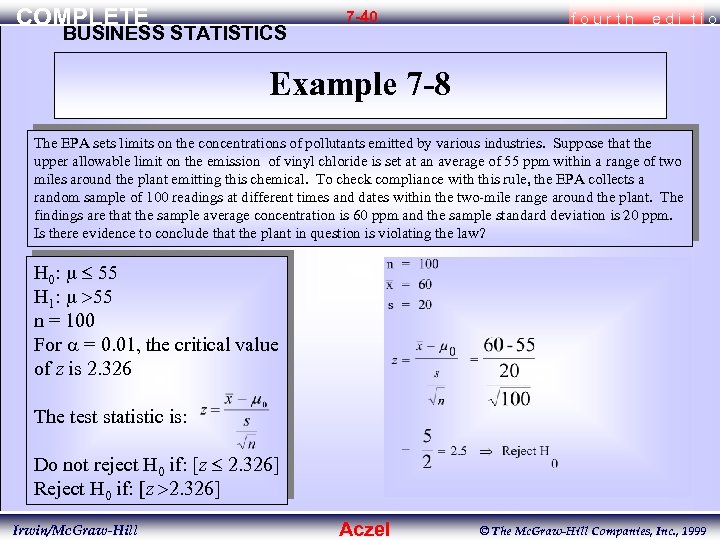
COMPLETE BUSINESS STATISTICS 7 -40 fourth edi tio Example 7 -8 The EPA sets limits on the concentrations of pollutants emitted by various industries. Suppose that the upper allowable limit on the emission of vinyl chloride is set at an average of 55 ppm within a range of two miles around the plant emitting this chemical. To check compliance with this rule, the EPA collects a random sample of 100 readings at different times and dates within the two-mile range around the plant. The findings are that the sample average concentration is 60 ppm and the sample standard deviation is 20 ppm. Is there evidence to conclude that the plant in question is violating the law? H 0: 55 H 1: 55 n = 100 For = 0. 01, the critical value of z is 2. 326 The test statistic is: Do not reject H 0 if: [z 2. 326] Reject H 0 if: z 2. 326] Irwin/Mc. Graw-Hill Aczel © The Mc. Graw-Hill Companies, Inc. , 1999
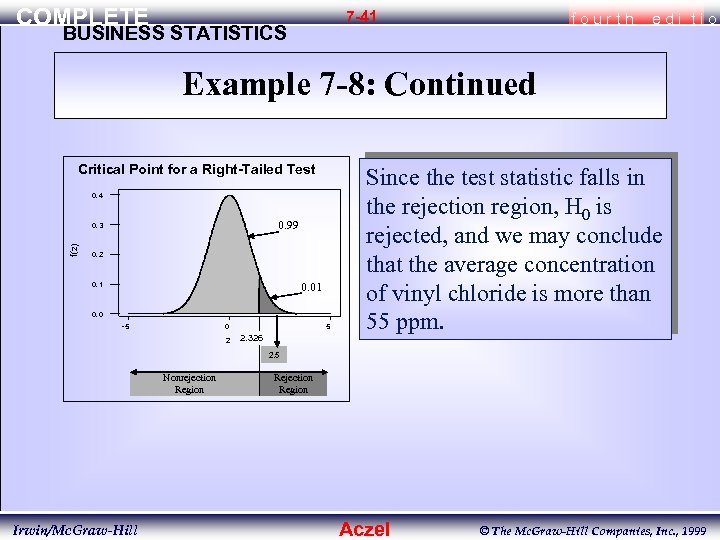
COMPLETE 7 -41 BUSINESS STATISTICS fourth edi tio Example 7 -8: Continued Critical Point for a Right-Tailed Test 0. 4 0. 99 f(z) 0. 3 0. 2 0. 1 0. 0 -5 0 z 5 2. 326 Since the test statistic falls in the rejection region, H 0 is rejected, and we may conclude that the average concentration of vinyl chloride is more than 55 ppm. 2. 5 Nonrejection Region Irwin/Mc. Graw-Hill Rejection Region Aczel © The Mc. Graw-Hill Companies, Inc. , 1999
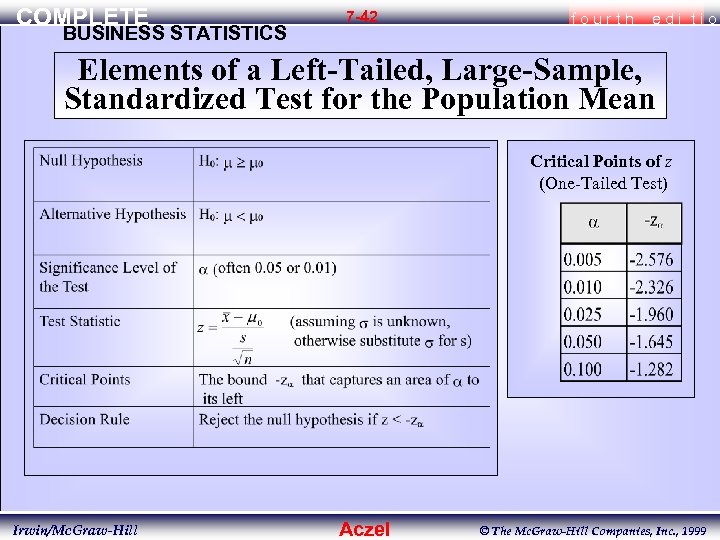
COMPLETE BUSINESS STATISTICS 7 -42 fourth edi tio Elements of a Left-Tailed, Large-Sample, Standardized Test for the Population Mean Critical Points of z (One-Tailed Test) Irwin/Mc. Graw-Hill Aczel © The Mc. Graw-Hill Companies, Inc. , 1999
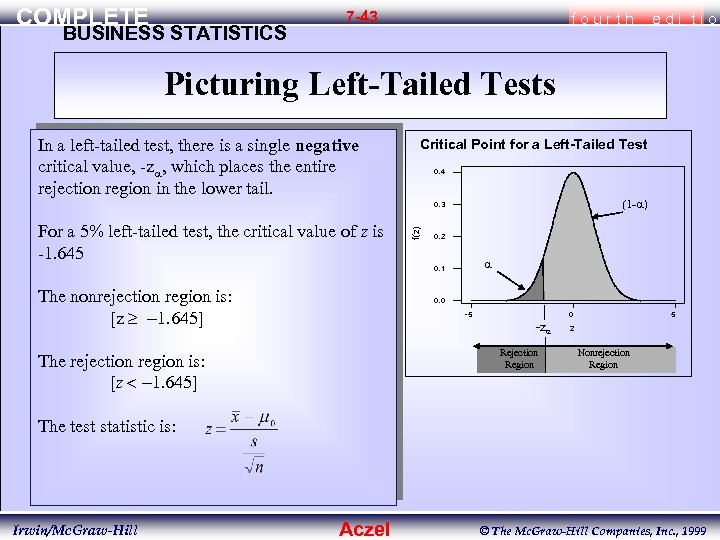
COMPLETE BUSINESS STATISTICS 7 -43 fourth edi tio Picturing Left-Tailed Tests In a left-tailed test, there is a single negative critical value, -z , which places the entire rejection region in the lower tail. Critical Point for a Left-Tailed Test 0. 4 (1 - ) For a 5% left-tailed test, the critical value of z is - f(z) 0. 3 0. 2 0. 1 The nonrejection region is: [z 1. 645] 0. 0 -5 0 -z Rejection Region The rejection region is: [z 1. 645] 5 z Nonrejection Region The test statistic is: Irwin/Mc. Graw-Hill Aczel © The Mc. Graw-Hill Companies, Inc. , 1999
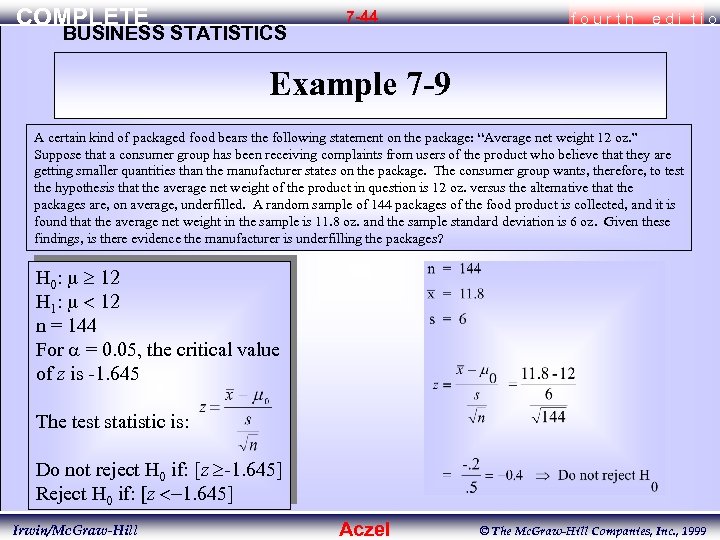
COMPLETE BUSINESS STATISTICS 7 -44 fourth edi tio Example 7 -9 A certain kind of packaged food bears the following statement on the package: “Average net weight 12 oz. ” Suppose that a consumer group has been receiving complaints from users of the product who believe that they are getting smaller quantities than the manufacturer states on the package. The consumer group wants, therefore, to test the hypothesis that the average net weight of the product in question is 12 oz. versus the alternative that the packages are, on average, underfilled. A random sample of 144 packages of the food product is collected, and it is found that the average net weight in the sample is 11. 8 oz. and the sample standard deviation is 6 oz. Given these findings, is there evidence the manufacturer is underfilling the packages? H 0: 12 H 1: 12 n = 144 For = 0. 05, the critical value of z is -1. 645 The test statistic is: Do not reject H 0 if: [z -1. 645] Reject H 0 if: z ] Irwin/Mc. Graw-Hill Aczel © The Mc. Graw-Hill Companies, Inc. , 1999
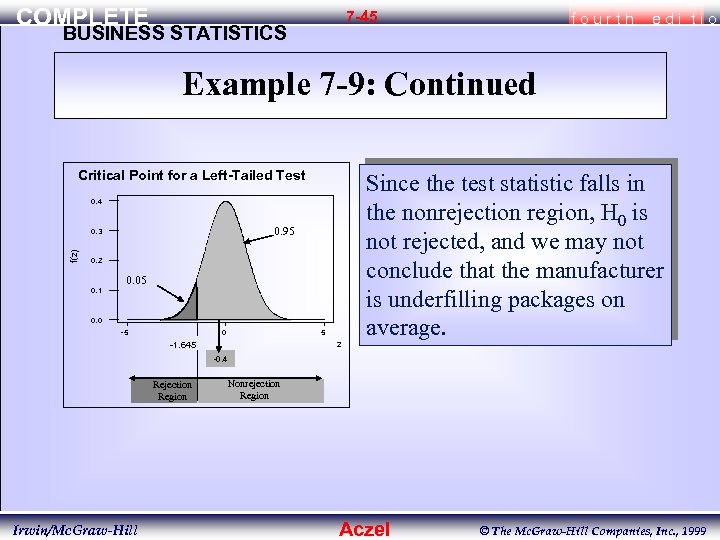
COMPLETE 7 -45 BUSINESS STATISTICS fourth edi tio Example 7 -9: Continued Critical Point for a Left-Tailed Test 0. 4 0. 95 f(z) 0. 3 0. 2 0. 1 0. 0 -5 0 5 z -1. 645 Since the test statistic falls in the nonrejection region, H 0 is not rejected, and we may not conclude that the manufacturer is underfilling packages on average. -0. 4 Rejection Region Irwin/Mc. Graw-Hill Nonrejection Region Aczel © The Mc. Graw-Hill Companies, Inc. , 1999
COMPLETE BUSINESS STATISTICS 7 -46 fourth edi tio Example 7 -9: Continued Using Excel • The NORMSINV function is used to determine the critical z-value. The NORMSDIST function is used to determine the p-value from the test statistic. The graph shows the standard normal (or z) distribution and the range of test statistic values that would result in a decision to reject the null hypothesis. Irwin/Mc. Graw-Hill Aczel © The Mc. Graw-Hill Companies, Inc. , 1999
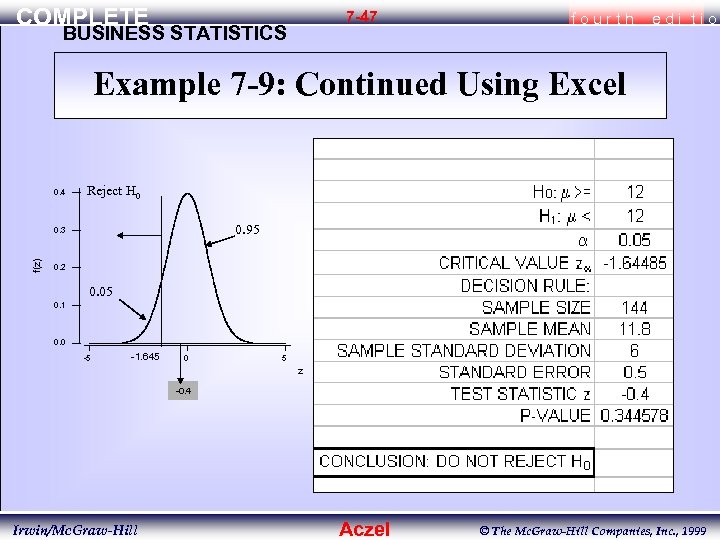
COMPLETE 7 -47 BUSINESS STATISTICS fourth edi tio Example 7 -9: Continued Using Excel 0. 4 Reject H 0 0. 95 f(z) 0. 3 0. 2 0. 1 0. 0 -5 -1. 645 0 5 z -0. 4 Irwin/Mc. Graw-Hill Aczel © The Mc. Graw-Hill Companies, Inc. , 1999
COMPLETE BUSINESS STATISTICS 7 -48 fourth edi tio Example 7 -10: Using Excel • • The state newspaper believes it takes a newspaper 5 seconds to travel from the driver’s car to the doorstep. This is a cause for concern because competitors claim their drivers throw the paper in 4. 58 seconds, speeding up overall delivery time. If there is such a difference, management has decided to hire a former quarterback to assist its drivers with their throwing technique. The paper has a statistician accompany 40 different drivers to find out the real time, which ended up being 4. 91 seconds. At the 0. 05 level of significance, is there a problem? Use the STDEVP Function to find the population standard deviation of the data set. Use the AVERAGE Function to find the mean. Use the ZTEST Function to find the test statistic. Irwin/Mc. Graw-Hill Aczel © The Mc. Graw-Hill Companies, Inc. , 1999
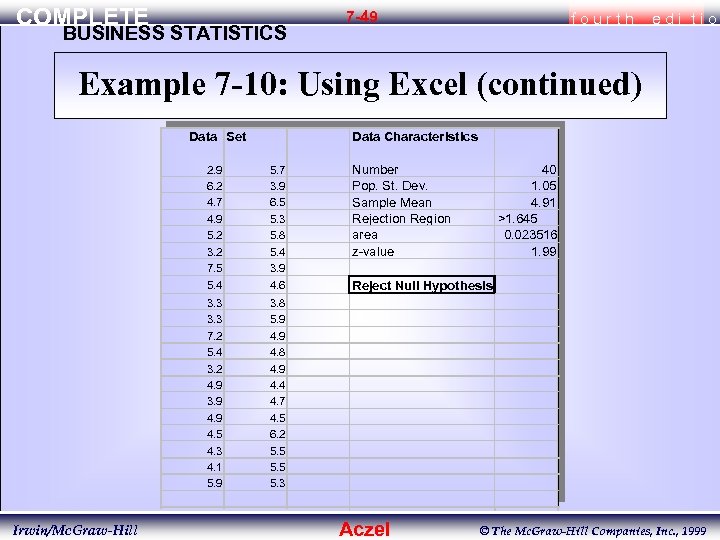
COMPLETE BUSINESS STATISTICS 7 -49 fourth edi tio Example 7 -10: Using Excel (continued) Data Set Data Characteristics 2. 9 6. 2 4. 7 4. 9 5. 2 3. 2 7. 5 5. 3 5. 8 5. 4 3. 9 5. 4 4. 6 3. 3 7. 2 5. 4 3. 2 4. 9 3. 9 4. 5 4. 3 4. 1 5. 9 Irwin/Mc. Graw-Hill 5. 7 3. 9 6. 5 Number Pop. St. Dev. Sample Mean Rejection Region area z-value 40 1. 05 4. 91 >1. 645 0. 023516 1. 99 3. 8 5. 9 4. 8 4. 9 4. 4 4. 7 4. 5 6. 2 5. 5 5. 3 Reject Null Hypothesis Aczel © The Mc. Graw-Hill Companies, Inc. , 1999
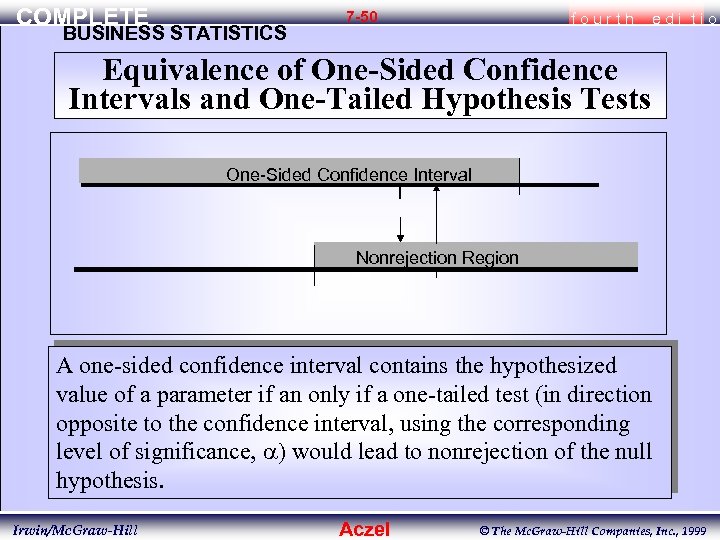
COMPLETE BUSINESS STATISTICS 7 -50 fourth edi tio Equivalence of One-Sided Confidence Intervals and One-Tailed Hypothesis Tests One-Sided Confidence Interval Nonrejection Region A one-sided confidence interval contains the hypothesized value of a parameter if an only if a one-tailed test (in direction opposite to the confidence interval, using the corresponding level of significance, ) would lead to nonrejection of the null hypothesis. Irwin/Mc. Graw-Hill Aczel © The Mc. Graw-Hill Companies, Inc. , 1999
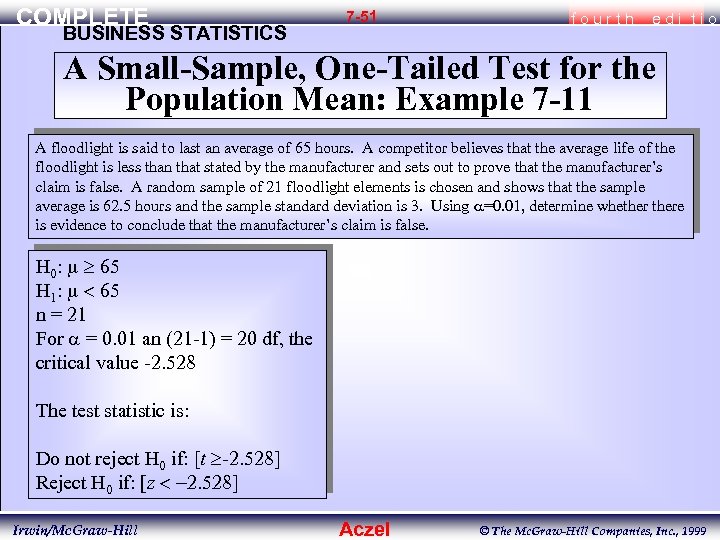
COMPLETE BUSINESS STATISTICS 7 -51 fourth edi tio A Small-Sample, One-Tailed Test for the Population Mean: Example 7 -11 A floodlight is said to last an average of 65 hours. A competitor believes that the average life of the floodlight is less than that stated by the manufacturer and sets out to prove that the manufacturer’s claim is false. A random sample of 21 floodlight elements is chosen and shows that the sample average is 62. 5 hours and the sample standard deviation is 3. Using =0. 01, determine whethere is evidence to conclude that the manufacturer’s claim is false. H 0: 65 H 1: 65 n = 21 For = 0. 01 an (21 -1) = 20 df, the critical value -2. 528 The test statistic is: Do not reject H 0 if: [t -2. 528] Reject H 0 if: z ] Irwin/Mc. Graw-Hill Aczel © The Mc. Graw-Hill Companies, Inc. , 1999
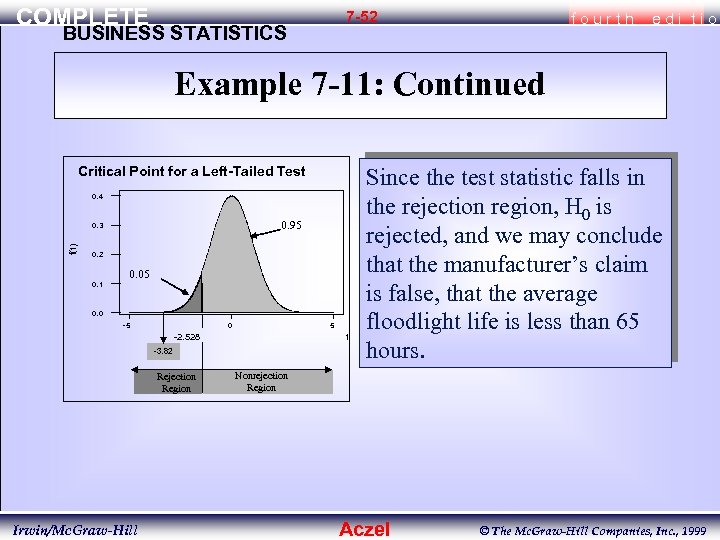
COMPLETE 7 -52 BUSINESS STATISTICS fourth edi tio Example 7 -11: Continued Critical Point for a Left-Tailed Test 0. 4 0. 95 f(t) 0. 3 0. 2 0. 1 0. 0 -5 0 5 t -2. 528 -3. 82 Rejection Region Irwin/Mc. Graw-Hill Since the test statistic falls in the rejection region, H 0 is rejected, and we may conclude that the manufacturer’s claim is false, that the average floodlight life is less than 65 hours. Nonrejection Region Aczel © The Mc. Graw-Hill Companies, Inc. , 1999
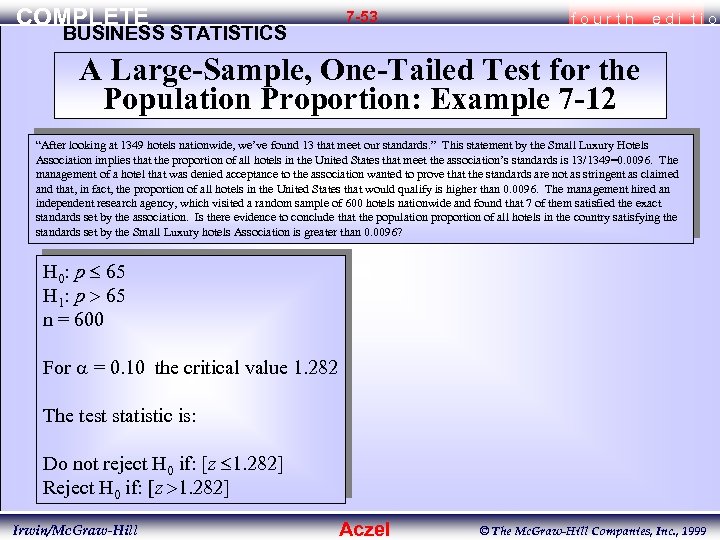
COMPLETE BUSINESS STATISTICS 7 -53 fourth edi tio A Large-Sample, One-Tailed Test for the Population Proportion: Example 7 -12 “After looking at 1349 hotels nationwide, we’ve found 13 that meet our standards. ” This statement by the Small Luxury Hotels Association implies that the proportion of all hotels in the United States that meet the association’s standards is 13/1349=0. 0096. The management of a hotel that was denied acceptance to the association wanted to prove that the standards are not as stringent as claimed and that, in fact, the proportion of all hotels in the United States that would qualify is higher than 0. 0096. The management hired an independent research agency, which visited a random sample of 600 hotels nationwide and found that 7 of them satisfied the exact standards set by the association. Is there evidence to conclude that the population proportion of all hotels in the country satisfying the standards set by the Small Luxury hotels Association is greater than 0. 0096? H 0: p 65 H 1: p 65 n = 600 For = 0. 10 the critical value 1. 282 The test statistic is: Do not reject H 0 if: [z 1. 282] Reject H 0 if: z ] Irwin/Mc. Graw-Hill Aczel © The Mc. Graw-Hill Companies, Inc. , 1999
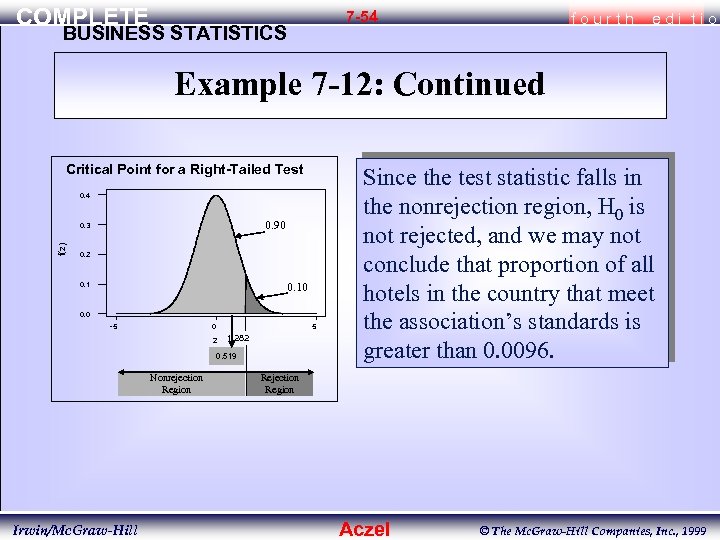
COMPLETE 7 -54 BUSINESS STATISTICS fourth edi tio Example 7 -12: Continued Critical Point for a Right-Tailed Test 0. 4 0. 90 f(z) 0. 3 0. 2 0. 1 0. 0 -5 0 5 z 1. 282 0. 519 Nonrejection Region Irwin/Mc. Graw-Hill Since the test statistic falls in the nonrejection region, H 0 is not rejected, and we may not conclude that proportion of all hotels in the country that meet the association’s standards is greater than 0. 0096. Rejection Region Aczel © The Mc. Graw-Hill Companies, Inc. , 1999
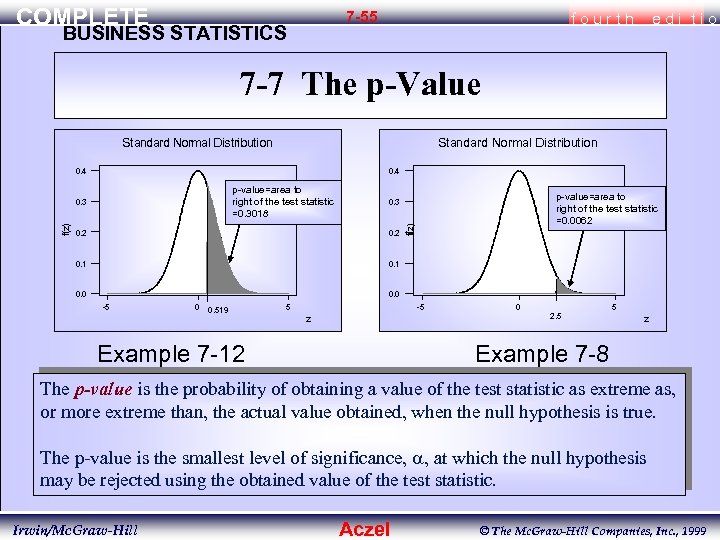
COMPLETE 7 -55 BUSINESS STATISTICS fourth edi tio 7 -7 The p-Value Standard Normal Distribution 0. 4 f(z) p-value=area to right of the test statistic =0. 0062 0. 3 0. 2 0. 1 f(z) p-value=area to right of the test statistic =0. 3018 0. 3 0. 1 0. 0 -5 0 0. 519 5 -5 z Example 7 -12 0 2. 5 5 z Example 7 -8 The p-value is the probability of obtaining a value of the test statistic as extreme as, or more extreme than, the actual value obtained, when the null hypothesis is true. The p-value is the smallest level of significance, , at which the null hypothesis may be rejected using the obtained value of the test statistic. Irwin/Mc. Graw-Hill Aczel © The Mc. Graw-Hill Companies, Inc. , 1999
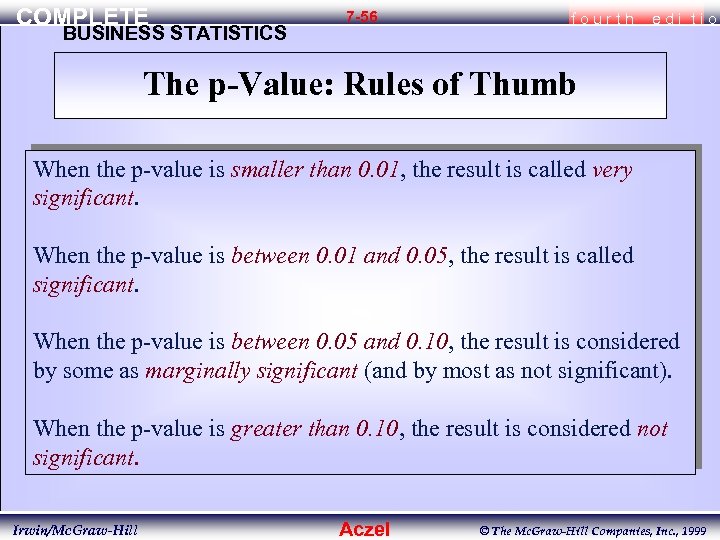
COMPLETE BUSINESS STATISTICS 7 -56 fourth edi tio The p-Value: Rules of Thumb When the p-value is smaller than 0. 01, the result is called very significant. When the p-value is between 0. 01 and 0. 05, the result is called significant. When the p-value is between 0. 05 and 0. 10, the result is considered by some as marginally significant (and by most as not significant). When the p-value is greater than 0. 10, the result is considered not significant. Irwin/Mc. Graw-Hill Aczel © The Mc. Graw-Hill Companies, Inc. , 1999
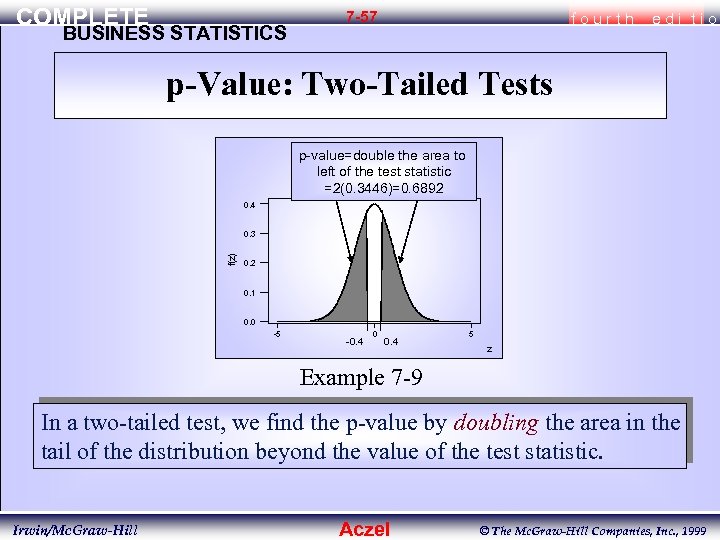
COMPLETE BUSINESS STATISTICS 7 -57 fourth edi tio p-Value: Two-Tailed Tests p-value=double the area to left of the test statistic =2(0. 3446)=0. 6892 0. 4 f(z) 0. 3 0. 2 0. 1 0. 0 -5 -0. 4 0 0. 4 5 z Example 7 -9 In a two-tailed test, we find the p-value by doubling the area in the tail of the distribution beyond the value of the test statistic. Irwin/Mc. Graw-Hill Aczel © The Mc. Graw-Hill Companies, Inc. , 1999
COMPLETE BUSINESS STATISTICS 7 -58 fourth edi tio The p-Value and Hypothesis Testing The further away in the tail of the distribution the test statistic falls, the smaller is the p-value and, hence, the more convinced we are that the null hypothesis is false and should be rejected. In a right-tailed test, the p-value is the area to the right of the test statistic is positive. In a left-tailed test, the p-value is the area to the left of the test statistic is negative. In a two-tailed test, the p-value is twice the area to the right of a positive test statistic or to the left of a negative test statistic. For a given level of significance, : Reject the null hypothesis if and only if p-value Irwin/Mc. Graw-Hill Aczel © The Mc. Graw-Hill Companies, Inc. , 1999
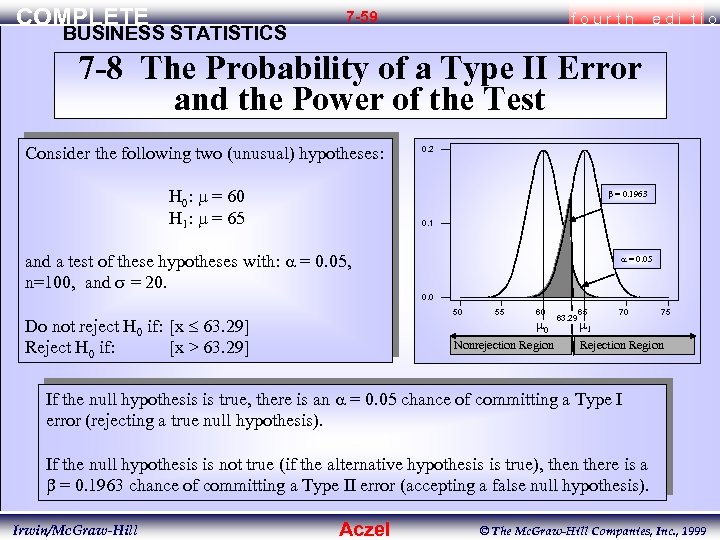
COMPLETE BUSINESS STATISTICS 7 -59 fourth edi tio 7 -8 The Probability of a Type II Error and the Power of the Test Consider the following two (unusual) hypotheses: H 0: = 60 H 1: = 65 0. 2 = 0. 1963 0. 1 and a test of these hypotheses with: = 0. 05, n=100, and = 20. = 0. 05 0. 0 50 Do not reject H 0 if: [x 63. 29] Reject H 0 if: [x > 63. 29] 55 60 Nonrejection Region 63. 29 65 70 75 Rejection Region If the null hypothesis is true, there is an = 0. 05 chance of committing a Type I error (rejecting a true null hypothesis). If the null hypothesis is not true (if the alternative hypothesis is true), then there is a = 0. 1963 chance of committing a Type II error (accepting a false null hypothesis). Irwin/Mc. Graw-Hill Aczel © The Mc. Graw-Hill Companies, Inc. , 1999
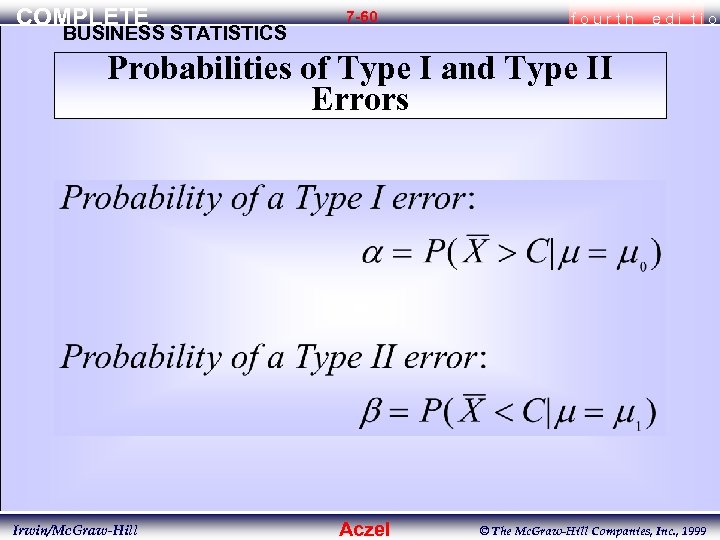
COMPLETE BUSINESS STATISTICS 7 -60 fourth edi tio Probabilities of Type I and Type II Errors Irwin/Mc. Graw-Hill Aczel © The Mc. Graw-Hill Companies, Inc. , 1999
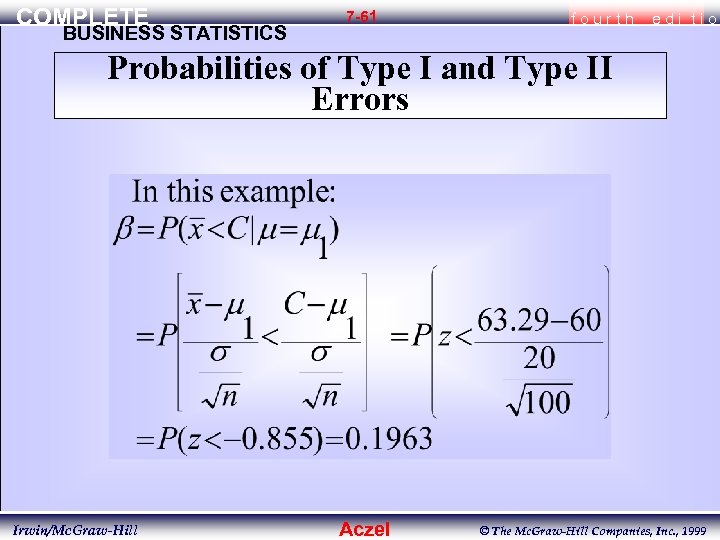
COMPLETE BUSINESS STATISTICS 7 -61 fourth edi tio Probabilities of Type I and Type II Errors Irwin/Mc. Graw-Hill Aczel © The Mc. Graw-Hill Companies, Inc. , 1999
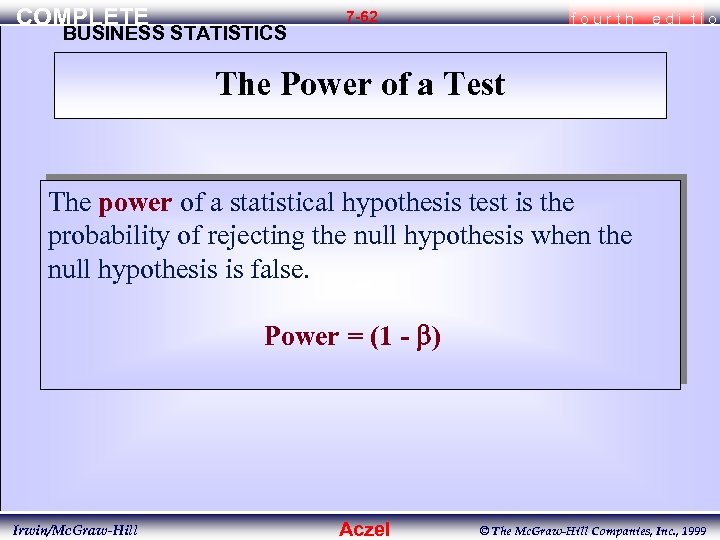
COMPLETE BUSINESS STATISTICS 7 -62 fourth edi tio The Power of a Test The power of a statistical hypothesis test is the probability of rejecting the null hypothesis when the null hypothesis is false. Power = (1 - ) Irwin/Mc. Graw-Hill Aczel © The Mc. Graw-Hill Companies, Inc. , 1999
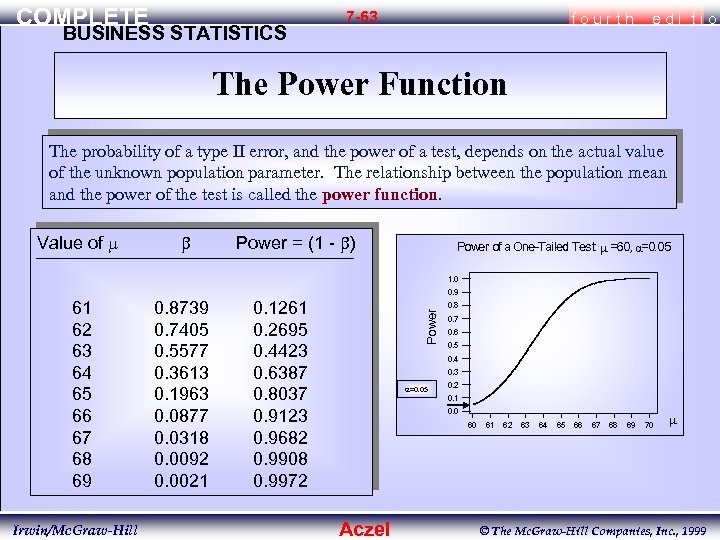
COMPLETE BUSINESS STATISTICS 7 -63 fourth edi tio The Power Function The probability of a type II error, and the power of a test, depends on the actual value of the unknown population parameter. The relationship between the population mean and the power of the test is called the power function. Value of Power = (1 - ) Power of a One-Tailed Test: =60, =0. 05 1. 0 0. 9 Irwin/Mc. Graw-Hill 0. 8739 0. 7405 0. 5577 0. 3613 0. 1963 0. 0877 0. 0318 0. 0092 0. 0021 0. 1261 0. 2695 0. 4423 0. 6387 0. 8037 0. 9123 0. 9682 0. 9908 0. 9972 Power 61 62 63 64 65 66 67 68 69 0. 8 0. 7 0. 6 0. 5 0. 4 0. 3 0. 2 0. 1 0. 0 60 Aczel 61 62 63 64 65 66 67 68 69 70 © The Mc. Graw-Hill Companies, Inc. , 1999
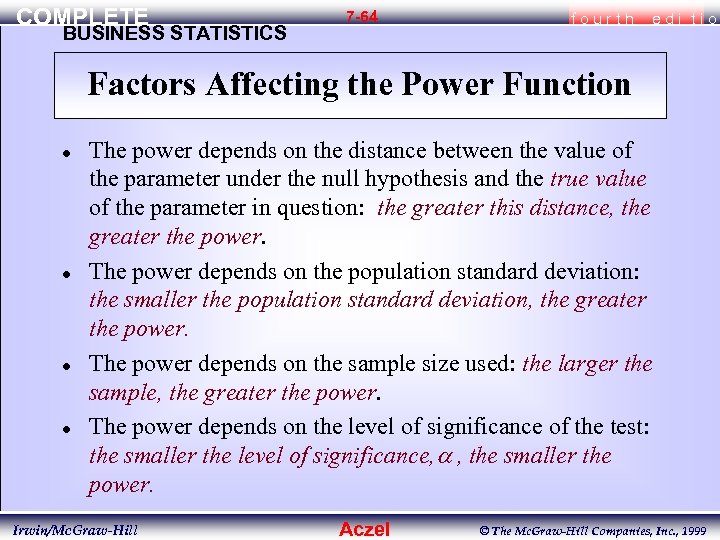
COMPLETE BUSINESS STATISTICS 7 -64 fourth edi tio Factors Affecting the Power Function l l The power depends on the distance between the value of the parameter under the null hypothesis and the true value of the parameter in question: the greater this distance, the greater the power. The power depends on the population standard deviation: the smaller the population standard deviation, the greater the power. The power depends on the sample size used: the larger the sample, the greater the power. The power depends on the level of significance of the test: the smaller the level of significance, , the smaller the power. Irwin/Mc. Graw-Hill Aczel © The Mc. Graw-Hill Companies, Inc. , 1999
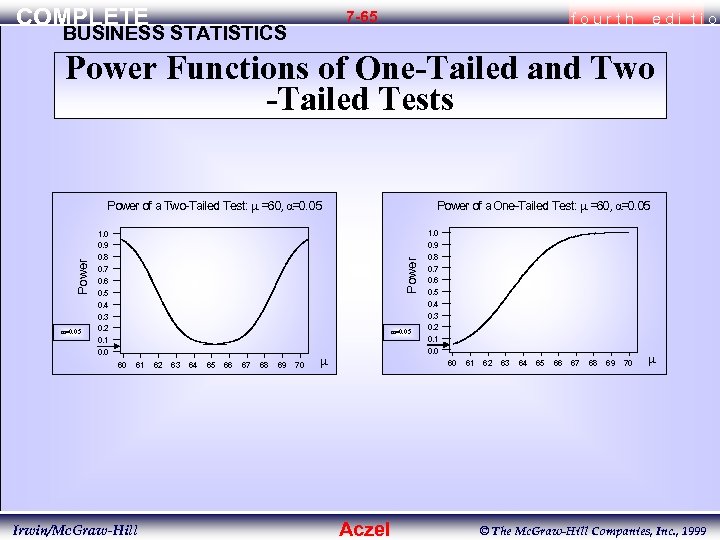
COMPLETE 7 -65 BUSINESS STATISTICS fourth edi tio Power Functions of One-Tailed and Two -Tailed Tests Power of a One-Tailed Test: =60, =0. 05 1. 0 0. 9 0. 8 0. 7 0. 6 0. 5 0. 4 0. 3 0. 2 0. 1 0. 0 Power of a Two-Tailed Test: =60, =0. 05 60 61 Irwin/Mc. Graw-Hill 62 63 64 65 66 67 68 69 70 1. 0 0. 9 0. 8 0. 7 0. 6 0. 5 0. 4 0. 3 0. 2 0. 1 0. 0 60 Aczel 61 62 63 64 65 66 67 68 69 70 © The Mc. Graw-Hill Companies, Inc. , 1999
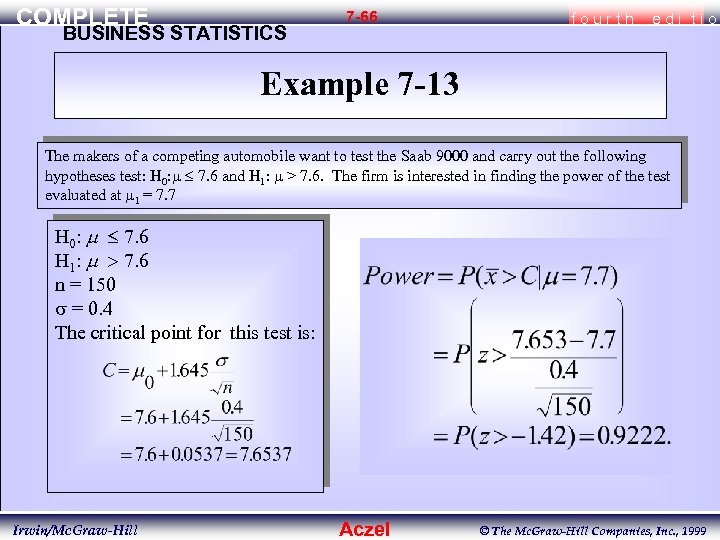
COMPLETE BUSINESS STATISTICS 7 -66 fourth edi tio Example 7 -13 The makers of a competing automobile want to test the Saab 9000 and carry out the following hypotheses test: H 0: and H 1: > 7. 6. The firm is interested in finding the power of the test evaluated at 1 = 7. 7 H 0: H 1: 7. 6 n = 150 = 0. 4 The critical point for this test is: Irwin/Mc. Graw-Hill Aczel © The Mc. Graw-Hill Companies, Inc. , 1999
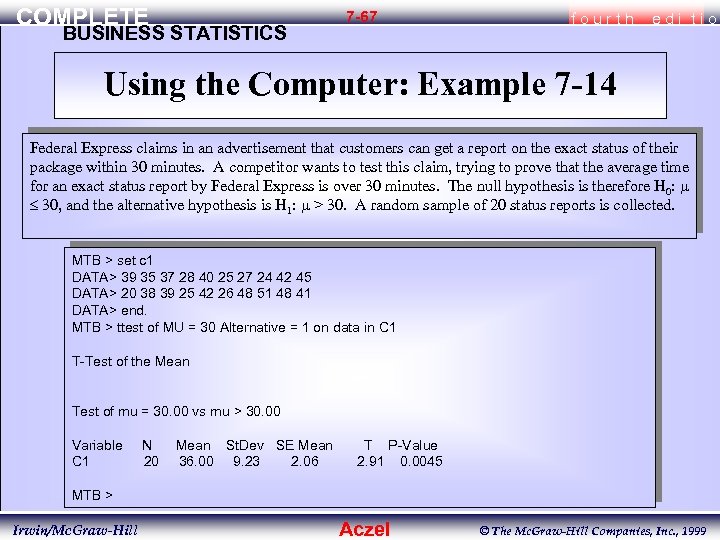
COMPLETE BUSINESS STATISTICS 7 -67 fourth edi tio Using the Computer: Example 7 -14 Federal Express claims in an advertisement that customers can get a report on the exact status of their package within 30 minutes. A competitor wants to test this claim, trying to prove that the average time for an exact status report by Federal Express is over 30 minutes. The null hypothesis is therefore H 0: , and the alternative hypothesis is H 1: > 30. A random sample of 20 status reports is collected. MTB > set c 1 DATA> 39 35 37 28 40 25 27 24 42 45 DATA> 20 38 39 25 42 26 48 51 48 41 DATA> end. MTB > ttest of MU = 30 Alternative = 1 on data in C 1 T-Test of the Mean Test of mu = 30. 00 vs mu > 30. 00 Variable C 1 N 20 Mean St. Dev SE Mean 36. 00 9. 23 2. 06 T P-Value 2. 91 0. 0045 MTB > Irwin/Mc. Graw-Hill Aczel © The Mc. Graw-Hill Companies, Inc. , 1999
Скачать презентацию COMPLETE BUSINESS STATISTICS 7 7
6c8b0d76fe7ba4e8d6962ed8bb1cca06.ppt