 Скачать презентацию Competitive Marketing Strategy Masterclass Day 2 by Professor
050f7e5ff0f043b2e26108770c99e531.ppt
- Количество слайдов: 137



Competitive Marketing Strategy Masterclass Day 2 by Professor Malcolm Mc. Donald Cranfield School of Management
Objectives l l l l To highlight the growing concern about marketing’s lack of accountability and the frustration of boards with their marketing colleagues. To explain how return on marketing expenditure can be measured. To explain how institutional investors assess company performance. To highlight the pivotal importance of intelligence in implementing successful CRM systems To provide a step-by-step process for carrying out market segmentation To explore with delegates implementation issues, especially those relating to e-commerce. To spell out competitive marketing strategies to gain differential advantage. To provide ten practical steps to world class marketing.
Programme l Measuring the contribution of marketing, including brand equity l CRM: faster, smarter, bigger; but is it better? l Marketing implementation issues l Competitive marketing strategies and gaining differential advantage
“Growth is often the wrong objective for promotional expenditure. It’s a bit like an ingredient (or component, or raw material) in a product. You wouldn’t stop putting a component in a product just because sales didn’t grow in any budget period! Similarly, much promotional expenditure is about maintaining the status quo”. Professor Malcolm Mc. Donald
Marketing expenditure adds value when it creates assets that generate future cash flows with a positive net present value.
l l Suppliers are still interested principally in volume Whilst they are interested in the potential for ‘added value’, most still do not measure account profitability From ‘Key Account Management’ Cranfield University School of Management, 1996
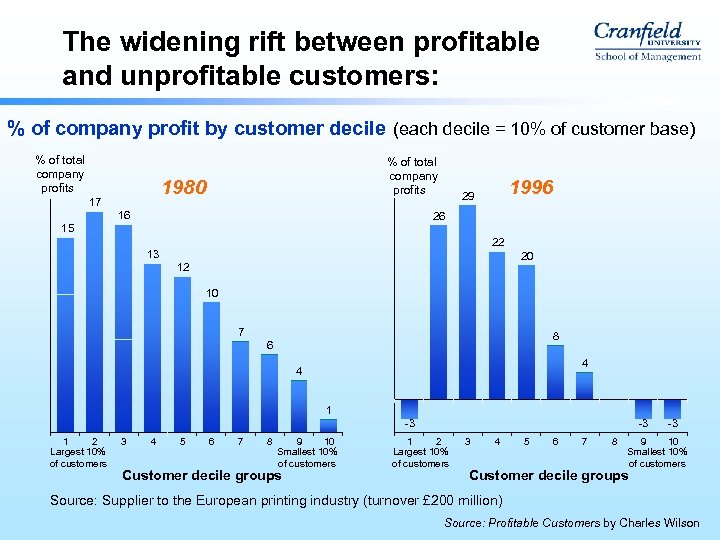
The widening rift between profitable and unprofitable customers: % of company profit by customer decile (each decile = 10% of customer base) % of total company profits 1980 17 16 1996 29 26 15 22 13 20 12 10 7 8 6 4 4 1 -3 1 2 Largest 10% of customers 3 4 5 6 7 8 9 10 Smallest 10% of customers Customer decile groups -3 1 2 Largest 10% of customers 3 4 5 6 7 8 -3 9 10 Smallest 10% of customers Customer decile groups Source: Supplier to the European printing industry (turnover £ 200 million) Source: Profitable Customers by Charles Wilson
Customer account profitability analysis The key phrase is Attributable Costing The objective is to highlight the financial impact of the different ways in which customers are serviced
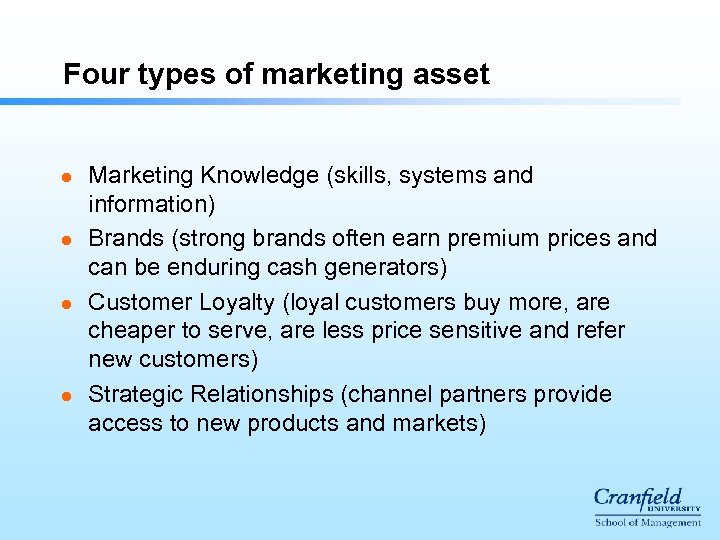
Four types of marketing asset l l Marketing Knowledge (skills, systems and information) Brands (strong brands often earn premium prices and can be enduring cash generators) Customer Loyalty (loyal customers buy more, are cheaper to serve, are less price sensitive and refer new customers) Strategic Relationships (channel partners provide access to new products and markets)
Justifying investment in marketing assets Whilst accountants do not measure intangible assets, the discrepancy between market and book values shows that investors do. Expenditures to develop marketing assets make sense if the sum of the discounted cash flow they generate is positive.
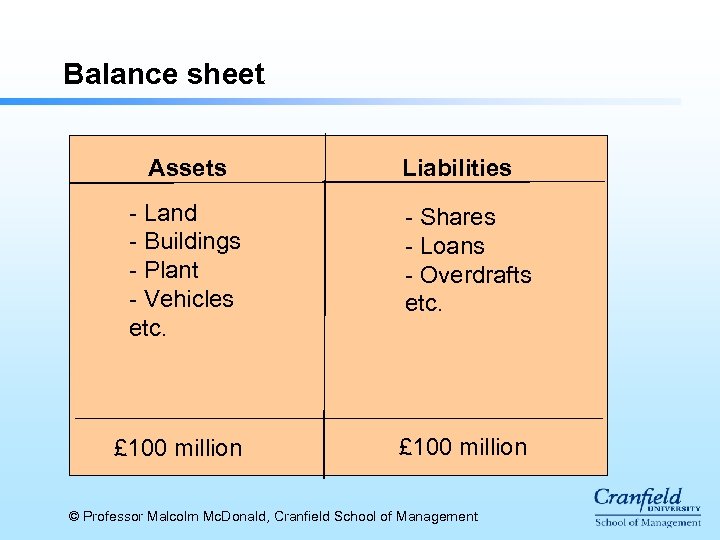
Balance sheet Assets Liabilities - Land - Buildings - Plant - Vehicles etc. - Shares - Loans - Overdrafts etc. £ 100 million © Professor Malcolm Mc. Donald, Cranfield School of Management
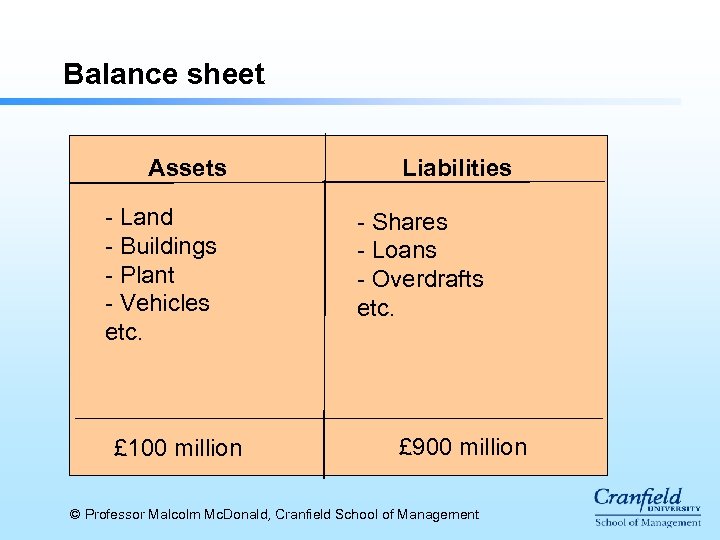
Balance sheet Assets - Land - Buildings - Plant - Vehicles etc. £ 100 million Liabilities - Shares - Loans - Overdrafts etc. £ 900 million © Professor Malcolm Mc. Donald, Cranfield School of Management
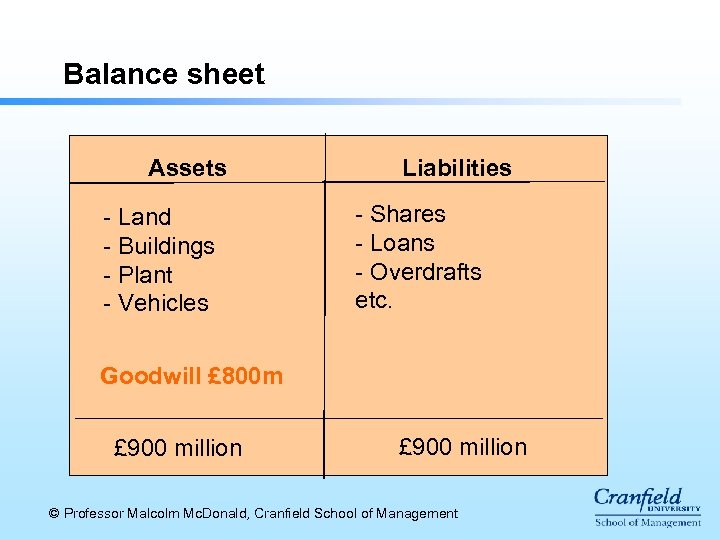
Balance sheet Assets - Land - Buildings - Plant - Vehicles Liabilities - Shares - Loans - Overdrafts etc. Goodwill £ 800 m £ 900 million © Professor Malcolm Mc. Donald, Cranfield School of Management
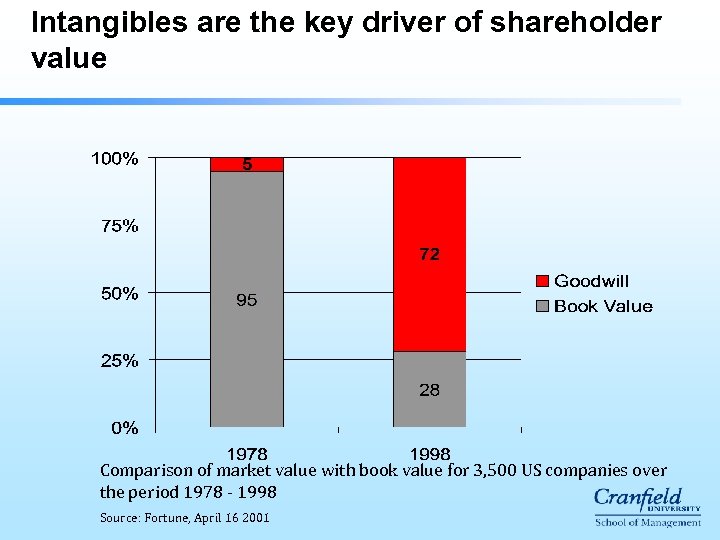
Intangibles are the key driver of shareholder value Comparison of market value with book value for 3, 500 US companies over the period 1978 - 1998 Source: Fortune, April 16 2001
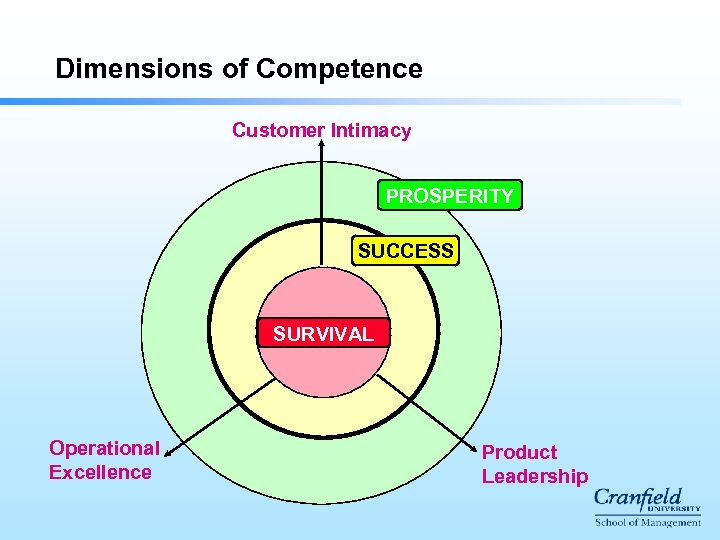
Dimensions of Competence Customer Intimacy PROSPERITY SUCCESS SURVIVAL Operational Excellence Product Leadership
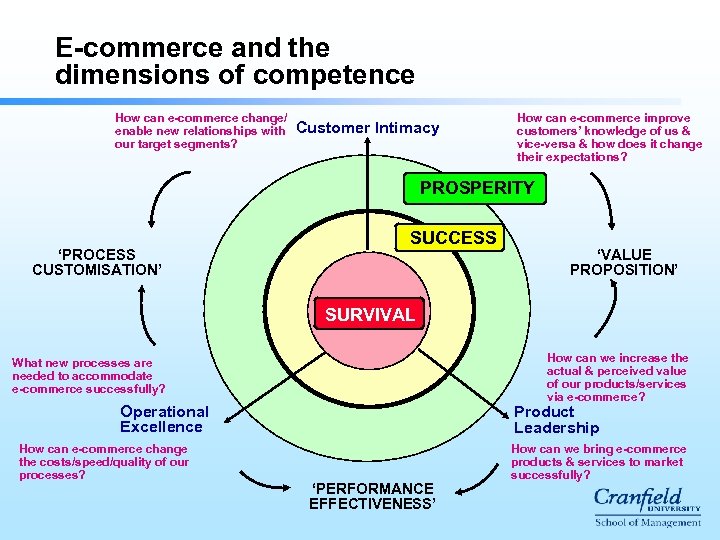
E-commerce and the dimensions of competence How can e-commerce change/ enable new relationships with our target segments? Customer Intimacy How can e-commerce improve customers’ knowledge of us & vice-versa & how does it change their expectations? PROSPERITY ‘PROCESS CUSTOMISATION’ SUCCESS ‘VALUE PROPOSITION’ SURVIVAL How can we increase the actual & perceived value of our products/services via e-commerce? What new processes are needed to accommodate e-commerce successfully? Operational Excellence How can e-commerce change the costs/speed/quality of our processes? Product Leadership ‘PERFORMANCE EFFECTIVENESS’ How can we bring e-commerce products & services to market successfully?
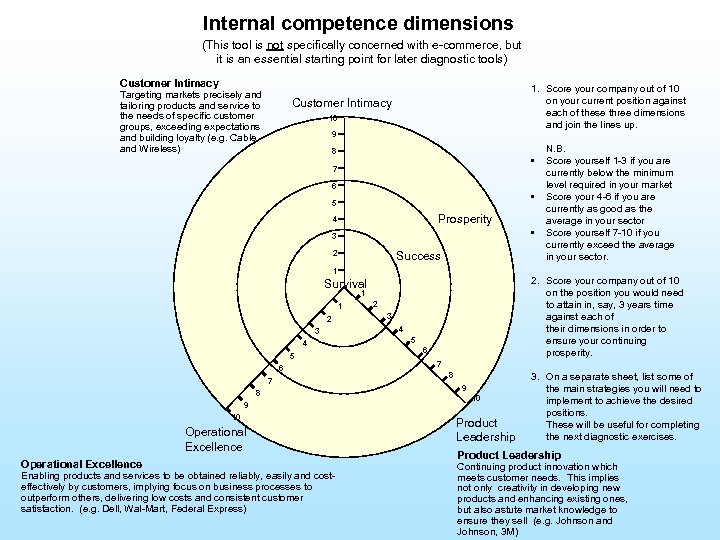
Internal competence dimensions (This tool is not specifically concerned with e-commerce, but it is an essential starting point for later diagnostic tools) Customer Intimacy Targeting markets precisely and tailoring products and service to the needs of specific customer groups, exceeding expectations and building loyalty (e. g. Cable and Wireless) 1. Score your company out of 10 on your current position against each of these three dimensions and join the lines up. Customer Intimacy 10 9 8 • 7 6 • 5 Prosperity 4 • 3 2 Success 1 2. Score your company out of 10 on the position you would need to attain in, say, 3 years time against each of their dimensions in order to ensure your continuing prosperity. Survival 1 1 2 3 4 5 6 7 8 9 10 Operational Excellence Enabling products and services to be obtained reliably, easily and costeffectively by customers, implying focus on business processes to outperform others, delivering low costs and consistent customer satisfaction. (e. g. Dell, Wal-Mart, Federal Express) N. B. Score yourself 1 -3 if you are currently below the minimum level required in your market Score your 4 -6 if you are currently as good as the average in your sector Score yourself 7 -10 if you currently exceed the average in your sector. 2 3 4 5 6 7 8 9 10 Product Leadership 3. On a separate sheet, list some of the main strategies you will need to implement to achieve the desired positions. These will be useful for completing the next diagnostic exercises. Product Leadership Continuing product innovation which meets customer needs. This implies not only creativity in developing new products and enhancing existing ones, but also astute market knowledge to ensure they sell (e. g. Johnson and Johnson, 3 M)
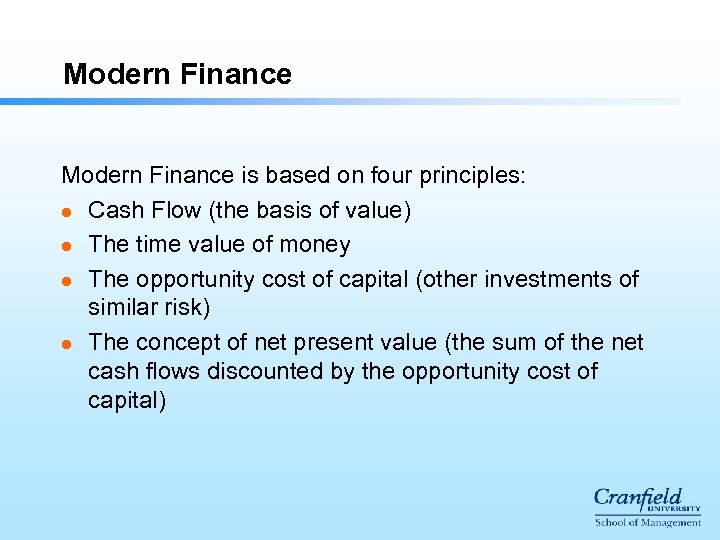
Modern Finance is based on four principles: l Cash Flow (the basis of value) l The time value of money l The opportunity cost of capital (other investments of similar risk) l The concept of net present value (the sum of the net cash flows discounted by the opportunity cost of capital)
Marketing Accountability
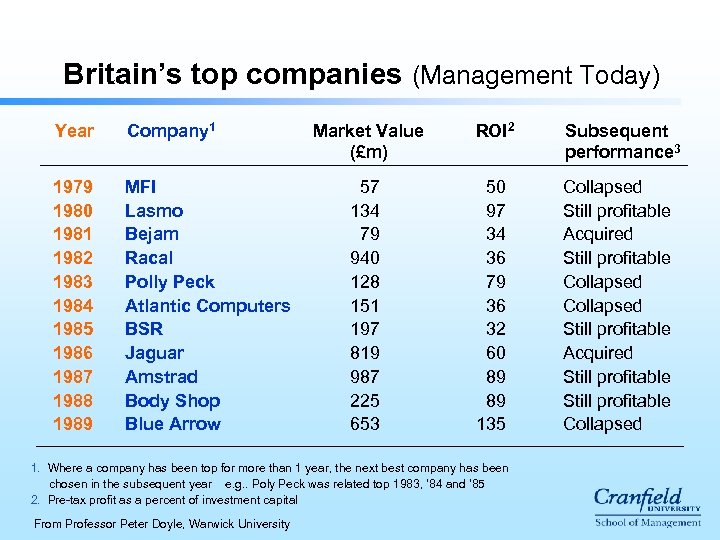
Britain’s top companies (Management Today) Year Company 1 1979 1980 1981 1982 1983 1984 1985 1986 1987 1988 1989 MFI Lasmo Bejam Racal Polly Peck Atlantic Computers BSR Jaguar Amstrad Body Shop Blue Arrow Market Value (£m) ROI 2 Subsequent performance 3 57 134 79 940 128 151 197 819 987 225 653 50 97 34 36 79 36 32 60 89 89 135 Collapsed Still profitable Acquired Still profitable Collapsed 1. Where a company has been top for more than 1 year, the next best company has been chosen in the subsequent year e. g. . Poly Peck was related top 1983, ‘ 84 and ‘ 85 2. Pre-tax profit as a percent of investment capital From Professor Peter Doyle, Warwick University
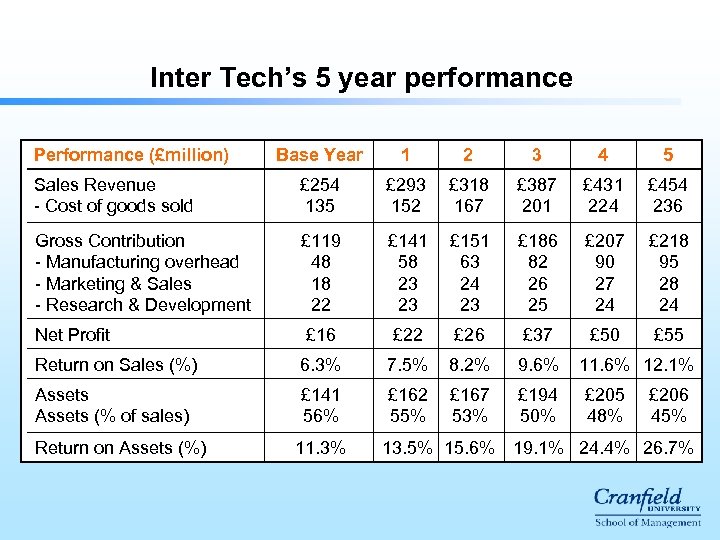
Inter Tech’s 5 year performance Performance (£million) Base Year 1 2 3 4 5 Sales Revenue - Cost of goods sold £ 254 135 £ 293 152 £ 318 167 £ 387 201 £ 431 224 £ 454 236 Gross Contribution - Manufacturing overhead - Marketing & Sales - Research & Development £ 119 48 18 22 £ 141 58 23 23 £ 151 63 24 23 £ 186 82 26 25 £ 207 90 27 24 £ 218 95 28 24 Net Profit £ 16 £ 22 £ 26 £ 37 £ 50 £ 55 Return on Sales (%) 6. 3% 7. 5% 8. 2% 9. 6% Assets (% of sales) £ 141 56% £ 162 55% £ 167 53% £ 194 50% Return on Assets (%) 11. 3% 11. 6% 12. 1% £ 205 48% £ 206 45% 13. 5% 15. 6% 19. 1% 24. 4% 26. 7%
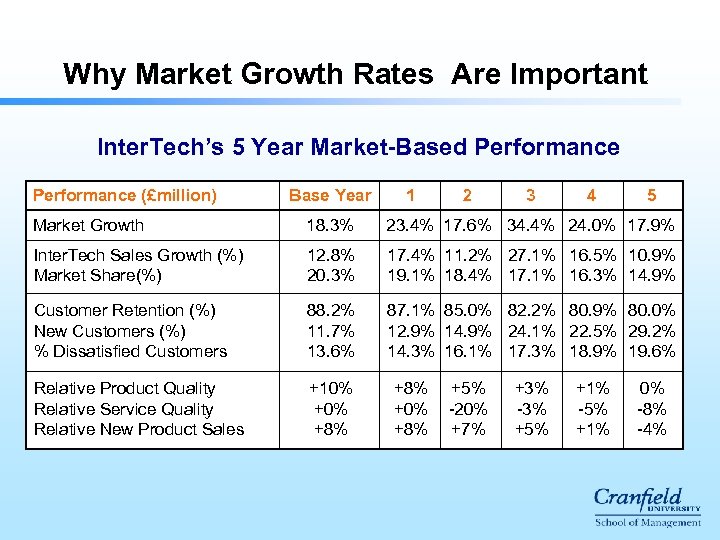
Why Market Growth Rates Are Important Inter. Tech’s 5 Year Market-Based Performance (£million) Base Year 1 2 3 4 5 Market Growth 18. 3% 23. 4% 17. 6% 34. 4% 24. 0% 17. 9% Inter. Tech Sales Growth (%) Market Share(%) 12. 8% 20. 3% 17. 4% 11. 2% 27. 1% 16. 5% 10. 9% 19. 1% 18. 4% 17. 1% 16. 3% 14. 9% Customer Retention (%) New Customers (%) % Dissatisfied Customers 88. 2% 11. 7% 13. 6% 87. 1% 85. 0% 82. 2% 80. 9% 80. 0% 12. 9% 14. 9% 24. 1% 22. 5% 29. 2% 14. 3% 16. 1% 17. 3% 18. 9% 19. 6% Relative Product Quality Relative Service Quality Relative New Product Sales +10% +8% +0% +8% +5% -20% +7% +3% -3% +5% +1% -5% +1% 0% -8% -4%
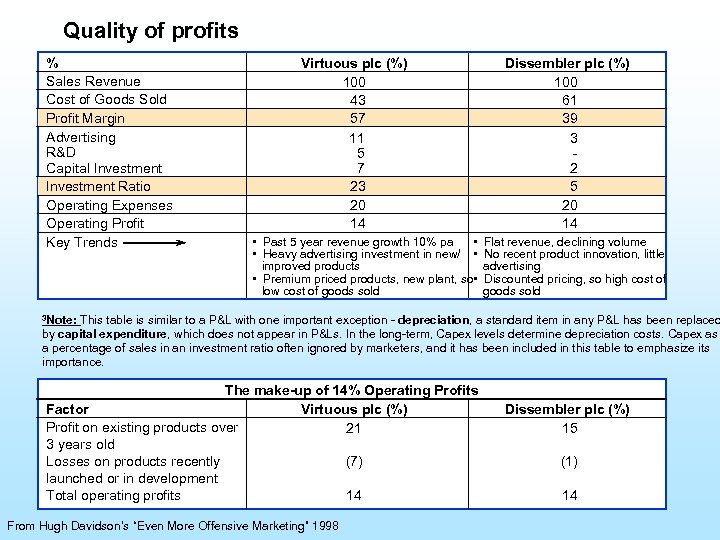
Quality of profits % Sales Revenue Cost of Goods Sold Profit Margin Advertising R&D Capital Investment Ratio Operating Expenses Operating Profit Key Trends Virtuous plc (%) 100 43 57 11 5 7 23 20 14 • Past 5 year revenue growth 10% pa • • Heavy advertising investment in new/ • improved products • Premium priced products, new plant, so • low cost of goods sold Dissembler plc (%) 100 61 39 3 2 5 20 14 Flat revenue, declining volume No recent product innovation, little advertising Discounted pricing, so high cost of goods sold 3 Note: This table is similar to a P&L with one important exception - depreciation, a standard item in any P&L has been replaced by capital expenditure, which does not appear in P&Ls. In the long-term, Capex levels determine depreciation costs. Capex as a percentage of sales in an investment ratio often ignored by marketers, and it has been included in this table to emphasize its importance. The make-up of 14% Operating Profits Factor Virtuous plc (%) Profit on existing products over 21 3 years old Losses on products recently (7) launched or in development Total operating profits 14 From Hugh Davidson’s “Even More Offensive Marketing” 1998 Dissembler plc (%) 15 (1) 14
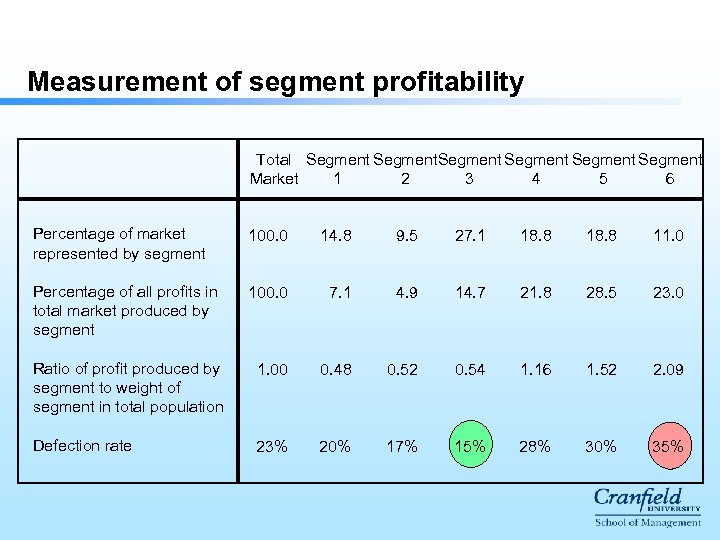
Measurement of segment profitability Total Segment Segment Market 1 2 3 4 5 6 Percentage of market represented by segment 100. 0 14. 8 9. 5 27. 1 18. 8 11. 0 Percentage of all profits in total market produced by segment 100. 0 7. 1 4. 9 14. 7 21. 8 28. 5 23. 0 Ratio of profit produced by segment to weight of segment in total population 1. 00 0. 48 0. 52 0. 54 1. 16 1. 52 2. 09 Defection rate 23% 20% 17% 15% 28% 30% 35%
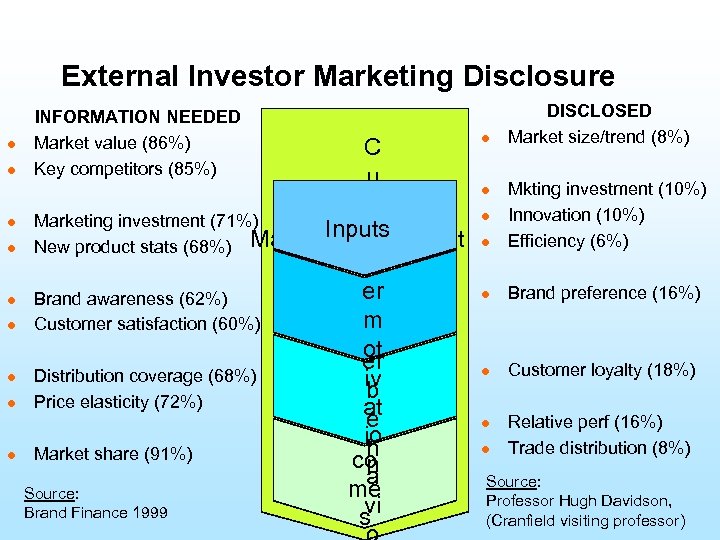
External Investor Marketing Disclosure l l l l l INFORMATION NEEDED Market value (86%) Key competitors (85%) C u st C Marketing investment (71%) Inputs o New product stats (68%) Market Environment u m st er Brand awareness (62%) o m Customer satisfaction (60%) m ot er Distribution coverage (68%) iv b Price elasticity (72%) at e Out io h Market share (91%) co n a me Source: vi Brand Finance 1999 s l DISCLOSED Market size/trend (8%) l Mkting investment (10%) Innovation (10%) Efficiency (6%) l Brand preference (16%) l Customer loyalty (18%) l l Relative perf (16%) Trade distribution (8%) Source: Professor Hugh Davidson, (Cranfield visiting professor)
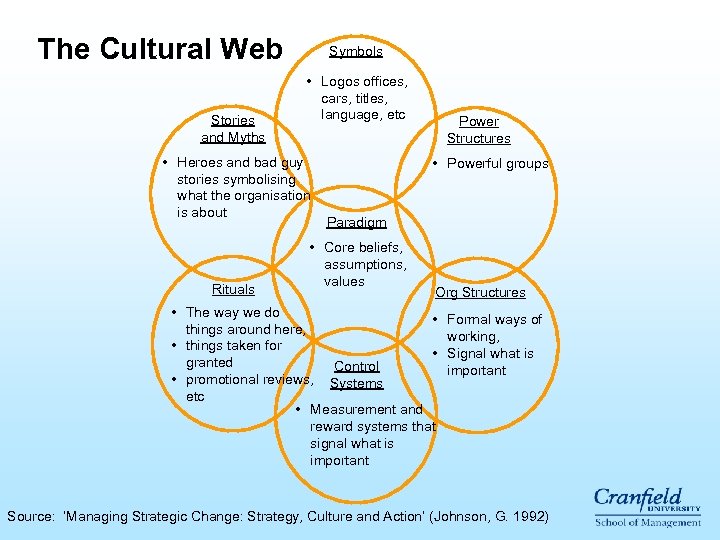
The Cultural Web Stories and Myths Symbols • Logos offices, cars, titles, language, etc • Heroes and bad guy stories symbolising what the organisation is about Rituals Power Structures • Powerful groups Paradigm • Core beliefs, assumptions, values Org Structures • The way we do • things around here, • things taken for • granted Control • promotional reviews, Systems etc • Measurement and reward systems that signal what is important Formal ways of working, Signal what is important Source: ‘Managing Strategic Change: Strategy, Culture and Action’ (Johnson, G. 1992)
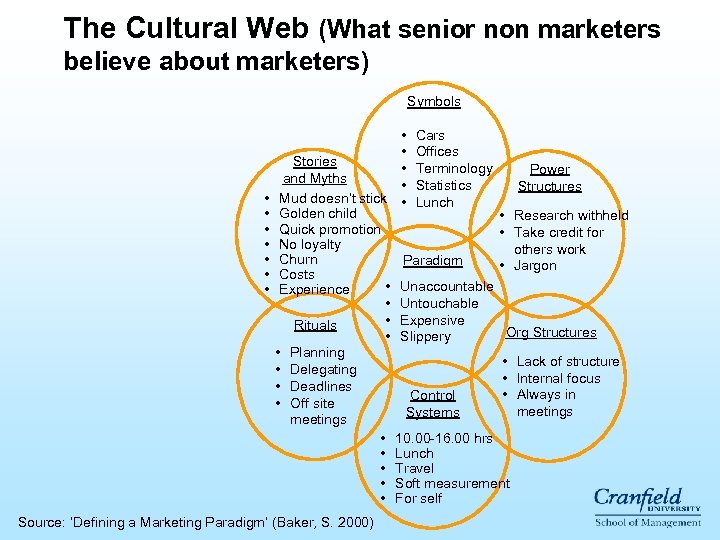
The Cultural Web (What senior non marketers believe about marketers) Symbols • • Cars • Offices Stories • Terminology Power and Myths • Statistics Structures Mud doesn’t stick • Lunch Golden child • Research withheld Quick promotion • Take credit for No loyalty others work Churn Paradigm • Jargon Costs • Unaccountable Experience • Untouchable • Expensive Rituals Org Structures • Slippery • Planning • Lack of structure • Delegating • Internal focus • Deadlines • Always in Control • Off site meetings Systems meetings • 10. 00 -16. 00 hrs • Lunch • Travel • Soft measurement • For self Source: ‘Defining a Marketing Paradigm’ (Baker, S. 2000)
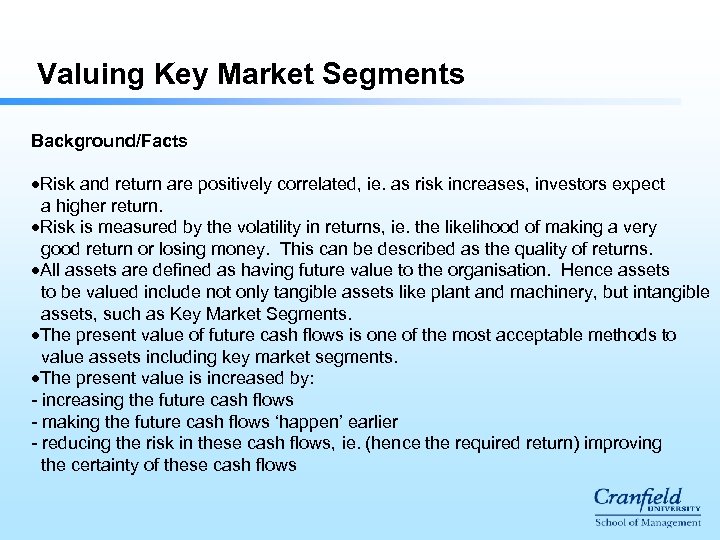
Valuing Key Market Segments Background/Facts ·Risk and return are positively correlated, ie. as risk increases, investors expect a higher return. ·Risk is measured by the volatility in returns, ie. the likelihood of making a very good return or losing money. This can be described as the quality of returns. ·All assets are defined as having future value to the organisation. Hence assets to be valued include not only tangible assets like plant and machinery, but intangible assets, such as Key Market Segments. ·The present value of future cash flows is one of the most acceptable methods to value assets including key market segments. ·The present value is increased by: - increasing the future cash flows - making the future cash flows ‘happen’ earlier - reducing the risk in these cash flows, ie. (hence the required return) improving the certainty of these cash flows
Suggested Approach ·Identify your key market segments. It is helpful if they can be classified on a vertical axis (a kind of thermometer) according to their attractiveness to your company. ‘Attractiveness’ usually means the potential of each for growth in your profits over a period of between 3 and 5 years. ·Based on your current experience and planning horizon that you are confident with, make a projection of future net free cash in-flows from your segments. It is normal to select a period such as 3 or 5 years. ·Identify the key factors that are likely to either increase or decrease these future cash flows. We suggest identifying the top 5 factors. ·Use your judgement to rank your segments according to the likelihood of the events leading to those factors occurring. This will help you to identify the relative risk of your key market segments. ·Ask your accountant to provide you with the overall required return for your company: this is often referred to as the weighted average cost of capital (WACC), or cost of capital.
• Now identify the required rate of return for each of your key segments based on the WACC. (WACC is the return required from the average segment). A higher required rate will apply for more risky segments and a lower rate for less risky segments. Your ranking of segments above will help you to decide the required return based on your understanding of the risk of each of these key segments. • We recommend a range of plus or minus 30% of WACC provided by your accountant. • Thus, (assuming your WACC is, say, 10%) in a matrix such as the one shown in Figure 1, you and your financial advisor may decide to use say, 8. 5% for segments in Box 1, ie. a 15% reduction on the WACC, 11. 5% for those in Box 2, (ie. a 15% premium over the WACC), 13% for segments in Box 3 (ie. a 30% premium over the WACC) and 10% for segments in Box 4. • Discount the future cash flows identified above using the risk adjusted rates to arrive at a value for your segments. • An aggregate positive net present value indicates that you are creating shareholder value – ie. achieving actual overall returns greater than the weighted average cost of capital, having taken into account the risk associated with future cash flows.
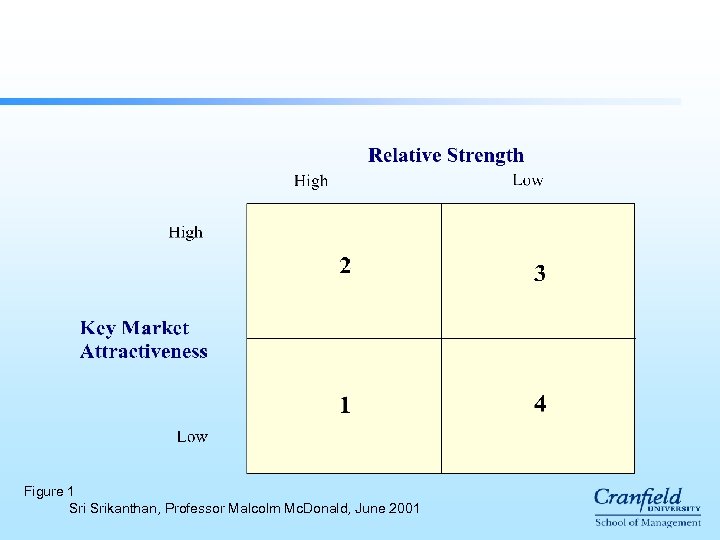
Figure 1 Srikanthan, Professor Malcolm Mc. Donald, June 2001
Customer Power © Professor Malcolm Mc. Donald, Cranfield School of Management
In future, the most powerful brands will be customer-centric. Successful companies will know the customer and will be the customer’s advocate © Professor Malcolm Mc. Donald, Cranfield School of Management
Confusion Marketing “Even when your product is not that different, better or special, it’s the job of the marketer to make people think it’s different, better or special” (Sergio Zyman former chief marketing officer, Coca Cola) What he really means is: “when you genuinely can’t add value for your customer (compared with what your competitors are offering), pull the wool over their eyes instead!” (Alan Mitchell, Marketing Business, May, 2001)
Confusion Marketing Ultimately, wherever confusion reigns, brands risk losing more in consumer trust than they gain in short term advantage. (James Curtis, Marketing Business, Feb. 2001)
The purpose of strategic marketing is the creation of sustainable competitive advantage.
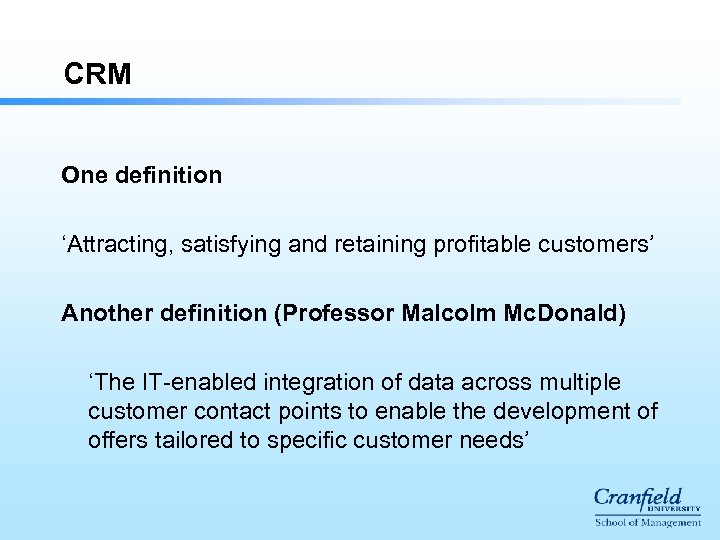
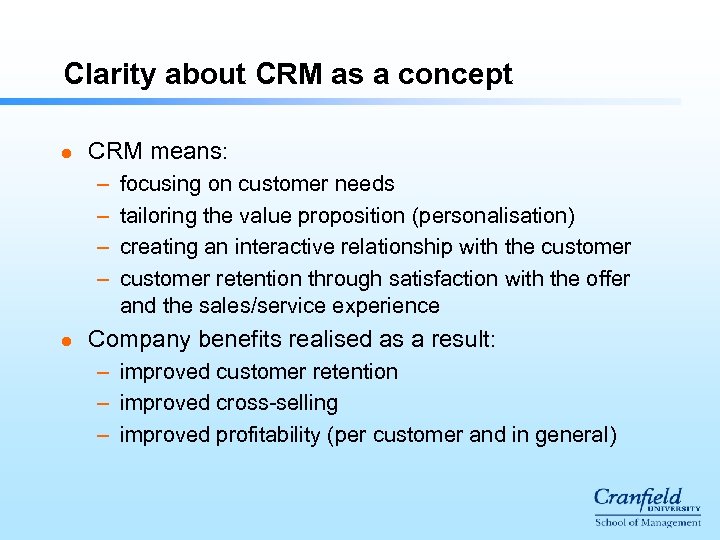
CRM One definition ‘Attracting, satisfying and retaining profitable customers’ Another definition (Professor Malcolm Mc. Donald) ‘The IT-enabled integration of data across multiple customer contact points to enable the development of offers tailored to specific customer needs’
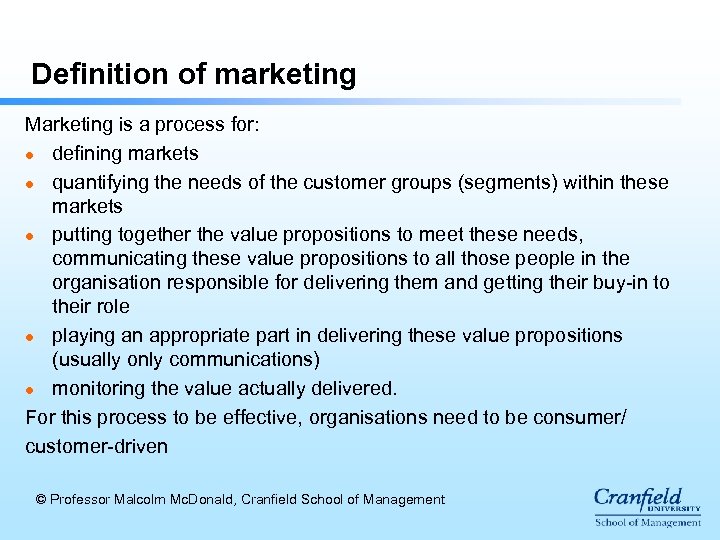
Definition of marketing Marketing is a process for: l defining markets l quantifying the needs of the customer groups (segments) within these markets l putting together the value propositions to meet these needs, communicating these value propositions to all those people in the organisation responsible for delivering them and getting their buy-in to their role l playing an appropriate part in delivering these value propositions (usually only communications) l monitoring the value actually delivered. For this process to be effective, organisations need to be consumer/ customer-driven © Professor Malcolm Mc. Donald, Cranfield School of Management
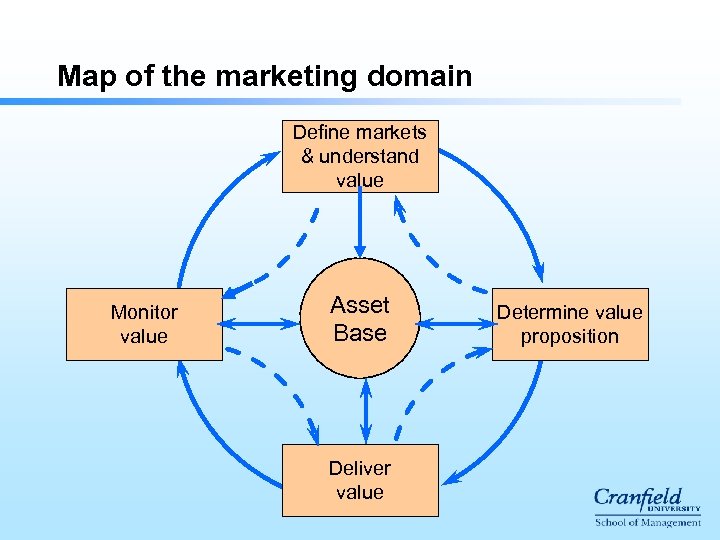
Map of the marketing domain Define markets & understand value Monitor value Asset Base Deliver value Determine value proposition
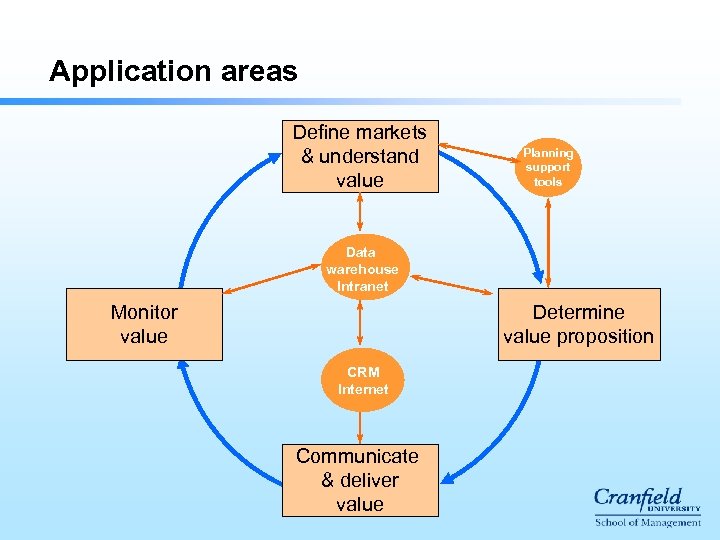
Application areas Define markets & understand value Planning support tools Data warehouse Intranet Monitor value Determine value proposition CRM Internet Communicate & deliver value
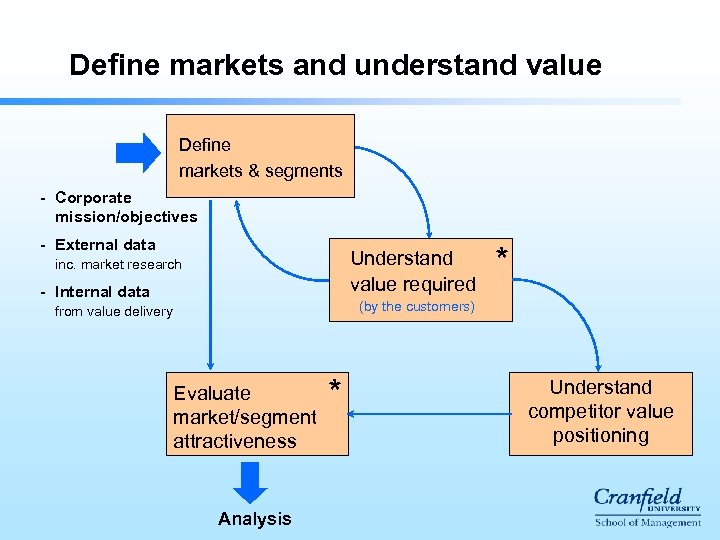
Define markets and understand value Define markets & segments - Corporate mission/objectives - External data Understand value required inc. market research - Internal data * (by the customers) from value delivery Evaluate market/segment attractiveness Analysis * Understand competitor value positioning
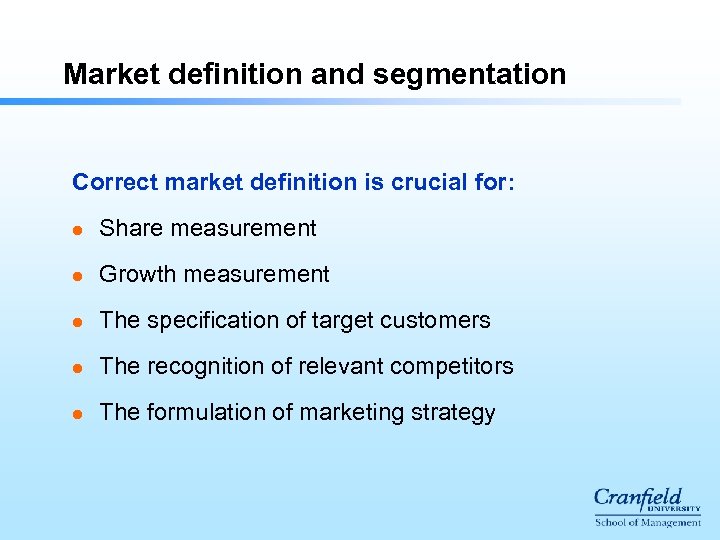
Market definition and segmentation Correct market definition is crucial for: l Share measurement l Growth measurement l The specification of target customers l The recognition of relevant competitors l The formulation of marketing strategy
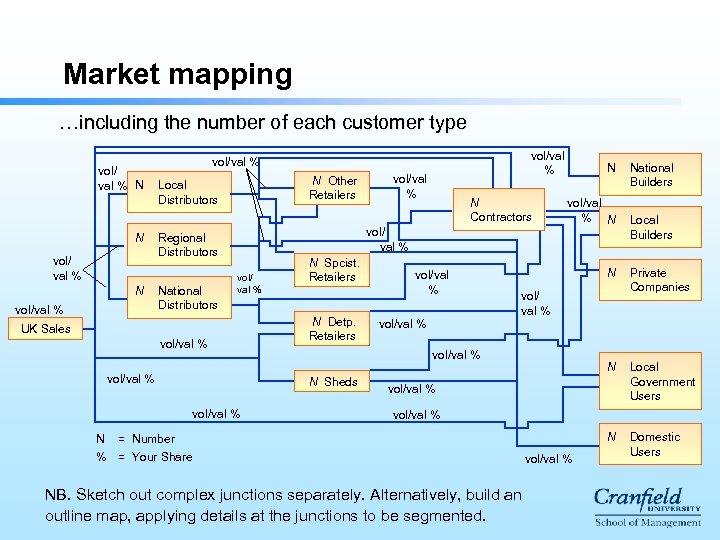
Market mapping …including the number of each customer type vol/ val % N N vol/ val % N vol/val % N Other Retailers Local Distributors N Contractors vol/ val % Regional Distributors National Distributors vol/val % vol/ val % UK Sales vol/val % N Spcist. Retailers N Detp. Retailers vol/val % N National Builders Local Builders N Private Companies N Local Government Users N Domestic Users vol/ val % vol/val % N Sheds vol/val % N = Number % = Your Share NB. Sketch out complex junctions separately. Alternatively, build an outline map, applying details at the junctions to be segmented. vol/val %
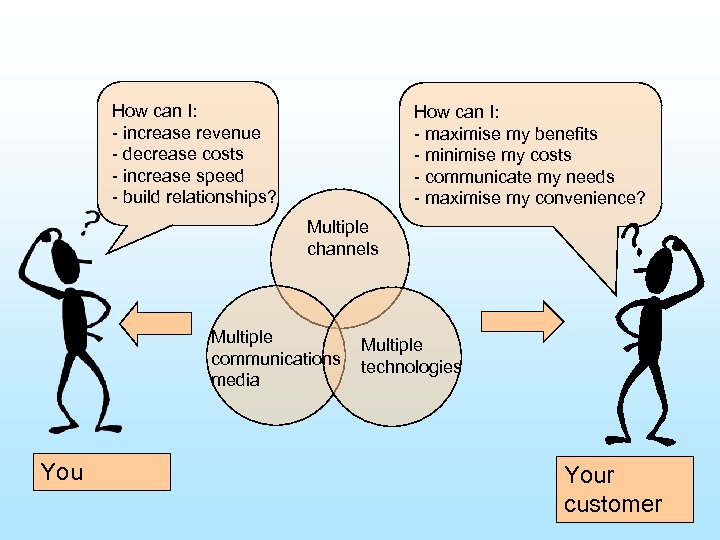
How can I: - increase revenue - decrease costs - increase speed - build relationships? How can I: - maximise my benefits - minimise my costs - communicate my needs - maximise my convenience? Multiple channels Multiple communications media You Multiple technologies Your customer
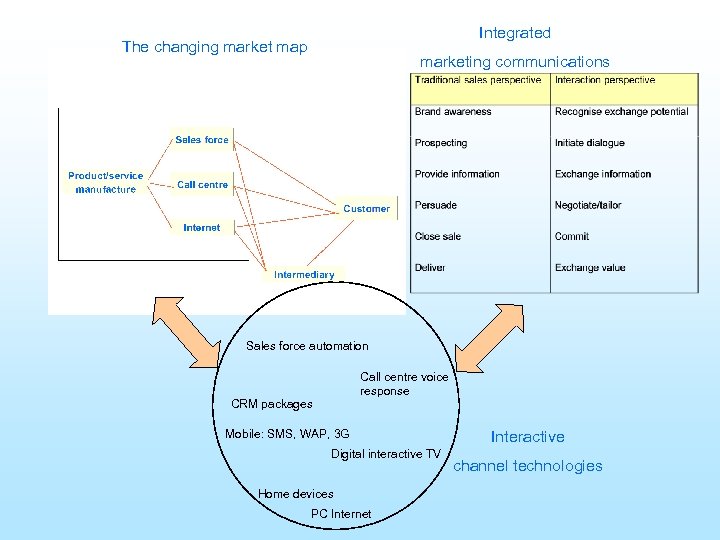
Integrated The changing market map marketing communications Sales force automation Call centre voice response CRM packages Mobile: SMS, WAP, 3 G Digital interactive TV Home devices PC Internet Interactive channel technologies
l Mapping future channels
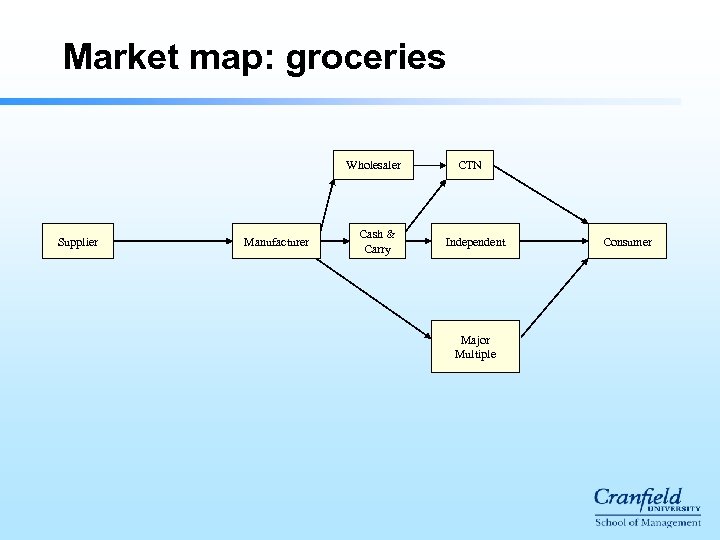
Market map: groceries Wholesaler Supplier Manufacturer Cash & Carry CTN Independent Major Multiple Consumer
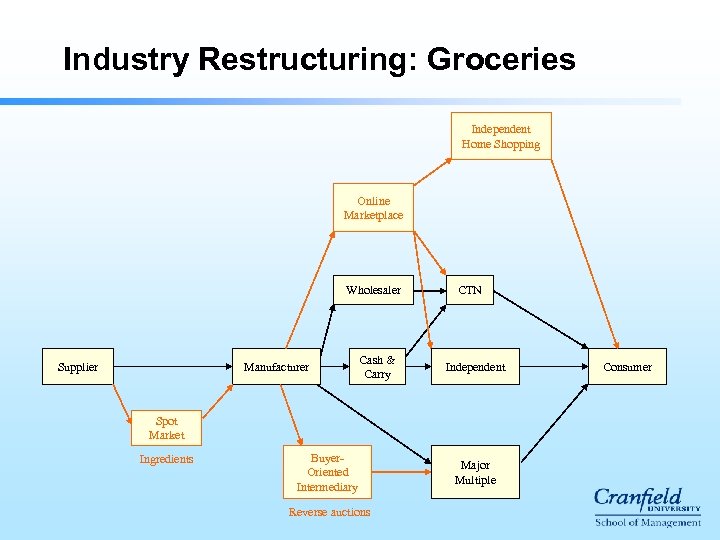
Industry Restructuring: Groceries Independent Home Shopping Online Marketplace Wholesaler Supplier Manufacturer Cash & Carry CTN Independent Spot Market Ingredients Buyer. Oriented Intermediary Reverse auctions Major Multiple Consumer
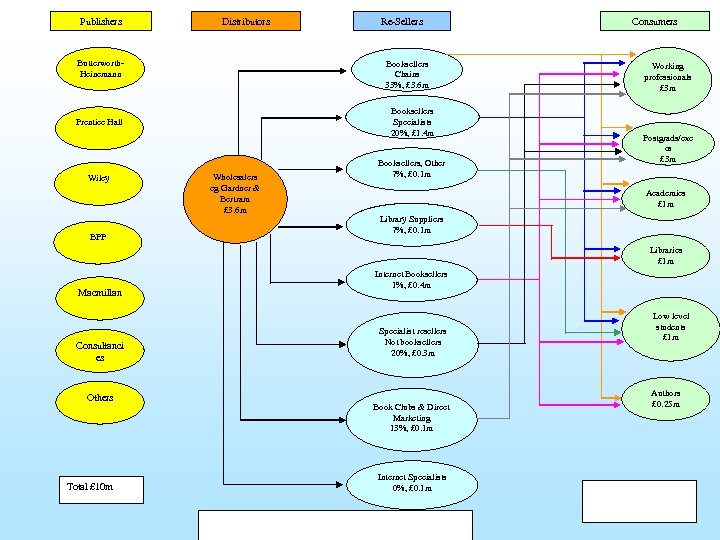
Publishers Distributors Butterworth. Heinemann Booksellers Chains 33%, £ 3. 6 m Booksellers Specialists 20%, £ 1. 4 m Prentice Hall Wiley BPP Re-Sellers Wholesalers eg Gardner & Bertram £ 3. 6 m Booksellers, Other 7%, £ 0. 1 m Consumers Working professionals £ 3 m Postgrads/exe cs £ 3 m Academics £ 1 m Library Suppliers 7%, £ 0. 1 m Libraries £ 1 m Macmillan Consultanci es Others Total £ 10 m Internet Booksellers 1%, £ 0. 4 m Specialist resellers Not booksellers 20%, £ 0. 3 m Book Clubs & Direct Marketing 13%, £ 0. 1 m Internet Specialists 0%, £ 0. 1 m Low level students £ 1 m Authors £ 0. 25 m
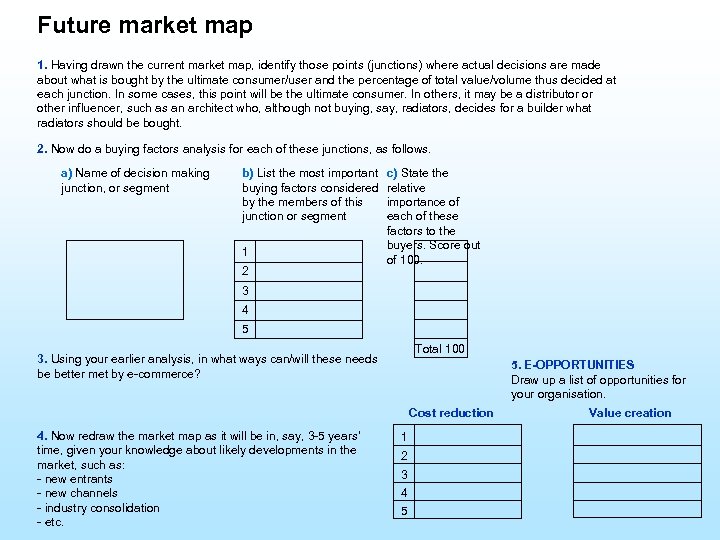
Future market map 1. Having drawn the current market map, identify those points (junctions) where actual decisions are made about what is bought by the ultimate consumer/user and the percentage of total value/volume thus decided at each junction. In some cases, this point will be the ultimate consumer. In others, it may be a distributor or other influencer, such as an architect who, although not buying, say, radiators, decides for a builder what radiators should be bought. 2. Now do a buying factors analysis for each of these junctions, as follows. a) Name of decision making junction, or segment b) List the most important buying factors considered by the members of this junction or segment 1 2 c) State the relative importance of each of these factors to the buyers. Score out of 100. 3 4 5 Total 100 3. Using your earlier analysis, in what ways can/will these needs be better met by e-commerce? 5. E-OPPORTUNITIES Draw up a list of opportunities for your organisation. Cost reduction 4. Now redraw the market map as it will be in, say, 3 -5 years’ time, given your knowledge about likely developments in the market, such as: - new entrants - new channels - industry consolidation - etc. 1 2 3 4 5 Value creation
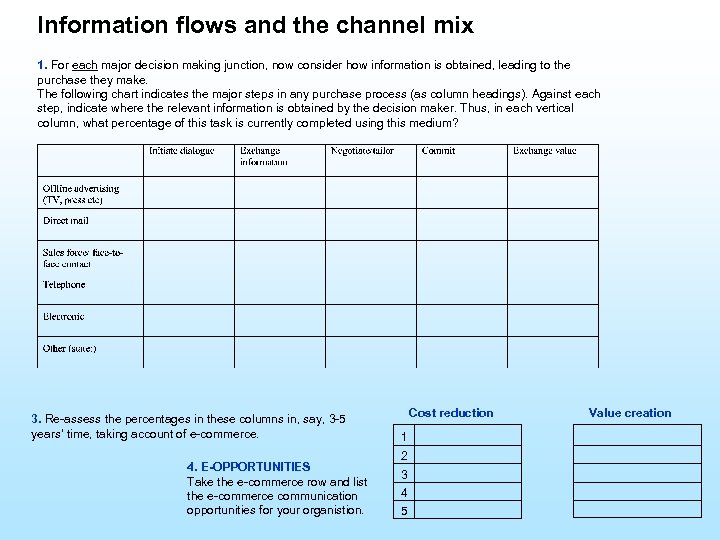
Information flows and the channel mix 1. For each major decision making junction, now consider how information is obtained, leading to the purchase they make. The following chart indicates the major steps in any purchase process (as column headings). Against each step, indicate where the relevant information is obtained by the decision maker. Thus, in each vertical column, what percentage of this task is currently completed using this medium? 3. Re-assess the percentages in these columns in, say, 3 -5 years’ time, taking account of e-commerce. 4. E-OPPORTUNITIES Take the e-commerce row and list the e-commerce communication opportunities for your organistion. Cost reduction 1 2 3 4 5 Value creation
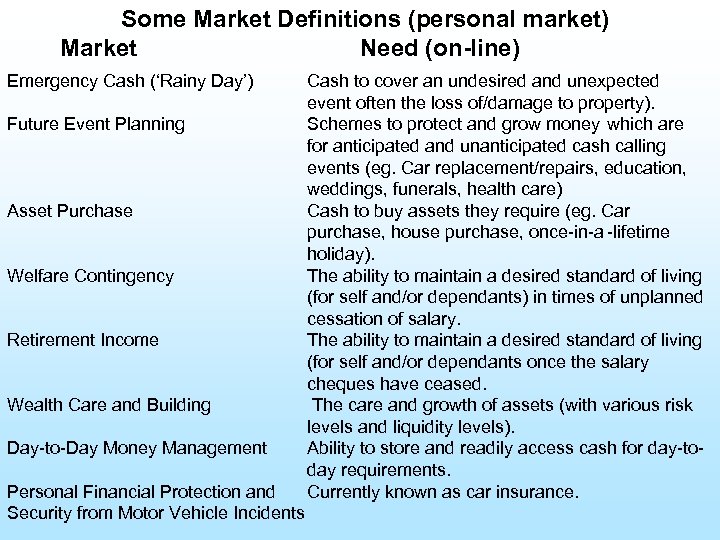
Some Market Definitions (personal market) Market Need (on-line) Emergency Cash (‘Rainy Day’) Future Event Planning Asset Purchase Welfare Contingency Retirement Income Wealth Care and Building Day-to-Day Money Management Personal Financial Protection and Security from Motor Vehicle Incidents Cash to cover an undesired and unexpected event often the loss of/damage to property). Schemes to protect and grow money which are for anticipated and unanticipated cash calling events (eg. Car replacement/repairs, education, weddings, funerals, health care) Cash to buy assets they require (eg. Car purchase, house purchase, once-in-a -lifetime holiday). The ability to maintain a desired standard of living (for self and/or dependants) in times of unplanned cessation of salary. The ability to maintain a desired standard of living (for self and/or dependants once the salary cheques have ceased. The care and growth of assets (with various risk levels and liquidity levels). Ability to store and readily access cash for day-today requirements. Currently known as car insurance.
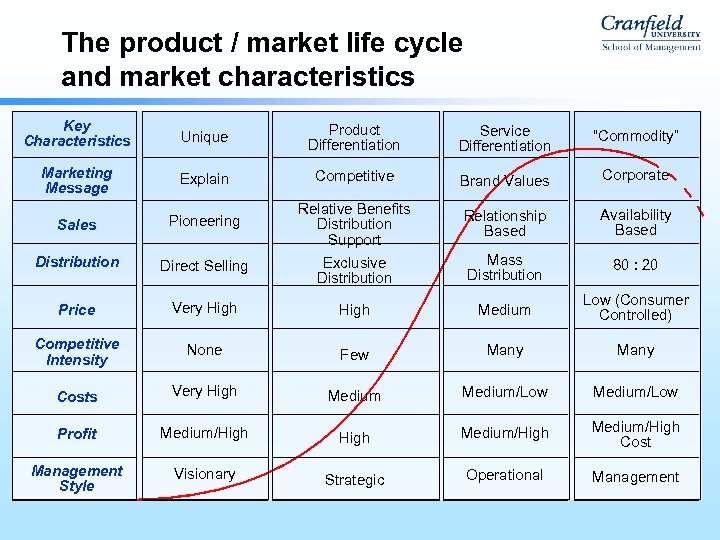
The product / market life cycle and market characteristics Key Characteristics Unique Product Differentiation Service Differentiation “Commodity” Marketing Message Explain Competitive Brand Values Corporate Sales Pioneering Relative Benefits Distribution Support Relationship Based Availability Based Distribution Direct Selling Exclusive Distribution Mass Distribution 80 : 20 Price Very High Medium Low (Consumer Controlled) Competitive Intensity None Few Many Costs Very High Medium/Low Profit Medium/High Cost Management Style Visionary Strategic Operational Management
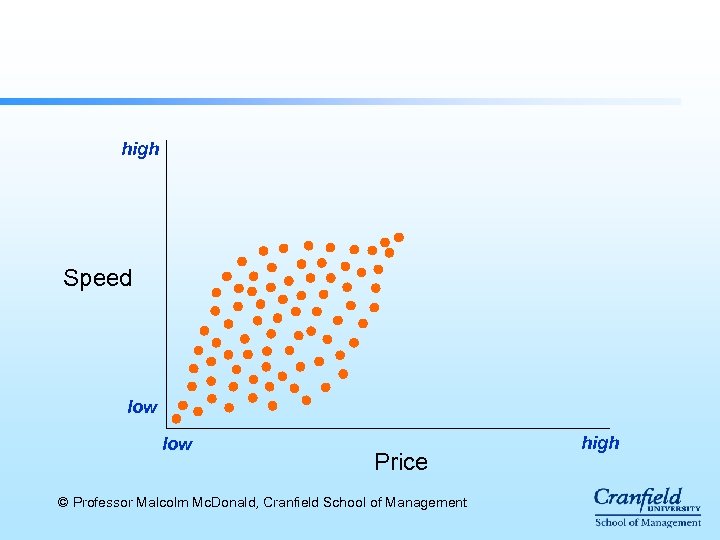
high Speed low Price © Professor Malcolm Mc. Donald, Cranfield School of Management high
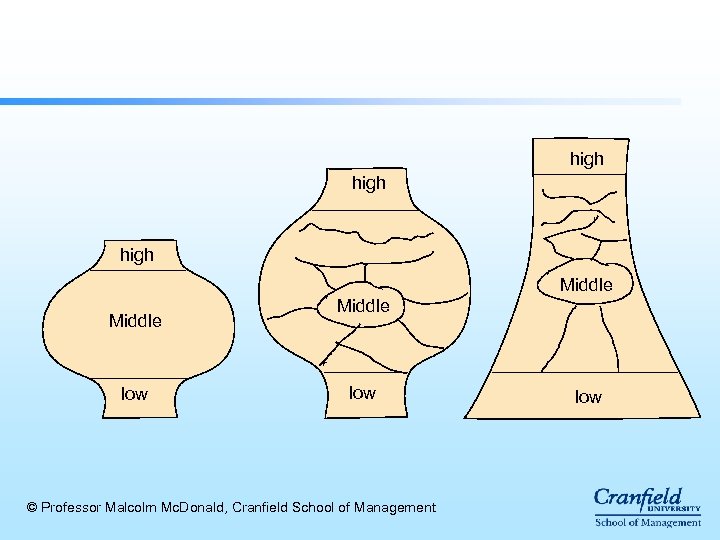
high Middle low © Professor Malcolm Mc. Donald, Cranfield School of Management low
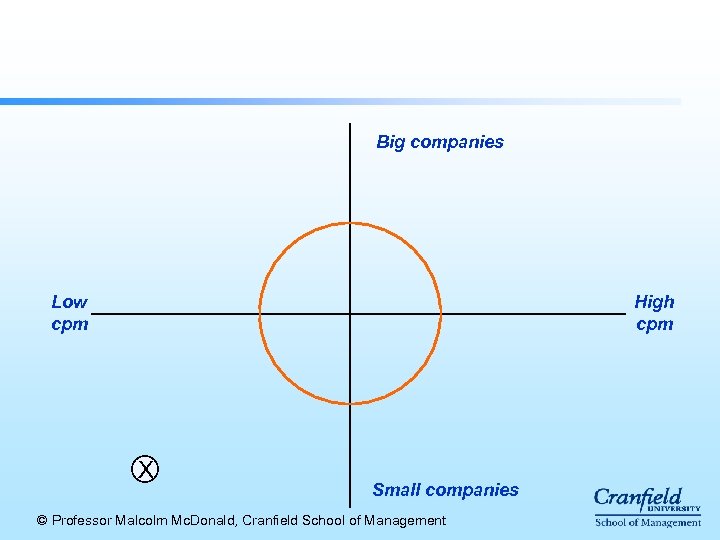
Big companies Low cpm High cpm X Small companies © Professor Malcolm Mc. Donald, Cranfield School of Management
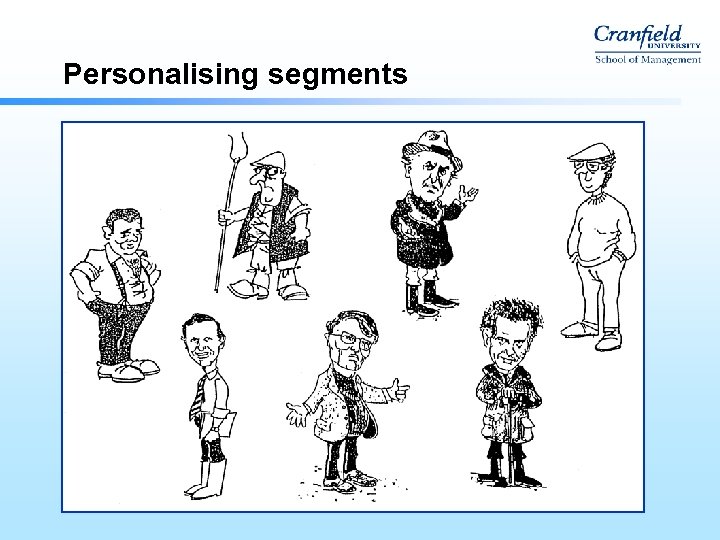
Personalising segments OIO 0599. 58
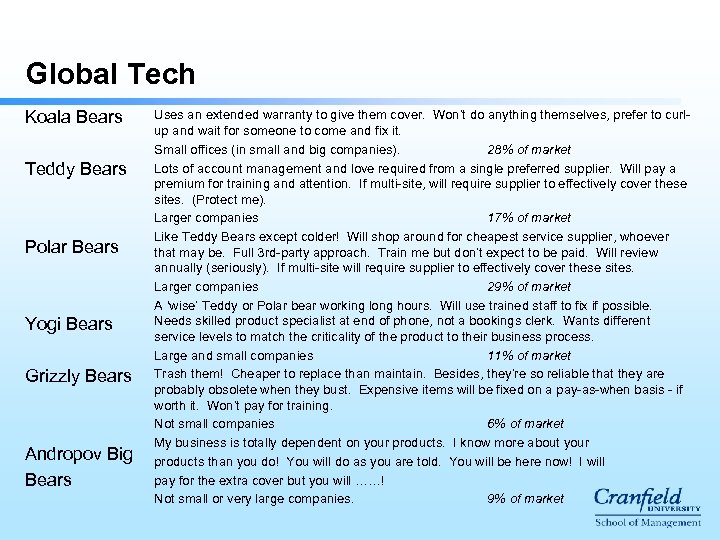
Global Tech Koala Bears Teddy Bears Polar Bears Yogi Bears Grizzly Bears Andropov Big Bears Uses an extended warranty to give them cover. Won’t do anything themselves, prefer to curlup and wait for someone to come and fix it. Small offices (in small and big companies). 28% of market Lots of account management and love required from a single preferred supplier. Will pay a premium for training and attention. If multi-site, will require supplier to effectively cover these sites. (Protect me). Larger companies 17% of market Like Teddy Bears except colder! Will shop around for cheapest service supplier, whoever that may be. Full 3 rd-party approach. Train me but don’t expect to be paid. Will review annually (seriously). If multi-site will require supplier to effectively cover these sites. Larger companies 29% of market A ‘wise’ Teddy or Polar bear working long hours. Will use trained staff to fix if possible. Needs skilled product specialist at end of phone, not a bookings clerk. Wants different service levels to match the criticality of the product to their business process. Large and small companies 11% of market Trash them! Cheaper to replace than maintain. Besides, they’re so reliable that they are probably obsolete when they bust. Expensive items will be fixed on a pay-as-when basis - if worth it. Won’t pay for training. Not small companies 6% of market My business is totally dependent on your products. I know more about your products than you do! You will do as you are told. You will be here now! I will pay for the extra cover but you will ……! Not small or very large companies. 9% of market
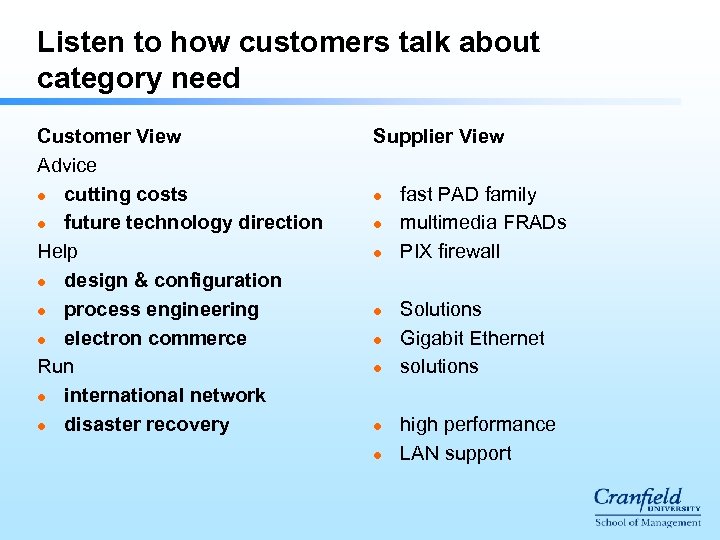
Listen to how customers talk about category need Customer View Advice l cutting costs l future technology direction Help l design & configuration l process engineering l electron commerce Run l international network l disaster recovery Supplier View l l l l fast PAD family multimedia FRADs PIX firewall Solutions Gigabit Ethernet solutions high performance LAN support
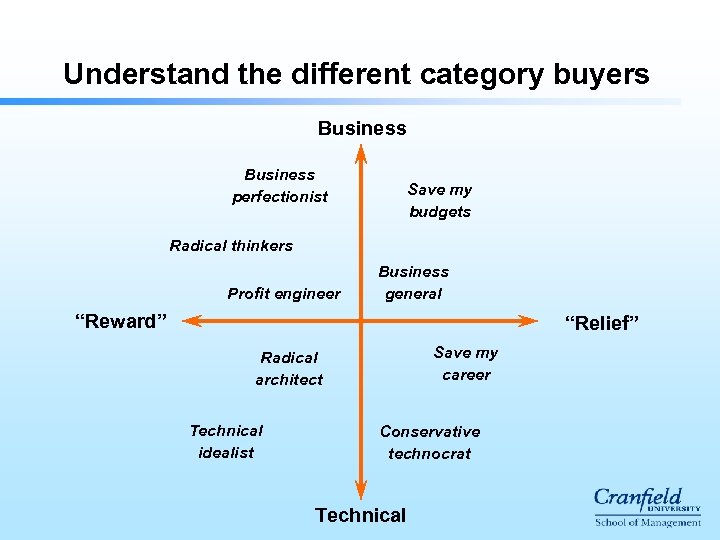
Understand the different category buyers Business perfectionist Save my budgets Radical thinkers Profit engineer Business general “Reward” “Relief” Save my career Radical architect Technical idealist Conservative technocrat Technical
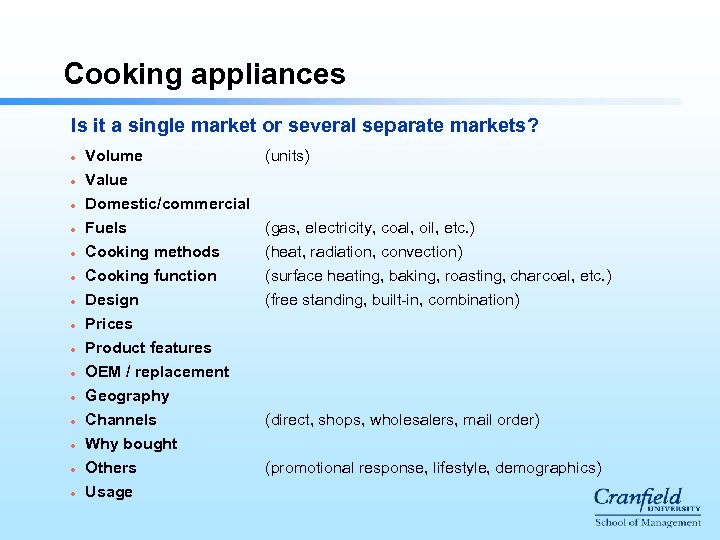
Cooking appliances Is it a single market or several separate markets? l Volume l Value l Domestic/commercial l l l Fuels Cooking methods Cooking function Design Prices Product features OEM / replacement Geography Channels Why bought Others Usage (units) (gas, electricity, coal, oil, etc. ) (heat, radiation, convection) (surface heating, baking, roasting, charcoal, etc. ) (free standing, built-in, combination) (direct, shops, wholesalers, mail order) (promotional response, lifestyle, demographics)
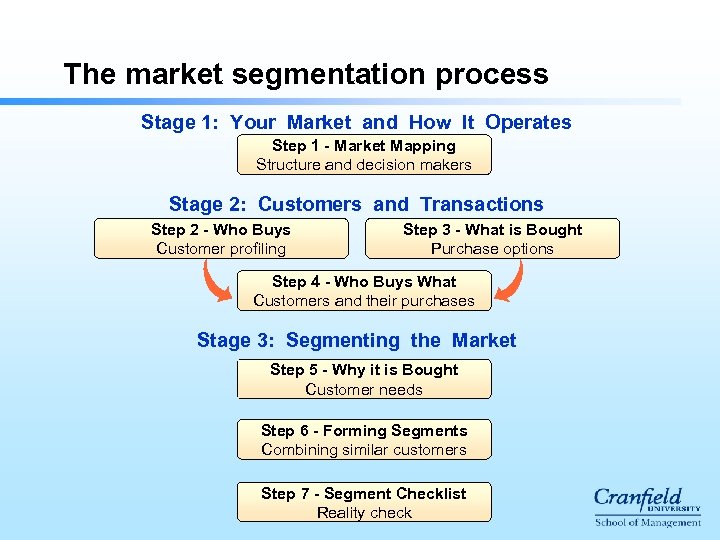
The market segmentation process Stage 1: Your Market and How It Operates Step 1 - Market Mapping Structure and decision makers Stage 2: Customers and Transactions Step 2 - Who Buys Customer profiling Step 3 - What is Bought Purchase options Step 4 - Who Buys What Customers and their purchases Stage 3: Segmenting the Market Step 5 - Why it is Bought Customer needs Step 6 - Forming Segments Combining similar customers Step 7 - Segment Checklist Reality check
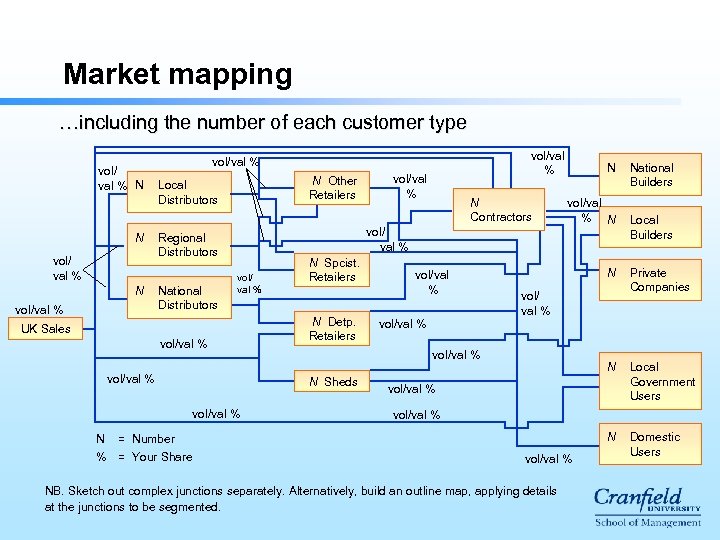
Market mapping …including the number of each customer type vol/ val % N N vol/ val % N vol/val % N Other Retailers Local Distributors vol/ val % UK Sales vol/val % N Spcist. Retailers N Detp. Retailers vol/val % N National Builders Local Builders N Private Companies N Local Government Users N Domestic Users vol/ val % vol/val % N Sheds N = Number % = Your Share N Contractors vol/ val % Regional Distributors National Distributors vol/val % NB. Sketch out complex junctions separately. Alternatively, build an outline map, applying details at the junctions to be segmented.
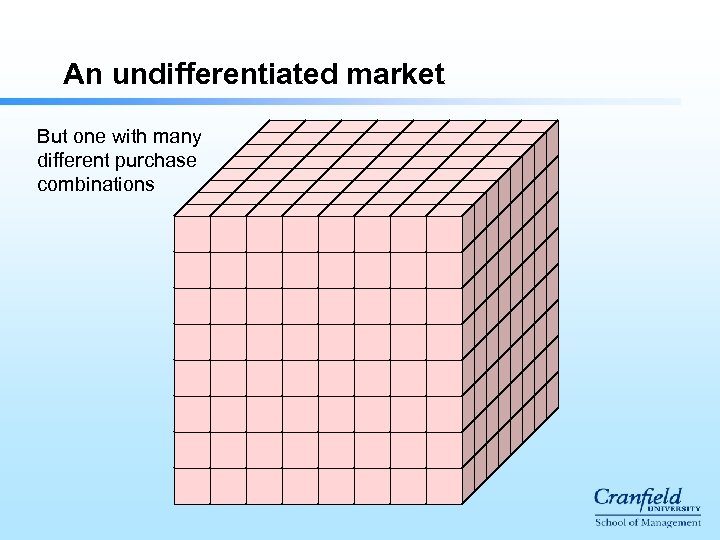
An undifferentiated market But one with many different purchase combinations
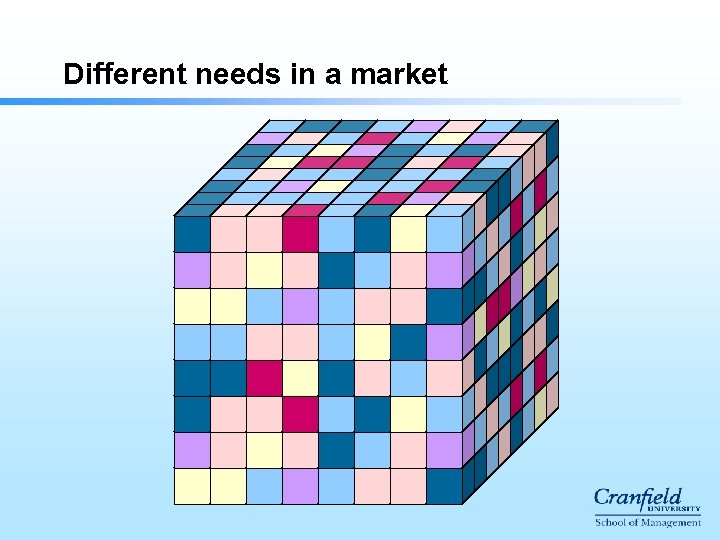
Different needs in a market
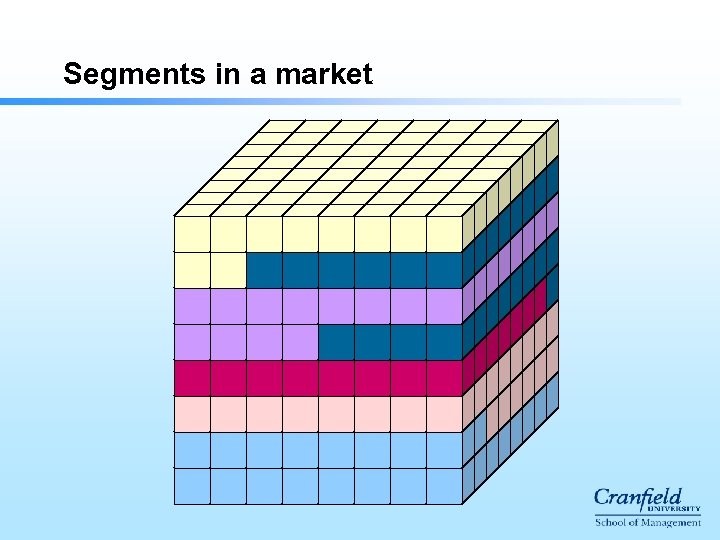
Segments in a market
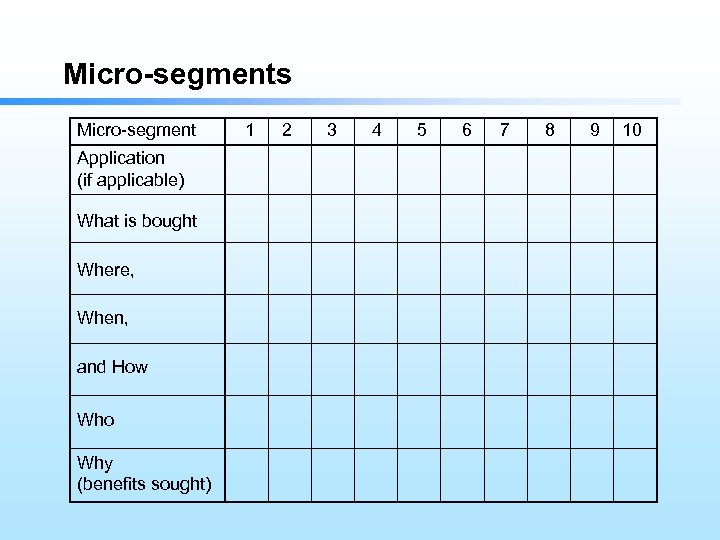
Micro-segments Micro-segment Application (if applicable) What is bought Where, When, and How Who Why (benefits sought) 1 2 3 4 5 6 7 8 9 10
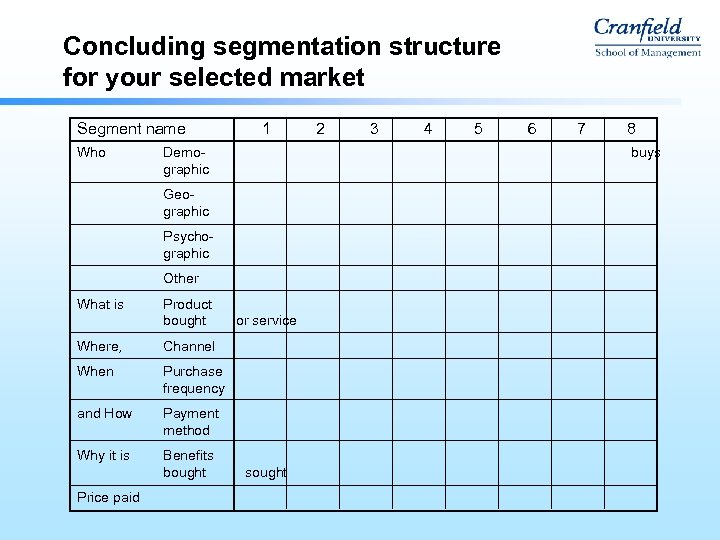
Concluding segmentation structure for your selected market Segment name Who 1 Demographic Psychographic Other Product bought Where, Purchase frequency and How Payment method Why it is Benefits bought or service Channel When Price paid 3 4 5 6 7 8 buys Geographic What is 2 sought
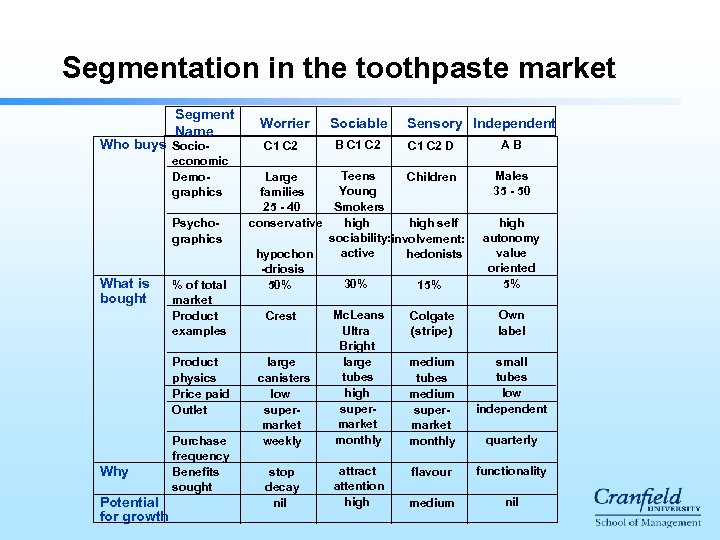
Segmentation in the toothpaste market Segment Name Who buys Socio- economic Demographics Psychographics What is bought % of total market Product examples Product physics Price paid Outlet Why Potential for growth Purchase frequency Benefits sought Worrier C 1 C 2 Sociable B C 1 C 2 Sensory Independent C 1 C 2 D Teens Large Children Young families Smokers 25 - 40 high conservative high self sociability: involvement: active hypochon hedonists -driosis 30% 50% 15% large canisters low supermarket weekly Mc. Leans Ultra Bright large tubes high supermarket monthly stop decay nil attract attention high Crest AB Males 35 - 50 high autonomy value oriented 5% Colgate (stripe) Own label medium tubes medium supermarket monthly small tubes low independent flavour functionality medium nil quarterly
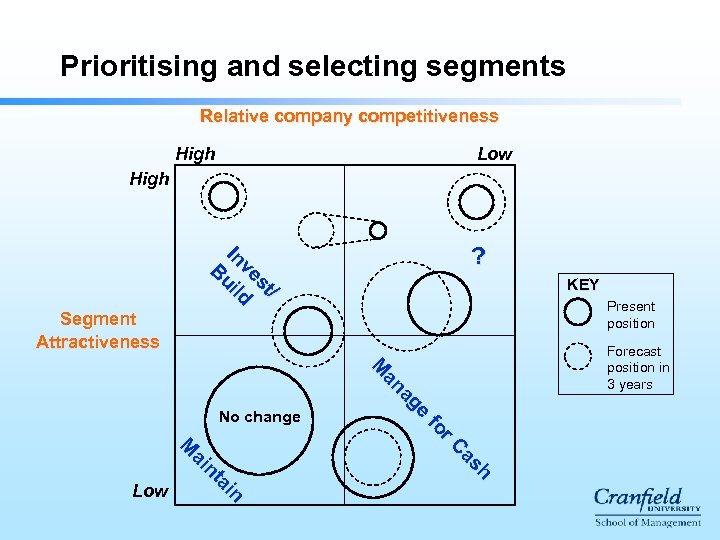
Prioritising and selecting segments Relative company competitiveness High Low High // stt es ve nv d IIn uiilld u B B ? KEY Present position Segment Attractiveness h h as as C r. C or ffo n n a aii n ntt a aii M M Low e e ag ag an an M M No change Forecast position in 3 years
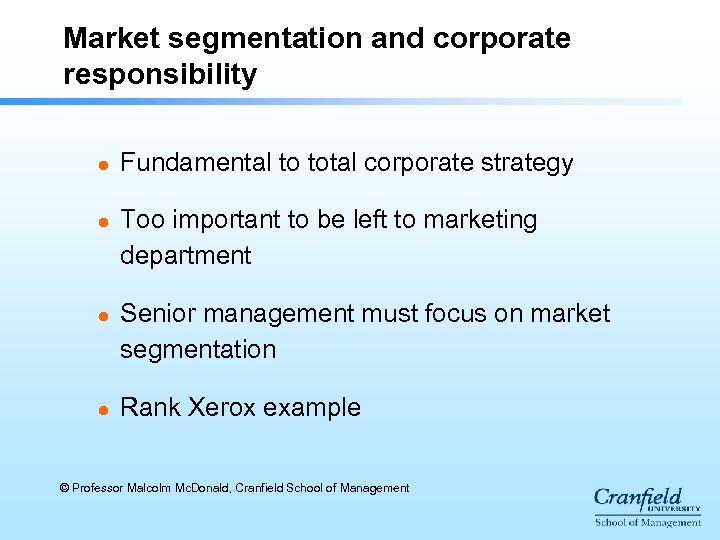
Market segmentation and corporate responsibility l l Fundamental to total corporate strategy Too important to be left to marketing department Senior management must focus on market segmentation Rank Xerox example © Professor Malcolm Mc. Donald, Cranfield School of Management
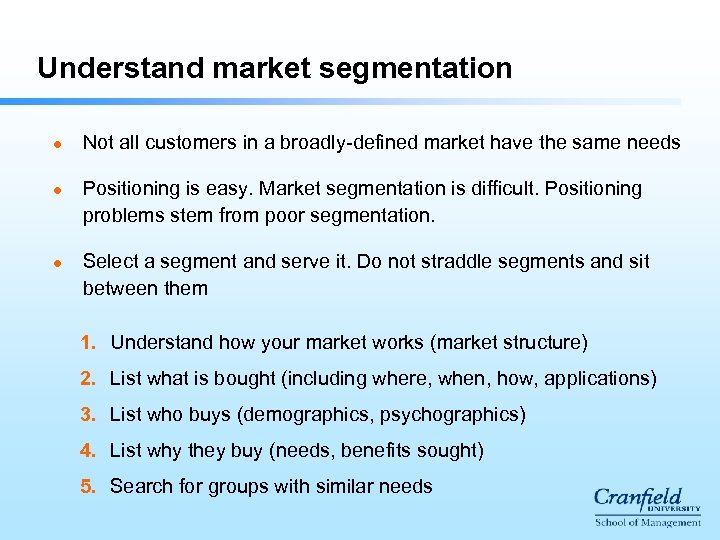
Understand market segmentation l l l Not all customers in a broadly-defined market have the same needs Positioning is easy. Market segmentation is difficult. Positioning problems stem from poor segmentation. Select a segment and serve it. Do not straddle segments and sit between them 1. Understand how your market works (market structure) 2. List what is bought (including where, when, how, applications) 3. List who buys (demographics, psychographics) 4. List why they buy (needs, benefits sought) 5. Search for groups with similar needs
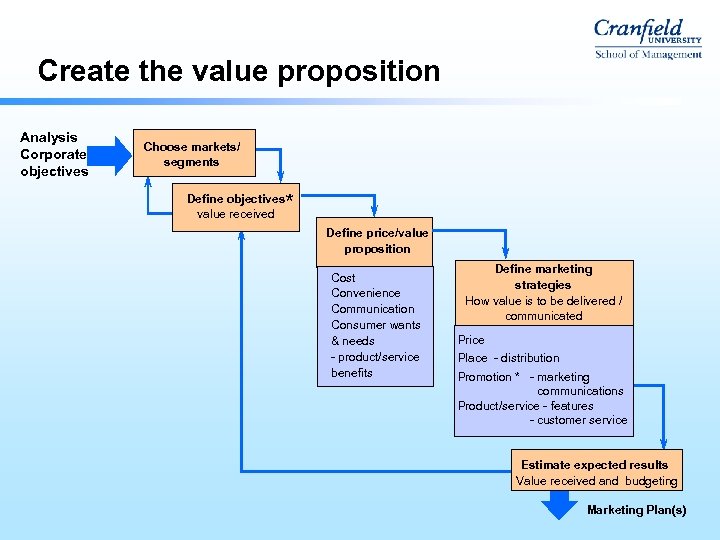
Create the value proposition Analysis Corporate objectives Choose markets/ segments * Define objectives value received Define price/value proposition Cost Convenience Communication Consumer wants & needs - product/service benefits Define marketing strategies How value is to be delivered / communicated Price Place - distribution Promotion * - marketing communications Product/service - features - customer service Estimate expected results Value received and budgeting Marketing Plan(s)
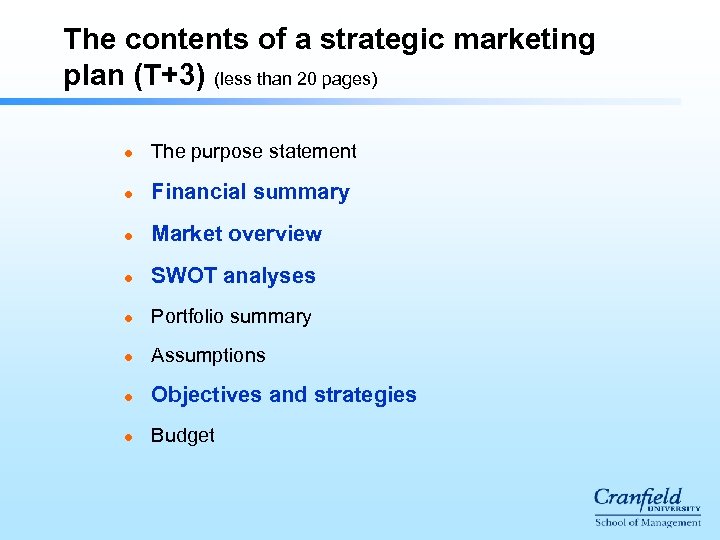
The contents of a strategic marketing plan (T+3) (less than 20 pages) l The purpose statement l Financial summary l Market overview l SWOT analyses l Portfolio summary l Assumptions l Objectives and strategies l Budget
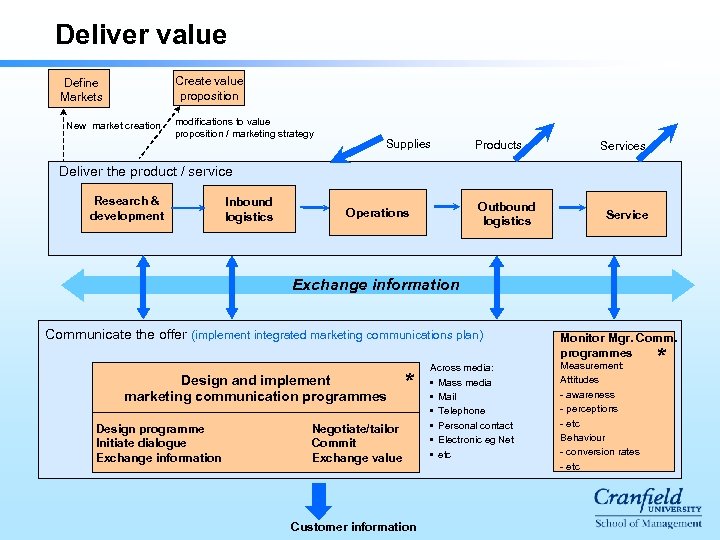
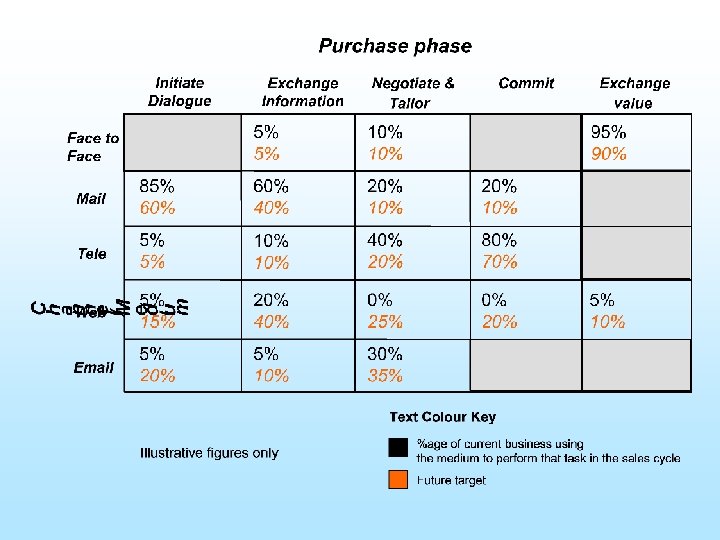
Deliver value Create value proposition Define Markets New market creation modifications to value proposition / marketing strategy Supplies Products Services Deliver the product / service Research & development Inbound logistics Outbound logistics Operations Service Exchange information Communicate the offer (implement integrated marketing communications plan) Design and implement marketing communication programmes Design programme Initiate dialogue Exchange information * Negotiate/tailor Commit Exchange value Customer information Across media: • Mass media • Mail • Telephone • Personal contact • Electronic eg Net • etc Monitor Mgr. Comm. programmes Measurement: Attitudes - awareness - perceptions - etc Behaviour - conversion rates - etc *
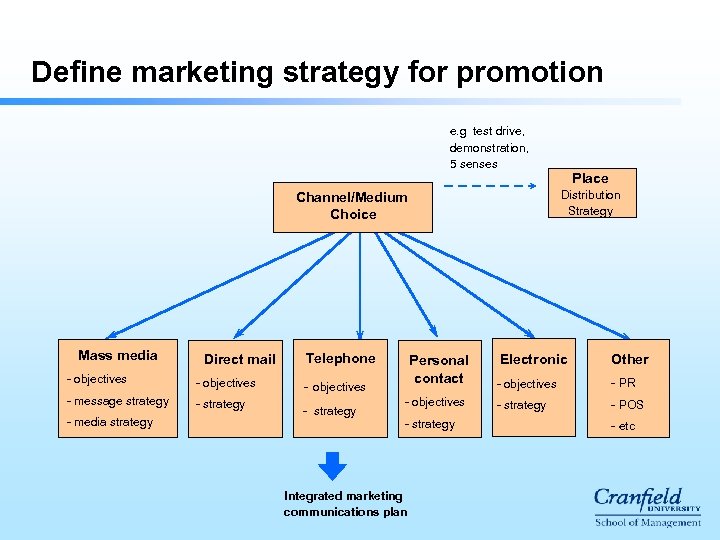
Define marketing strategy for promotion e. g test drive, demonstration, 5 senses Distribution Strategy Channel/Medium Choice Mass media Direct mail - objectives - message strategy - media strategy Telephone Personal contact - objectives - strategy Integrated marketing communications plan Place Electronic Other - objectives - PR - strategy - POS - etc
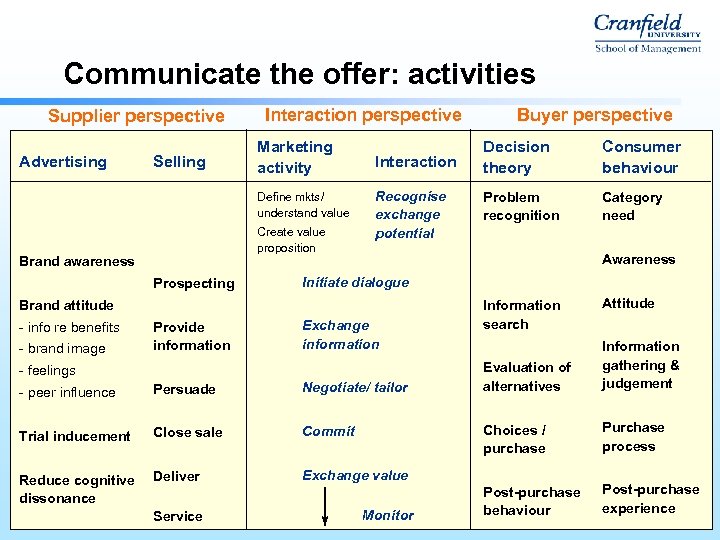
Communicate the offer: activities Supplier perspective Advertising Selling Interaction perspective Marketing activity Define mkts/ understand value Create value proposition Brand awareness Prospecting Interaction Recognise exchange potential - brand image Provide information Decision theory Consumer behaviour Problem recognition Category need Awareness Initiate dialogue Brand attitude - info re benefits Buyer perspective Exchange information Information search - peer influence Persuade Negotiate/ tailor Trial inducement Close sale Commit Reduce cognitive dissonance Deliver Evaluation of alternatives Information gathering & judgement Choices / purchase - feelings Purchase process Post-purchase behaviour Post-purchase experience Exchange value Service Attitude Monitor
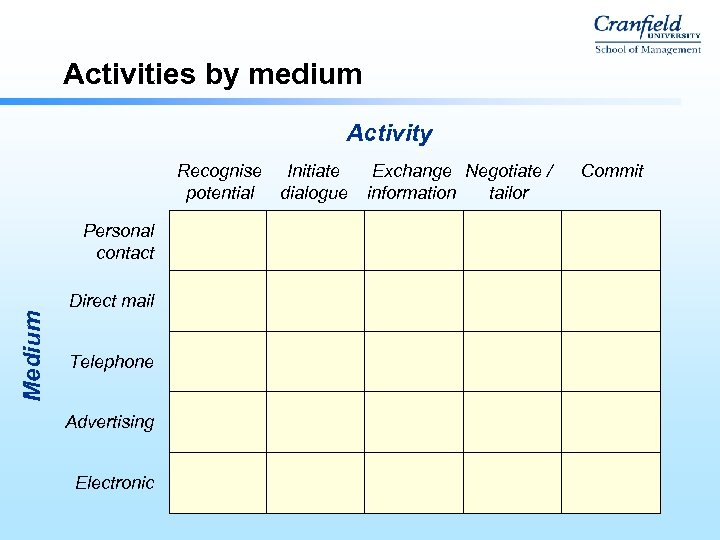
Activities by medium Activity Recognise Initiate potential dialogue Medium Personal contact Direct mail Telephone Advertising Electronic Exchange Negotiate / information tailor Commit
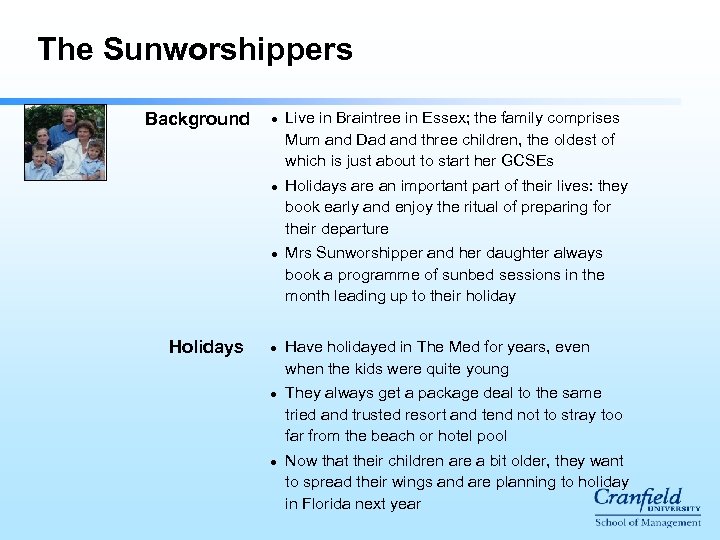
The Sunworshippers Background l l l Holidays l l l Live in Braintree in Essex; the family comprises Mum and Dad and three children, the oldest of which is just about to start her GCSEs Holidays are an important part of their lives: they book early and enjoy the ritual of preparing for their departure Mrs Sunworshipper and her daughter always book a programme of sunbed sessions in the month leading up to their holiday Have holidayed in The Med for years, even when the kids were quite young They always get a package deal to the same tried and trusted resort and tend not to stray too far from the beach or hotel pool Now that their children are a bit older, they want to spread their wings and are planning to holiday in Florida next year
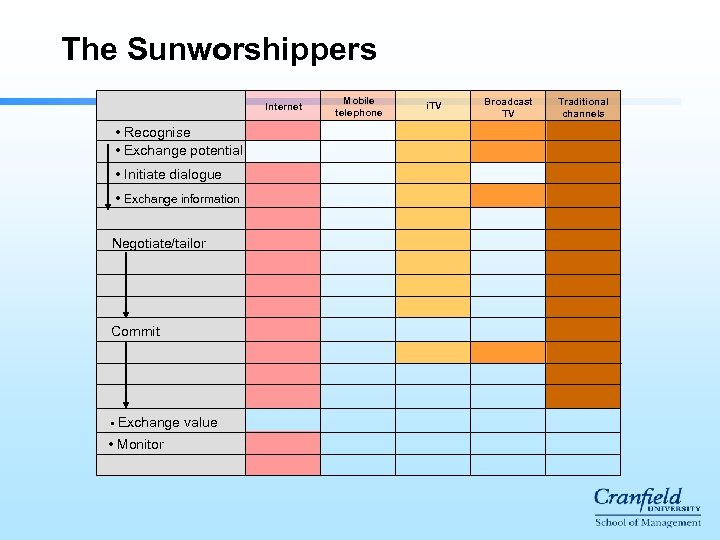
The Sunworshippers Internet • Recognise • Exchange potential • Initiate dialogue • Exchange information Negotiate/tailor Commit • Exchange • Monitor value Mobile telephone i. TV Broadcast TV Traditional channels
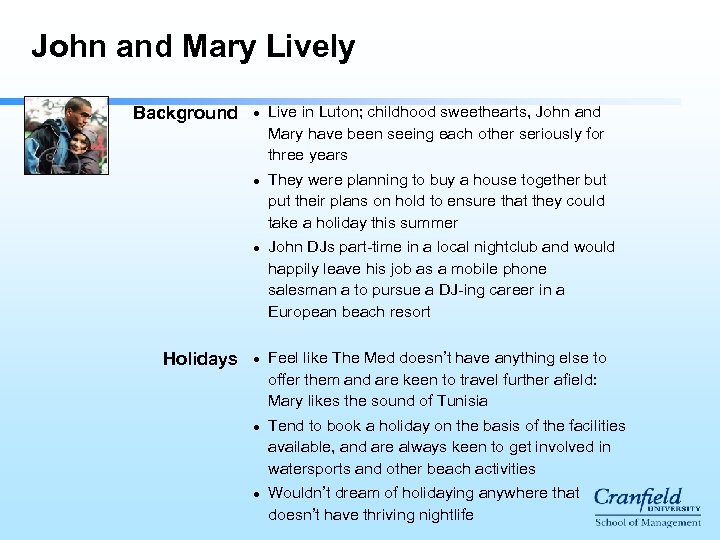
John and Mary Lively Background l l l Holidays l l l Live in Luton; childhood sweethearts, John and Mary have been seeing each other seriously for three years They were planning to buy a house together but put their plans on hold to ensure that they could take a holiday this summer John DJs part-time in a local nightclub and would happily leave his job as a mobile phone salesman a to pursue a DJ-ing career in a European beach resort Feel like The Med doesn’t have anything else to offer them and are keen to travel further afield: Mary likes the sound of Tunisia Tend to book a holiday on the basis of the facilities available, and are always keen to get involved in watersports and other beach activities Wouldn’t dream of holidaying anywhere that doesn’t have thriving nightlife
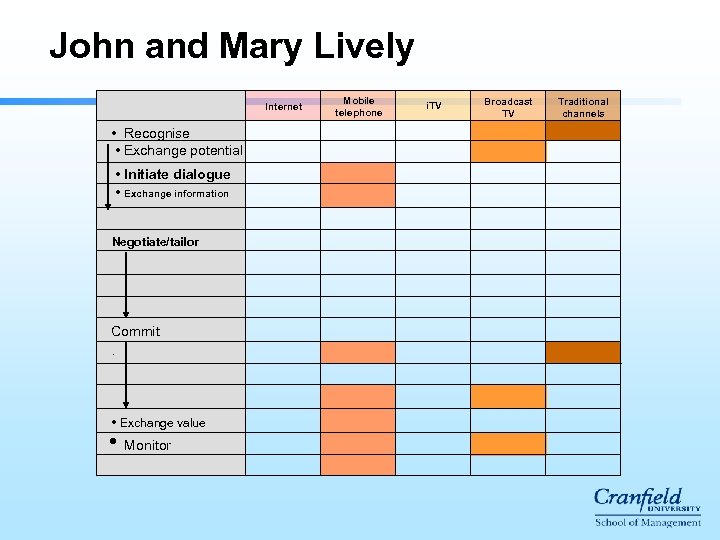
John and Mary Lively Internet • Recognise • Exchange potential • Initiate dialogue • Exchange information Negotiate/tailor Commit. • Exchange value • Monitor Mobile telephone i. TV Broadcast TV Traditional channels
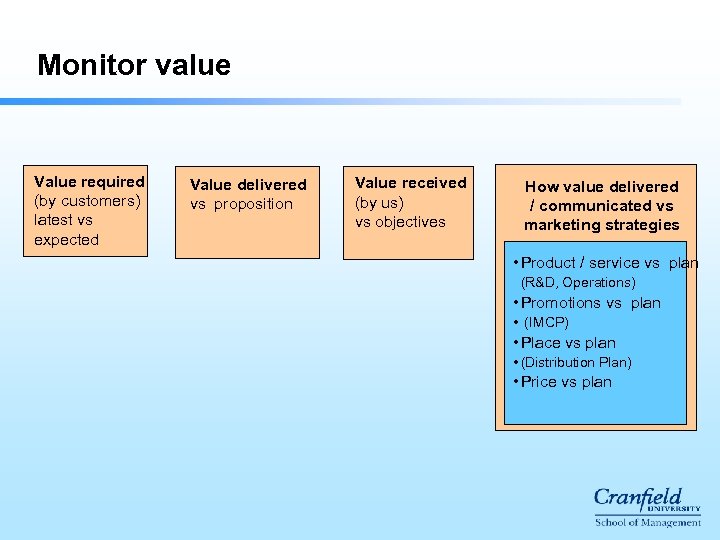
Monitor value Value required (by customers) latest vs expected Value delivered vs proposition Value received (by us) vs objectives How value delivered / communicated vs marketing strategies • Product / service vs plan (R&D, Operations) • Promotions vs plan • (IMCP) • Place vs plan • (Distribution Plan) • Price vs plan
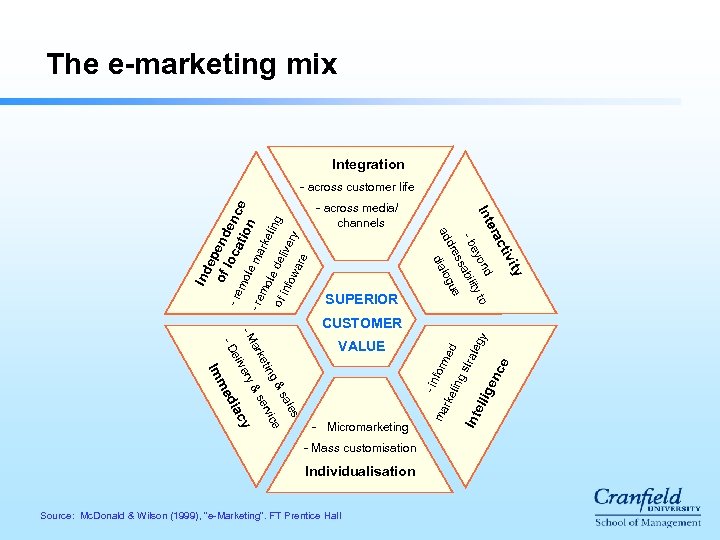
The e-marketing mix Integration live are ry fow VALUE Im s ale &s ice ng eti erv ark &s ry -M y ve eli iac -D ed CUSTOMER nc e of in SUPERIOR - in for ma m rke ting ed str Int ate ell gy etin g de ark ote log rem ity tiv dia res rac e d Int on to ey ty -b bili sa e u - across media/ channels d ad Ind e of pend loc en - re ati ce mo on te m - across customer life ige m - Micromarketing - Mass customisation Individualisation Source: Mc. Donald & Wilson (1999), “e-Marketing”. FT Prentice Hall
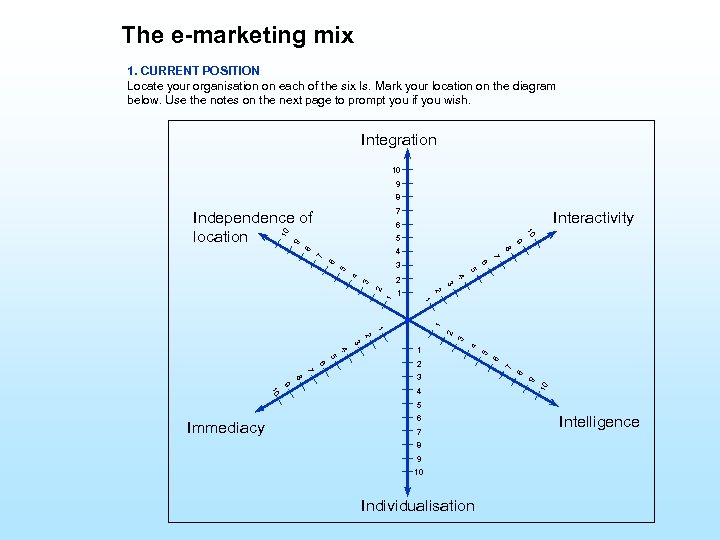
The e-marketing mix 1. CURRENT POSITION Locate your organisation on each of the six Is. Mark your location on the diagram below. Use the notes on the next page to prompt you if you wish. Integration 10 9 Independence of location 7 8 8 4 Interactivity 10 10 6 8 7 7 9 9 5 6 4 5 5 6 3 2 1 1 1 3 3 4 2 7 10 10 9 8 6 8 9 4 6 4 5 7 3 5 4 3 2 2 1 3 1 2 5 Immediacy 6 7 8 9 10 Individualisation Intelligence
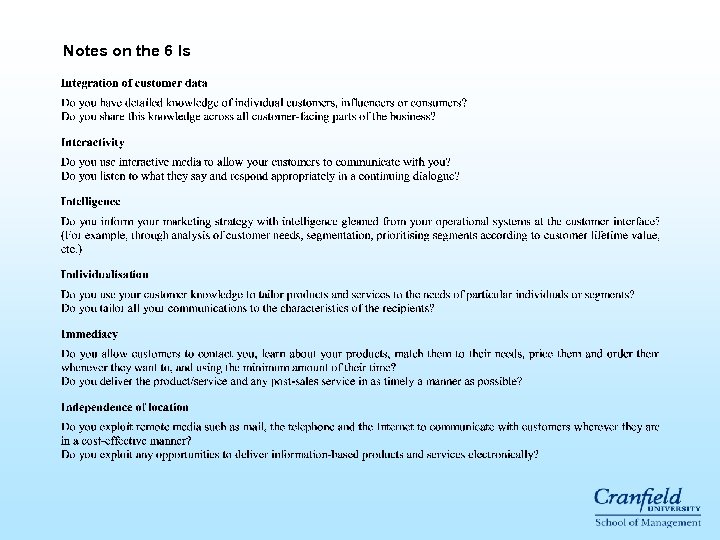
Notes on the 6 Is
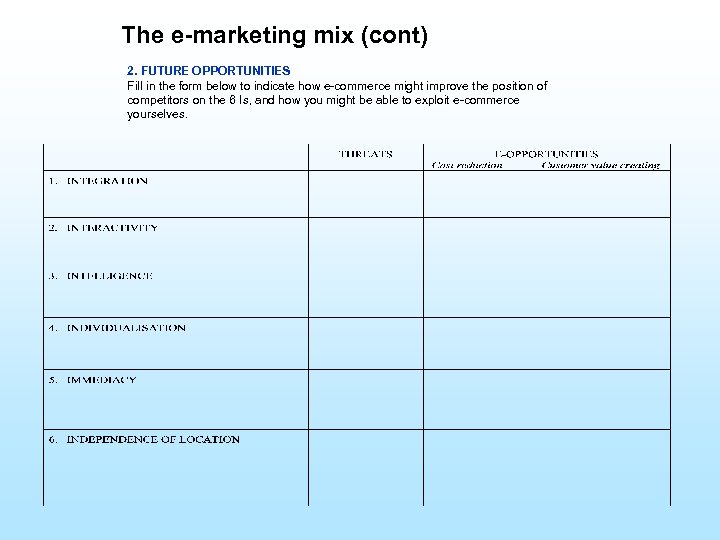
The e-marketing mix (cont) 2. FUTURE OPPORTUNITIES Fill in the form below to indicate how e-commerce might improve the position of competitors on the 6 Is, and how you might be able to exploit e-commerce yourselves.
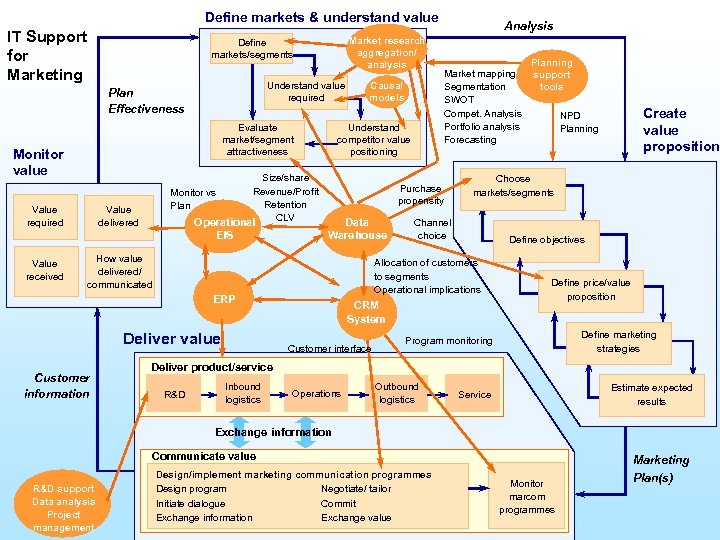
Define markets & understand value IT Support for Marketing Understand value required Plan Effectiveness Evaluate market/segment attractiveness Monitor value Value required Size/share Revenue/Profit Retention CLV Operational Causal models Understand competitor value positioning Value delivered Data Warehouse How value delivered/ communicated Customer information Channel choice Create value proposition NPD Planning Define objectives CRM System Customer interface Planning support tools Choose markets/segments Allocation of customers to segments Operational implications ERP Deliver value Market mapping Segmentation SWOT Compet. Analysis Portfolio analysis Forecasting Purchase propensity Monitor vs Plan EIS Value received Market research aggregation/ analysis Define markets/segments Analysis Define price/value proposition Define marketing strategies Program monitoring Deliver product/service R&D Inbound logistics Operations Outbound logistics Estimate expected results Service Exchange information Communicate value R&D support Data analysis Project management Design/implement marketing communication programmes Design program Negotiate/ tailor Initiate dialogue Commit Exchange information Exchange value Monitor marcom programmes Marketing Plan(s)
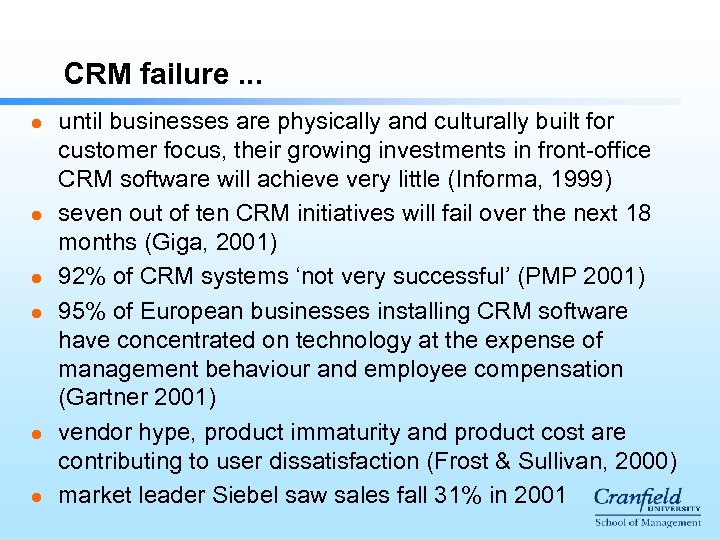
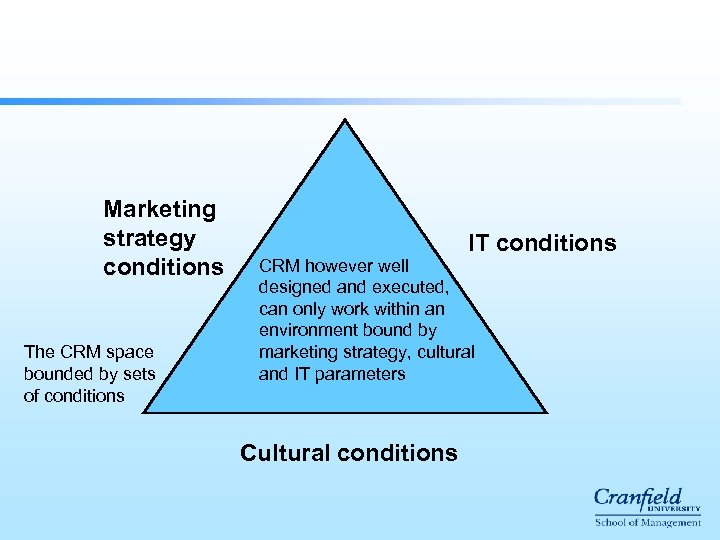
CRM failure. . . l l l until businesses are physically and culturally built for customer focus, their growing investments in front-office CRM software will achieve very little (Informa, 1999) seven out of ten CRM initiatives will fail over the next 18 months (Giga, 2001) 92% of CRM systems ‘not very successful’ (PMP 2001) 95% of European businesses installing CRM software have concentrated on technology at the expense of management behaviour and employee compensation (Gartner 2001) vendor hype, product immaturity and product cost are contributing to user dissatisfaction (Frost & Sullivan, 2000) market leader Siebel saw sales fall 31% in 2001
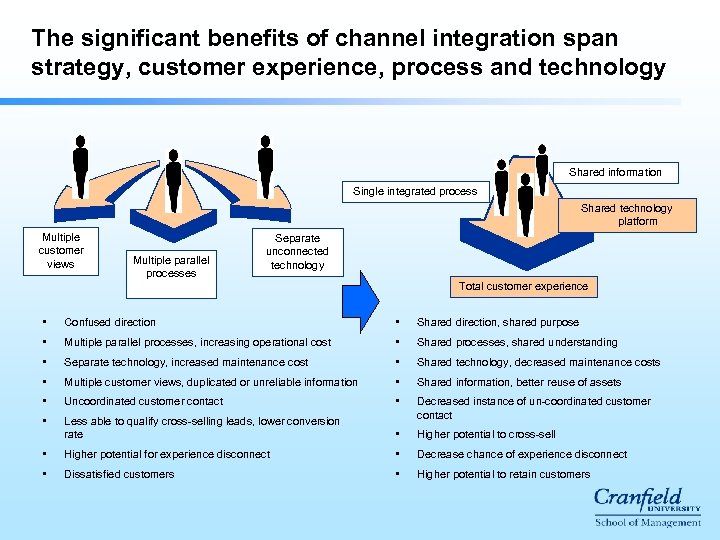
The significant benefits of channel integration span strategy, customer experience, process and technology Shared information Single integrated process Shared technology platform Multiple customer views Multiple parallel processes Separate unconnected technology Total customer experience • Confused direction • Shared direction, shared purpose • Multiple parallel processes, increasing operational cost • Shared processes, shared understanding • Separate technology, increased maintenance cost • Shared technology, decreased maintenance costs • Multiple customer views, duplicated or unreliable information • Shared information, better reuse of assets • Uncoordinated customer contact • • Less able to qualify cross-selling leads, lower conversion rate Decreased instance of un-coordinated customer contact • Higher potential to cross-sell • Higher potential for experience disconnect • Decrease chance of experience disconnect • Dissatisfied customers • Higher potential to retain customers
E-commerce has given the customer: l l speed/convenience choice control comparability © Professor Malcolm Mc. Donald, Cranfield School of Management
E-commerce In future, the most powerful brands will be customercentric. Successful companies will know the customer and will be the customer’s advocate
Clarity about CRM as a concept l CRM means: – – l focusing on customer needs tailoring the value proposition (personalisation) creating an interactive relationship with the customer retention through satisfaction with the offer and the sales/service experience Company benefits realised as a result: – improved customer retention – improved cross-selling – improved profitability (per customer and in general)
Key elements of world class marketing 1. Profound understanding of the market-place 2. Creative segmentation and selection 3. Powerful differentiation positioning and branding 4. Effective marketing planning processes 5. Long-term integrated marketing strategies 6. Institutionalised creativity and innovation 7. Total supply chain management 8. Market-driven organisation structures 9. Careful recruitment, training and career management 10. Vigorous line management implementation
Marketing strategy conditions The CRM space bounded by sets of conditions IT conditions CRM however well designed and executed, can only work within an environment bound by marketing strategy, cultural and IT parameters Cultural conditions
Implementation Issues
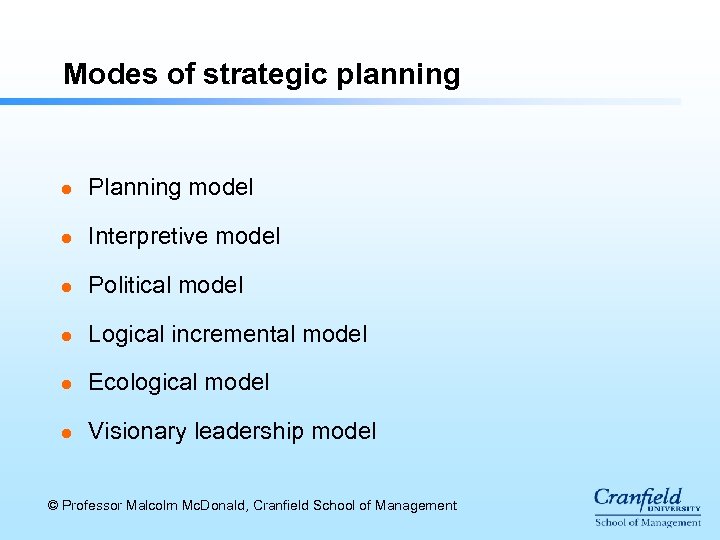
Modes of strategic planning l Planning model l Interpretive model l Political model l Logical incremental model l Ecological model l Visionary leadership model © Professor Malcolm Mc. Donald, Cranfield School of Management
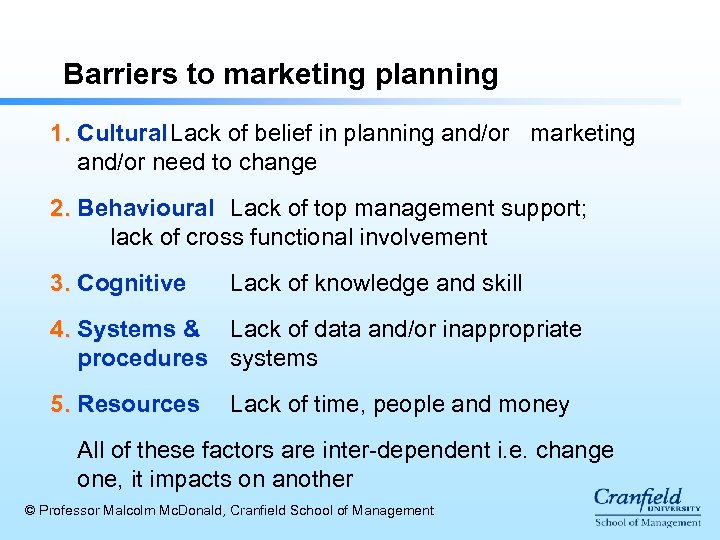
Barriers to marketing planning 1. Cultural Lack of belief in planning and/or marketing and/or need to change 2. Behavioural Lack of top management support; lack of cross functional involvement 3. Cognitive Lack of knowledge and skill 4. Systems & Lack of data and/or inappropriate procedures systems 5. Resources Lack of time, people and money All of these factors are inter-dependent i. e. change one, it impacts on another © Professor Malcolm Mc. Donald, Cranfield School of Management
Cultural/Behavioural Factors
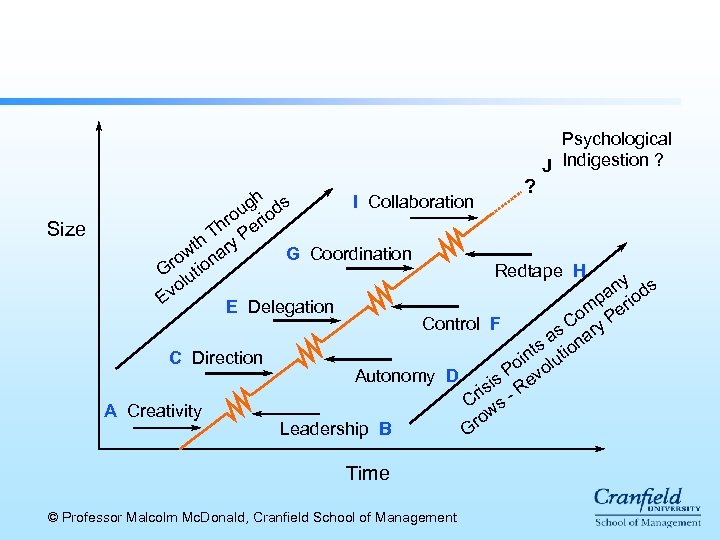
? Size Psychological J Indigestion ? h I Collaboration ug iods o hr er T P th ary w G Coordination ro tion Redtape H G lu y vo an iods p E E Delegation m er Co ry P Control F s a tion int lu C Direction Po vo Autonomy D is e ris - R C s A Creativity w ro Leadership B G Time © Professor Malcolm Mc. Donald, Cranfield School of Management
Lack of Knowledge and Skills
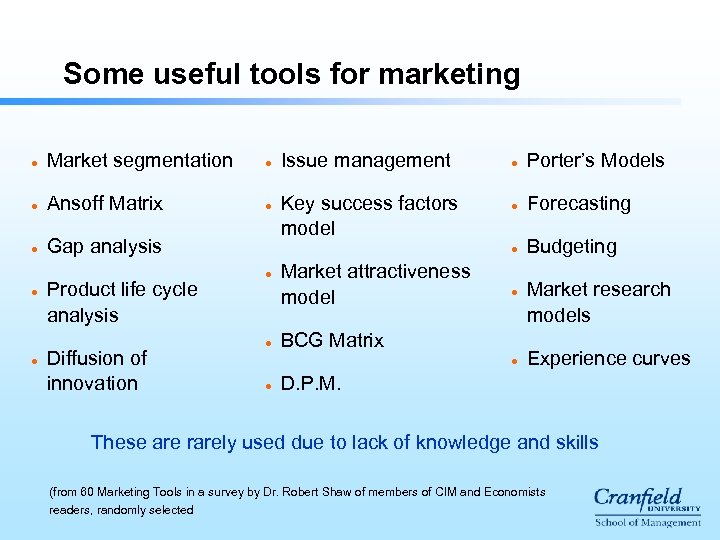
Some useful tools for marketing l Market segmentation l l Ansoff Matrix l l Gap analysis l l Product life cycle analysis Diffusion of innovation l Key success factors model Market attractiveness model l Porter’s Models l Forecasting l l Issue management Budgeting l BCG Matrix l l Market research models Experience curves D. P. M. These are rarely used due to lack of knowledge and skills (from 60 Marketing Tools in a survey by Dr. Robert Shaw of members of CIM and Economists readers, randomly selected
Problems of Technique Interrelationships
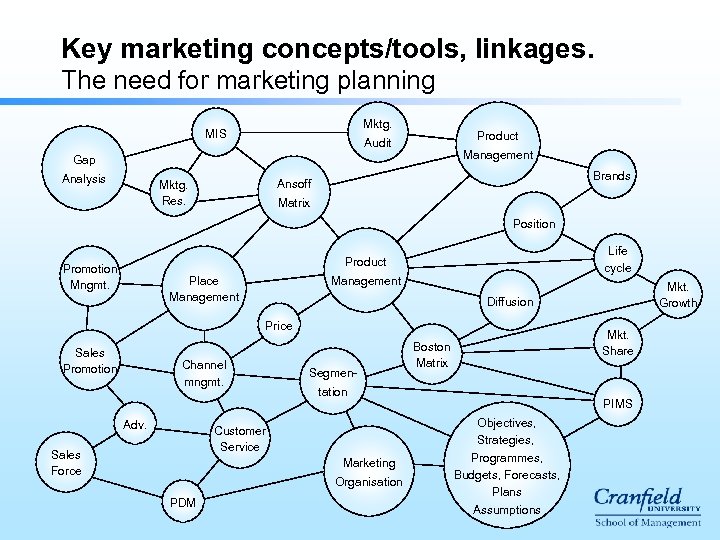
Key marketing concepts/tools, linkages. The need for marketing planning Mktg. MIS Product Audit Management Gap Analysis Brands Ansoff Mktg. Res. Matrix Position Life cycle Product Promotion Mngmt. Place Management Diffusion Price Sales Promotion Channel mngmt. Adv. Segmen- Marketing Organisation PDM Mkt. Share Boston Matrix tation Customer Service Sales Force Mkt. Growth PIMS Objectives, Strategies, Programmes, Budgets, Forecasts, Plans Assumptions
Cranfield Centre for Advanced Research in Marketing To develop solutions, via information technology, which make available the power of marketing tools, techniques and processes, to personnel at all levels within an organisation, who have an influence on marketing. © Professor Malcolm Mc. Donald, Cranfield School of Management
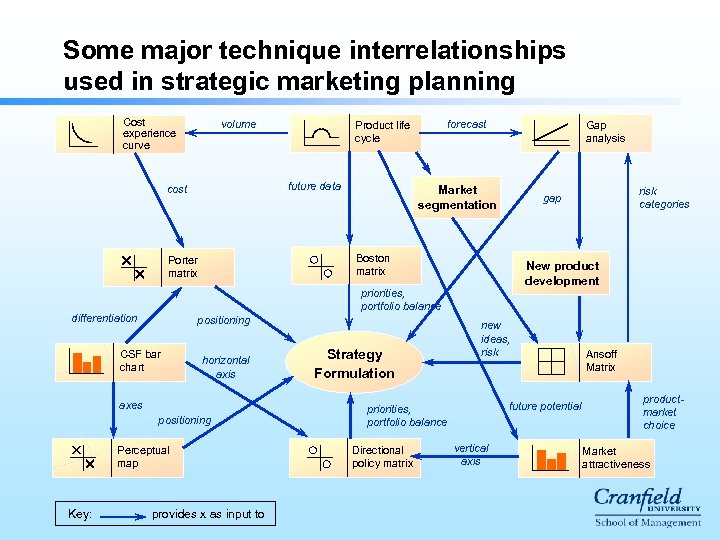
Some major technique interrelationships used in strategic marketing planning Cost experience curve volume future data cost Gap analysis Market segmentation New product development priorities, portfolio balance differentiation positioning CSF bar chart horizontal axis axes positioning Perceptual map provides x as input to Strategy Formulation new ideas, risk future potential priorities, portfolio balance Directional policy matrix risk categories gap Boston matrix Porter matrix Key: forecast Product life cycle vertical axis Ansoff Matrix productmarket choice Market attractiveness
Competitive Marketing Strategies and gaining differential advantage
Competitive Strategies - what are they? © Professor Malcolm Mc. Donald, Cranfield School of Management
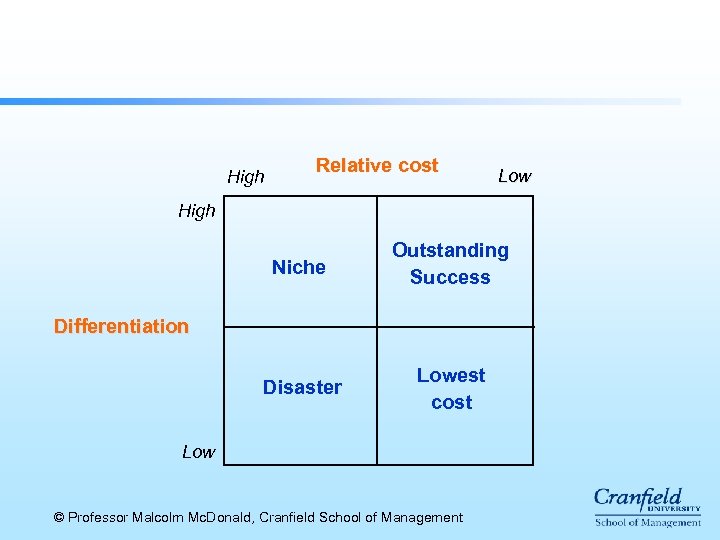
High Relative cost Low High Niche Outstanding Success Disaster Lowest cost Differentiation Low © Professor Malcolm Mc. Donald, Cranfield School of Management
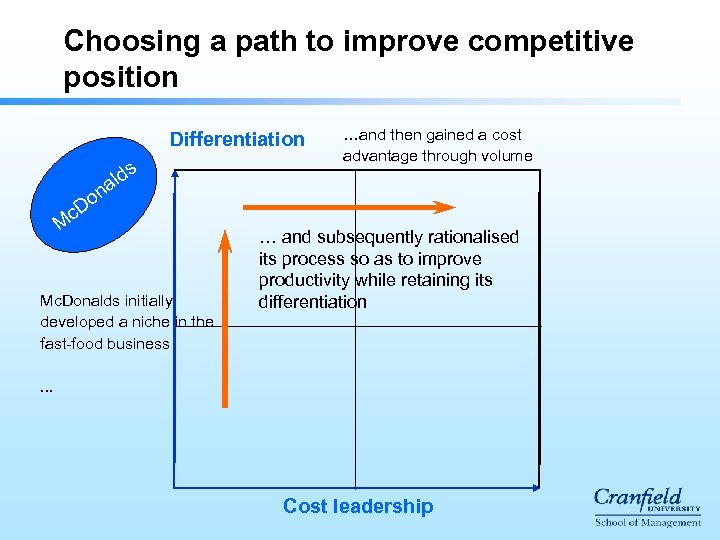
Choosing a path to improve competitive position Differentiation lds a …and then gained a cost advantage through volume on c. D M Mc. Donalds initially developed a niche in the fast-food business … and subsequently rationalised its process so as to improve productivity while retaining its differentiation . . . Cost leadership
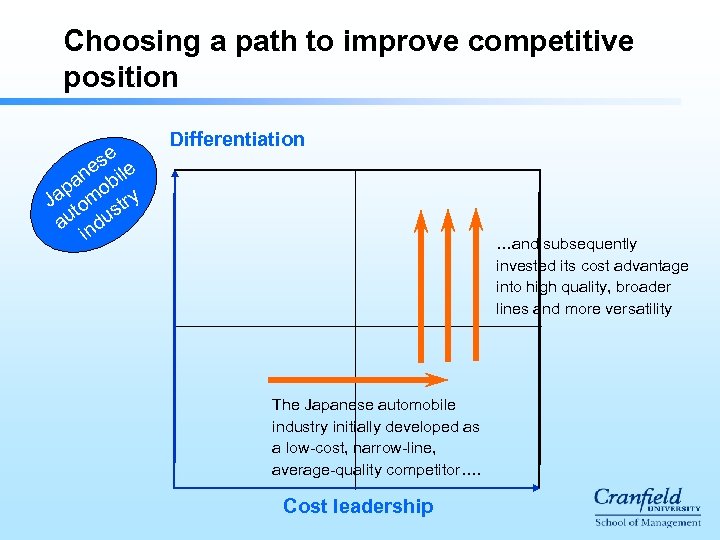
Choosing a path to improve competitive position e es ile n pa ob y Ja tom str au ndu i Differentiation …and subsequently invested its cost advantage into high quality, broader lines and more versatility The Japanese automobile industry initially developed as a low-cost, narrow-line, average-quality competitor…. Cost leadership
© Professor Malcolm Mc. Donald, Cranfield School of Management
© Professor Malcolm Mc. Donald, Cranfield School of Management
© Professor Malcolm Mc. Donald, Cranfield School of Management
1. Terrain 2. Impregnable fortress 1 2 © Professor Malcolm Mc. Donald, Cranfield School of Management
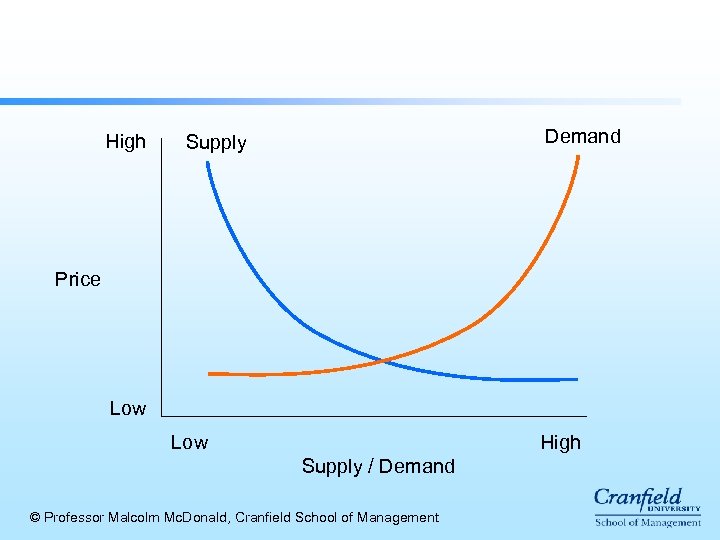
High Demand Supply Price Low High Low Supply / Demand © Professor Malcolm Mc. Donald, Cranfield School of Management
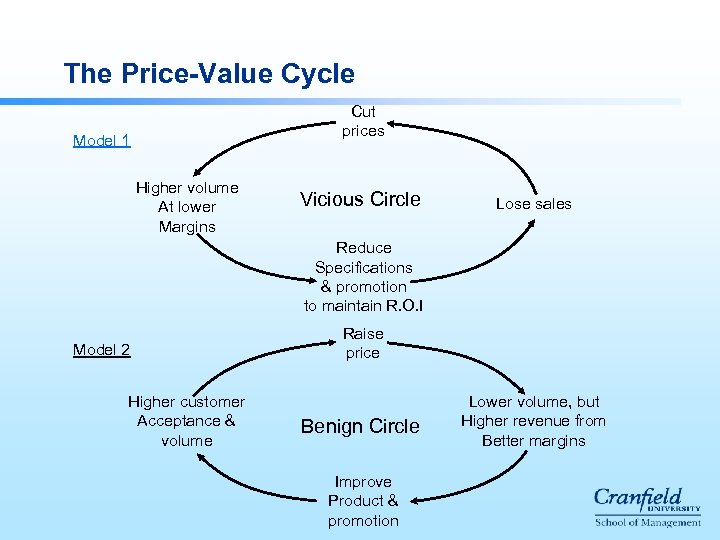
The Price-Value Cycle Cut prices Model 1 Higher volume At lower Margins Vicious Circle Lose sales Reduce Specifications & promotion to maintain R. O. I Model 2 Higher customer Acceptance & volume Raise price Benign Circle Improve Product & promotion Lower volume, but Higher revenue from Better margins
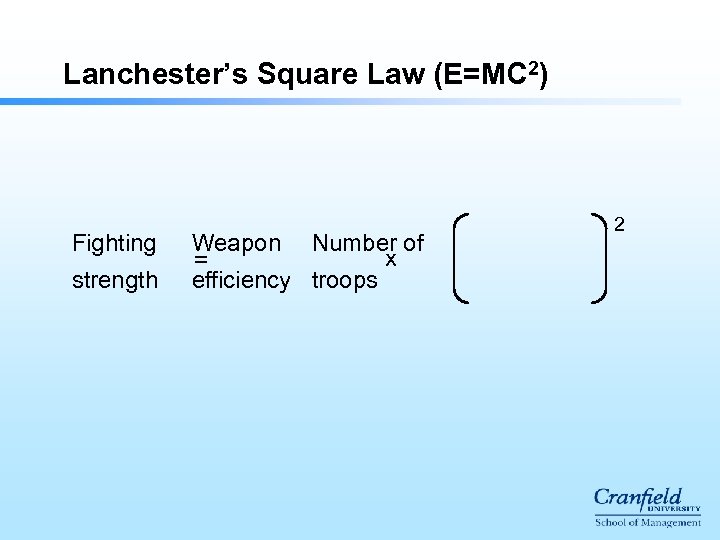
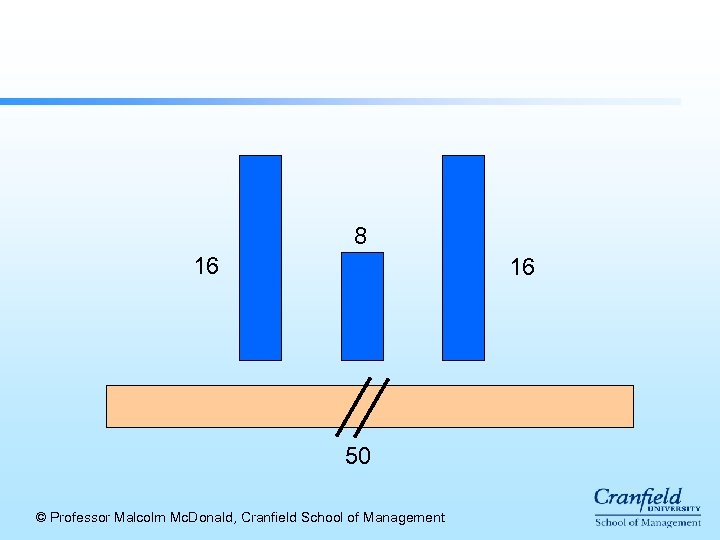
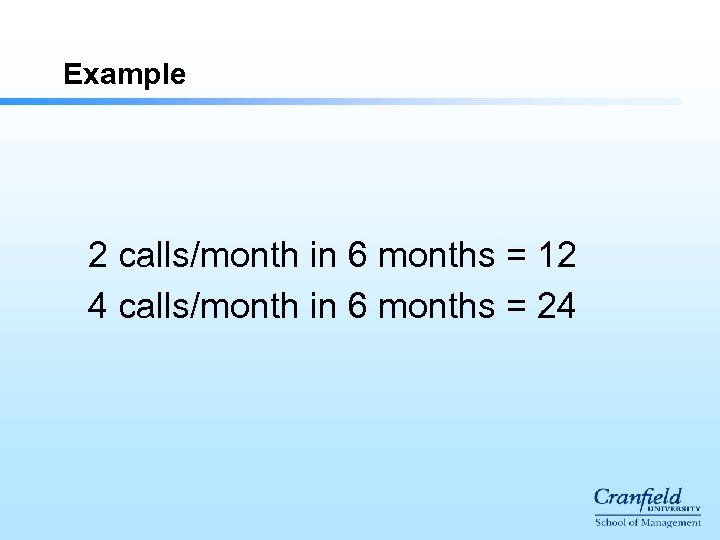
Lanchester’s Square Law (E=MC 2) Fighting strength Weapon Number of x = efficiency troops 2
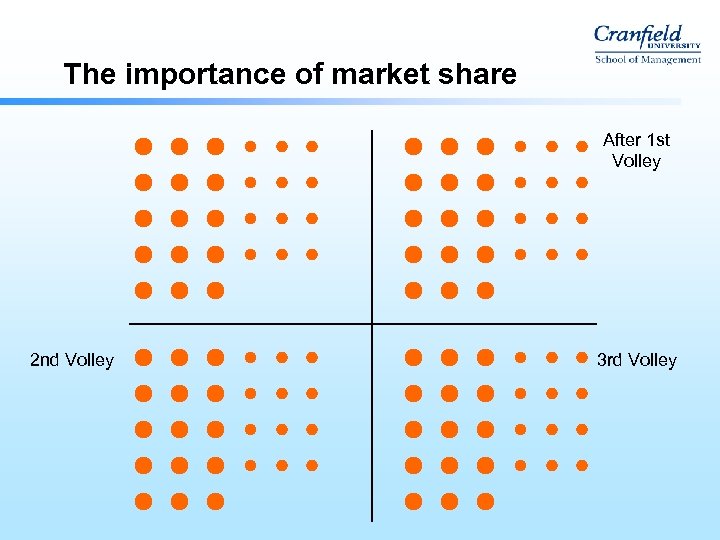
The importance of market share After 1 st Volley 2 nd Volley 3 rd Volley
8 16 16 50 © Professor Malcolm Mc. Donald, Cranfield School of Management
Example 2 calls/month in 6 months = 12 4 calls/month in 6 months = 24
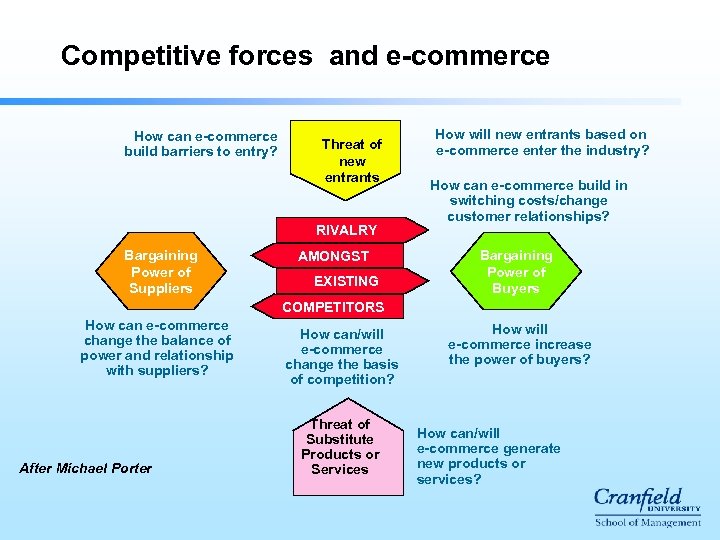
Competitive forces and e-commerce How can e-commerce build barriers to entry? Threat of new entrants RIVALRY Bargaining Power of Suppliers AMONGST EXISTING How will new entrants based on e-commerce enter the industry? How can e-commerce build in switching costs/change customer relationships? Bargaining Power of Buyers COMPETITORS How can e-commerce change the balance of power and relationship with suppliers? After Michael Porter How can/will e-commerce change the basis of competition? Threat of Substitute Products or Services How will e-commerce increase the power of buyers? How can/will e-commerce generate new products or services?
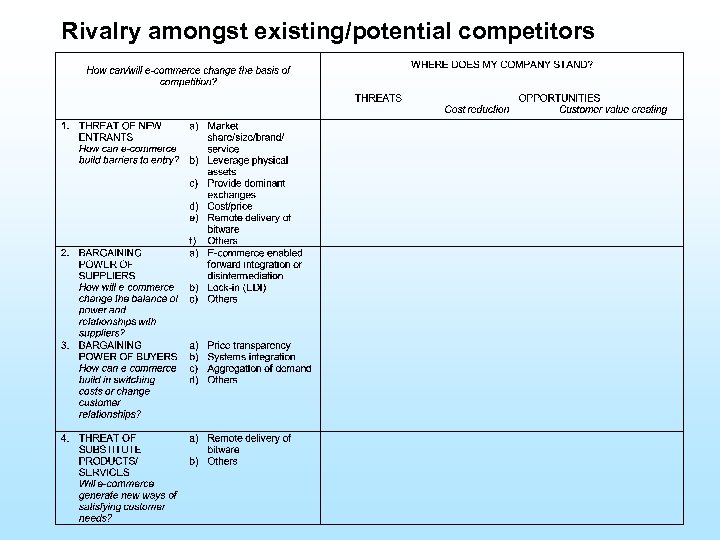
Rivalry amongst existing/potential competitors
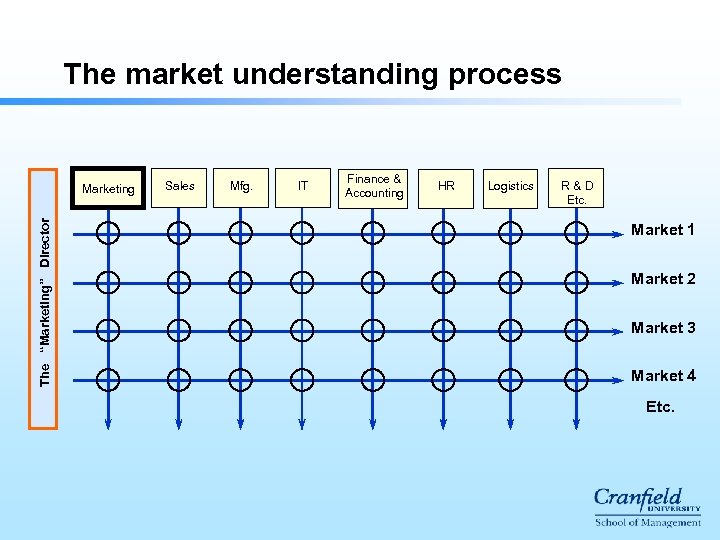
The market understanding process The “Marketing” Director Marketing Sales Mfg. IT Finance & Accounting HR Logistics R&D Etc. Market 1 Market 2 Market 3 Market 4 Etc.
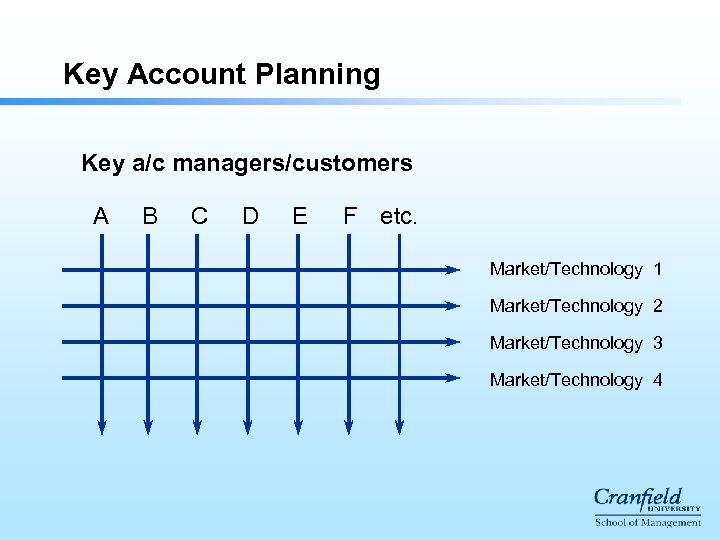
Key Account Planning Key a/c managers/customers A B C D E F etc. Market/Technology 1 Market/Technology 2 Market/Technology 3 Market/Technology 4
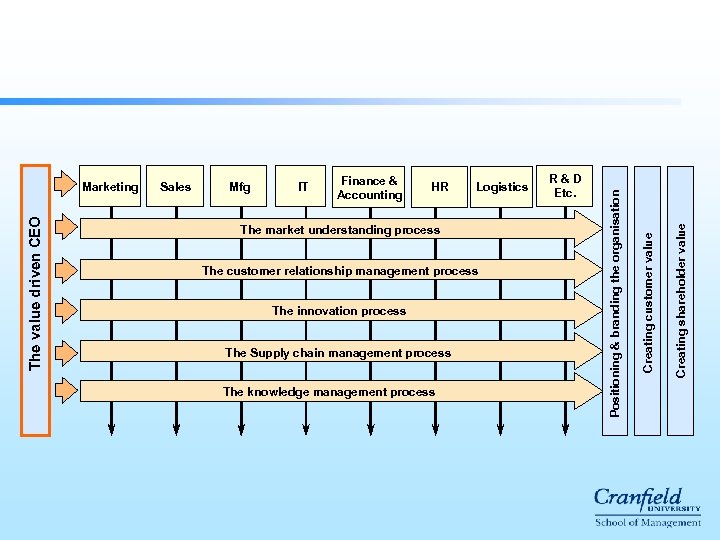
IT Finance & Accounting HR Logistics The market understanding process The customer relationship management process The innovation process The Supply chain management process The knowledge management process R&D Etc. Creating shareholder value Mfg Creating customer value Sales Positioning & branding the organisation The value driven CEO Marketing
1. Understand Customer Orientation l l Develop customer orientation in all functions. Ensure that every function understands that they are there to serve the customer, not their own narrow functional interests. This must be driven from the board downwards. Where possible, organise in cross-functional teams around customer groups and core processes. Make customers the arbiter of quality
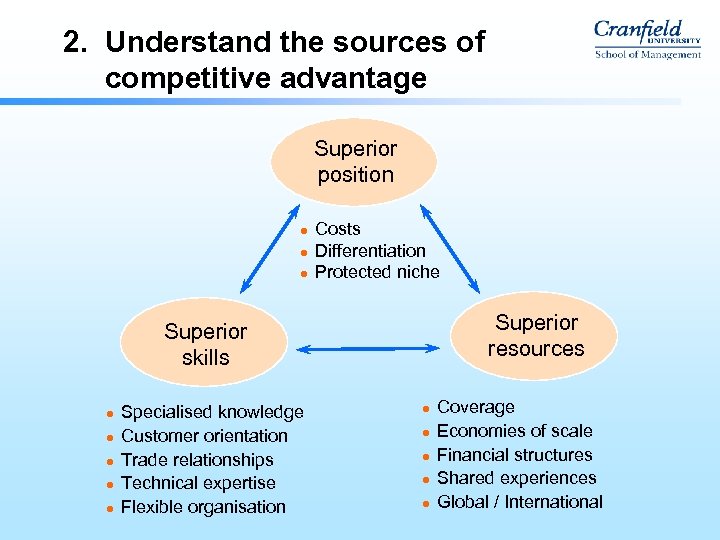
2. Understand the sources of competitive advantage Superior position l l l Costs Differentiation Protected niche Superior resources Superior skills l l l Specialised knowledge Customer orientation Trade relationships Technical expertise Flexible organisation l l l Coverage Economies of scale Financial structures Shared experiences Global / International
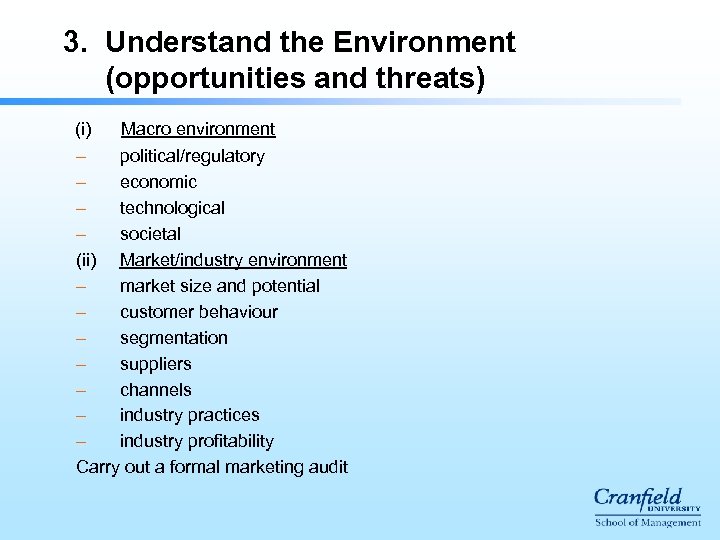
3. Understand the Environment (opportunities and threats) (i) Macro environment – political/regulatory – economic – technological – societal (ii) Market/industry environment – market size and potential – customer behaviour – segmentation – suppliers – channels – industry practices – industry profitability Carry out a formal marketing audit
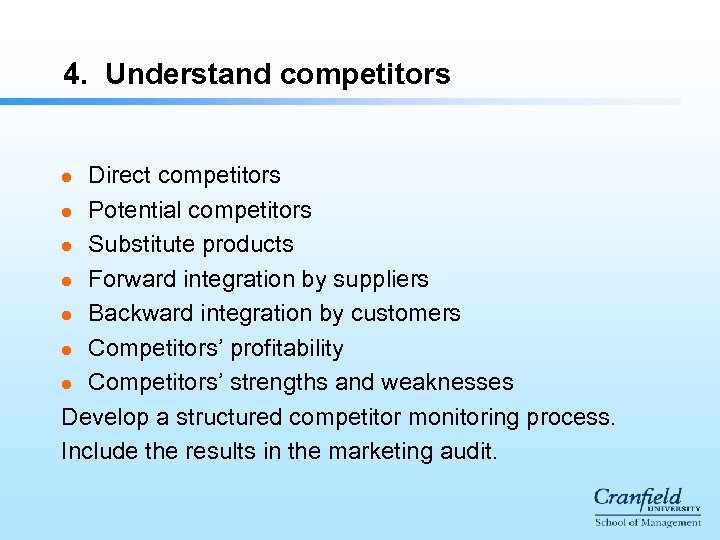
4. Understand competitors Direct competitors l Potential competitors l Substitute products l Forward integration by suppliers l Backward integration by customers l Competitors’ profitability l Competitors’ strengths and weaknesses Develop a structured competitor monitoring process. Include the results in the marketing audit. l
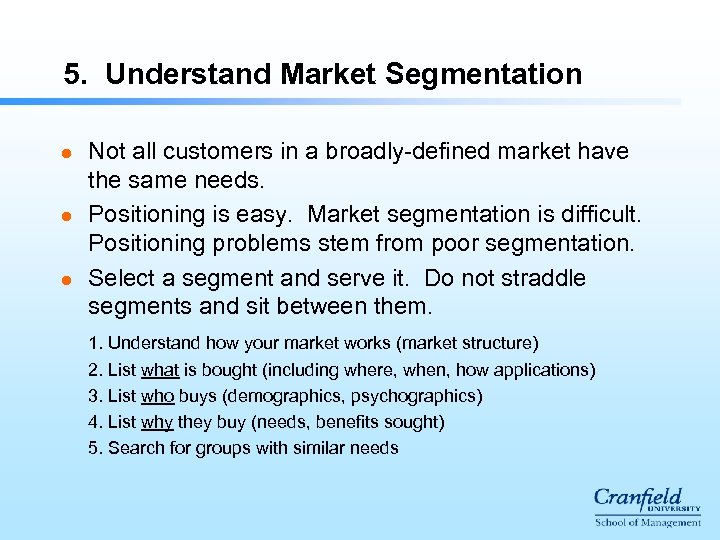
5. Understand Market Segmentation l l l Not all customers in a broadly-defined market have the same needs. Positioning is easy. Market segmentation is difficult. Positioning problems stem from poor segmentation. Select a segment and serve it. Do not straddle segments and sit between them. 1. Understand how your market works (market structure) 2. List what is bought (including where, when, how applications) 3. List who buys (demographics, psychographics) 4. List why they buy (needs, benefits sought) 5. Search for groups with similar needs
6. Understand Your Own Strengths and Weaknesses l l Carry out a formal audit of your own product/market position in each segment in which you compete, particularly of your ability to: – conceive/design – buy – produce – distribute – market – service – finance – manage These must all be organised to provide superior customer value Include the results in the marketing audit Look for market opportunities where you can utilise your strengths
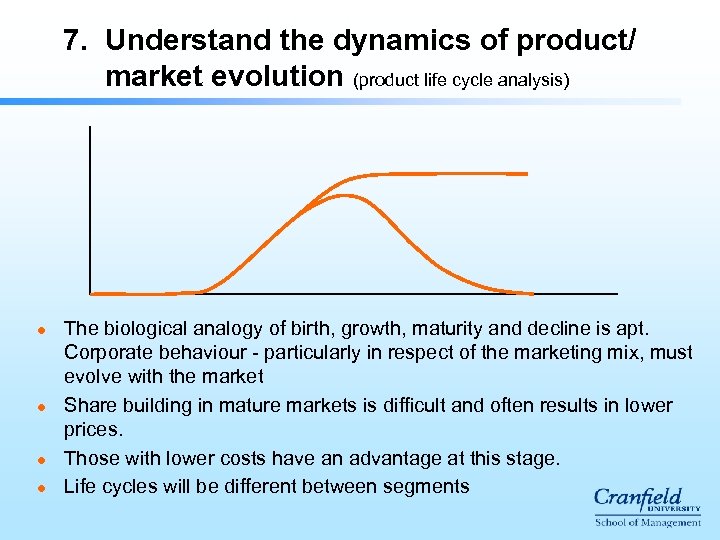
7. Understand the dynamics of product/ market evolution (product life cycle analysis) l l The biological analogy of birth, growth, maturity and decline is apt. Corporate behaviour - particularly in respect of the marketing mix, must evolve with the market Share building in mature markets is difficult and often results in lower prices. Those with lower costs have an advantage at this stage. Life cycles will be different between segments
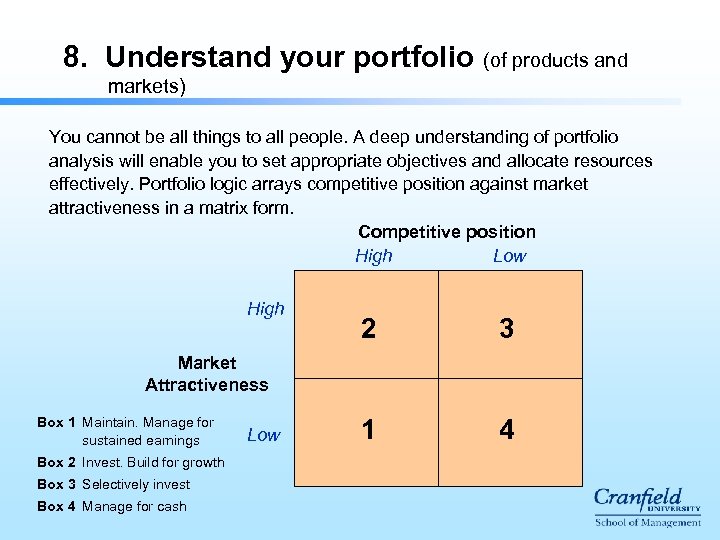
8. Understand your portfolio (of products and markets) You cannot be all things to all people. A deep understanding of portfolio analysis will enable you to set appropriate objectives and allocate resources effectively. Portfolio logic arrays competitive position against market attractiveness in a matrix form. Competitive position High Low High 2 3 1 4 Market Attractiveness Box 1 Maintain. Manage for sustained earnings Box 2 Invest. Build for growth Box 3 Selectively invest Box 4 Manage for cash Low
9. Set Clear Strategic Priorities and Stick to Them l l l Focus your best resources on the best opportunities for achieving continuous growth in sales and profits. This means having a written strategic marketing plan for 3 years containing: - a mission statement - a financial summary - a market overview - a SWOT on key segments - a portfolio summary - assumptions - marketing objectives and strategies - a budget This strategic plan can then be converted into a detailed one year plan. To do this, an agreed marketing planning process will be necessary. Focus on key performance indicators with an unrelenting discipline.
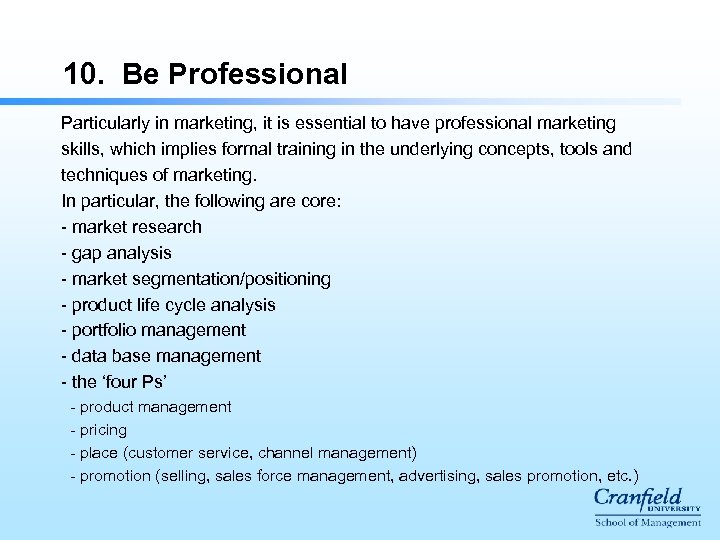
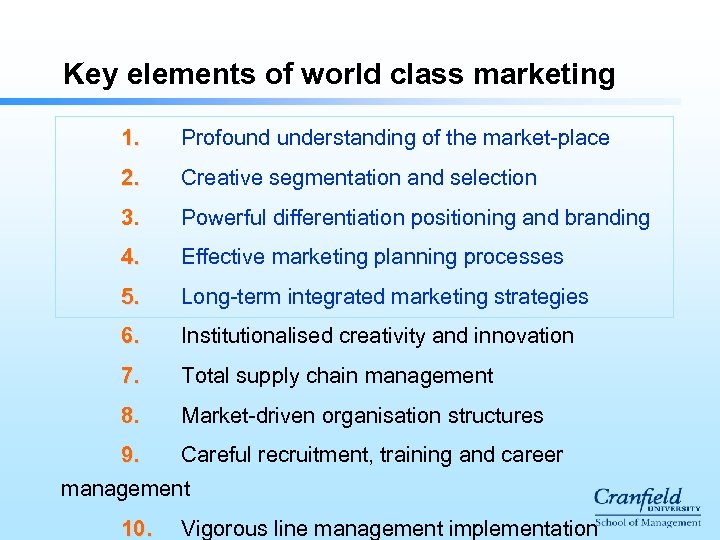
10. Be Professional Particularly in marketing, it is essential to have professional marketing skills, which implies formal training in the underlying concepts, tools and techniques of marketing. In particular, the following are core: - market research - gap analysis - market segmentation/positioning - product life cycle analysis - portfolio management - data base management - the ‘four Ps’ - product management - pricing - place (customer service, channel management) - promotion (selling, sales force management, advertising, sales promotion, etc. )
Скачать презентацию Competitive Marketing Strategy Masterclass Day 2 by Professor
050f7e5ff0f043b2e26108770c99e531.ppt