


 Скачать презентацию Competition and Monopoly 1 The essence of competition
Competition and Monopoly.pptx
- Количество слайдов: 17
 Competition and Monopoly. 1. The essence of competition, its economic role. Сущность и экономическая роль конкуренции 2. Types of competition. Виды конкуренции 3. The theory of monopoly. Monopolistic competition. Теория монополии. Монополистической конкуренции 4. Anti Monopoly legislation and anti monopoly policy. Антимонопольная политика и законодательство
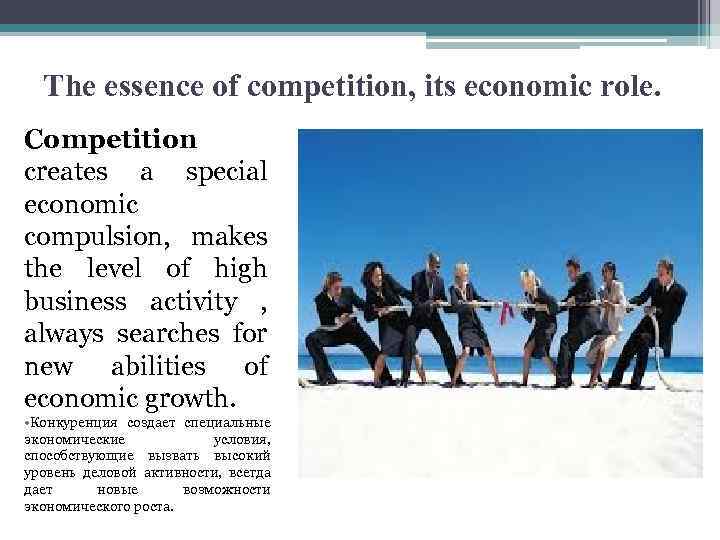 The essence of competition, its economic role. Competition creates a special economic compulsion, makes the level of high business activity , always searches for new abilities of economic growth. • Конкуренция создает специальные экономические условия, способствующие вызвать высокий уровень деловой активности, всегда дает новые возможности экономического роста.
 • Competition – is an element of market economy, it is the rivalry between participants of economic market, and it is the struggle for the sources of raw materials, for the market, profitable conditions of enclosure the capital, for a big profit share. • Конкуренция - элемент рыночной экономики, это соперничество между участниками хозяйственного рынка и борьба за источники сырья, за рынок, за выгодные условия вложения капитала, за большую долю прибыли.
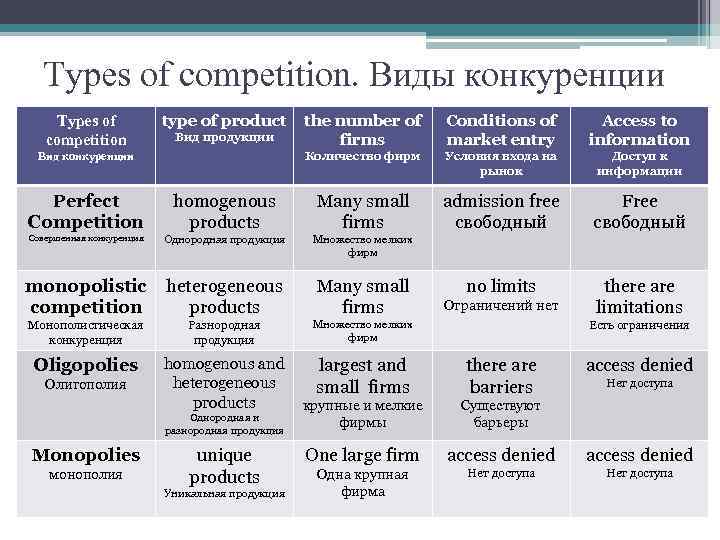 Types of competition. Виды конкуренции Types of competition type of product Вид конкуренции Conditions of market entry Access to information Количество фирм Вид продукции the number of firms Условия входа на рынок Доступ к информации admission free свободный Free свободный no limits there are limitations Perfect Competition homogenous products Many small firms Совершенная конкуренция Однородная продукция Множество мелких фирм monopolistic competition heterogeneous products Many small firms Монополистическая конкуренция Разнородная продукция Множество мелких фирм Oligopolies Олигополия homogenous and largest and heterogeneous small firms products крупные и мелкие Ограничений нет Есть ограничения there are barriers access denied Нет доступа Однородная и разнородная продукция Monopolies монополия фирмы Существуют барьеры unique products One large firm access denied Одна крупная фирма Нет доступа Уникальная продукция
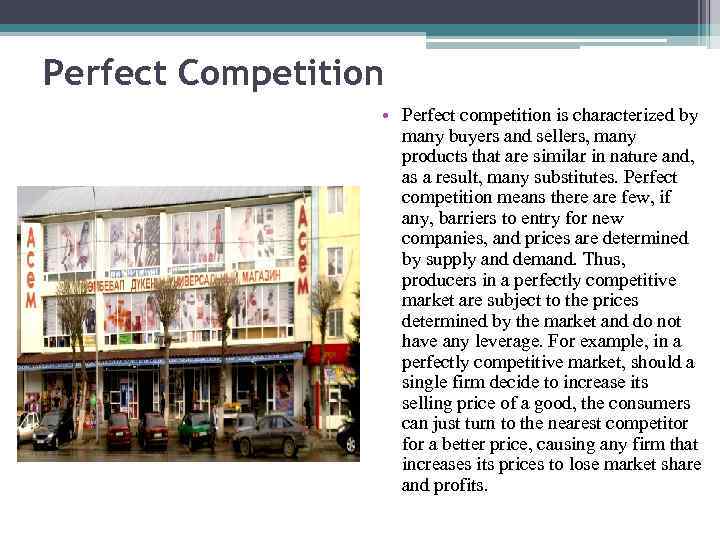 Perfect Competition • Perfect competition is characterized by many buyers and sellers, many products that are similar in nature and, as a result, many substitutes. Perfect competition means there are few, if any, barriers to entry for new companies, and prices are determined by supply and demand. Thus, producers in a perfectly competitive market are subject to the prices determined by the market and do not have any leverage. For example, in a perfectly competitive market, should a single firm decide to increase its selling price of a good, the consumers can just turn to the nearest competitor for a better price, causing any firm that increases its prices to lose market share and profits.
 Совершенная конкуренция • Совершенная конкуренция характеризуется множеством покупателей и продавцов, многие продукты, которых схожи по характеру и как следствие у них много заменителей. Совершенная конкуренция означает, что на рынке нет существенных барьеров для входа, а цены определяются спросом и предложением. Таким образом, производители на совершенно конкурентном рынке устанавливают цены, которые определяются рынком и не имеют никаких рычагов. Например, на совершенно конкурентном рынке одна из фирмы приняла решение об увеличении продажной цены товара, потребители в этом случае просто обратятся к ближайшим конкурентам за лучшую цену, в результате чего фирма, которая увеличивает цену потеряет свою долю рынка и прибыль.
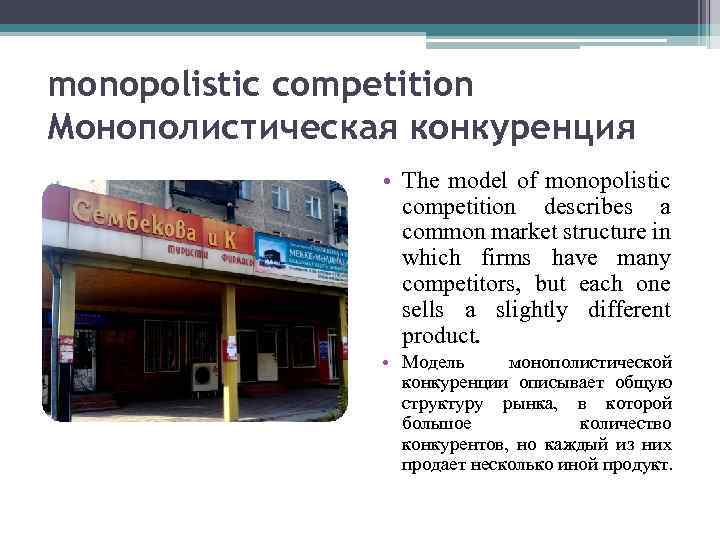 monopolistic competition Монополистическая конкуренция • The model of monopolistic competition describes a common market structure in which firms have many competitors, but each one sells a slightly different product. • Модель монополистической конкуренции описывает общую структуру рынка, в которой большое количество конкурентов, но каждый из них продает несколько иной продукт.
 • Monopolistic competition as a market structure was first identified in the 1930 s by American economist Edward Chamberlin, and English economist Joan Robinson. Монополистическая конкуренция как тип рыночной структуры был впервые выявлен в 1930 году американским экономистом Эдвардом Чемберлином и английским экономистом Джоан Робинсон. • Many small businesses operate under conditions of monopolistic competition, including independently owned and operated high-street stores and restaurants. In the case of restaurants, each one offers something different and possesses an element of uniqueness, but all are essentially competing for the same customers. • Многие мелкие фирмы работают в условиях монополистической конкуренции, в том числе самостоятельно владеют и управляют большой сетью магазинов и ресторанов. В случае ресторанов, каждый из которых предлагает что-то другое и имеет элемент уникальности, но все они по существу предназначены для одних и тех же клиентов.
 Characteristics Monopolistically competitive markets exhibit the following characteristics: Each firm makes independent decisions about price and output, based on its product, its market, and its costs of production. характеристика Монополистическая конкуренция на рынке демонстрируют следующие характеристики: 1. Каждая фирма самостоятельно принимает решения о цене и выходе на рынок, опираясь на свою продукцию, рынок и издержки производства.
 2. Knowledge is widely spread between participants, but it is unlikely to be perfect. For example, diners can review all the menus available from restaurants in a town, before they make their choice. Once inside the restaurant, they can view the menu again, before ordering. However, they cannot fully appreciate the restaurant or the meal until after they have dined. Доступ к информации свободный, т. е информация широко распространена между участниками, но вряд ли она идеальна. Например, посетители могут ознакомиться со всеми меню из ресторанов в городе, прежде чем сделать свой выбор. Однако в ресторане, они просматривают меню снова перед заказом. Тем не менее, они не могут в полной мере оценить ресторан или еду, пока они не обедают. 3. There is freedom to enter or leave the market, as there are no major barriers to entry or exit. Существует свобода для при входе на рынок и выхода из него, так ка кнет никаких серьезных барьеров для входа или выхода. 4. A central feature of monopolistic competition is that products are differentiated. Главной особенностью монополистической конкуренции является то, что продукты дифференцированы.
 Oligopolies In an oligopoly, there are only a few firms that make up an industry. This select group of firms has control over the price and, like a monopoly, an oligopoly has high barriers to entry. The products that the oligopolistic firms produce are often nearly identical and, therefore, the companies, which are competing for market share, are interdependent as a result of market forces. Олигополия – характеризуется количеством нескольких фирм, входящих в состав отрасли. Эти группы фирм имеют контроль над ценами, как и монополия, а также имеют высокие барьеры при входе на рынок. Продукция на олигополистическом рынке однородная (идентичная) либо разнородная. Поэтому компании, которые ведут конкурентную борьбу за долю рынка, являются взаимозависимыми.

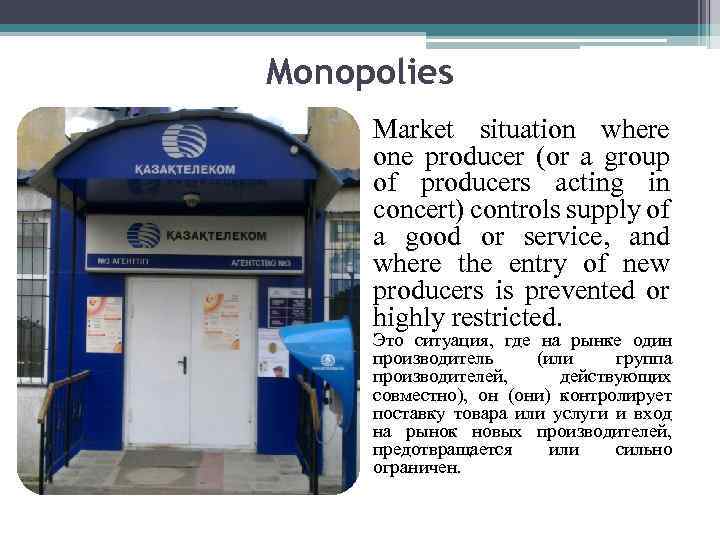 Monopolies Market situation where one producer (or a group of producers acting in concert) controls supply of a good or service, and where the entry of new producers is prevented or highly restricted. Это ситуация, где на рынке один производитель (или группа производителей, действующих совместно), он (они) контролирует поставку товара или услуги и вход на рынок новых производителей, предотвращается или сильно ограничен.
 Monopolist firms (in their attempt to maximize profits) keep the price high and restrict the output, and show little or no responsiveness to the needs of their customers. Фирма монополист (в их попытке максимизировать прибыль) держит цены высокими и ограничивает вход, а также вообще не реагирует на потребности своих клиентов. Most governments therefore try to control monopolies by 1) imposing price controls, 2) taking over their ownership (called 'nationalization') or 3) by breaking them up into two or more competing firms. Поэтом большинство государств пытаются контролировать монополии с помощью следующих механизмов: 1) вводят контроль над ценами, 2) захватывают их собственность (т. е проводят национализацию) либо 3) разбивают их на две или несколько конкурирующих фирм.
 Sometimes governments facilitate the creation of monopolies for reasons of national security, to realize economies of scale for competing internationally, or where two or more producers would be wasteful or pointless (as in the case of utilities). Although monopolies exist in varying degrees (due to copyrights, patents, access to materials, exclusive technologies, or unfair trade practices) Иногда правительства способствуют созданию монополий по соображениям национальной безопасности, иногда реализовывают эффект масштаба для международной конкуренции, так когда на рынке два или более производителей это расточительно и бессмысленно (как в случае коммунальных услуг). Хотя монополии существуют в той или иной степени (в связи с авторскими правами, патентами, единственные владельцы ресурсов, эксклюзивных технологий или ведут недобросовестную торговую практику) почти ни одна фирма обладает полной монополией в эпоху глобализации.
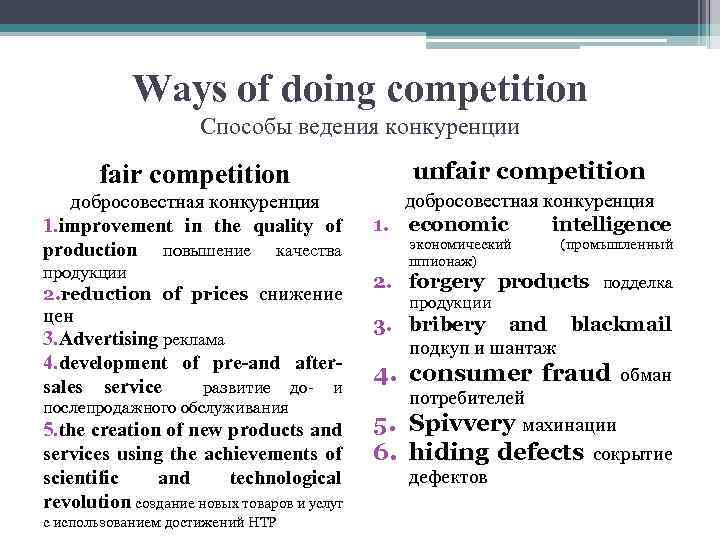 Ways of doing competition Способы ведения конкуренции fair competition unfair competition добросовестная конкуренция 1. improvement in the quality of production повышение качества добросовестная конкуренция 1. economic intelligence продукции 2. reduction of prices снижение цен 3. Advertising реклама 2. forgery products 4. development of pre-and aftersales service развитие до- и 4. consumer fraud послепродажного обслуживания 5. the creation of new products and services using the achievements of scientific and technological revolution создание новых товаров и услуг с использованием достижений НТР экономический шпионаж) (промышленный подделка продукции 3. bribery and blackmail подкуп и шантаж обман потребителей 5. Spivvery махинации 6. hiding defects сокрытие дефектов
 price discrimination Ценовая дискриминация A monopolist may be able to engage in a policy of price discrimination. This occurs when a firm charges a different price to different groups of consumers for an identical good or service, for reasons not associated with the costs of production. It is important to stress that charging different prices for similar goods is not price discrimination. For example, price discrimination does not occur when a rail company charges a higher price for a first class seat. This is because the price premium over a second-class seat can be explained by differences in the cost of providing the service. На рынке в основном монополисты проводят политику ценовой дискриминации. Это происходит тогда, когда фирма устанавливает различные цены идентичных товаров или услуг для разных групп потребителей, по причинам, не связанным с издержками производства. (т. е. , продают один и то же товар по различным ценам) Важно отметить, что иногда устанавливаются различные цены на аналогичный товар не по ценовой дискриминации. Например, ценовая дискриминация не происходит, когда железнодорожная компания устанавливает более высокую цену билета за первое место класса. Это объясняется тем, что в стоимость билета второго класса входит разница стоимости предоставляемых услуг.