


 Скачать презентацию Competition and Equity in Health Care The English
830021d07d80b343787e85233f696d30.ppt
- Количество слайдов: 22
 Competition and Equity in Health Care: The English Experience Richard Cookson Centre for Health Economics University of York
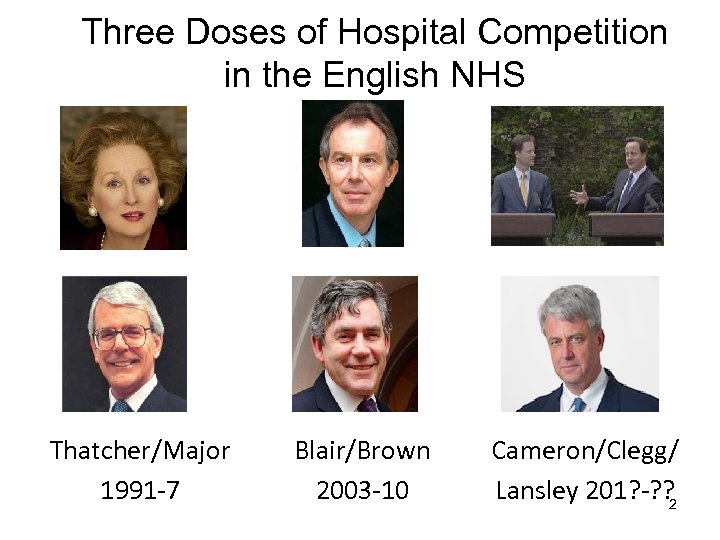 Three Doses of Hospital Competition in the English NHS Thatcher/Major 1991 -7 Blair/Brown 2003 -10 Cameron/Clegg/ Lansley 201? -? ? 2
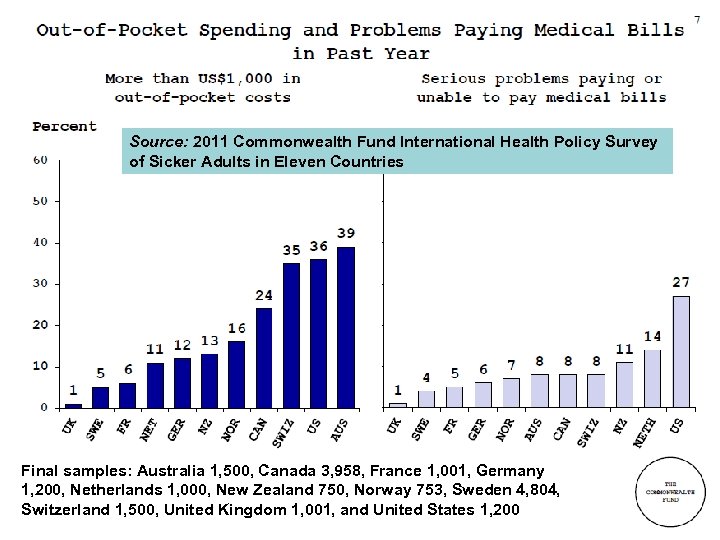 Source: 2011 Commonwealth Fund International Health Policy Survey of Sicker Adults in Eleven Countries Final samples: Australia 1, 500, Canada 3, 958, France 1, 001, Germany 1, 200, Netherlands 1, 000, New Zealand 750, Norway 753, Sweden 4, 804, Switzerland 1, 500, United Kingdom 1, 001, and United States 1, 200
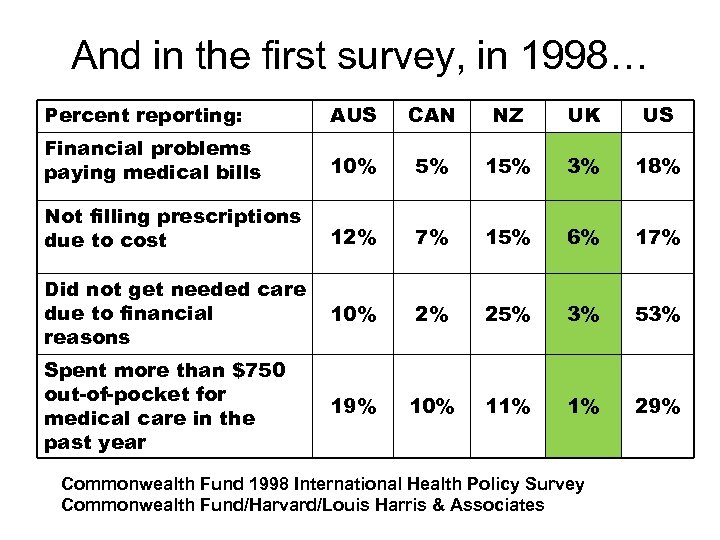 And in the first survey, in 1998… Percent reporting: AUS CAN NZ UK US Financial problems paying medical bills 10% 5% 15% 3% 18% Not filling prescriptions due to cost 12% 7% 15% 6% 17% Did not get needed care due to financial reasons 10% 2% 25% 3% 53% Spent more than $750 out-of-pocket for medical care in the past year 19% 10% 11% 1% 29% Commonwealth Fund 1998 International Health Policy Survey Commonwealth Fund/Harvard/Louis Harris & Associates
 Historical and longitudinal small area analysis of the effects of market-oriented reform on equity of access to NHS care from 1991 to 2001 Project duration: July 2006 to June 2007 Funding body: ESRC Public Services Programme Co-investigators: Richard Cookson and Mark Dusheiko Consultants: Geoffrey Hardman, Paul Chalmers-Dixon, Stephen Martin, and Alan Maynard
 Project title: Effects of health reform on health care inequality Funded by: Managed by: NHS NIHR Service, Delivery and Organisation Programme DH PRP Health Reform Evaluation Programme Project duration: 1 April 2007 - 31 October 2010 Lead investigator: Richard Cookson Data analysis: Mauro Laudicella and Paulo Li Donni Advisory input: James Carpenter, Roy Carr-Hill, Diane Dawson, Mark Dusheiko, Hugh Gravelle, Geoffrey Hardman, Russell Mannion, Steven Martin, James Nelson-Smith, Andrew Street Special thanks: George Leckie and Carol Propper Department of Social Policy and Social Work The York Management School Department of Economics and Related Studies Yorkshire & Humber Public Health Observatory
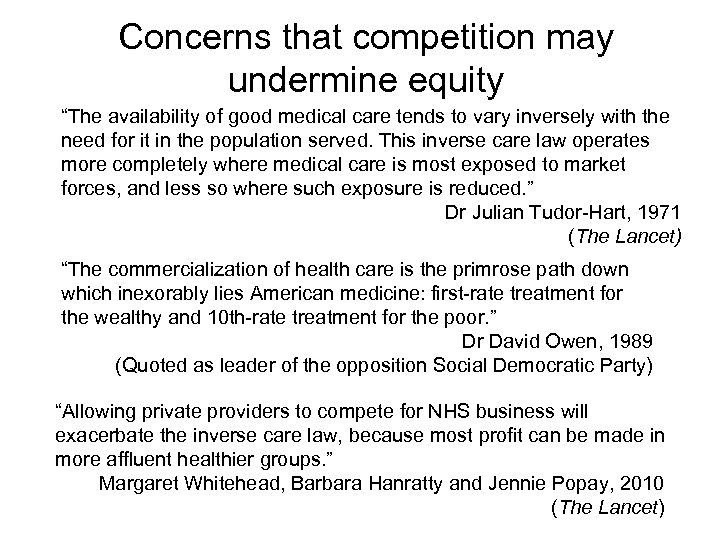 Concerns that competition may undermine equity “The availability of good medical care tends to vary inversely with the need for it in the population served. This inverse care law operates more completely where medical care is most exposed to market forces, and less so where such exposure is reduced. ” Dr Julian Tudor-Hart, 1971 (The Lancet) “The commercialization of health care is the primrose path down which inexorably lies American medicine: first-rate treatment for the wealthy and 10 th-rate treatment for the poor. ” Dr David Owen, 1989 (Quoted as leader of the opposition Social Democratic Party) “Allowing private providers to compete for NHS business will exacerbate the inverse care law, because most profit can be made in more affluent healthier groups. ” Margaret Whitehead, Barbara Hanratty and Jennie Popay, 2010 (The Lancet)
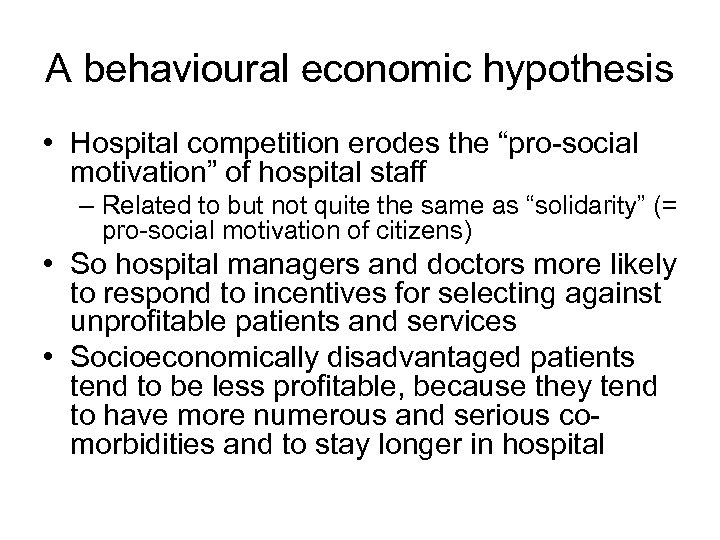 A behavioural economic hypothesis • Hospital competition erodes the “pro-social motivation” of hospital staff – Related to but not quite the same as “solidarity” (= pro-social motivation of citizens) • So hospital managers and doctors more likely to respond to incentives for selecting against unprofitable patients and services • Socioeconomically disadvantaged patients tend to be less profitable, because they tend to have more numerous and serious comorbidities and to stay longer in hospital
 NHS “Internal Market” 1991 -7 Cookson, R, Dusheiko, M, Hardman, G, Martin, S. (2010). Competition and Inequality: Evidence from the English National Health Service 1991 -2001. Journal of Public Administration Research and Theory 20: i 181 -i 205.
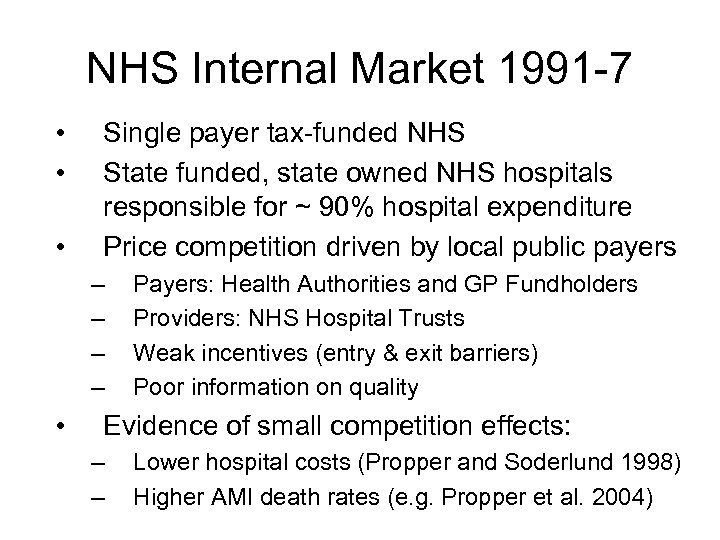 NHS Internal Market 1991 -7 • • • Single payer tax-funded NHS State funded, state owned NHS hospitals responsible for ~ 90% hospital expenditure Price competition driven by local public payers – – • Payers: Health Authorities and GP Fundholders Providers: NHS Hospital Trusts Weak incentives (entry & exit barriers) Poor information on quality Evidence of small competition effects: – – Lower hospital costs (Propper and Soderlund 1998) Higher AMI death rates (e. g. Propper et al. 2004)
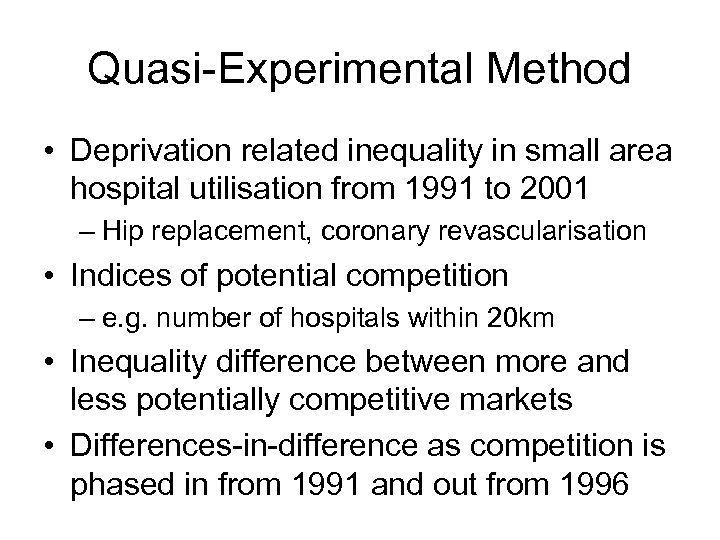 Quasi-Experimental Method • Deprivation related inequality in small area hospital utilisation from 1991 to 2001 – Hip replacement, coronary revascularisation • Indices of potential competition – e. g. number of hospitals within 20 km • Inequality difference between more and less potentially competitive markets • Differences-in-difference as competition is phased in from 1991 and out from 1996
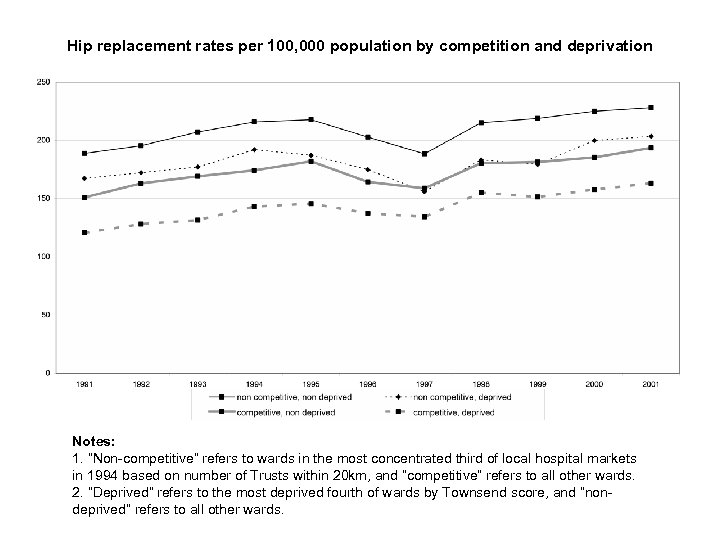 Hip replacement rates per 100, 000 population by competition and deprivation Notes: 1. “Non-competitive” refers to wards in the most concentrated third of local hospital markets in 1994 based on number of Trusts within 20 km, and “competitive” refers to all other wards. 2. “Deprived” refers to the most deprived fourth of wards by Townsend score, and “nondeprived” refers to all other wards.
 Blair/Brown NHS Reforms 2001 -8 Cookson R, Laudicella M, Li Donni P. Does hospital competition harm equity? Evidence from the English National Health Service. Centre for Health Economics, University of York, CHE Research Paper 66. www. york. ac. uk/che/news/che-research-papers-66 -67/
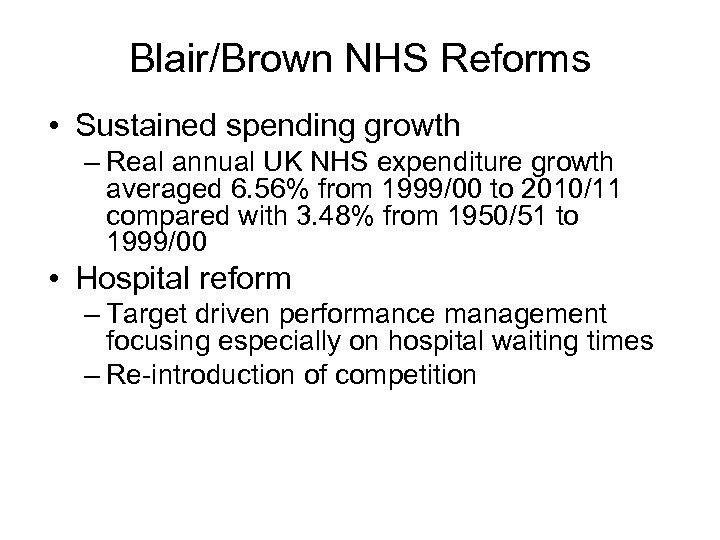 Blair/Brown NHS Reforms • Sustained spending growth – Real annual UK NHS expenditure growth averaged 6. 56% from 1999/00 to 2010/11 compared with 3. 48% from 1950/51 to 1999/00 • Hospital reform – Target driven performance management focusing especially on hospital waiting times – Re-introduction of competition
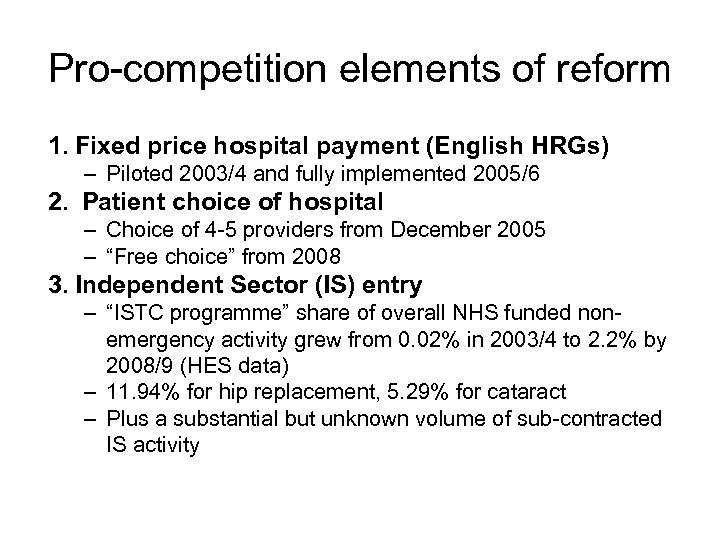 Pro-competition elements of reform 1. Fixed price hospital payment (English HRGs) – Piloted 2003/4 and fully implemented 2005/6 2. Patient choice of hospital – Choice of 4 -5 providers from December 2005 – “Free choice” from 2008 3. Independent Sector (IS) entry – “ISTC programme” share of overall NHS funded nonemergency activity grew from 0. 02% in 2003/4 to 2. 2% by 2008/9 (HES data) – 11. 94% for hip replacement, 5. 29% for cataract – Plus a substantial but unknown volume of sub-contracted IS activity
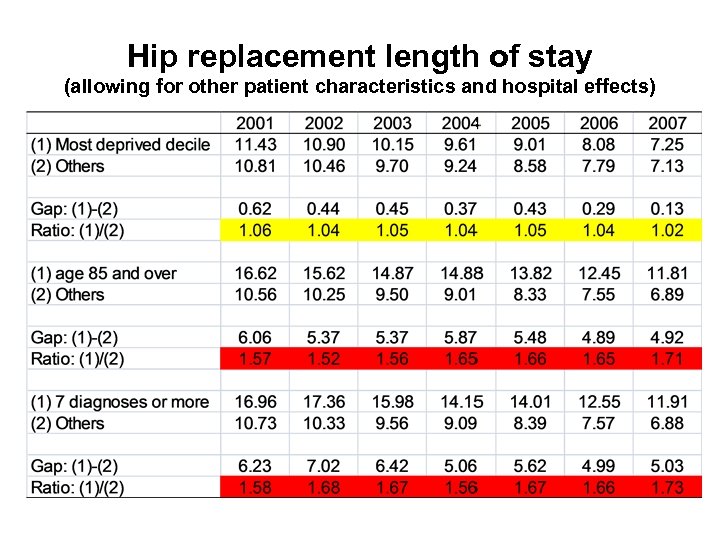 Hip replacement length of stay (allowing for other patient characteristics and hospital effects)
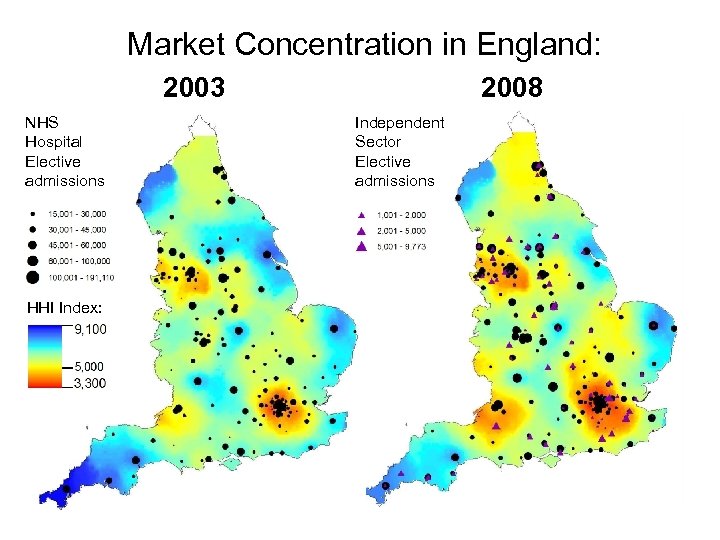 Market Concentration in England: 2003 NHS Hospital Elective admissions HHI Index: 2008 Independent Sector Elective admissions
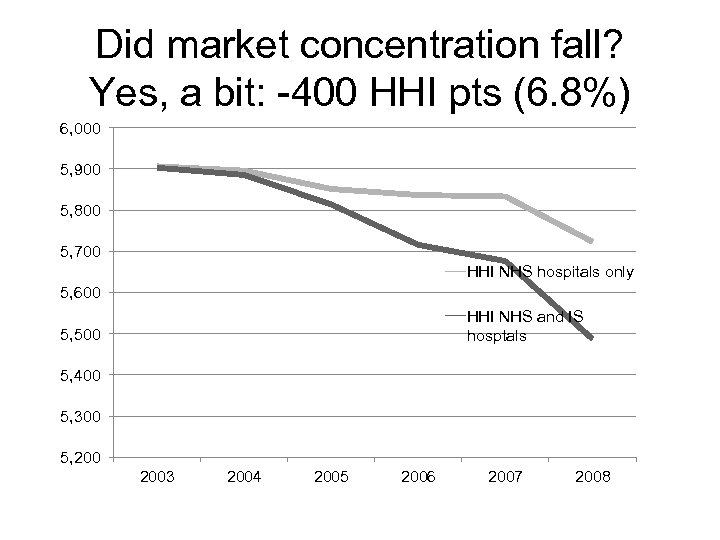 Did market concentration fall? Yes, a bit: -400 HHI pts (6. 8%) 6, 000 5, 900 5, 800 5, 700 HHI NHS hospitals only 5, 600 HHI NHS and IS hosptals 5, 500 5, 400 5, 300 5, 2003 2004 2005 2006 2007 2008
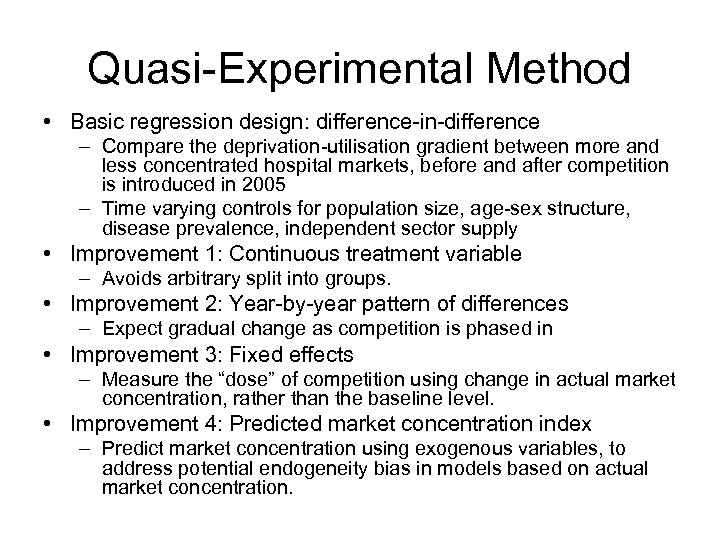 Quasi-Experimental Method • Basic regression design: difference-in-difference – Compare the deprivation-utilisation gradient between more and less concentrated hospital markets, before and after competition is introduced in 2005 – Time varying controls for population size, age-sex structure, disease prevalence, independent sector supply • Improvement 1: Continuous treatment variable – Avoids arbitrary split into groups. • Improvement 2: Year-by-year pattern of differences – Expect gradual change as competition is phased in • Improvement 3: Fixed effects – Measure the “dose” of competition using change in actual market concentration, rather than the baseline level. • Improvement 4: Predicted market concentration index – Predict market concentration using exogenous variables, to address potential endogeneity bias in models based on actual market concentration.
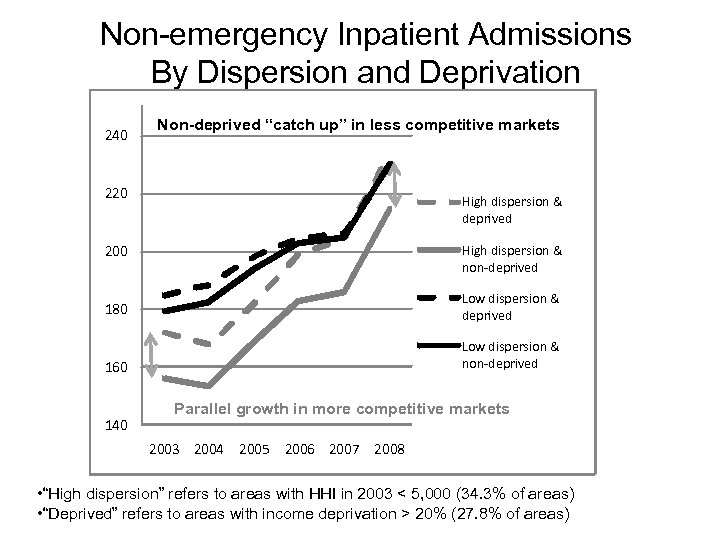 Non-emergency Inpatient Admissions By Dispersion and Deprivation 240 Non-deprived “catch up” in less competitive markets Affluent areas catching up in less competitive markets 220 High dispersion & deprived 200 High dispersion & non-deprived 180 Low dispersion & deprived 160 Low dispersion & non-deprived 140 Parallel growth in more competitive markets 2003 2004 2005 2006 2007 2008 • “High dispersion” refers to areas with HHI in 2003 < 5, 000 (34. 3% of areas) • “Deprived” refers to areas with income deprivation > 20% (27. 8% of areas)
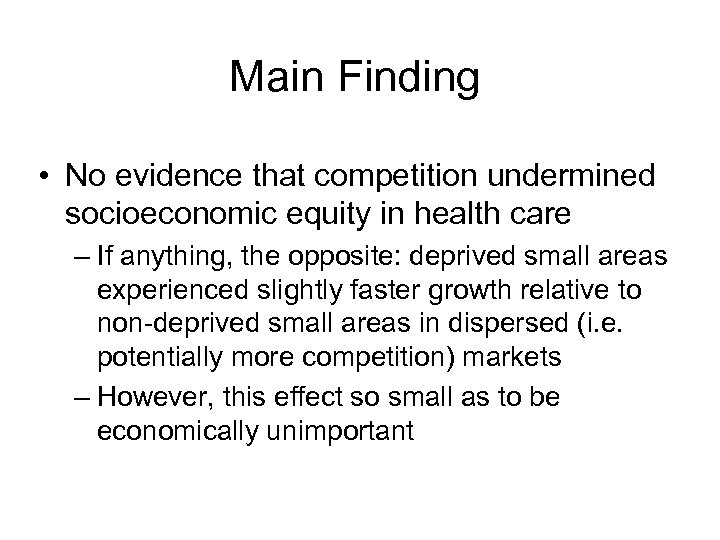 Main Finding • No evidence that competition undermined socioeconomic equity in health care – If anything, the opposite: deprived small areas experienced slightly faster growth relative to non-deprived small areas in dispersed (i. e. potentially more competition) markets – However, this effect so small as to be economically unimportant
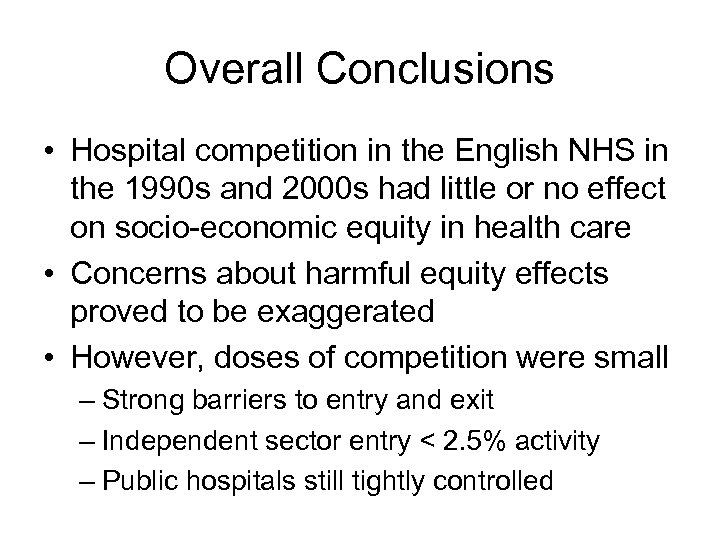 Overall Conclusions • Hospital competition in the English NHS in the 1990 s and 2000 s had little or no effect on socio-economic equity in health care • Concerns about harmful equity effects proved to be exaggerated • However, doses of competition were small – Strong barriers to entry and exit – Independent sector entry < 2. 5% activity – Public hospitals still tightly controlled