


 Скачать презентацию Competition and Cooperation in Societal and Technological Systems
805a724502209532373d80d515a6d9bd.ppt
- Количество слайдов: 112
 Competition and Cooperation in Societal and Technological Systems of Systems Keynote Address: 2007 IEEE International Conference on Systems, Man, and Cybernetics: Smart Cooperative Systems and Cybernetics Advancing Knowledge and Security for Humanity Keith W. Hipel University Professor Conflict Analysis Group Department of Systems Design Engineering University of Waterloo 1
 DEFINITION OF A CANADIAN A Canadian is an American who carries a Medicare Card but does not carry a gun. 2
 ABORIGINAL PLACE NAMES • Canada: means “village” in the Huron language. • Ontario: “beautiful lake” in Huron • Toronto: “a place of meeting” in Huron • Nunavut: “our land” in Inuktitut • Ottawa: “to trade” from the Algonquin language • Yukon: “great river” in the Loucheux language • Quebec: “narrow passage” in Algonquin • Saskatchewan: “swift flowing river” from the Cree language 3
 PURPOSE Present an encompassing perspective on competition and cooperation among multiple participants strategically interacting within societal and technological systems of systems according to their underlying value systems as they strive to reach their goals. By appreciating the reality that systems of systems are inhabited by multiple participants or agents having multiple objectives, one can adhere to adaptive and integrative decision making principles to properly design, construct, maintain, and operate systems of systems that serve the interests of stakeholders in a fair and sustainable manner throughout the systems’ life cycles. 4
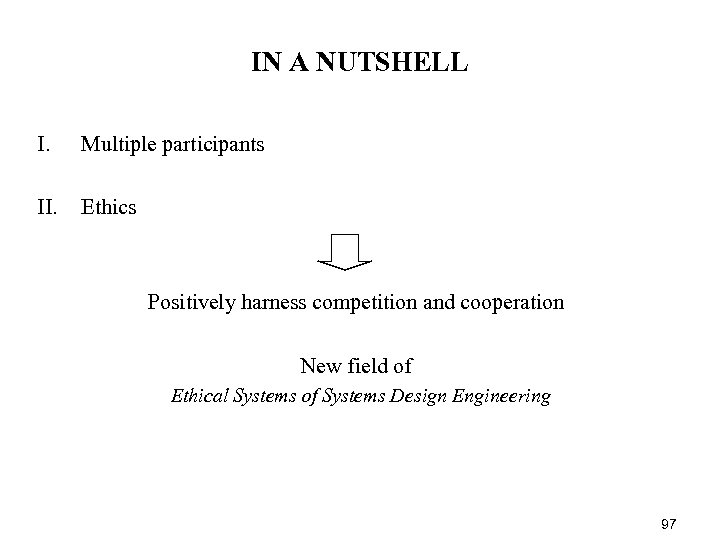
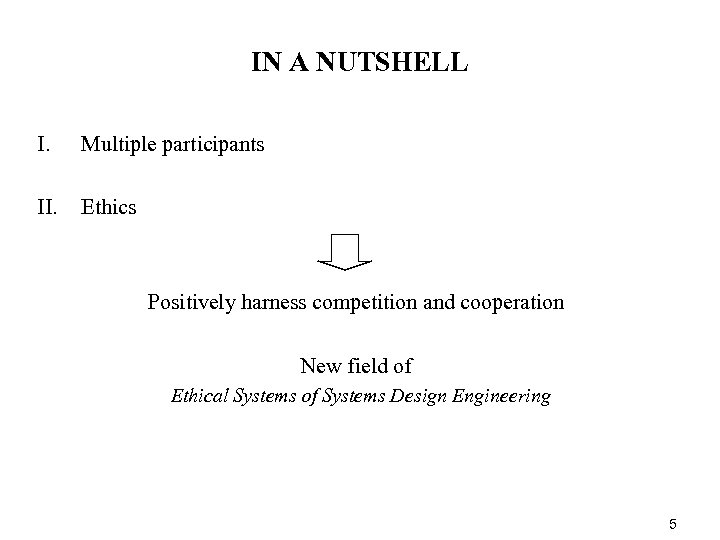 IN A NUTSHELL I. Multiple participants II. Ethics Positively harness competition and cooperation New field of Ethical Systems of Systems Design Engineering 5
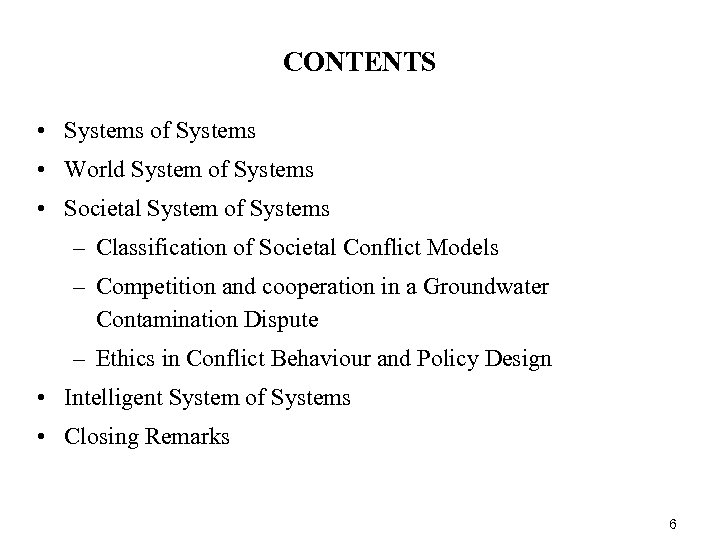 CONTENTS • Systems of Systems • World System of Systems • Societal System of Systems – Classification of Societal Conflict Models – Competition and cooperation in a Groundwater Contamination Dispute – Ethics in Conflict Behaviour and Policy Design • Intelligent System of Systems • Closing Remarks 6
 SYSTEM OF SYSTEMS (So. S) • Solid paradigm on which to build methodologies and techniques in systems, man, and cybernetics. • Alternative labels: – Federation of Systems – Systems Family 7
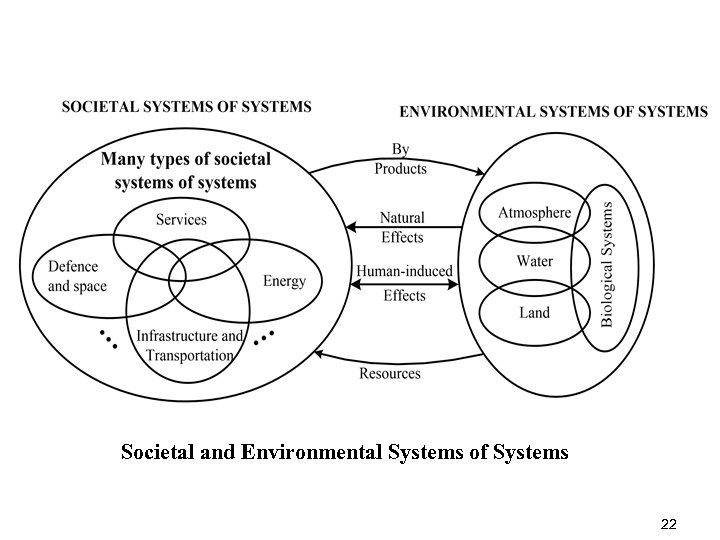
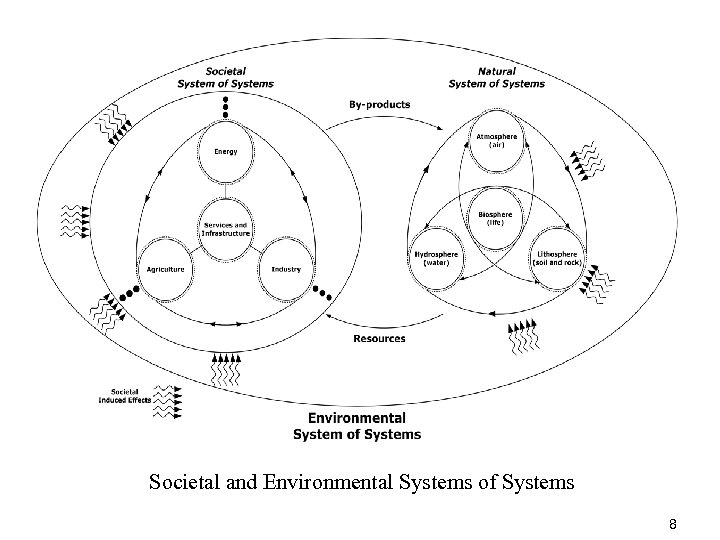 Societal and Environmental Systems of Systems 8
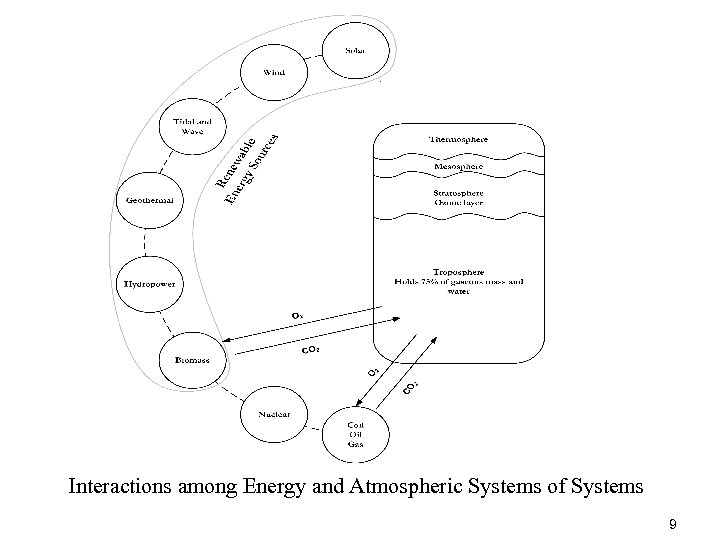 Interactions among Energy and Atmospheric Systems of Systems 9
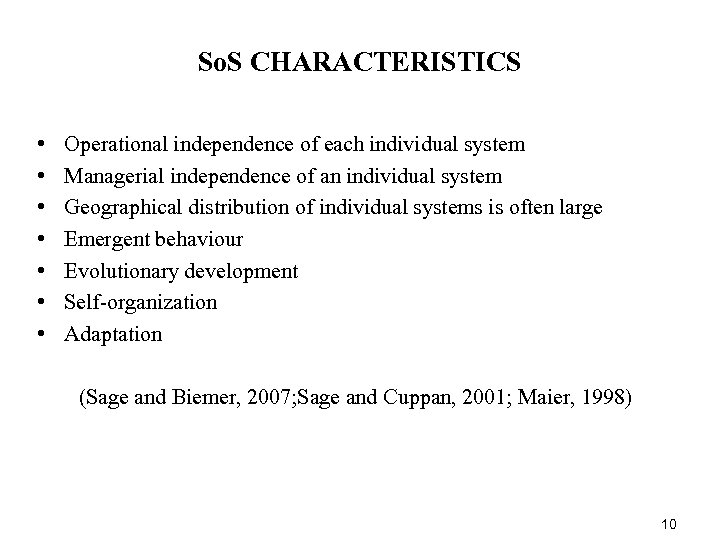 So. S CHARACTERISTICS • • Operational independence of each individual system Managerial independence of an individual system Geographical distribution of individual systems is often large Emergent behaviour Evolutionary development Self-organization Adaptation (Sage and Biemer, 2007; Sage and Cuppan, 2001; Maier, 1998) 10
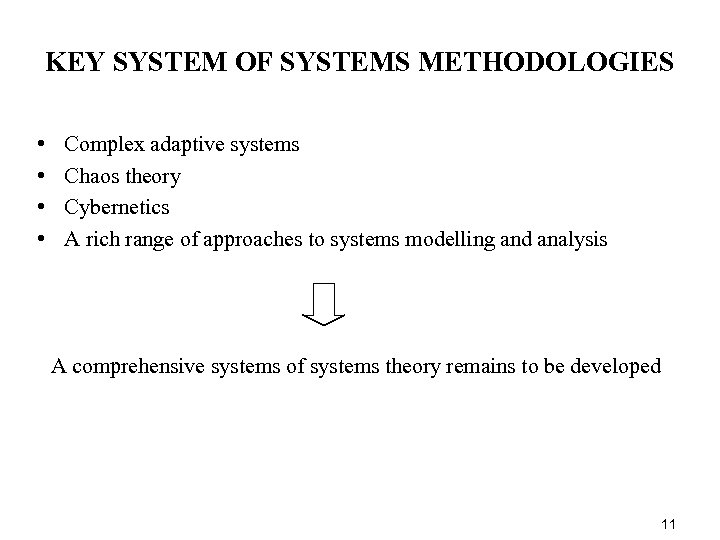 KEY SYSTEM OF SYSTEMS METHODOLOGIES • • Complex adaptive systems Chaos theory Cybernetics A rich range of approaches to systems modelling and analysis A comprehensive systems of systems theory remains to be developed 11
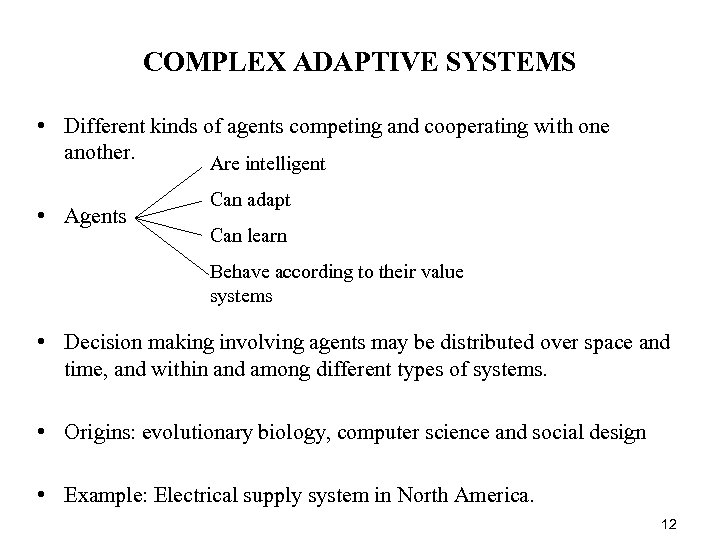 COMPLEX ADAPTIVE SYSTEMS • Different kinds of agents competing and cooperating with one another. Are intelligent • Agents Can adapt Can learn Behave according to their value systems • Decision making involving agents may be distributed over space and time, and within and among different types of systems. • Origins: evolutionary biology, computer science and social design • Example: Electrical supply system in North America. 12
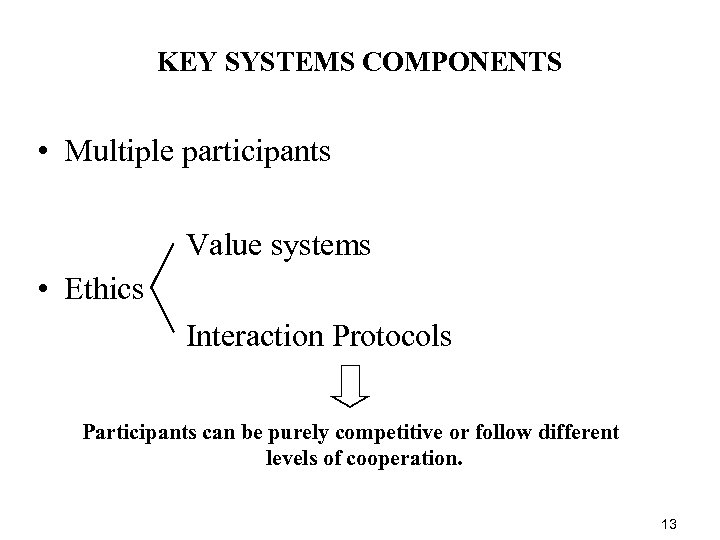 KEY SYSTEMS COMPONENTS • Multiple participants Value systems • Ethics Interaction Protocols Participants can be purely competitive or follow different levels of cooperation. 13
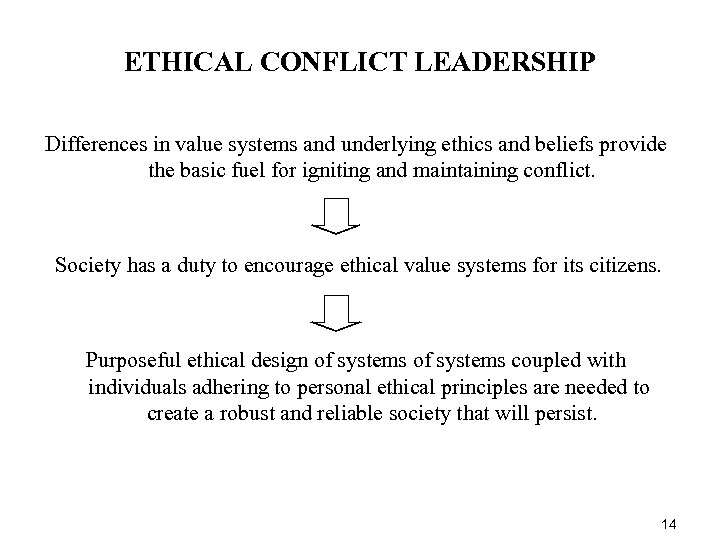 ETHICAL CONFLICT LEADERSHIP Differences in value systems and underlying ethics and beliefs provide the basic fuel for igniting and maintaining conflict. Society has a duty to encourage ethical value systems for its citizens. Purposeful ethical design of systems coupled with individuals adhering to personal ethical principles are needed to create a robust and reliable society that will persist. 14
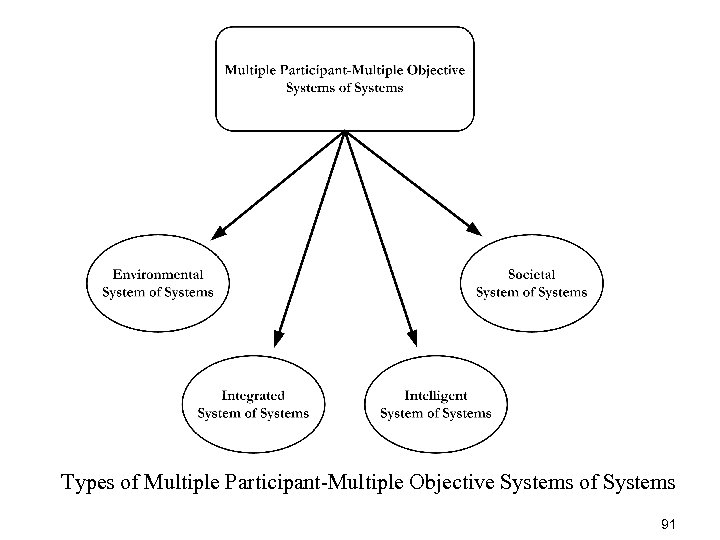
 WORLD SYSTEMS OF SYSTEMS • Environmental • Societal • Intelligent • Integrated 15
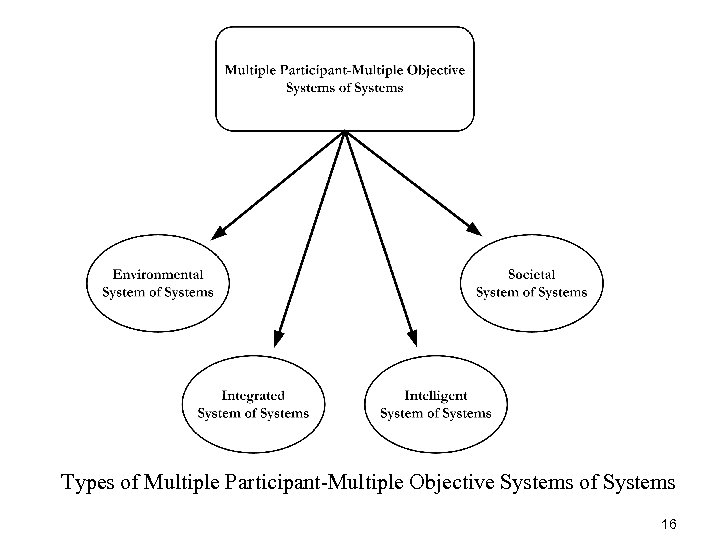 Types of Multiple Participant-Multiple Objective Systems of Systems 16
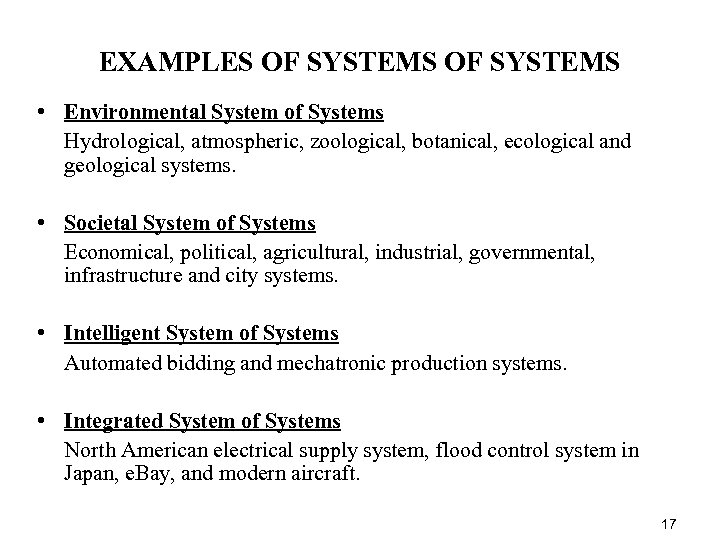 EXAMPLES OF SYSTEMS • Environmental System of Systems Hydrological, atmospheric, zoological, botanical, ecological and geological systems. • Societal System of Systems Economical, political, agricultural, industrial, governmental, infrastructure and city systems. • Intelligent System of Systems Automated bidding and mechatronic production systems. • Integrated System of Systems North American electrical supply system, flood control system in Japan, e. Bay, and modern aircraft. 17
 WORLD SYSTEMS OF SYSTEMS • Environmental • Societal • Intelligent • Integrated 18
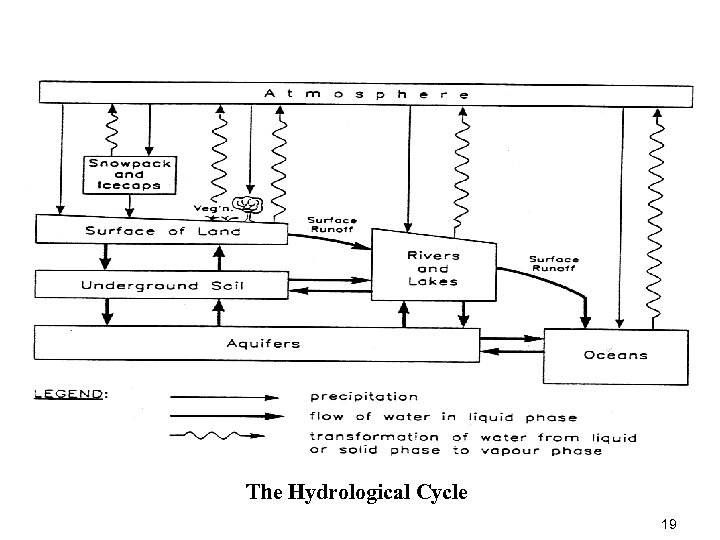 The Hydrological Cycle 19
 Societal and Environmental Systems of Systems 20
 WORLD SYSTEMS OF SYSTEMS • Environmental • Societal • Intelligent • Integrated 21
 Societal and Environmental Systems of Systems 22
 SOCIETAL SYSTEMS OF SYSTEMS • Classification of Societal Conflict Models • Competition and Cooperation in a Groundwater Contamination Dispute • Ethics in Conflict Behaviour and Policy Design 23
 DECISION MAKING Must consider physical realm of nature and the social world of humankind 24
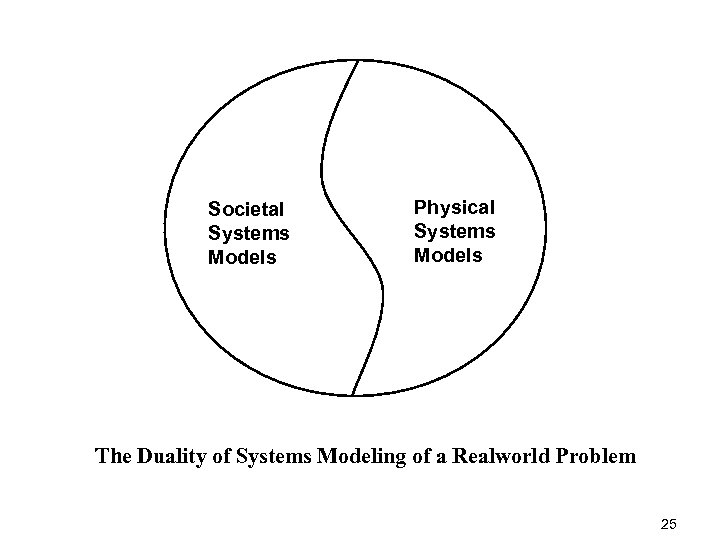 Societal Systems Models Physical Systems Models The Duality of Systems Modeling of a Realworld Problem 25
 SYSTEMS OF SYSTEMS TOOLBOX A wide range of systems tools from both the physical and decision sciences are required to investigate a given problem in sustainable development. Decision Support Systems (DSSs) allow these systems tools to be conveniently used in practice. 26
 CLASSIFICATION OF SOCIETAL CONFLICT MODELS • Conflicts inevitably arise whenever humans interact. Example: environmentalists are in conflict with private companies that would like to export water in bulk quantities. • Because of the ubiquitous nature of conflict, research in conflict resolution has taken place in a wide range of disciplines. • Many formal models for use in conflict resolution and decision making situations were developed in the fields of Operational Research and Systems Engineering. 27
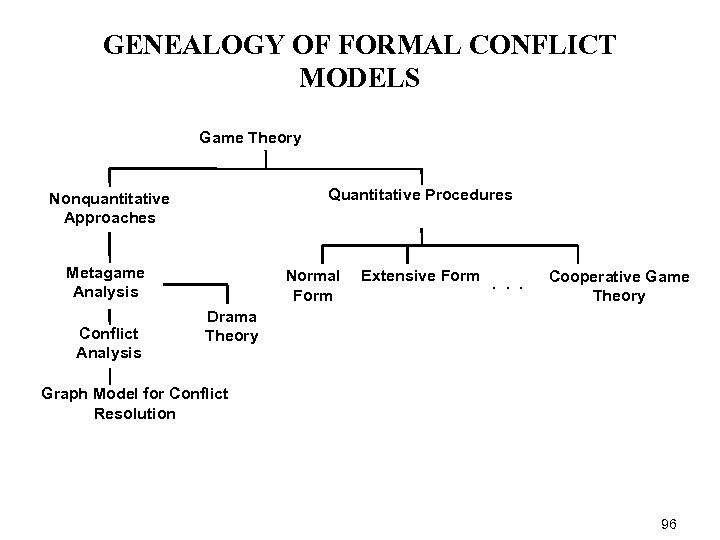
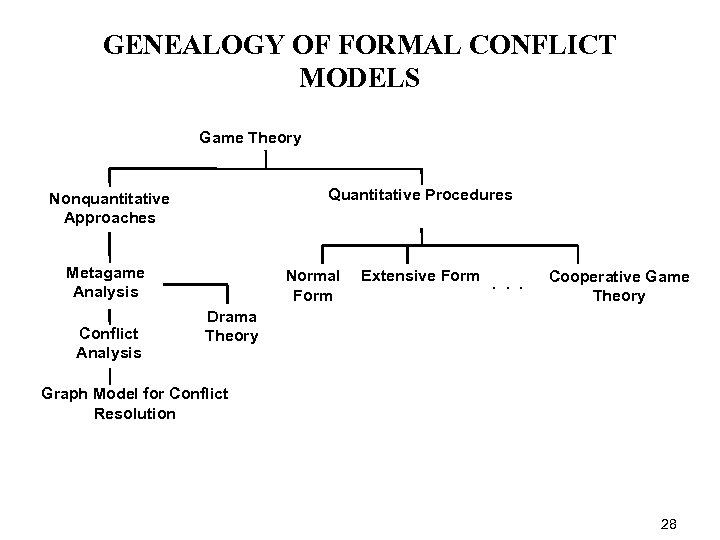 GENEALOGY OF FORMAL CONFLICT MODELS Game Theory Quantitative Procedures Nonquantitative Approaches Metagame Analysis Conflict Analysis Normal Form Extensive Form. . . Cooperative Game Theory Drama Theory Graph Model for Conflict Resolution 28
 PREFERENCES • Would you like to have tea or coffee to drink. – Quantitative response: I have a utility value of 1. 9673 for coffee and 1. 0000 for tea. – Human response: I would prefer to drink tea. Thank you. • Quantitative preferences: – Cardinal number is assigned to each state or object (ex. Dollars or utility value). • Non-quantitative or relative preferences: – One state is either more preferred, less preferred or equally preferred to another. 29
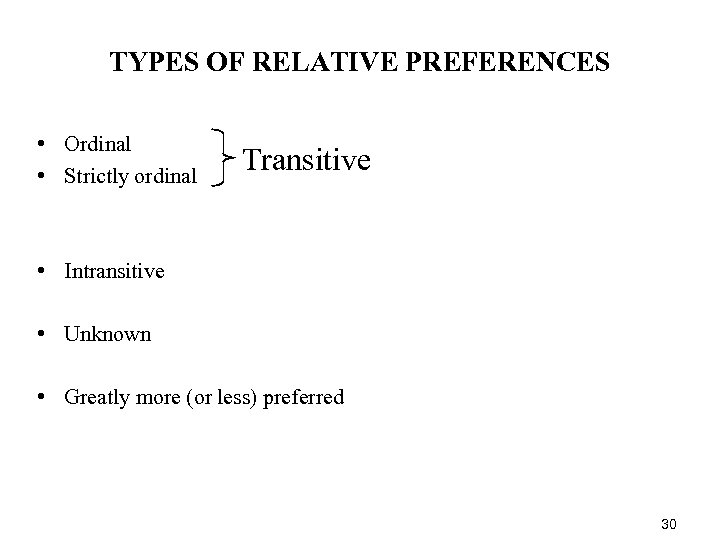 TYPES OF RELATIVE PREFERENCES • Ordinal • Strictly ordinal Transitive • Intransitive • Unknown • Greatly more (or less) preferred 30
 GRAPH MODEL FOR CONFLICT RESOLUTION • Handles a rich range of relative preferences Takes into account a given decision maker’s value system • Models both independent (noncooperative) and coalitional (cooperative behaviour) • Provides key strategic guidance for reaching win/win resolutions 31
 32
32
 COMPETITION AND COOPERATION IN A GROUNDWATER CONTAMINATION DISPUTE 33
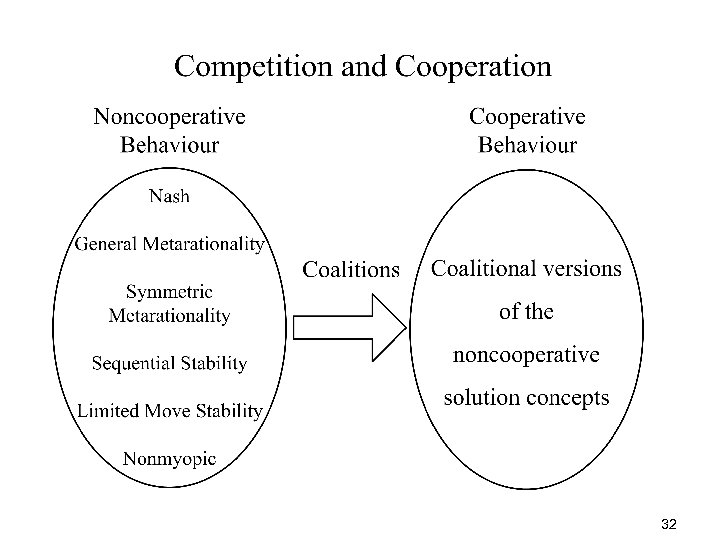
 MODELING PHILOSOPHY OF THE GRAPH MODEL FOR CONFLICT RESOLUTION • Determine the best a decision maker can do on his or her own. • Check if the decision maker can do even better by cooperating with others through coalition formation. 34
 ELMIRA GROUNDWATER CONTAMINATION DISPUTE • Elmira is a town of 7, 500 residents located in Southern Ontario, Canada. • Municipal water is drawn from an underground aquifer. • In late 1989, the Ontario Ministry of the Environment (Mo. E) discovered that the aquifer was contaminated by a carcinogen Nnitroso demethylamine (NDMA). • Uniroyal Chemical Ltd. (Uniroyal) operates NDMA-producing processes. 35
 ELMIRA GROUNDWATER CONTAMINATION DISPUTE • Mo. E issued a Control Order to Uniroyal to clean up the contaminants. • Uniroyal appealed the Control Order. • Regional Municipality of Waterloo and Woolwich Township (Local Government) hired consultants and obtained legal advice. • Negotiations involving the three DM’s took place in mid-1991. Study the negotiations using GMCR II 36
 GMCR II A flexible and comprehensive Decision Support System which allows the Graph Model for Conflict Resolution methodology to be applied to practical real world problems. 37
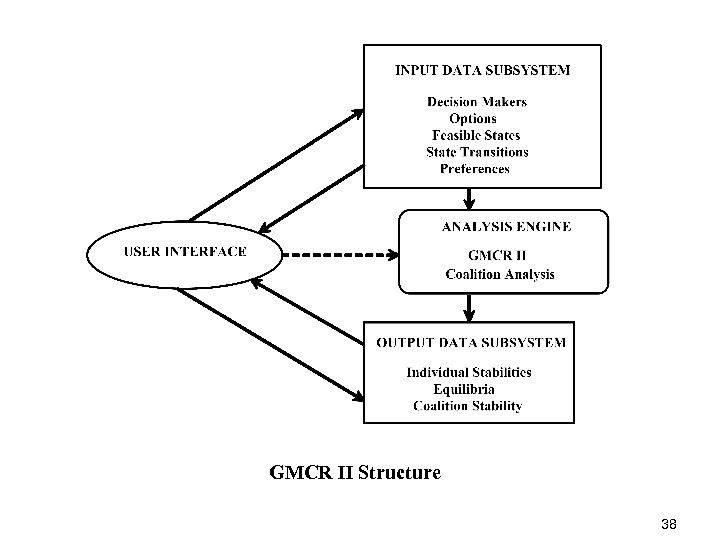 GMCR II Structure 38
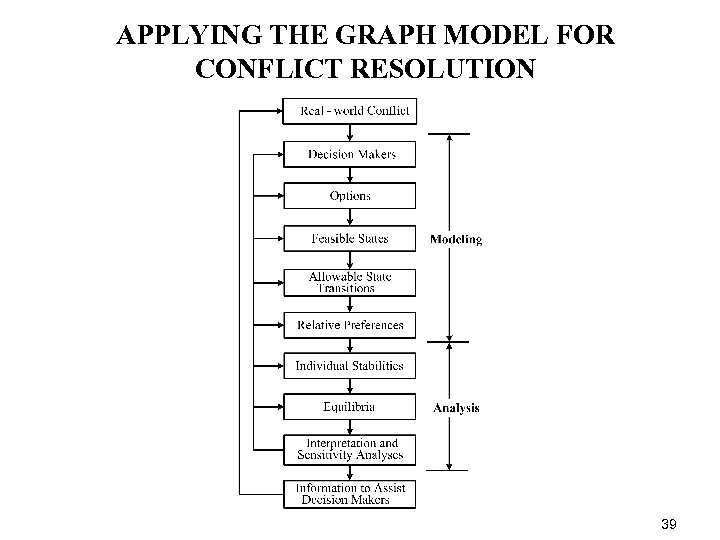 APPLYING THE GRAPH MODEL FOR CONFLICT RESOLUTION 39
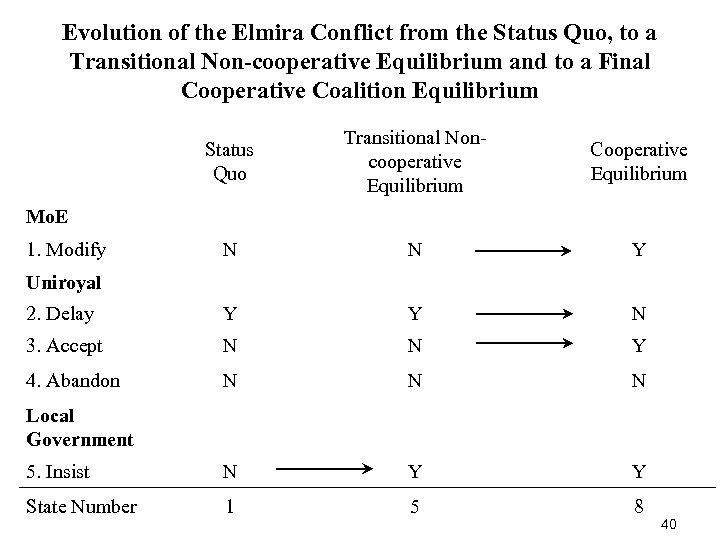 Evolution of the Elmira Conflict from the Status Quo, to a Transitional Non-cooperative Equilibrium and to a Final Cooperative Coalition Equilibrium Status Quo Transitional Noncooperative Equilibrium Cooperative Equilibrium N N Y 2. Delay Y Y N 3. Accept N N Y 4. Abandon N N N 5. Insist N Y Y State Number 1 5 8 Mo. E 1. Modify Uniroyal Local Government 40
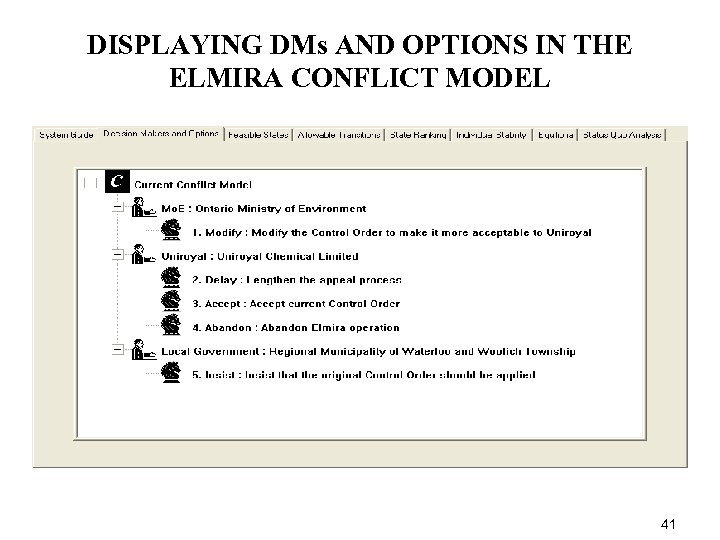 DISPLAYING DMs AND OPTIONS IN THE ELMIRA CONFLICT MODEL 41
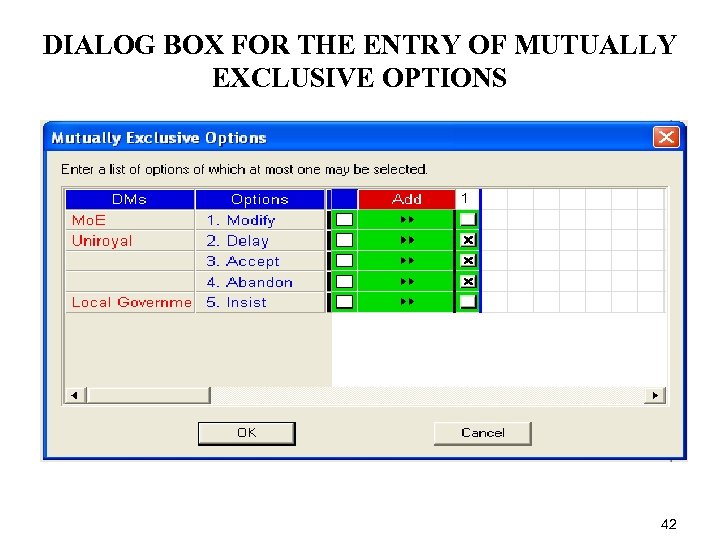 DIALOG BOX FOR THE ENTRY OF MUTUALLY EXCLUSIVE OPTIONS 42
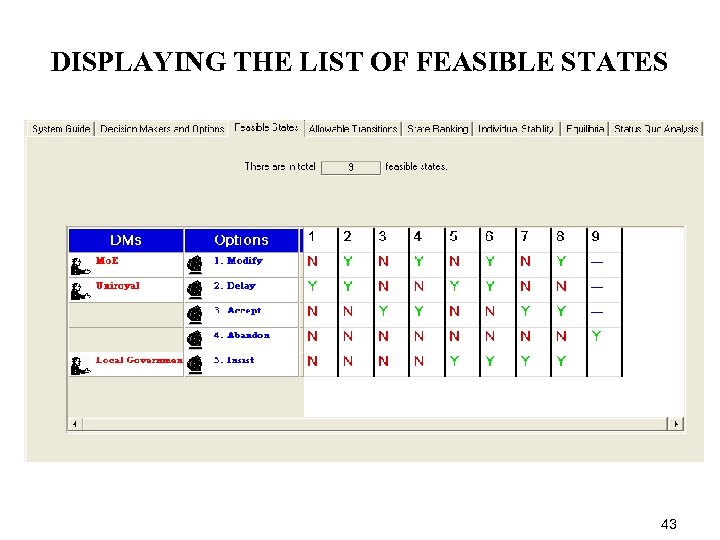 DISPLAYING THE LIST OF FEASIBLE STATES 43
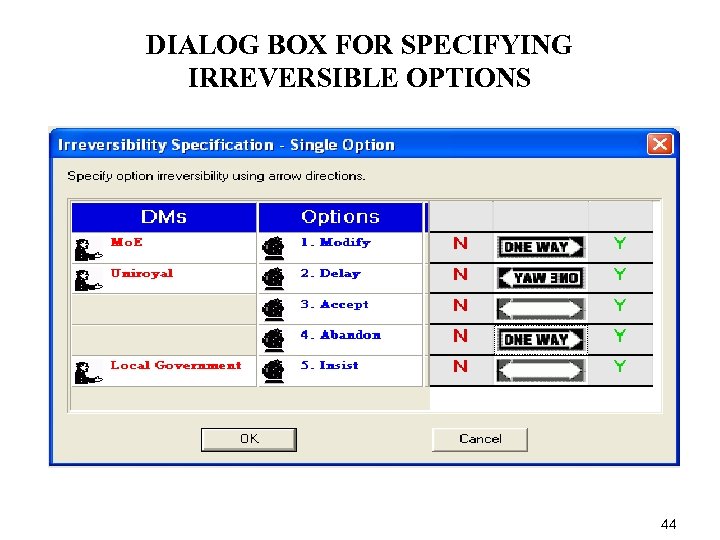 DIALOG BOX FOR SPECIFYING IRREVERSIBLE OPTIONS 44
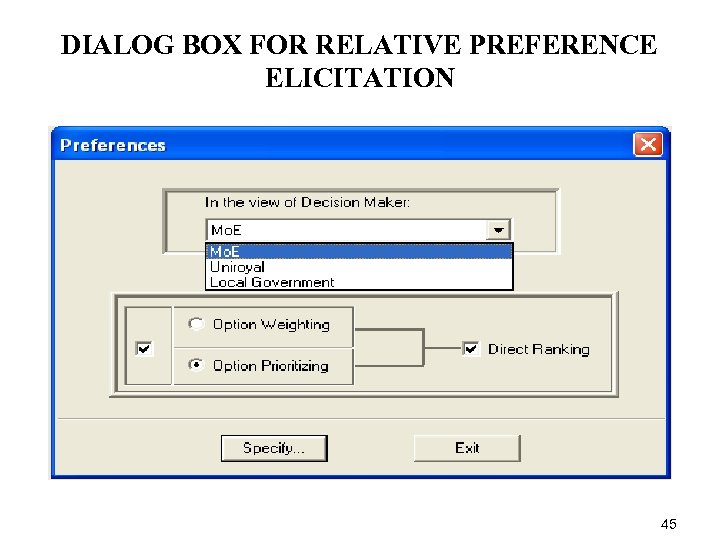 DIALOG BOX FOR RELATIVE PREFERENCE ELICITATION 45
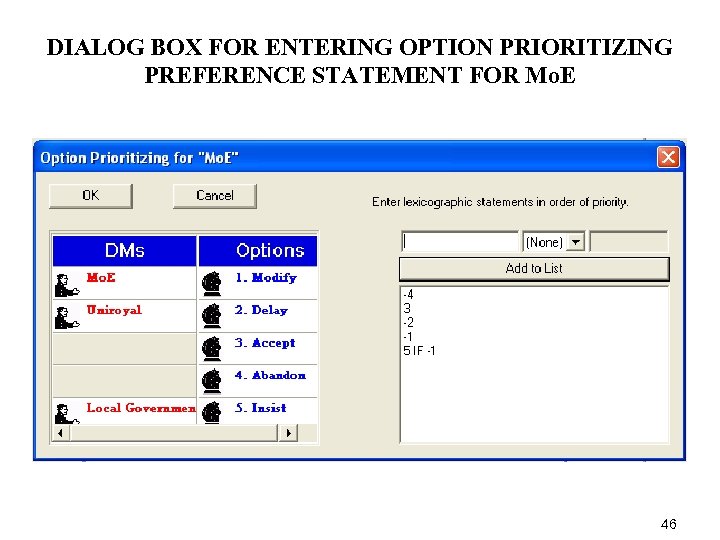 DIALOG BOX FOR ENTERING OPTION PRIORITIZING PREFERENCE STATEMENT FOR Mo. E 46
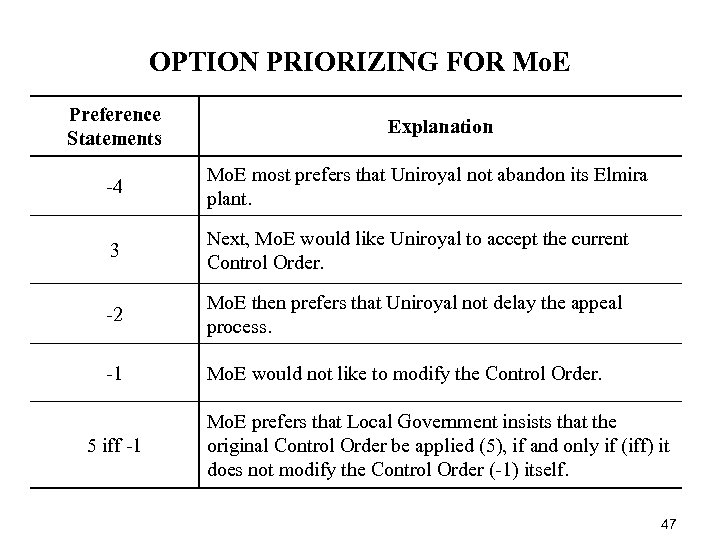 OPTION PRIORIZING FOR Mo. E Preference Statements Explanation -4 Mo. E most prefers that Uniroyal not abandon its Elmira plant. 3 Next, Mo. E would like Uniroyal to accept the current Control Order. -2 Mo. E then prefers that Uniroyal not delay the appeal process. -1 Mo. E would not like to modify the Control Order. 5 iff -1 Mo. E prefers that Local Government insists that the original Control Order be applied (5), if and only if (iff) it does not modify the Control Order (-1) itself. 47
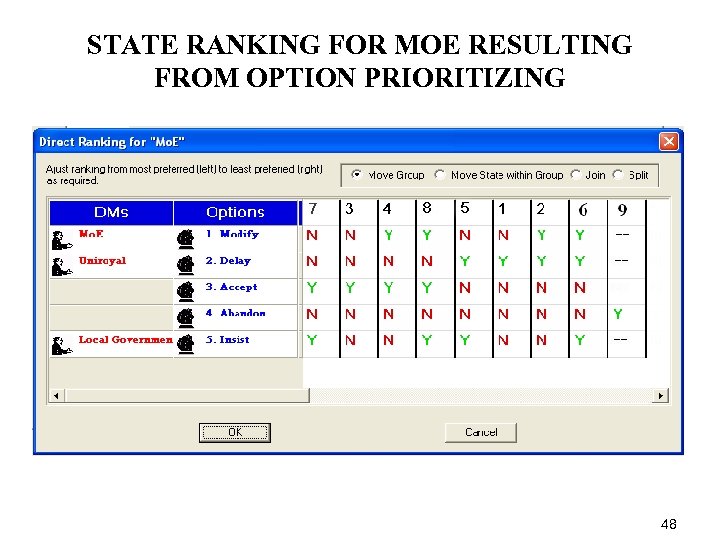 STATE RANKING FOR MOE RESULTING FROM OPTION PRIORITIZING 48
 OPTION PRIORITIZATION • Provides an operational approach for conveniently eliciting the relative preferences of a decision maker. Clearly reveals the underlying value systems of the decision makers through the prioritization of preference statements. 49
 ANALYSIS AND RESULTS • GMCR II analyzes every state for stability for each DM according to all of the solution concepts in Table 1. GMCR II CAN DISPLAY • Individual stability results. • Equilibria according to the preferences of a given decision maker. • Customized equilibria after the user specifies the kind of solution concept each decision maker should follow. • Common features of the equilibria. • Equilibria which contain specified patterns desired by the user. 50
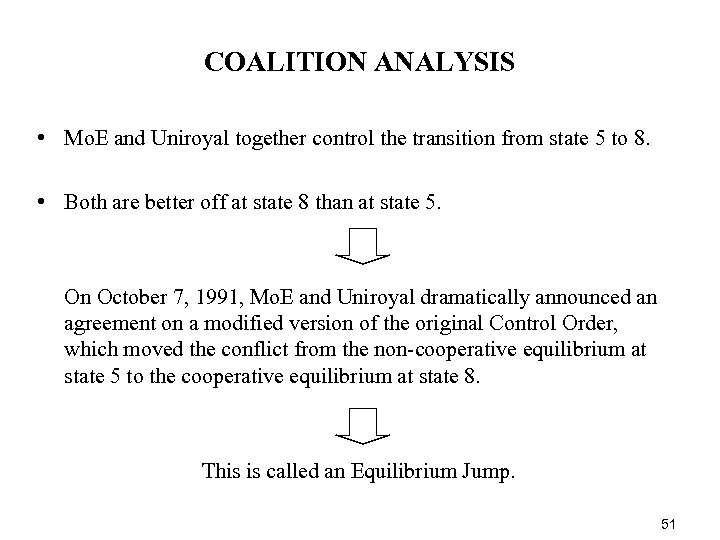 COALITION ANALYSIS • Mo. E and Uniroyal together control the transition from state 5 to 8. • Both are better off at state 8 than at state 5. On October 7, 1991, Mo. E and Uniroyal dramatically announced an agreement on a modified version of the original Control Order, which moved the conflict from the non-cooperative equilibrium at state 5 to the cooperative equilibrium at state 8. This is called an Equilibrium Jump. 51
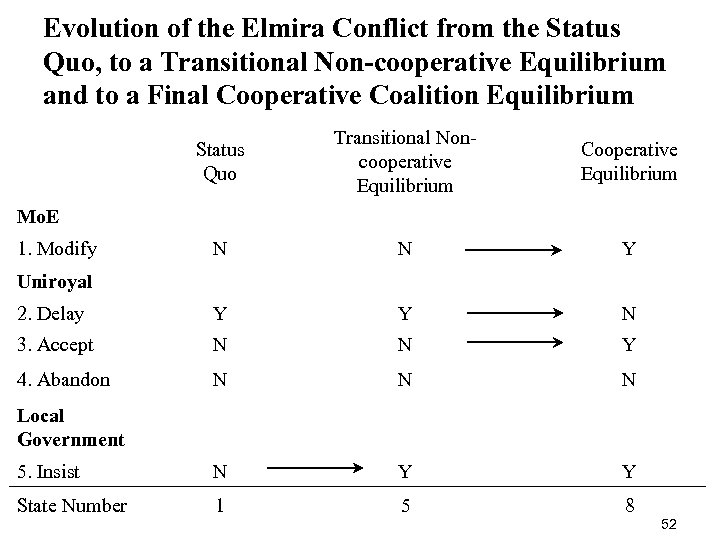 Evolution of the Elmira Conflict from the Status Quo, to a Transitional Non-cooperative Equilibrium and to a Final Cooperative Coalition Equilibrium Status Quo Transitional Noncooperative Equilibrium Cooperative Equilibrium N N Y 2. Delay Y Y N 3. Accept N N Y 4. Abandon N N N 5. Insist N Y Y State Number 1 5 8 Mo. E 1. Modify Uniroyal Local Government 52
 CONCLUSIONS • As illustrated by the Elmira conflict, GMCR II can be conveniently applied to an actual conflict. • GMCR II can determine non-cooperative equilibria which reflect the best a DM can do on his or her own when a given equilibrium is reached. • GMCR II can indicate when beneficial coalitions can be formed so that coalition members can achieve even better results. 53
 THE GRAPH MODEL FOR CONFLICT RESOLUTION: RECENT DEVELOPMENTS • Identifying opportunities for coalition formation to move to a mutually preferred stable outcome • Handling emotions and strength of preference • Tracing the evolution of a conflict to a final outcome • Taking care of uncertain preference information • Incorporating policy analysis into a conflict study • Modeling attitudes and misperceptions • Determining strategic implications of misperceptions • Having efficient algorithms for handling large conflicts 54
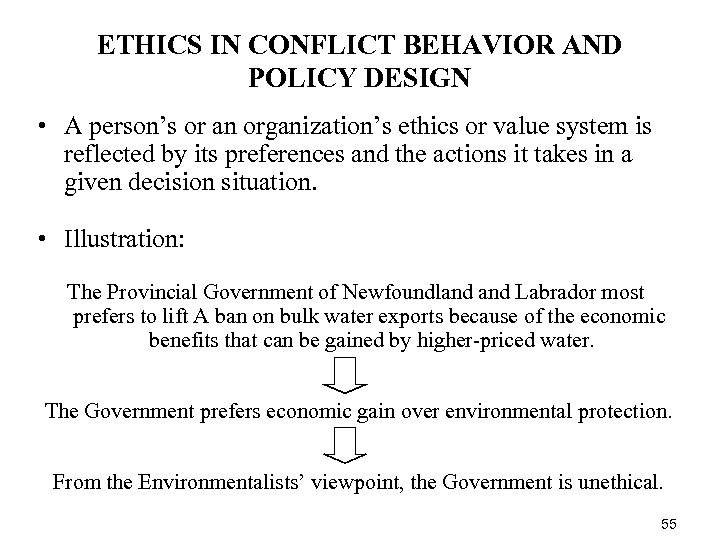 ETHICS IN CONFLICT BEHAVIOR AND POLICY DESIGN • A person’s or an organization’s ethics or value system is reflected by its preferences and the actions it takes in a given decision situation. • Illustration: The Provincial Government of Newfoundland Labrador most prefers to lift A ban on bulk water exports because of the economic benefits that can be gained by higher-priced water. The Government prefers economic gain over environmental protection. From the Environmentalists’ viewpoint, the Government is unethical. 55
 DESIGN OPPORTUNITY Great need for responsible and ethical designs of policies, governance organizations and associated infrastructure underlying our societal systems of systems Misplaced value systems are causing havoc around the globe. 56
 MISPLACED VALUE SYSTEM A Fire Fighting Negotiating System Using the Unidimensional Value Of Bottom Line Economics 57
 58
58
 TRAGEDY OF COMMONS • Irresponsible utilization of a common resource due to individual greed causes the destruction of the resource. • Example: One nation continues to harvest an endangered species of fish, resulting in the extinction of the fish, since other nations do likewise. • Societies are participating in innumerable versions of Tragedies of the Commons as human populations explode and common resources are depleted. Societies require ethical sustainable behavior within the confines of enforceable international agreements closely connected to trade agreements. 59
 SUSTAINABLE DEVELOPMENT The economic needs of society are met in a manner which maintains a healthy environment for present and future generations. The earth is not an infinite source of raw materials nor an infinite sink for absorbing wastes. Inherent conflict: Economics versus Environmental Protection Future generations and nature are not sitting at the bargaining table. 60
 EASTER ISLAND • The Moai people on Easter Island destroyed their environment by cutting down all of the trees. • When the Dutch explorer Jacob Rogereen arrived on Easter Island on Easter Sunday, 1722, the Moai people had disappeared. • Only large stone statues of grotesquely-shaped humans remain as tombstones marking a once great culture. 61
 INTERNATIONAL TRADE AGREEMENTS • Prioritize profits of large corporations, bottom-line economics, and protection of foreign investments. • Directly challenge national social and environmental policies, laws and regulations. Cause social hardship and environmental devastation. 62
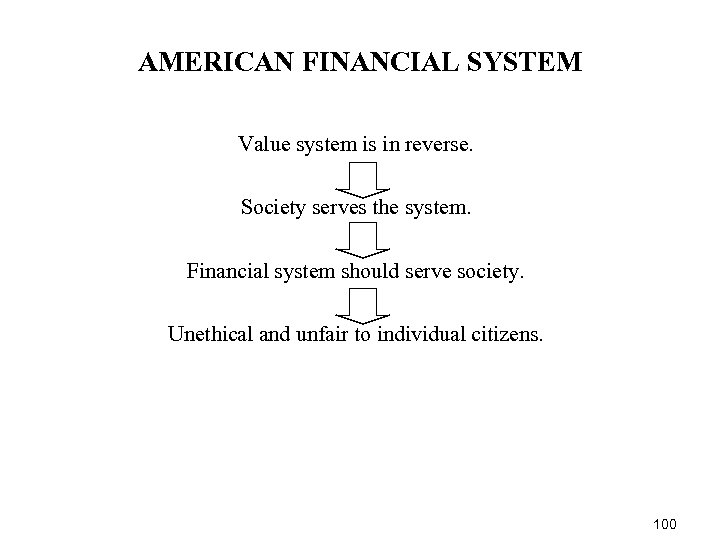
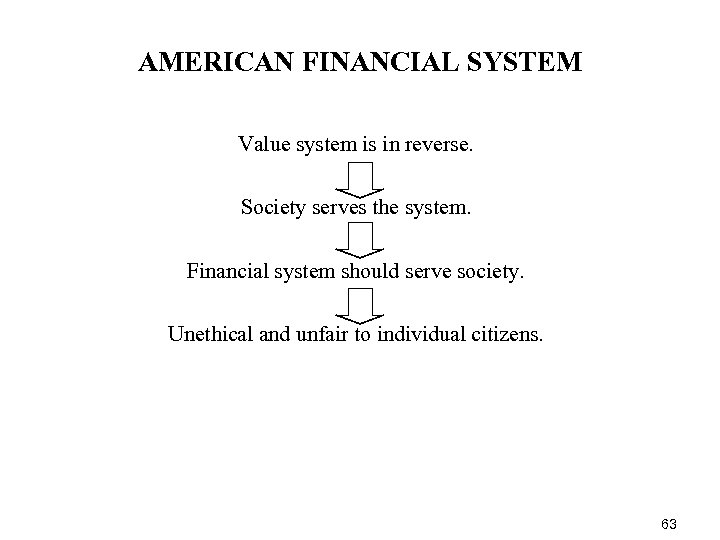 AMERICAN FINANCIAL SYSTEM Value system is in reverse. Society serves the system. Financial system should serve society. Unethical and unfair to individual citizens. 63
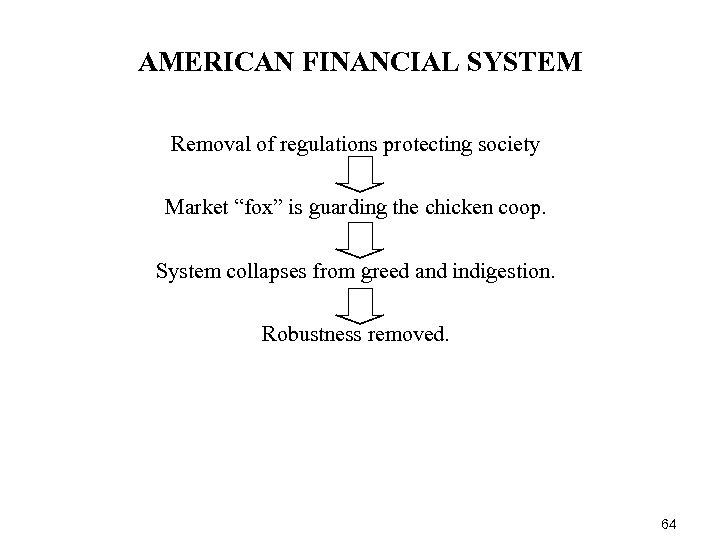 AMERICAN FINANCIAL SYSTEM Removal of regulations protecting society Market “fox” is guarding the chicken coop. System collapses from greed and indigestion. Robustness removed. 64
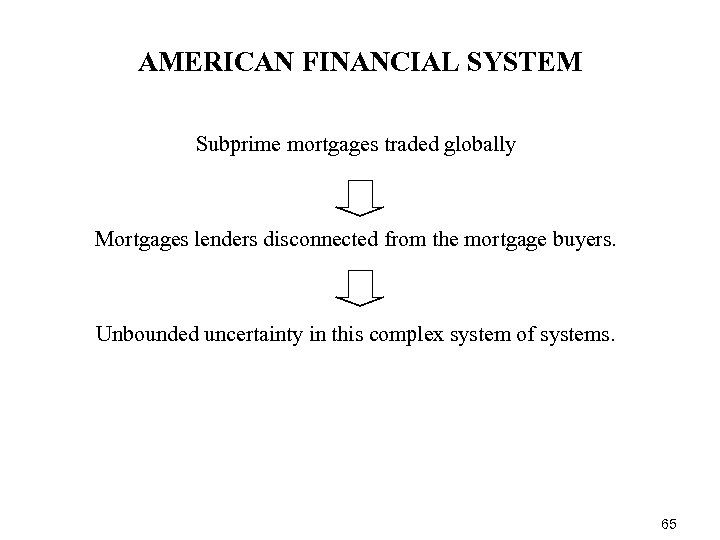 AMERICAN FINANCIAL SYSTEM Subprime mortgages traded globally Mortgages lenders disconnected from the mortgage buyers. Unbounded uncertainty in this complex system of systems. 65
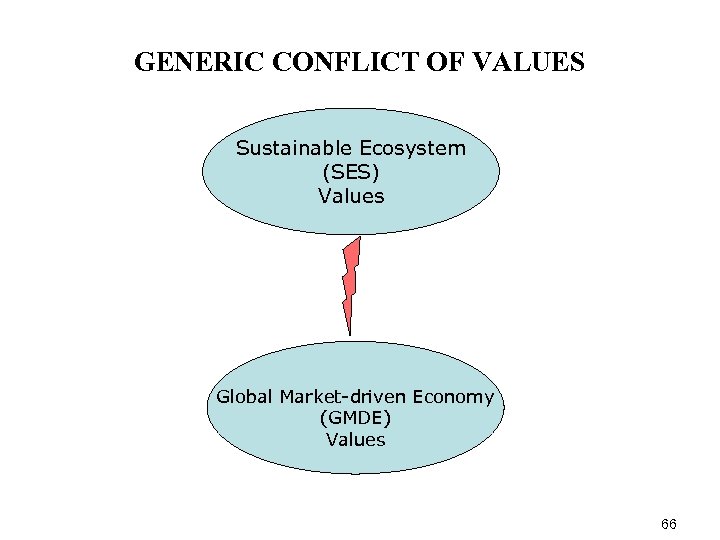 GENERIC CONFLICT OF VALUES Sustainable Ecosystem (SES) Values Global Market-driven Economy (GMDE) Values 66
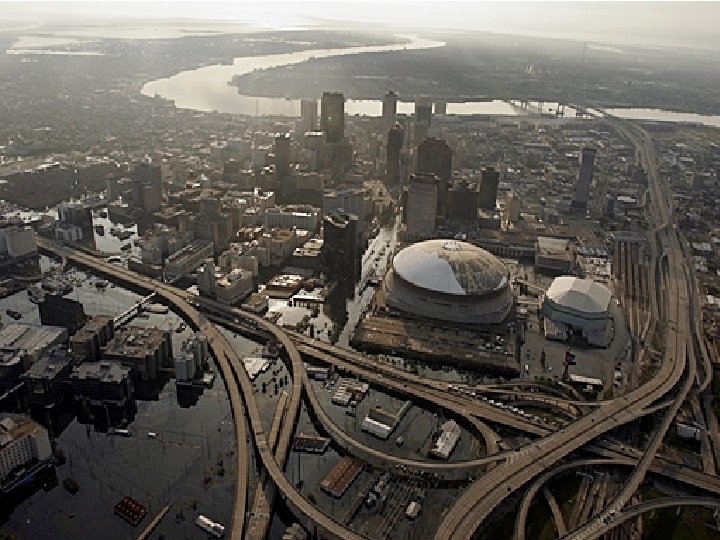
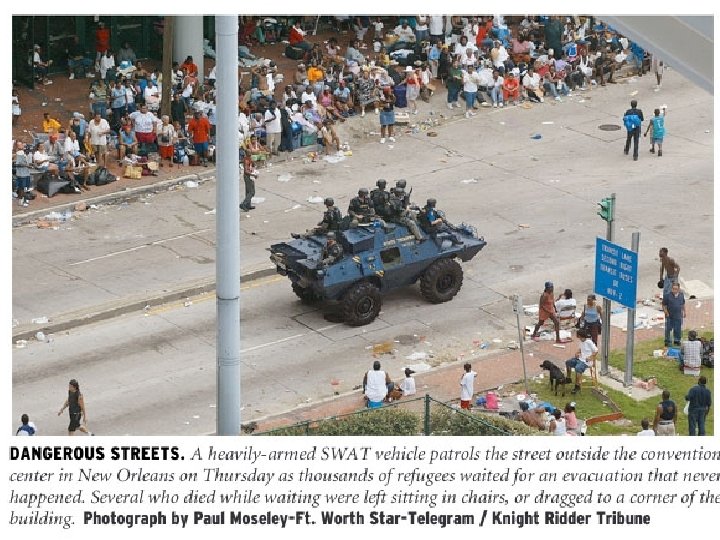
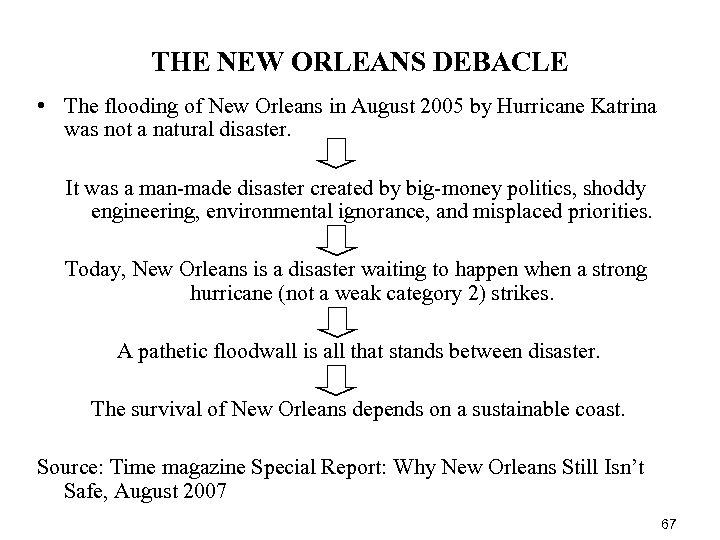 THE NEW ORLEANS DEBACLE • The flooding of New Orleans in August 2005 by Hurricane Katrina was not a natural disaster. It was a man-made disaster created by big-money politics, shoddy engineering, environmental ignorance, and misplaced priorities. Today, New Orleans is a disaster waiting to happen when a strong hurricane (not a weak category 2) strikes. A pathetic floodwall is all that stands between disaster. The survival of New Orleans depends on a sustainable coast. Source: Time magazine Special Report: Why New Orleans Still Isn’t Safe, August 2007 67
 68
68
 69
69
 WHY NEW ORLEANS DROWNED? • The principle of sustainability was purposefully ignored and a creeping corrupted value system was the real culprit that drowned New Orleans. We must design our systems of systems according to responsible and ethical values In fact, it is our called duty as Systems Engineers to carry this important message everywhere and ensure that our organizations adhere to it. 70
 NEW ORLEANS SLOGANS • Maker levees, not war. • Fix the coast or we are toast. (Need wetland to absorb storm surges) US Corps of Engineers is still concentrating on controlling nature instead of preserving it. There is even a plan to build levees along the entire coast: “The Great Wall of Louisiana” 71
 THE GREAT ELECTRICAL SYSTEM FAILURE • At 4: 11 PM on Thursday August 14, 2003, the electrical supply system in the northeastern part of North America suddenly ceased to function. • Canadian Province of Ontario and seven nearby American states were affected. • 10 million Canadians and 40 million Americans were without electricity. • 22 nuclear and 80 fossil-fuel plants were shut down. • Electrical system out of commission for up to 30 hours. 72
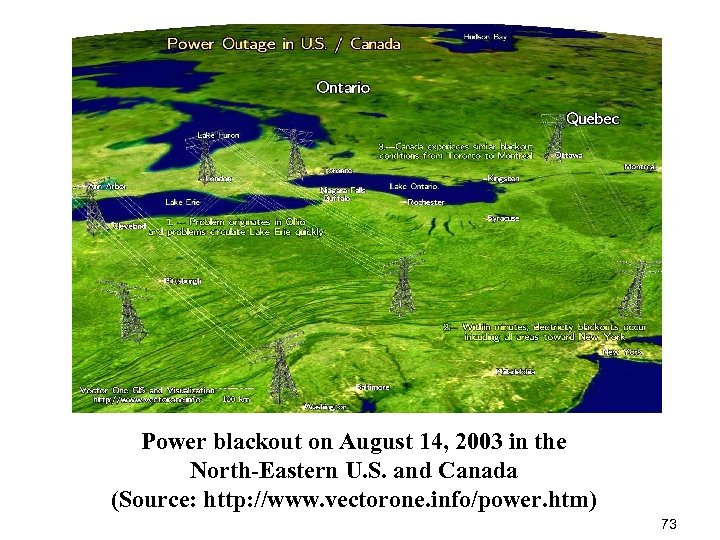 Power blackout on August 14, 2003 in the North-Eastern U. S. and Canada (Source: http: //www. vectorone. info/power. htm) 73
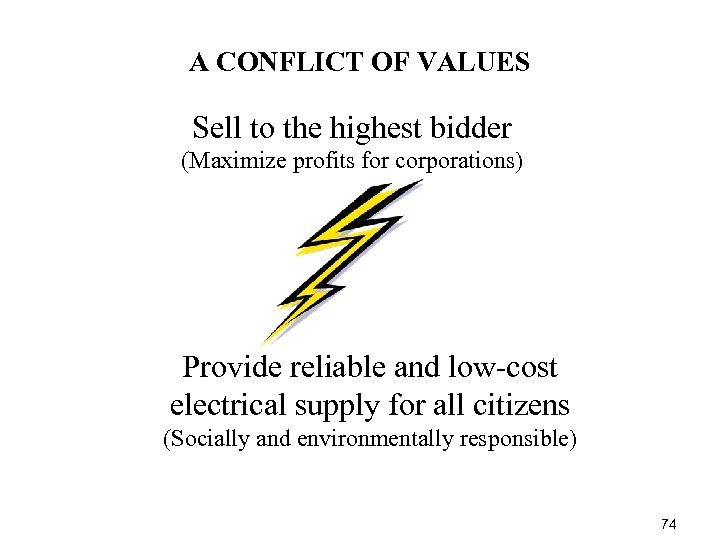 A CONFLICT OF VALUES Sell to the highest bidder (Maximize profits for corporations) Provide reliable and low-cost electrical supply for all citizens (Socially and environmentally responsible) 74
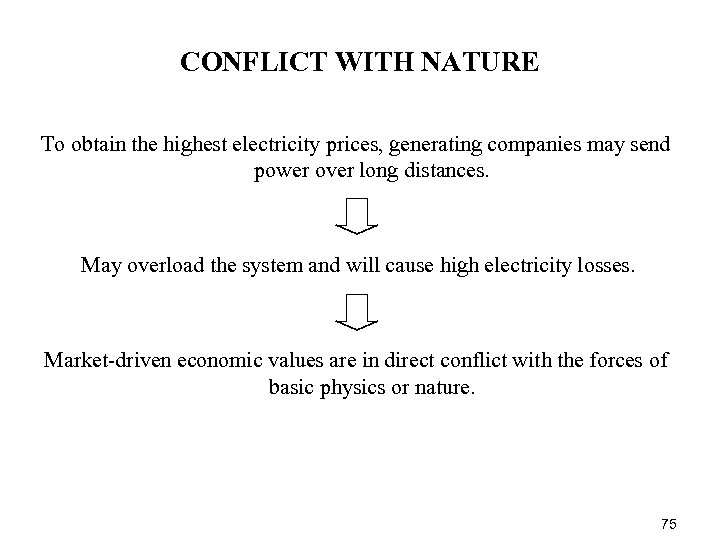 CONFLICT WITH NATURE To obtain the highest electricity prices, generating companies may send power over long distances. May overload the system and will cause high electricity losses. Market-driven economic values are in direct conflict with the forces of basic physics or nature. 75
 CANADA’S GLOBAL WARMING POLICY “A Complete and total fraud” Former US Vice President Al Gore Al Gove gives his presentation at the Green Living Show in Toronto on April 28, 2007 76
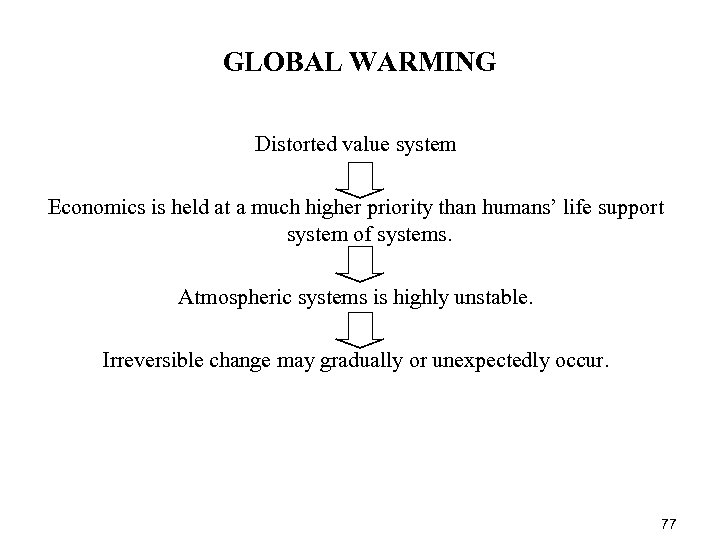 GLOBAL WARMING Distorted value system Economics is held at a much higher priority than humans’ life support system of systems. Atmospheric systems is highly unstable. Irreversible change may gradually or unexpectedly occur. 77
 WORLD SYSTEM OF SYSTEMS • Environmental • Societal • Intelligent • Integrated 78
 INTELLIGENT SYSTEM OF SYSTEMS • An Intelligent System of Systems is an artificial, computerized world inhabited by agents that interact with one another as they strive to reach their objectives either independently or in cooperation with other agents. • An agent may be a software program that represents someone’s bidding strategy and objectives when purchasing a product on the Internet or it may be a mechatronic entity such as a robot working in cooperation with other robots assembling a car on a production line. • A specific intelligent system consisting of multiple interacting agents is entirely created by humans. 79
 INTELLIGENT SYSTEM OF SYSTEMS (Cont’d) • A given agent living in the system is capable of independent or autonomous action on behalf of its user or owner and behaves according to the powers that it has been bestowed in its software design as it strives to achieve its preprogrammed goals by following particular strategies it can control. • Often agents are programmed to cooperate with one another in order to enhance the effectiveness of the intelligent system to achieve its goals. • A protocol constitutes the public rules by which agents can come to agreements within a given system or domain. 80
 ETHICAL INTELLIGENT SYSTEMS DESIGN Just like the Dutch created the polders in Holland, human beings are the designers, builders and caretakers of intelligent systems. Humans have a great moral responsibility to construct intelligent systems having social environments in which agents behave ethically under appropriate domain protocols and strategies as they compete to obtain results which in turn must be ethical and fair. 81
 MODELLING CONFLICT IN INTELLIGENT SYSTEMS • Rosenschien and Zlotkin (1994) mention that they directly import concepts from game theory for employment in their formal analyses of rules or protocols governing the high-level behavior of interacting computer systems or agents. However, it is difficult to apply game theory to conflicts arising among decision makers in a societal context such as the groundwater contamination dispute. • Designers may wish to consider incorporating into their intelligent systems design flexible concepts offered by non-quantitative conflict analysis techniques. 82
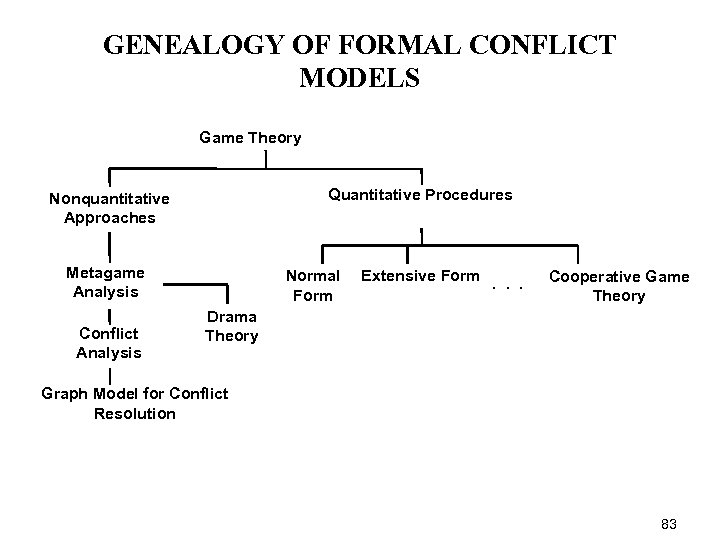 GENEALOGY OF FORMAL CONFLICT MODELS Game Theory Quantitative Procedures Nonquantitative Approaches Metagame Analysis Conflict Analysis Normal Form Extensive Form. . . Cooperative Game Theory Drama Theory Graph Model for Conflict Resolution 83
 DRAWBACKS OF CLASSICAL GAME THEORY • Preferences over states for a decision maker are represented cardinally by von Neumann-Morgenstern utilities. These are notoriously difficult to calibrate. People think in terms of relative preferences. • Players must act in a specific sequence (extensive-form game) or simultaneously (normal-form game). In social conflicts as well as disputes among agents in a complex intelligent system like the Internet, players can choose to act in any sequence, at the same time or not at all. 84
 COMPETITION AND COOPERATION IN THE GRAPH MODEL FOR CONFLICT RESOLUTION • Determine the best a decision maker can do on his or her own. • Check if the decision maker can do even better by cooperating with others through coalition formation. 85
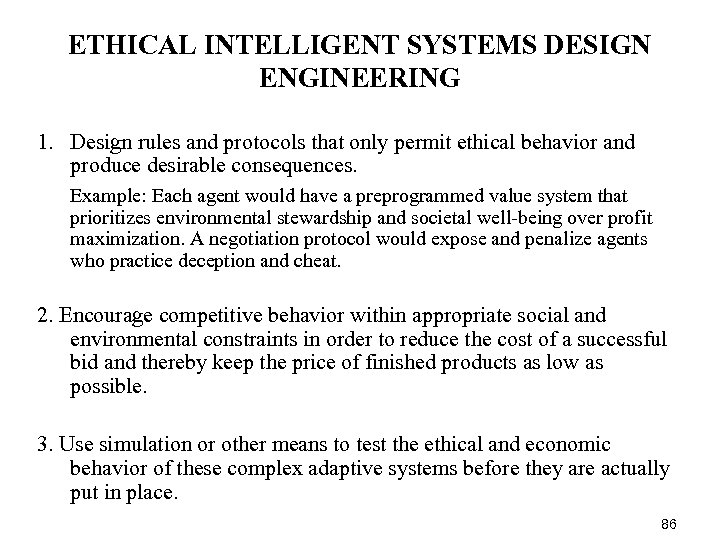 ETHICAL INTELLIGENT SYSTEMS DESIGN ENGINEERING 1. Design rules and protocols that only permit ethical behavior and produce desirable consequences. Example: Each agent would have a preprogrammed value system that prioritizes environmental stewardship and societal well-being over profit maximization. A negotiation protocol would expose and penalize agents who practice deception and cheat. 2. Encourage competitive behavior within appropriate social and environmental constraints in order to reduce the cost of a successful bid and thereby keep the price of finished products as low as possible. 3. Use simulation or other means to test the ethical and economic behavior of these complex adaptive systems before they are actually put in place. 86
 WORLD SYSTEM OF SYSTEMS • Environmental • Societal • Intelligent • Integrated 87
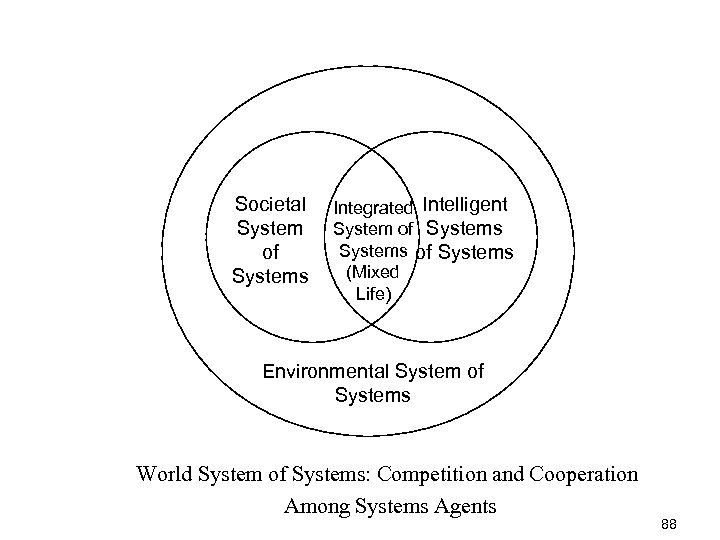 Societal System of Systems Integrated Intelligent System of Systems (Mixed Life) Environmental System of Systems World System of Systems: Competition and Cooperation Among Systems Agents 88
 INTEGRATED SYSTEMS • Combination of societal and intelligent systems. • Examples: – People and software agents placing bids within e. Bay – Modern aircraft – Electrical supply system • An intelligent system should be designed using concepts from Ethical System Design Engineering and take into account physical constraints. • A human or an agent may not know if it is interacting with another human or agent. 89
 MULTIPLE PARTICIPANT DECISION MAKING • Each type of system, or system of systems, is fraught with interacting and conflicting agents who may also be in dispute with decision makers existing in other systems. • Participants can ethically interact in a highly competitive manner or exhibit cooperation via coalition formation. 90
 Types of Multiple Participant-Multiple Objective Systems of Systems 91
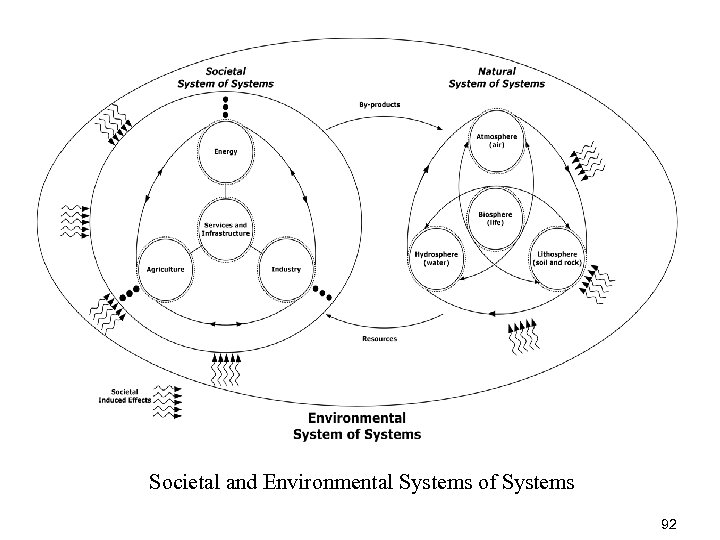 Societal and Environmental Systems of Systems 92
 ETHICAL SYSTEM OF SYSTEMS DESIGN ENGINEERING Design and operate systems of systems in which multiple participants compete and cooperate in an ethical fashion according to their value systems to create beneficial consequences for maintaining a sustainable, fair and secure society. 93
 BEHAVIOR OF AGENTS • Solution concepts for describing behavior of agents under conflict in societal systems can be considered for employment in other kinds of systems. • The employment of classical game theory methods in intelligent and integrated systems should be carefully assessed. • Any conflict or game theory method utilized within a given system should be scientifically tested. When necessary, suitable refinements and extensions can be made to the conflict models being entertained or a new class of models can be created. 94
 SPECIFIC RESEARCH TOPICS OF MULTIPLE PARTICIPANT DECISION MAKING • Determine if non-quantitative techniques can be used outside of the domain of societal systems. • For example, the graph model for conflict resolution, along with its associated solution concepts, may be useful for designing the behavior of agents living in a particular intelligent system in which the agents interact in a fashion that mimics human behavior under conflict. Technology transfer from one area of systems design engineering to another. 95
 GENEALOGY OF FORMAL CONFLICT MODELS Game Theory Quantitative Procedures Nonquantitative Approaches Metagame Analysis Conflict Analysis Normal Form Extensive Form. . . Cooperative Game Theory Drama Theory Graph Model for Conflict Resolution 96
 IN A NUTSHELL I. Multiple participants II. Ethics Positively harness competition and cooperation New field of Ethical Systems of Systems Design Engineering 97
 CONFLICT ANALYSIS GROUP RESEARCH TEAM Department of Systems Design Engineering University of Waterloo Faculty Members Keith W. Hipel – Coordinator Liping Fang – Ryerson University D. Marc Kilgour – Wilfrid Laurier University Kevin W. Li – University of Windsor Post-Doctoral Fellows Ye Chen; Amer Obeidi; Lizhong Wang Doctoral Students Majid Sheikhmohammady; Haiyan Xu; Qian Wang; Saied Yousefi; Master’s Students Sean Walk; Kaixian Hu; Yi Ke Senior Project Students Global Network 98
 PANEL SESSION • The Future of Systems, Man and Cybernetics: Application Domains and Research Members • Panelists: Keith Hipel Mo Jamshidi Jim Tien (Chair) Chip White 99
 AMERICAN FINANCIAL SYSTEM Value system is in reverse. Society serves the system. Financial system should serve society. Unethical and unfair to individual citizens. 100
 AMERICAN FINANCIAL SYSTEM Removal of regulations protecting society Market “fox” is guarding the chicken coop. System collapses from greed and indigestion. Robustness removed. 101
 AMERICAN FINANCIAL SYSTEM Subprime mortgages traded globally Mortgages lenders disconnected from the mortgage buyers. Unbounded uncertainty in this complex system of systems. 102
 GLOBAL WARMING Distorted value system Economics is held at a much higher priority than humans’ life support system of systems. Atmospheric systems is highly unstable. Irreversible change may gradually or unexpectedly occur. 103
 END OF THE COLD WAR Anatol Rapoport predicted that an enlightened Soviet Leader would end the Cold War. (1983 presentation at the University of Waterloo) The US Government was incapable of instituting real change because of its suffocating lobbying system. Soviet Premier Gorbachev stopped the ridiculous Clod War in 1990. Likewise, China has a unique historical opportunity to lead the world in green house gas reduction.
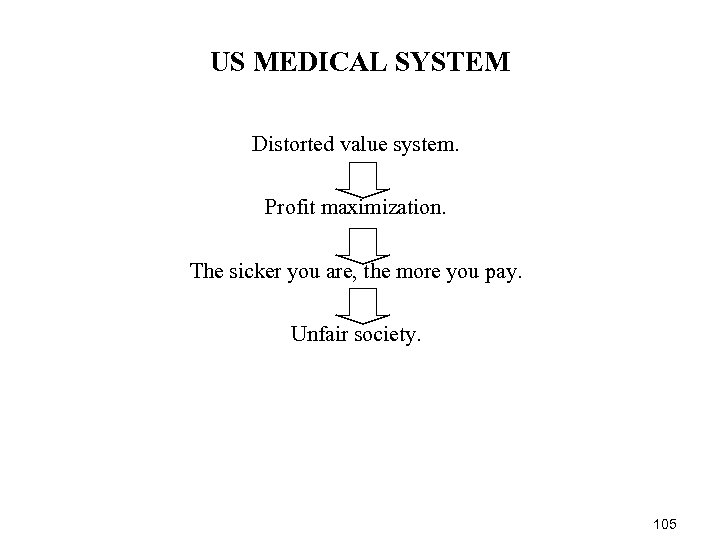 US MEDICAL SYSTEM Distorted value system. Profit maximization. The sicker you are, the more you pay. Unfair society. 105
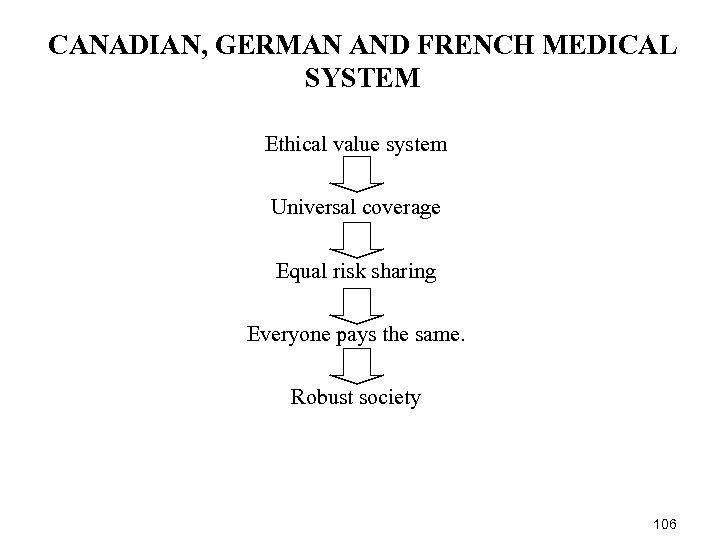 CANADIAN, GERMAN AND FRENCH MEDICAL SYSTEM Ethical value system Universal coverage Equal risk sharing Everyone pays the same. Robust society 106
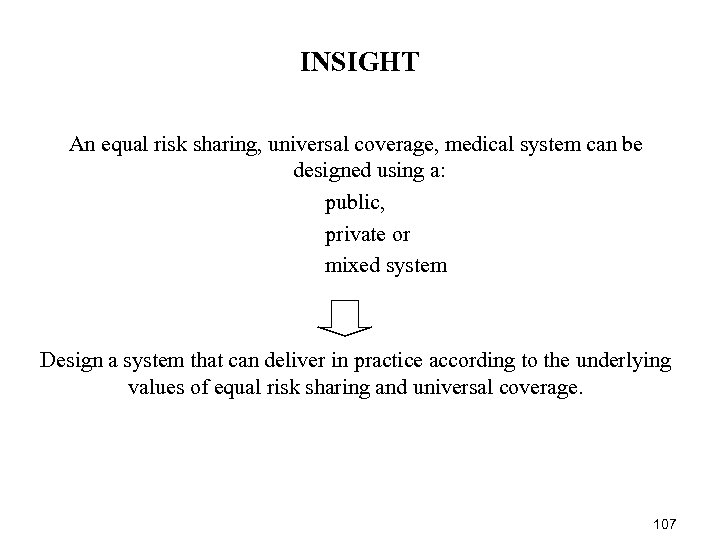 INSIGHT An equal risk sharing, universal coverage, medical system can be designed using a: public, private or mixed system Design a system that can deliver in practice according to the underlying values of equal risk sharing and universal coverage. 107
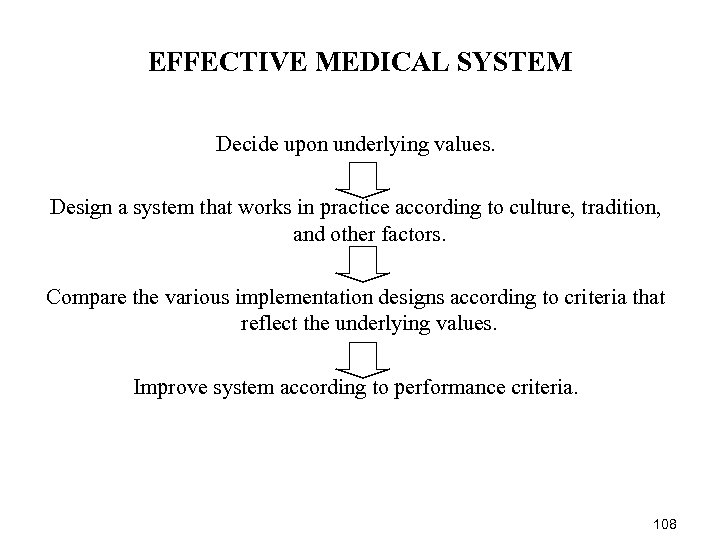 EFFECTIVE MEDICAL SYSTEM Decide upon underlying values. Design a system that works in practice according to culture, tradition, and other factors. Compare the various implementation designs according to criteria that reflect the underlying values. Improve system according to performance criteria. 108
 OPPORTUNITY FOR THE GLOBE AND US LEADERSHIP US President Barok Obama could use the financial crisis to meaningfully address climate change and institute an integrative and adaptive global governance system. A unique historical opportunity for the USA. 109
 CHINA Bright highly educated leader. An enlightened leader has the power to implement dramatic changes (ex. Deng Xiao Ping’s economic reforms of the late 1970’s. ) Increasing gaps between the rich and poor motivates environmental problems. Huge investments in education and infrastructure. 110
 USA Legacy of neo-conservative incompetence Financial crisis gives change of real reform by Obama. Smothering lobbying system stifle, needed political initiatives. See books in social and environmental reform Increasing gap between the rich and poor. A spirit of innovation and entrepreneurship. 111
 EUROPEAN UNION Informed, highly trained leaders. Cooperatively implemented, real free trade over many years. Socially and environmentally responsible. Fairness in wealth sharing. Huge investment in research and development. A race to the top. 112