


 Скачать презентацию Comparison of Four Hemostatic Agents in Control of
2ea9296fdff23d586f931e17d45ee7b8.ppt
- Количество слайдов: 17
 Comparison of Four Hemostatic Agents in Control of Extremity Hemorrhage in a Model of Penetrating Trauma NATO Medical Conference Lisbon, Portugal October 1, 2009 Lanny Littlejohn, MD LCDR MC (FS/DMO) USN NMCP Dept of Emergency Medicine Medical Director, TCCC
 Acknowledgements • This study was funded by SAM Medical Products® Portland, Oregon (unrestricted grant). None of the authors have received salary from, or are spokespersons for, the funding company. • The views expressed in this presentation are those of the author and do not necessarily reflect the official policy or position of the Department of the Navy, Department of Defense, or the United States Government
 The Problem • Uncontrolled Hemorrhage Causes Unnecessary Death – Leading cause of death in combat trauma – Second leading cause of death in civilian trauma • Hemostatic Agents hold great potential – …in early control of bleeding when tourniquets cannot be used – However. . Combat medics report. . . » commonly deployed agents less efficacious in smaller wounds (Devlin, 2009) • Various Agents are available – – – Standard Gauze dressing (SD) CELOX-A (CA) Chitoflex (CF) Combat Gauze (CG) Wound. Stat (WS) However, which agent is superior remains unclear.
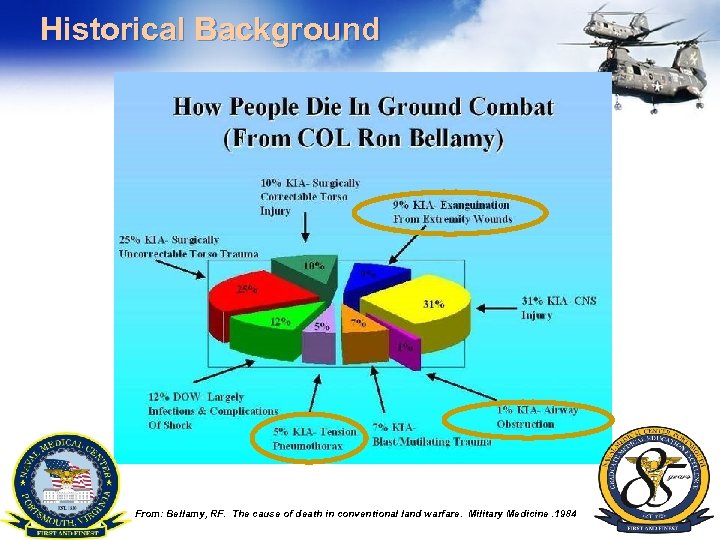 Historical Background From: Bellamy, RF. The cause of death in conventional land warfare. Military Medicine. 1984
 Study Objectives • Conduct a randomized, prospective, controlled trial in a clinically relevant model of penetrating trauma • To assess the equivalence of 4 hemostatic agents compared to standard gauze dressing. • Primary endpoints • Achievement of Initial Hemostasis • Incidence of Rebleeding • Survival
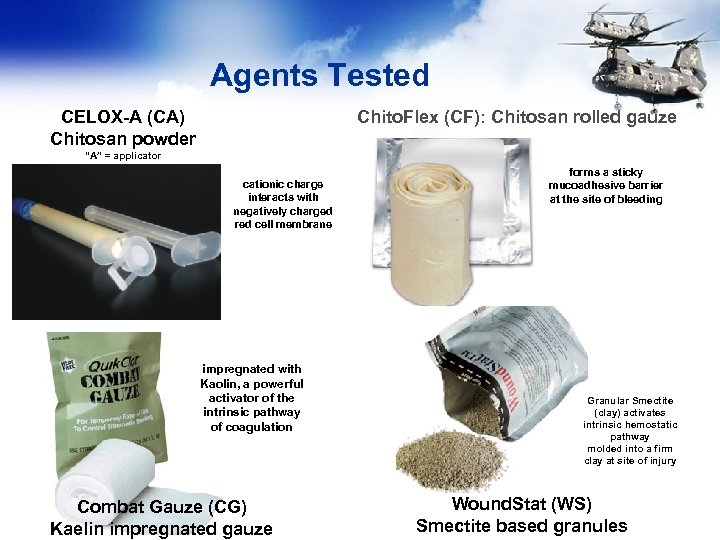 Agents Tested CELOX-A (CA) Chitosan powder Chito. Flex (CF): Chitosan rolled gauze “A” = applicator cationic charge interacts with negatively charged red cell membrane impregnated with Kaolin, a powerful activator of the intrinsic pathway of coagulation Combat Gauze (CG) Kaelin impregnated gauze forms a sticky mucoadhesive barrier at the site of bleeding Granular Smectite (clay) activates intrinsic hemostatic pathway molded into a firm clay at site of injury Wound. Stat (WS) Smectite based granules
 Test Subjects • Swine (sus scrofa) – (N = 80) randomized into 5 treatment arms (n=16 per arm) – similar across groups in weight (43 kg, SD=7. 7) and baseline hemodynamics Compliance with Ethical Guidelines • Protocol 2009. 0037 was approved by the institution animal care and utilization committee
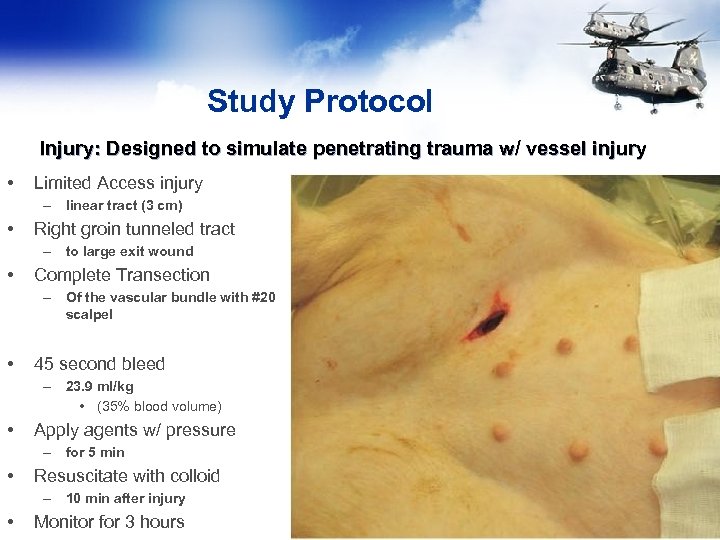 Study Protocol Injury: Designed to simulate penetrating trauma w/ vessel injury • Limited Access injury – linear tract (3 cm) • Right groin tunneled tract – to large exit wound • Complete Transection – Of the vascular bundle with #20 scalpel • 45 second bleed – 23. 9 ml/kg • (35% blood volume) • Apply agents w/ pressure – for 5 min • Resuscitate with colloid – 10 min after injury • Monitor for 3 hours
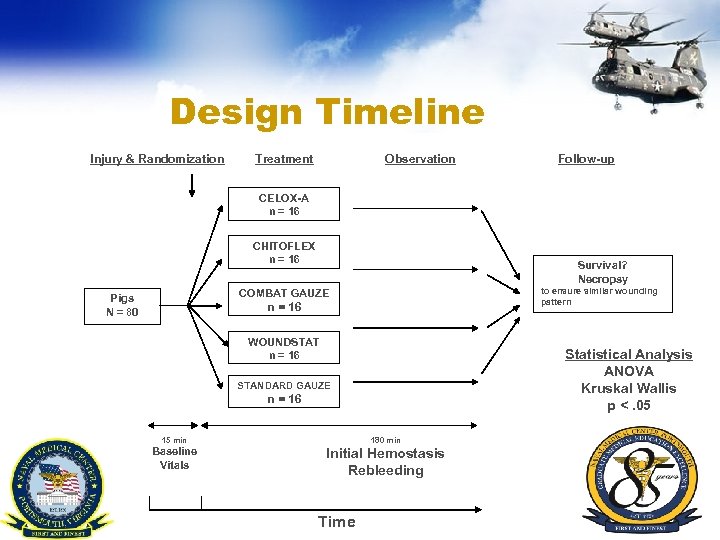 Design Timeline Injury & Randomization Observation Treatment Follow-up CELOX-A n = 16 CHITOFLEX n = 16 Survival? Necropsy to ensure similar wounding pattern COMBAT GAUZE Pigs N = 80 n = 16 WOUNDSTAT n = 16 Statistical Analysis ANOVA Kruskal Wallis p <. 05 STANDARD GAUZE n = 16 15 min 180 min Baseline Vitals Initial Hemostasis Rebleeding Time
 Mean Arterial Pressure
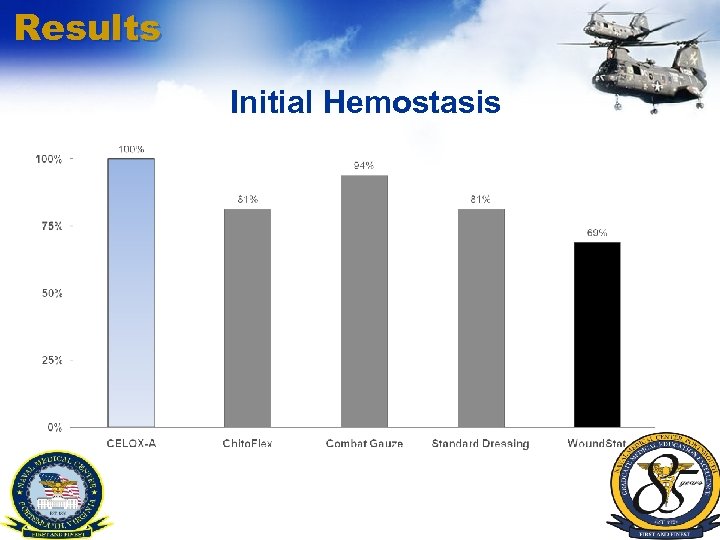 Results Initial Hemostasis
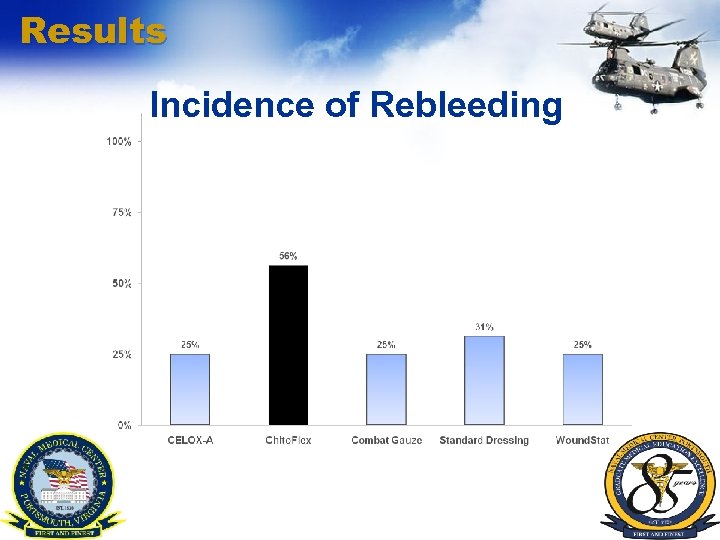 Results Incidence of Rebleeding
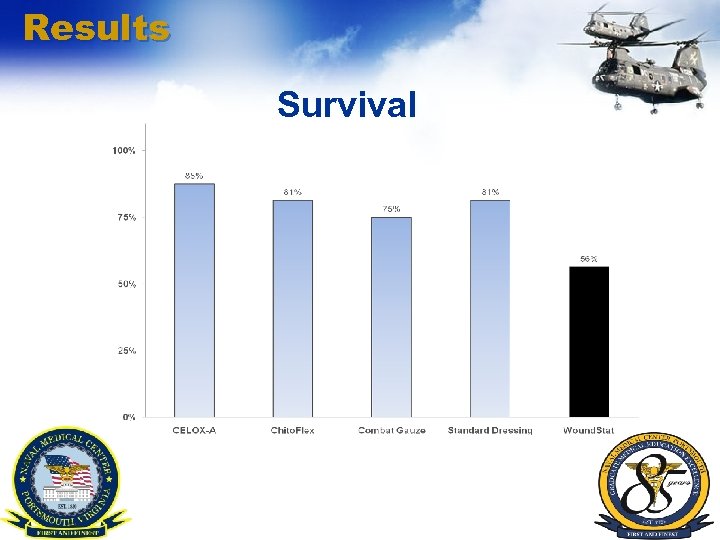 Results Survival
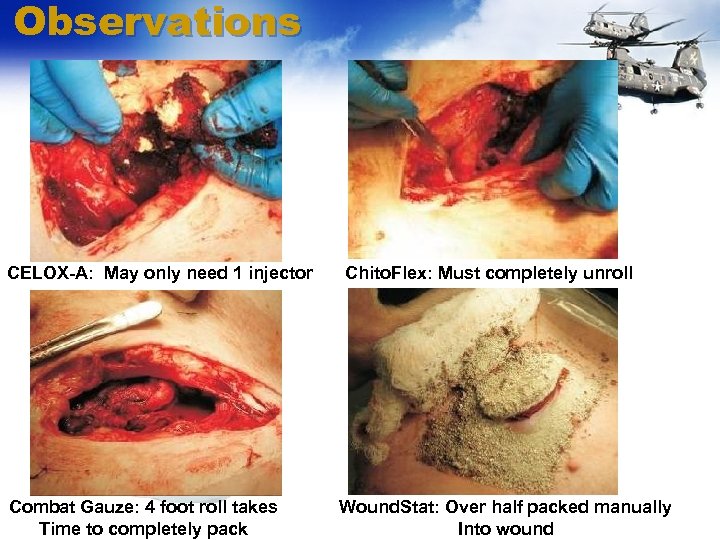 Observations CELOX-A: May only need 1 injector Combat Gauze: 4 foot roll takes Time to completely pack Chito. Flex: Must completely unroll Wound. Stat: Over half packed manually Into wound
 Practical Implications • CELOX-A – best alternative where initial hemostasis is crucial: • Far forward Combat Environment • Remote locations (Wilderness, Rural) • Mass Casualty (little time to spend per patient) • Gauze products – reasonable when: • Evacuation times short (most civilian EMS systems) • Single patient (more time to spend on basic wound care)
 • CELOX-A Conclusions – Ý initial hemostasis over other agents • except Combat. Gauze • Chitoflex – Ý incidence of rebleeding • Wound. Stat – Ý mortality • Standard dressing worked reasonably well – no significant increase in mortality.
 Comparison of Four Hemostatic Agents in Control of Extremity Hemorrhage in a Model of Penetrating Trauma Lanny F. Littlejohn, MD LCDR MC USN Assistant Investigators: Sara Kircher, BS Michael Melia, MD Veterinarian: Statistical Analysis: John Devlin, MD Robert Lueken, MD Andrew Johnson, MD Len Murray, DVM Gregory J Zarow, Ph. D