


 Скачать презентацию Comparing Two Thesaurus Representations for Russian Natalia Loukachevitch
3deeaf4cac43215b54ce85e8aebb98a9.ppt
- Количество слайдов: 25
 Comparing Two Thesaurus Representations for Russian Natalia Loukachevitch, German Lashevich, Boris Dobrov Lomonosov Moscow State University louk_nat@mail. ru
 Russian Thesauri for NLP • More than four attempts to create Russian wordnet • Existing large Ru. Thes thesaurus, which can be used for NLP – Another structure but most techniques developed for Word. Net can be applied – But people want to have a wordnet for their own language • This talk: – semi-automatic conversion of data from thesaurus Ru. Thes into Word. Net-like structure-> Ru. Word. Net – Conversion process allows better understanding the differences between resources
 Outline • Wordnets for Russian • Thesaurus of the Russian language Ru. Thes – Differences from Word. Net • Generation of the Ru. Word. Net basic structure • Additional relationships in Ru. Word. Net
 Projects of Russian Wordnets • Automatically-generated – Balkova et al. , 2008 • State of the project is unknown – http: //wordnet. ru/ (Gelfenbeyn et al. , 2003) • direct translation without any manual revision • Developed from scratch – Russ. Net (Azarowa, 2008) – YARN – Yet Another Russ. Net (2012) • • Crowdsourcing, use of Wiktionary https: //russianword. net/ Many naïve decisions Only synsets without relations – Новый проект Russ. Net+YARN (2016)
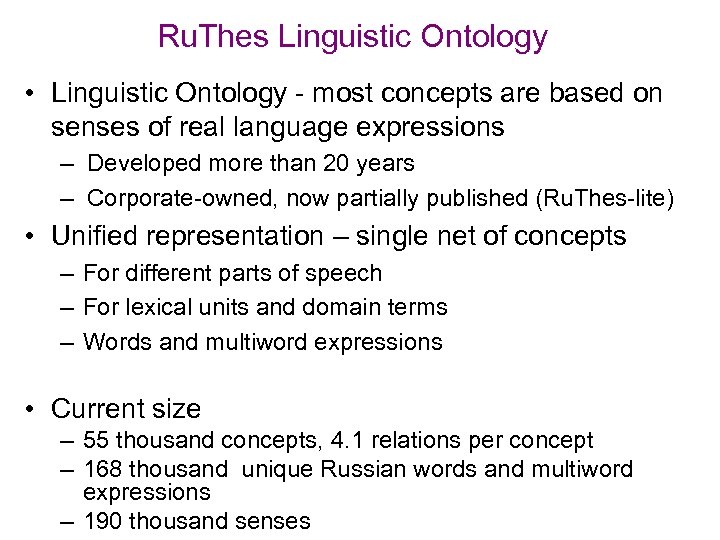 Ru. Thes Linguistic Ontology • Linguistic Ontology - most concepts are based on senses of real language expressions – Developed more than 20 years – Corporate-owned, now partially published (Ru. Thes-lite) • Unified representation – single net of concepts – For different parts of speech – For lexical units and domain terms – Words and multiword expressions • Current size – 55 thousand concepts, 4. 1 relations per concept – 168 thousand unique Russian words and multiword expressions – 190 thousand senses
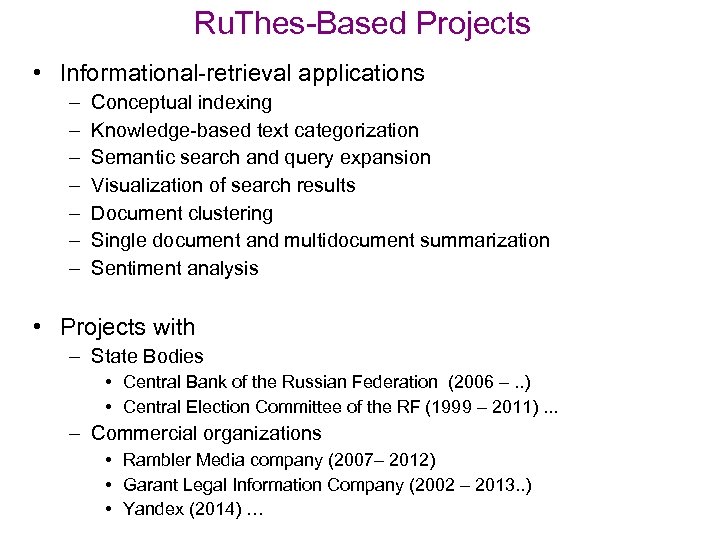 Ru. Thes-Based Projects • Informational-retrieval applications – – – – Conceptual indexing Knowledge-based text categorization Semantic search and query expansion Visualization of search results Document clustering Single document and multidocument summarization Sentiment analysis • Projects with – State Bodies • Central Bank of the Russian Federation (2006 –. . ) • Central Election Committee of the RF (1999 – 2011). . . – Commercial organizations • Rambler Media company (2007– 2012) • Garant Legal Information Company (2002 – 2013. . ) • Yandex (2014) …
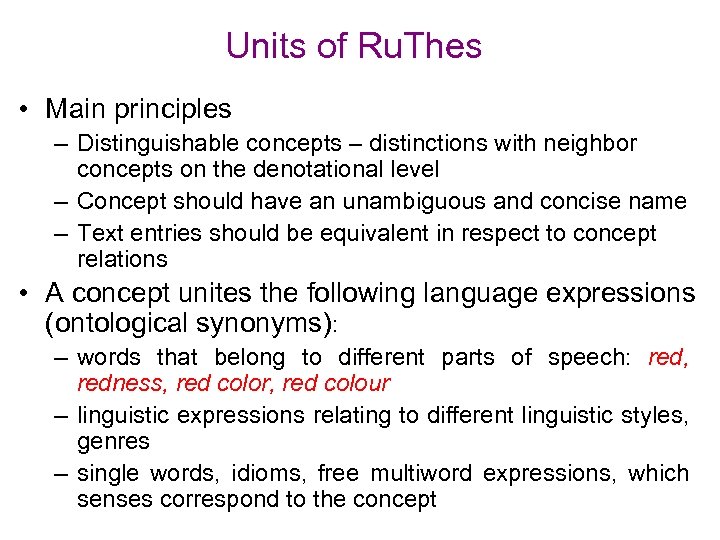 Units of Ru. Thes • Main principles – Distinguishable concepts – distinctions with neighbor concepts on the denotational level – Concept should have an unambiguous and concise name – Text entries should be equivalent in respect to concept relations • A concept unites the following language expressions (ontological synonyms): – words that belong to different parts of speech: red, redness, red color, red colour – linguistic expressions relating to different linguistic styles, genres – single words, idioms, free multiword expressions, which senses correspond to the concept
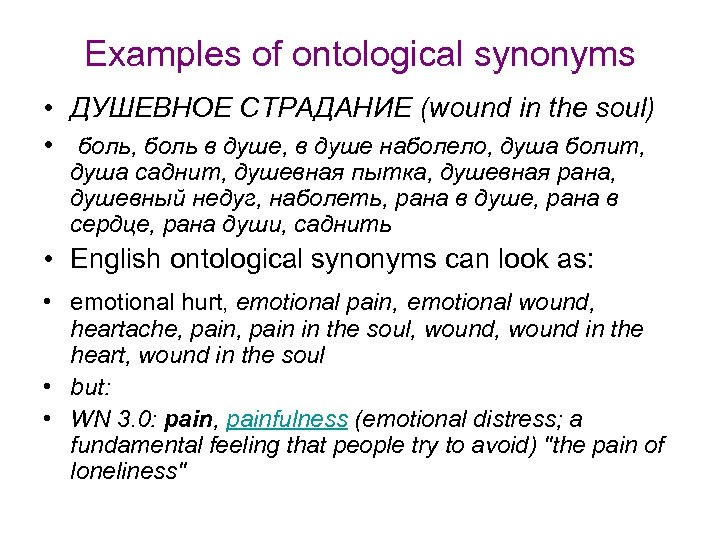 Examples of ontological synonyms • ДУШЕВНОЕ СТРАДАНИЕ (wound in the soul) • боль, боль в душе, в душе наболело, душа болит, душа саднит, душевная пытка, душевная рана, душевный недуг, наболеть, рана в душе, рана в сердце, рана души, саднить • English ontological synonyms can look as: • emotional hurt, emotional pain, emotional wound, heartache, pain in the soul, wound in the heart, wound in the soul • but: • WN 3. 0: pain, painfulness (emotional distress; a fundamental feeling that people try to avoid) "the pain of loneliness"
 Ru. Thes Conceptual Relations • Small set of relations: motivated by informationretrieval thesauri and formal ontologies – Class – subclass • Transitivity, inheritance – Part-whole • Transitivity of part-whole relations – External ontological dependence (Gangemi et al. , 2001; Guarino, 2009) • Existence of Car plant depends on existence of car • Main principle for establishing relations – reliable relations – Concepts of lower levels of the hierarchy should be rigidly related to upper concepts
 Part-Whole Relations in Ru. Thes • Parts described in Ru. Thes should be “attached” to their wholes – Existential or generic dependence of part from whole (Gangemi et al. , 2001 Guizzardi, 2011) • Inseparable parts, Mandatory wholes – Different semantic types • Physical entities, elements, processes • Roles in processes (investor – investing) • Processes in spheres of activities • Properties of entities • Such a part-whole relation is close to Guarino internal relations (Guarino, 2009) – Property of transitivity of part-whole is supposed
 External dependence • External dependence relation concept C 2 from concept C 1 (asc 1 (C 2, C 1)) can be established if: – neither taxonomic nor part-whole relations can be established between C 1 and C 2 in Ru. Thes linguistic ontology, – the following assertion is true: C 2 exists means C 1 exists – Relations asc 1 are inherited on subclasses and parts • Examples: – – asc 1 (automative industry, car (vehicle)) asc 1 (forest, tree) asc 1(forest fire, forest) asc 1(forestry, forest)
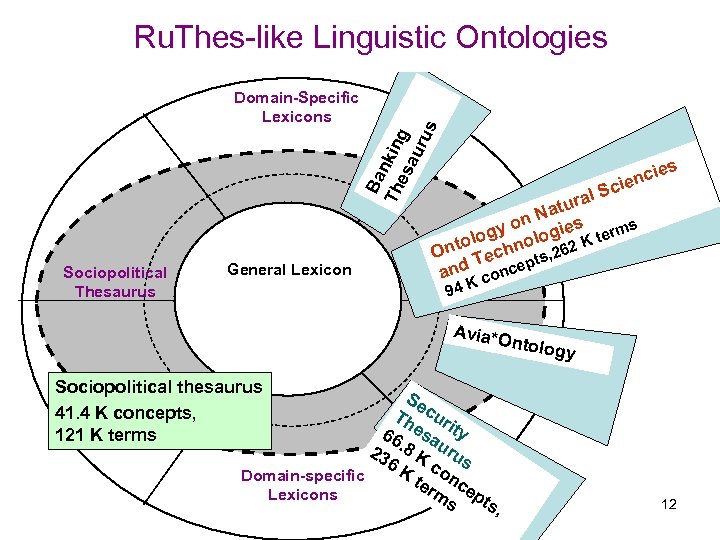 Domain-Specific Lexicons Sociopolitical Thesaurus General Lexicon Ba Th nkin es g au rus Ru. Thes-like Linguistic Ontologies s ie ienc c al S r atu N y on ogies terms g tolo hnol 262 K On Tec ts, nd concep a 94 K Avia*O n tology Sociopolitical thesaurus 41. 4 K concepts, 121 K terms Se Th cur 66 esa ity 23. 8 K uru 6 K co s Domain-specific ter nce ms pt Lexicons s, 12
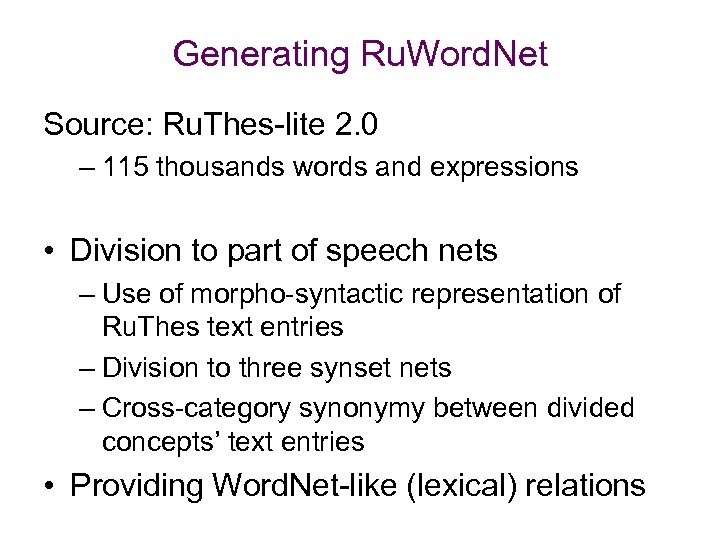 Generating Ru. Word. Net Source: Ru. Thes-lite 2. 0 – 115 thousands words and expressions • Division to part of speech nets – Use of morpho-syntactic representation of Ru. Thes text entries – Division to three synset nets – Cross-category synonymy between divided concepts’ text entries • Providing Word. Net-like (lexical) relations
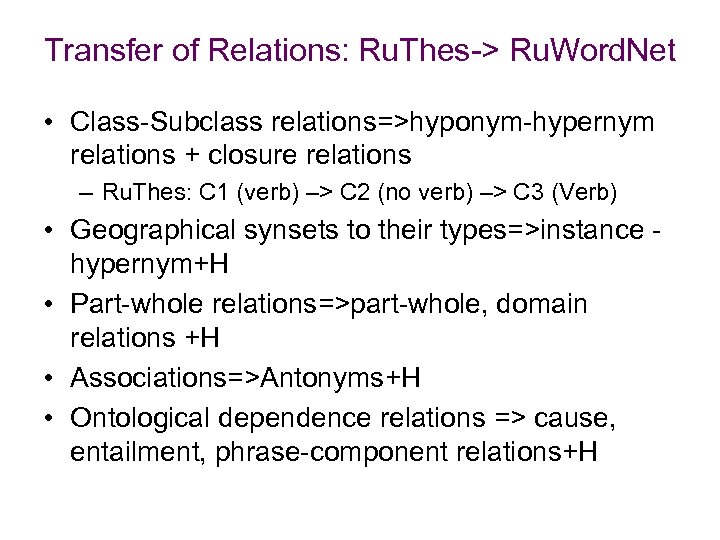 Transfer of Relations: Ru. Thes-> Ru. Word. Net • Class-Subclass relations=>hyponym-hypernym relations + closure relations – Ru. Thes: C 1 (verb) –> C 2 (no verb) –> C 3 (Verb) • Geographical synsets to their types=>instance hypernym+H • Part-whole relations=>part-whole, domain relations +H • Associations=>Antonyms+H • Ontological dependence relations => cause, entailment, phrase-component relations+H
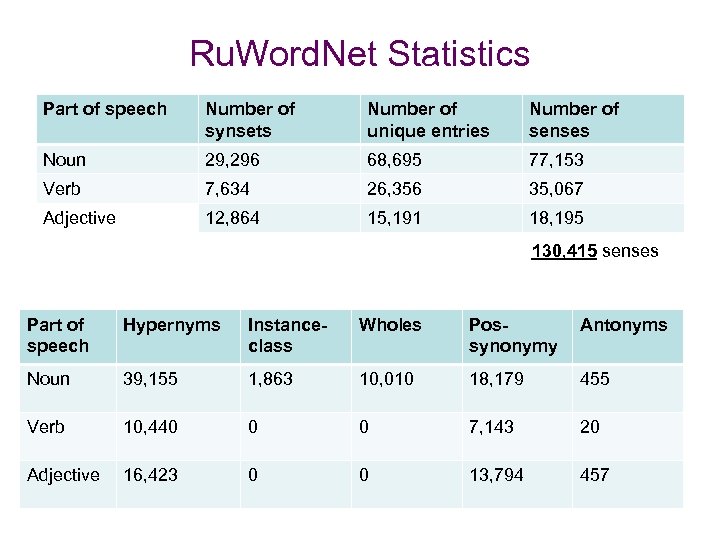 Ru. Word. Net Statistics Part of speech Number of synsets Number of unique entries Number of senses Noun 29, 296 68, 695 77, 153 Verb 7, 634 26, 356 35, 067 Adjective 12, 864 15, 191 18, 195 130, 415 senses Part of speech Hypernyms Instanceclass Wholes Possynonymy Antonyms Noun 39, 155 1, 863 10, 010 18, 179 455 Verb 10, 440 0 0 7, 143 20 Adjective 16, 423 0 0 13, 794 457
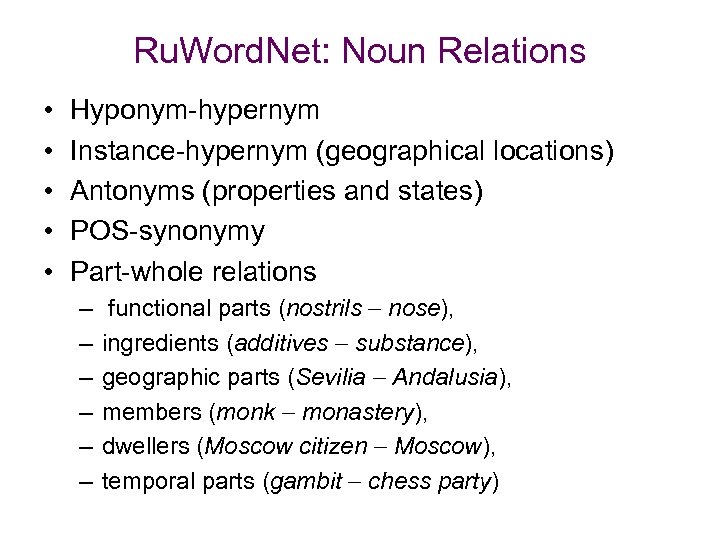 Ru. Word. Net: Noun Relations • • • Hyponym-hypernym Instance-hypernym (geographical locations) Antonyms (properties and states) POS-synonymy Part-whole relations – – – functional parts (nostrils nose), ingredients (additives substance), geographic parts (Sevilia Andalusia), members (monk monastery), dwellers (Moscow citizen Moscow), temporal parts (gambit chess party)
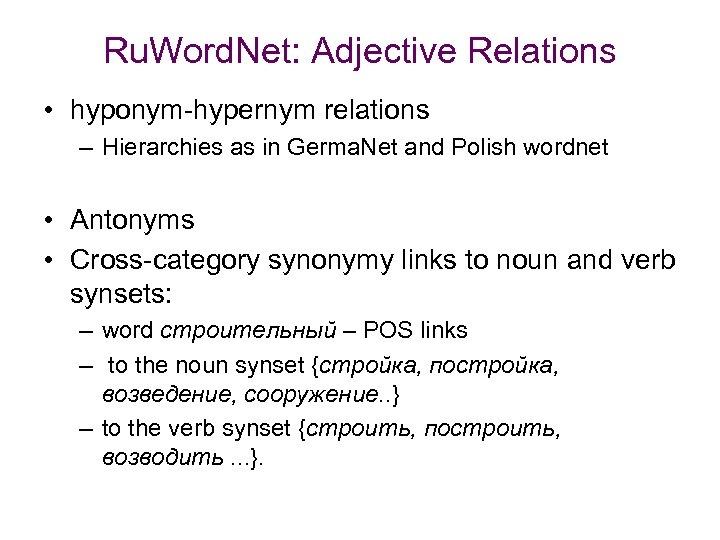 Ru. Word. Net: Adjective Relations • hyponym-hypernym relations – Hierarchies as in Germa. Net and Polish wordnet • Antonyms • Cross-category synonymy links to noun and verb synsets: – word строительный – POS links – to the noun synset {стройка, постройка, возведение, сооружение. . } – to the verb synset {строить, построить, возводить. . . }.
 Enrichment of Relation Set in Ru. Word. Net • • Cause and entailment relations Domain relations Phrase and its component relations Derivational relations
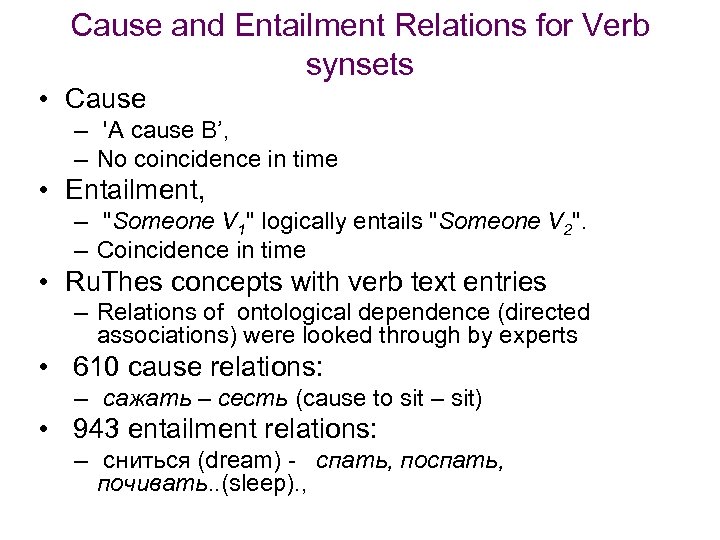 Cause and Entailment Relations for Verb synsets • Cause – 'A cause B’, – No coincidence in time • Entailment, – "Someone V 1" logically entails "Someone V 2". – Coincidence in time • Ru. Thes concepts with verb text entries – Relations of ontological dependence (directed associations) were looked through by experts • 610 cause relations: – сажать – сесть (cause to sit – sit) • 943 entailment relations: – сниться (dream) - спать, почивать. . (sleep). ,
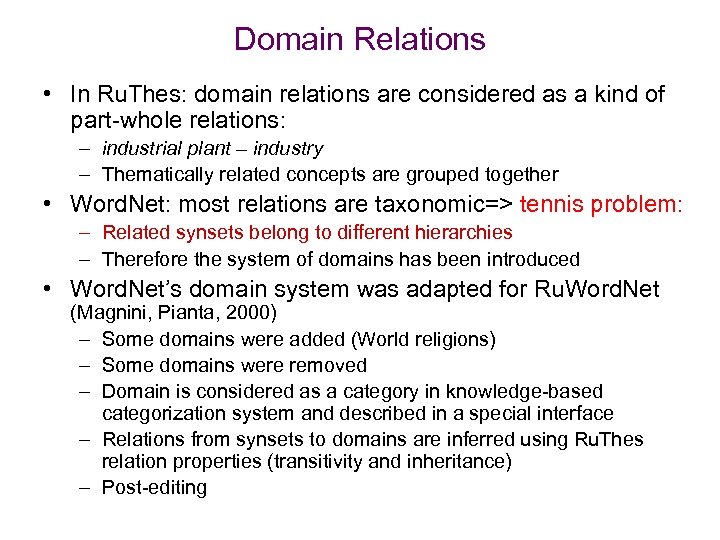 Domain Relations • In Ru. Thes: domain relations are considered as a kind of part-whole relations: – industrial plant – industry – Thematically related concepts are grouped together • Word. Net: most relations are taxonomic=> tennis problem: – Related synsets belong to different hierarchies – Therefore the system of domains has been introduced • Word. Net’s domain system was adapted for Ru. Word. Net (Magnini, Pianta, 2000) – Some domains were added (World religions) – Some domains were removed – Domain is considered as a category in knowledge-based categorization system and described in a special interface – Relations from synsets to domains are inferred using Ru. Thes relation properties (transitivity and inheritance) – Post-editing
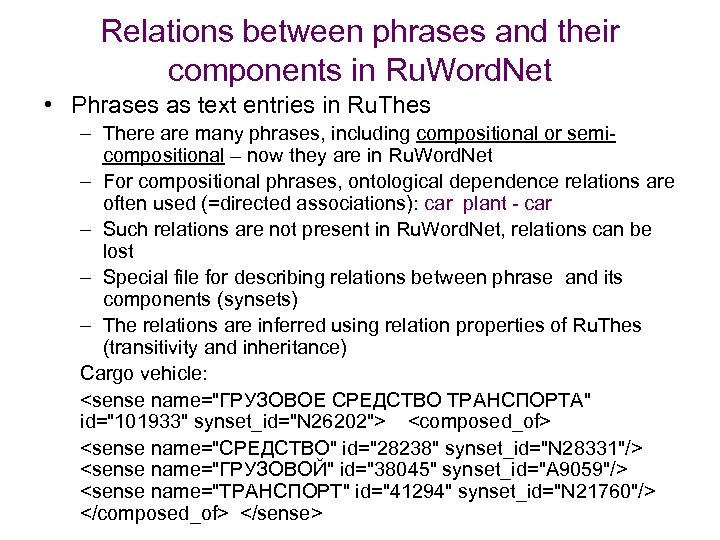 Relations between phrases and their components in Ru. Word. Net • Phrases as text entries in Ru. Thes – There are many phrases, including compositional or semicompositional – now they are in Ru. Word. Net – For compositional phrases, ontological dependence relations are often used (=directed associations): car plant - car – Such relations are not present in Ru. Word. Net, relations can be lost – Special file for describing relations between phrase and its components (synsets) – The relations are inferred using relation properties of Ru. Thes (transitivity and inheritance) Cargo vehicle:
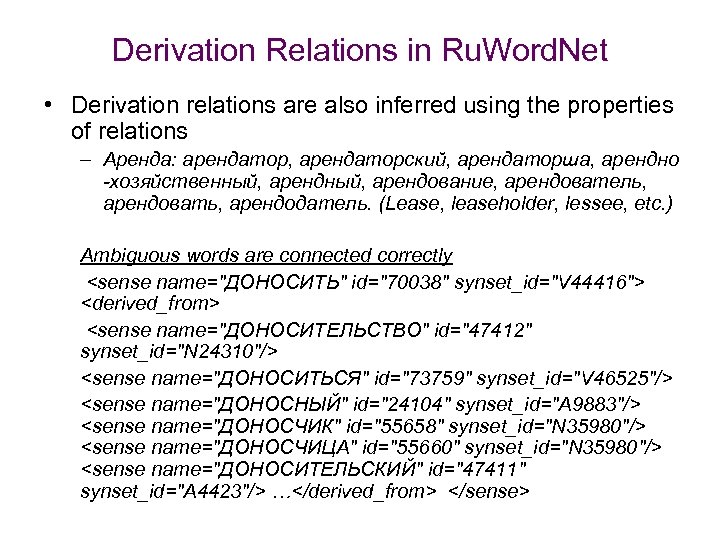 Derivation Relations in Ru. Word. Net • Derivation relations are also inferred using the properties of relations – Аренда: арендатор, арендаторский, арендаторша, арендно -хозяйственный, арендование, арендователь, арендовать, арендодатель. (Lease, leaseholder, lessee, etc. ) Ambiguous words are connected correctly
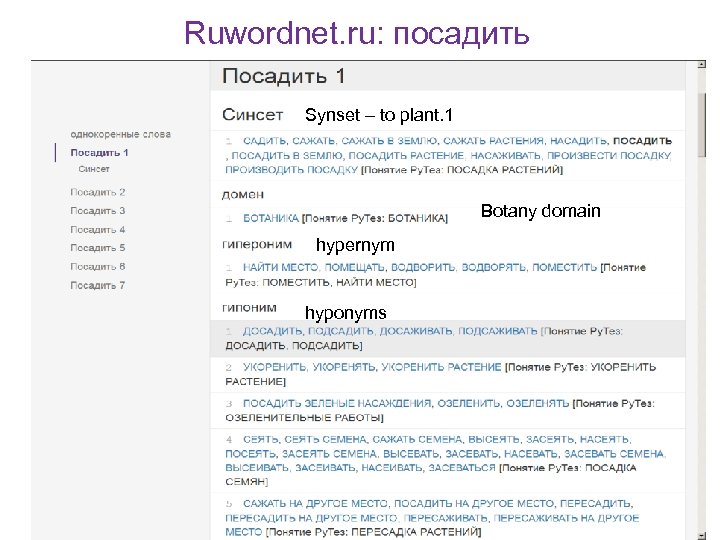 Ruwordnet. ru: посадить Synset – to plant. 1 Botany domain hypernym hyponyms
 Accessibility of Ru. Thes and Ru. Word. Net • Ru. Thes web-site • http: //www. labinform. ru/pub/ruthes/index. htm • Ru. Word. Net web-sites – http: //www. labinform. ru/pub/ruwordnet/index. htm – ruwordnet. ru • Xml-files can be obtained non-commercial use: louk_nat@mail. ru
 Conclusion • We have described the semi-automatic process of transforming the Russian language thesaurus Ru. Thes (in version, Ru. Thes-lite 2. 0) to Word. Net-like thesaurus, called Ru. Word. Net (130 thousand senses) • In this procedure we attempted to achieve two main characteristic features of wordnet-like resources: – division of data into part-of-speech-oriented structures with crossreferences between them – providing a set of relations similar to wordnet-like relations • Both thesauri, Ru. Thes-lite 2. 0 and Ru. Word. Net, are currently published – Researchers can obtain both types of thesauri, compare them in applications – We would like to develop both resources because the relations are different and can be useful in different applications –