


 Скачать презентацию Comparing Systems Using Sample Data Andy Wang CIS
94bd2c0ac003fec88b6a2724265a841f.ppt
- Количество слайдов: 34
 Comparing Systems Using Sample Data Andy Wang CIS 5930 -03 Computer Systems Performance Analysis
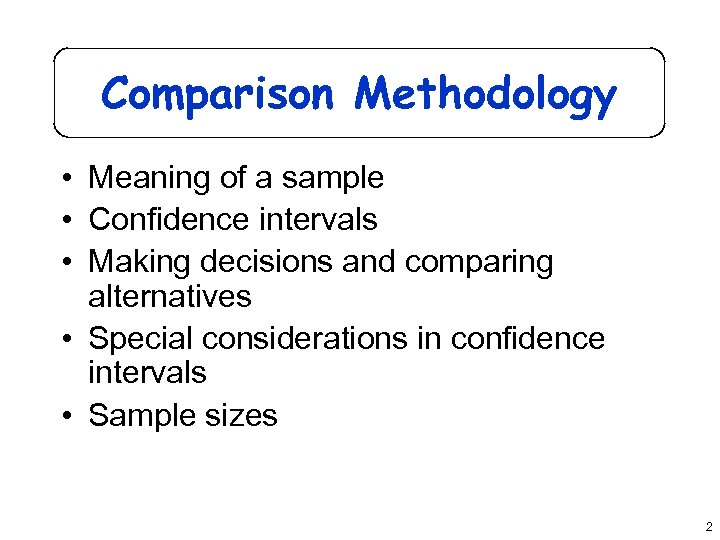 Comparison Methodology • Meaning of a sample • Confidence intervals • Making decisions and comparing alternatives • Special considerations in confidence intervals • Sample sizes 2
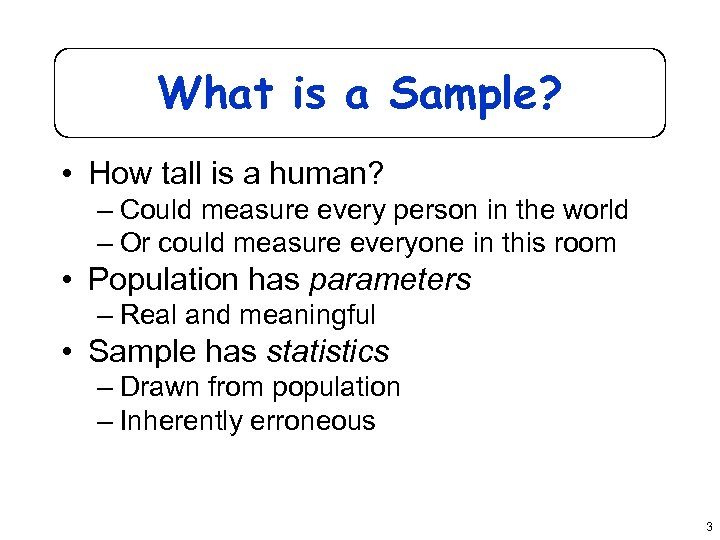 What is a Sample? • How tall is a human? – Could measure every person in the world – Or could measure everyone in this room • Population has parameters – Real and meaningful • Sample has statistics – Drawn from population – Inherently erroneous 3
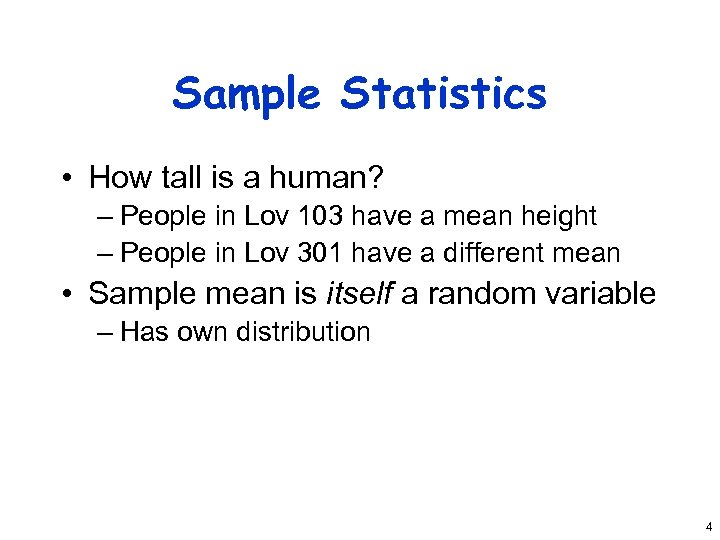 Sample Statistics • How tall is a human? – People in Lov 103 have a mean height – People in Lov 301 have a different mean • Sample mean is itself a random variable – Has own distribution 4
 Estimating Population from Samples • How tall is a human? – Measure everybody in this room – Calculate sample mean – Assume population mean equals • What is the error in our estimate? 5
 Estimating Error • Sample mean is a random variable Þ Mean has some distribution Multiple sample means have “mean of means” • Knowing distribution of means, we can estimate error 6
 Estimating the Value of a Random Variable • How tall is Fred? • Suppose average human height is 170 cm Fred is 170 cm tall – Yeah, right • Safer to assume a range 7
 Confidence Intervals • How tall is Fred? – Suppose 90% of humans are between 155 and 190 cm Fred is between 155 and 190 cm • We are 90% confident that Fred is between 155 and 190 cm 8
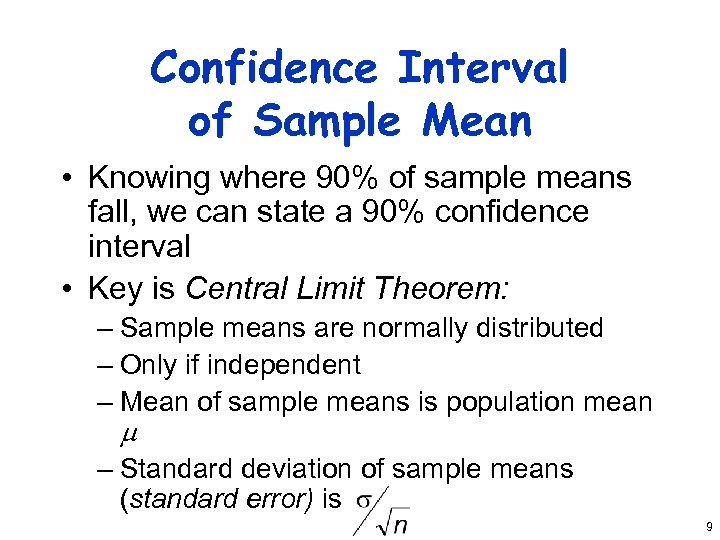 Confidence Interval of Sample Mean • Knowing where 90% of sample means fall, we can state a 90% confidence interval • Key is Central Limit Theorem: – Sample means are normally distributed – Only if independent – Mean of sample means is population mean – Standard deviation of sample means (standard error) is 9
 Estimating Confidence Intervals • Two formulas for confidence intervals – Over 30 samples from any distribution: zdistribution – Small sample from normally distributed population: t-distribution • Common error: using t-distribution for non-normal population – Central Limit Theorem often saves us 10
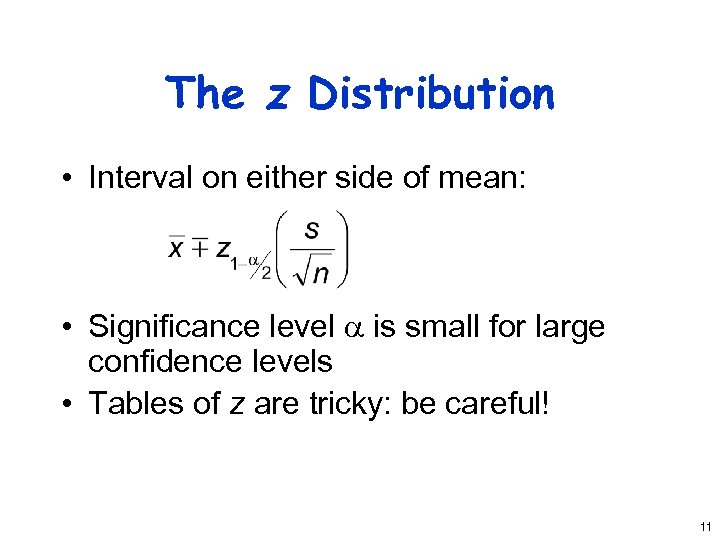 The z Distribution • Interval on either side of mean: • Significance level is small for large confidence levels • Tables of z are tricky: be careful! 11
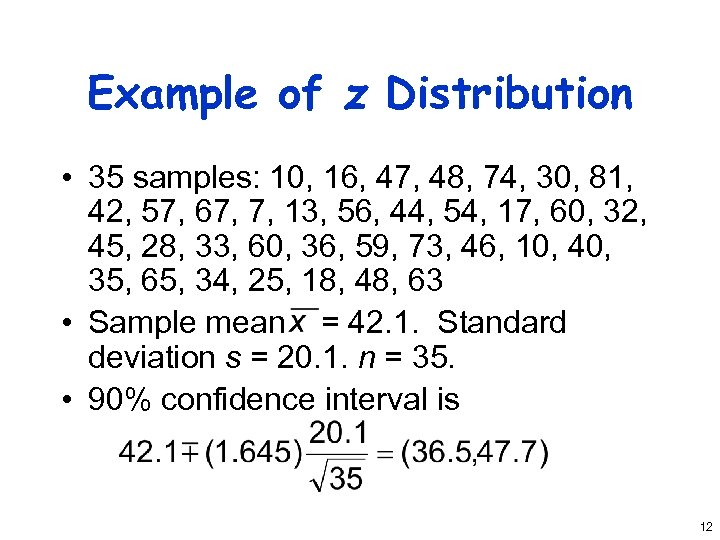 Example of z Distribution • 35 samples: 10, 16, 47, 48, 74, 30, 81, 42, 57, 67, 7, 13, 56, 44, 54, 17, 60, 32, 45, 28, 33, 60, 36, 59, 73, 46, 10, 40, 35, 65, 34, 25, 18, 48, 63 • Sample mean = 42. 1. Standard deviation s = 20. 1. n = 35. • 90% confidence interval is 12
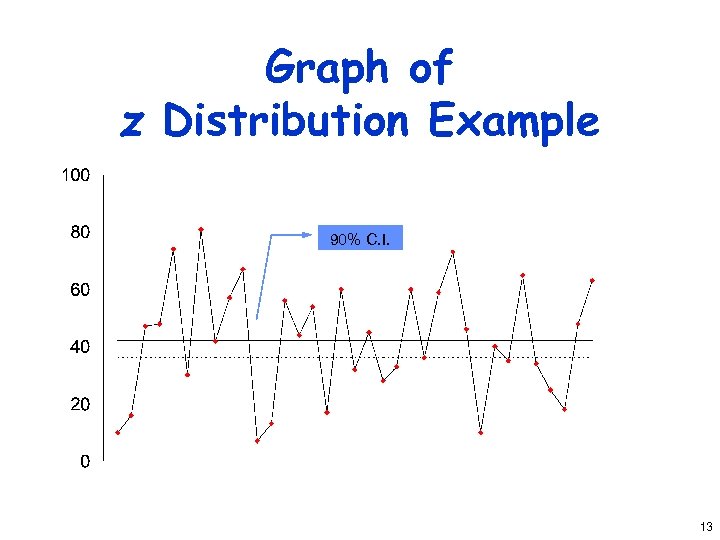 Graph of z Distribution Example 90% C. I. 13
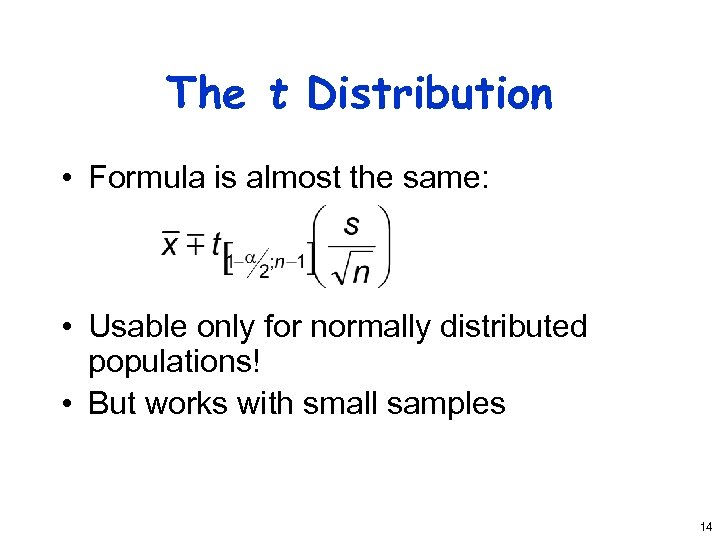 The t Distribution • Formula is almost the same: • Usable only for normally distributed populations! • But works with small samples 14
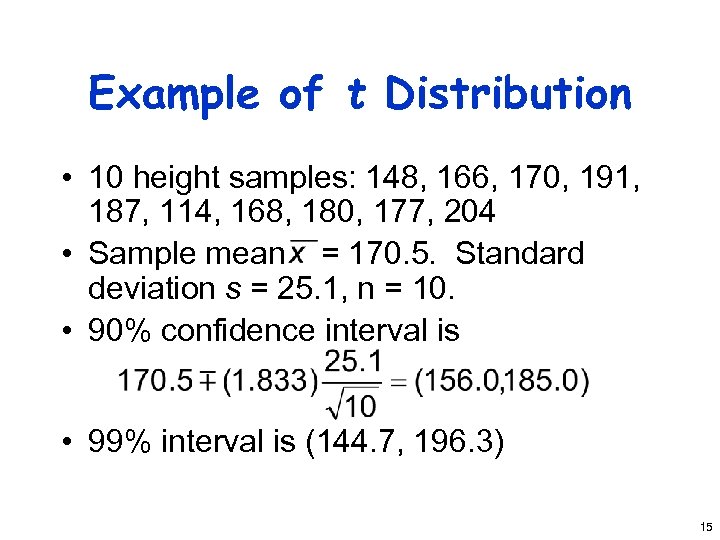 Example of t Distribution • 10 height samples: 148, 166, 170, 191, 187, 114, 168, 180, 177, 204 • Sample mean = 170. 5. Standard deviation s = 25. 1, n = 10. • 90% confidence interval is • 99% interval is (144. 7, 196. 3) 15
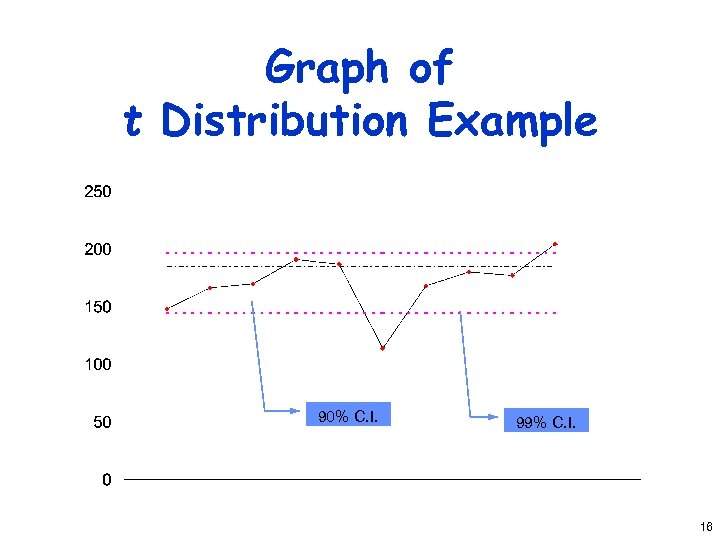 Graph of t Distribution Example 90% C. I. 99% C. I. 16
 Getting More Confidence • Asking for a higher confidence level widens the confidence interval – Counterintuitive? • How tall is Fred? – 90% sure he’s between 155 and 190 cm – We want to be 99% sure we’re right – So we need more room: 99% sure he’s between 145 and 200 cm 17
 Making Decisions • Why do we use confidence intervals? – Summarizes error in sample mean – Gives way to decide if measurement is meaningful – Allows comparisons in face of error • But remember: at 90% confidence, 10% of sample C. I. s do not include population mean 18
 Testing for Zero Mean • Is population mean significantly 0? • If confidence interval includes 0, answer is no • Can test for any value (mean of sums is sum of means) • Our height samples are consistent with average height of 170 cm – Also consistent with 160 and 180! 19
 Comparing Alternatives • Often need to find better system – Choose fastest computer to buy – Prove our algorithm runs faster • Different methods for paired/unpaired observations – Paired if ith test on each system was same – Unpaired otherwise 20
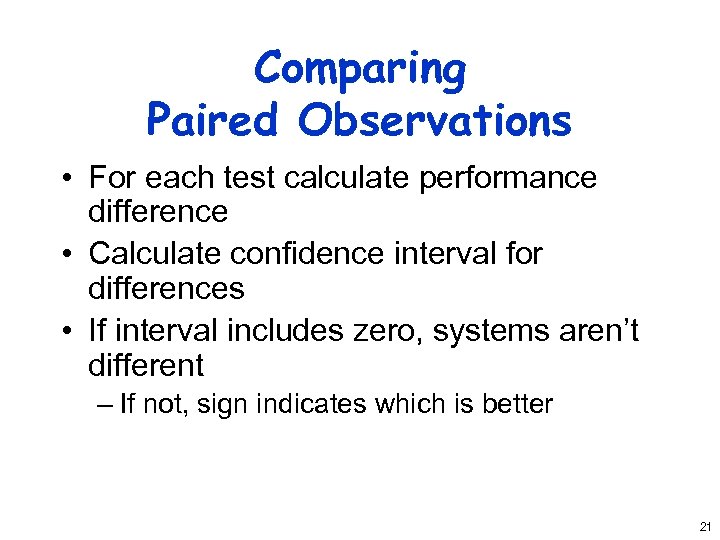 Comparing Paired Observations • For each test calculate performance difference • Calculate confidence interval for differences • If interval includes zero, systems aren’t different – If not, sign indicates which is better 21
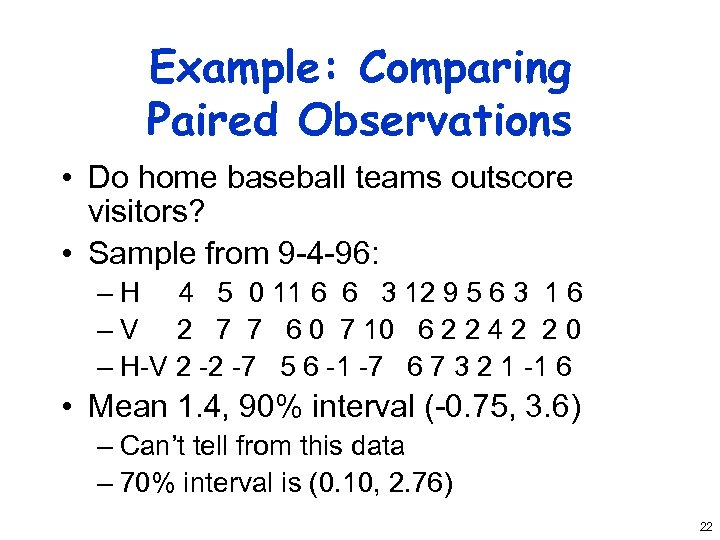 Example: Comparing Paired Observations • Do home baseball teams outscore visitors? • Sample from 9 -4 -96: – H 4 5 0 11 6 6 3 12 9 5 6 3 1 6 – V 2 7 7 6 0 7 10 6 2 2 4 2 2 0 – H-V 2 -2 -7 5 6 -1 -7 6 7 3 2 1 -1 6 • Mean 1. 4, 90% interval (-0. 75, 3. 6) – Can’t tell from this data – 70% interval is (0. 10, 2. 76) 22
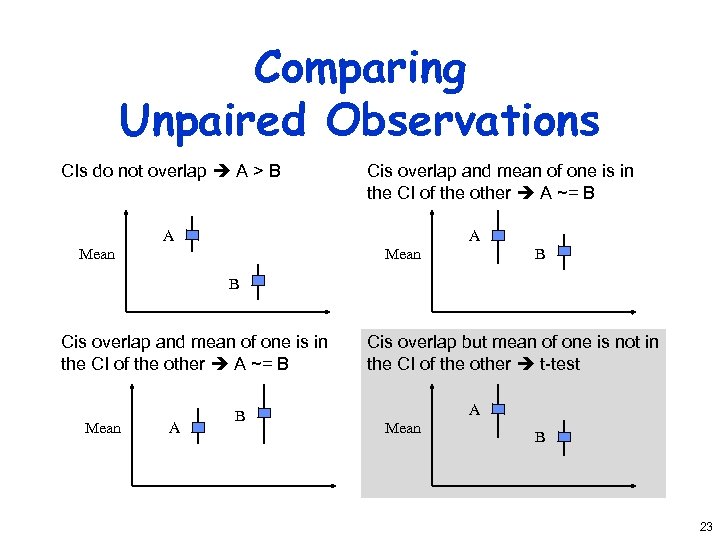 Comparing Unpaired Observations CIs do not overlap A > B Cis overlap and mean of one is in the CI of the other A ~= B A A Mean B Cis overlap and mean of one is in the CI of the other A ~= B Mean A B Cis overlap but mean of one is not in the CI of the other t-test A Mean B 23
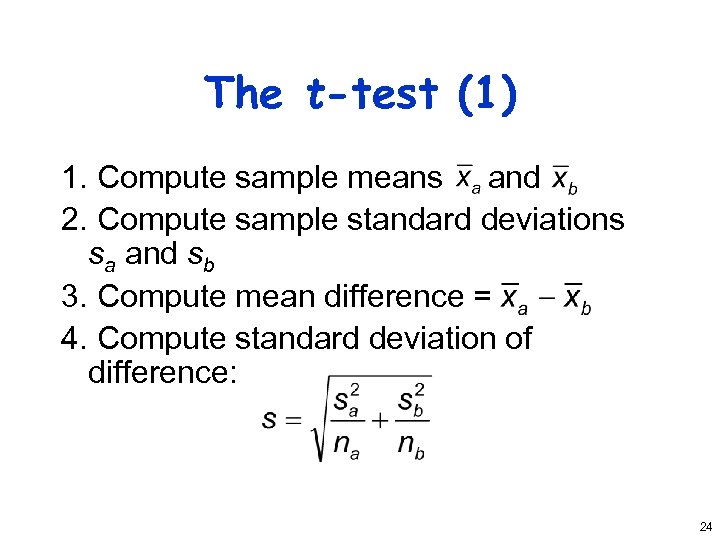 The t-test (1) 1. Compute sample means and 2. Compute sample standard deviations sa and sb 3. Compute mean difference = 4. Compute standard deviation of difference: 24
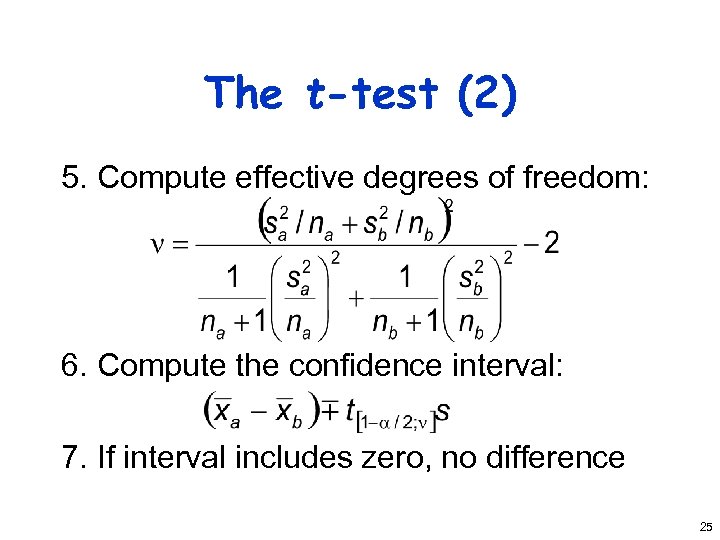 The t-test (2) 5. Compute effective degrees of freedom: 6. Compute the confidence interval: 7. If interval includes zero, no difference 25
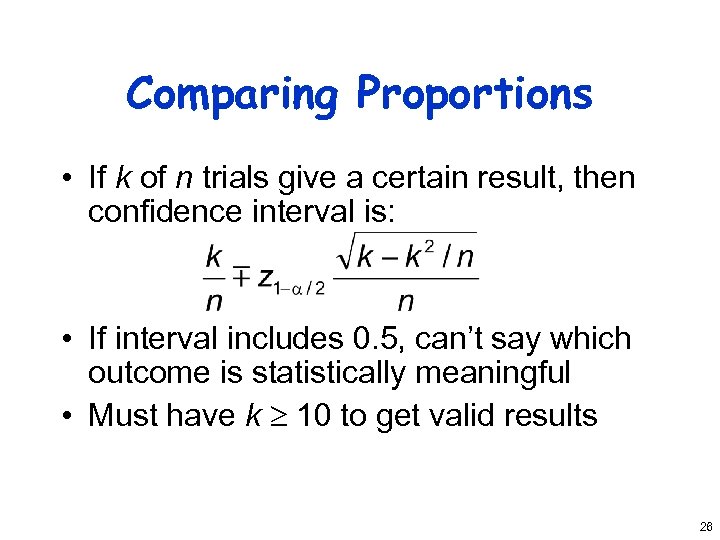 Comparing Proportions • If k of n trials give a certain result, then confidence interval is: • If interval includes 0. 5, can’t say which outcome is statistically meaningful • Must have k 10 to get valid results 26
 Special Considerations • Selecting a confidence level • Hypothesis testing • One-sided confidence intervals 27
 Selecting a Confidence Level • Depends on cost of being wrong • 90%, 95% are common values for scientific papers • Generally, use highest value that lets you make a firm statement – But it’s better to be consistent throughout a given paper 28
 Hypothesis Testing • The null hypothesis (H 0) is common in statistics – Confusing due to double negative – Gives less information than confidence interval – Often harder to compute • Should understand that rejecting null hypothesis implies result is meaningful 29
 One-Sided Confidence Intervals • Two-sided intervals test for mean being outside a certain range (see “error bands” in previous graphs) • One-sided tests useful if only interested in one limit • Use z 1 - or t 1 - ; n instead of z 1 - /2 or t 1 - /2; n in formulas 30
 Sample Sizes • Bigger sample sizes give narrower intervals – Smaller values of t, as n increases – in formulas • But sample collection is often expensive – What is minimum we can get away with? 31
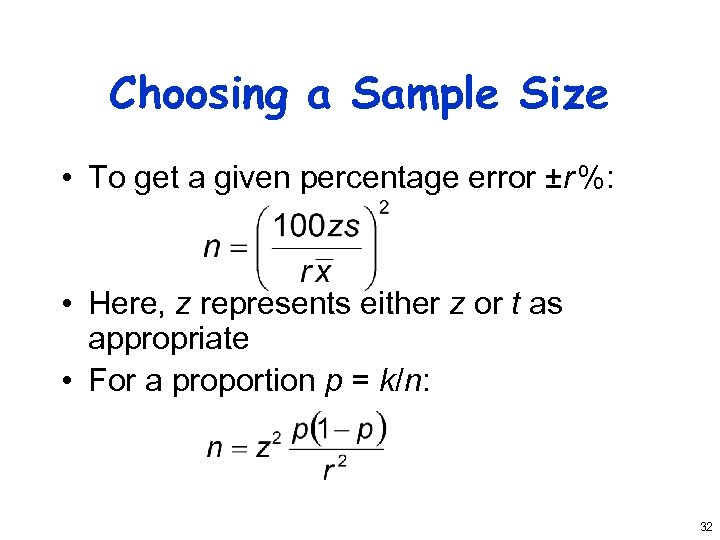 Choosing a Sample Size • To get a given percentage error ±r %: • Here, z represents either z or t as appropriate • For a proportion p = k/n: 32
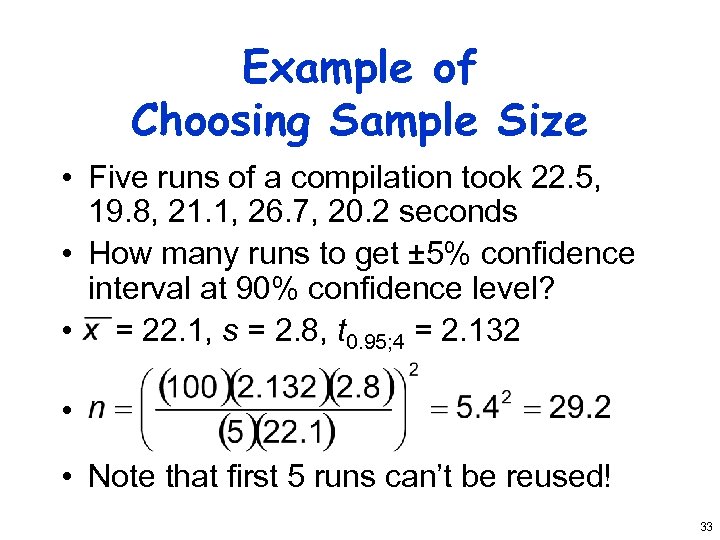 Example of Choosing Sample Size • Five runs of a compilation took 22. 5, 19. 8, 21. 1, 26. 7, 20. 2 seconds • How many runs to get ± 5% confidence interval at 90% confidence level? • = 22. 1, s = 2. 8, t 0. 95; 4 = 2. 132 • • Note that first 5 runs can’t be reused! 33
 White Slide