


 Скачать презентацию Comparing local government performance regimes Steve Martin James
6f355fd3b6229d6fdd4eda8921ec3697.ppt
- Количество слайдов: 17
 Comparing local government performance regimes Steve Martin, James Downe, Clive Grace, Sandra Nutley Comparing for Improvement
 Context of the research Emphasis on public service improvement Investment in new performance frameworks designed to support/drive improvement Central role for whole organisation assessments Emergence of significant differences in local government frameworks in E, S and W Comparing for Improvement
 Why performance assessments? Market failure Democratic failure Administrative solutions: Take it in house Self actualisation/localism – improvement from within Contracts – SOAs, LAAs, IAs External checking and challenge Comparing for Improvement
 Inspection for assurance Public assurance Selected services Minimum standards defined by professional bodies and networks Retrospective Inspectors with expertise in inspected services Inform policy and practice Comparing for Improvement
 Inspection for improvement Continuous improvement (improvement journeys) Comprehensive - whole organisation Capacity (not outcomes) Prospective performance Generalist inspectors Trigger support and intervention Comparing for Improvement
 Risk regulatory regimes Systems of interconnecting institutions and instruments that steer performance through information gathering, standard setting and behaviour modification Whole organisation assessments within wider local government performance improvement framework which in turn is linked to wider strategy for public services reform Comparing for Improvement
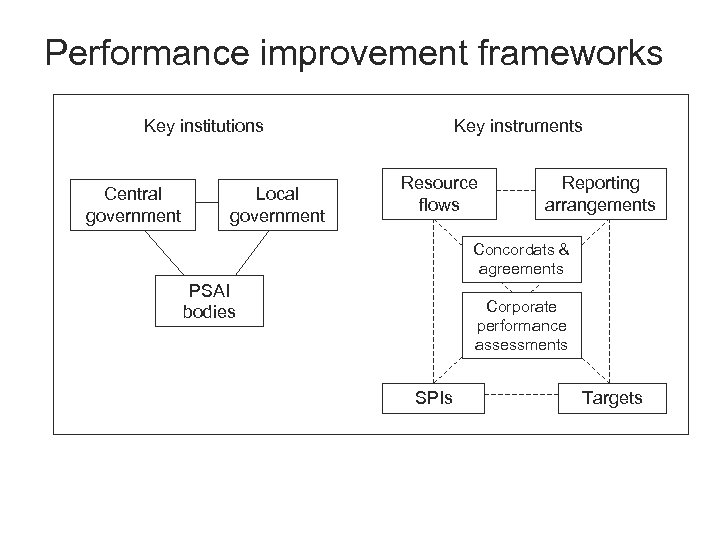 Performance improvement frameworks Key institutions Central government Local government Key instruments Resource flows Reporting arrangements Concordats & agreements PSAI bodies Corporate performance assessments SPIs Comparing for Improvement Targets
 BVA - winning without scoring? Introduced in 2003 – all councils audited once by 2009 Conducted by a specialist team within Audit Scotland Selective and tailored audit in response to selfevaluation and other information Focused on corporate arrangements Published report but no scores or league tables Sanctions for poor performance and limited support for improvement from Improvement Service BV II – area focused, linked to outcome agreements Comparing for Improvement
 CPA - the harder edged test? Introduced in 2002 - annual assessments for unitary and higher tier councils Auditor-led process, though element of self assessment Uniform, rules-based scoring system for measuring corporate and service performance Published report and league table of scores Strong sanctions for poor performance coupled with support from IDe. A and others CAA – 7 inspectorates; linked to LAAs Comparing for Improvement
 WPI - improving from within? Introduced in 2002 and annual since then Joint tailored process between WAO and councils, with high degree of self assessment Focused on corporate arrangements Confidentiality agreements between LAs and WAO No sanctions and limited support for poor performance; behaviour modification depends on internal accountability arrangements WLGA key role in brokering interventions LG measure public reporting and stronger powers of direction/intervention Comparing for Improvement
 Effectiveness Increasing confidence in WOAs in E and S All three regimes credited with significant improvements in corporate capacity esp. poorer authorities - ‘lifted the floor but not raised the roof’ CPA – greatest impact in early rounds, increasingly vulnerable to gaming WPI - dissatisfaction with lack of ‘hard’ evidence of improvement Concerns about clarity of method, consistency of judgements and lack of improvement guidance Calls for greater emphasis on service outcomes Comparing for Improvement
 Similarities Origins - duty of continuous improvement Theory of improvement – ‘serious and sustained service failure is also a failure of corporate leadership’ Focus on poor performance Organisational attributes (and service outcomes) Delivered by audit bodies Evolved in response to changing environment and learning – more proportionate, joined up, citizenfocused, area based approaches – CAA, Crerar, Wales review Comparing for Improvement
 Differences Standing of local government – rules based vs. self assessments Theories of change motivation - ‘naming and shame’ vs. learning from within Methods, frequency and perceived intensity Reporting Nature of local government performance framework and PSR strategies and links between these and WOAs Relationships to service inspections Comparing for Improvement
 Why the differences? Scale and policy communities Ideology – standing of local government Confidence of governments Policy awareness and avoidance - post-devolution opportunity to be different Cohesion of local government family Wider context of public service reform Individual actors Relational distance Comparing for Improvement
 Some policy implications External challenge Public reporting Incentives Rules based regimes allow comparisons between organisations and over time But customised approaches less susceptible to gaming Comparing for Improvement
 Some policy implications Scope for more policy learning Nature of the ‘risk’ unclear – vulnerable groups, poor performance, undetected poor performance, failure to improve? Theory of improvement - good capacity but poor outcomes and vice versa (Baby P, West Dunbartonshire) Assessment methodologies now being stretched by move to outcome focused, area based approaches Comparing for Improvement
 Comparing for Improvement: the development and impact of public services audit and inspection in UK local government For further information see: www. esrcsocietytoday. ac. uk/esrcinfocentre/viewawardpa ge. aspx? awardnumber=RES-166 -25 -0034 Or email: Martin. SJ@Cardiff. ac. uk Comparing for Improvement