 Скачать презентацию COMPARING ENVIRONMENTAL PERFORMANCE Environmental benchmarking for SMEs in
587165be5d62ad15d7d29d098efb2960.ppt
- Количество слайдов: 1



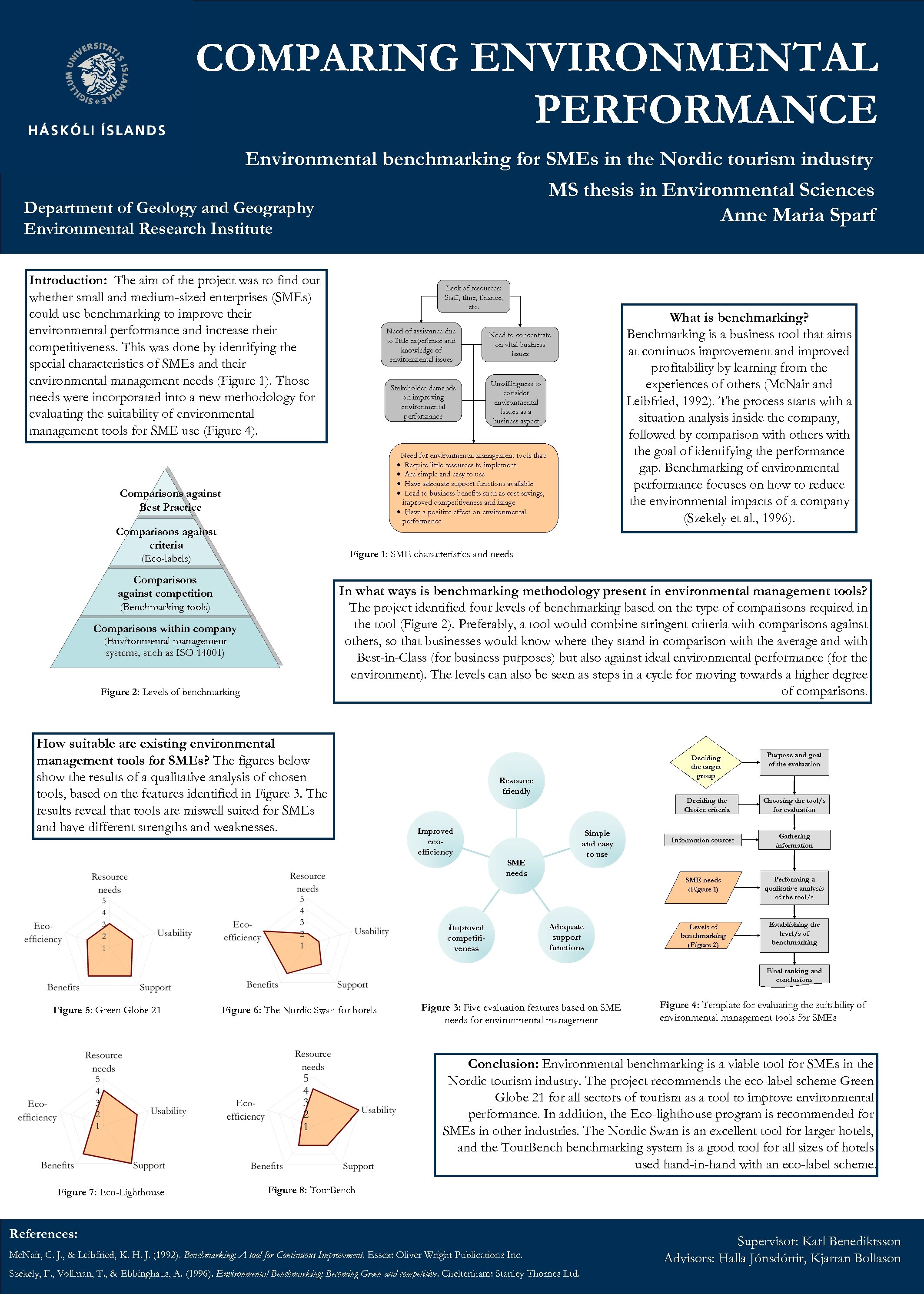
COMPARING ENVIRONMENTAL PERFORMANCE Environmental benchmarking for SMEs in the Nordic tourism industry MS thesis in Environmental Sciences Department of Geology and Geography Anne Maria Sparf Environmental Research Institute Introduction: The aim of the project was to find out whether small and medium-sized enterprises (SMEs) could use benchmarking to improve their environmental performance and increase their competitiveness. This was done by identifying the special characteristics of SMEs and their environmental management needs (Figure 1). Those needs were incorporated into a new methodology for evaluating the suitability of environmental management tools for SME use (Figure 4). Lack of resources: Staff, time, finance, etc. Need of assistance due to little experience and knowledge of environmental issues Stakeholder demands on improving environmental performance What is benchmarking? Benchmarking is a business tool that aims at continuos improvement and improved profitability by learning from the experiences of others (Mc. Nair and Leibfried, 1992). The process starts with a situation analysis inside the company, followed by comparison with others with the goal of identifying the performance gap. Benchmarking of environmental performance focuses on how to reduce the environmental impacts of a company (Szekely et al. , 1996). Need to concentrate on vital business issues Unwillingness to consider environmental issues as a business aspect Need for environmental management tools that: · Require little resources to implement · Are simple and easy to use · Have adequate support functions available · Lead to business benefits such as cost savings, improved competitiveness and image · Have a positive effect on environmental performance Comparisons against Best Practice Comparisons against criteria (Eco-labels) Figure 1: SME characteristics and needs Comparisons against competition (Benchmarking tools) In what ways is benchmarking methodology present in environmental management tools? The project identified four levels of benchmarking based on the type of comparisons required in the tool (Figure 2). Preferably, a tool would combine stringent criteria with comparisons against others, so that businesses would know where they stand in comparison with the average and with Best-in-Class (for business purposes) but also against ideal environmental performance (for the environment). The levels can also be seen as steps in a cycle for moving towards a higher degree of comparisons. Comparisons within company (Environmental management systems, such as ISO 14001) Figure 2: Levels of benchmarking How suitable are existing environmental management tools for SMEs? The figures below show the results of a qualitative analysis of chosen tools, based on the features identified in Figure 3. The results reveal that tools are miswell suited for SMEs and have different strengths and weaknesses. Deciding the target group Deciding the Choice criteria Resource friendly Improved ecoefficiency Simple and easy to use Choosing the tool/s for evaluation Adequate support functions Information sources Gathering information SME needs (Figure 1) SME needs Improved competitiveness Purpose and goal of the evaluation Performing a qualitative analysis of the tool/s Levels of benchmarking (Figure 2) Establishing the level/s of benchmarking Final ranking and conclusions Figure 5: Green Globe 21 Figure 6: The Nordic Swan for hotels Figure 3: Five evaluation features based on SME needs for environmental management Figure 4: Template for evaluating the suitability of environmental management tools for SMEs Conclusion: Environmental benchmarking is a viable tool for SMEs in the Nordic tourism industry. The project recommends the eco-label scheme Green Globe 21 for all sectors of tourism as a tool to improve environmental performance. In addition, the Eco-lighthouse program is recommended for SMEs in other industries. The Nordic Swan is an excellent tool for larger hotels, and the Tour. Bench benchmarking system is a good tool for all sizes of hotels used hand-in-hand with an eco-label scheme. Figure 7: Eco-Lighthouse Figure 8: Tour. Bench References: Mc. Nair, C. J. , & Leibfried, K. H. J. (1992). Benchmarking: A tool for Continuous Improvement. Essex: Oliver Wright Publications Inc. Szekely, F. , Vollman, T. , & Ebbinghaus, A. (1996). Environmental Benchmarking: Becoming Green and competitive. Cheltenham: Stanley Thornes Ltd. Supervisor: Karl Benediktsson Advisors: Halla Jónsdóttir, Kjartan Bollason
Скачать презентацию COMPARING ENVIRONMENTAL PERFORMANCE Environmental benchmarking for SMEs in
587165be5d62ad15d7d29d098efb2960.ppt