


 Скачать презентацию Comparative Political Systems Russia Mrs Van Wart
35eda901924e359902adbda82ea987da.ppt
- Количество слайдов: 29
 Comparative Political Systems Russia Mrs. Van. Wart
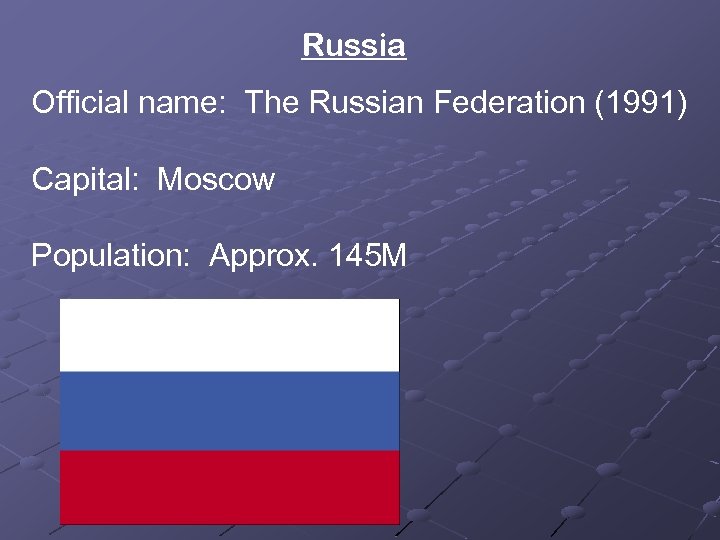 Russia Official name: The Russian Federation (1991) Capital: Moscow Population: Approx. 145 M
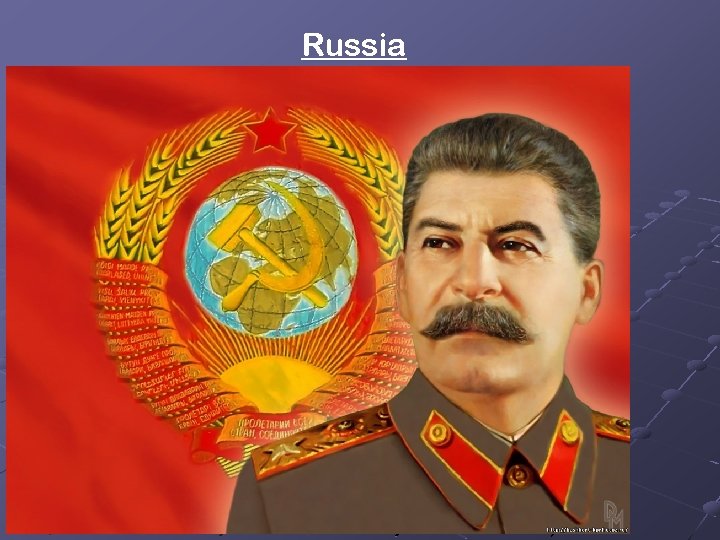
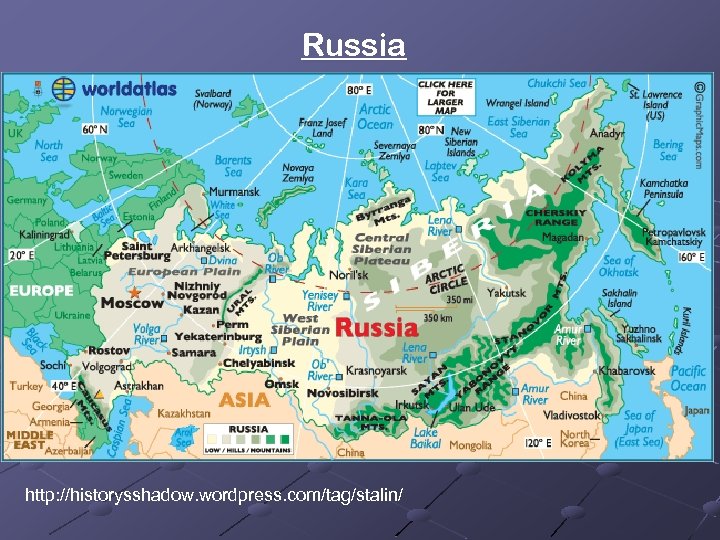 Russia http: //historysshadow. wordpress. com/tag/stalin/
 Russia early political history Ivan the Terrible 1547 first tsar Romanov dynasty (1613 -1917) --Michael I thru Nicholas II Peter the Great 1721 --began modernization Catherine the Great (1762 -96) -- “golden age”
 Russia Bolshevik Revolution (1917) March 1917: --Nicholas II abdicates (later assassinated) --Alexander Kerensky (prov. govt) Nov 1917: --Vladimir Lenin & Communists come to power --Soviet Union (USSR) established (1922 -1991)
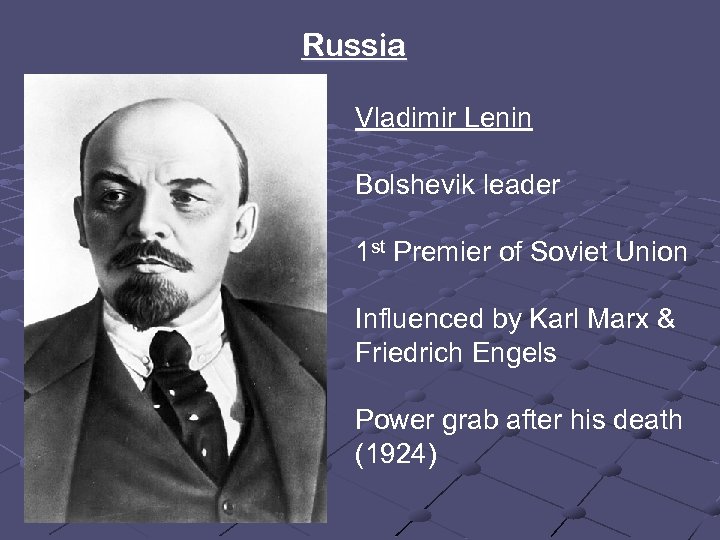 Russia Vladimir Lenin Bolshevik leader 1 st Premier of Soviet Union Influenced by Karl Marx & Friedrich Engels Power grab after his death (1924)
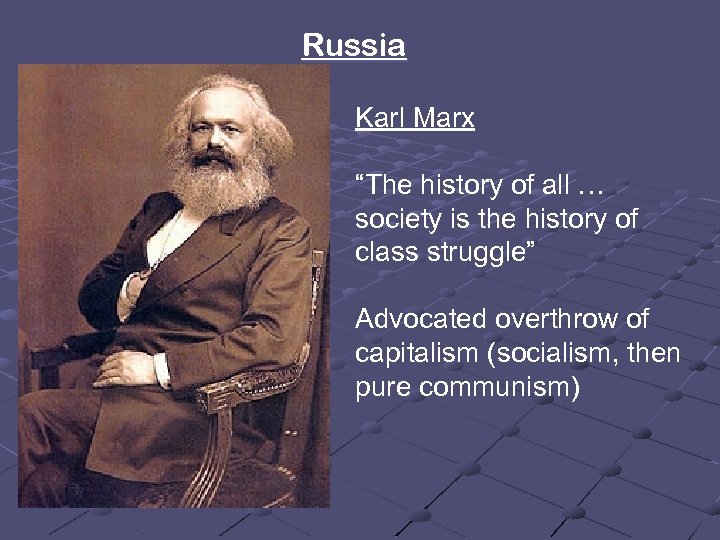 Russia Karl Marx “The history of all … society is the history of class struggle” Advocated overthrow of capitalism (socialism, then pure communism)
 Russia Joseph Stalin (“man of steel”) Took power after Lenin’s death (1924) Eliminated opposition through purges Modernized USSR; military superpower -- forced collectivization of farms -- rapid industrialization
 Russia
 Russia USSR – Post WWII Controlled much of Eastern Europe -- installed Communist govts -- promise of democratic govts not fulfilled -- “iron curtain” divided east & west Europe Cold War – tensions with US; no direct fighting (1947 -1991) --US policy of “containment”
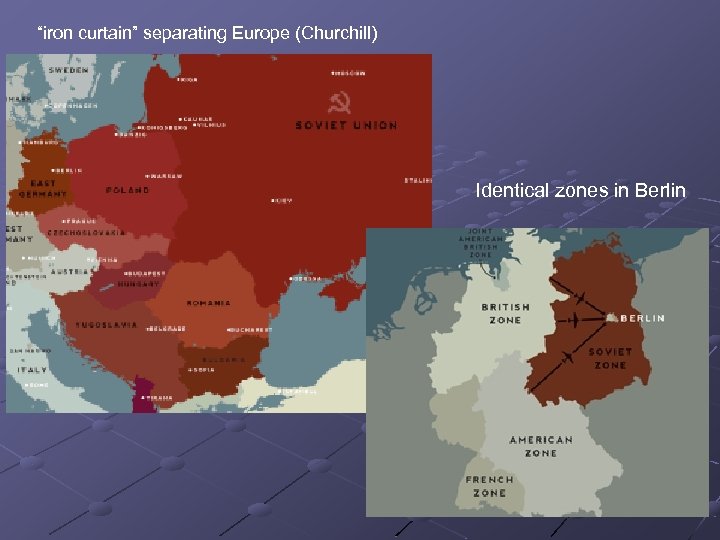 “iron curtain” separating Europe (Churchill) Identical zones in Berlin
 Russia Soviet Government Structure 15 republics (by nationality mostly) -- Russia largest (70% land; 50% people) -- soviets (councils) -- “the Kremlin” (Soviet seat of power) “kremlin” = castle, fortress
 Russia Soviet Government Structure Soviet Constitution -- basic freedoms not guaranteed -- the state’s interests superseded all
 Russia Soviet Government Structure Legislature -- Supreme Soviet -- basically “rubber-stamped” Communist decrees
 Russia Soviet Government Structure Communist Party (“CPSU”) -- one-party rule (1917 -1990) -- Politburo elected by Central Committee -- headed by General Secretary
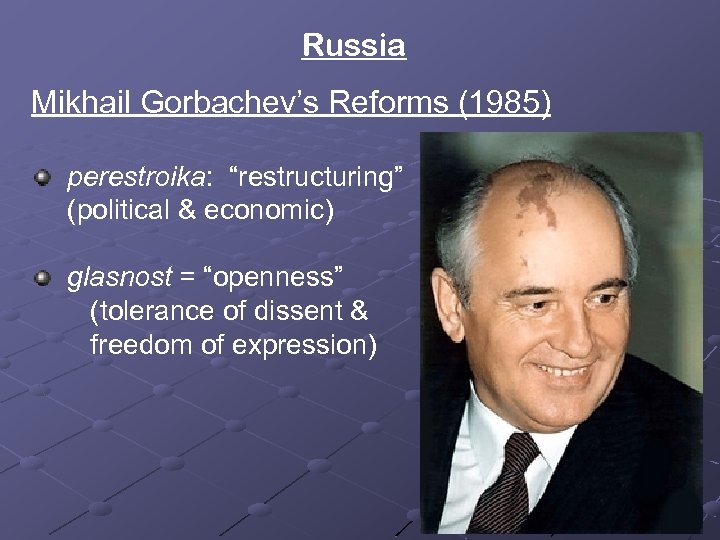 Russia Mikhail Gorbachev’s Reforms (1985) perestroika: “restructuring” (political & economic) glasnost = “openness” (tolerance of dissent & freedom of expression)
 Russia Mikhail Gorbachev’s Reforms (1985) Legislature: -elections: competitive, multi-party Presidency: -new position created (head of state vs. head of party) CPSU: -lost power by 1990
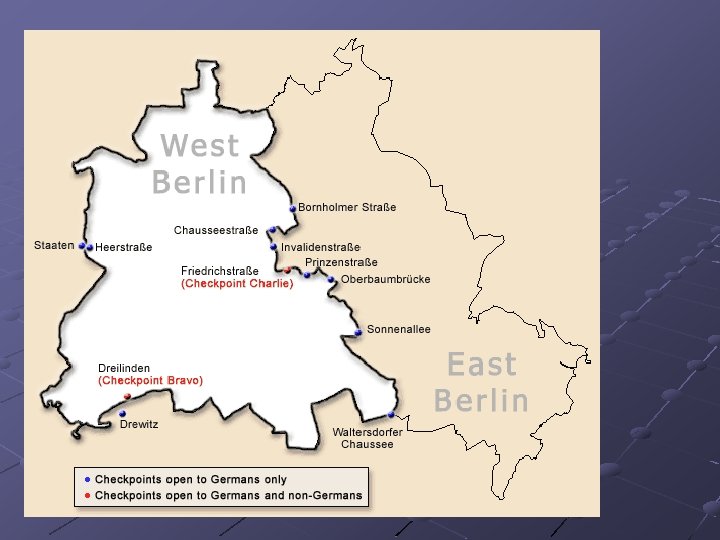
 Russia Mikhail Gorbachev’s Reforms (1985) Reforms (inadvertently) swept Communist govts from power in E. Europe --Poland 1988 (Solidarity movement) --Hungary, E. Germany, Czech. , Romania, Bulgaria followed -- “Fall” of Berlin Wall (Nov. 1989)
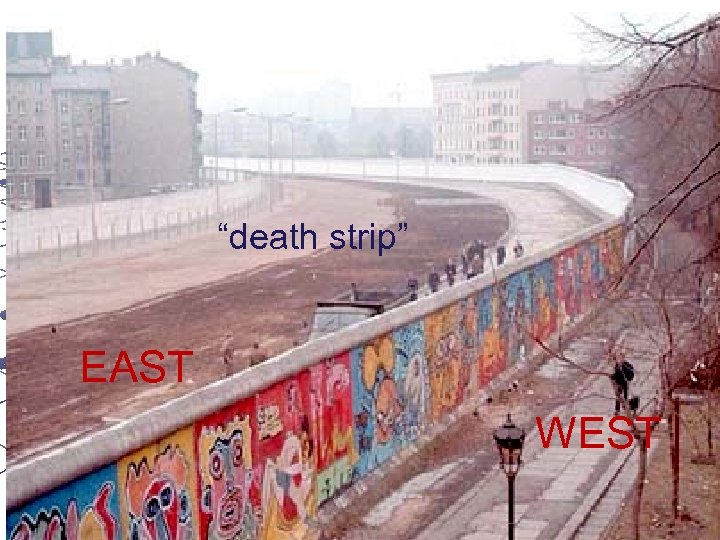 “death strip” EAST WEST
 Russia Mikhail Gorbachev’s Reforms (1985) coup attempt (Aug. 1991) -hardliners put MG under house arrest in Crimea; declare themselves in charge -Boris Yeltsin (Pres of Russia) led opposition to coup --support of public, military --MG restored to power
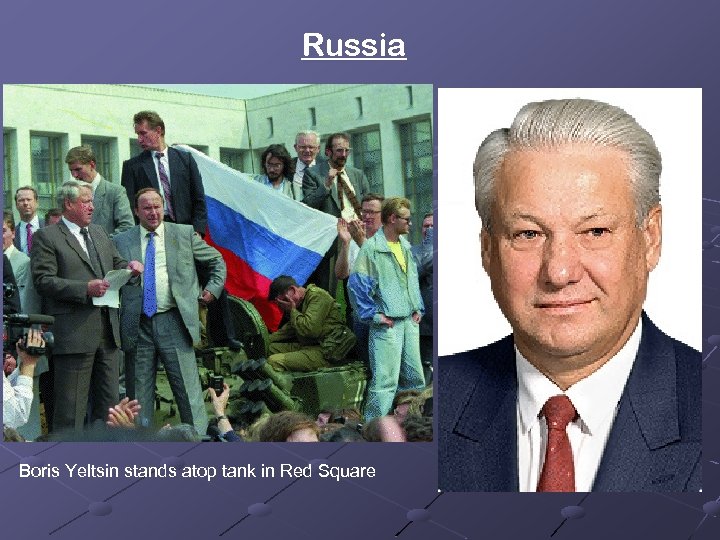 Russia Boris Yeltsin stands atop tank in Red Square
 Russia Mikhail Gorbachev’s Reforms (1985) Soviet republics declared independence -- signaled collapse of Soviet Union Gorbachev resigned Dec. 25, 1991 Yeltsin became 1 st President of Russian Federation
 Mikhail Gorbachev instituted reforms such as perestroika and glasnost because he believed: a) the USSR should “fall” for its own good, then reemerge stronger than ever; b) the USSR needed to change its ways in order to survive socially, politically, and economically; c) maintaining control over the Eastern Bloc countries was burdensome to the USSR and this was a way to encourage them to declare independence
 Russian Government Today Constitution of 1993 --includes free housing (low income), medical care, higher education (competitive basis) 38 -3. Able-bodied children over 18 years of age shall take care of disabled parents.
 Russian Government Today Executive Branch Chief of State: President Vladimir Putin (May 2012) (6 -year term; no VP) --Putin’s 3 rd term (non-consecutive) Head of Govt: Prime Minister Dmitriy Medvedev (appointed by President; confirmed by Duma)
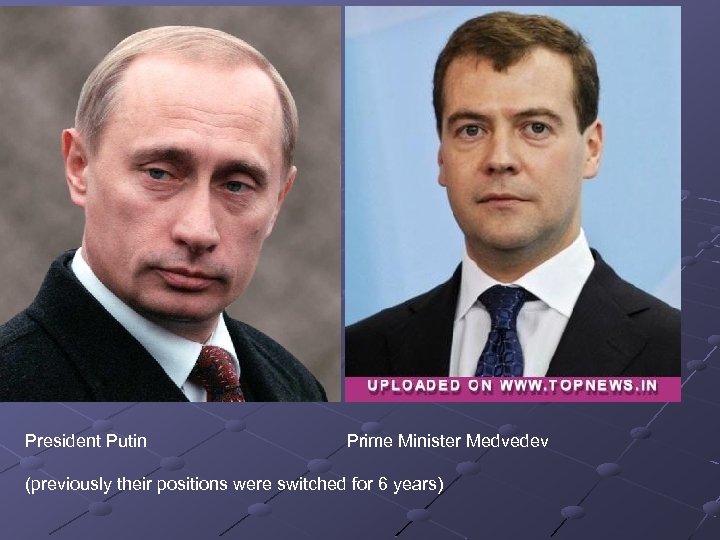 President Putin Prime Minister Medvedev (previously their positions were switched for 6 years)
 Russian Government Today Legislature (“Federal Assembly”) Council of the Federation (upper house) --178 members (2 x 89 regions) State Duma (lower house) --450 members (aka “deputies”) --more powerful --may be dissolved (a la Br. House of Commons)
 Russian Government Today Judiciary (“Constitutional Court”) 19 judges -- elected to 12 -year terms