


 Скачать презентацию Comparative Evaluation of Two Optical Spectrum Analyzers D
6ae3eace3cb0a70732168864eae6910e.ppt
- Количество слайдов: 23
 Comparative Evaluation of Two Optical Spectrum Analyzers D. Sporea, Laura Mihai, and Adelina Sporea National Institute for Laser, Plasma and Radiation Physics Laser Metrology and Standardization Laboratory 409 Atomistilor St. , RO-077125, Romania e-mail: dan. sporea@inflpr. ro
 Overview n Introduction n Objectives n Spectral response calibrations of the two OSAs n Optical power calibration of the two OSAs n Uncertainties sources identification and uncertainties budget n n Comparative tests using the two OSAs (stability of laser sources power, channels drift, evaluation of the spectral transmittance for optical fiber systems passive components) Conclusions
 Introduction Optical spectrum analyzers (OSA) are key instruments in today quality assessment of passive and active components for optical communication systems, as well as for CWDM (coarse wavelength division multiplexing) and DWDM (dense wavelength division multiplexing) networks diagnostics. The main applications envisioned by OSAs on the components testing side are: the characterization of light sources for optical communication applications (distributed feedback laser diodes – DFB-LD; Fabry–Perot laser diodes – FP-LD; LEDs); a. the measurement of the spectral transmission width of pass band notch filters; a. the evaluation of the spectral attenuation of optical fiber links; a. the polarization mode dispersion (PMD) in passive optical fiber components; the evaluation of reconfigurable optical add/drop multiplexers (ROADMs) to be used as efficient deployment time and costs solutions for present DWDM networks and agile optical network (AON); b.
 Objective In order to provide reliable measurement results, OSAs have to be calibrated for wavelength, optical power and spectral response. On the other side, each OSA has its own strengths and weaknesses in relation to a specific metrological task. Some OSAs have stronger processing functions for spectral analyzes of light sources; some others accommodate well the tests run on WDM systems. Our task was to assess the characteristics of two OSAs, a bench top one (for research applications) and a portable one (for field tests), through a comparative investigation of their capabilities.
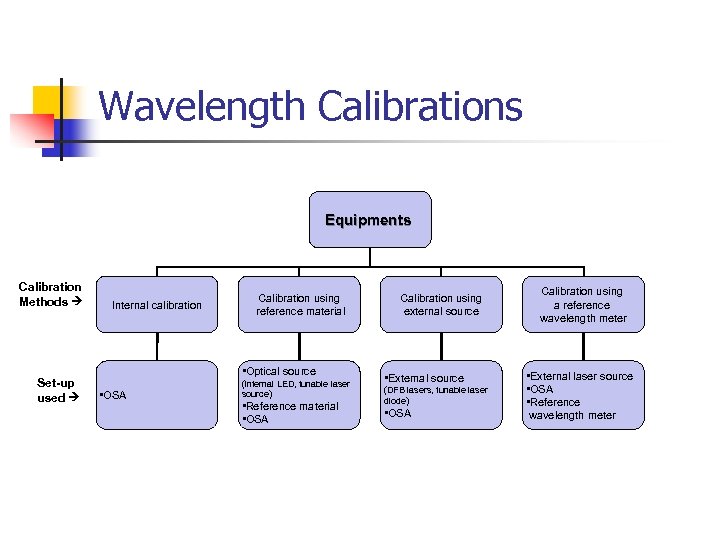 Wavelength Calibrations Equipments Calibration Methods Set-up used Internal calibration Calibration using reference material • Optical source • OSA (internal LED, tunable laser source) • Reference material • OSA Calibration using external source • External source (DFB lasers, tunable laser diode) • OSA Calibration using a reference wavelength meter • External laser source • OSA • Reference wavelength meter
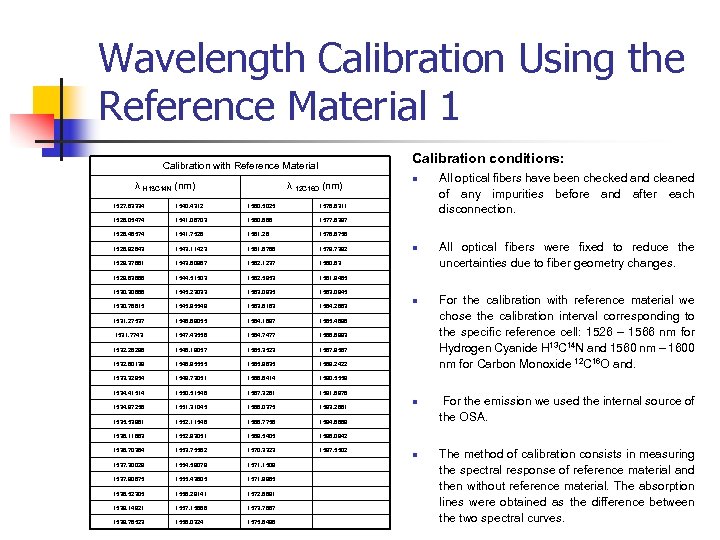 Wavelength Calibration Using the Reference Material 1 Calibration conditions: Calibration with Reference Material λ H 13 C 14 N (nm) λ 12 C 16 O (nm) 1527. 63334 1540. 4312 1560. 5025 1576. 6311 1528. 05474 1541. 08703 1560. 868 1541. 7528 1561. 26 1578. 6758 1528. 92643 1543. 11423 1561. 6786 1579. 7392 1529. 37681 1543. 80967 1562. 1237 1580. 83 1529. 83688 1544. 51503 1562. 5953 1581. 9485 1530. 30666 1545. 23033 1563. 0935 1583. 0945 1530. 78615 1545. 95549 1563. 6183 1584. 2683 1531. 27537 1546. 69055 1564. 1697 1585. 4698 All optical fibers have been checked and cleaned of any impurities before and after each disconnection. 1577. 6397 1528. 48574 n 1531. 7743 1547. 43558 1564. 7477 1548. 19057 1565. 3523 1587. 9567 1532. 80139 1548. 95555 1565. 9835 1589. 2422 1533. 32954 1549. 73051 1566. 6414 1550. 51546 1567. 3261 1591. 8978 1534. 97258 1551. 31045 1568. 0375 1593. 2681 1535. 53981 1552. 11546 1568. 7756 1594. 6669 1536. 11683 1552. 93051 1569. 5405 1553. 75562 1570. 3323 1597. 5502 1537. 30029 1554. 59079 1571. 1509 1537. 90675 1555. 43605 1571. 9965 1538. 52305 1556. 29141 1572. 8691 1539. 14921 1557. 15686 1573. 7687 1539. 78523 1558. 0324 1575. 6498 For the calibration with reference material we chose the calibration interval corresponding to the specific reference cell: 1526 – 1566 nm for Hydrogen Cyanide H 13 C 14 N and 1560 nm – 1600 nm for Carbon Monoxide 12 C 16 O and. 1596. 0942 1536. 70364 All optical fibers were fixed to reduce the uncertainties due to fiber geometry changes. 1590. 5559 1534. 41514 n 1586. 6993 1532. 28298 n n n For the emission we used the internal source of the OSA. The method of calibration consists in measuring the spectral response of reference material and then without reference material. The absorption lines were obtained as the difference between the two spectral curves.
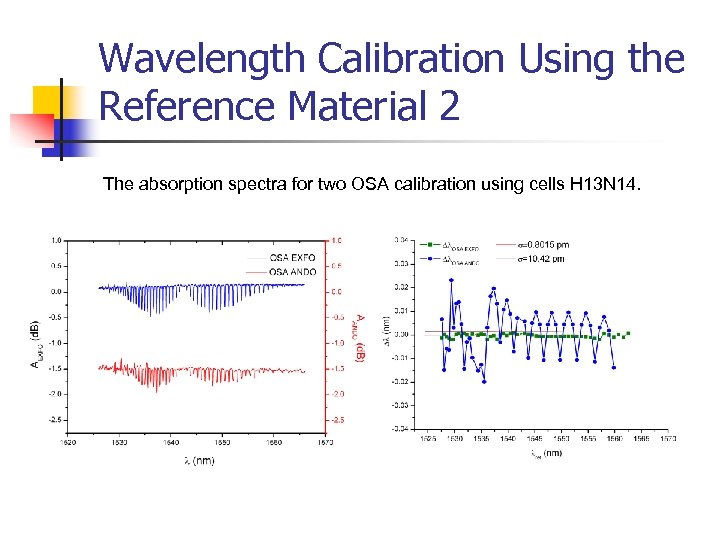 Wavelength Calibration Using the Reference Material 2 The absorption spectra for two OSA calibration using cells H 13 N 14.
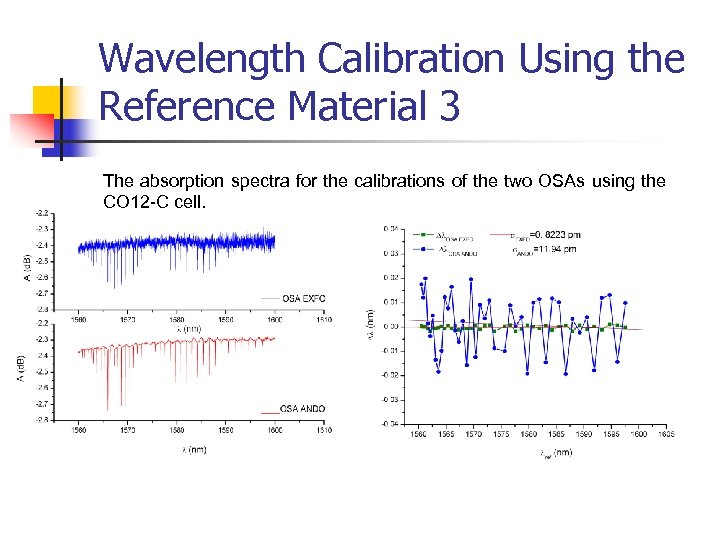 Wavelength Calibration Using the Reference Material 3 The absorption spectra for the calibrations of the two OSAs using the CO 12 -C cell.
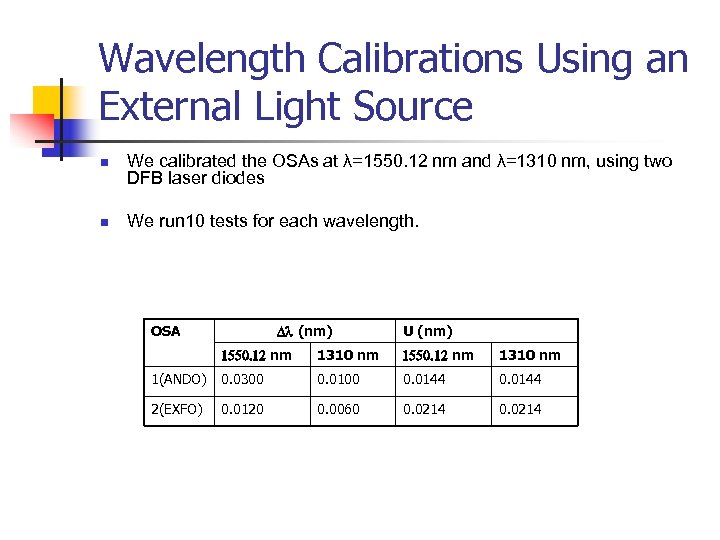 Wavelength Calibrations Using an External Light Source n n We calibrated the OSAs at λ=1550. 12 nm and λ=1310 nm, using two DFB laser diodes We run 10 tests for each wavelength. Dl (nm) OSA U (nm) 1550. 12 nm 1310 nm 1(ANDO) 0. 0300 0. 0144 2(EXFO) 0. 0120 0. 0060 0. 0214
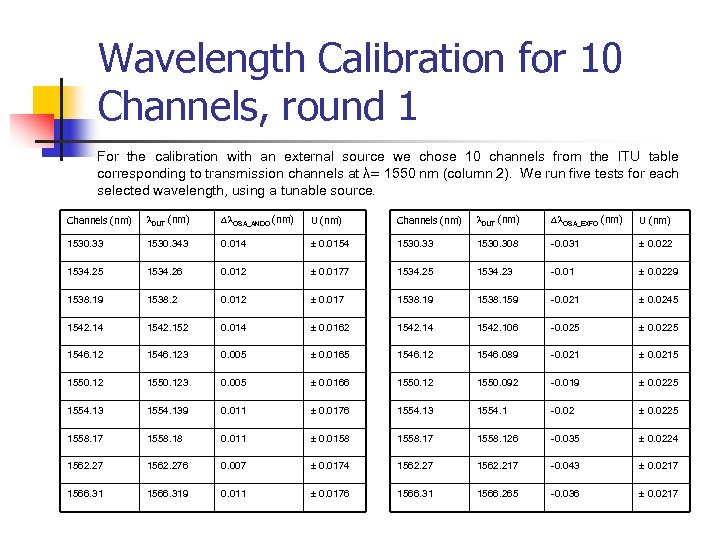 Wavelength Calibration for 10 Channels, round 1 For the calibration with an external source we chose 10 channels from the ITU table corresponding to transmission channels at λ= 1550 nm (column 2). We run five tests for each selected wavelength, using a tunable source. Channels (nm) l. DUT (nm) Dl. OSA_ANDO (nm) U (nm) Channels (nm) l. DUT (nm) Dl. OSA_EXFO (nm) U (nm) 1530. 33 1530. 343 0. 014 ± 0. 0154 1530. 33 1530. 308 -0. 031 ± 0. 022 1534. 25 1534. 26 0. 012 ± 0. 0177 1534. 25 1534. 23 -0. 01 ± 0. 0229 1538. 19 1538. 2 0. 012 ± 0. 017 1538. 19 1538. 159 -0. 021 ± 0. 0245 1542. 14 1542. 152 0. 014 ± 0. 0162 1542. 14 1542. 106 -0. 025 ± 0. 0225 1546. 123 0. 005 ± 0. 0165 1546. 12 1546. 089 -0. 021 ± 0. 0215 1550. 123 0. 005 ± 0. 0166 1550. 12 1550. 092 -0. 019 ± 0. 0225 1554. 139 0. 011 ± 0. 0176 1554. 13 1554. 1 -0. 02 ± 0. 0225 1558. 17 1558. 18 0. 011 ± 0. 0158 1558. 17 1558. 126 -0. 035 ± 0. 0224 1562. 276 0. 007 ± 0. 0174 1562. 27 1562. 217 -0. 043 ± 0. 0217 1566. 319 0. 011 ± 0. 0176 1566. 31 1566. 265 -0. 036 ± 0. 0217
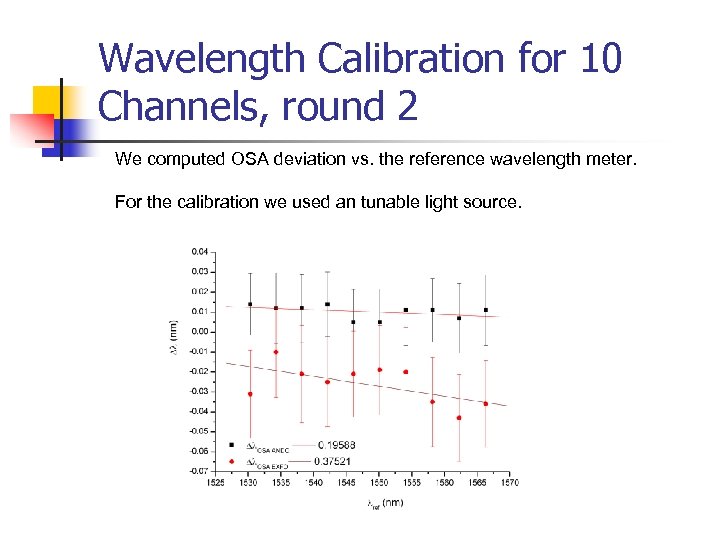 Wavelength Calibration for 10 Channels, round 2 We computed OSA deviation vs. the reference wavelength meter. For the calibration we used an tunable light source.
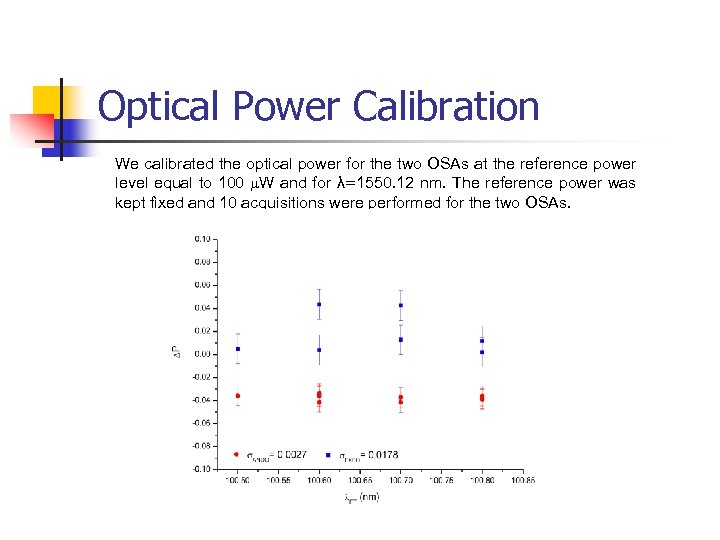 Optical Power Calibration We calibrated the optical power for the two OSAs at the reference power level equal to 100 m. W and for λ=1550. 12 nm. The reference power was kept fixed and 10 acquisitions were performed for the two OSAs.
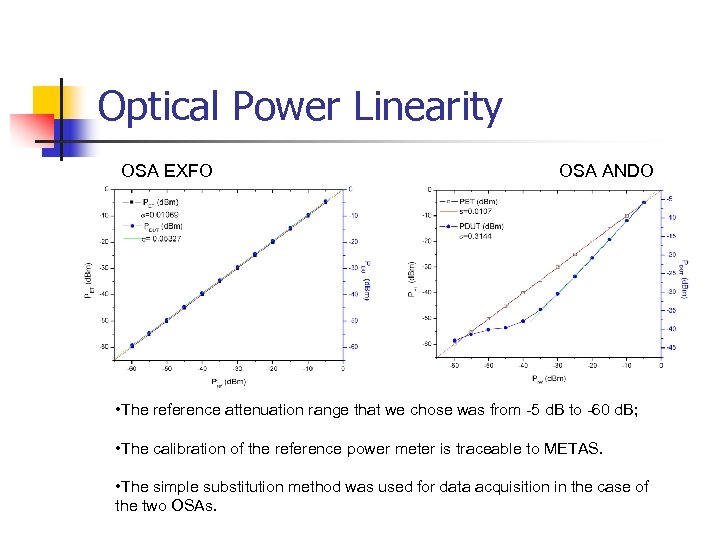 Optical Power Linearity OSA EXFO OSA ANDO • The reference attenuation range that we chose was from -5 d. B to -60 d. B; • The calibration of the reference power meter is traceable to METAS. • The simple substitution method was used for data acquisition in the case of the two OSAs.
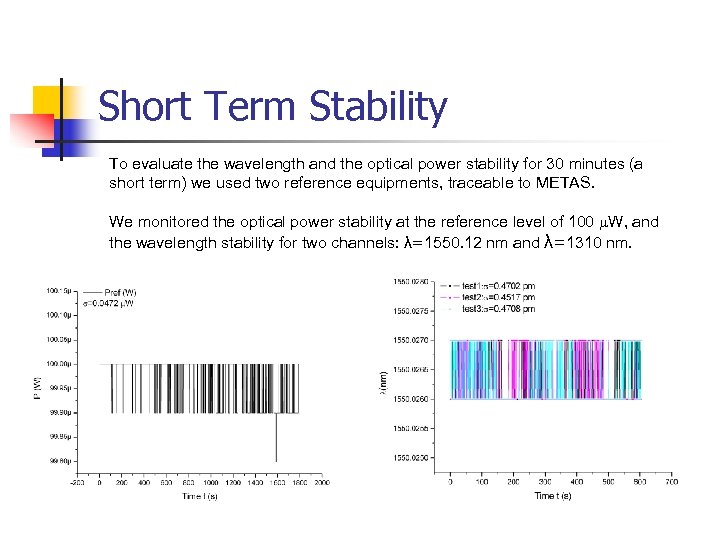 Short Term Stability To evaluate the wavelength and the optical power stability for 30 minutes (a short term) we used two reference equipments, traceable to METAS. We monitored the optical power stability at the reference level of 100 m. W, and the wavelength stability for two channels: λ=1550. 12 nm and λ=1310 nm.
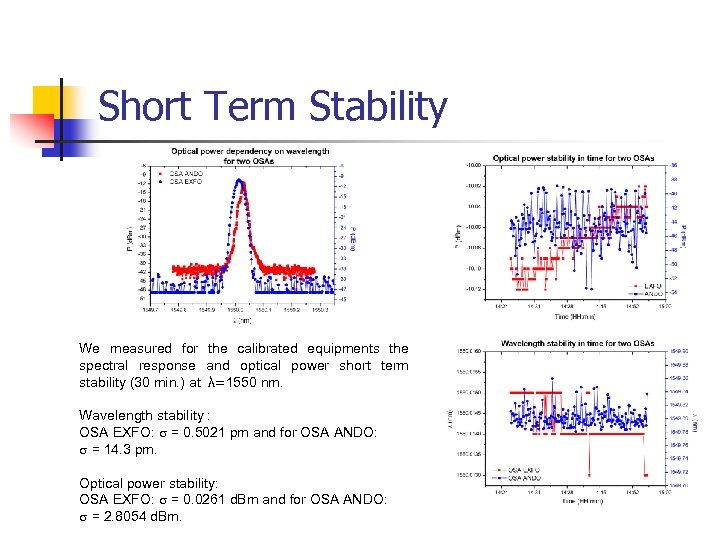 Short Term Stability We measured for the calibrated equipments the spectral response and optical power short term stability (30 min. ) at λ=1550 nm. Wavelength stability : OSA EXFO: s = 0. 5021 pm and for OSA ANDO: s = 14. 3 pm. Optical power stability: OSA EXFO: s = 0. 0261 d. Bm and for OSA ANDO: s = 2. 8054 d. Bm.
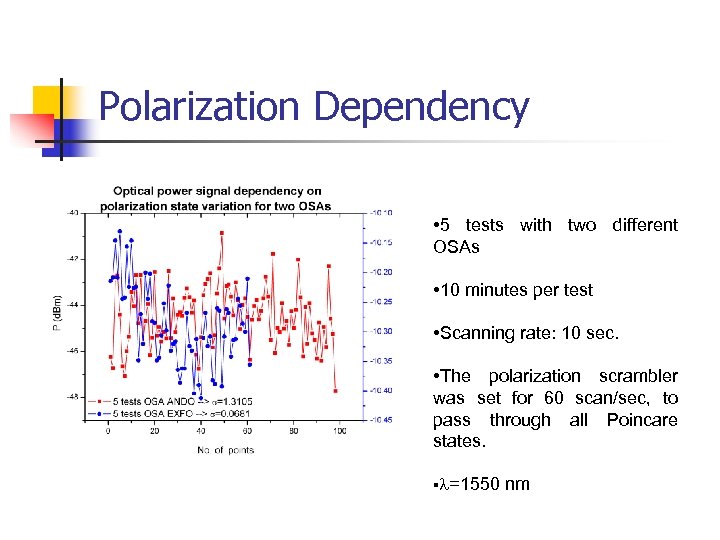 Polarization Dependency • 5 tests with two different OSAs • 10 minutes per test • Scanning rate: 10 sec. • The polarization scrambler was set for 60 scan/sec, to pass through all Poincare states. §l=1550 nm
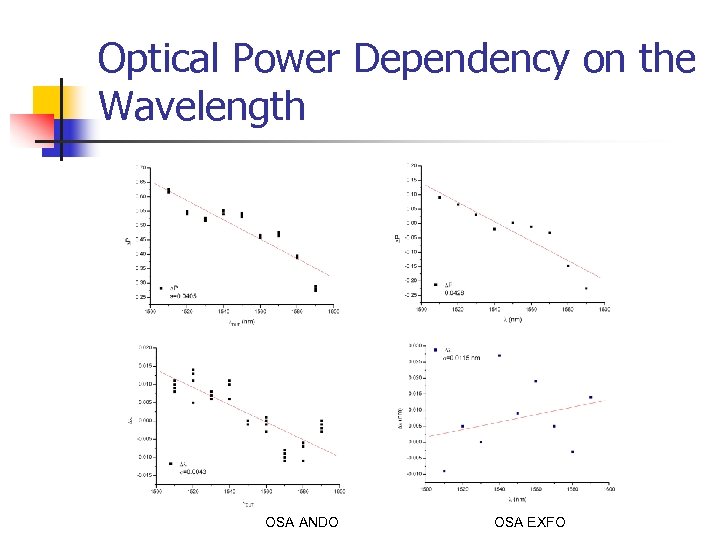 Optical Power Dependency on the Wavelength OSA ANDO OSA EXFO
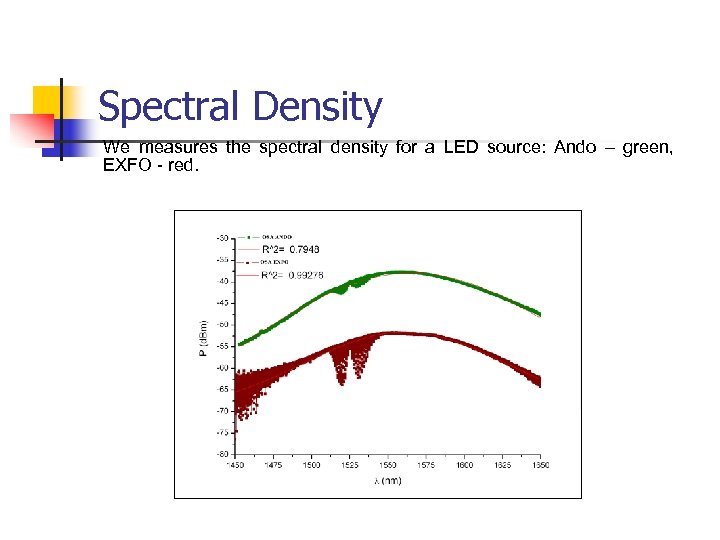 Spectral Density We measures the spectral density for a LED source: Ando – green, EXFO - red.
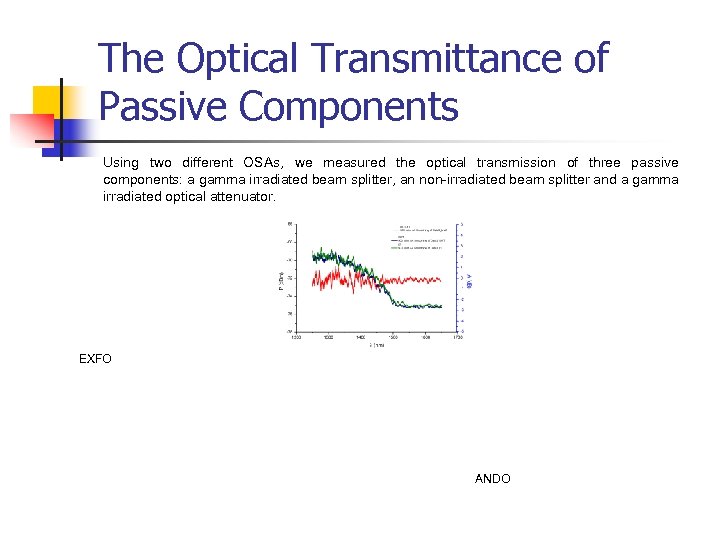 The Optical Transmittance of Passive Components Using two different OSAs, we measured the optical transmission of three passive components: a gamma irradiated beam splitter, an non-irradiated beam splitter and a gamma irradiated optical attenuator. EXFO ANDO
 The Optical Transmittance of a Reference Optical Fiber We measured the transmittance through a reference optical fiber using the two OSAs. OSA ANDO OSA EXFO
 The channel drift ANDO EXFO
 Conclusions n n n The procedures for the power and wavelength calibration of the OSAs were developed Three calibration set-ups were developed for the wavelength calibration of OSAs The optical power and wavelength linearity for two OSAs was assessed A comparative study of the wavelength and power short term stability, the channel drift and the polarization dependence of the detected optical power was carried out for two OSAs The two equipments were used for a comparative evaluation of the spectral density of LEDs sources, the optical transmission of passive different optical components Spectral responsivity calibration of the two OSAs was done by using as a reference material a standard optical fiber developed at METAS
 References n n n n Calibration of optical spectrum analyzers, IEC 62129 Ed. 1. 0 b: 2006. Reference Guide to Fiber Optic Testing, Vol. 1, 2007. Guide to WDM Technology Testing, 2000. Certificate of Analysis – Standard Reference Material 2514, NIST, 2002. Certificate of Analysis – Standard Reference Material 2519 a, NIST, 2005. White Paper: In-service Measurement of the OSNR in ROADM-based Networks, JDSU, 2005. Pocket Guide: Dense Wavelength Division Multiplexing, JDSU. Sarah L. Gilbert, William C. Swann, and Tasshi Dennis: “Wavelength control and calibration for wavelength division multiplexed optical communication”, in the proceedings of the 2001 IEEE International Frequency Control Symposium, pp. 122 -126. Igor Vayshenker, Xiaoyu Li and Thomas R. Scott: “Optical power meter calibration using tunable laser diodes”, 1994 h. JCSLWorkshop & Symposium. EXFO Electro-Optical Engineering Inc. : “Technical Note 019: Testing PMD in Fibers Using the FPMD-5600 Femtosecond PMD Analyzer”, 2002. EXFO Electro-Optical Engineering Inc. : ”Testing with LED source”, 2005. EXFO Electro-Optical Engineering Inc. : “Optimizing the selection of your optical 129 spectrum analyzer”, 2005. EXFO Electro-Optical Engineering Inc. : “CWDM and dwdm testing in the field using broadband sources and an OSA”, 2005.