


 Скачать презентацию Comparative Analysis of Spectral Unmixing Algorithms Lidan Miao
6f457fab3c2e699a287e55c44af9802b.ppt
- Количество слайдов: 21
 Comparative Analysis of Spectral Unmixing Algorithms Lidan Miao Nov. 10, 2005
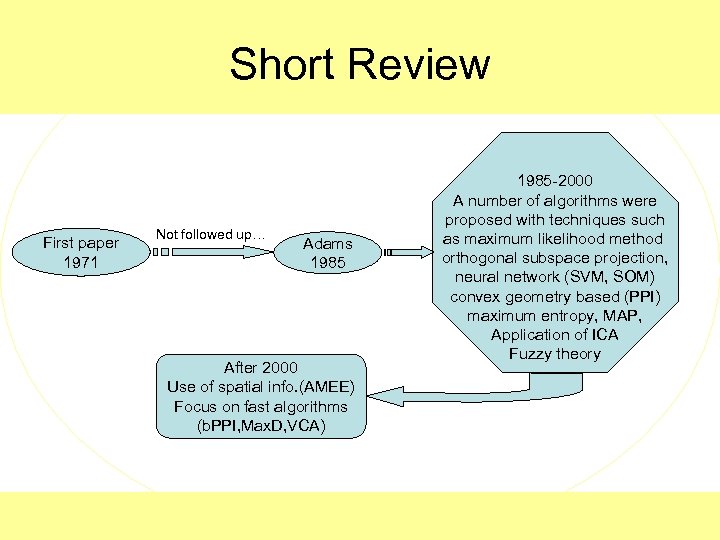 Short Review First paper 1971 Not followed up… Adams 1985 After 2000 Use of spatial info. (AMEE) Focus on fast algorithms (b. PPI, Max. D, VCA) 1985 -2000 A number of algorithms were proposed with techniques such as maximum likelihood method orthogonal subspace projection, neural network (SVM, SOM) convex geometry based (PPI) maximum entropy, MAP, Application of ICA Fuzzy theory
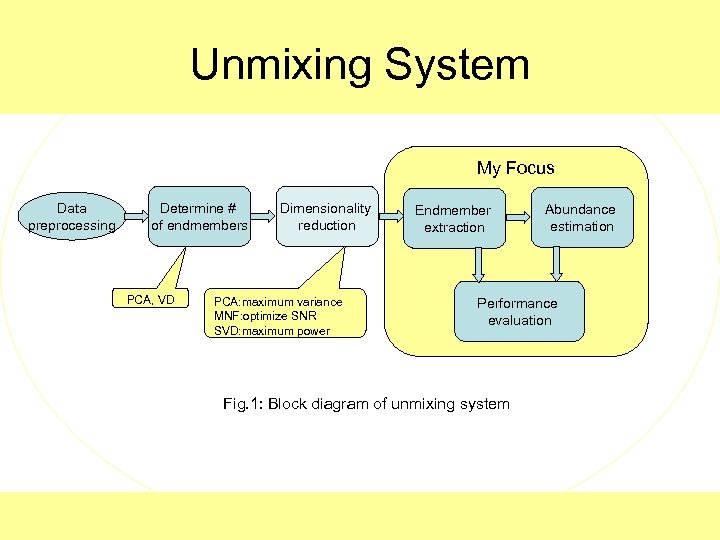 Unmixing System My Focus Data preprocessing Determine # of endmembers PCA, VD Dimensionality reduction PCA: maximum variance MNF: optimize SNR SVD: maximum power Endmember extraction Abundance estimation Performance evaluation Fig. 1: Block diagram of unmixing system
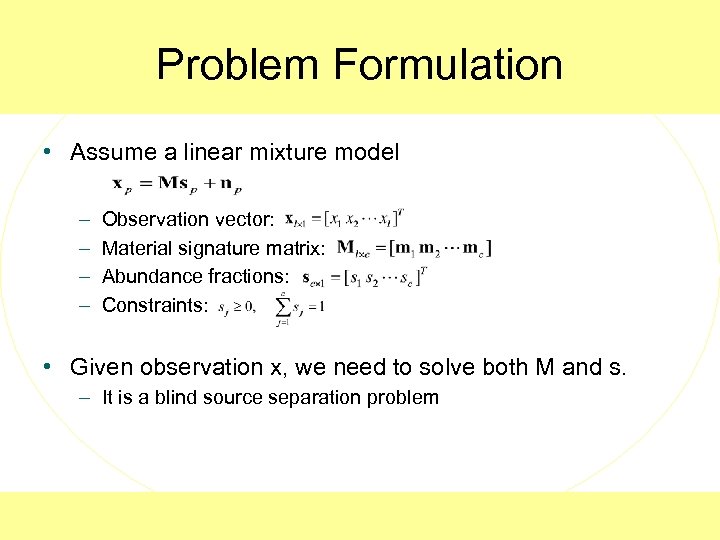 Problem Formulation • Assume a linear mixture model – – Observation vector: Material signature matrix: Abundance fractions: Constraints: • Given observation x, we need to solve both M and s. – It is a blind source separation problem
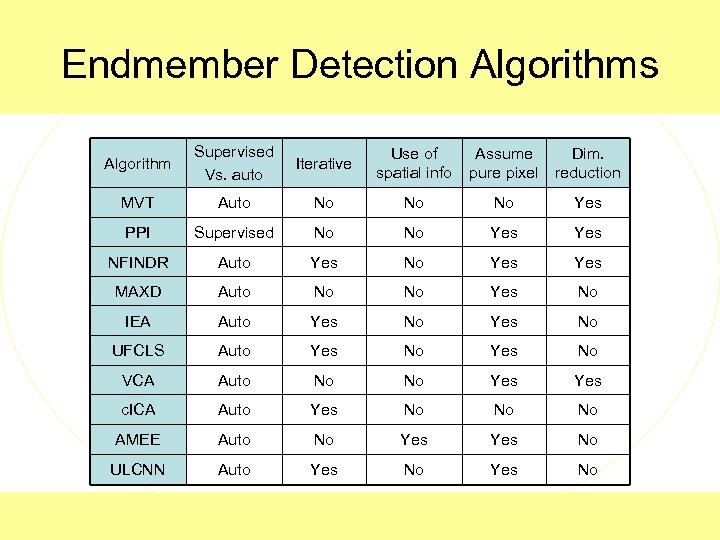 Endmember Detection Algorithms Algorithm Supervised Vs. auto Iterative Use of spatial info Assume pure pixel Dim. reduction MVT Auto No No No Yes PPI Supervised No No Yes NFINDR Auto Yes No Yes MAXD Auto No No Yes No IEA Auto Yes No UFCLS Auto Yes No VCA Auto No No Yes c. ICA Auto Yes No No No AMEE Auto No Yes No ULCNN Auto Yes No
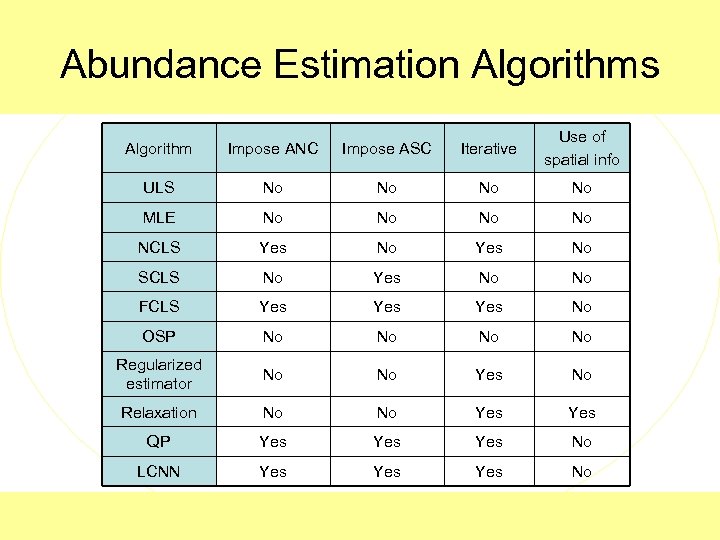 Abundance Estimation Algorithms Algorithm Impose ANC Impose ASC Iterative Use of spatial info ULS No No MLE No No NCLS Yes No SCLS No Yes No No FCLS Yes Yes No OSP No No Regularized estimator No No Yes No Relaxation No No Yes QP Yes Yes No LCNN Yes Yes No
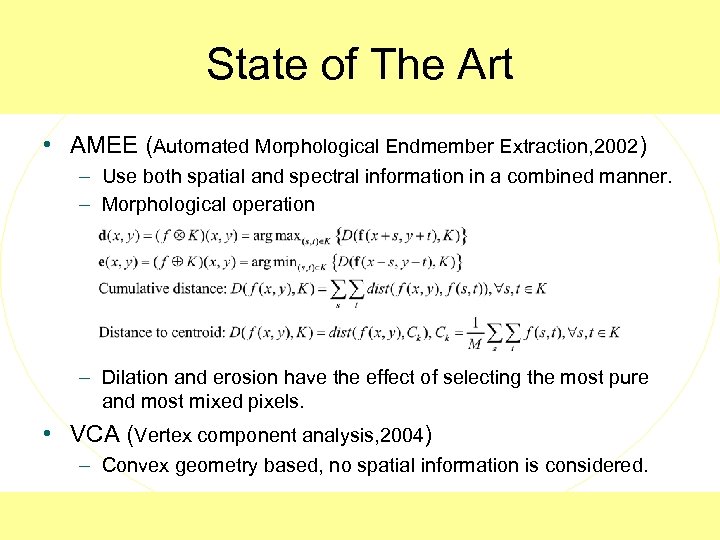 State of The Art • AMEE (Automated Morphological Endmember Extraction, 2002) – Use both spatial and spectral information in a combined manner. – Morphological operation – Dilation and erosion have the effect of selecting the most pure and most mixed pixels. • VCA (Vertex component analysis, 2004) – Convex geometry based, no spatial information is considered.
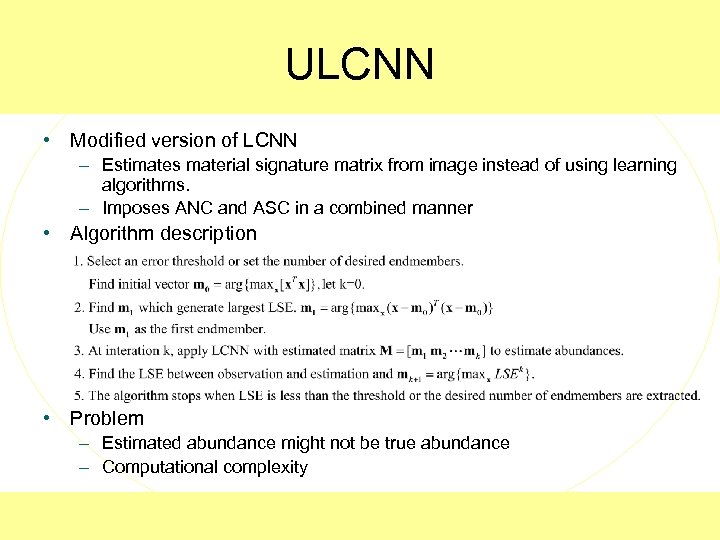 ULCNN • Modified version of LCNN – Estimates material signature matrix from image instead of using learning algorithms. – Imposes ANC and ASC in a combined manner • Algorithm description • Problem – Estimated abundance might not be true abundance – Computational complexity
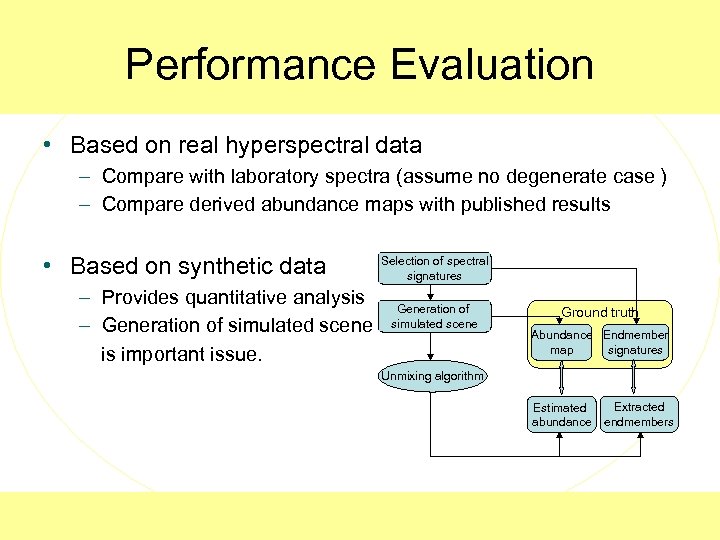 Performance Evaluation • Based on real hyperspectral data – Compare with laboratory spectra (assume no degenerate case ) – Compare derived abundance maps with published results • Based on synthetic data – Provides quantitative analysis – Generation of simulated scene is important issue. Selection of spectral signatures Generation of simulated scene Ground truth Abundance Endmember map signatures Unmixing algorithm Estimated abundance Extracted endmembers
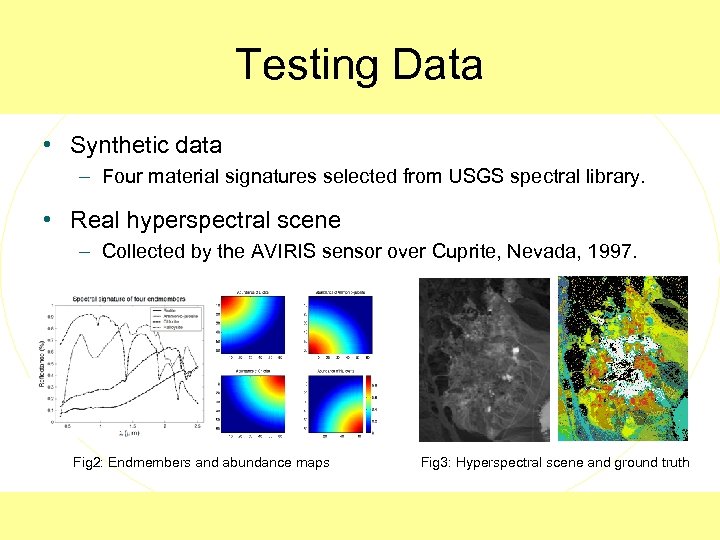 Testing Data • Synthetic data – Four material signatures selected from USGS spectral library. • Real hyperspectral scene – Collected by the AVIRIS sensor over Cuprite, Nevada, 1997. Fig 2: Endmembers and abundance maps Fig 3: Hyperspectral scene and ground truth
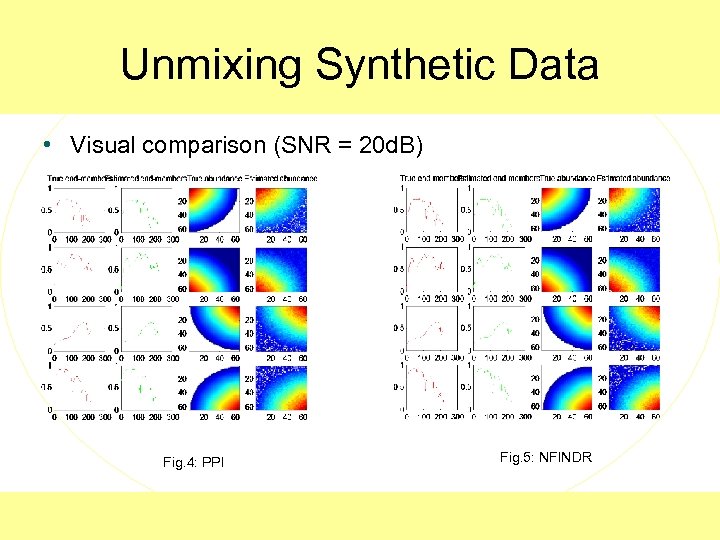 Unmixing Synthetic Data • Visual comparison (SNR = 20 d. B) Fig. 4: PPI Fig. 5: NFINDR
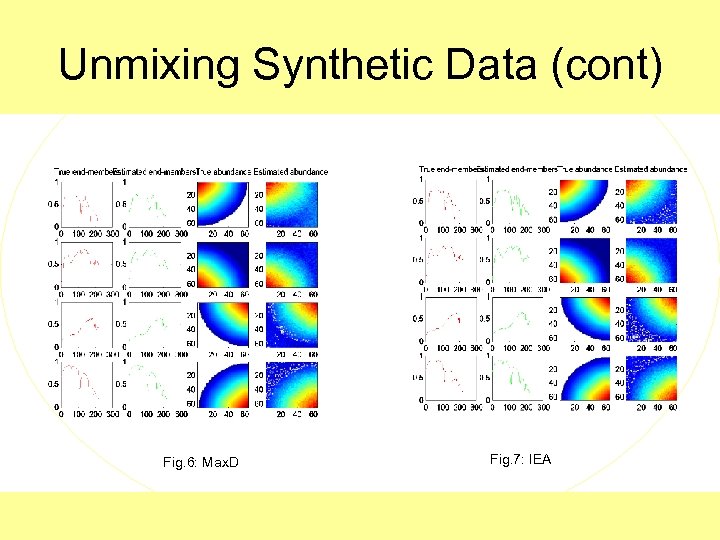 Unmixing Synthetic Data (cont) Fig. 6: Max. D Fig. 7: IEA
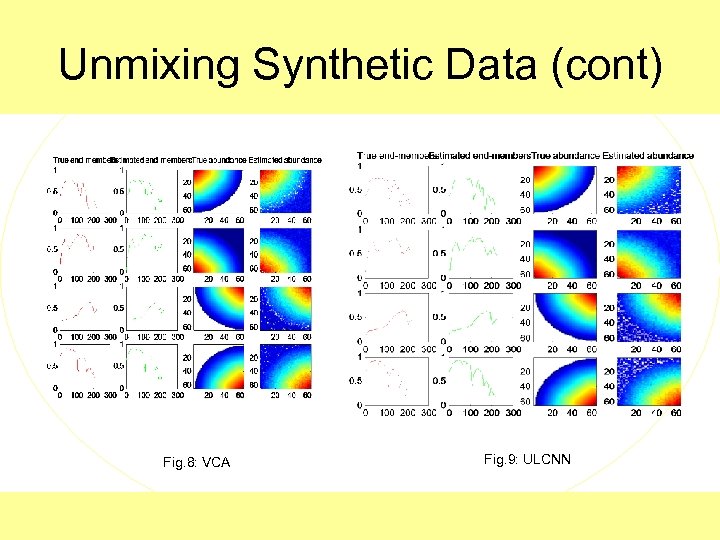 Unmixing Synthetic Data (cont) Fig. 8: VCA Fig. 9: ULCNN
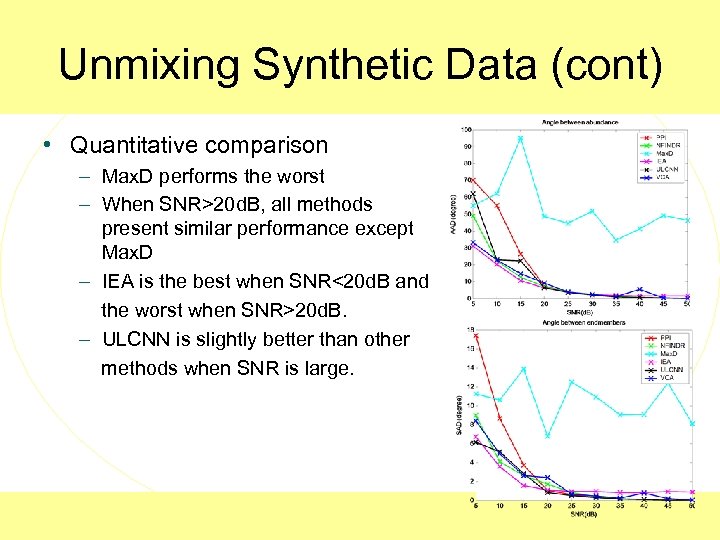 Unmixing Synthetic Data (cont) • Quantitative comparison – Max. D performs the worst – When SNR>20 d. B, all methods present similar performance except Max. D – IEA is the best when SNR<20 d. B and the worst when SNR>20 d. B. – ULCNN is slightly better than other methods when SNR is large.
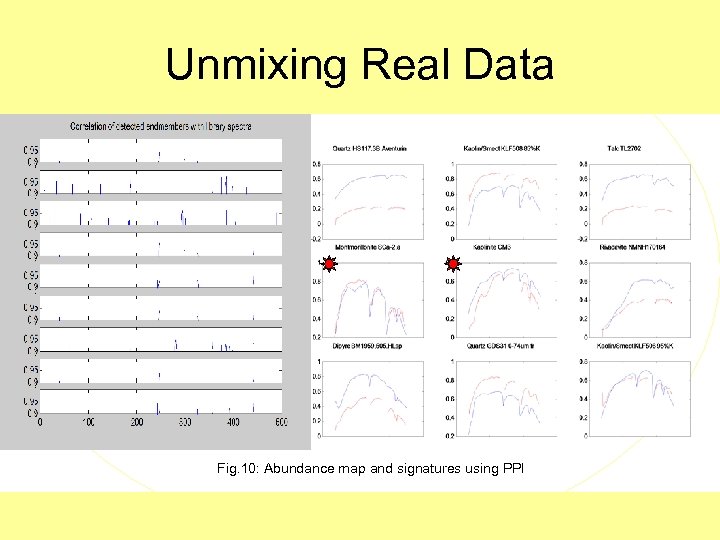 Unmixing Real Data Fig. 10: Abundance map and signatures using PPI
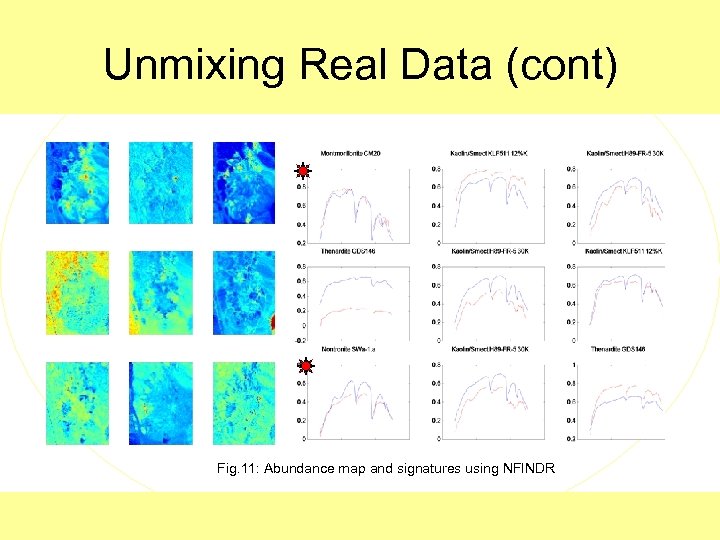 Unmixing Real Data (cont) Fig. 11: Abundance map and signatures using NFINDR
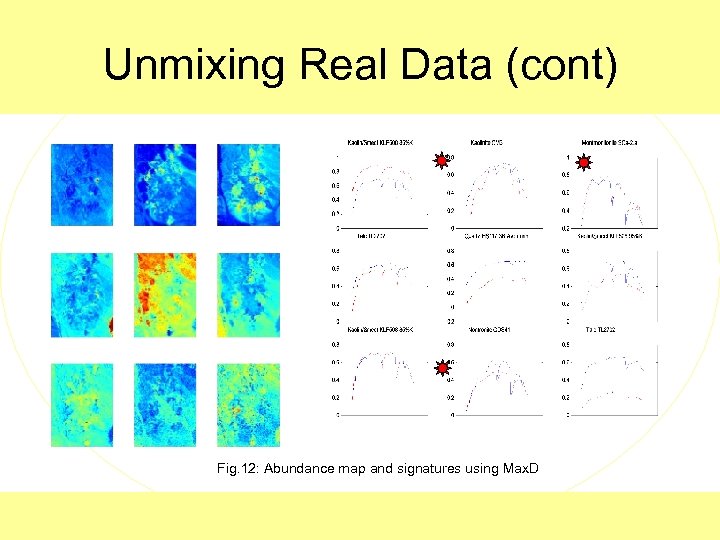 Unmixing Real Data (cont) Fig. 12: Abundance map and signatures using Max. D
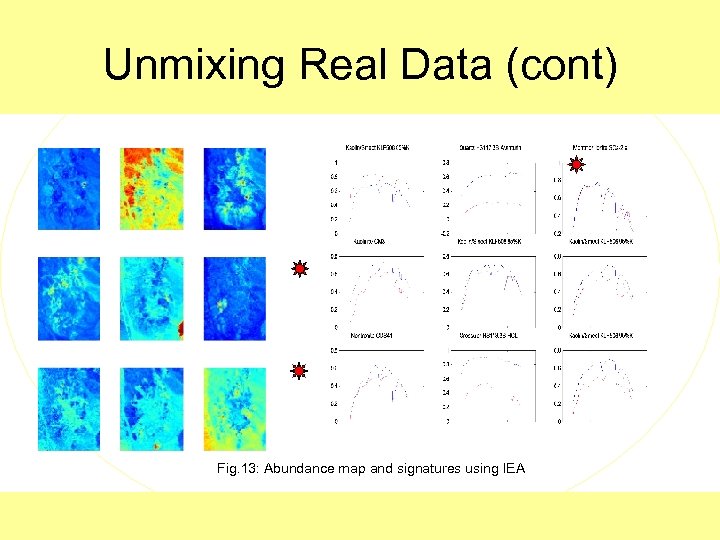 Unmixing Real Data (cont) Fig. 13: Abundance map and signatures using IEA
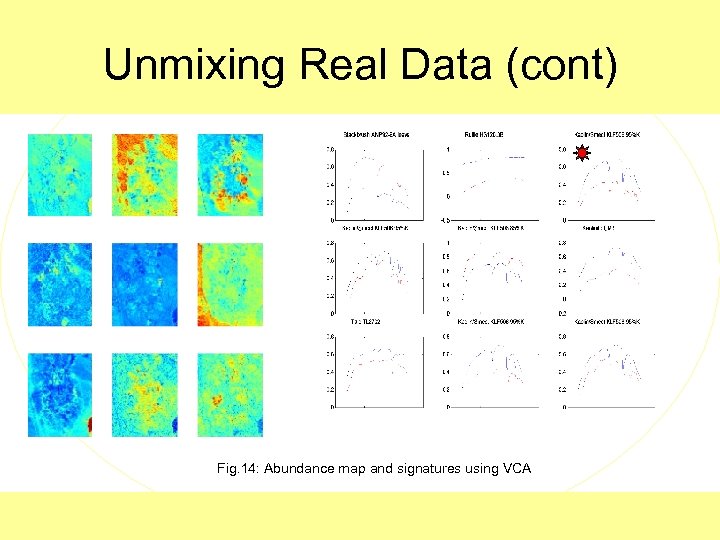 Unmixing Real Data (cont) Fig. 14: Abundance map and signatures using VCA
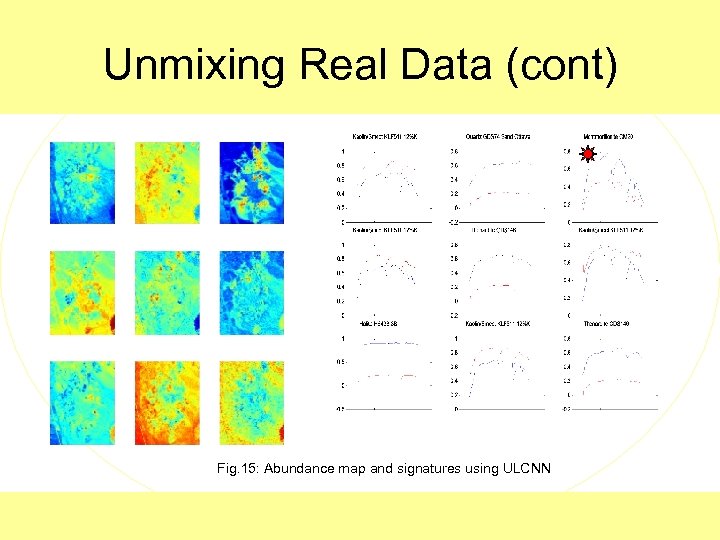 Unmixing Real Data (cont) Fig. 15: Abundance map and signatures using ULCNN
 Conclusion and Future Work • Comparison summary – Different algorithms generate similar results under high SNR. – Some algorithms use similar ideas (IEA vs. UFCLS, Max. D vs. PPI vs. VCA ). – AMEE is just a window-based pure pixel selection. (I expect that it can only work for large target, not subpixel) • Problems of existing algorithms – Assumption of pure pixel – Computational burden • Future work – Consider spatial information? – Data depletion – Improve ULCNN