 Скачать презентацию Comparability of Electronic and Manual Influenza-like Illness ILI
e0d939d08a47245c1e5edc3e2f15a38c.ppt
- Количество слайдов: 1



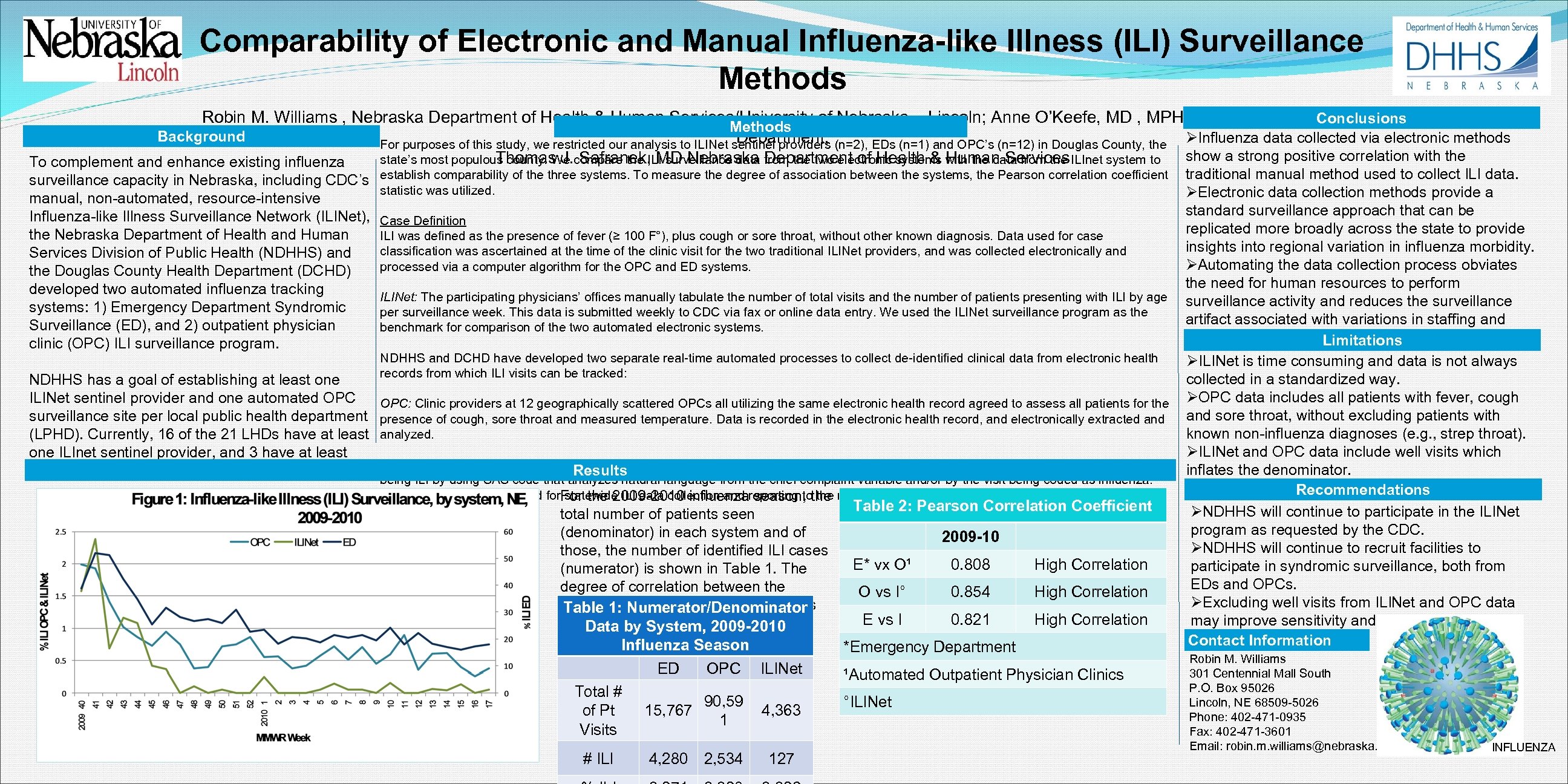
Comparability of Electronic and Manual Influenza-like Illness (ILI) Surveillance Methods Robin M. Williams , Nebraska Department of Health & Human Services/University of Nebraska – Lincoln; Anne O’Keefe, MD , MPH Douglas County Health Conclusions Methods Background Department; For purposes of this study, we restricted our analysis to ILINet sentinel providers (n=2), EDs (n=1) and OPC’s (n=12) in Douglas County, the ØInfluenza data collected via electronic methods show a strong positive correlation with the Thomas J. Safranek, MD Nebraska Department of Health & Human Services state’s most populous county. We compare the ILI surveillance data from the two electronic systems with the data from the ILInet system to To complement and enhance existing influenza surveillance capacity in Nebraska, including CDC’s manual, non-automated, resource-intensive Influenza-like Illness Surveillance Network (ILINet), the Nebraska Department of Health and Human Services Division of Public Health (NDHHS) and the Douglas County Health Department (DCHD) developed two automated influenza tracking systems: 1) Emergency Department Syndromic Surveillance (ED), and 2) outpatient physician clinic (OPC) ILI surveillance program. NDHHS has a goal of establishing at least one ILINet sentinel provider and one automated OPC surveillance site per local public health department (LPHD). Currently, 16 of the 21 LHDs have at least one ILInet sentinel provider, and 3 have at least one OPC site submitting data to NDHHS. traditional manual method used to collect ILI data. ØElectronic data collection methods provide a standard surveillance approach that can be replicated more broadly across the state to provide insights into regional variation in influenza morbidity. ØAutomating the data collection process obviates the need for human resources to perform ILINet: The participating physicians’ offices manually tabulate the number of total visits and the number of patients presenting with ILI by age surveillance activity and reduces the surveillance per surveillance week. This data is submitted weekly to CDC via fax or online data entry. We used the ILINet surveillance program as the artifact associated with variations in staffing and benchmark for comparison of the two automated electronic systems. training at ILINet physician offices. Limitations NDHHS and DCHD have developed two separate real-time automated processes to collect de-identified clinical data from electronic health ØILINet is time consuming and data is not always records from which ILI visits can be tracked: collected in a standardized way. OPC: Clinic providers at 12 geographically scattered OPCs all utilizing the same electronic health record agreed to assess all patients for the ØOPC data includes all patients with fever, cough presence of cough, sore throat and measured temperature. Data is recorded in the electronic health record, and electronically extracted and sore throat, without excluding patients with analyzed. known non-influenza diagnoses (e. g. , strep throat). ØILINet and OPC data include well visits which ED: All ED visits from one ED are processed to identify ILI using the chief complaint and ICD 9 code data variables. A visit is classified as inflates the denominator. Results being ILI by using SAS code that analyzes natural language from the chief complaint variable and/or by the visit being coded as influenza. Recommendations This same process is utilized for statewide ILI data collection and reporting to the national Distribute ILI tracking system. For the 2009 -2010 influenza season, the Table 2: Pearson Correlation Coefficient ØNDHHS will continue to participate in the ILINet total number of patients seen program as requested by the CDC. (denominator) in each system and of 2009 -10 ØNDHHS will continue to recruit facilities to those, the number of identified ILI cases E* vx O¹ 0. 808 High Correlation participate in syndromic surveillance, both from (numerator) is shown in Table 1. The EDs and OPCs. degree of correlation between the O vs I° 0. 854 High Correlation ØExcluding well visits from ILINet and OPC data electronic and manual data systems is Table 1: Numerator/Denominator E vs I 0. 821 High Correlation may improve sensitivity and specificity of those shown Figure 1 and Table 2. Data by System, 2009 -2010 tracking systems. Contact Information. Influenza Season *Emergency Department Robin M. Williams ED OPC ILINet 301 Centennial Mall South ¹Automated Outpatient Physician Clinics establish comparability of the three systems. To measure the degree of association between the systems, the Pearson correlation coefficient statistic was utilized. Case Definition ILI was defined as the presence of fever (≥ 100 F°), plus cough or sore throat, without other known diagnosis. Data used for case classification was ascertained at the time of the clinic visit for the two traditional ILINet providers, and was collected electronically and processed via a computer algorithm for the OPC and ED systems. Total # of Pt Visits # ILI 90, 59 15, 767 1 4, 280 2, 534 4, 363 127 °ILINet P. O. Box 95026 Lincoln, NE 68509 -5026 Phone: 402 -471 -0935 Fax: 402 -471 -3601 Email: robin. m. williams@nebraska. gov INFLUENZA
Скачать презентацию Comparability of Electronic and Manual Influenza-like Illness ILI
e0d939d08a47245c1e5edc3e2f15a38c.ppt