Скачать презентацию Company Presentation Summary Company profile
e6d2a890e68f916ce3e3dccd6832330a.ppt
- Количество слайдов: 41
 Company Presentation
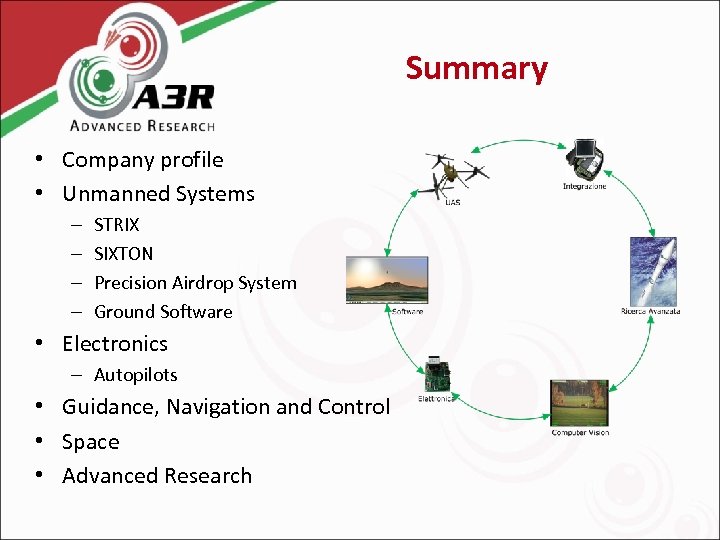 Summary • Company profile • Unmanned Systems – – STRIX SIXTON Precision Airdrop System Ground Software • Electronics – Autopilots • Guidance, Navigation and Control • Space • Advanced Research
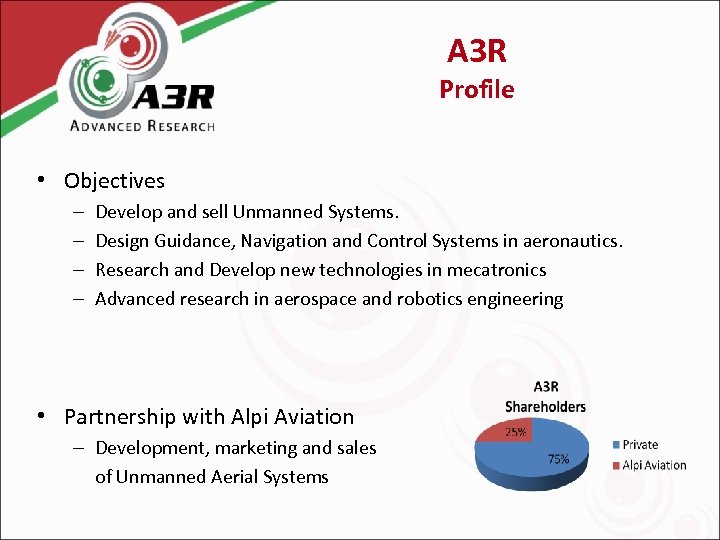 A 3 R Profile • Objectives – – Develop and sell Unmanned Systems. Design Guidance, Navigation and Control Systems in aeronautics. Research and Develop new technologies in mecatronics Advanced research in aerospace and robotics engineering • Partnership with Alpi Aviation – Development, marketing and sales of Unmanned Aerial Systems
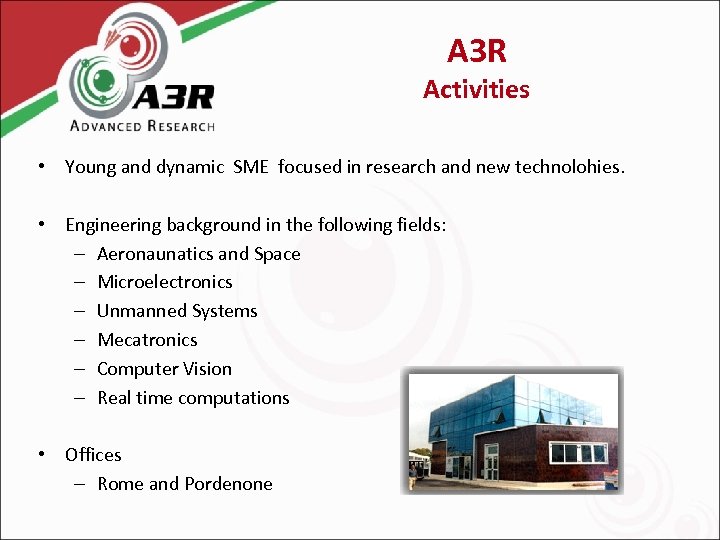 A 3 R Activities • Young and dynamic SME focused in research and new technolohies. • Engineering background in the following fields: – Aeronaunatics and Space – Microelectronics – Unmanned Systems – Mecatronics – Computer Vision – Real time computations • Offices – Rome and Pordenone
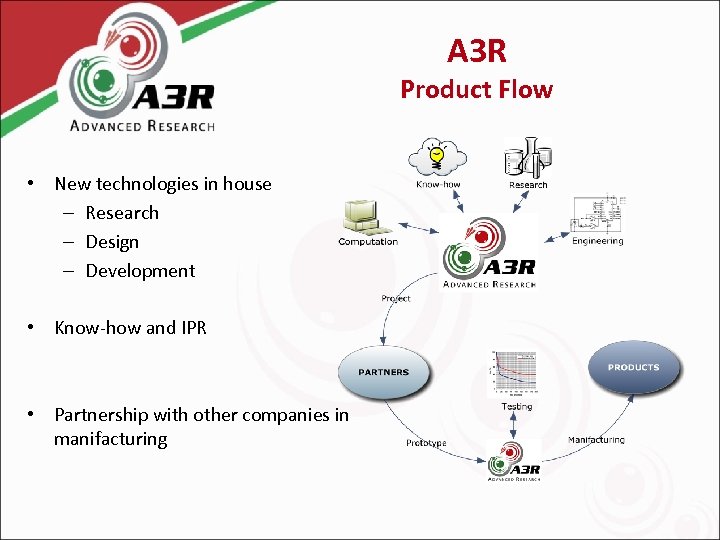 A 3 R Product Flow • New technologies in house – Research – Design – Development • Know-how and IPR • Partnership with other companies in manifacturing
 Unmanned Aerial Systems
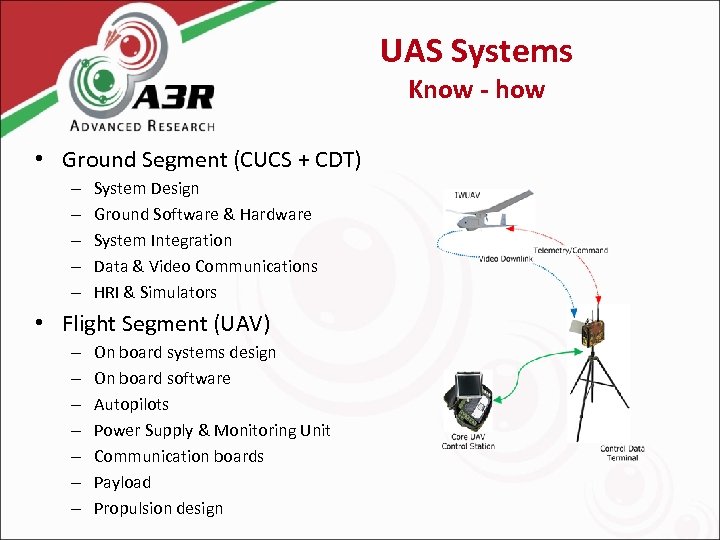 UAS Systems Know - how • Ground Segment (CUCS + CDT) – – – System Design Ground Software & Hardware System Integration Data & Video Communications HRI & Simulators • Flight Segment (UAV) – – – – On board systems design On board software Autopilots Power Supply & Monitoring Unit Communication boards Payload Propulsion design
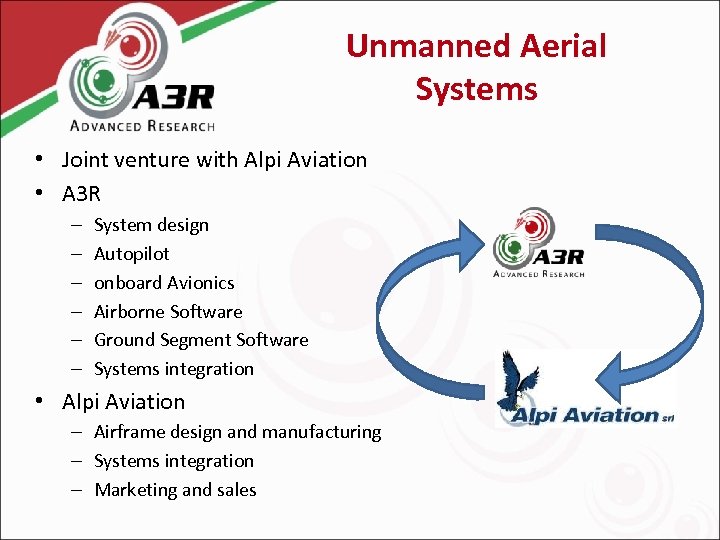 Unmanned Aerial Systems • Joint venture with Alpi Aviation • A 3 R – – – System design Autopilot onboard Avionics Airborne Software Ground Segment Software Systems integration • Alpi Aviation – Airframe design and manufacturing – Systems integration – Marketing and sales
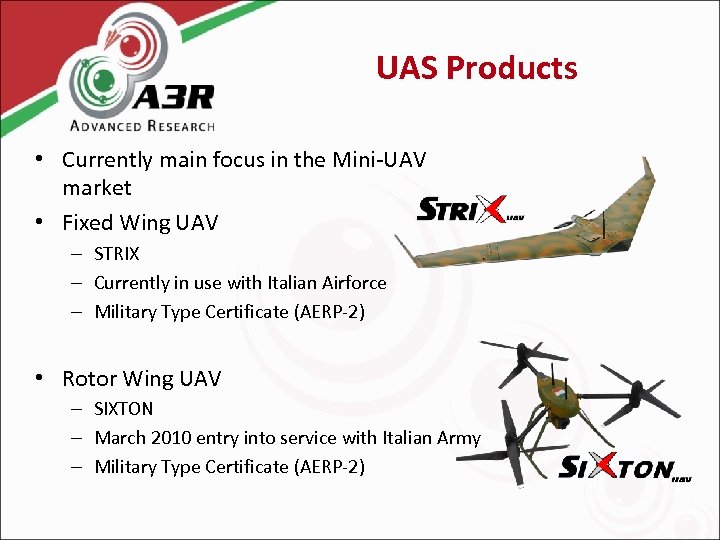 UAS Products • Currently main focus in the Mini-UAV market • Fixed Wing UAV – STRIX – Currently in use with Italian Airforce – Military Type Certificate (AERP-2) • Rotor Wing UAV – SIXTON – March 2010 entry into service with Italian Army – Military Type Certificate (AERP-2)
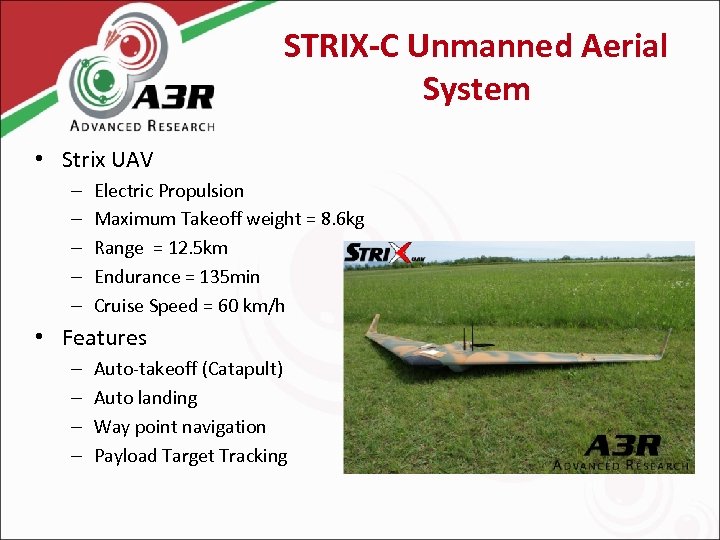 STRIX-C Unmanned Aerial System • Strix UAV – – – Electric Propulsion Maximum Takeoff weight = 8. 6 kg Range = 12. 5 km Endurance = 135 min Cruise Speed = 60 km/h • Features – – Auto-takeoff (Catapult) Auto landing Way point navigation Payload Target Tracking
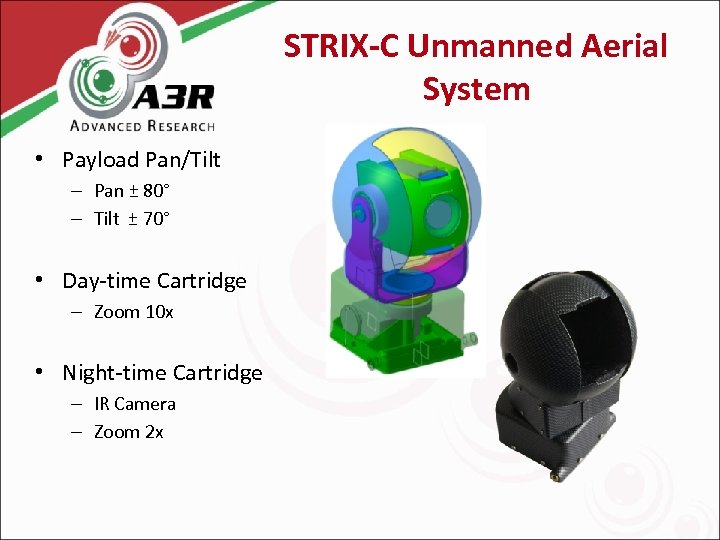 STRIX-C Unmanned Aerial System • Payload Pan/Tilt – Pan ± 80° – Tilt ± 70° • Day-time Cartridge – Zoom 10 x • Night-time Cartridge – IR Camera – Zoom 2 x
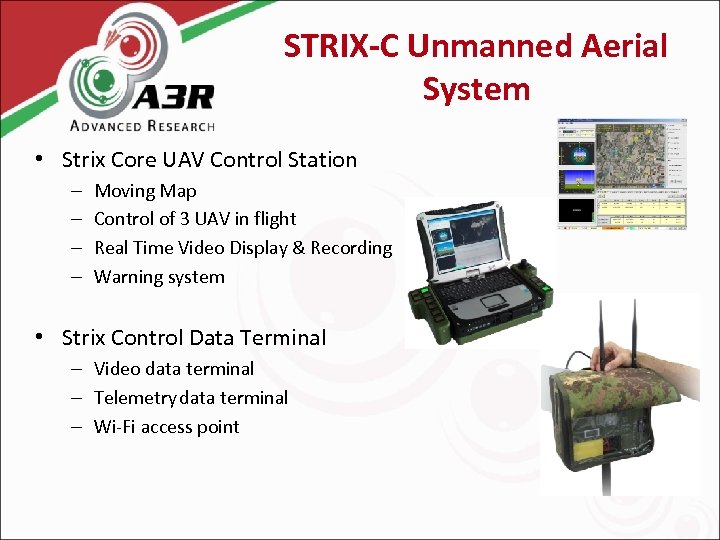 STRIX-C Unmanned Aerial System • Strix Core UAV Control Station – – Moving Map Control of 3 UAV in flight Real Time Video Display & Recording Warning system • Strix Control Data Terminal – Video data terminal – Telemetry data terminal – Wi-Fi access point
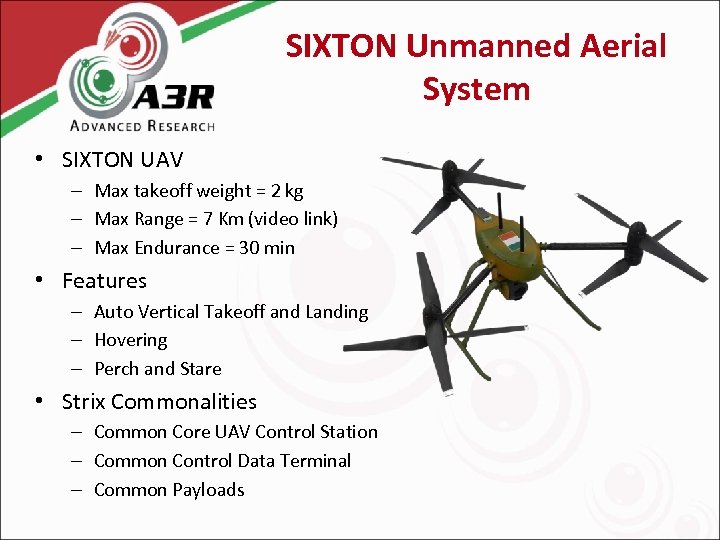 SIXTON Unmanned Aerial System • SIXTON UAV – Max takeoff weight = 2 kg – Max Range = 7 Km (video link) – Max Endurance = 30 min • Features – Auto Vertical Takeoff and Landing – Hovering – Perch and Stare • Strix Commonalities – Common Core UAV Control Station – Common Control Data Terminal – Common Payloads
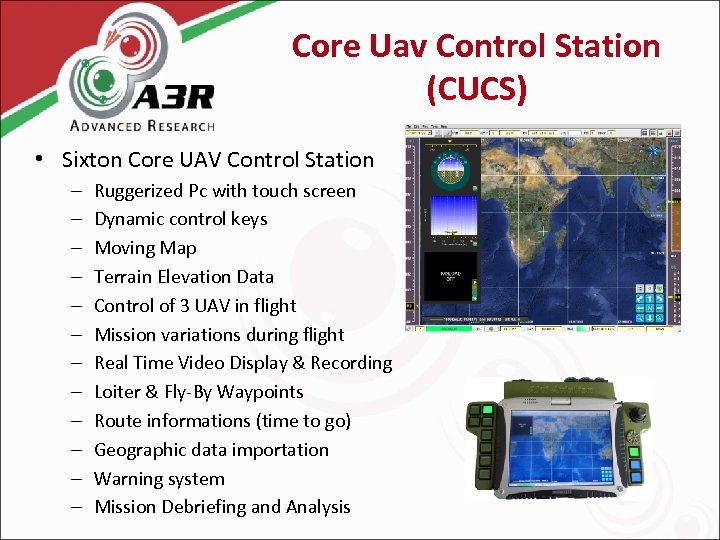 Core Uav Control Station (CUCS) • Sixton Core UAV Control Station – – – Ruggerized Pc with touch screen Dynamic control keys Moving Map Terrain Elevation Data Control of 3 UAV in flight Mission variations during flight Real Time Video Display & Recording Loiter & Fly-By Waypoints Route informations (time to go) Geographic data importation Warning system Mission Debriefing and Analysis
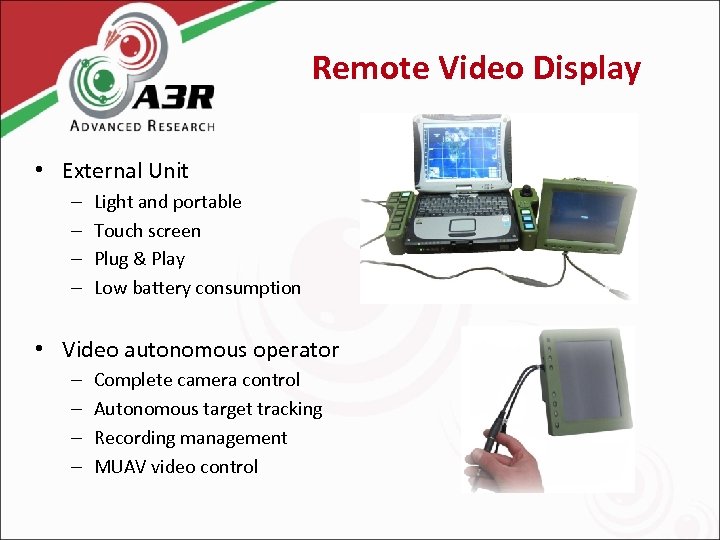 Remote Video Display • External Unit – – Light and portable Touch screen Plug & Play Low battery consumption • Video autonomous operator – – Complete camera control Autonomous target tracking Recording management MUAV video control
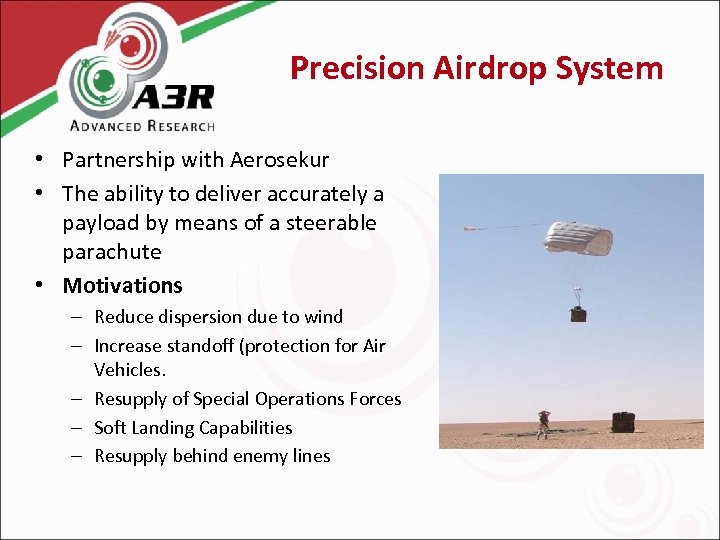 Precision Airdrop System • Partnership with Aerosekur • The ability to deliver accurately a payload by means of a steerable parachute • Motivations – Reduce dispersion due to wind – Increase standoff (protection for Air Vehicles. – Resupply of Special Operations Forces – Soft Landing Capabilities – Resupply behind enemy lines
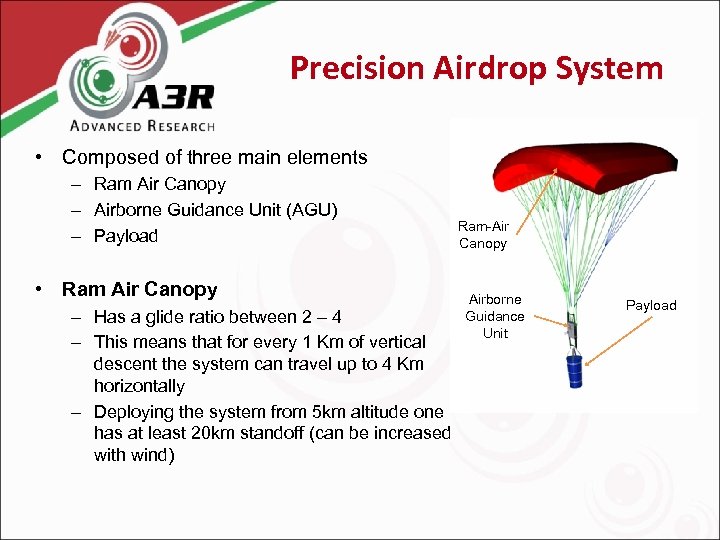 Precision Airdrop System • Composed of three main elements – Ram Air Canopy – Airborne Guidance Unit (AGU) – Payload • Ram Air Canopy – Has a glide ratio between 2 – 4 – This means that for every 1 Km of vertical descent the system can travel up to 4 Km horizontally – Deploying the system from 5 km altitude one has at least 20 km standoff (can be increased with wind) Ram-Air Canopy Airborne Guidance Unit Payload
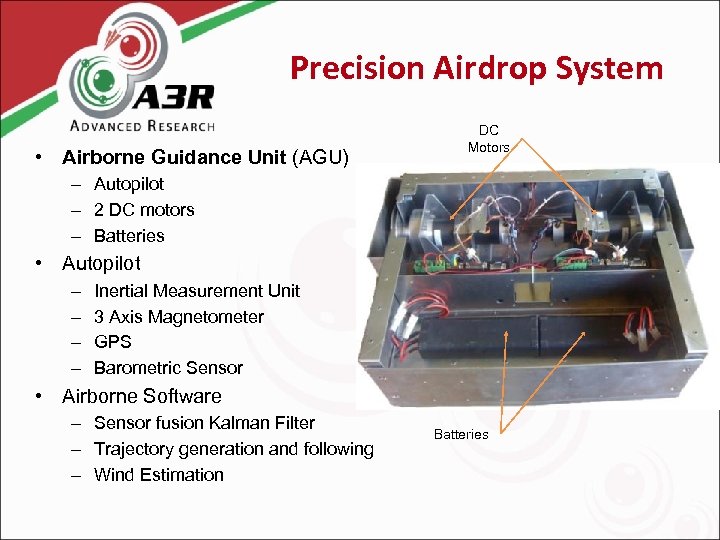 Precision Airdrop System • Airborne Guidance Unit (AGU) DC Motors – Autopilot – 2 DC motors – Batteries • Autopilot – – Inertial Measurement Unit 3 Axis Magnetometer GPS Barometric Sensor • Airborne Software – Sensor fusion Kalman Filter – Trajectory generation and following – Wind Estimation Batteries
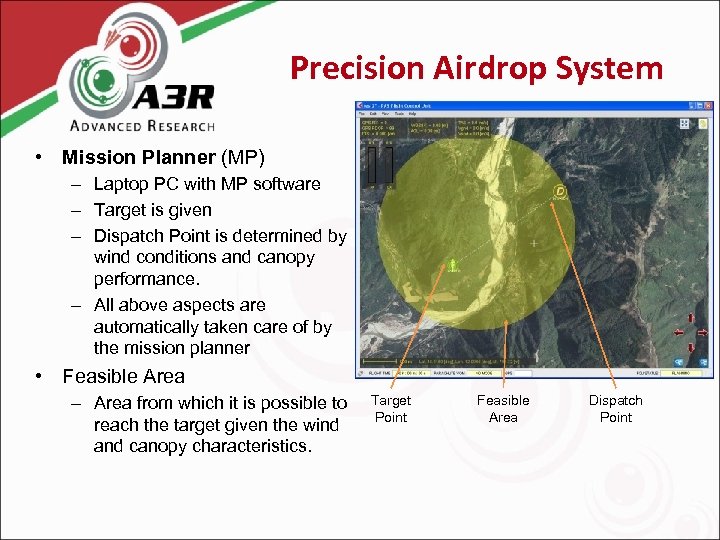 Precision Airdrop System • Mission Planner (MP) – Laptop PC with MP software – Target is given – Dispatch Point is determined by wind conditions and canopy performance. – All above aspects are automatically taken care of by the mission planner • Feasible Area – Area from which it is possible to reach the target given the wind and canopy characteristics. Target Point Feasible Area Dispatch Point
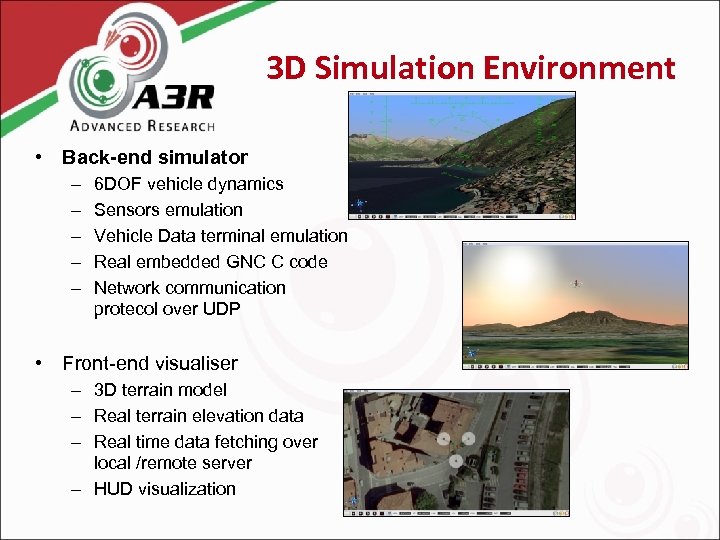 3 D Simulation Environment • Back-end simulator – – – 6 DOF vehicle dynamics Sensors emulation Vehicle Data terminal emulation Real embedded GNC C code Network communication protecol over UDP • Front-end visualiser – 3 D terrain model – Real terrain elevation data – Real time data fetching over local /remote server – HUD visualization
 Guidance, Navigation and Control
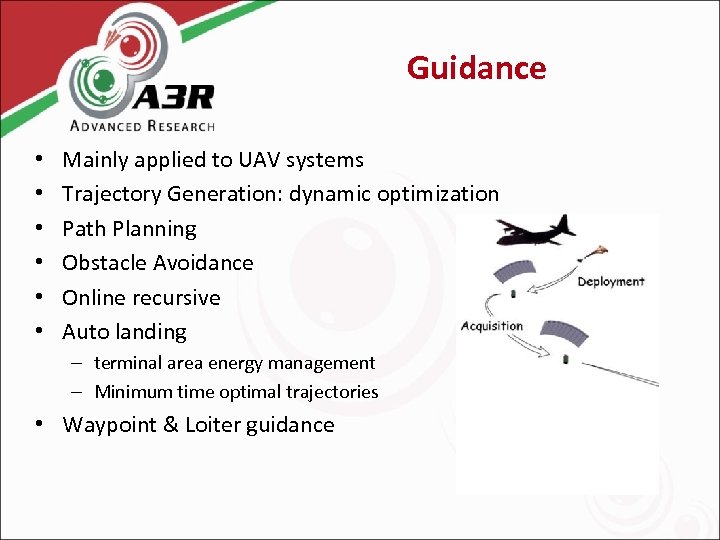 Guidance • • • Mainly applied to UAV systems Trajectory Generation: dynamic optimization Path Planning Obstacle Avoidance Online recursive Auto landing – terminal area energy management – Minimum time optimal trajectories • Waypoint & Loiter guidance
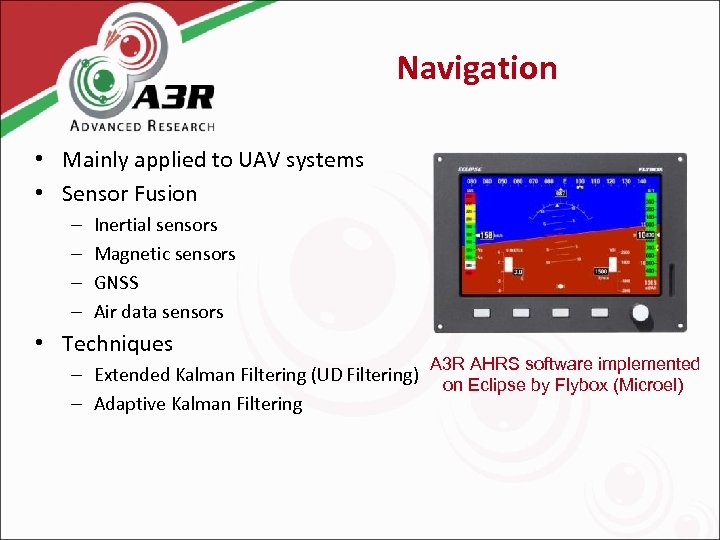 Navigation • Mainly applied to UAV systems • Sensor Fusion – – Inertial sensors Magnetic sensors GNSS Air data sensors • Techniques – Extended Kalman Filtering (UD Filtering) – Adaptive Kalman Filtering A 3 R AHRS software implemented on Eclipse by Flybox (Microel)
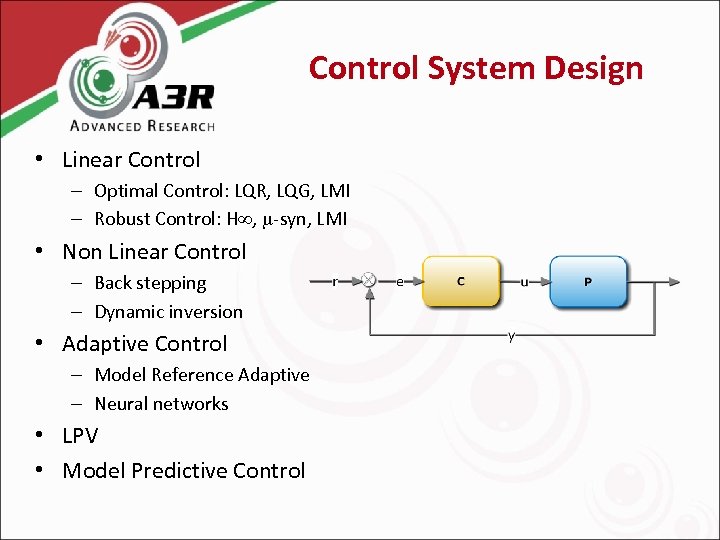 Control System Design • Linear Control – Optimal Control: LQR, LQG, LMI – Robust Control: H , -syn, LMI • Non Linear Control – Back stepping – Dynamic inversion • Adaptive Control – Model Reference Adaptive – Neural networks • LPV • Model Predictive Control
 Electronics
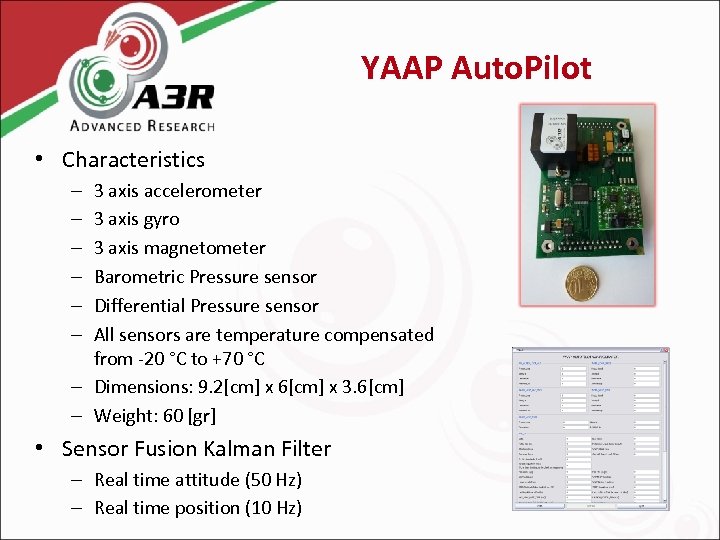 YAAP Auto. Pilot • Characteristics 3 axis accelerometer 3 axis gyro 3 axis magnetometer Barometric Pressure sensor Differential Pressure sensor All sensors are temperature compensated from -20 °C to +70 °C – Dimensions: 9. 2[cm] x 6[cm] x 3. 6[cm] – Weight: 60 [gr] – – – • Sensor Fusion Kalman Filter – Real time attitude (50 Hz) – Real time position (10 Hz)
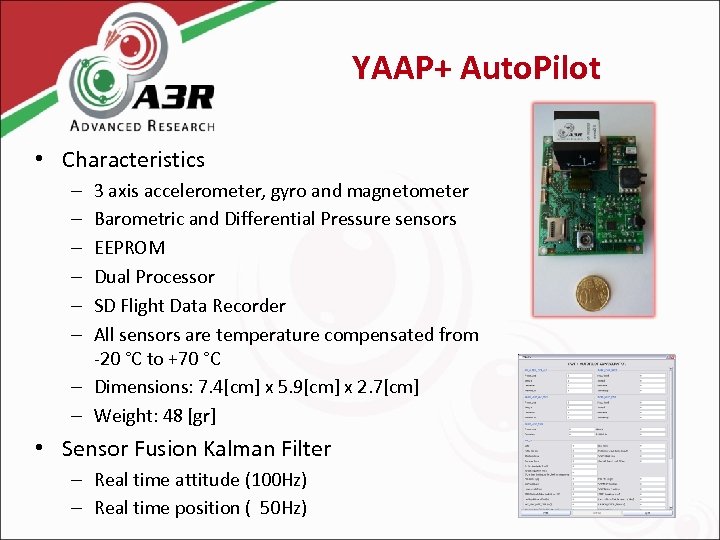 YAAP+ Auto. Pilot • Characteristics 3 axis accelerometer, gyro and magnetometer Barometric and Differential Pressure sensors EEPROM Dual Processor SD Flight Data Recorder All sensors are temperature compensated from -20 °C to +70 °C – Dimensions: 7. 4[cm] x 5. 9[cm] x 2. 7[cm] – Weight: 48 [gr] – – – • Sensor Fusion Kalman Filter – Real time attitude (100 Hz) – Real time position ( 50 Hz)
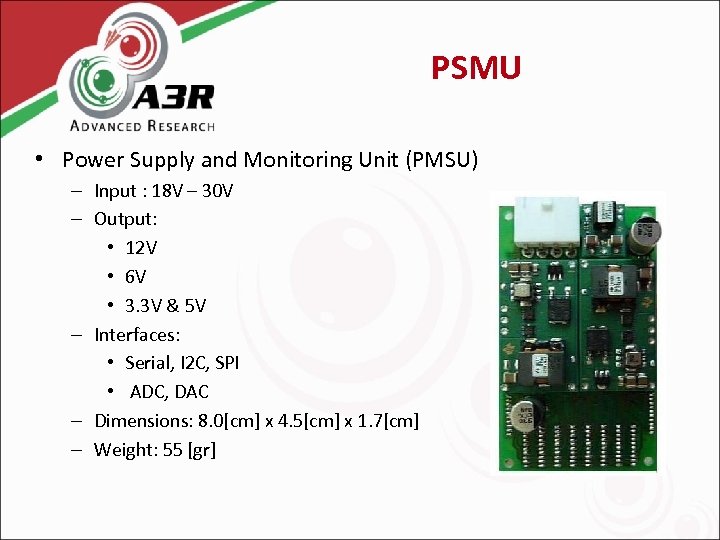 PSMU • Power Supply and Monitoring Unit (PMSU) – Input : 18 V – 30 V – Output: • 12 V • 6 V • 3. 3 V & 5 V – Interfaces: • Serial, I 2 C, SPI • ADC, DAC – Dimensions: 8. 0[cm] x 4. 5[cm] x 1. 7[cm] – Weight: 55 [gr]
 Space
Space
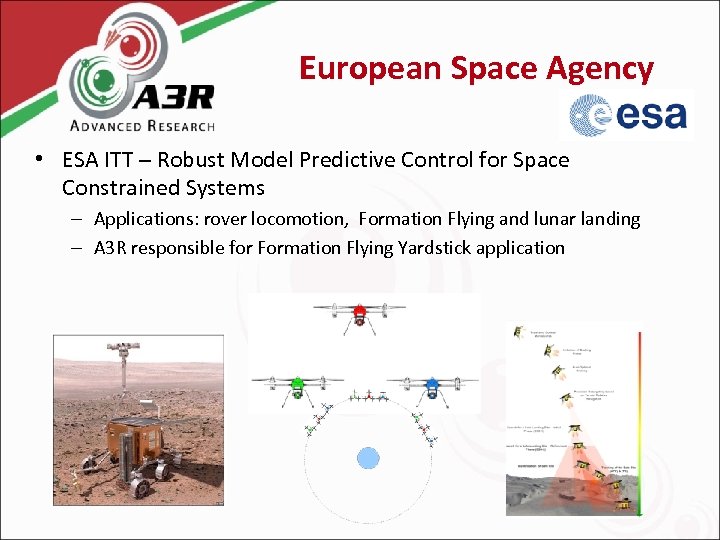 European Space Agency • ESA ITT – Robust Model Predictive Control for Space Constrained Systems – Applications: rover locomotion, Formation Flying and lunar landing – A 3 R responsible for Formation Flying Yardstick application
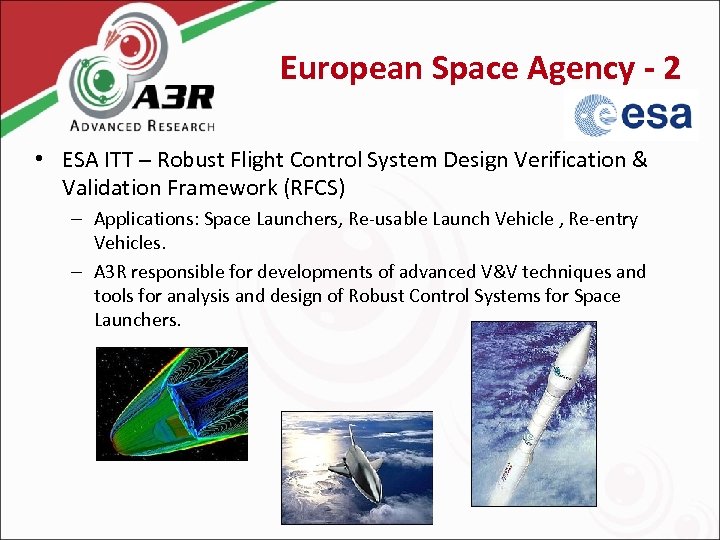 European Space Agency - 2 • ESA ITT – Robust Flight Control System Design Verification & Validation Framework (RFCS) – Applications: Space Launchers, Re-usable Launch Vehicle , Re-entry Vehicles. – A 3 R responsible for developments of advanced V&V techniques and tools for analysis and design of Robust Control Systems for Space Launchers.
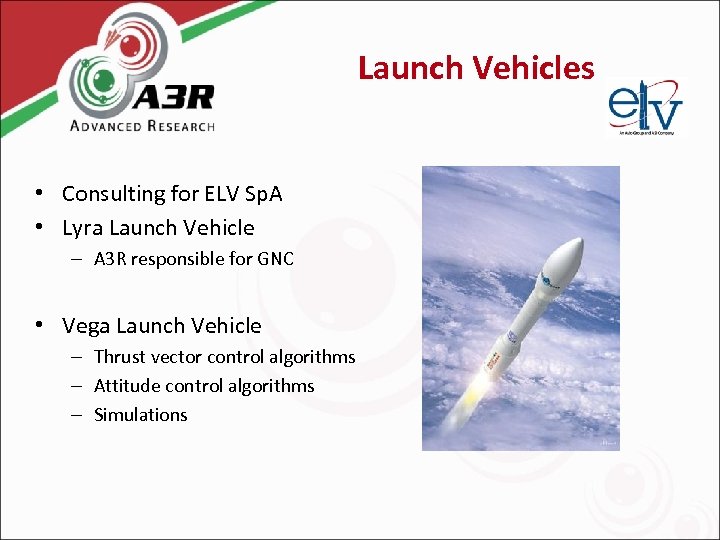 Launch Vehicles • Consulting for ELV Sp. A • Lyra Launch Vehicle – A 3 R responsible for GNC • Vega Launch Vehicle – Thrust vector control algorithms – Attitude control algorithms – Simulations
 Advanced Research
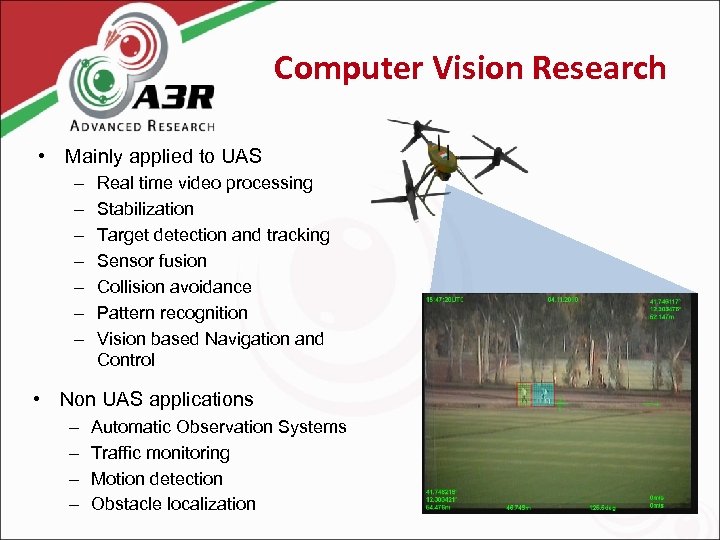 Computer Vision Research • Mainly applied to UAS – – – – Real time video processing Stabilization Target detection and tracking Sensor fusion Collision avoidance Pattern recognition Vision based Navigation and Control • Non UAS applications – – Automatic Observation Systems Traffic monitoring Motion detection Obstacle localization
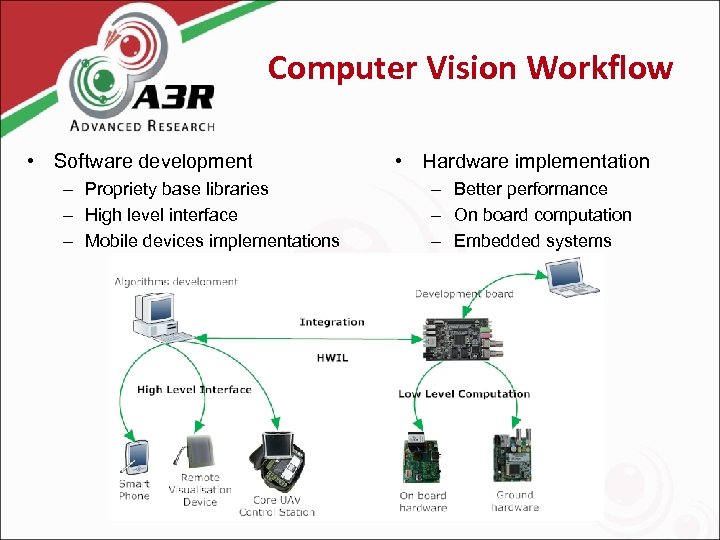 Computer Vision Workflow • Software development – Propriety base libraries – High level interface – Mobile devices implementations • Hardware implementation – Better performance – On board computation – Embedded systems
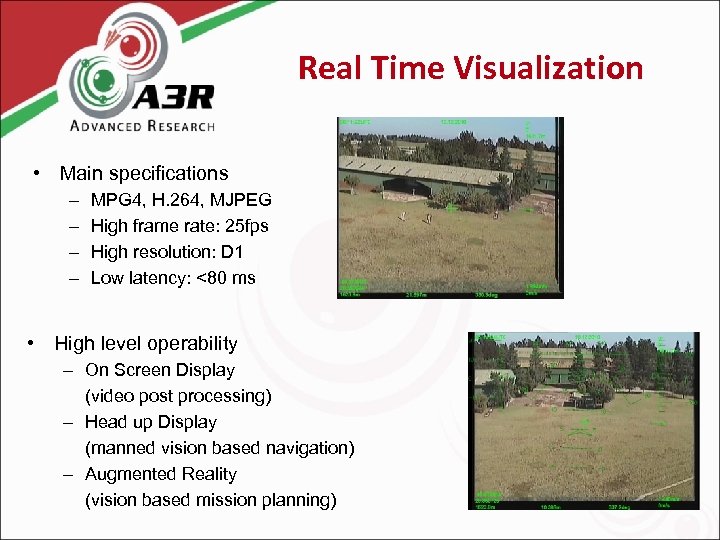 Real Time Visualization • Main specifications – – MPG 4, H. 264, MJPEG High frame rate: 25 fps High resolution: D 1 Low latency: <80 ms • High level operability – On Screen Display (video post processing) – Head up Display (manned vision based navigation) – Augmented Reality (vision based mission planning)
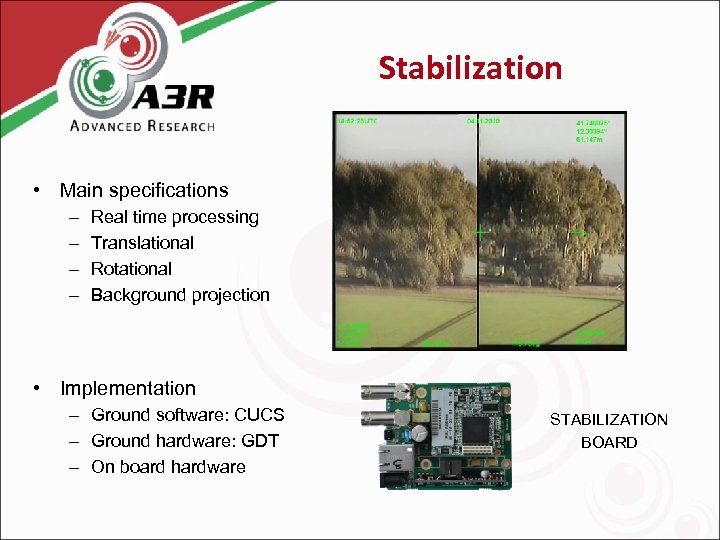 Stabilization • Main specifications – – Real time processing Translational Rotational Background projection • Implementation – Ground software: CUCS – Ground hardware: GDT – On board hardware STABILIZATION BOARD
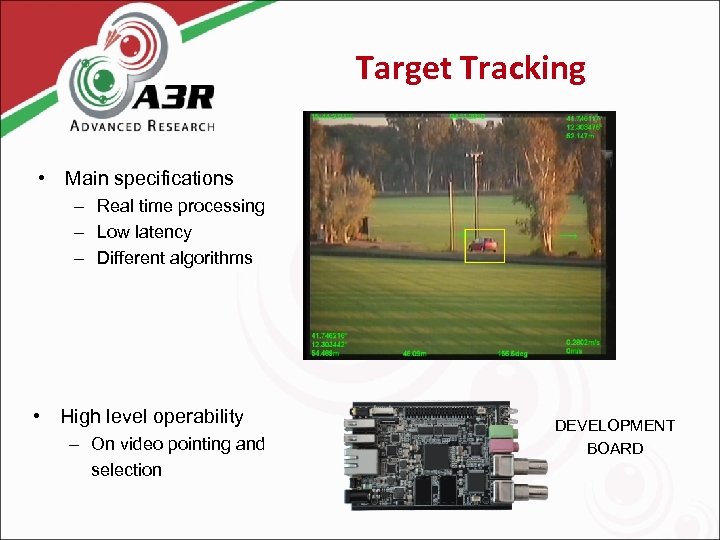 Target Tracking • Main specifications – Real time processing – Low latency – Different algorithms • High level operability – On video pointing and selection DEVELOPMENT BOARD
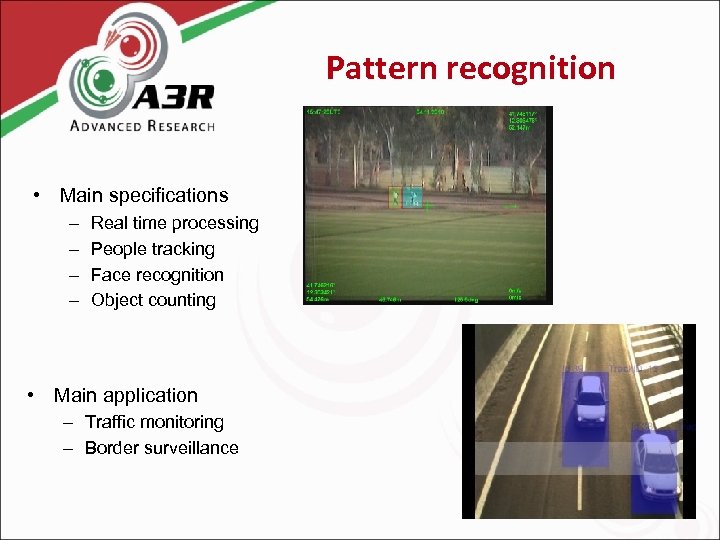 Pattern recognition • Main specifications – – Real time processing People tracking Face recognition Object counting • Main application – Traffic monitoring – Border surveillance
 Conclusions