


 Скачать презентацию Company Overview and Risk Management Analysis Kyle Jones
57e4024a585953179dbc62d9d3224b84.ppt
- Количество слайдов: 110
 Company Overview and Risk Management Analysis Kyle Jones Maggie Liang Yang Wu Rui (Richie) Zhang
 Agenda 1. Economic and Market Analysis 2. Financial Statements and Analysis 3. Risk Factors and Risk Management 4. Derivatives and Securities
 #1 Economic & Market Analysis
 Company Overview • Leading global investment banking securities and investment management firm • Provides a wide range of financial services • As of December 2014, had offices in over 30 countries • 49% of their total staff was based outside the Americas • 42% of their net revenues outside the Americas.
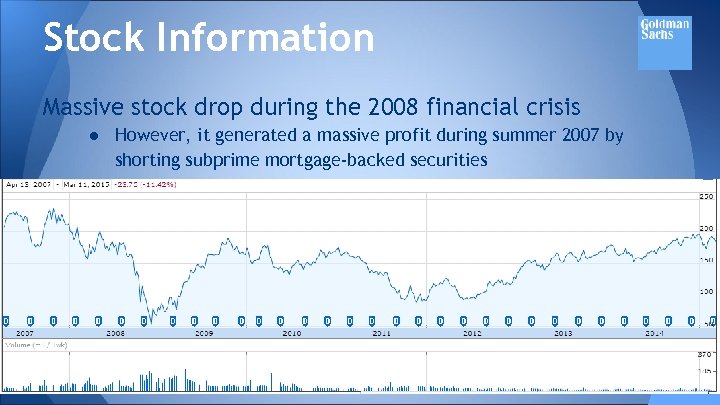 Stock Information Massive stock drop during the 2008 financial crisis ● However, it generated a massive profit during summer 2007 by shorting subprime mortgage-backed securities
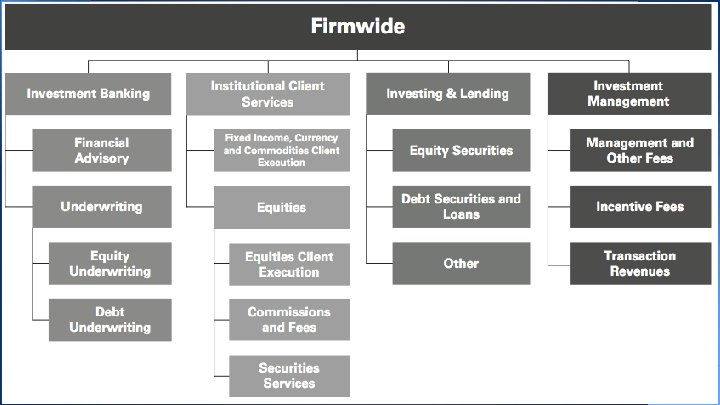
 Investment Banking (IB) • Serve corporate and government clients around the world • Provide financial advisory services • Help companies raise capital • Try to develop and maintain long term relationships • Goal: deliver to the clients the entire resources of the firm Investment Banking
 Financial Advisory • • Strategic advisory assignments Help clients execute large, complex transactions Revenues from derivative transactions Assist the clients in managing their asset and liability exposure and their capital • Provide lending commitments and bank loan • Bridge loan facilities Investment Banking
 Underwriting • Helping companies raise capital to fund their businesses • Match the capital of the investing clients with the needs of the client • Public offerings and private placements • Revenues from derivative transactions Investment Banking
 Equity Underwriting Leading position in: • Worldwide public common stock offerings • Worldwide initial public offerings Investment Banking
 Debt Underwriting • • • Investment-grade High yield debt Bank loans Bridge loans Emerging and growth-market debt Structured securities (mortgage-related securities) Investment Banking
 Institutional Client Services • Helps clients to buy and sell financial products, raise funding and manage risk • Acts as a market maker • Offers market expertise • Makes markets and facilitates client transactions in: o o Fixed income & Equity Currency & Commodity products Institutional Client Services
 Institutional Client Services(2) • • • Clear client transactions Provides liquidity Play a critical role in price discovery (efficiency of the capital markets) • Willingness to make markets is crucial • Relationships with clients are maintained • Prices to clients globally are provided Institutional Client Services
 Institutional Client Services (3) Four ways to generate revenues: • In large, highly liquid markets: high volume of transactions for modest spread and fees • In less liquid markets: transactions for spread and fees somewhat larger • Customized or tailor-made products that address the client's risk exposures • Financing to the clients is provided Institutional Client Services
 Institutional Client Services (4) The activities are organized by asset class including: ● Cash instruments: trading the underlying instrument ● Derivative: instruments that derive their value Institutional Client Services
 Fixed Income, Currency and Commodities Client Execution (1) Equities client execution: • Facilitates client transactions by providing liquidity with large blocks of stocks or options • Engagement in insurance activities • Structure and execute derivatives on indices, industry groups, financial measures and individual company stocks • Developing of strategies and portfolio hedging and restructuring • Asset allocation transactions • Creation of tailored instruments to establish or undertake hedging strategies Institutional Client Services
 Fixed Income, Currency and Commodities Client Execution (2) Commissions and fees: • Generated from executing and clearing institutional client transactions on major stock, options and futures • Access to electronic “low touch” equity trading platforms • Most of the revenues continued to be derived from the “high-touch” handling Institutional Client Services
 Fixed Income, Currency and Commodities Client Execution (3) Securities services: • Financial services: through margin loans collateralized by securities and cash or collateral • Securities lending services: borrowing and lending securities • Other prime brokerage services: technology platform is provided, custody services Institutional Client Services
 Investing and Lending • • • Long-term activities Investing directly in publicly and privately traded securities and loans Managing diversified global portfolio of investments in equity securities and debt Investment in the ordinary shares of ICBC Equity-related investments Investing & Lending
 Investing and Lending Corporate, infrastructure debt investments: • Credit to corporate clients through loan facilities • Investment entities with a defined exit strategy not related to the principal businesses • Invest in distressed assets Investing & Lending
 Investment Management • • • Provides investment and wealth advisory services to help clients preserve and grow their financial assets Managing client assets Income and liability management Trust and estate planning Philanthropic giving and tax planning Use of global securities to address the clients' needs Investment Management
 Management and Other Fees • Fees vary by asset class and affected by investment performance, asset inflows and redemptions • Assets under management • Incentive fees (when a return exceeds a specific benchmark) Investment Management
 Business Continuity Program • • • Firmwide Business continuity and information security are high priorities Key elements of the program: Crisis planning and management People recovery Business recovery System and data recovery Process improvement
 Employees and Competition • Quality, commitment, professionalism, excellence, diversity, cooperation are the keys of success • Competitors are other entities that provide investment banking, securities and investment management services (brokers, dealers, investment advisors) • Advantages are taken from competing successfully with larger financial institutions (which have more capital and stronger local presence) Firmwide
 Competition • Price competition • Competition in attracting and retaining qualified employees • Dodd-Frank Act: enacted in July 2010 which provides extension on the rules adopted by the fed board • Supervision and examination by the fed board
 Regulation • BHC Act restricts bank holding companies from engaging in business activities • Fed board has the authority to limit the ability to conduct activities and it is necessary its approval before engaging in financial activities • The Volker Rule prohibits “proprietary trading” sponsorship and investment in hedge funds Regulation
 The Volker Rule • Is expected to limit certain kind of transactions with the sponsored funds • Many aspects remain unclear and very complex • In October 2011 the rules to implement the Volker Rule were issued • The Volker Rule limitation on investments in hedge funds and private equity funds required to reduce investments to 3% or less Regulation
 Capital and Liquidity Requirements • As a bank holding company, Goldman Sachs is subject to consolidated regulatory capital requirements by fed board Regulation
 Changes in Capital Requirements (1) • Changes to the market risk capital rules became effective on January 1, 2013 and these require the addition of new model based capital requirements • Basel 2 revises the regulatory capital framework for credit risk and equity investments and will be adopted once the regulators will approve GS to do so Regulation
 Changes in Capital Requirements (2) • “The Collins Amendment” of the Dodd-Frank Act requires advanced approach banking organization to continue upon adoption of Basel 2 to calculate riskbased capital ratios under both Basel 2 and the fed reserve board's risk-based capital requirements Regulation
 Changes in Capital Requirements (3) • • • Regulation More stringent capital standards: New Basel 3 requirements In December 2011 the fed board proposed rules to implement the enhanced prudential standards contemplate by the Dodd-frank Act which may affect if finalized, the ability of GS to transact or hedge
 Payment of Dividends and Stock Repurchases • Subject to the oversight of the fed board based on capital plans and stress tests to judge the capital planning processes • GS not object to its capital actions through the first quarter of 2013 Regulation
 Compensation Practices • • • Regulation Oversight by the fed board Risk must be taken in account Incentives that balance risk and financial results Review of the incentive compensation policies Enforcement actions taken against the risk of the organization's safety caused by related risk management If the regulations are adopted the flexibility will be restricted
 Regulation of GS Bank USA • Undertake stress test is required, according to Doddfrank act and submit them to the fed board • “Derivative push-out” will prevent GS from conducting certain swaps-related activities • Transactions between GS bank USA and its subsidiaries are regulated by the fed board Regulation
 Prompt Corrective Actions and Capital Ratios • The US Federal Deposit Insurance Corporation Improvement Act of 1991 (FDCIA) establishes 5 capital categories: • Well-capitalized depositary institution: if it has a tier 1 capital ratio of at least 6%, a total capital ratio of at least 10% and a tier 1 leverage ratio of at least 5% • • Adequately capitalized Undercapitalized Significantly undercapitalized Critically undercapitalized Regulation
 Insolvency of an Insured Depository Institution • Transfer the depository institution's assets and liabilities to a new obligor • Enforce the terms of the depository institution's contracts • Repudiation of any contracts to which the institution is a Party • Resolution plan: submitted to the regulators on June 29, 2012, which established GS bank USA is protected from risks Regulation
 Broker-Dealer and Securities Regulation • It is required to maintain orderly markets in the securities assigned • According to the Dodd-Frank Act, any person who organizes an asset-backed security transaction to retain a portion of any credit risk that the person conveys with a third party Regulation
 Swap, Derivatives and Commodities Regulations • Subject to regulation of us commodity exchange act • The Dodd-frank act provides increased regulation, imposing the following requirements: ◆ Real time public and regulatory reporting of trade information for swaps Registration of swap dealers ◆ Position limits the cap exposure to derivatives on certain physical commodities ◆ Mandated clearing through central counterparties for certain swaps ◆ New business conduct standards for swap dealers ◆ Margin requirements for trades that are not cleared ◆ Entity level capital requirements for swap dealers Regulation
 Other Regulations Some examples. . . • Insurance subsidiaries: subject to state insurance regulation in the states in which they are domiciled • Investment management: subject to significant regulation in numerous jurisdictions around the world Regulation
 Risk Environment GS faces a variety of risks in the operation of their business, such as: ● ● Market uncertainty and global financial markets conditions Regulation in jurisdictions around the world Declining asset values particularly those assets with long position. Credit spreads and declines in the availability of credit will affected our ability to borrow on a secured and unsecured basis ● Poor investment performance and ineffective risk management ● Failure to appropriately identify and address potential conflicts of interest ● Catastrophic events such as terrorist attacks Risk Environment
 Market Uncertainty ● The firm does not produce predictable earnings, and is affected by conditions in the global financial markets and economic conditions in the environment that the firm operates in. ● Favourable environment: high global GDP growth; transparent, liquid and efficient capital markets; low inflation; high business and investor confidence, stable geopolitical conditions; regulatory certainty; and strong business earnings. ● Unfavourable environment: concerns about sovereign defaults; uncertainty in U. S. federal fiscal or monetary policy; uncertainty about the timing and nature of regulatory reforms; declines in economic growth; increases in inflation, interest rates, exchange rate volatility, default rates or the price of basic commodities; etc. Risk Environment
 Global Regulations ● The firm faces the risk of significant intervention by regulatory and taxing authorities in all jurisdictions in which they conduct business. ● The firm could be: ○ fined; ○ prohibited from engaging in business activities, subject to limitations or conditions ○ subjected to new or substantially higher taxes or other governmental charges ○ etc. Risk Environment
 #2 Financial Statements and Analysis
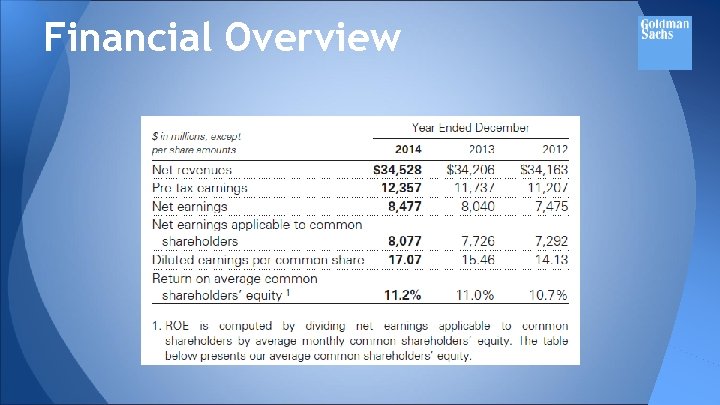 Financial Overview
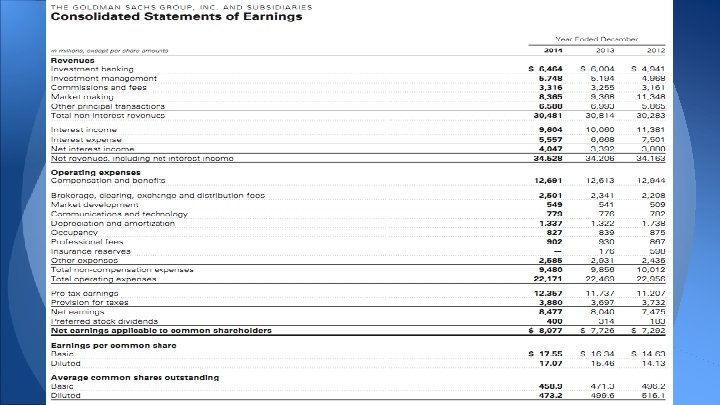
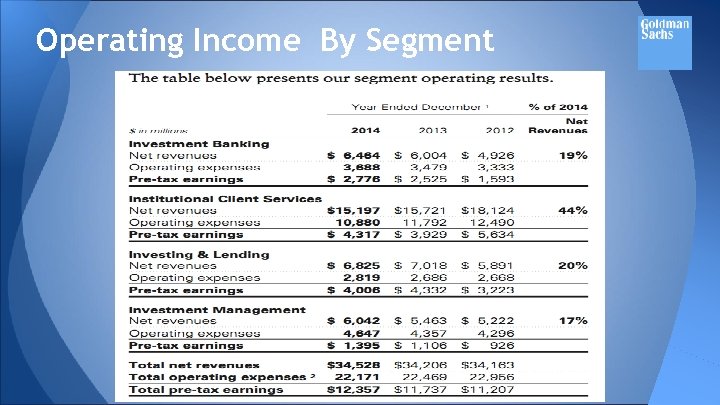 Operating Income By Segment
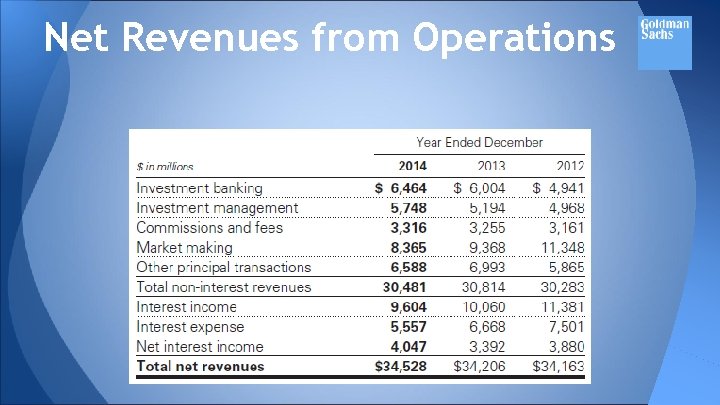 Net Revenues from Operations
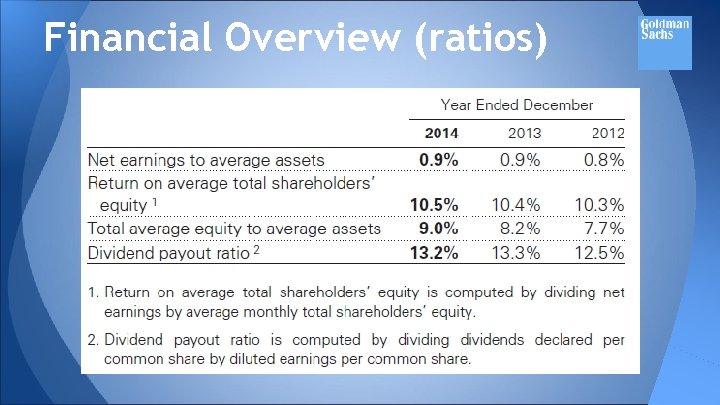 Financial Overview (ratios)
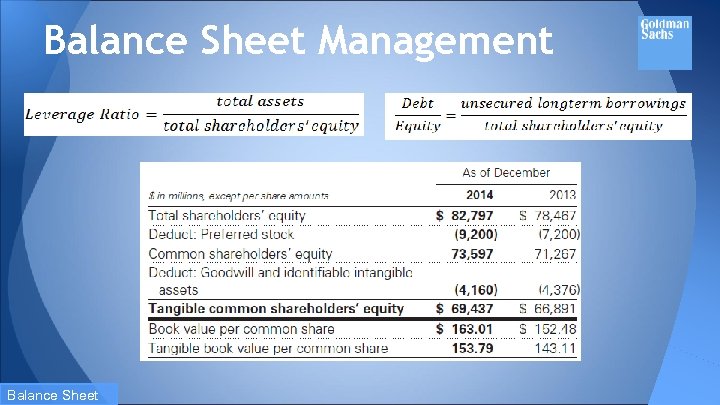
 Balance Sheet Management One of the most important risk management disciplines is the firm’s ability to manage the size and composition of their balance sheet. The size and composition of the balance sheet reflects: 1. the firm’s overall risk tolerance, 2. the firm’s ability to access stable funding sources and 3. the amount of equity capital the firm holds. Balance Sheet
 Balance Sheet Management During 2014, the firm undertook an initiative to reduce their balance sheet in response to regulatory developments, to improve the overall efficiency of the balance sheet and to position the firm to provide additional risk capacity to clients. Balance Sheet
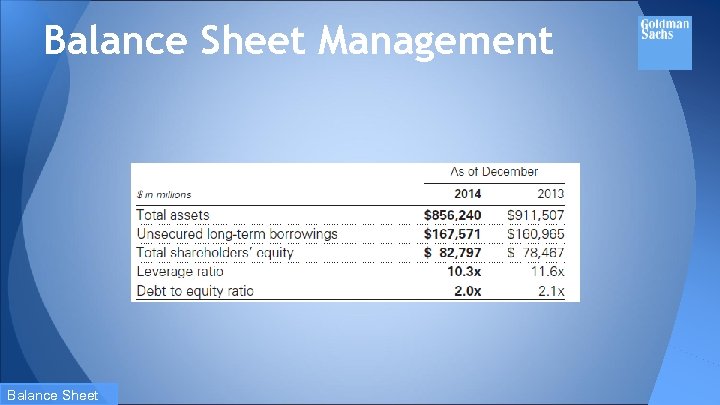 Balance Sheet Management Balance Sheet
 Balance Sheet Management Balance Sheet
 Funding Sources The firm’s primary sources of funding are : ● secured financings ● unsecured long-term ● short-term borrowings ● deposits Balance Sheet
 Unsecured Long-Term Borrowing Balance Sheet
 Capital Adequacy Objective: conservatively capitalized in terms of the amount and composition of their equity base, both relative to their risk exposures and compared to external requirements and benchmarks.
 Capital Framework (1) ● As of January 1, 2014, the firm became subject to the Federal Reserve Board’s revised risk-based capital and leverage regulations, known as the Revised Capital Framework (RCF) ○ Regulatory capital to be calculated under the Revised Capital Framework ● Risk weighted assets (RWAs) are required to be calculated under Basel III advanced rules Capital Framework
 Capital Framework (2) ● As a result of the change in framework during 2014, the capital ratios calculated as of December 2014 and December 2013 are not directly comparable Capital Framework
 Risk Weighted Assets (RWAs) ● Calculated under both Basel III Advanced Rules and Hybrid Capital Rules ○ Under both, certain amounts not required to be deducted from CET 1 under the transitional provisions are either deducted from Tier 1 capital or are risk weighted Capital Framework
 Capital Conservation Buffer Mandatory capital that Goldman Sachs is required to hold ● The amount is to increase in increments of 0. 625% per year, starting on January 1, 2016, until it reaches 2. 5% of all RWAs This has been mandated due to the 2008 financial crisis where banks held insufficient capital on hand Capital Framework
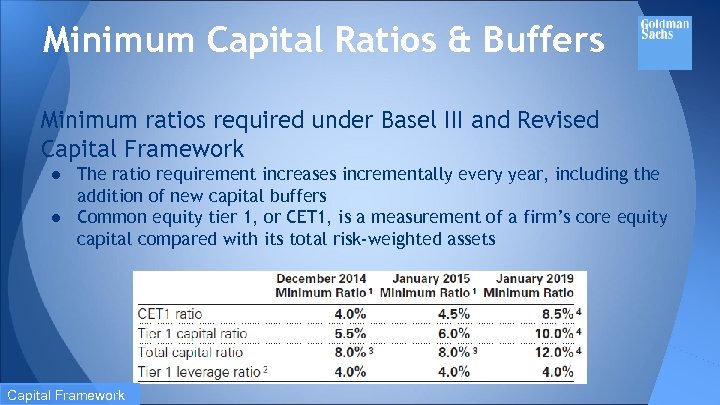 Minimum Capital Ratios & Buffers Minimum ratios required under Basel III and Revised Capital Framework ● The ratio requirement increases incrementally every year, including the addition of new capital buffers ● Common equity tier 1, or CET 1, is a measurement of a firm’s core equity capital compared with its total risk-weighted assets Capital Framework
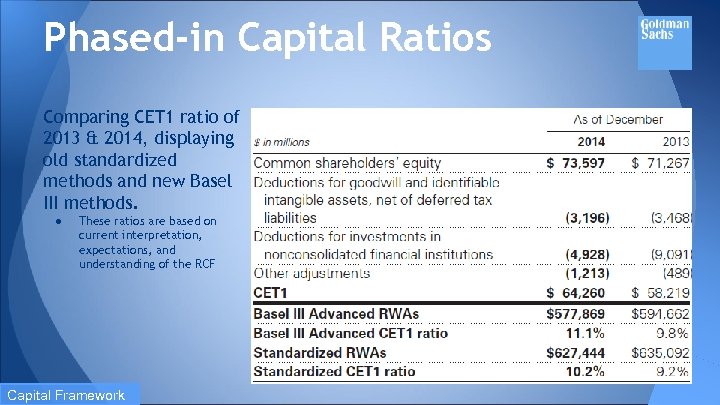 Phased-in Capital Ratios Comparing CET 1 ratio of 2013 & 2014, displaying old standardized methods and new Basel III methods. ● These ratios are based on current interpretation, expectations, and understanding of the RCF Capital Framework
 #2 Risk Factors and Risk Management
 Risk Factors The four main risk categories that Goldman Sachs faces in their operations are: ● Liquidity Risk ● Market Risk ● Credit Risk ● Operational Risk Goldman Sachs also faces risk which have uncertain outcomes and have the potential to materially impact their financial results, liquidity and reputation.
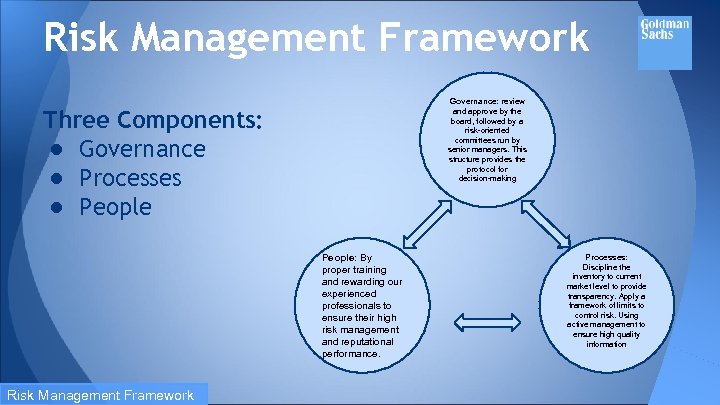 Risk Management Framework Governance: review and approve by the board, followed by a risk-oriented committees run by senior managers. This structure provides the protocol for decision-making Three Components: ● Governance ● Processes ● People: By proper training and rewarding our experienced professionals to ensure their high risk management and reputational performance. Risk Management Framework Processes: Discipline the inventory to current market level to provide transparency. Apply a framework of limits to control risk. Using active management to ensure high quality information
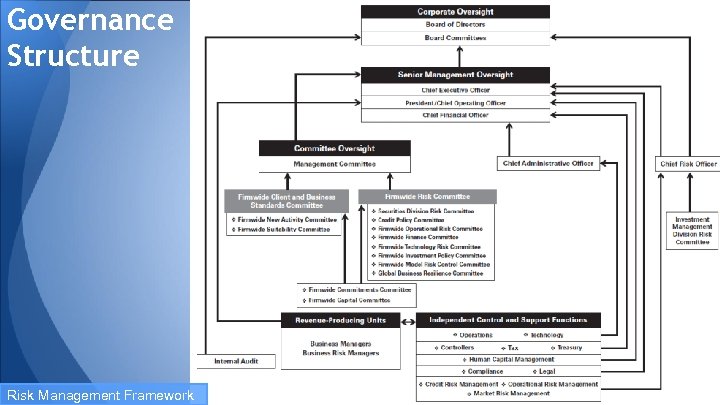 Governance Structure Risk Management Framework
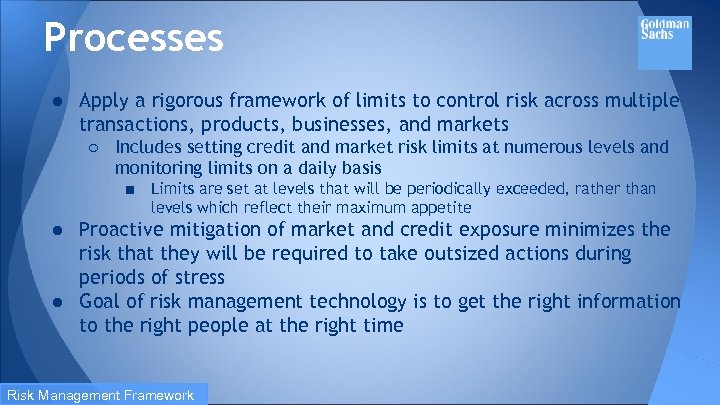 Processes ● Apply a rigorous framework of limits to control risk across multiple transactions, products, businesses, and markets ○ Includes setting credit and market risk limits at numerous levels and monitoring limits on a daily basis ■ Limits are set at levels that will be periodically exceeded, rather than levels which reflect their maximum appetite ● Proactive mitigation of market and credit exposure minimizes the risk that they will be required to take outsized actions during periods of stress ● Goal of risk management technology is to get the right information to the right people at the right time Risk Management Framework
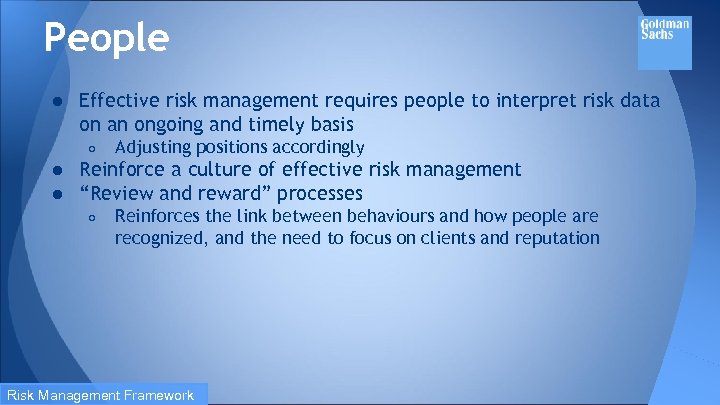 People ● Effective risk management requires people to interpret risk data on an ongoing and timely basis ○ Adjusting positions accordingly ● Reinforce a culture of effective risk management ● “Review and reward” processes ○ Reinforces the link between behaviours and how people are recognized, and the need to focus on clients and reputation Risk Management Framework
 Liquidity Risk Management (1) Objective: to be able to fund the firm and to enable Goldman Sachs core businesses to continue to serve clients and generate revenues, even under adverse circumstances. Liquidity Risk Management
 Liquidity Risk Management (2) Global Core Liquid Assets: maintain substantial liquidity to meet a broad range of potential cash outflows and collateral needs in a stressed environment. Asset-Liability Management: manage the maturities and diversity of funding across markets, products and counterparties, and seek to maintain liabilities of appropriate tenor relative to the asset base. Liquidity Risk Management
 Liquidity Risk Management (2) Contingency Funding Plan: maintain a contingency funding plan to provide a framework for analyzing and responding to a liquidity crisis situation or periods of market stress. Liquidity Risk Management
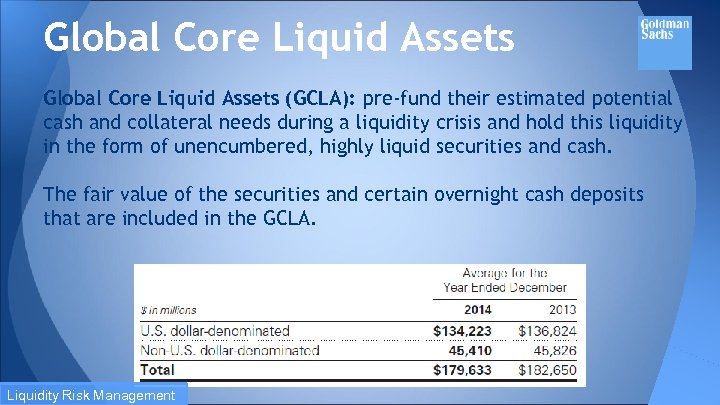 Global Core Liquid Assets (GCLA): pre-fund their estimated potential cash and collateral needs during a liquidity crisis and hold this liquidity in the form of unencumbered, highly liquid securities and cash. The fair value of the securities and certain overnight cash deposits that are included in the GCLA. Liquidity Risk Management
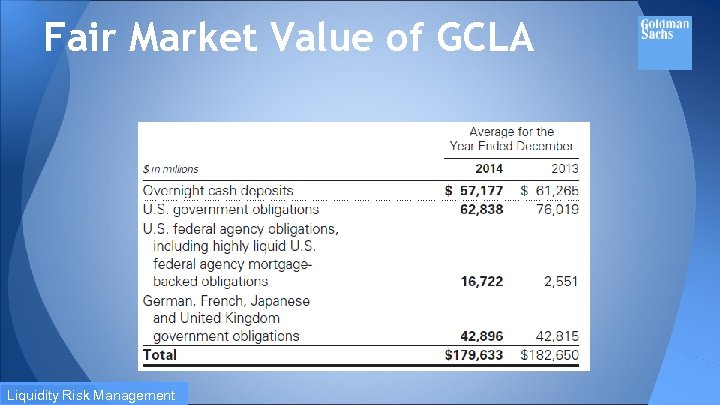 Fair Market Value of GCLA Liquidity Risk Management
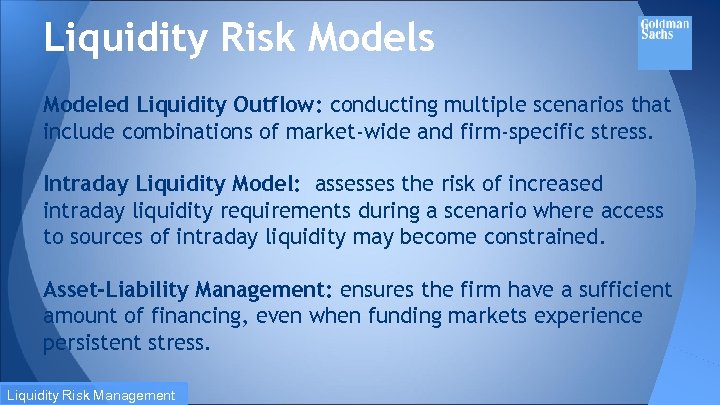 Liquidity Risk Models Modeled Liquidity Outflow: conducting multiple scenarios that include combinations of market-wide and firm-specific stress. Intraday Liquidity Model: assesses the risk of increased intraday liquidity requirements during a scenario where access to sources of intraday liquidity may become constrained. Asset-Liability Management: ensures the firm have a sufficient amount of financing, even when funding markets experience persistent stress. Liquidity Risk Management
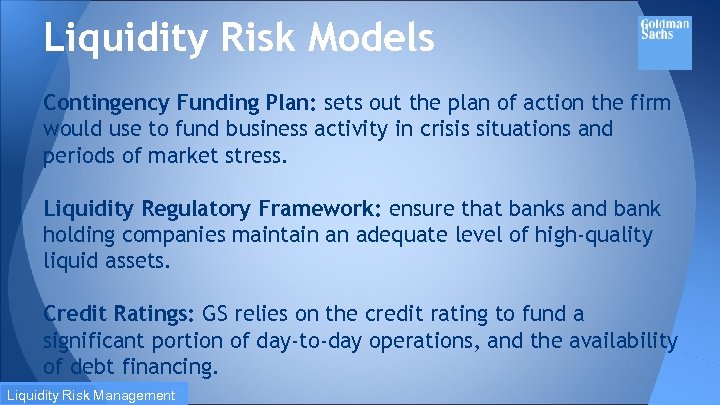 Liquidity Risk Models Contingency Funding Plan: sets out the plan of action the firm would use to fund business activity in crisis situations and periods of market stress. Liquidity Regulatory Framework: ensure that banks and bank holding companies maintain an adequate level of high-quality liquid assets. Credit Ratings: GS relies on the credit rating to fund a significant portion of day-to-day operations, and the availability of debt financing. Liquidity Risk Management
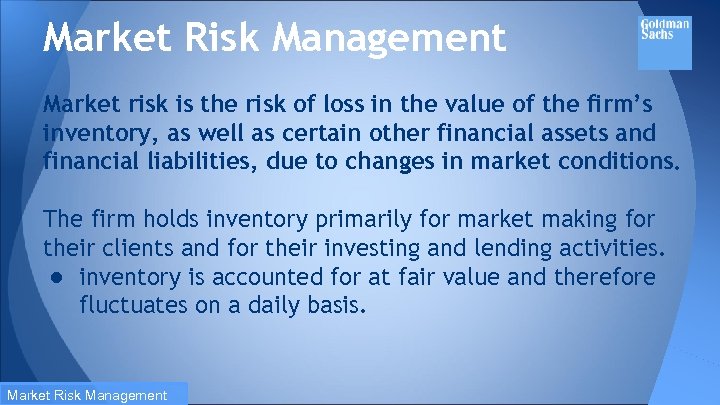 Market Risk Management Market risk is the risk of loss in the value of the firm’s inventory, as well as certain other financial assets and financial liabilities, due to changes in market conditions. The firm holds inventory primarily for market making for their clients and for their investing and lending activities. ● inventory is accounted for at fair value and therefore fluctuates on a daily basis. Market Risk Management
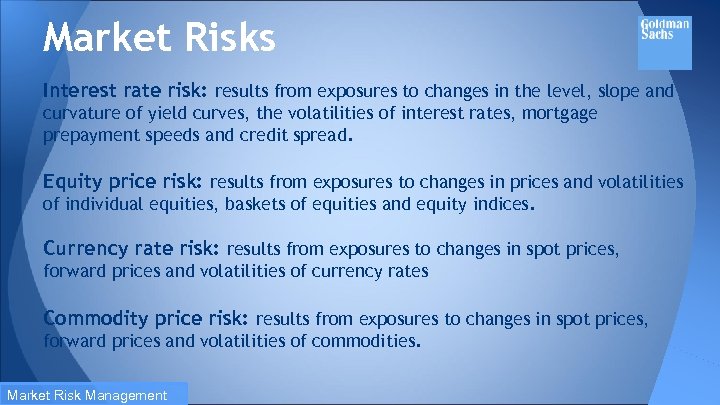 Market Risks Interest rate risk: results from exposures to changes in the level, slope and curvature of yield curves, the volatilities of interest rates, mortgage prepayment speeds and credit spread. Equity price risk: results from exposures to changes in prices and volatilities of individual equities, baskets of equities and equity indices. Currency rate risk: results from exposures to changes in spot prices, forward prices and volatilities of currency rates Commodity price risk: results from exposures to changes in spot prices, forward prices and volatilities of commodities. Market Risk Management
 Market Risk Management The firm manages market risk by diversifying exposures, controlling position sizes and establishing economic hedges in related securities or derivatives. Risk measures are used to estimate the size of potential losses for both moderate and more extreme market moves over both short-term and long-term time horizons. Market Risk Management
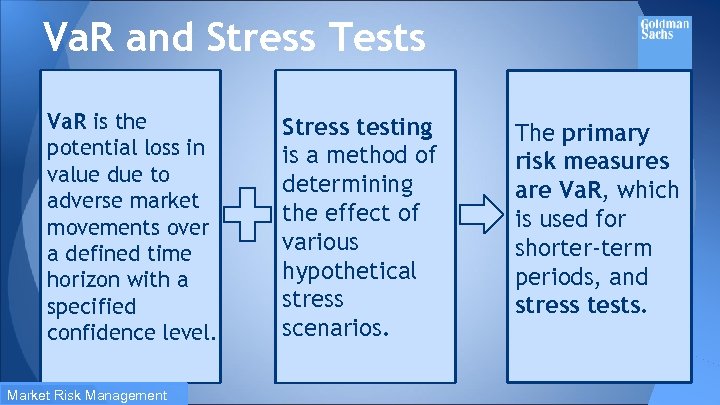 Va. R and Stress Tests Va. R is the potential loss in value due to adverse market movements over a defined time horizon with a specified confidence level. Market Risk Management Stress testing is a method of determining the effect of various hypothetical stress scenarios. The primary risk measures are Va. R, which is used for shorter-term periods, and stress tests.
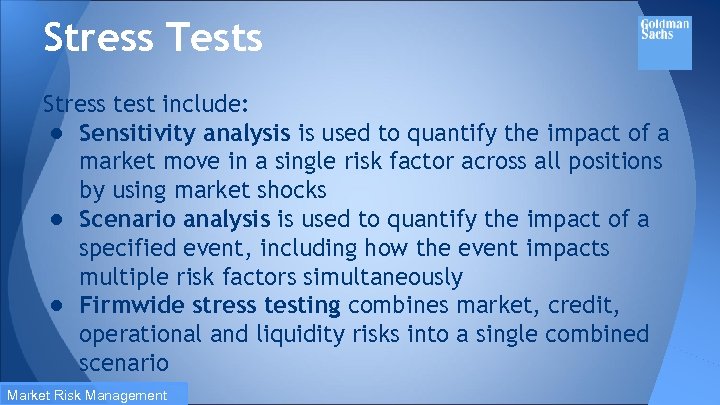 Stress Tests Stress test include: ● Sensitivity analysis is used to quantify the impact of a market move in a single risk factor across all positions by using market shocks ● Scenario analysis is used to quantify the impact of a specified event, including how the event impacts multiple risk factors simultaneously ● Firmwide stress testing combines market, credit, operational and liquidity risks into a single combined scenario Market Risk Management
 Value at Risk (Va. R) Limitations to Va. R: ● Va. R does not estimate potential losses over longer time horizons where moves may be extreme; ● Va. R does not take account of the relative liquidity of different risk positions; ● Previous moves in market risk factors may not produce accurate predictions of all future market moves. ● Either take on additional risk or to incur losses in order to decrease the Va. R. But increases in volatility increase the level of RWAs. Market Risk Management
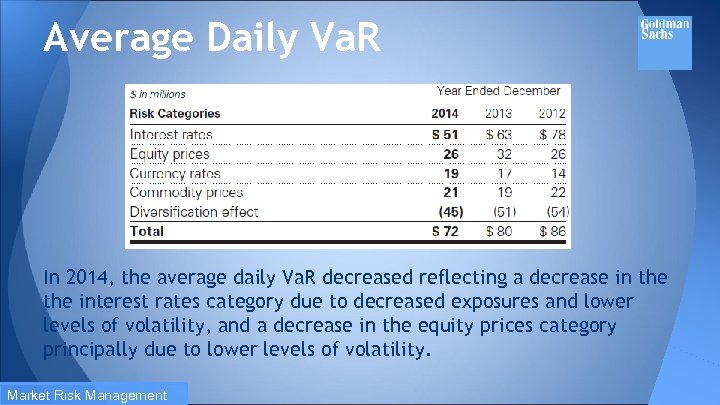 Average Daily Va. R In 2014, the average daily Va. R decreased reflecting a decrease in the interest rates category due to decreased exposures and lower levels of volatility, and a decrease in the equity prices category principally due to lower levels of volatility. Market Risk Management
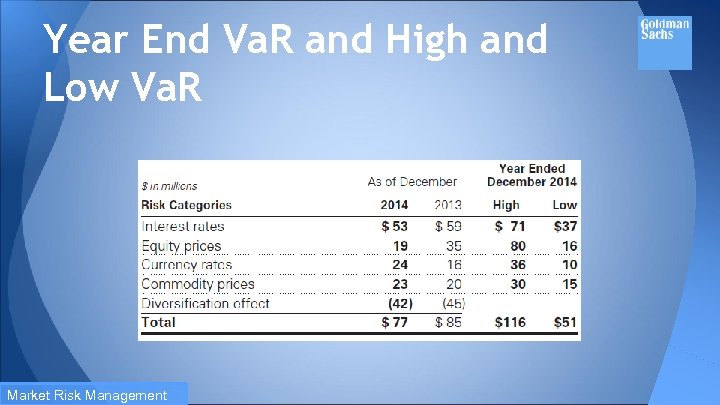 Year End Va. R and High and Low Va. R Market Risk Management
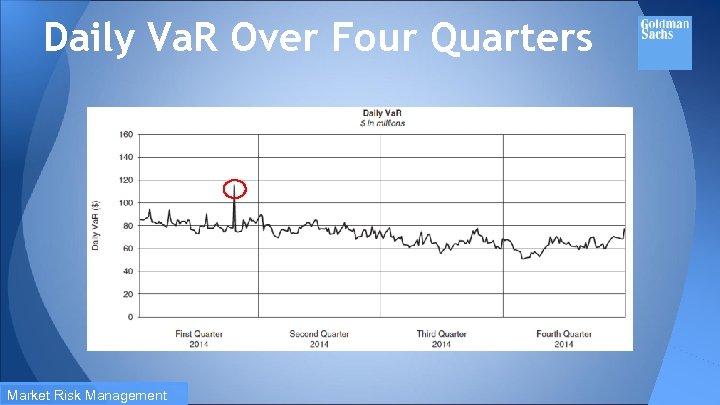 Daily Va. R Over Four Quarters Market Risk Management
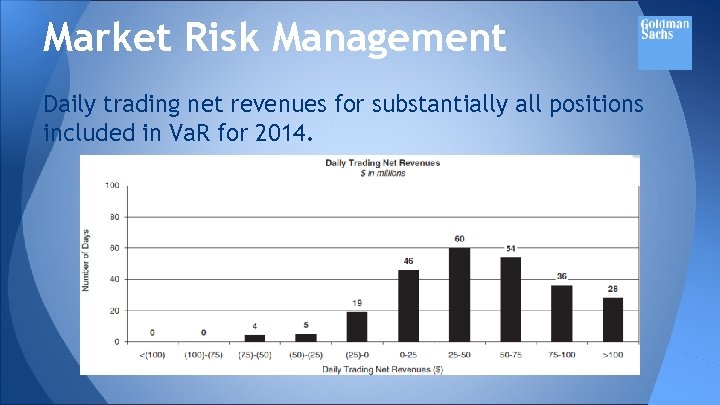 Market Risk Management Daily trading net revenues for substantially all positions included in Va. R for 2014.
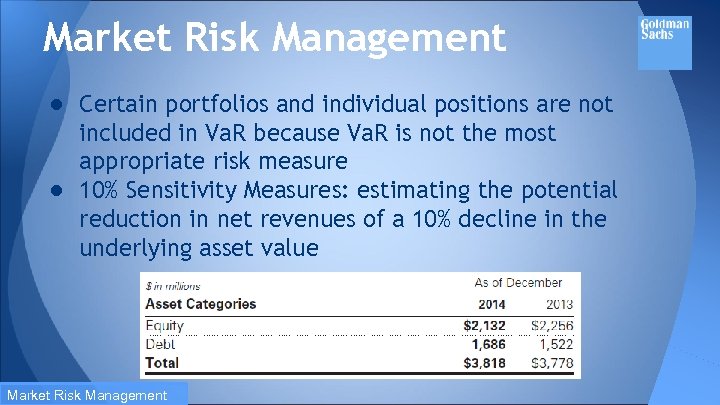 Market Risk Management ● Certain portfolios and individual positions are not included in Va. R because Va. R is not the most appropriate risk measure ● 10% Sensitivity Measures: estimating the potential reduction in net revenues of a 10% decline in the underlying asset value Market Risk Management
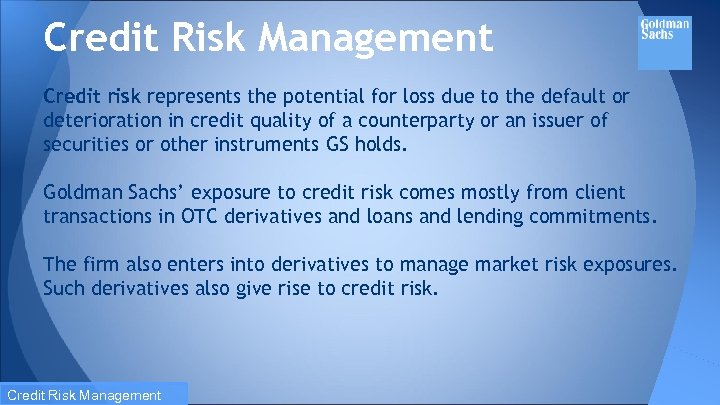 Credit Risk Management Credit risk represents the potential for loss due to the default or deterioration in credit quality of a counterparty or an issuer of securities or other instruments GS holds. Goldman Sachs’ exposure to credit risk comes mostly from client transactions in OTC derivatives and loans and lending commitments. The firm also enters into derivatives to manage market risk exposures. Such derivatives also give rise to credit risk. Credit Risk Management
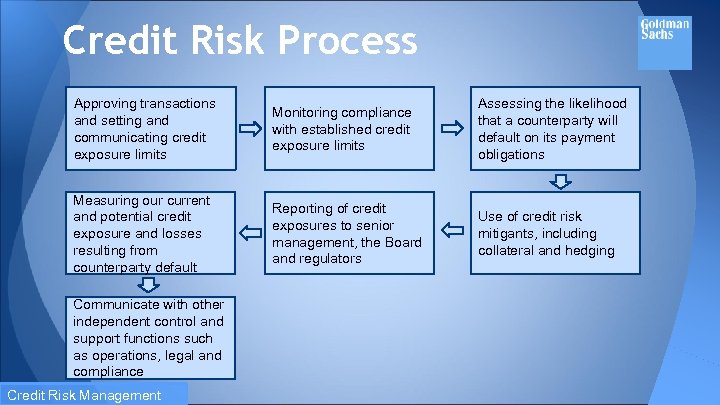 Credit Risk Process Approving transactions and setting and communicating credit exposure limits Monitoring compliance with established credit exposure limits Assessing the likelihood that a counterparty will default on its payment obligations Measuring our current and potential credit exposure and losses resulting from counterparty default Reporting of credit exposures to senior management, the Board and regulators Use of credit risk mitigants, including collateral and hedging Communicate with other independent control and support functions such as operations, legal and compliance Credit Risk Management
 Risk Measures and Limits ● The firm measures credit risk based on the potential loss in an event of non-payment by a counterparty. ● For derivatives and securities financing transactions, the primary measure is potential exposure. ● For loans and lending commitments, the primary measure is a function of the notional amount of the position. ● The firm uses credit limits at various levels (counterparty, economic group, industry, country) to control the size of our credit exposures. Credit Risk Management
 Stress Tests ● Use regular stress tests to calculate the credit exposures ● Applying shocks to counterparty credit ratings or credit risk factors: currency rates, interest rates, equity prices, etc ● Some of the stress tests include shocks to multiple risk factors ● They run stress tests on a regular basis as part of their routine risk management processes ● Stress tests are regularly conducted jointly with the market and liquidity risk functions Credit Risk Management
 Risk Mitigants For Derivatives and Securities: ● netting agreements to offset receivables and payables agreements to obtain collateral on an upfront or contingent basis and/or to terminate transactions the credit rating falls below a specified level For loans and lending commitments: ● collateral provisions, guarantees, covenants, structural seniority of the bank loan claims, certain lending commitments, provisions in the legal documentation to adjust loan amounts, pricing, structure and other terms Credit Risk Management
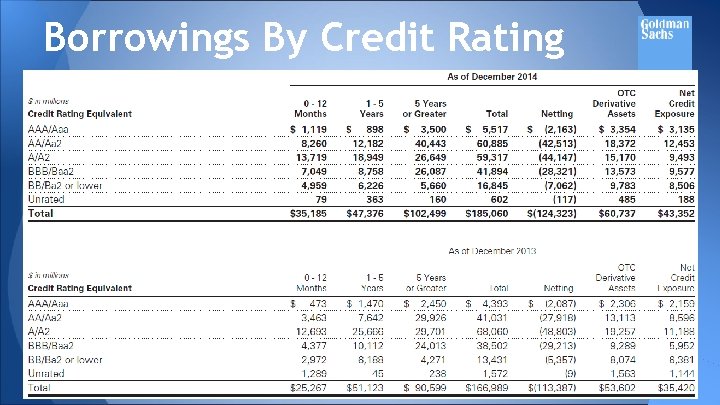 Borrowings By Credit Rating
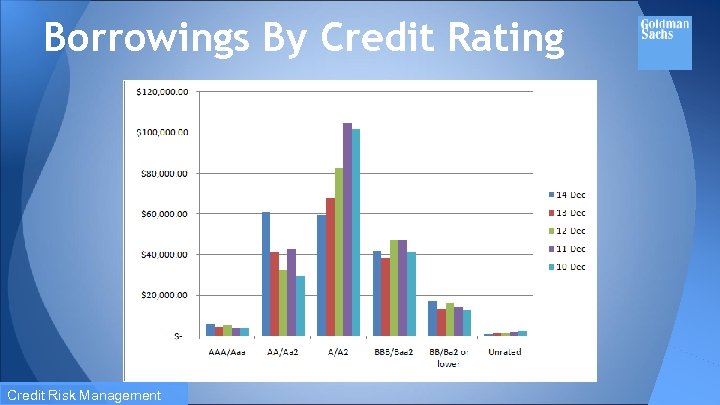 Borrowings By Credit Rating Credit Risk Management
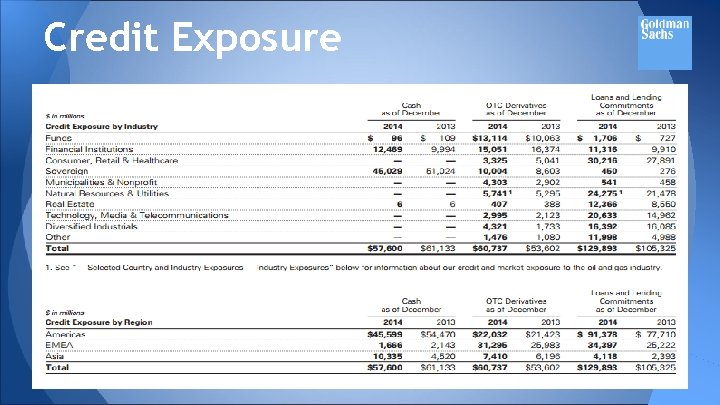 Credit Exposure
 Operational Risk Management Operational risk is the risk of loss resulting from inadequate or failed internal processes, people and systems or from external events. ● Results from routine processing errors as well as extraordinary incidents, such as major systems failures Operational Risk Management
 Operational Risk Perspectives Top Down Perspective: ● senior management assesses firmwide and business level operational risk profiles. Bottom Up Perspective: ● revenue-producing units and independent control and support functions are responsible for risk management on a day-to-day basis, Operational Risk Management
 Operational Framework The firm’s operational risk framework is designed to comply with operational risk measurement rules under Basel III The framework comprises of: ● Risk identification and reporting ● Risk measurement ● Risk monitoring. Operational Risk Management
 Operational Risk Management Country Exposures: During 2014, the political situations in Iraq, Russia and Ukraine have negatively affected market sentiment toward those countries Industry Exposures: Significant declines in the price of oil have led to market concerns regarding the creditworthiness of certain companies in the oil and gas industry Operational Risk Management
 #4 Valuation of Derivatives and Securities
 Fair Market Measurements The fair value of a financial instrument is the amount that would be received to sell an asset or paid to transfer a liability in an orderly transaction between market participants. Financial assets are marked to bid prices and financial liabilities are marked to offer prices.
 The Fair Value Hierarchy U. S. GAAP has a three-level fair value hierarchy for disclosure of fair value measurements. ● Level 1: Inputs are unadjusted quoted prices in active markets to which the firm had access at the measurement date for identical, unrestricted assets or liabilities. ● Level 2: Inputs to valuation techniques are observable, either directly or indirectly. ● Level 3: One or more inputs to valuation techniques are significant and unobservable.
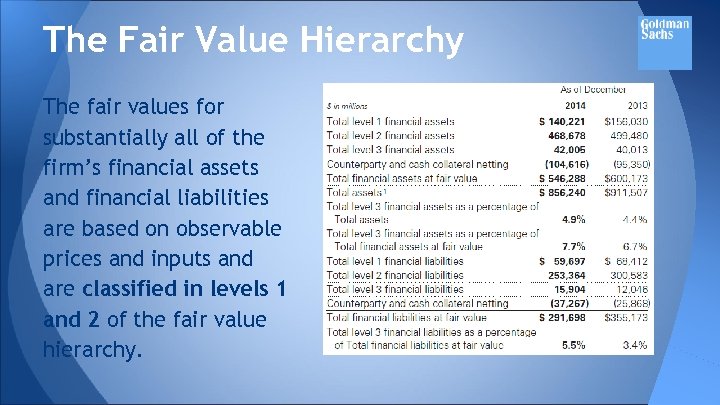 The Fair Value Hierarchy The fair values for substantially all of the firm’s financial assets and financial liabilities are based on observable prices and inputs and are classified in levels 1 and 2 of the fair value hierarchy.
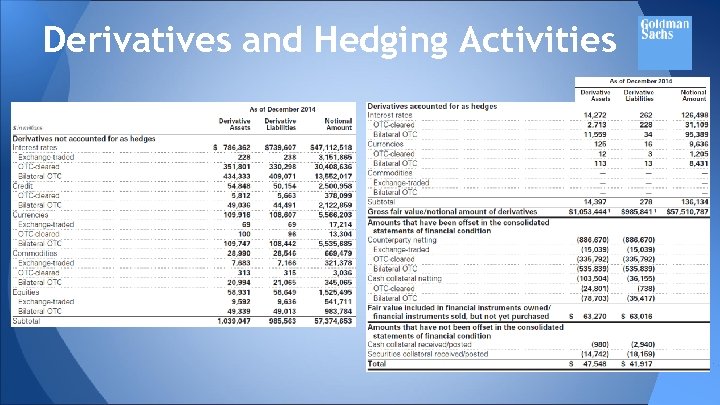
 Derivatives and Hedging Activities Market-Making Activities: the firm enters into derivative transactions to provide liquidity to clients and to facilitate the transfer and hedging of their risks. Risk Management: the firm also enters into derivatives to actively manage risk exposures that arise from its market making and investing and lending activities in derivative and cash instruments. The firm’s holdings and exposures are hedged, in many cases, on either a portfolio or risk specific basis, as opposed to an instrument-by-instrument basis.
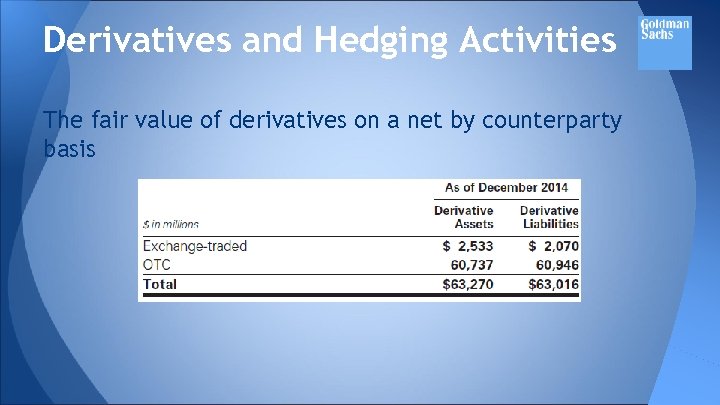 Derivatives and Hedging Activities The fair value of derivatives on a net by counterparty basis
 Derivatives and Hedging Activities Stuff
 Valuation Techniques Level 1 Derivatives: includes short-term contracts for future delivery of securities when the underlying security is a level 1 instrument, and exchange-traded derivatives if they are actively traded and are valued at their quoted market price. Level 2 Derivatives: includes OTC derivatives for which all significant valuation inputs are corroborated by market evidence and exchange-traded derivatives that are not actively traded and/or that are valued using models that calibrate to market-clearing levels of OTC derivatives.
 Valuation Techniques Level 3 Derivatives: valued using models which utilize observable level 1 and/or level 2 inputs, as well as unobservable level 3 inputs ● the firm updates the level 1 and level 2 inputs to reflect observable market changes and any resulting gains and losses are recorded in level 3.
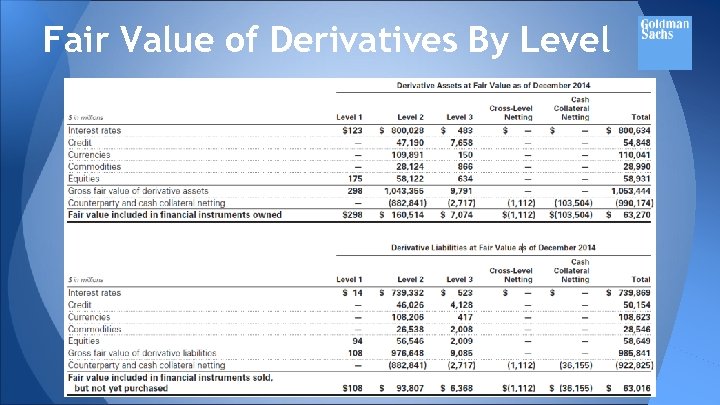 Fair Value of Derivatives By Level
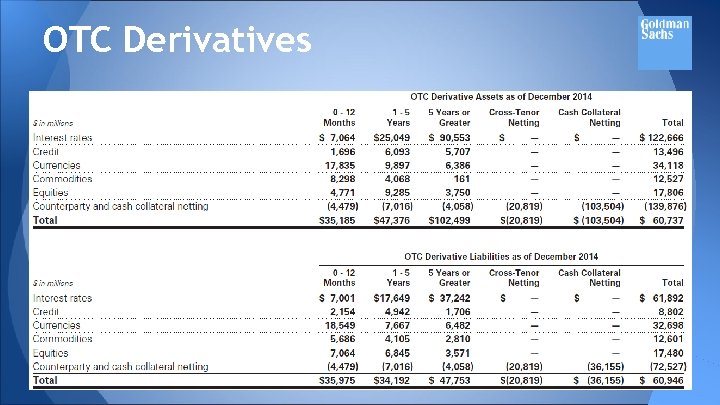 OTC Derivatives
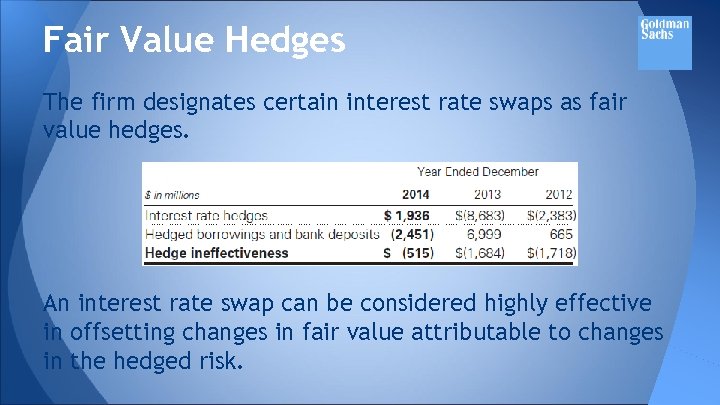 Fair Value Hedges The firm designates certain interest rate swaps as fair value hedges. An interest rate swap can be considered highly effective in offsetting changes in fair value attributable to changes in the hedged risk.
 Thank You For Listening Any Questions? 110