 Скачать презентацию Companies Retained Profits Share Splits and Buy-backs and
64850961c3484cab9fec779b11ea9aaa.ppt
- Количество слайдов: 40



Companies: Retained Profits, Share Splits and Buy-backs and the Statement of Financial Performance Chapter 15 HORNGREN ♦ HARRISON ♦ BAMBER ♦ BEST ♦ FRASER ♦ WILLETT
Objectives 1. Account for share dividends. 2. Distinguish share splits from share dividends. 3. Account for share buy-backs. 4. Report transfer to reserves. 5. Identify the elements of a company’s statement of financial performance. 6. Calculate earnings per share. Horngren ♦ Harrison ♦ Bamber ♦ Best ♦ Fraser ♦ Willett, Accounting 4 e Copyright © 2004 Pearson Education Australia 15 - 2
Retained Profits and Dividends Retained Profits shows the amount of profits allowed to accumulate from the beginning of the company’s life to the present. l Retained Profits represents a claim on assets, but it is not cash. l Horngren ♦ Harrison ♦ Bamber ♦ Best ♦ Fraser ♦ Willett, Accounting 4 e Copyright © 2004 Pearson Education Australia 15 - 3
Retained Profits and Dividends The balance in the Profit and Loss Summary account is closed to Retained Profits at period end. l Dividends are distributions to the shareholders. l To declare dividends there must be adequate retained profits. l Horngren ♦ Harrison ♦ Bamber ♦ Best ♦ Fraser ♦ Willett, Accounting 4 e Copyright © 2004 Pearson Education Australia 15 - 4
Objective 1 Account for share dividends. Horngren ♦ Harrison ♦ Bamber ♦ Best ♦ Fraser ♦ Willett, Accounting 4 e Copyright © 2004 Pearson Education Australia 15 - 5
Share Dividends What are shares dividends? l They are a proportional distribution of a company’s own shares to shareholders. l They do not change total shareholders’ equity. l A share dividend is a transfer of retained profits to contributed equity. l Horngren ♦ Harrison ♦ Bamber ♦ Best ♦ Fraser ♦ Willett, Accounting 4 e Copyright © 2004 Pearson Education Australia 15 - 6
Reasons for a Share Dividend To continue dividends but conserve cash l To reduce the market price of shares: ä How ? ä Why ? l Horngren ♦ Harrison ♦ Bamber ♦ Best ♦ Fraser ♦ Willett, Accounting 4 e Copyright © 2004 Pearson Education Australia 15 - 7
Recording Shares Dividend Same sequence as cash dividends l Assume Perth Limited declared a dividend of $1 per share for 90, 000 shares. l What are the entries when the dividend is declared and distributed? Horngren ♦ Harrison ♦ Bamber ♦ Best ♦ Fraser ♦ Willett, Accounting 4 e Copyright © 2004 Pearson Education Australia 15 - 8
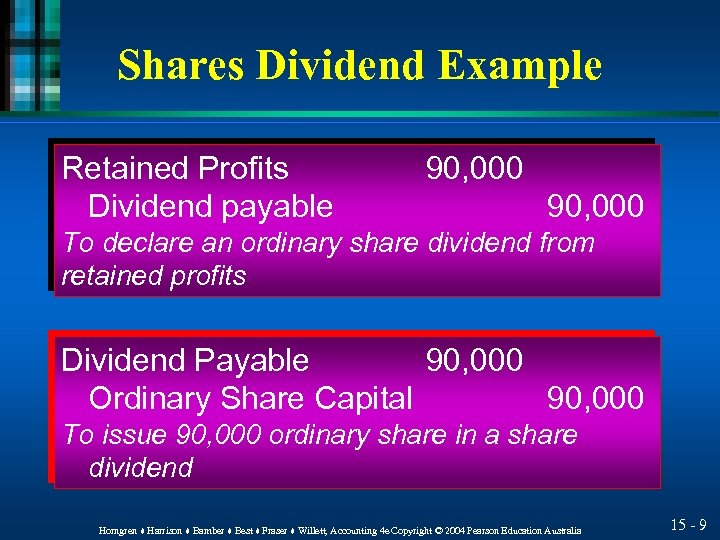
Shares Dividend Example Retained Profits Dividend payable 90, 000 To declare an ordinary share dividend from retained profits Dividend Payable 90, 000 Ordinary Share Capital 90, 000 To issue 90, 000 ordinary share in a share dividend Horngren ♦ Harrison ♦ Bamber ♦ Best ♦ Fraser ♦ Willett, Accounting 4 e Copyright © 2004 Pearson Education Australia 15 - 9
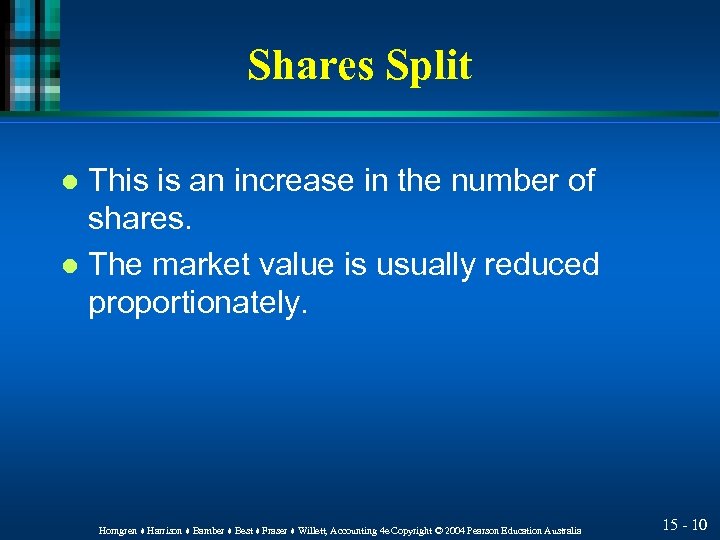
Shares Split This is an increase in the number of shares. l The market value is usually reduced proportionately. l Horngren ♦ Harrison ♦ Bamber ♦ Best ♦ Fraser ♦ Willett, Accounting 4 e Copyright © 2004 Pearson Education Australia 15 - 10
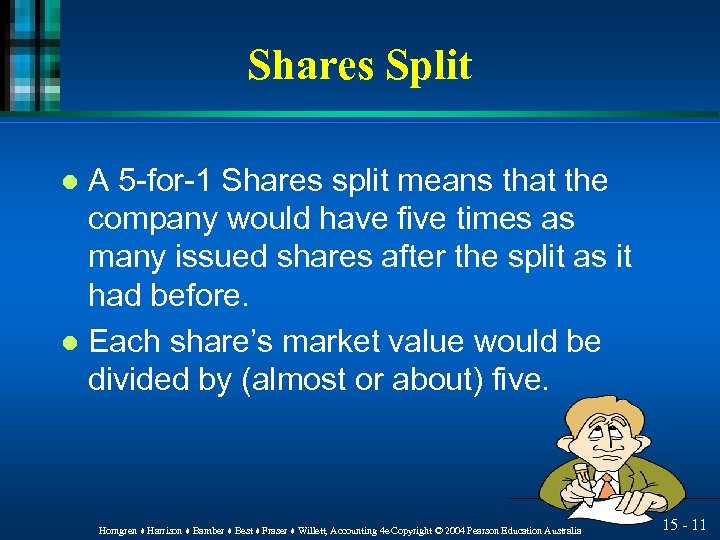
Shares Split A 5 -for-1 Shares split means that the company would have five times as many issued shares after the split as it had before. l Each share’s market value would be divided by (almost or about) five. l Horngren ♦ Harrison ♦ Bamber ♦ Best ♦ Fraser ♦ Willett, Accounting 4 e Copyright © 2004 Pearson Education Australia 15 - 11
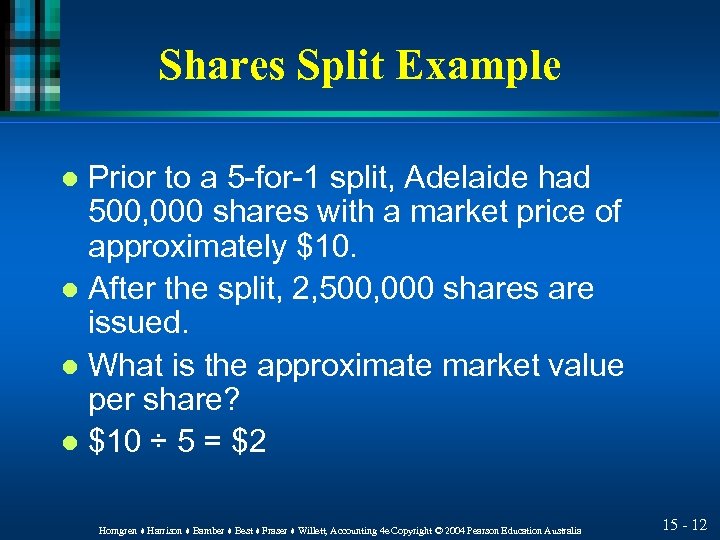
Shares Split Example Prior to a 5 -for-1 split, Adelaide had 500, 000 shares with a market price of approximately $10. l After the split, 2, 500, 000 shares are issued. l What is the approximate market value per share? l $10 ÷ 5 = $2 l Horngren ♦ Harrison ♦ Bamber ♦ Best ♦ Fraser ♦ Willett, Accounting 4 e Copyright © 2004 Pearson Education Australia 15 - 12
Objective 2 Distinguish share splits from share dividends. Horngren ♦ Harrison ♦ Bamber ♦ Best ♦ Fraser ♦ Willett, Accounting 4 e Copyright © 2004 Pearson Education Australia 15 - 13
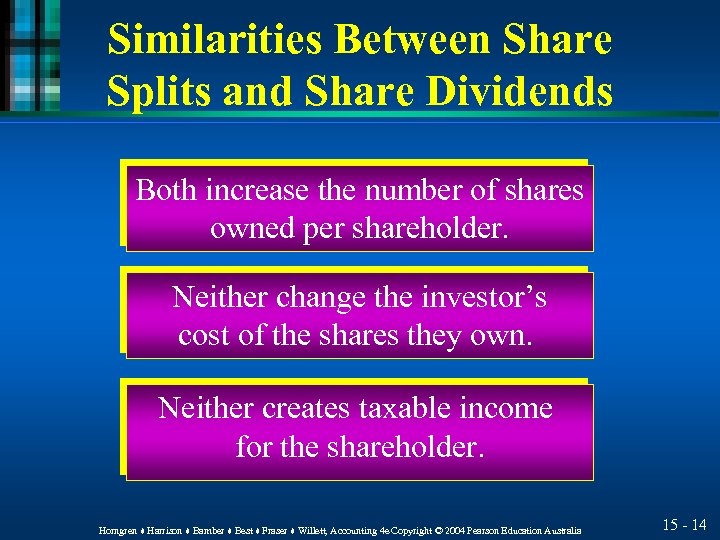
Similarities Between Share Splits and Share Dividends Both increase the number of shares owned per shareholder. Neither change the investor’s cost of the shares they own. Neither creates taxable income for the shareholder. Horngren ♦ Harrison ♦ Bamber ♦ Best ♦ Fraser ♦ Willett, Accounting 4 e Copyright © 2004 Pearson Education Australia 15 - 14
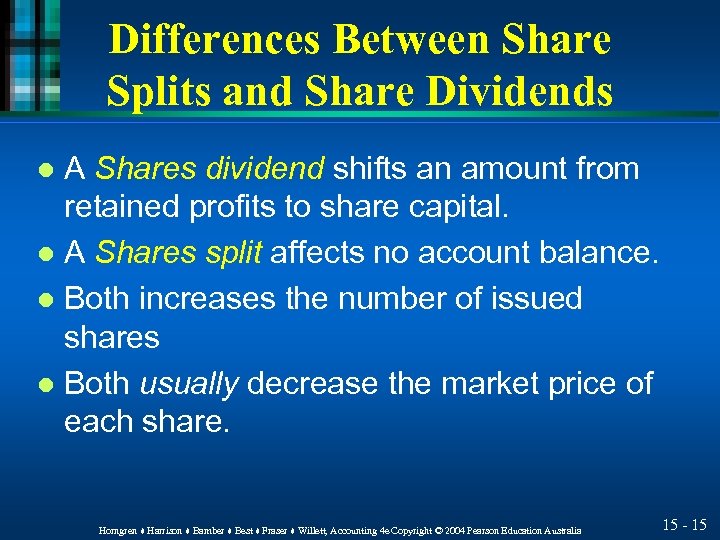
Differences Between Share Splits and Share Dividends A Shares dividend shifts an amount from retained profits to share capital. l A Shares split affects no account balance. l Both increases the number of issued shares l Both usually decrease the market price of each share. l Horngren ♦ Harrison ♦ Bamber ♦ Best ♦ Fraser ♦ Willett, Accounting 4 e Copyright © 2004 Pearson Education Australia 15 - 15
Objective 3 Account for share buy-backs. Horngren ♦ Harrison ♦ Bamber ♦ Best ♦ Fraser ♦ Willett, Accounting 4 e Copyright © 2004 Pearson Education Australia 15 - 16

Shares Buy-backs. l Purchasing your own shares decreases assets and shareholders’ equity. Horngren ♦ Harrison ♦ Bamber ♦ Best ♦ Fraser ♦ Willett, Accounting 4 e Copyright © 2004 Pearson Education Australia 15 - 17
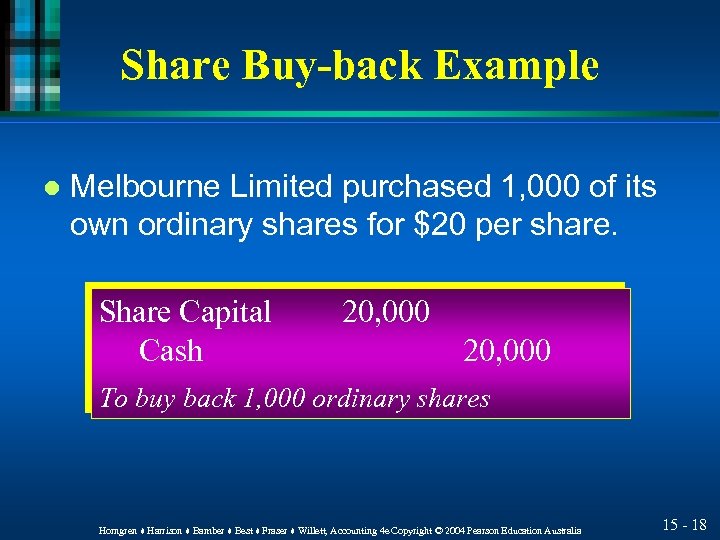
Share Buy-back Example l Melbourne Limited purchased 1, 000 of its own ordinary shares for $20 per share. Share Capital Cash 20, 000 To buy back 1, 000 ordinary shares Horngren ♦ Harrison ♦ Bamber ♦ Best ♦ Fraser ♦ Willett, Accounting 4 e Copyright © 2004 Pearson Education Australia 15 - 18
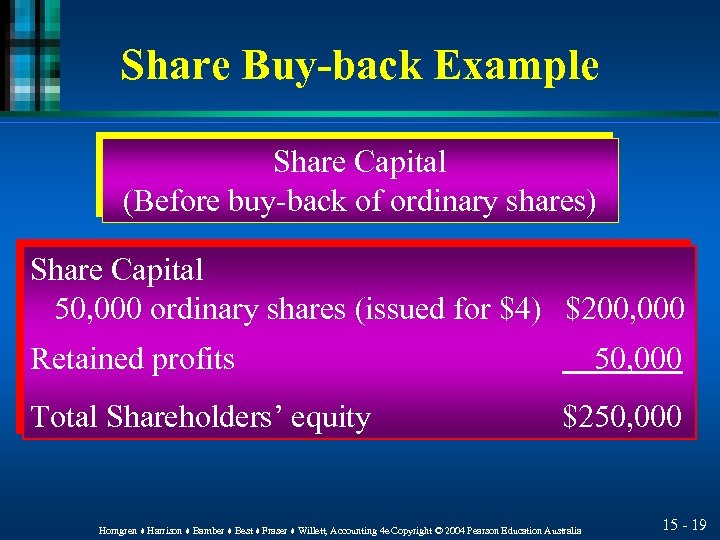
Share Buy-back Example Share Capital (Before buy-back of ordinary shares) Share Capital 50, 000 ordinary shares (issued for $4) $200, 000 Retained profits Total Shareholders’ equity 50, 000 $250, 000 Horngren ♦ Harrison ♦ Bamber ♦ Best ♦ Fraser ♦ Willett, Accounting 4 e Copyright © 2004 Pearson Education Australia 15 - 19
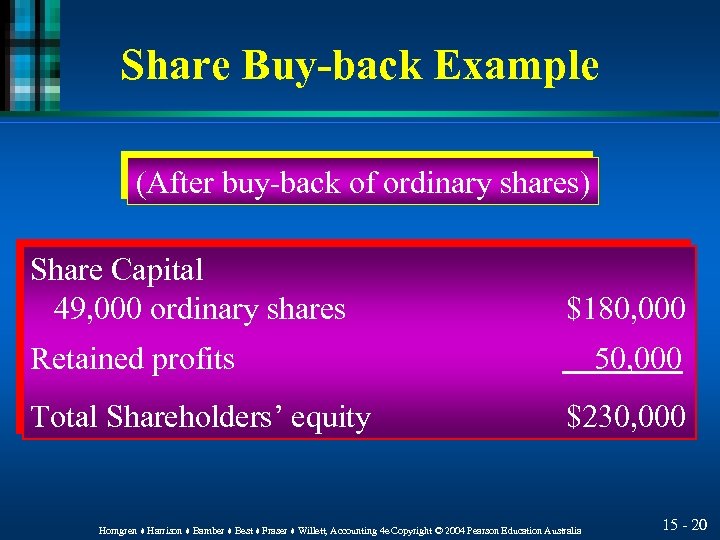
Share Buy-back Example (After buy-back of ordinary shares) Share Capital 49, 000 ordinary shares $180, 000 Retained profits Total Shareholders’ equity 50, 000 $230, 000 Horngren ♦ Harrison ♦ Bamber ♦ Best ♦ Fraser ♦ Willett, Accounting 4 e Copyright © 2004 Pearson Education Australia 15 - 20
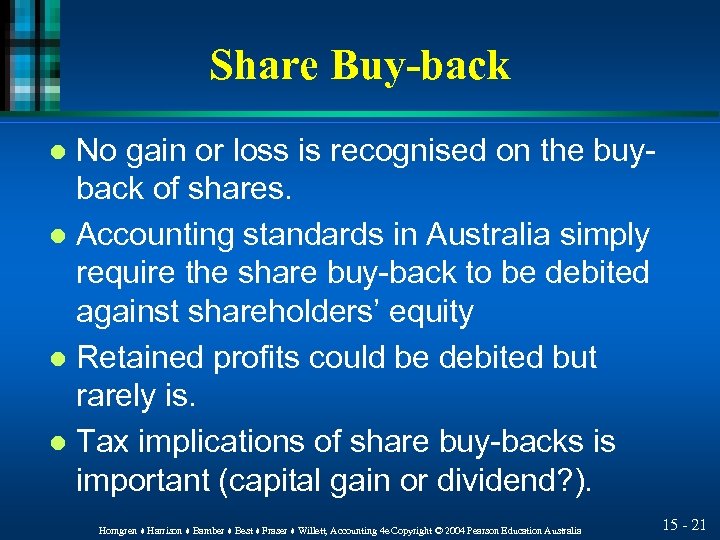
Share Buy-back No gain or loss is recognised on the buyback of shares. l Accounting standards in Australia simply require the share buy-back to be debited against shareholders’ equity l Retained profits could be debited but rarely is. l Tax implications of share buy-backs is important (capital gain or dividend? ). l Horngren ♦ Harrison ♦ Bamber ♦ Best ♦ Fraser ♦ Willett, Accounting 4 e Copyright © 2004 Pearson Education Australia 15 - 21
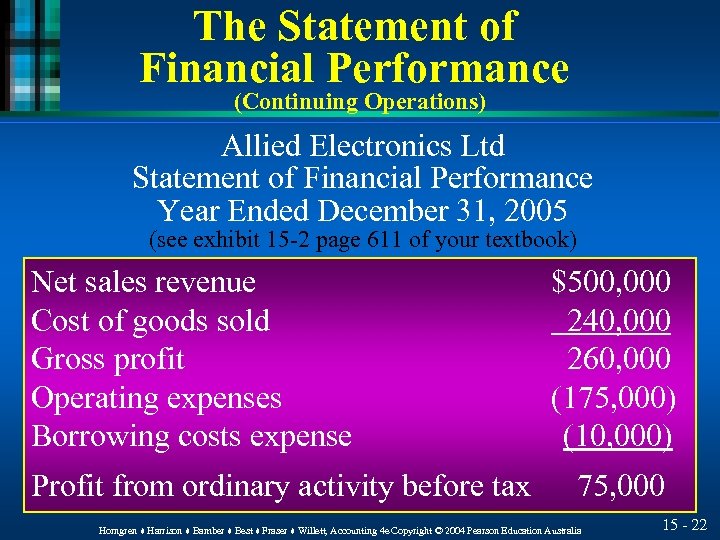
The Statement of Financial Performance (Continuing Operations) Allied Electronics Ltd Statement of Financial Performance Year Ended December 31, 2005 (see exhibit 15 -2 page 611 of your textbook) Net sales revenue Cost of goods sold Gross profit Operating expenses Borrowing costs expense Profit from ordinary activity before tax $500, 000 240, 000 260, 000 (175, 000) (10, 000) 75, 000 Horngren ♦ Harrison ♦ Bamber ♦ Best ♦ Fraser ♦ Willett, Accounting 4 e Copyright © 2004 Pearson Education Australia 15 - 22
Objective 4 Report transfers to reserves Horngren ♦ Harrison ♦ Bamber ♦ Best ♦ Fraser ♦ Willett, Accounting 4 e Copyright © 2004 Pearson Education Australia 15 - 23
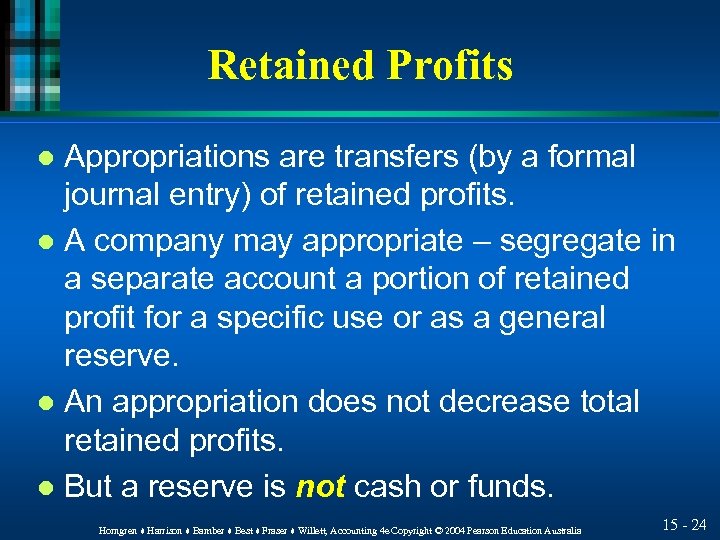
Retained Profits Appropriations are transfers (by a formal journal entry) of retained profits. l A company may appropriate – segregate in a separate account a portion of retained profit for a specific use or as a general reserve. l An appropriation does not decrease total retained profits. l But a reserve is not cash or funds. l Horngren ♦ Harrison ♦ Bamber ♦ Best ♦ Fraser ♦ Willett, Accounting 4 e Copyright © 2004 Pearson Education Australia 15 - 24
Objective 5 Identify the elements of a company’s statement of financial performance. Horngren ♦ Harrison ♦ Bamber ♦ Best ♦ Fraser ♦ Willett, Accounting 4 e Copyright © 2004 Pearson Education Australia 15 - 25
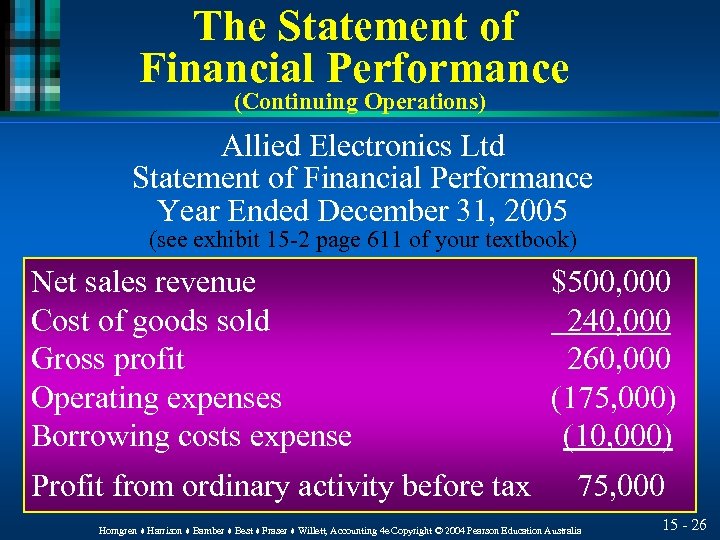
The Statement of Financial Performance (Continuing Operations) Allied Electronics Ltd Statement of Financial Performance Year Ended December 31, 2005 (see exhibit 15 -2 page 611 of your textbook) Net sales revenue Cost of goods sold Gross profit Operating expenses Borrowing costs expense Profit from ordinary activity before tax $500, 000 240, 000 260, 000 (175, 000) (10, 000) 75, 000 Horngren ♦ Harrison ♦ Bamber ♦ Best ♦ Fraser ♦ Willett, Accounting 4 e Copyright © 2004 Pearson Education Australia 15 - 26
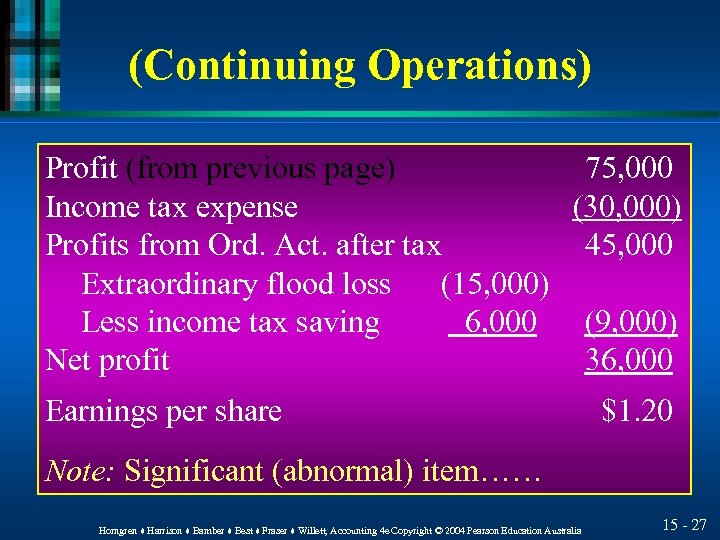
(Continuing Operations) Profit (from previous page) 75, 000 Income tax expense (30, 000) Profits from Ord. Act. after tax 45, 000 Extraordinary flood loss (15, 000) Less income tax saving 6, 000 (9, 000) Net profit 36, 000 Earnings per share $1. 20 Note: Significant (abnormal) item…… Horngren ♦ Harrison ♦ Bamber ♦ Best ♦ Fraser ♦ Willett, Accounting 4 e Copyright © 2004 Pearson Education Australia 15 - 27
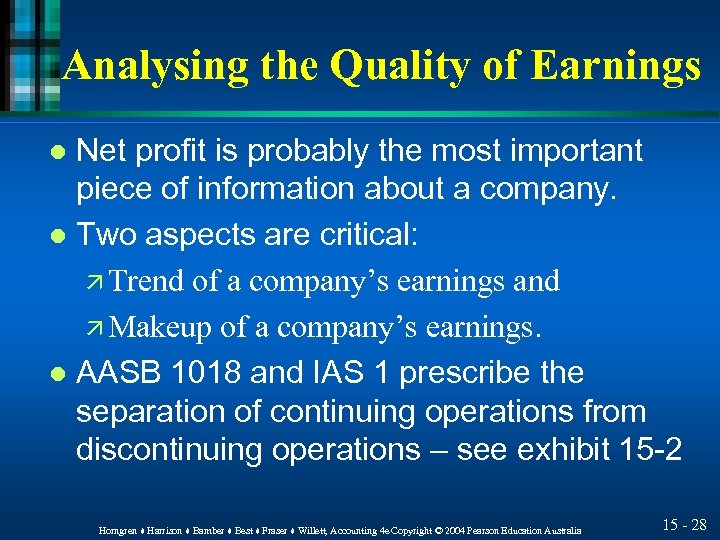
Analysing the Quality of Earnings Net profit is probably the most important piece of information about a company. l Two aspects are critical: ä Trend of a company’s earnings and ä Makeup of a company’s earnings. l AASB 1018 and IAS 1 prescribe the separation of continuing operations from discontinuing operations – see exhibit 15 -2 l Horngren ♦ Harrison ♦ Bamber ♦ Best ♦ Fraser ♦ Willett, Accounting 4 e Copyright © 2004 Pearson Education Australia 15 - 28
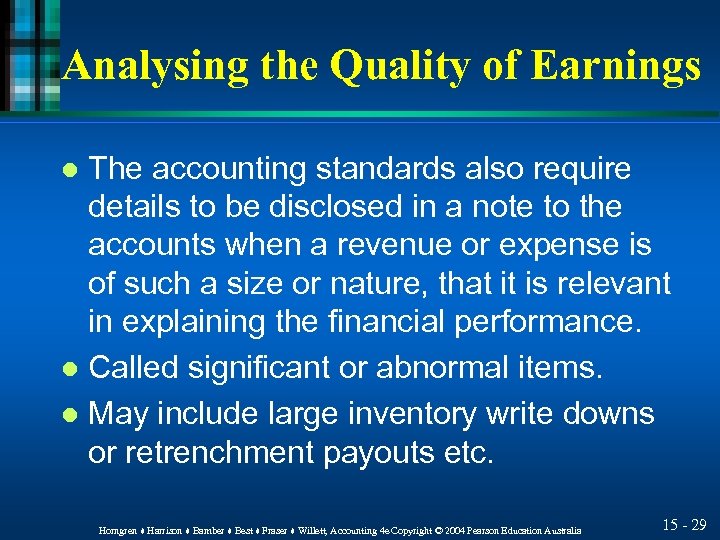
Analysing the Quality of Earnings The accounting standards also require details to be disclosed in a note to the accounts when a revenue or expense is of such a size or nature, that it is relevant in explaining the financial performance. l Called significant or abnormal items. l May include large inventory write downs or retrenchment payouts etc. l Horngren ♦ Harrison ♦ Bamber ♦ Best ♦ Fraser ♦ Willett, Accounting 4 e Copyright © 2004 Pearson Education Australia 15 - 29
Analysing the Quality of Earnings Extraordinary items are both unusual and infrequent. l They are outside the ordinary operations of the business. l They are reported along with their income tax effect. l Horngren ♦ Harrison ♦ Bamber ♦ Best ♦ Fraser ♦ Willett, Accounting 4 e Copyright © 2004 Pearson Education Australia 15 - 30
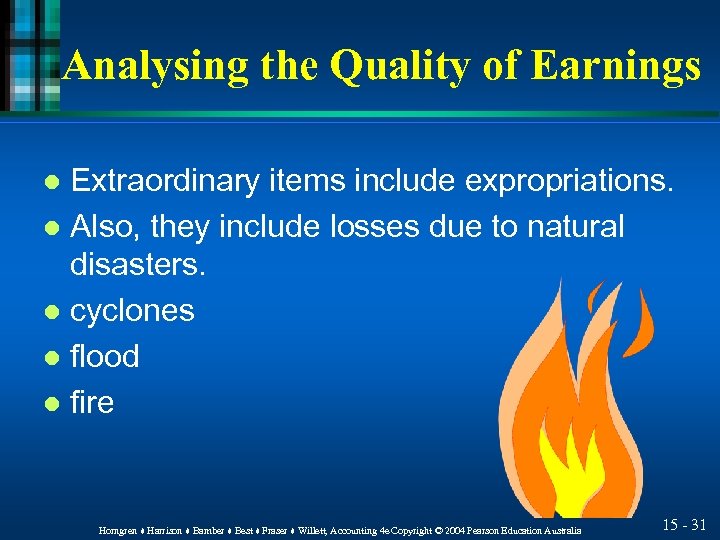
Analysing the Quality of Earnings Extraordinary items include expropriations. l Also, they include losses due to natural disasters. l cyclones l flood l fire l Horngren ♦ Harrison ♦ Bamber ♦ Best ♦ Fraser ♦ Willett, Accounting 4 e Copyright © 2004 Pearson Education Australia 15 - 31
Analysing the Quality of Earnings AASB 1018 requires that the statement of financial performance report an allinclusive or comprehensive profit figure. l Prior period adjustments therefore need to be included in current profits. l Significant adjustments will need separate disclosure – usually in the notes. l Horngren ♦ Harrison ♦ Bamber ♦ Best ♦ Fraser ♦ Willett, Accounting 4 e Copyright © 2004 Pearson Education Australia 15 - 32
Analysing the Quality of Earnings AASB 1040 Statement of Financial Position and IAS 1 Presentation of Financial Statements require retained profits to be disclosed separately. l Changes in retained profits are normally set out in the notes to the financial statements. l See exhibit 15 -3 page 614 of your textbook l Horngren ♦ Harrison ♦ Bamber ♦ Best ♦ Fraser ♦ Willett, Accounting 4 e Copyright © 2004 Pearson Education Australia 15 - 33
Objective 6 Calculate earnings per share. Horngren ♦ Harrison ♦ Bamber ♦ Best ♦ Fraser ♦ Willett, Accounting 4 e Copyright © 2004 Pearson Education Australia 15 - 34
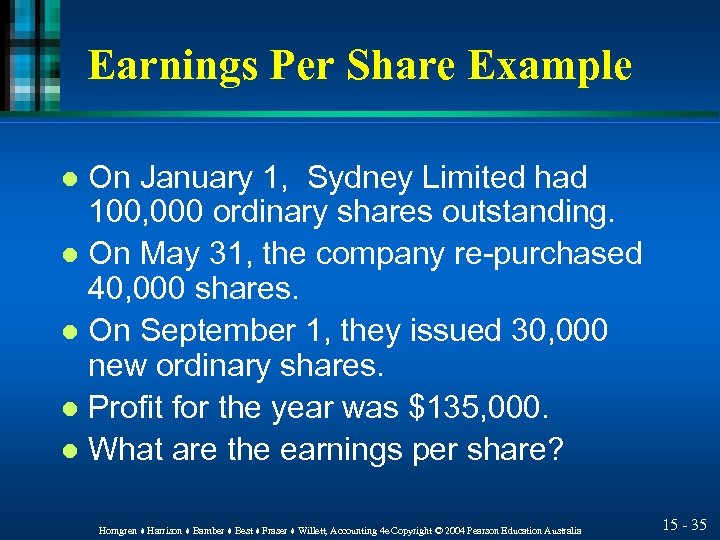
Earnings Per Share Example On January 1, Sydney Limited had 100, 000 ordinary shares outstanding. l On May 31, the company re-purchased 40, 000 shares. l On September 1, they issued 30, 000 new ordinary shares. l Profit for the year was $135, 000. l What are the earnings per share? l Horngren ♦ Harrison ♦ Bamber ♦ Best ♦ Fraser ♦ Willett, Accounting 4 e Copyright © 2004 Pearson Education Australia 15 - 35
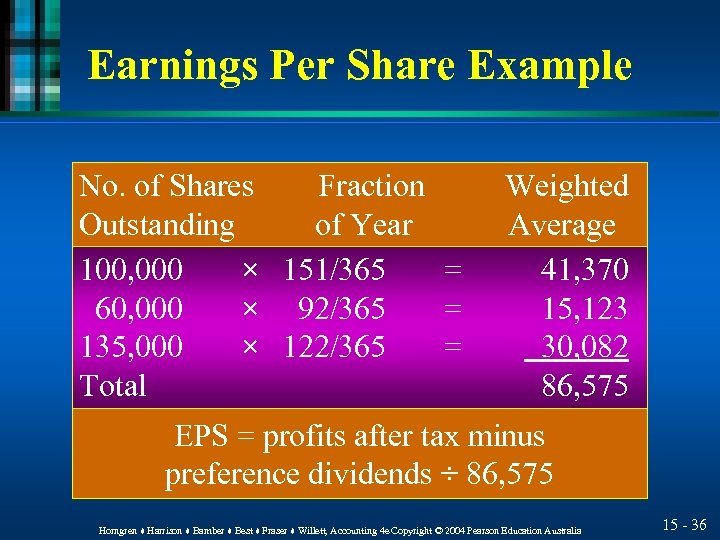
Earnings Per Share Example No. of Shares Fraction Outstanding of Year 100, 000 × 151/365 = 60, 000 × 92/365 = 135, 000 × 122/365 = Total Weighted Average 41, 370 15, 123 30, 082 86, 575 EPS = profits after tax minus preference dividends ÷ 86, 575 Horngren ♦ Harrison ♦ Bamber ♦ Best ♦ Fraser ♦ Willett, Accounting 4 e Copyright © 2004 Pearson Education Australia 15 - 36
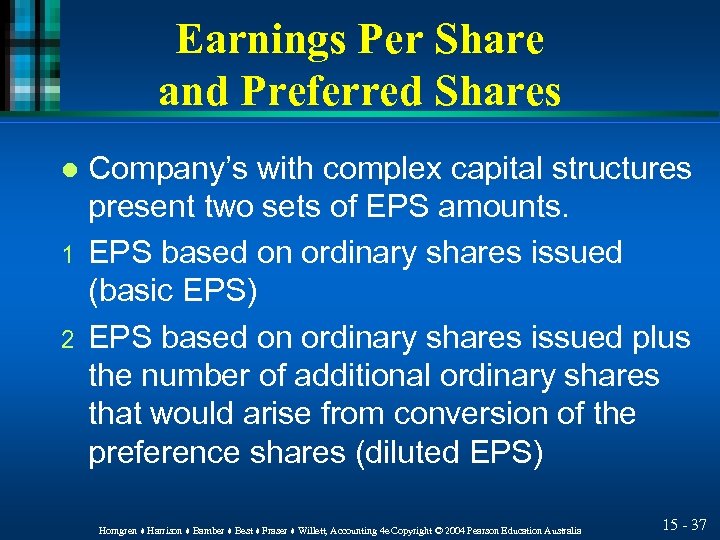
Earnings Per Share and Preferred Shares l 1 2 Company’s with complex capital structures present two sets of EPS amounts. EPS based on ordinary shares issued (basic EPS) EPS based on ordinary shares issued plus the number of additional ordinary shares that would arise from conversion of the preference shares (diluted EPS) Horngren ♦ Harrison ♦ Bamber ♦ Best ♦ Fraser ♦ Willett, Accounting 4 e Copyright © 2004 Pearson Education Australia 15 - 37
Reporting Other Items Affecting Equity l Many companies are required to report changes in: ä Asset Revaluation Reserve ä Exchange differences ä Changes in retained profits due to the adoption of new accounting standards. Horngren ♦ Harrison ♦ Bamber ♦ Best ♦ Fraser ♦ Willett, Accounting 4 e Copyright © 2004 Pearson Education Australia 15 - 38
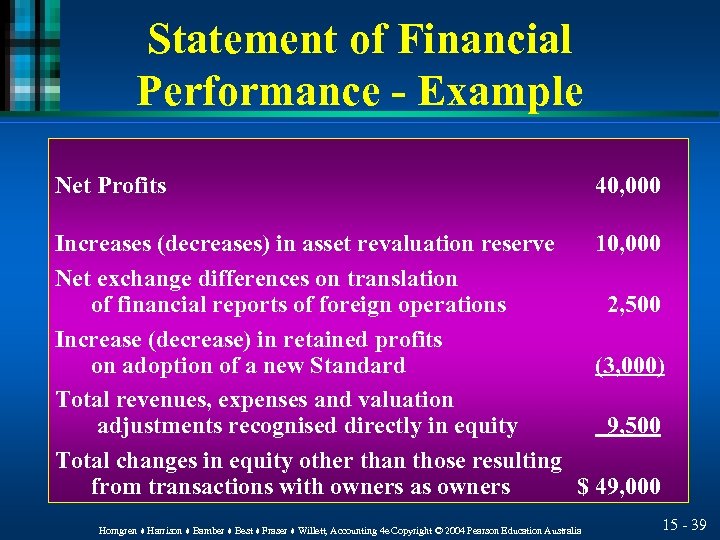
Statement of Financial Performance - Example Net Profits 40, 000 Increases (decreases) in asset revaluation reserve 10, 000 Net exchange differences on translation of financial reports of foreign operations 2, 500 Increase (decrease) in retained profits on adoption of a new Standard (3, 000) Total revenues, expenses and valuation adjustments recognised directly in equity 9, 500 Total changes in equity other than those resulting from transactions with owners as owners $ 49, 000 Horngren ♦ Harrison ♦ Bamber ♦ Best ♦ Fraser ♦ Willett, Accounting 4 e Copyright © 2004 Pearson Education Australia 15 - 39
End of Chapter 15 Horngren ♦ Harrison ♦ Bamber ♦ Best ♦ Fraser ♦ Willett, Accounting 4 e Copyright © 2004 Pearson Education Australia 15 - 40
Скачать презентацию Companies Retained Profits Share Splits and Buy-backs and
64850961c3484cab9fec779b11ea9aaa.ppt