


 Скачать презентацию COMP 9024 Data Structures and Algorithms Week Seven
cbf58d88c53ffe03d2d6d7a893277412.ppt
- Количество слайдов: 46
 COMP 9024: Data Structures and Algorithms Week Seven: Priority Queues Hui Wu Session 2, 2014 http: //www. cse. unsw. edu. au/~cs 9024 1
 Outline n n n Priority Queues Heaps Adaptable Priority Queues 2
 Priority Queues 3
 Priority Queue ADT n n n A priority queue stores a collection of entries. Each entry is a pair (key, value). Main methods of the Priority Queue ADT: n n insert(k, x) Inserts an entry with key k and value x. remove. Min() Removes and returns the entry with smallest key. n Additional methods n n n min() returns, but does not remove, an entry with smallest key size(), is. Empty() Applications: n n n Standby flyers Auctions Stock market 4
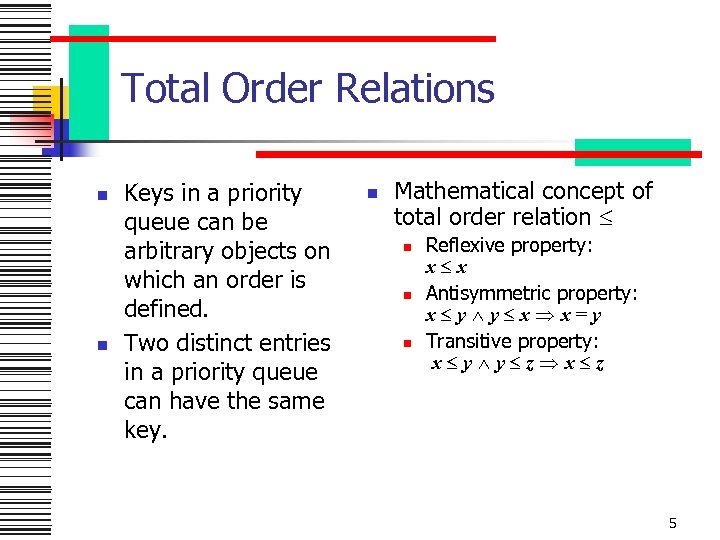 Total Order Relations n n Keys in a priority queue can be arbitrary objects on which an order is defined. Two distinct entries in a priority queue can have the same key. n Mathematical concept of total order relation n n n Reflexive property: x x Antisymmetric property: x y y x x=y Transitive property: x y y z x z 5
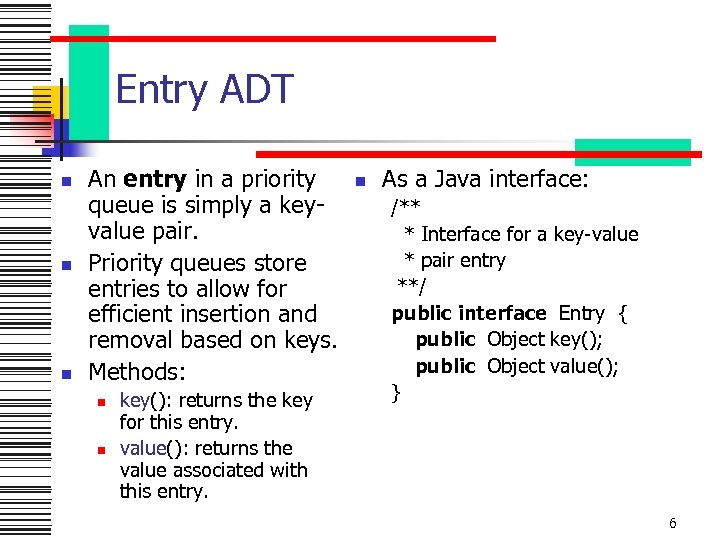 Entry ADT n n n An entry in a priority queue is simply a keyvalue pair. Priority queues store entries to allow for efficient insertion and removal based on keys. Methods: n n key(): returns the key for this entry. value(): returns the value associated with this entry. n As a Java interface: /** * Interface for a key-value * pair entry **/ public interface Entry { public Object key(); public Object value(); } 6
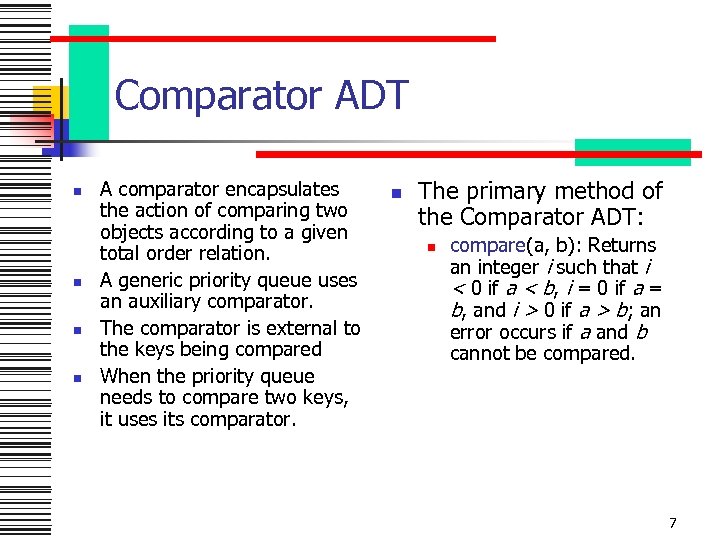 Comparator ADT n n A comparator encapsulates the action of comparing two objects according to a given total order relation. A generic priority queue uses an auxiliary comparator. The comparator is external to the keys being compared When the priority queue needs to compare two keys, it uses its comparator. n The primary method of the Comparator ADT: n compare(a, b): Returns an integer i such that i < 0 if a < b, i = 0 if a = b, and i > 0 if a > b; an error occurs if a and b cannot be compared. 7
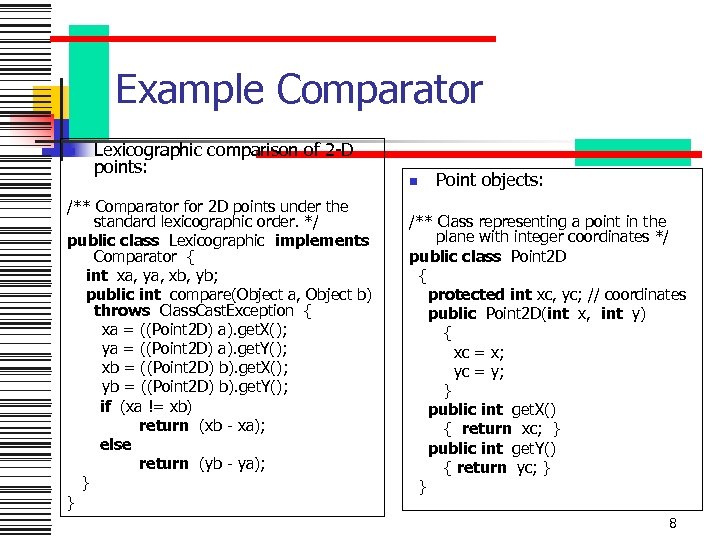 Example Comparator n Lexicographic comparison of 2 -D points: /** Comparator for 2 D points under the standard lexicographic order. */ public class Lexicographic implements Comparator { int xa, ya, xb, yb; public int compare(Object a, Object b) throws Class. Cast. Exception { xa = ((Point 2 D) a). get. X(); ya = ((Point 2 D) a). get. Y(); xb = ((Point 2 D) b). get. X(); yb = ((Point 2 D) b). get. Y(); if (xa != xb) return (xb - xa); else return (yb - ya); } } n Point objects: /** Class representing a point in the plane with integer coordinates */ public class Point 2 D { protected int xc, yc; // coordinates public Point 2 D(int x, int y) { xc = x; yc = y; } public int get. X() { return xc; } public int get. Y() { return yc; } } 8
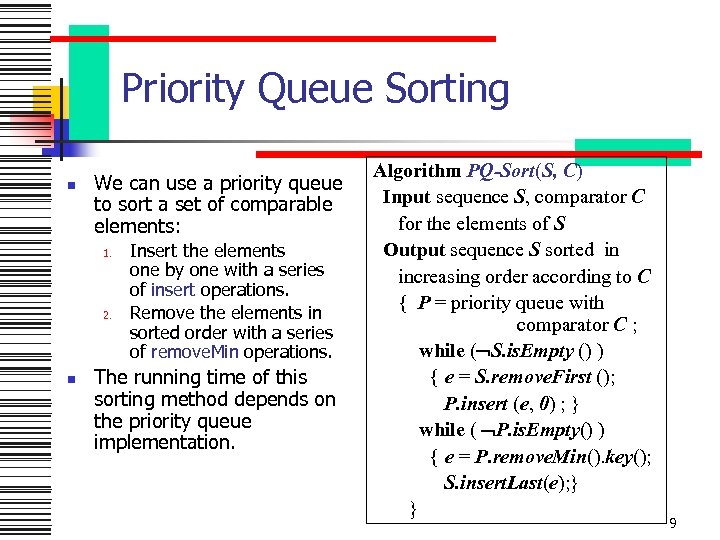 Priority Queue Sorting n We can use a priority queue to sort a set of comparable elements: 1. 2. n Insert the elements one by one with a series of insert operations. Remove the elements in sorted order with a series of remove. Min operations. The running time of this sorting method depends on the priority queue implementation. Algorithm PQ-Sort(S, C) Input sequence S, comparator C for the elements of S Output sequence S sorted in increasing order according to C { P = priority queue with comparator C ; while ( S. is. Empty () ) { e = S. remove. First (); P. insert (e, 0) ; } while ( P. is. Empty() ) { e = P. remove. Min(). key(); S. insert. Last(e); } } 9
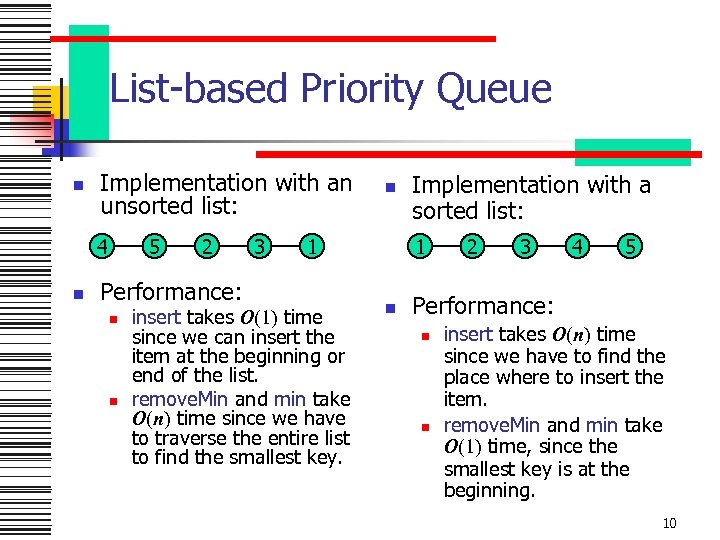 List-based Priority Queue n Implementation with an unsorted list: 4 n 5 2 Performance: n n 3 n 1 insert takes O(1) time since we can insert the item at the beginning or end of the list. remove. Min and min take O(n) time since we have to traverse the entire list to find the smallest key. Implementation with a sorted list: 1 n 2 3 4 5 Performance: n n insert takes O(n) time since we have to find the place where to insert the item. remove. Min and min take O(1) time, since the smallest key is at the beginning. 10
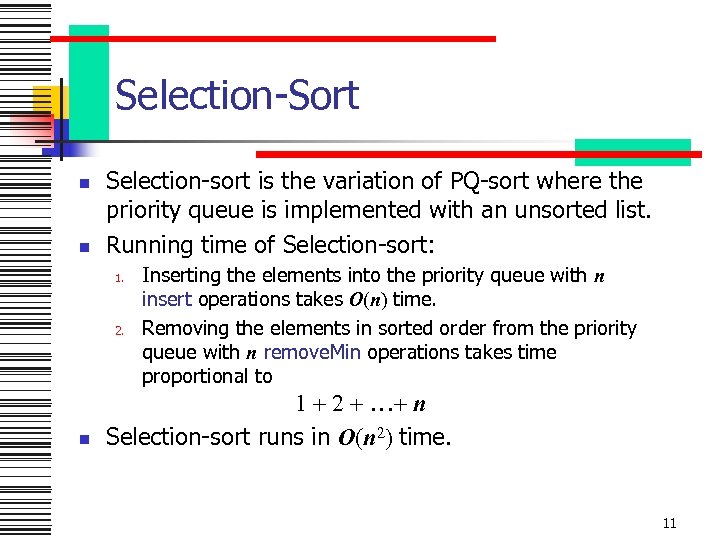 Selection-Sort n n Selection-sort is the variation of PQ-sort where the priority queue is implemented with an unsorted list. Running time of Selection-sort: 1. 2. n Inserting the elements into the priority queue with n insert operations takes O(n) time. Removing the elements in sorted order from the priority queue with n remove. Min operations takes time proportional to 1 + 2 + …+ n Selection-sort runs in O(n 2) time. 11
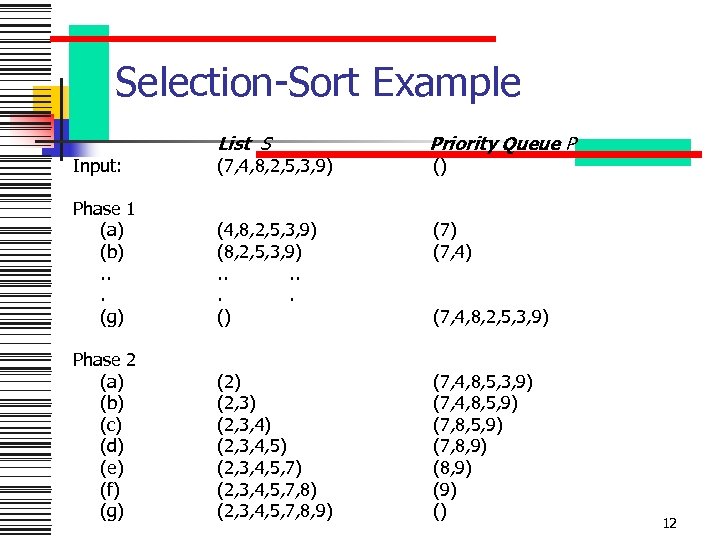 Selection-Sort Example Input: List S (7, 4, 8, 2, 5, 3, 9) Priority Queue P Phase 1 (a) (b). . . (g) (4, 8, 2, 5, 3, 9) (8, 2, 5, 3, 9). . . () (7, 4) Phase 2 (a) (b) (c) (d) (e) (f) (g) (2, 3) (2, 3, 4, 5) (2, 3, 4, 5, 7, 8) (2, 3, 4, 5, 7, 8, 9) (7, 4, 8, 5, 3, 9) (7, 4, 8, 5, 9) (7, 8, 9) (9) () () (7, 4, 8, 2, 5, 3, 9) 12
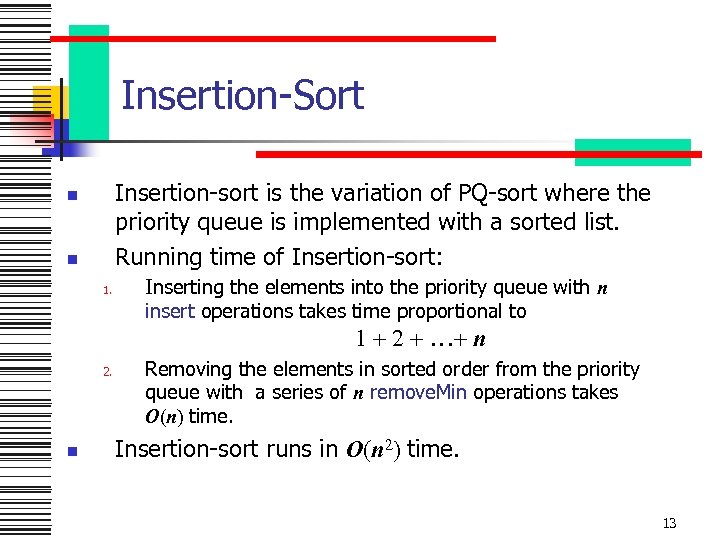 Insertion-Sort Insertion-sort is the variation of PQ-sort where the priority queue is implemented with a sorted list. Running time of Insertion-sort: n n 1. Inserting the elements into the priority queue with n insert operations takes time proportional to 1 + 2 + …+ n 2. n Removing the elements in sorted order from the priority queue with a series of n remove. Min operations takes O(n) time. Insertion-sort runs in O(n 2) time. 13
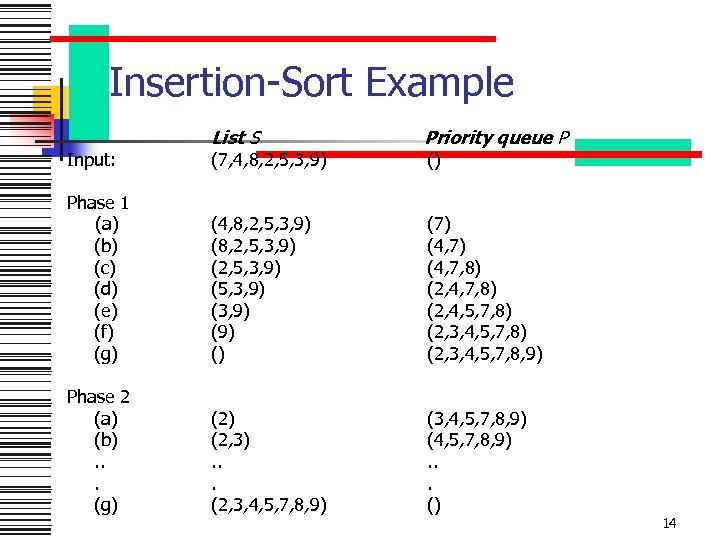 Insertion-Sort Example Input: List S (7, 4, 8, 2, 5, 3, 9) Priority queue P Phase 1 (a) (b) (c) (d) (e) (f) (g) (4, 8, 2, 5, 3, 9) (2, 5, 3, 9) (3, 9) () (7) (4, 7, 8) (2, 4, 5, 7, 8) (2, 3, 4, 5, 7, 8, 9) Phase 2 (a) (b). . . (g) (2, 3). . . (2, 3, 4, 5, 7, 8, 9) (4, 5, 7, 8, 9). . . () () 14
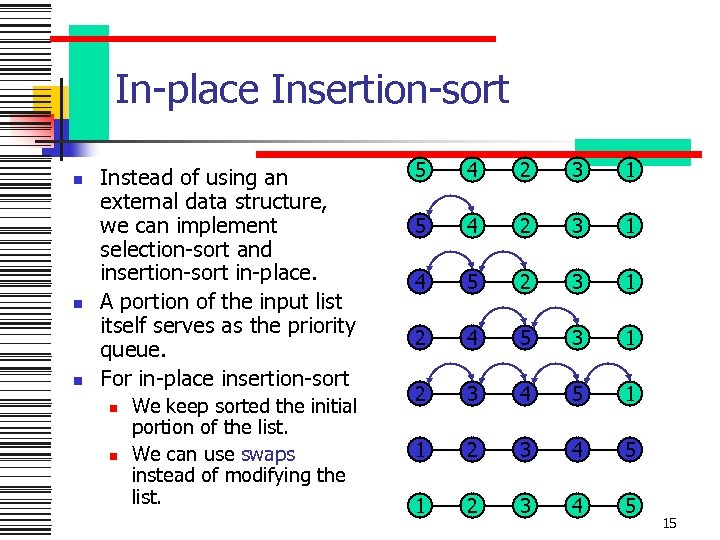 In-place Insertion-sort n n n Instead of using an external data structure, we can implement selection-sort and insertion-sort in-place. A portion of the input list itself serves as the priority queue. For in-place insertion-sort n n We keep sorted the initial portion of the list. We can use swaps instead of modifying the list. 5 4 2 3 1 4 5 2 3 1 2 4 5 3 1 2 3 4 5 15
 Heaps 2 5 9 6 7 16
 Recall Priority Queue ADT n n n A priority queue stores a collection of entries. Each entry is a pair (key, value). Main methods of the Priority Queue ADT: n n insert(k, x) inserts an entry with key k and value x. remove. Min() removes and returns the entry with smallest key. n Additional methods: n n n min() returns, but does not remove, an entry with smallest key size(), is. Empty() Applications: n n n Standby flyers Auctions Stock market 17
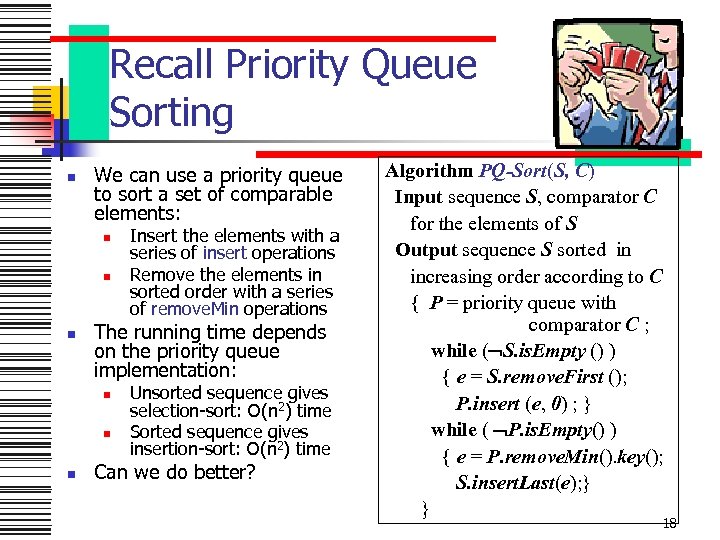 Recall Priority Queue Sorting n We can use a priority queue to sort a set of comparable elements: n n n The running time depends on the priority queue implementation: n n n Insert the elements with a series of insert operations Remove the elements in sorted order with a series of remove. Min operations Unsorted sequence gives selection-sort: O(n 2) time Sorted sequence gives insertion-sort: O(n 2) time Can we do better? Algorithm PQ-Sort(S, C) Input sequence S, comparator C for the elements of S Output sequence S sorted in increasing order according to C { P = priority queue with comparator C ; while ( S. is. Empty () ) { e = S. remove. First (); P. insert (e, 0) ; } while ( P. is. Empty() ) { e = P. remove. Min(). key(); S. insert. Last(e); } } 18
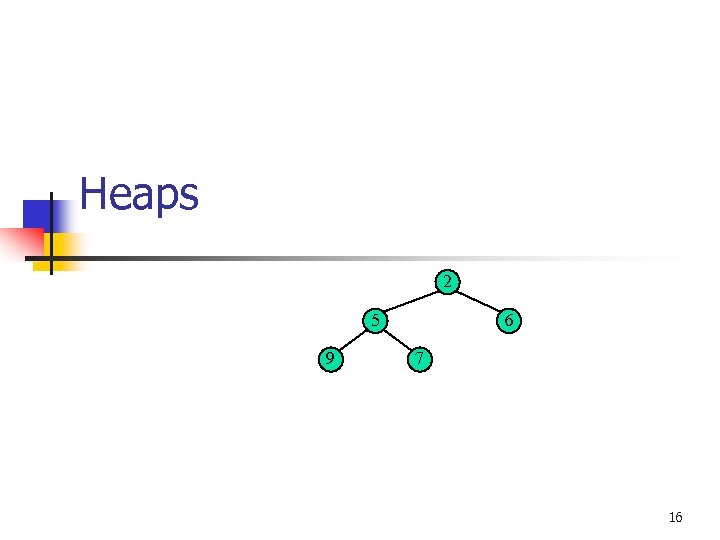
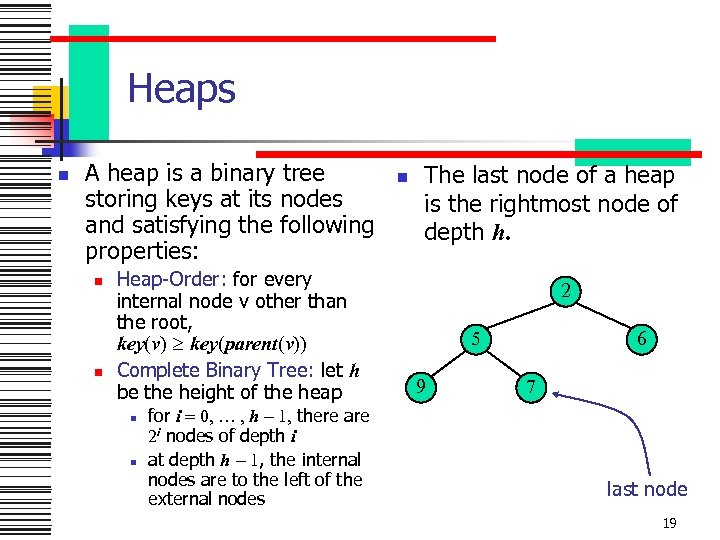 Heaps n A heap is a binary tree storing keys at its nodes and satisfying the following properties: n n Heap-Order: for every internal node v other than the root, key(v) key(parent(v)) Complete Binary Tree: let h be the height of the heap n n for i = 0, … , h - 1, there are 2 i nodes of depth i at depth h - 1, the internal nodes are to the left of the external nodes n The last node of a heap is the rightmost node of depth h. 2 5 9 6 7 last node 19
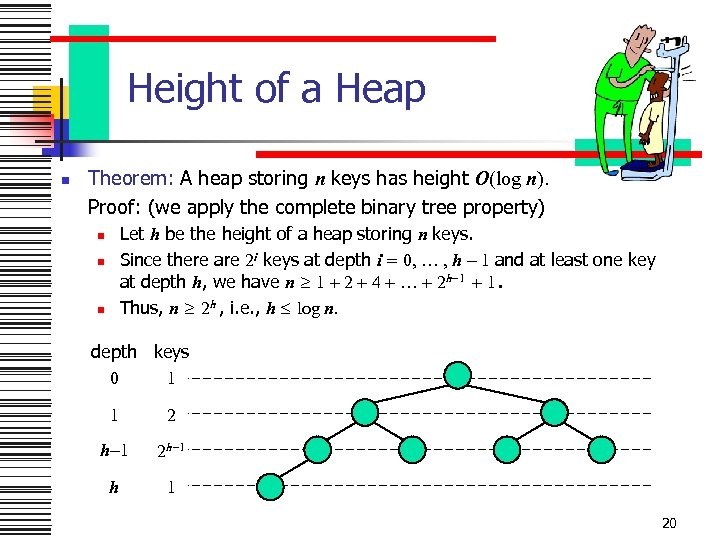 Height of a Heap n Theorem: A heap storing n keys has height O(log n). Proof: (we apply the complete binary tree property) Let h be the height of a heap storing n keys. Since there are 2 i keys at depth i = 0, … , h - 1 and at least one key at depth h, we have n 1 + 2 + 4 + … + 2 h-1 + 1. Thus, n 2 h , i. e. , h log n. n n n depth keys 0 1 1 2 h-1 2 h-1 h 1 20
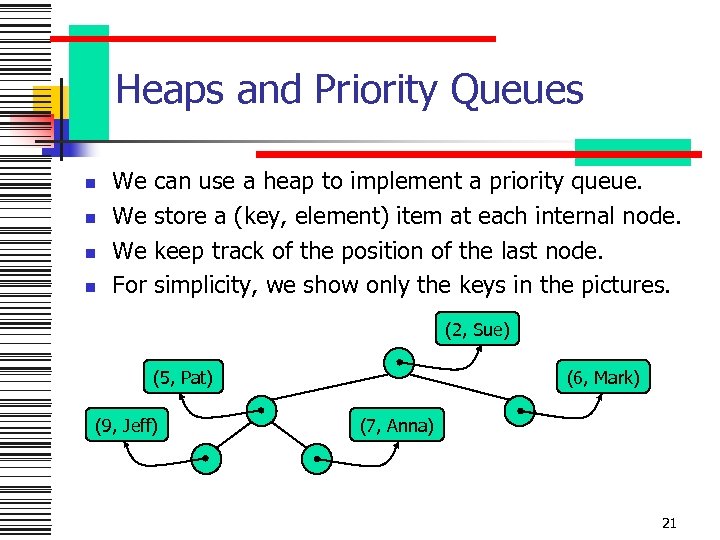 Heaps and Priority Queues n n We We We For can use a heap to implement a priority queue. store a (key, element) item at each internal node. keep track of the position of the last node. simplicity, we show only the keys in the pictures. (2, Sue) (5, Pat) (9, Jeff) (6, Mark) (7, Anna) 21
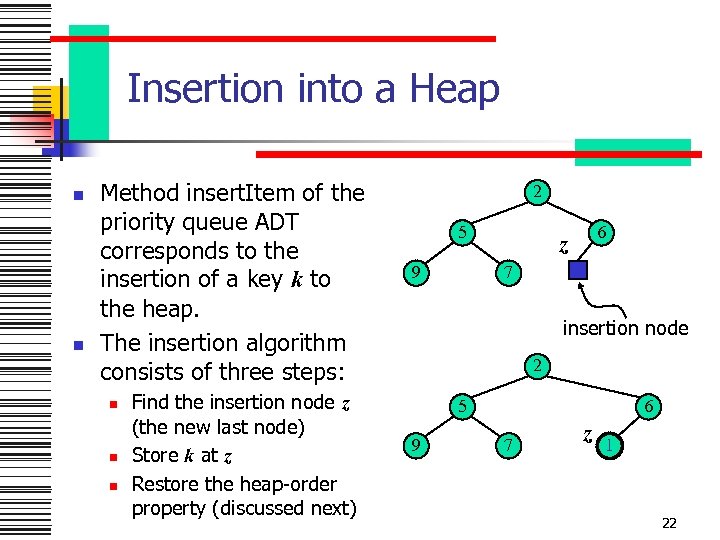 Insertion into a Heap n n Method insert. Item of the priority queue ADT corresponds to the insertion of a key k to the heap. The insertion algorithm consists of three steps: n n n Find the insertion node z (the new last node) Store k at z Restore the heap-order property (discussed next) 2 5 9 6 z 7 insertion node 2 5 9 6 7 z 1 22
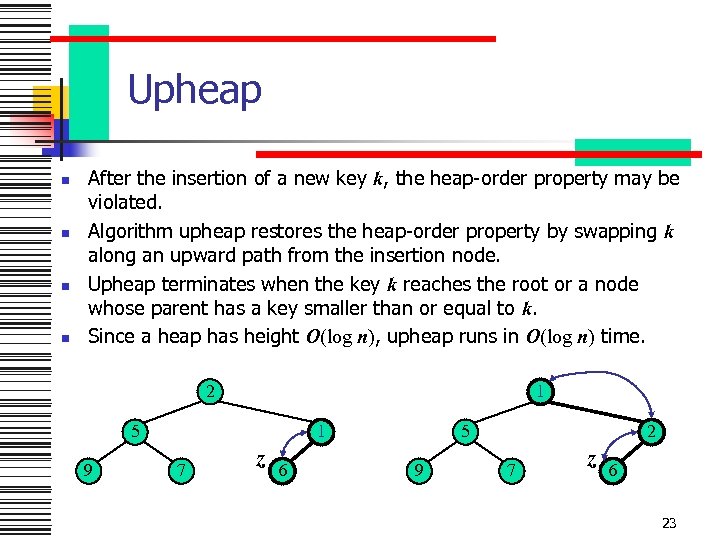 Upheap n n After the insertion of a new key k, the heap-order property may be violated. Algorithm upheap restores the heap-order property by swapping k along an upward path from the insertion node. Upheap terminates when the key k reaches the root or a node whose parent has a key smaller than or equal to k. Since a heap has height O(log n), upheap runs in O(log n) time. 2 1 5 9 1 7 z 6 5 9 2 7 z 6 23
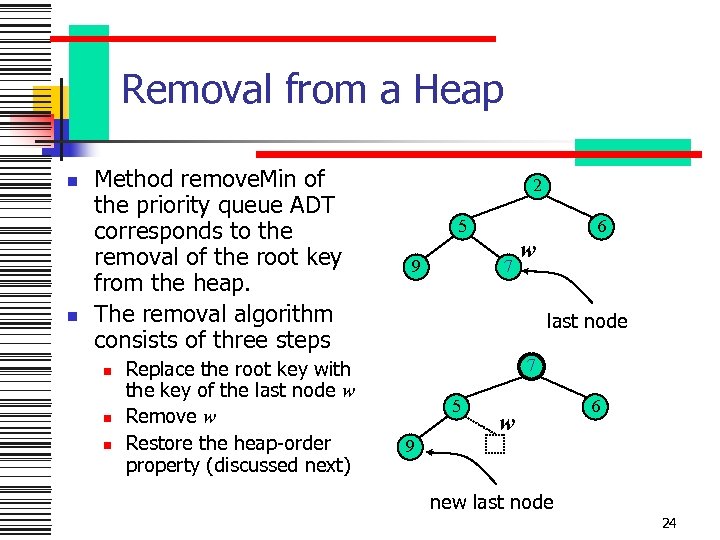 Removal from a Heap n n Method remove. Min of the priority queue ADT corresponds to the removal of the root key from the heap. The removal algorithm consists of three steps n n n Replace the root key with the key of the last node w Remove w Restore the heap-order property (discussed next) 2 5 9 6 7 w last node 7 5 w 6 9 new last node 24
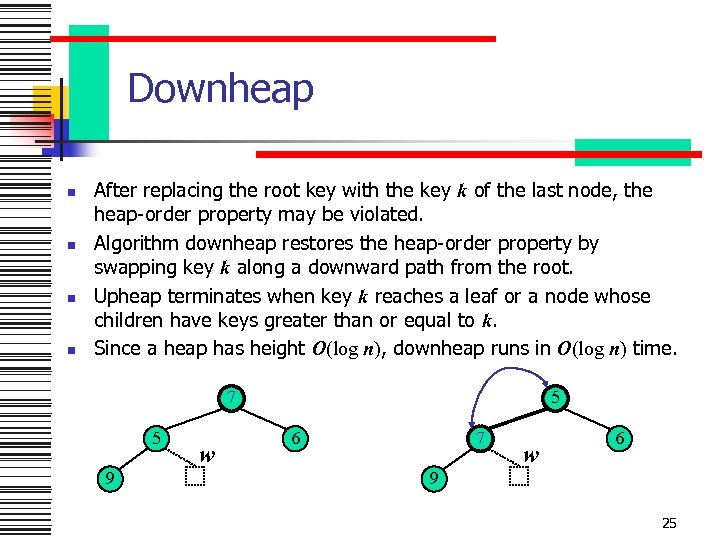 Downheap n n After replacing the root key with the key k of the last node, the heap-order property may be violated. Algorithm downheap restores the heap-order property by swapping key k along a downward path from the root. Upheap terminates when key k reaches a leaf or a node whose children have keys greater than or equal to k. Since a heap has height O(log n), downheap runs in O(log n) time. 7 5 9 w 5 6 7 w 6 9 25
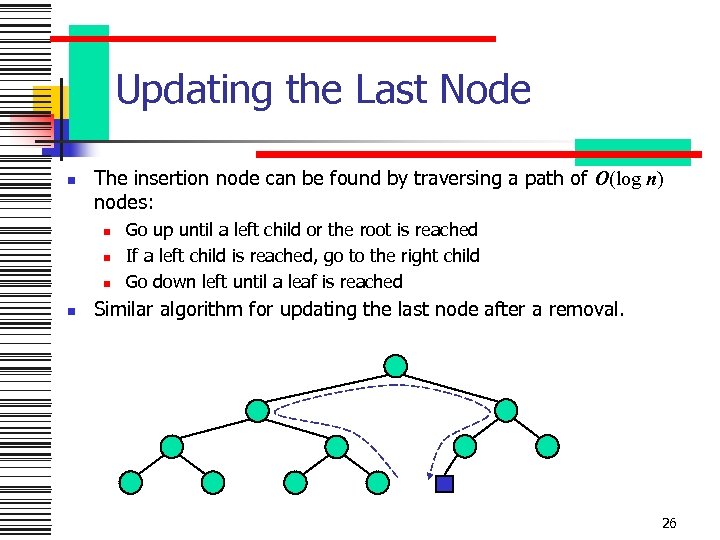 Updating the Last Node n The insertion node can be found by traversing a path of O(log n) nodes: n n Go up until a left child or the root is reached If a left child is reached, go to the right child Go down left until a leaf is reached Similar algorithm for updating the last node after a removal. 26
 Heap-Sort n Consider a priority queue with n items implemented by means of a heap n n n the space used is O(n) methods insert and remove. Min take O(log n) time methods size, is. Empty, and min take time O(1) time n n n Using a heap-based priority queue, we can sort a sequence of n elements in O(n log n) time. The resulting algorithm is called heap-sort. Heap-sort is much faster than quadratic sorting algorithms, such as insertion-sort and selection-sort. 27
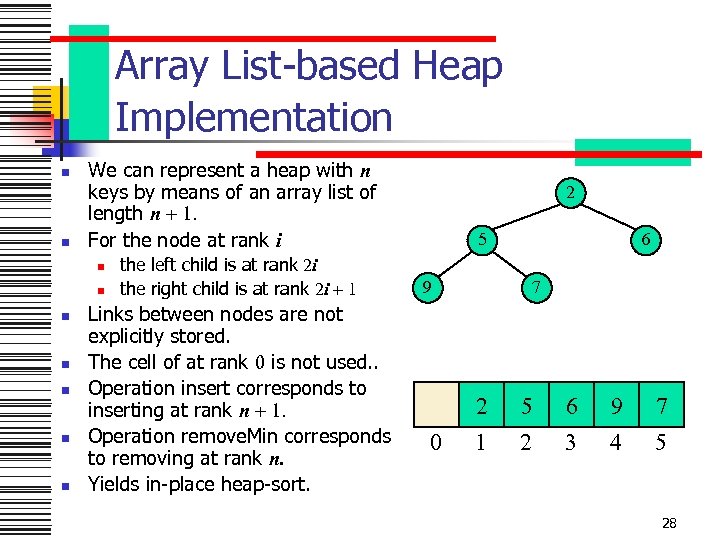 Array List-based Heap Implementation n n We can represent a heap with n keys by means of an array list of length n + 1. For the node at rank i n n n n the left child is at rank 2 i the right child is at rank 2 i + 1 Links between nodes are not explicitly stored. The cell of at rank 0 is not used. . Operation insert corresponds to inserting at rank n + 1. Operation remove. Min corresponds to removing at rank n. Yields in-place heap-sort. 2 5 6 9 7 2 0 5 6 9 7 1 2 3 4 5 28
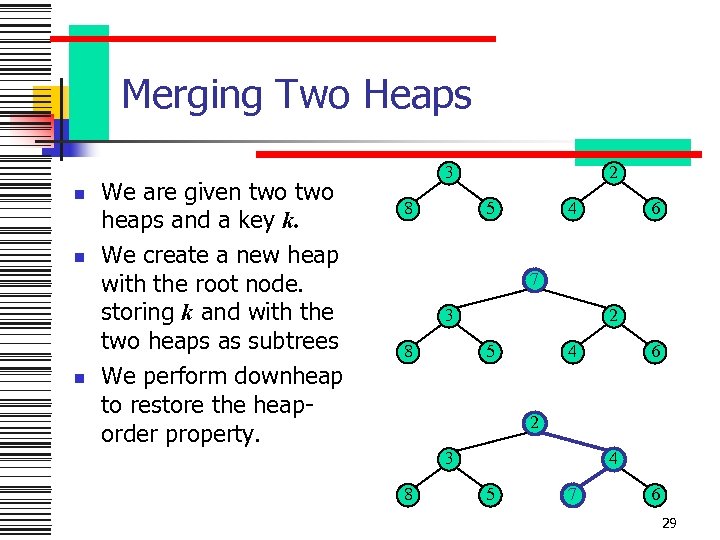 Merging Two Heaps n n n We are given two heaps and a key k. We create a new heap with the root node. storing k and with the two heaps as subtrees We perform downheap to restore the heaporder property. 3 8 2 5 4 6 7 3 8 2 5 4 6 2 3 8 4 5 7 6 29
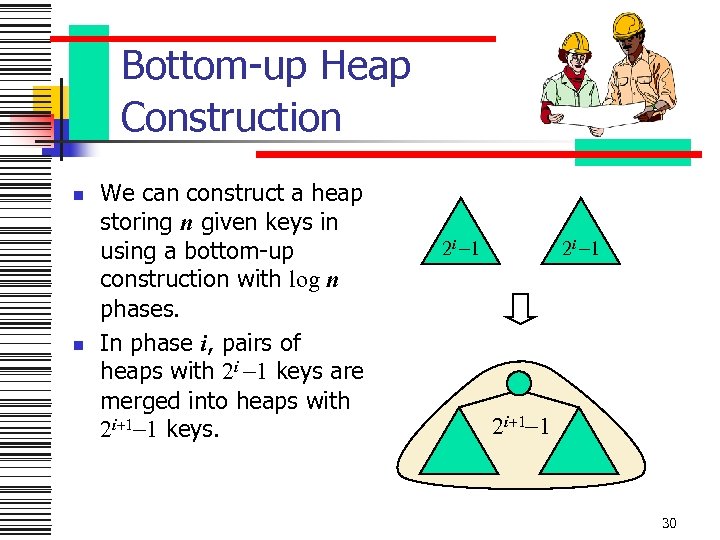 Bottom-up Heap Construction n n We can construct a heap storing n given keys in using a bottom-up construction with log n phases. In phase i, pairs of heaps with 2 i -1 keys are merged into heaps with 2 i+1 -1 keys. 2 i -1 2 i+1 -1 30
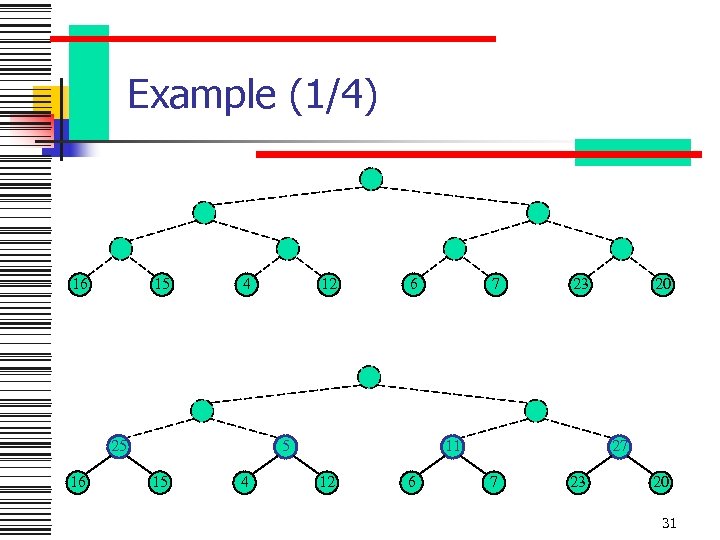 Example (1/4) 16 15 4 25 16 12 6 5 15 4 7 23 11 12 6 20 27 7 23 20 31
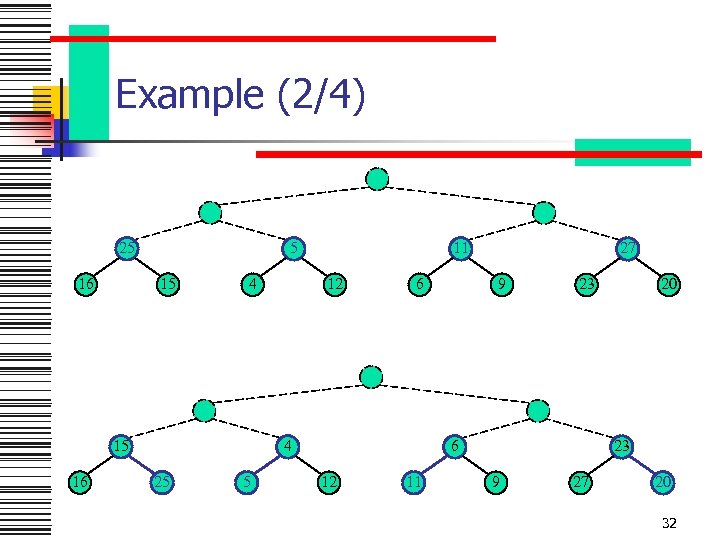 Example (2/4) 25 16 5 15 4 15 16 11 12 6 4 25 5 27 9 23 6 12 11 20 23 9 27 20 32
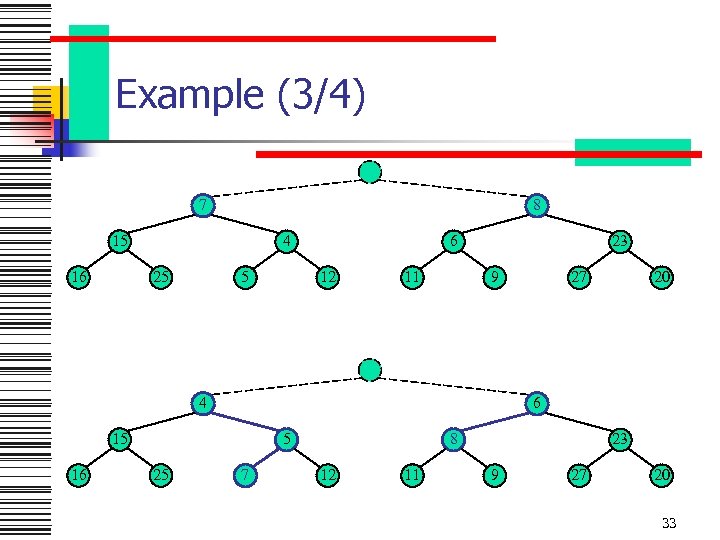 Example (3/4) 7 8 15 16 4 25 5 6 12 11 23 9 4 5 25 20 6 15 16 27 7 8 12 11 23 9 27 20 33
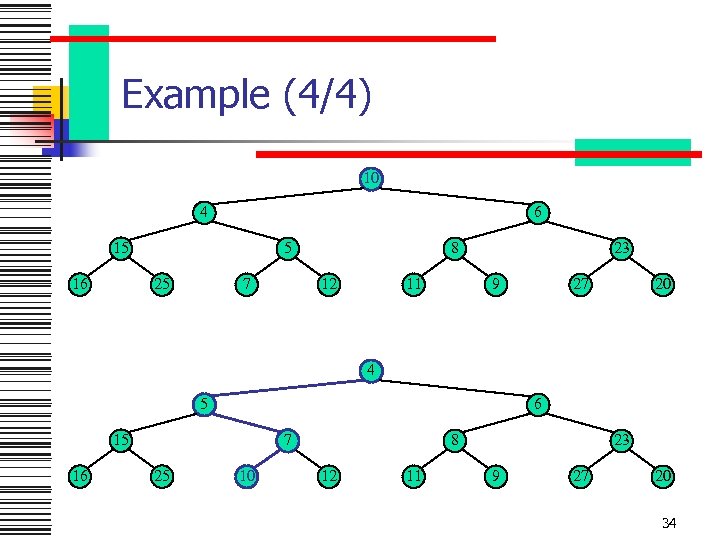 Example (4/4) 10 4 6 15 16 5 25 7 8 12 11 23 9 27 20 4 5 6 15 16 7 25 10 8 12 11 23 9 27 20 34
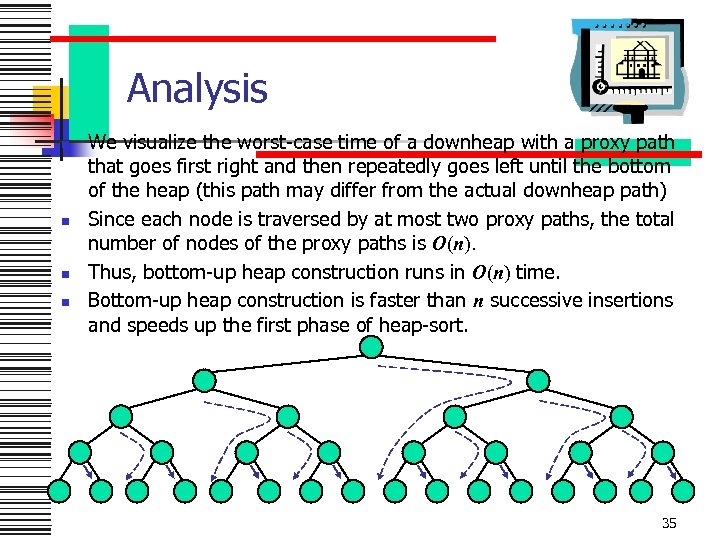 Analysis n n We visualize the worst-case time of a downheap with a proxy path that goes first right and then repeatedly goes left until the bottom of the heap (this path may differ from the actual downheap path) Since each node is traversed by at most two proxy paths, the total number of nodes of the proxy paths is O(n). Thus, bottom-up heap construction runs in O(n) time. Bottom-up heap construction is faster than n successive insertions and speeds up the first phase of heap-sort. 35
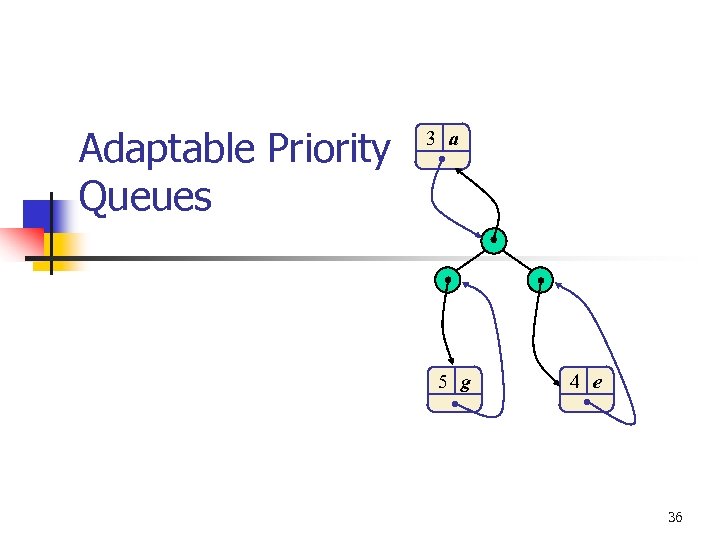 Adaptable Priority Queues 3 a 5 g 4 e 36
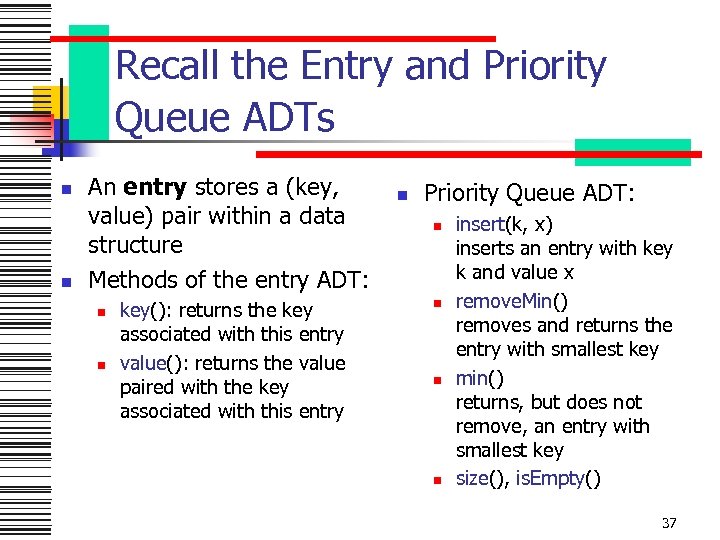 Recall the Entry and Priority Queue ADTs n n An entry stores a (key, value) pair within a data structure Methods of the entry ADT: n n key(): returns the key associated with this entry value(): returns the value paired with the key associated with this entry n Priority Queue ADT: n n insert(k, x) inserts an entry with key k and value x remove. Min() removes and returns the entry with smallest key min() returns, but does not remove, an entry with smallest key size(), is. Empty() 37
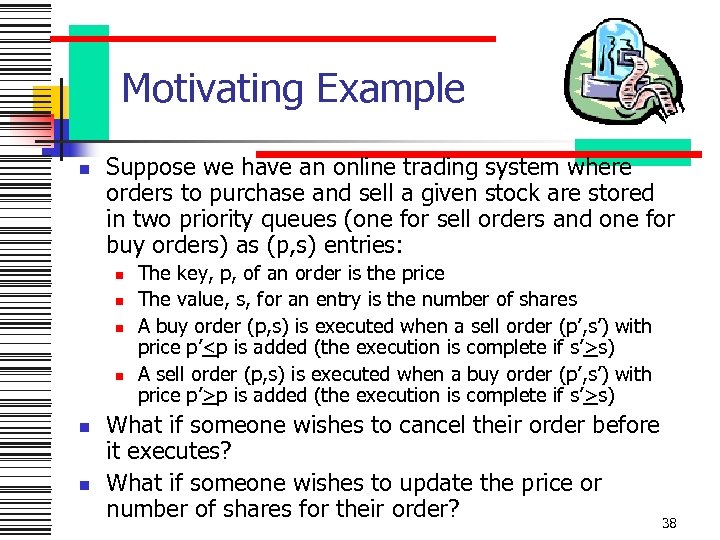 Motivating Example n Suppose we have an online trading system where orders to purchase and sell a given stock are stored in two priority queues (one for sell orders and one for buy orders) as (p, s) entries: n n n The key, p, of an order is the price The value, s, for an entry is the number of shares A buy order (p, s) is executed when a sell order (p’, s’) with price p’
s) A sell order (p, s) is executed when a buy order (p’, s’) with price p’>p is added (the execution is complete if s’>s) What if someone wishes to cancel their order before it executes? What if someone wishes to update the price or number of shares for their order? 38
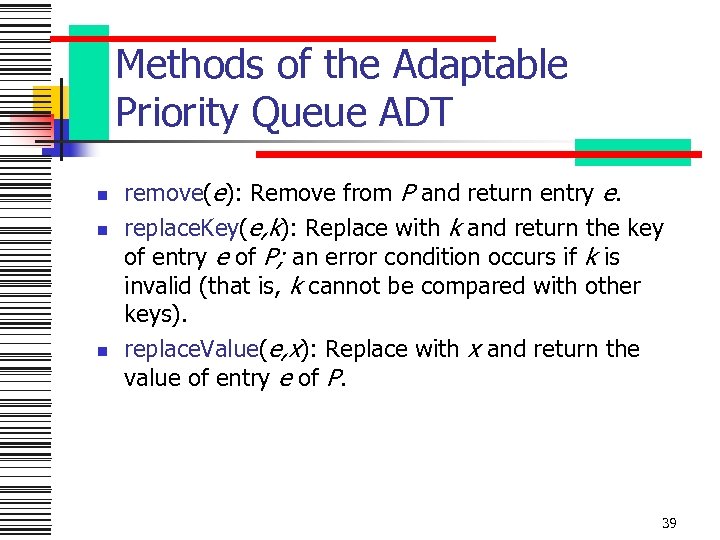 Methods of the Adaptable Priority Queue ADT n n n remove(e): Remove from P and return entry e. replace. Key(e, k): Replace with k and return the key of entry e of P; an error condition occurs if k is invalid (that is, k cannot be compared with other keys). replace. Value(e, x): Replace with x and return the value of entry e of P. 39
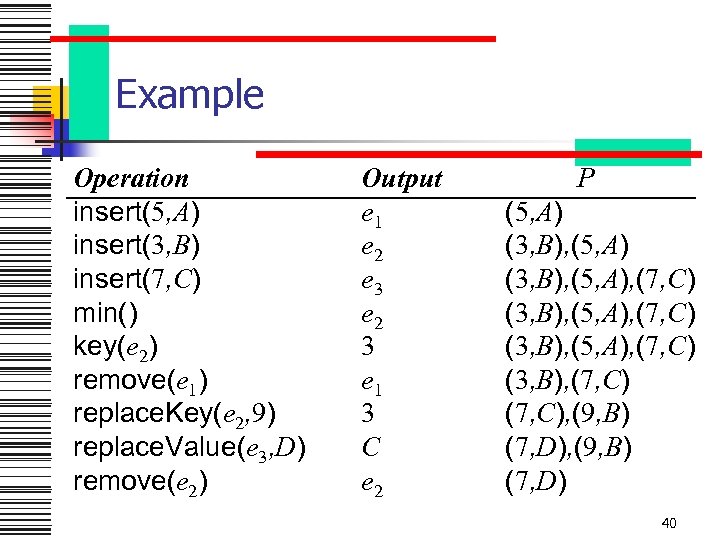 Example Operation insert(5, A) insert(3, B) insert(7, C) min() key(e 2) remove(e 1) replace. Key(e 2, 9) replace. Value(e 3, D) remove(e 2) Output e 1 e 2 e 3 e 2 3 e 1 3 C e 2 P (5, A) (3, B), (5, A), (7, C) (3, B), (7, C), (9, B) (7, D) 40
 Locating Entries n n In order to implement the operations remove(k), replace. Key(e), and replace. Value(k), we need fast ways of locating an entry e in a priority queue. We can always just search the entire data structure to find an entry e, but there are better ways for locating entries. 41
 Location-Aware Entries n n A locator-aware entry identifies and tracks the location of its (key, value) object within a data structure Intuitive notion: n n Coat claim check Valet claim ticket Reservation number Main idea: n Since entries are created and returned from the data structure itself, it can return location-aware entries, thereby making future updates easier 42
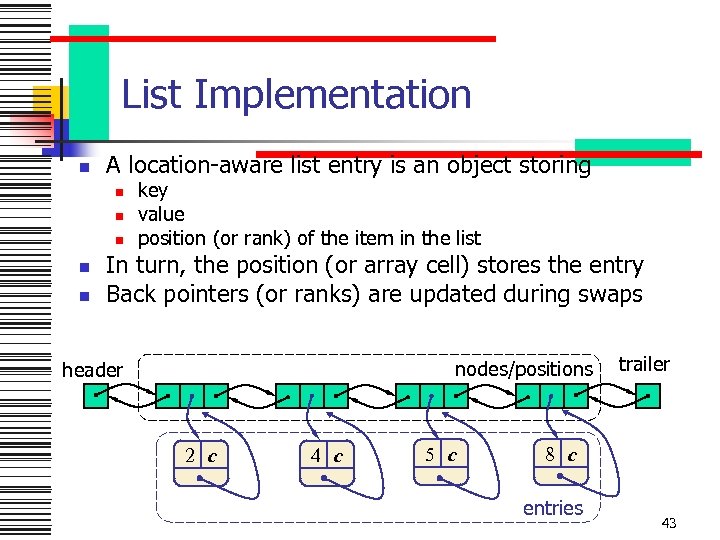 List Implementation n A location-aware list entry is an object storing n n n key value position (or rank) of the item in the list In turn, the position (or array cell) stores the entry Back pointers (or ranks) are updated during swaps nodes/positions header 2 c 4 c 5 c trailer 8 c entries 43
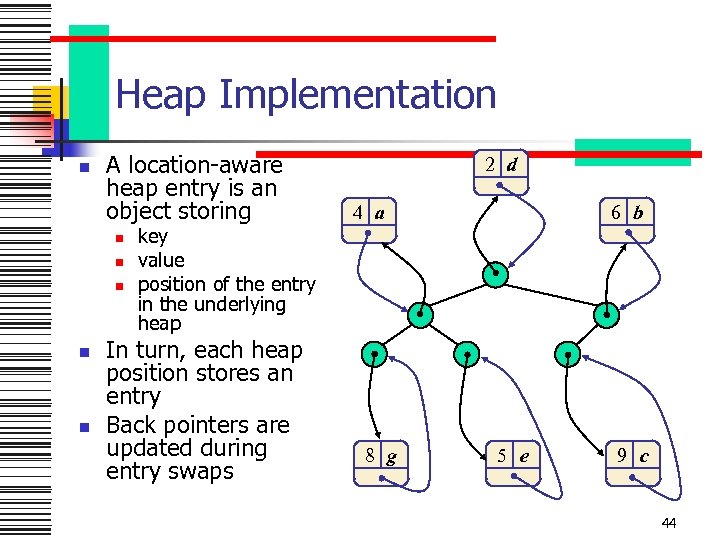 Heap Implementation n A location-aware heap entry is an object storing n n n key value position of the entry in the underlying heap In turn, each heap position stores an entry Back pointers are updated during entry swaps 2 d 4 a 8 g 6 b 5 e 9 c 44
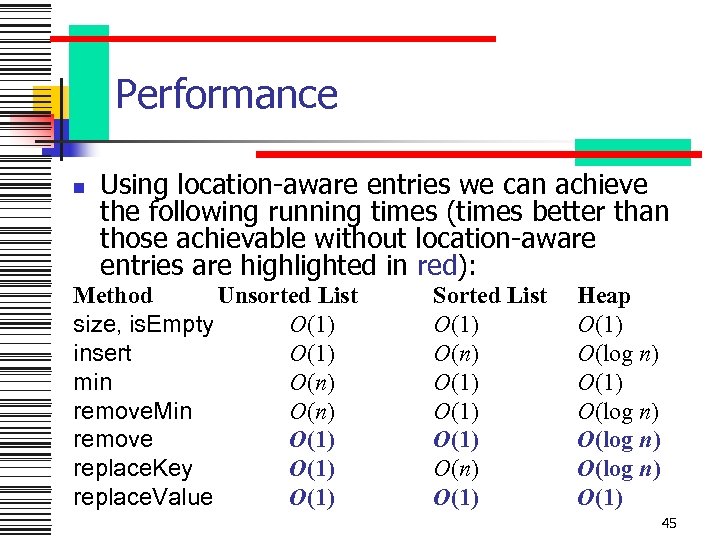 Performance n Using location-aware entries we can achieve the following running times (times better than those achievable without location-aware entries are highlighted in red): Method Unsorted List size, is. Empty O(1) insert O(1) min O(n) remove. Min O(n) remove O(1) replace. Key O(1) replace. Value O(1) Sorted List O(1) O(n) O(1) Heap O(1) O(log n) O(1) 45
 References 1. Chapter 8, Data Structures and Algorithms by Goodrich and Tamassia. 46