 Скачать презентацию COMP 7880 E-Business Strategies Summary and Outlook Dickson
66f0e90e7a7054890daece636e67eb4c.ppt
- Количество слайдов: 36



COMP 7880: E-Business Strategies Summary and Outlook Dickson K. W. Chiu Ph. D, SMIEEE, SMACM, Life MHKCS 1
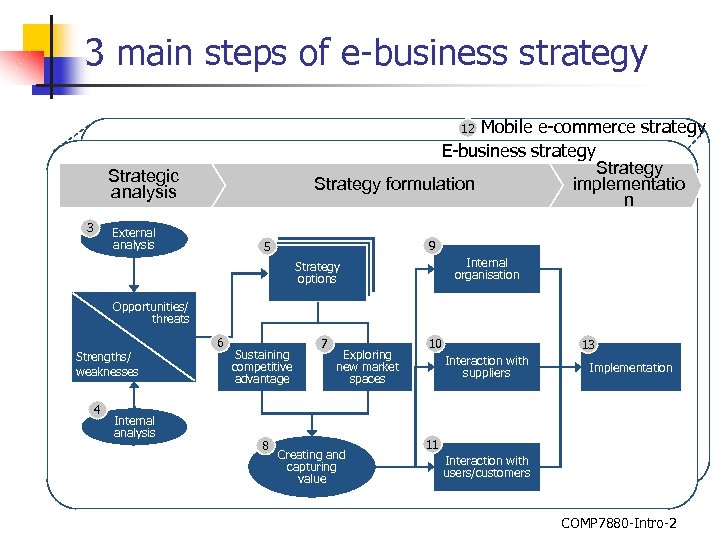
3 main steps of e-business strategy Mobile e-commerce strategy E-business strategy Strategy implementatio Strategy formulation n 12 Strategic analysis 3 External analysis 9 5 Internal organisation Strategy options Opportunities/ threats Strengths/ weaknesses 4 Internal analysis 6 Sustaining competitive advantage 8 7 Exploring new market spaces Creating and capturing value 10 13 Interaction with suppliers Implementation 11 Interaction with users/customers COMP 7880 -Intro-2
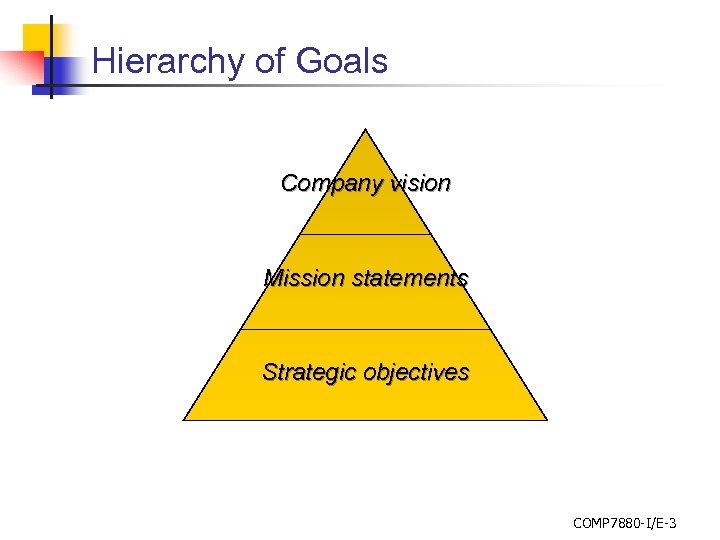
Hierarchy of Goals Company vision Mission statements Strategic objectives COMP 7880 -I/E-3
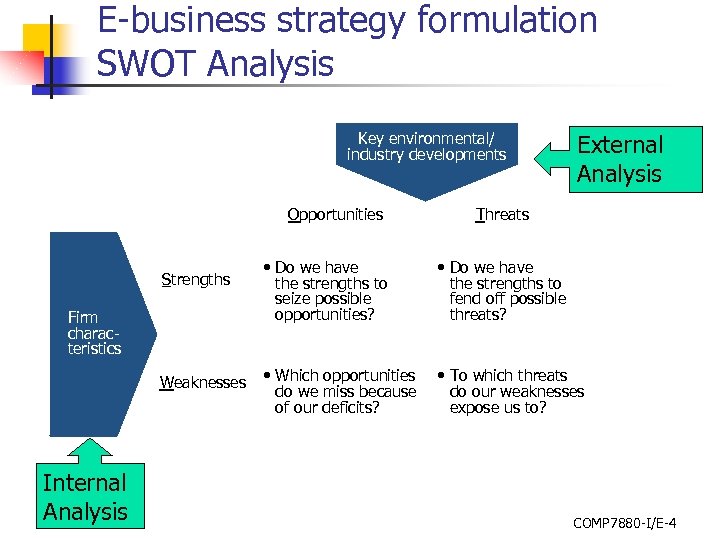
E-business strategy formulation SWOT Analysis Key environmental/ industry developments Opportunities Strengths Firm characteristics Weaknesses Internal Analysis External Analysis Threats • Do we have the strengths to seize possible opportunities? • Do we have the strengths to fend off possible threats? • Which opportunities do we miss because of our deficits? • To which threats do our weaknesses expose us to? COMP 7880 -I/E-4
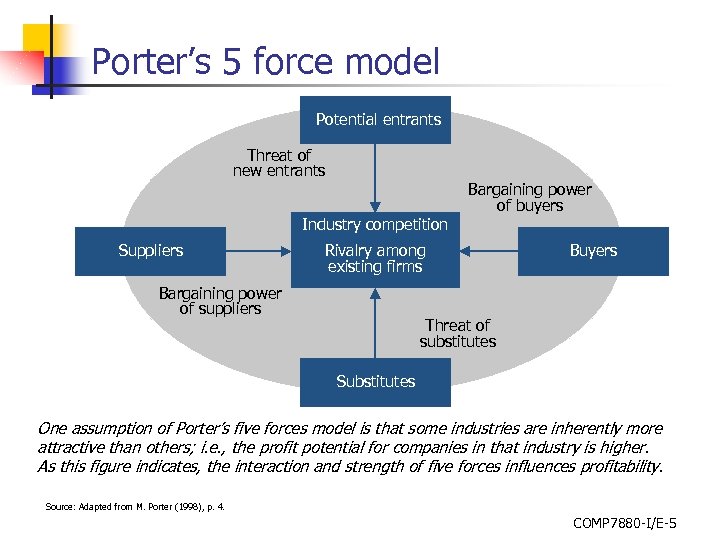
Porter’s 5 force model Potential entrants Threat of new entrants Industry competition Suppliers Bargaining power of buyers Rivalry among existing firms Bargaining power of suppliers Buyers Threat of substitutes Substitutes One assumption of Porter’s five forces model is that some industries are inherently more attractive than others; i. e. , the profit potential for companies in that industry is higher. As this figure indicates, the interaction and strength of five forces influences profitability. Source: Adapted from M. Porter (1998), p. 4. COMP 7880 -I/E-5
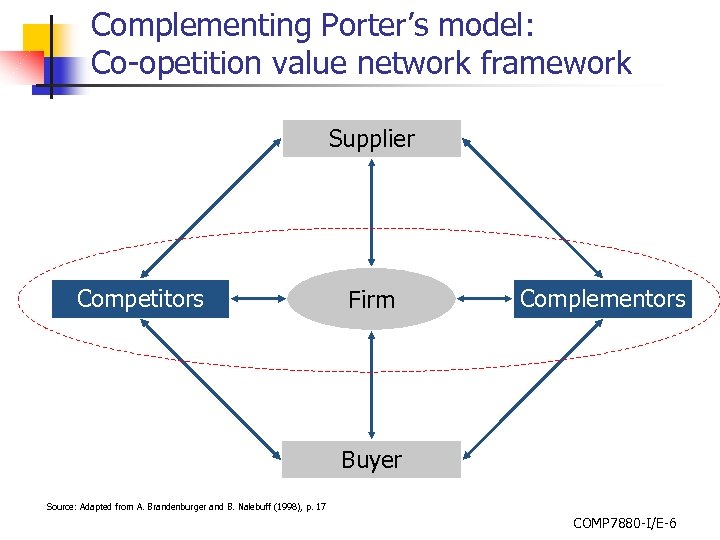
Complementing Porter’s model: Co-opetition value network framework Supplier Competitors Firm Complementors Buyer Source: Adapted from A. Brandenburger and B. Nalebuff (1998), p. 17 COMP 7880 -I/E-6
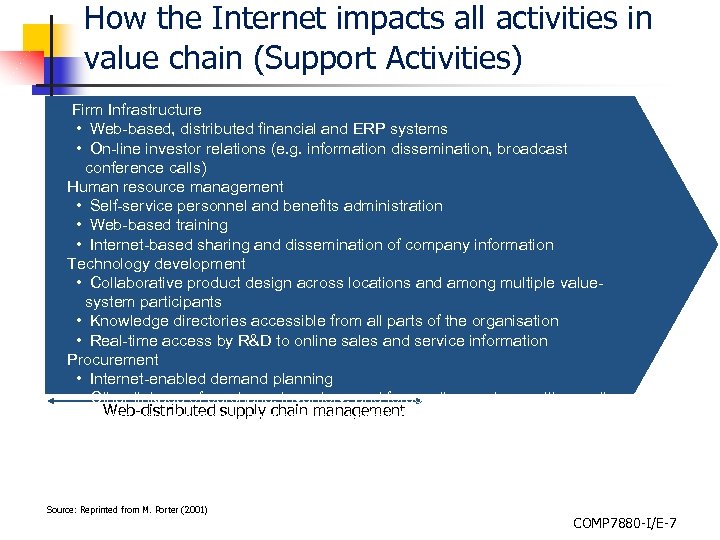
How the Internet impacts all activities in value chain (Support Activities) Firm Infrastructure • Web-based, distributed financial and ERP systems • On-line investor relations (e. g. information dissemination, broadcast conference calls) Human resource management • Self-service personnel and benefits administration • Web-based training • Internet-based sharing and dissemination of company information Technology development • Collaborative product design across locations and among multiple valuesystem participants • Knowledge directories accessible from all parts of the organisation • Real-time access by R&D to online sales and service information Procurement • Internet-enabled demand planning • Other linkage of purchase, inventory, and forecasting systems with suppliers Web-distributed procurement via marketplaces, auctions and buyer-seller • Direct and indirect supply chain management matching Source: Reprinted from M. Porter (2001) COMP 7880 -I/E-7
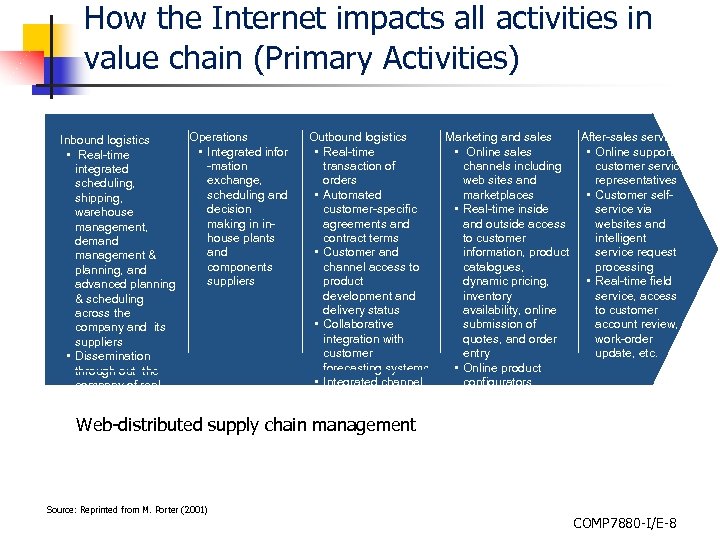
How the Internet impacts all activities in value chain (Primary Activities) Operations Outbound logistics Inbound logistics • Integrated infor • Real-time -mation transaction of integrated exchange, orders scheduling, scheduling and • Automated shipping, decision customer-specific warehouse making in inagreements and management, house plants contract terms demand • Customer and management & components channel access to planning, and suppliers product advanced planning development and & scheduling delivery status across the • Collaborative company and its integration with suppliers customer • Dissemination forecasting systems through out the • Integrated channel company of realmanagement time inbound and in-progress Web-distributed supply chain management inventory data Source: Reprinted from M. Porter (2001) Marketing and sales After-sales service • Online sales • Online support of channels including customer service web sites and representatives marketplaces • Customer self • Real-time inside service via and outside access websites and to customer intelligent information, product service request catalogues, processing dynamic pricing, • Real-time field inventory service, access availability, online to customer submission of account review, quotes, and order work-order entry update, etc. • Online product configurators • Customer-tailored marketing via customer profiling COMP 7880 -I/E-8
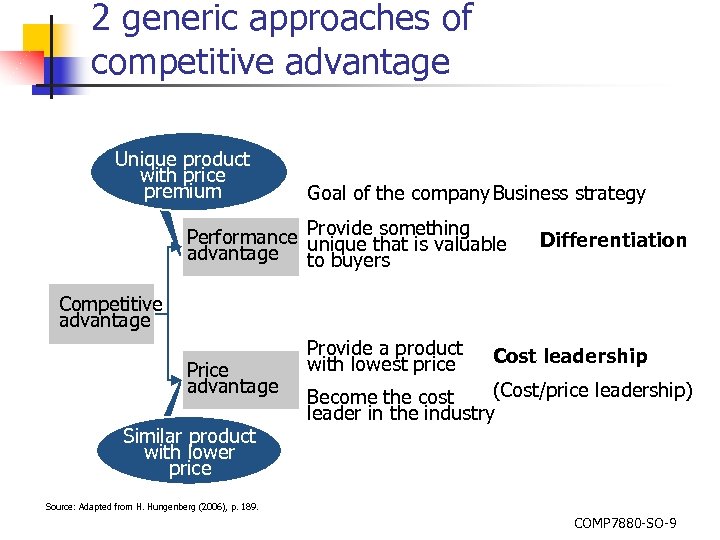
2 generic approaches of competitive advantage Unique product with price premium Goal of the company Business strategy something Performance Provide that is valuable advantage unique to buyers Differentiation Competitive advantage Price advantage Similar product with lower price Provide a product with lowest price Cost leadership (Cost/price leadership) Become the cost leader in the industry Source: Adapted from H. Hungenberg (2006), p. 189. COMP 7880 -SO-9
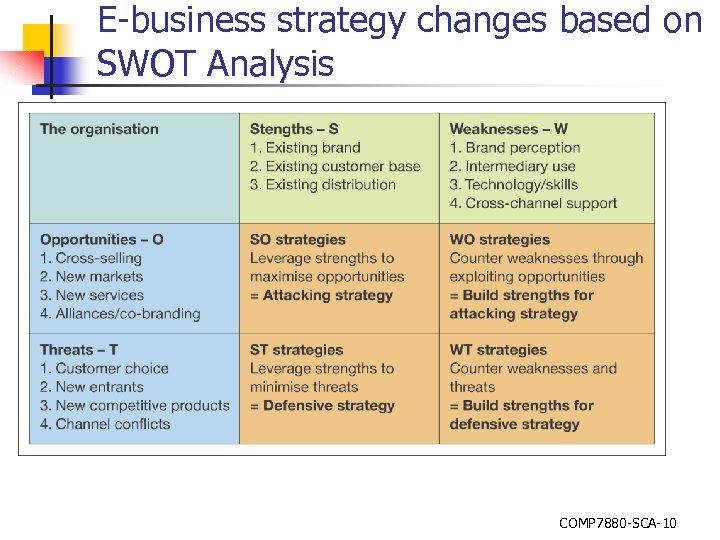
E-business strategy changes based on SWOT Analysis COMP 7880 -SCA-10
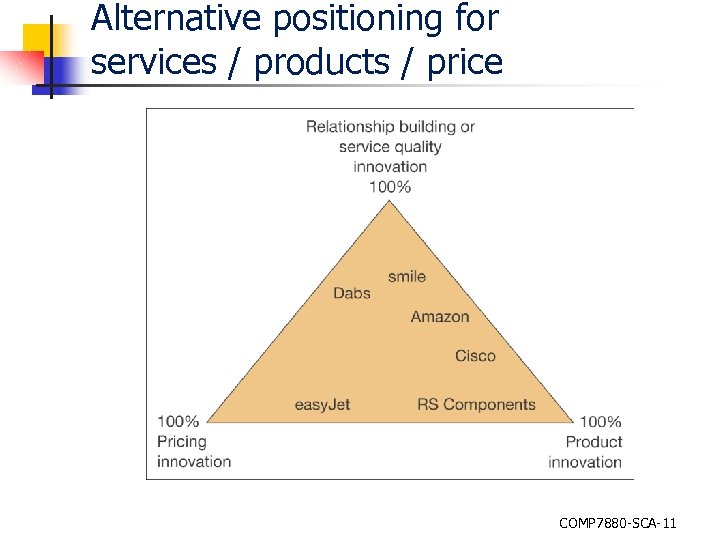
Alternative positioning for services / products / price COMP 7880 -SCA-11
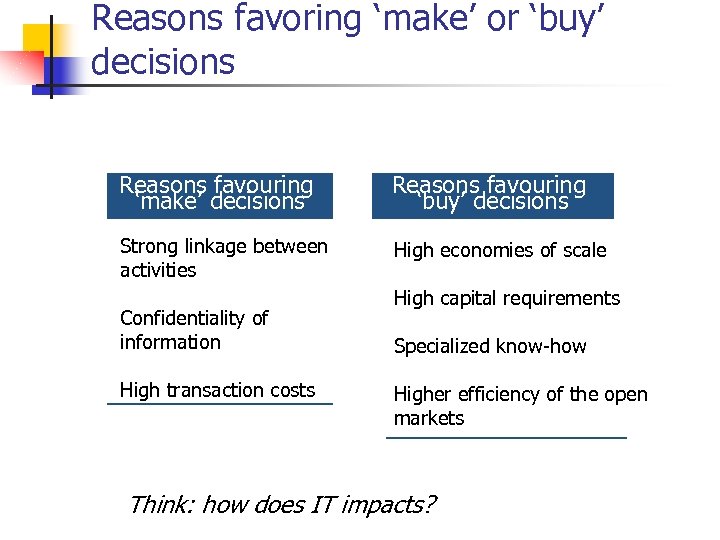
Reasons favoring ‘make’ or ‘buy’ decisions Reasons favouring ‘make’ decisions Reasons favouring ‘buy’ decisions Strong linkage between activities High economies of scale Confidentiality of information High transaction costs High capital requirements Specialized know-how Higher efficiency of the open markets Think: how does IT impacts?
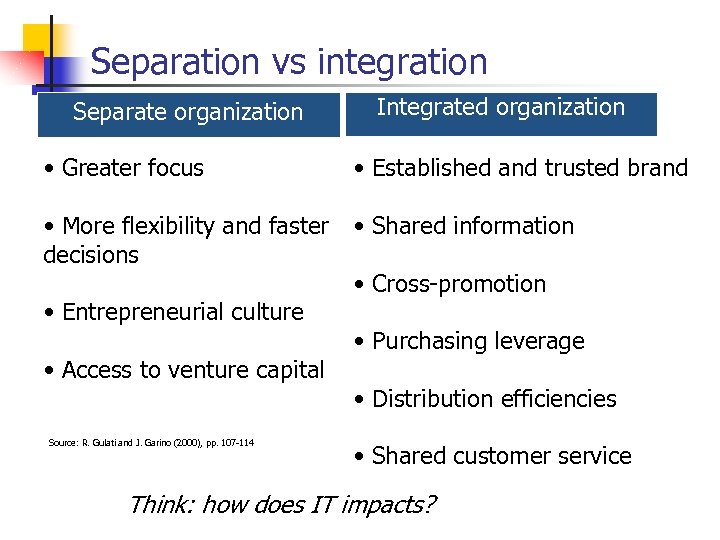
Separation vs integration Integrated organization Separate organization • Greater focus • Established and trusted brand • More flexibility and faster • decisions • • Entrepreneurial culture • • Access to venture capital • Source: R. Gulati and J. Garino (2000), pp. 107 -114 Shared information Cross-promotion Purchasing leverage Distribution efficiencies • Shared customer service Think: how does IT impacts?
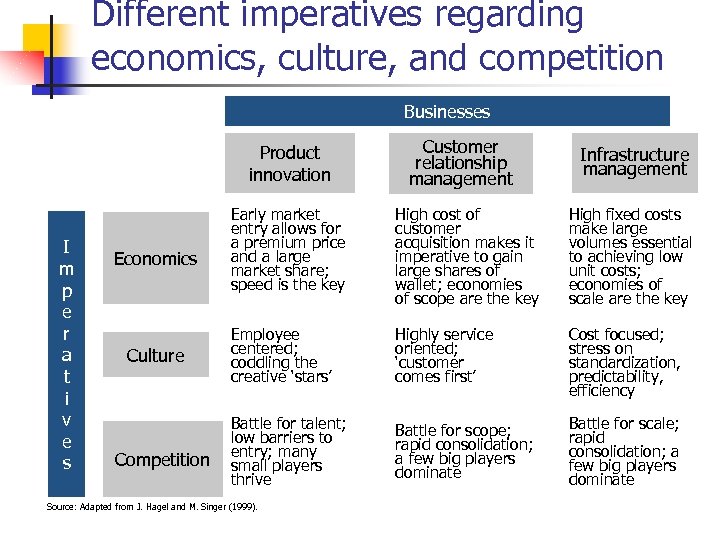
Different imperatives regarding economics, culture, and competition Businesses Product innovation I m p e r a t i v e s Economics Culture Competition Customer relationship management Infrastructure management Early market entry allows for a premium price and a large market share; speed is the key High cost of customer acquisition makes it imperative to gain large shares of wallet; economies of scope are the key High fixed costs make large volumes essential to achieving low unit costs; economies of scale are the key Employee centered; coddling the creative ‘stars’ Highly service oriented; ‘customer comes first’ Cost focused; stress on standardization, predictability, efficiency Battle for talent; low barriers to entry; many small players thrive Battle for scope; rapid consolidation; a few big players dominate Battle for scale; rapid consolidation; a few big players dominate Source: Adapted from J. Hagel and M. Singer (1999).
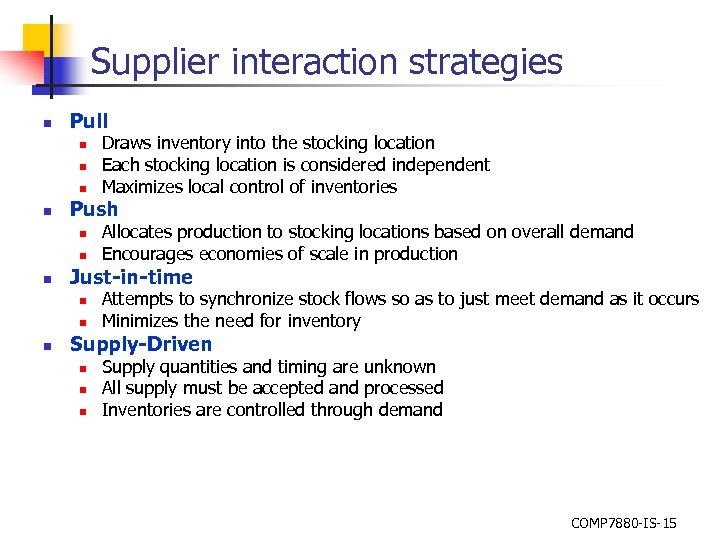
Supplier interaction strategies n Pull n n Push n n n Allocates production to stocking locations based on overall demand Encourages economies of scale in production Just-in-time n n n Draws inventory into the stocking location Each stocking location is considered independent Maximizes local control of inventories Attempts to synchronize stock flows so as to just meet demand as it occurs Minimizes the need for inventory Supply-Driven n Supply quantities and timing are unknown All supply must be accepted and processed Inventories are controlled through demand COMP 7880 -IS-15
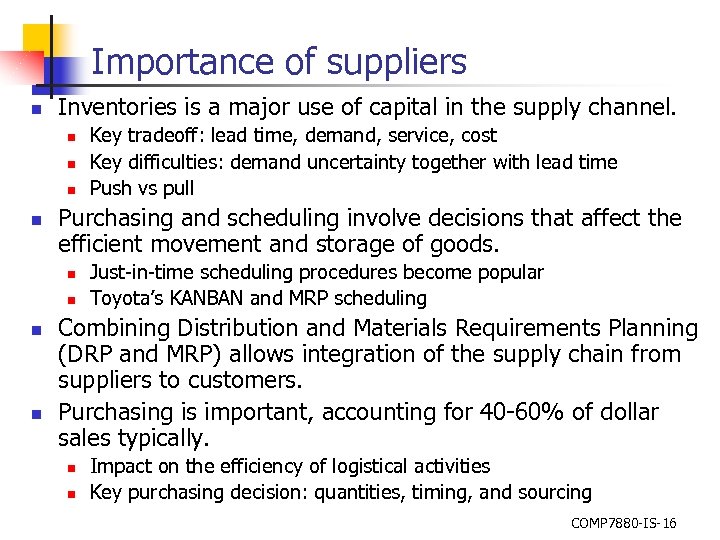
Importance of suppliers n Inventories is a major use of capital in the supply channel. n n Purchasing and scheduling involve decisions that affect the efficient movement and storage of goods. n n Key tradeoff: lead time, demand, service, cost Key difficulties: demand uncertainty together with lead time Push vs pull Just-in-time scheduling procedures become popular Toyota’s KANBAN and MRP scheduling Combining Distribution and Materials Requirements Planning (DRP and MRP) allows integration of the supply chain from suppliers to customers. Purchasing is important, accounting for 40 -60% of dollar sales typically. n n Impact on the efficiency of logistical activities Key purchasing decision: quantities, timing, and sourcing COMP 7880 -IS-16
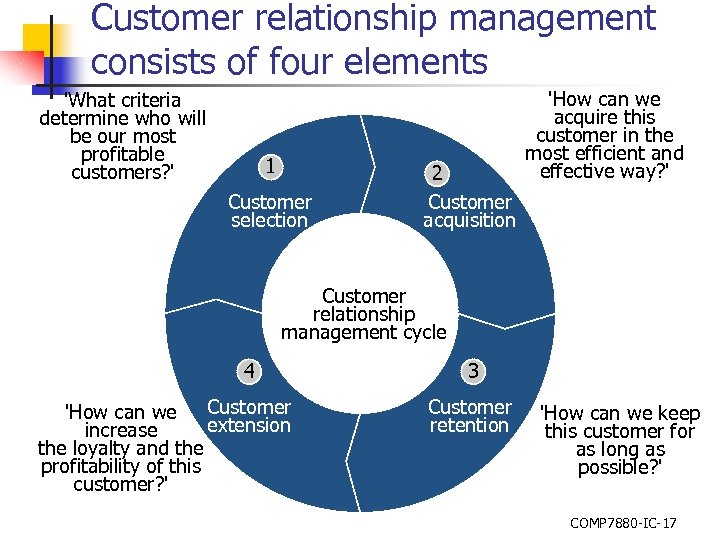
Customer relationship management consists of four elements 'What criteria determine who will be our most profitable customers? ' 1 Customer selection 2 Customer acquisition 'How can we acquire this customer in the most efficient and effective way? ' Customer relationship management cycle 4 Customer 'How can we extension increase the loyalty and the profitability of this customer? ' 3 Customer retention 'How can we keep this customer for as long as possible? ' COMP 7880 -IC-17
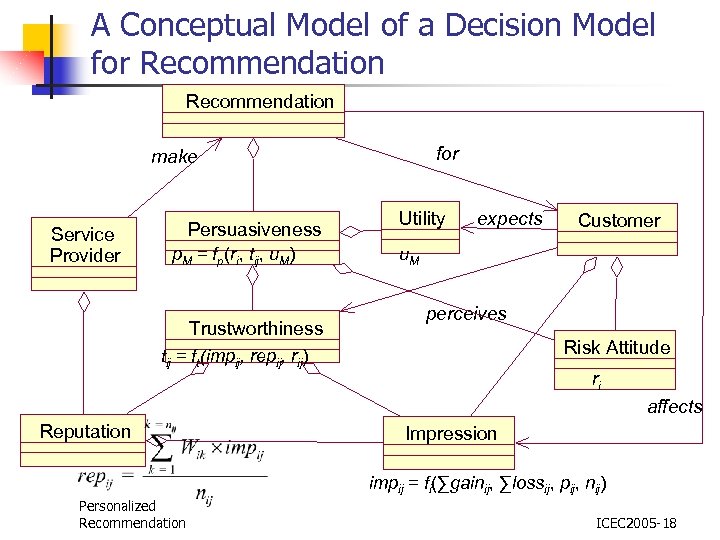
A Conceptual Model of a Decision Model for Recommendation for make Service Provider Persuasiveness p. M = fp(ri, tij, u. M) Trustworthiness Utility expects Customer u. M perceives Risk Attitude tij = ft(impij, repij, rij) ri affects Reputation Impression impij = fi(∑gainij, ∑lossij, pij, nij) Personalized Recommendation ICEC 2005 -18
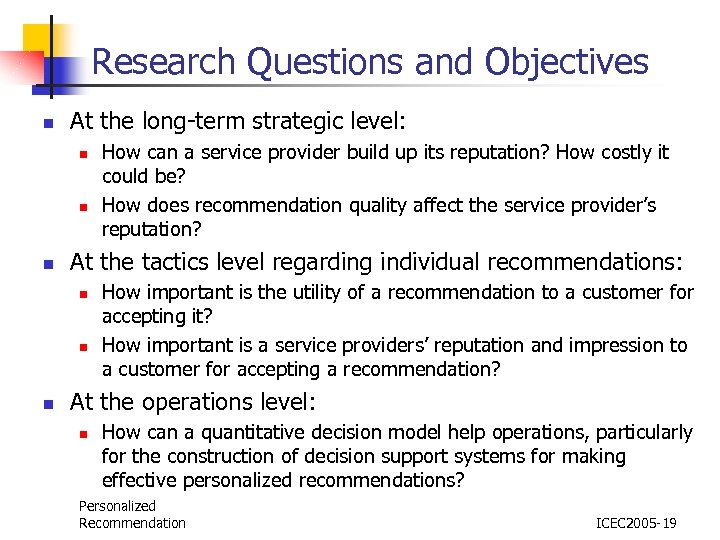
Research Questions and Objectives n At the long-term strategic level: n n n At the tactics level regarding individual recommendations: n n n How can a service provider build up its reputation? How costly it could be? How does recommendation quality affect the service provider’s reputation? How important is the utility of a recommendation to a customer for accepting it? How important is a service providers’ reputation and impression to a customer for accepting a recommendation? At the operations level: n How can a quantitative decision model help operations, particularly for the construction of decision support systems for making effective personalized recommendations? Personalized Recommendation ICEC 2005 -19
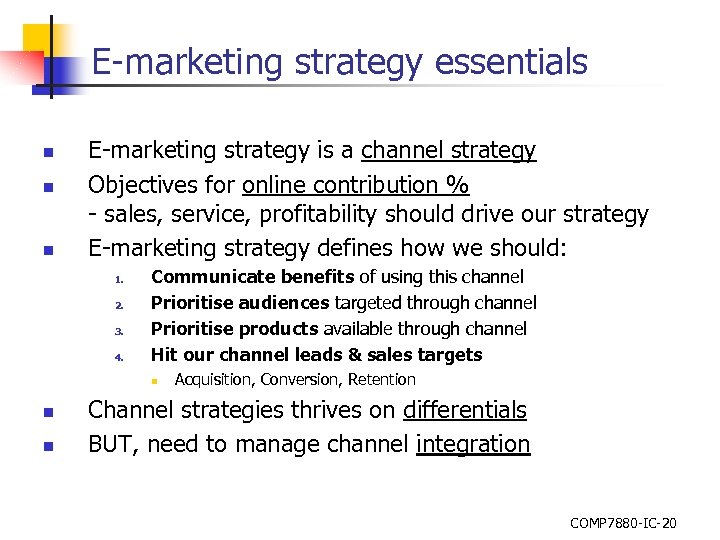
E-marketing strategy essentials n n n E-marketing strategy is a channel strategy Objectives for online contribution % - sales, service, profitability should drive our strategy E-marketing strategy defines how we should: 1. 2. 3. 4. Communicate benefits of using this channel Prioritise audiences targeted through channel Prioritise products available through channel Hit our channel leads & sales targets n n n Acquisition, Conversion, Retention Channel strategies thrives on differentials BUT, need to manage channel integration COMP 7880 -IC-20
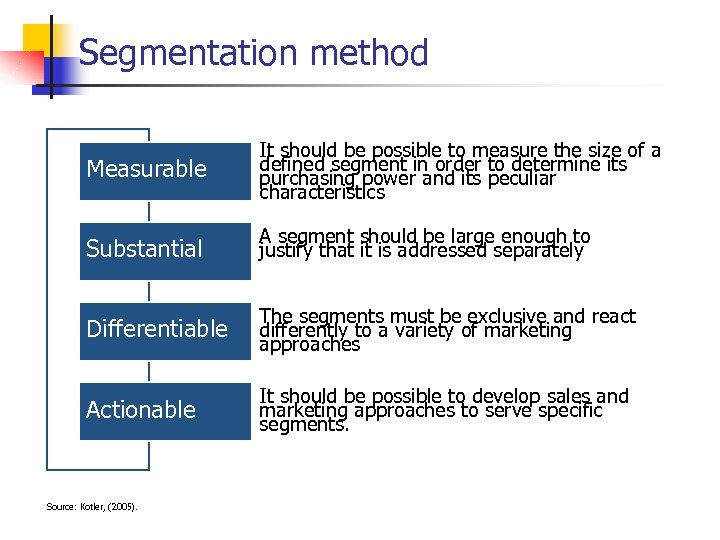
Segmentation method Measurable It should be possible to measure the size of a defined segment in order to determine its purchasing power and its peculiar characteristics Substantial A segment should be large enough to justify that it is addressed separately Differentiable The segments must be exclusive and react differently to a variety of marketing approaches Actionable It should be possible to develop sales and marketing approaches to serve specific segments. Source: Kotler, (2005).
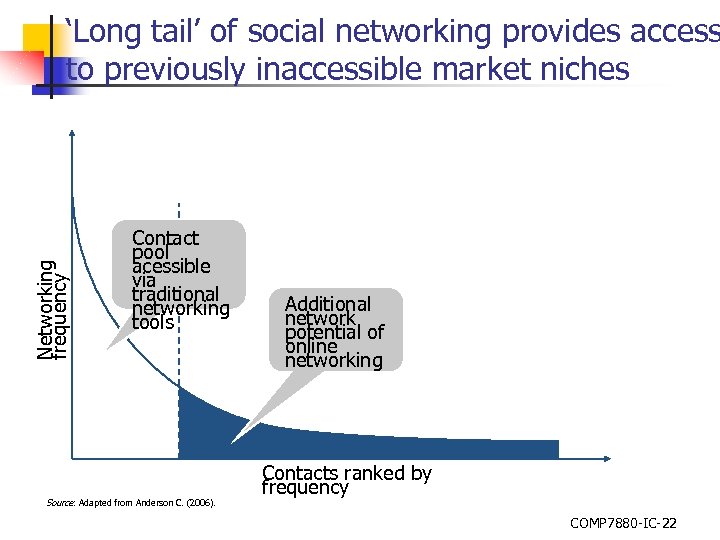
Networking frequency ‘Long tail’ of social networking provides access to previously inaccessible market niches Contact pool acessible via traditional networking tools Source: Adapted from Anderson C. (2006). Additional network potential of online networking Contacts ranked by frequency COMP 7880 -IC-22
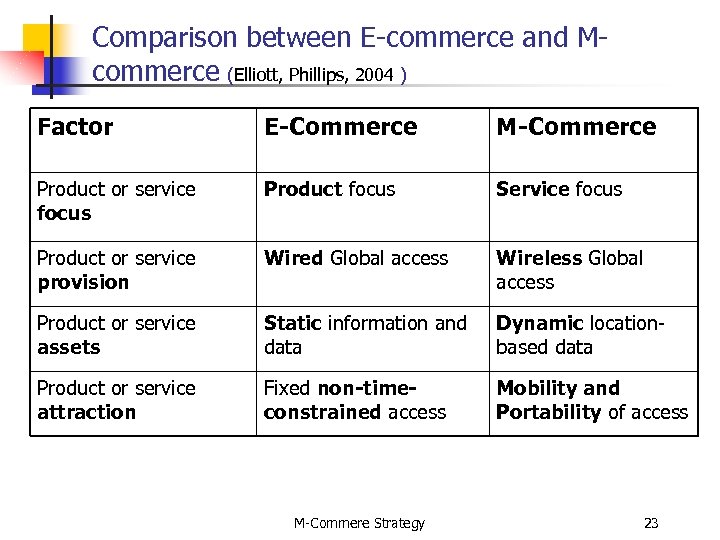
Comparison between E-commerce and Mcommerce (Elliott, Phillips, 2004 ) Factor E-Commerce M-Commerce Product or service focus Product focus Service focus Product or service provision Wired Global access Wireless Global access Product or service assets Static information and data Dynamic locationbased data Product or service attraction Fixed non-timeconstrained access Mobility and Portability of access M-Commere Strategy 23
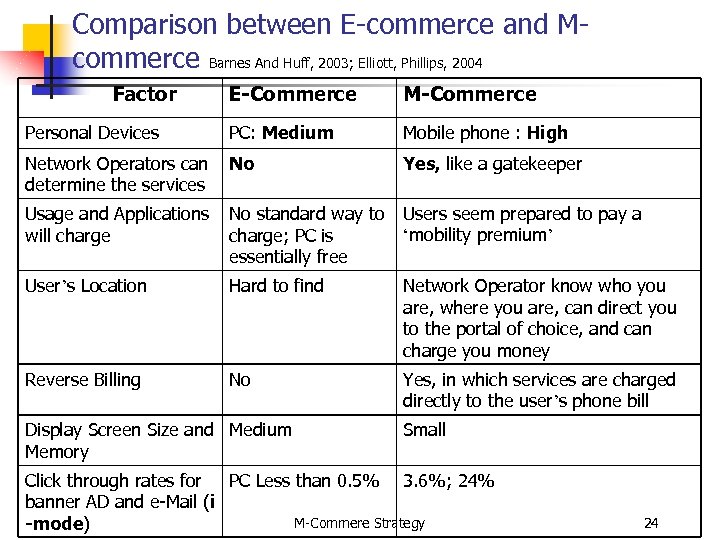
Comparison between E-commerce and Mcommerce Barnes And Huff, 2003; Elliott, Phillips, 2004 Factor E-Commerce M-Commerce Personal Devices PC: Medium Mobile phone : High Network Operators can determine the services No Yes, like a gatekeeper Usage and Applications will charge No standard way to charge; PC is essentially free Users seem prepared to pay a ‘mobility premium’ User’s Location Hard to find Network Operator know who you are, where you are, can direct you to the portal of choice, and can charge you money Reverse Billing No Yes, in which services are charged directly to the user’s phone bill Display Screen Size and Medium Memory Small Click through rates for PC Less than 0. 5% 3. 6%; 24% banner AD and e-Mail (i M-Commere Strategy -mode) 24
Obstacles to M-commerce (Elliott, Phillips, 2004 ) n n Efficient and fast wireless telecommunications services are often focused within specific area Wireless Mobile Internet access more costly than wired Internet access Concerns over privacy and security still pervade the wireless data transmission world Many individuals and organizations still harbor concerns over the health issues of wireless technology Note changes in environment since this 2004 view. M-Commere Strategy 25
The development of M-commerce n In Europe and Japan n In USA n n n Focus on delivering to the customer technology, such as internet –enable mobile phones, and the provision of Mobile Internet services Europe view: Lifestyle consideration Focus on the use of palm computers, other mobile devices (e. g. the Black. Berry mobile E-mail devices), and other wireless technology to improve the effectiveness of business systems process USA view: Support mobile working Currently both are important M-Commere Strategy 26
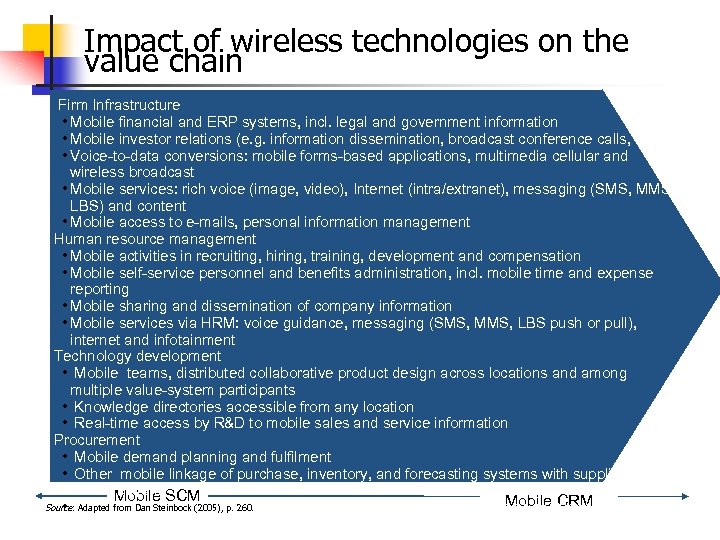
Impact of wireless technologies on the value chain Firm Infrastructure • Mobile financial and ERP systems, incl. legal and government information • Mobile investor relations (e. g. information dissemination, broadcast conference calls, alerts) • Voice-to-data conversions: mobile forms-based applications, multimedia cellular and wireless broadcast • Mobile services: rich voice (image, video), Internet (intra/extranet), messaging (SMS, MMS, LBS) and content • Mobile access to e-mails, personal information management Human resource management • Mobile activities in recruiting, hiring, training, development and compensation • Mobile self-service personnel and benefits administration, incl. mobile time and expense reporting • Mobile sharing and dissemination of company information • Mobile services via HRM: voice guidance, messaging (SMS, MMS, LBS push or pull), internet and infotainment Technology development • Mobile teams, distributed collaborative product design across locations and among multiple value-system participants • Knowledge directories accessible from any location • Real-time access by R&D to mobile sales and service information Procurement • Mobile demand planning and fulfilment • Other mobile linkage of purchase, inventory, and forecasting systems with suppliers and/or Mobile SCM buyers Mobile CRM Source: Mobile direct and indirect procurement via marketplaces, exchanges, auctions, and • Adapted from Dan Steinbock (2005), p. 260. buyer/seller matching
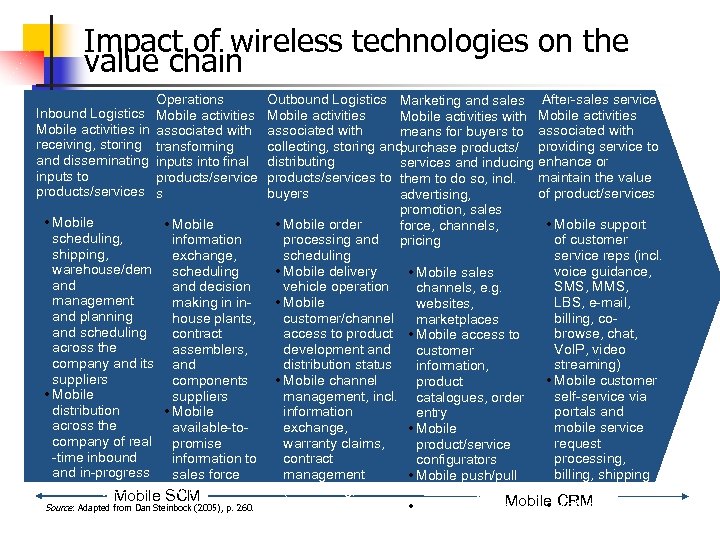
Impact of wireless technologies on the value chain Operations Mobile activities associated with transforming inputs into final products/service s Outbound Logistics Marketing and sales After-sales service Inbound Logistics Mobile activities with Mobile activities in associated with means for buyers to associated with receiving, storing collecting, storing andpurchase products/ providing service to and disseminating distributing services and inducing enhance or inputs to products/services to them to do so, incl. maintain the value products/services buyers of product/services advertising, promotion, sales • Mobile order • Mobile support force, channels, scheduling, information processing and of customer pricing shipping, exchange, scheduling service reps (incl. warehouse/dem scheduling • Mobile delivery voice guidance, • Mobile sales and decision vehicle operation SMS, MMS, channels, e. g. management making in in • Mobile LBS, e-mail, websites, and planning house plants, customer/channel billing, comarketplaces and scheduling contract access to product • Mobile access to browse, chat, across the assemblers, development and Vo. IP, video customer company and its and distribution status streaming) information, suppliers components • Mobile channel • Mobile customer product • Mobile suppliers management, incl. catalogues, order self-service via distribution • Mobile information portals and entry across the available-toexchange, mobile service • Mobile company of real promise warranty claims, request product/service -time inbound information to contract processing, configurators and in-progress sales force management billing, shipping • Mobile push/pull inventory data and (versioning, etc. advertising Mobile SCMchannels Mobile field process control) • CRM • Mobile surveys, Source: Adapted from Dan Steinbock (2005), p. 260. service access opt-in/opt-out
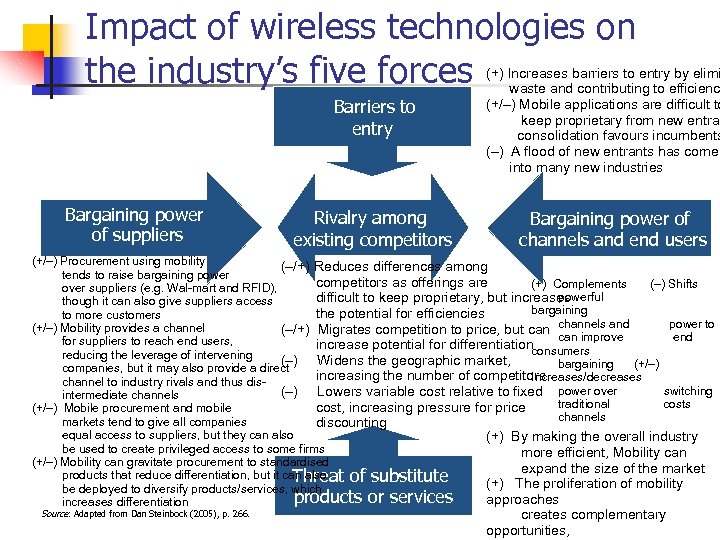
Impact of wireless technologies on the industry’s five forces Barriers to entry Bargaining power of suppliers Rivalry among existing competitors (+) Increases barriers to entry by elimi waste and contributing to efficienc (+/–) Mobile applications are difficult to keep proprietary from new entran consolidation favours incumbents (–) A flood of new entrants has come into many new industries Bargaining power of channels and end users (+/–) Procurement using mobility (–/+) Reduces differences among tends to raise bargaining power competitors as offerings are (+) Complements (–) Shifts over suppliers (e. g. Wal-mart and RFID), powerful difficult to keep proprietary, but increases though it can also give suppliers access bargaining the potential for efficiencies to more customers power to (+/–) Mobility provides a channel (–/+) Migrates competition to price, but can channels and can improve end for suppliers to reach end users, increase potential for differentiationconsumers reducing the leverage of intervening (–) Widens the geographic market, bargaining (+/–) companies, but it may also provide a direct increasing the number of competitors Increases/decreases channel to industry rivals and thus disswitching (–) Lowers variable cost relative to fixed power over intermediate channels traditional costs cost, increasing pressure for price (+/–) Mobile procurement and mobile channels markets tend to give all companies discounting equal access to suppliers, but they can also (+) By making the overall industry be used to create privileged access to some firms more efficient, Mobility can (+/–) Mobility can gravitate procurement to standardised expand the size of the market products that reduce differentiation, but it can also Threat of substitute (+) The proliferation of mobility be deployed to diversify products/services, which products or services approaches increases differentiation Source: Adapted from Dan Steinbock (2005), p. 266. creates complementary opportunities,
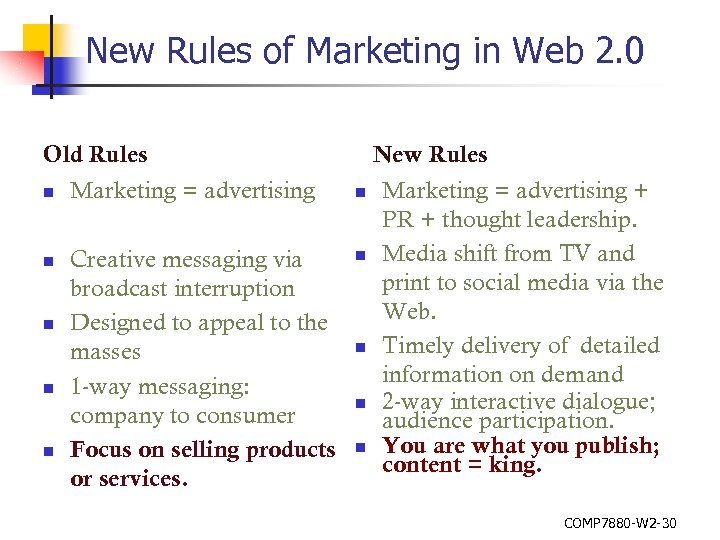
New Rules of Marketing in Web 2. 0 Old Rules n Marketing = advertising n n New Rules n Marketing = advertising + PR + thought leadership. n Media shift from TV and Creative messaging via print to social media via the broadcast interruption Web. Designed to appeal to the n Timely delivery of detailed masses information on demand 1 -way messaging: n 2 -way interactive dialogue; company to consumer audience participation. Focus on selling products n You are what you publish; content = king. or services. COMP 7880 -W 2 -30
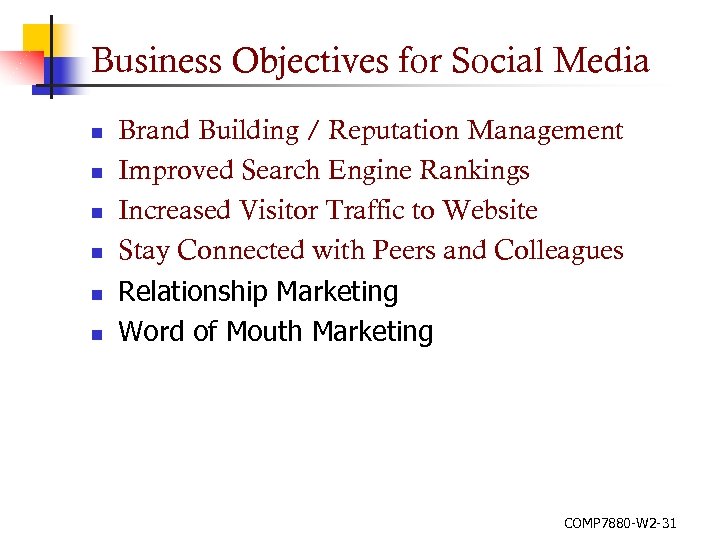
Business Objectives for Social Media n n n Brand Building / Reputation Management Improved Search Engine Rankings Increased Visitor Traffic to Website Stay Connected with Peers and Colleagues Relationship Marketing Word of Mouth Marketing COMP 7880 -W 2 -31
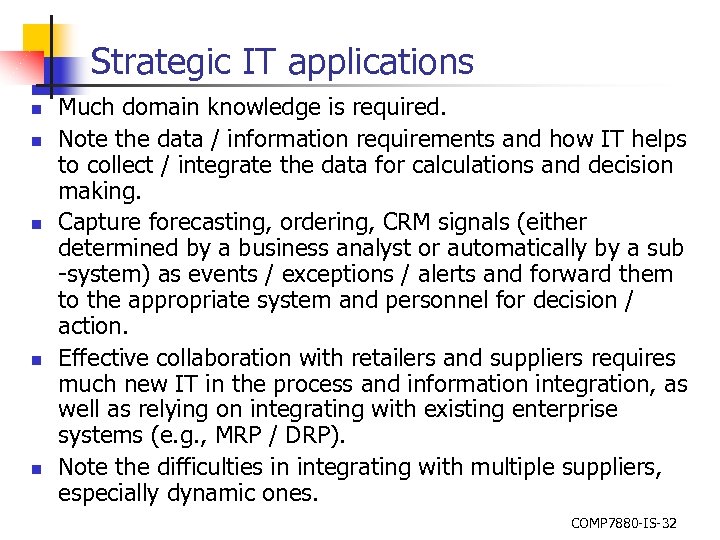
Strategic IT applications n n n Much domain knowledge is required. Note the data / information requirements and how IT helps to collect / integrate the data for calculations and decision making. Capture forecasting, ordering, CRM signals (either determined by a business analyst or automatically by a sub -system) as events / exceptions / alerts and forward them to the appropriate system and personnel for decision / action. Effective collaboration with retailers and suppliers requires much new IT in the process and information integration, as well as relying on integrating with existing enterprise systems (e. g. , MRP / DRP). Note the difficulties in integrating with multiple suppliers, especially dynamic ones. COMP 7880 -IS-32
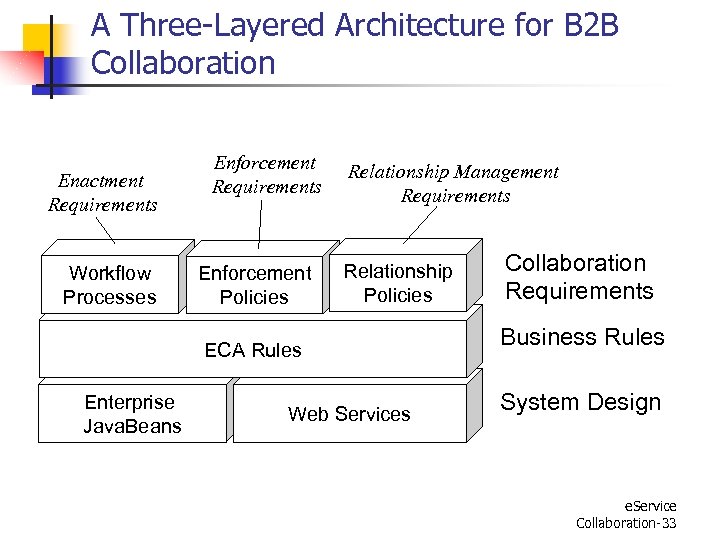
A Three-Layered Architecture for B 2 B Collaboration Enactment Requirements Workflow Processes Enforcement Requirements Enforcement Policies Relationship Management Requirements Relationship Policies ECA Rules Enterprise Java. Beans Web Services Collaboration Requirements Business Rules System Design e. Service Collaboration-33
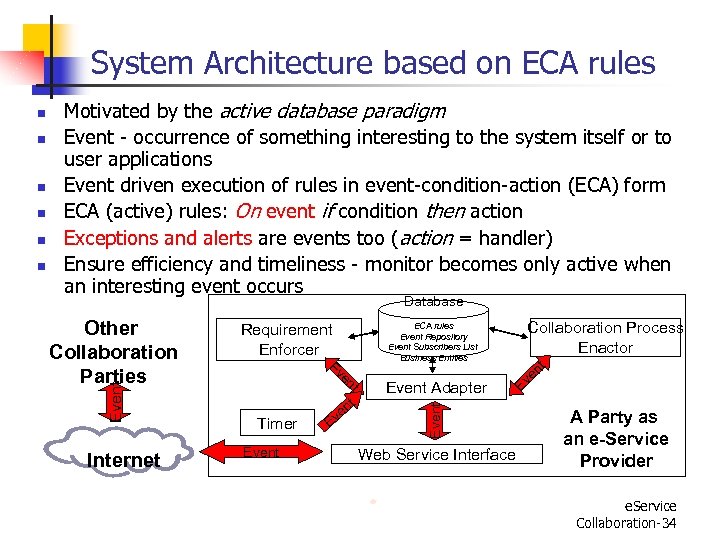
System Architecture based on ECA rules n n Database Other Collaboration Parties Internet Requirement Enforcer Ev e Timer Event E nt t en v Collaboration Process Enactor ECA rules Event Repository Event Subscribers List Business Entities Event Adapter Event n Motivated by the active database paradigm Event - occurrence of something interesting to the system itself or to user applications Event driven execution of rules in event-condition-action (ECA) form ECA (active) rules: On event if condition then action Exceptions and alerts are events too (action = handler) Ensure efficiency and timeliness - monitor becomes only active when an interesting event occurs Event n Web Service Interface t n ve E A Party as an e-Service Provider e. Service Collaboration-34
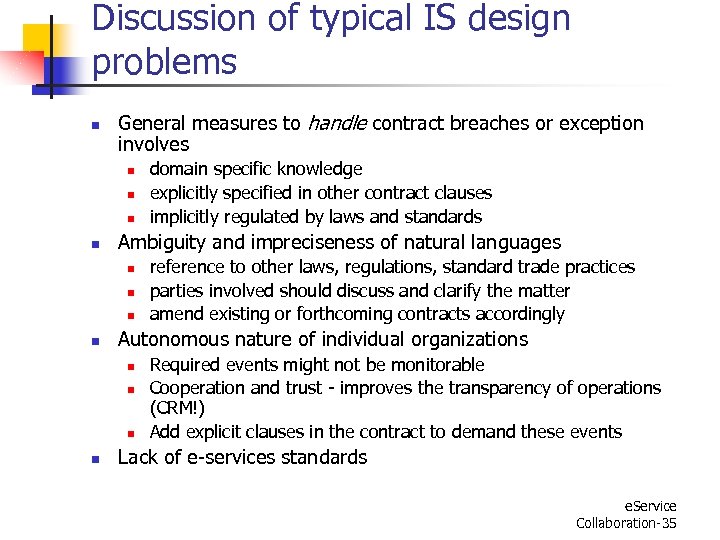
Discussion of typical IS design problems n General measures to handle contract breaches or exception involves n n Ambiguity and impreciseness of natural languages n n reference to other laws, regulations, standard trade practices parties involved should discuss and clarify the matter amend existing or forthcoming contracts accordingly Autonomous nature of individual organizations n n domain specific knowledge explicitly specified in other contract clauses implicitly regulated by laws and standards Required events might not be monitorable Cooperation and trust - improves the transparency of operations (CRM!) Add explicit clauses in the contract to demand these events Lack of e-services standards e. Service Collaboration-35
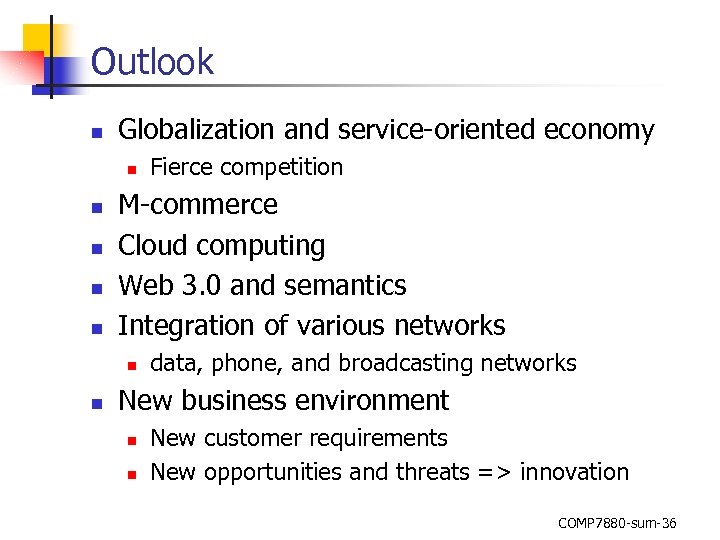
Outlook n Globalization and service-oriented economy n n n M-commerce Cloud computing Web 3. 0 and semantics Integration of various networks n n Fierce competition data, phone, and broadcasting networks New business environment n n New customer requirements New opportunities and threats => innovation COMP 7880 -sum-36
Скачать презентацию COMP 7880 E-Business Strategies Summary and Outlook Dickson
66f0e90e7a7054890daece636e67eb4c.ppt