 Скачать презентацию COMP 7880 E-Business Strategies Internal and External Analysis
e79394ccff6fb0f1231fa1ec3091d42c.ppt
- Количество слайдов: 43



COMP 7880: E-Business Strategies Internal and External Analysis Dickson K. W. Chiu Ph. D, SMIEEE, SMACM, Life MHKCS Jelassi & Enders: Chapter 3 -4 1
Focus of this course n n NOT how to implement EC / EB functions BUT to n n ANALYZE the business requirements in the perspective of strategic management FORMULATE suitable business models & strategies CHOOSE suitable IT options (especially Web-based ones) to implement the strategies Study tips - whenever mentioning something to be done, think: How IT helps? COMP 7880 -I/E-2
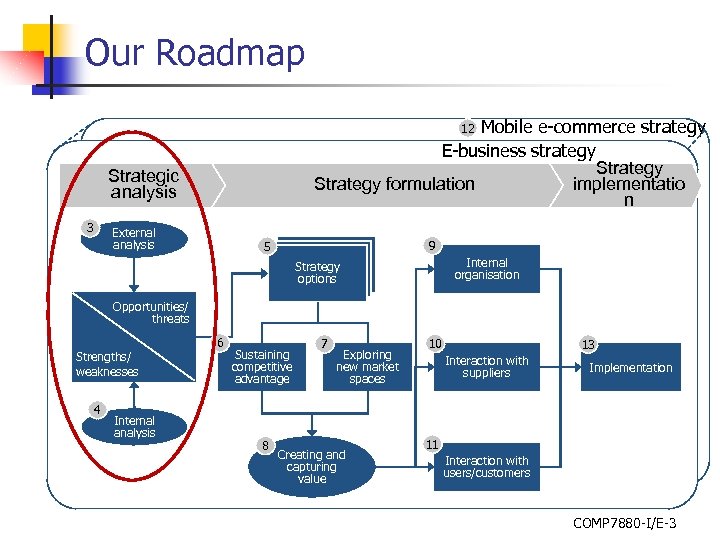
Our Roadmap Mobile e-commerce strategy E-business strategy Strategy implementatio Strategy formulation n 12 Strategic analysis 3 External analysis 9 5 Internal organisation Strategy options Opportunities/ threats Strengths/ weaknesses 4 Internal analysis 6 Sustaining competitive advantage 8 7 Exploring new market spaces Creating and capturing value 10 13 Interaction with suppliers Implementation 11 Interaction with users/customers COMP 7880 -I/E-3
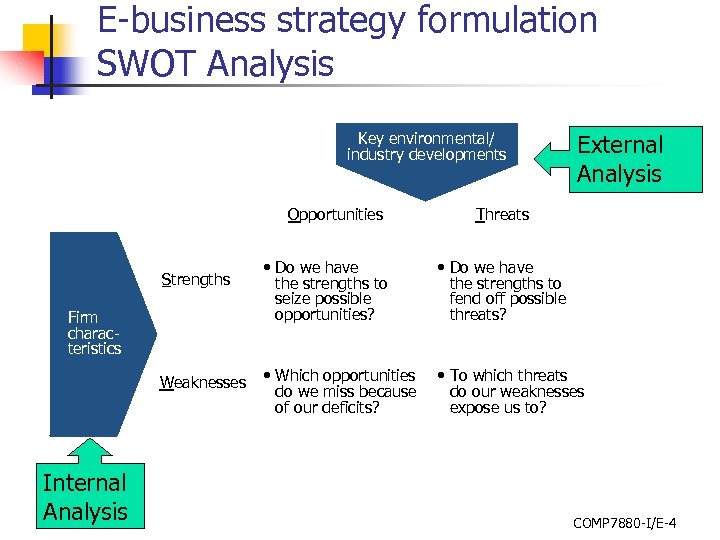
E-business strategy formulation SWOT Analysis Key environmental/ industry developments Opportunities Strengths Firm characteristics Weaknesses Internal Analysis External Analysis Threats • Do we have the strengths to seize possible opportunities? • Do we have the strengths to fend off possible threats? • Which opportunities do we miss because of our deficits? • To which threats do our weaknesses expose us to? COMP 7880 -I/E-4
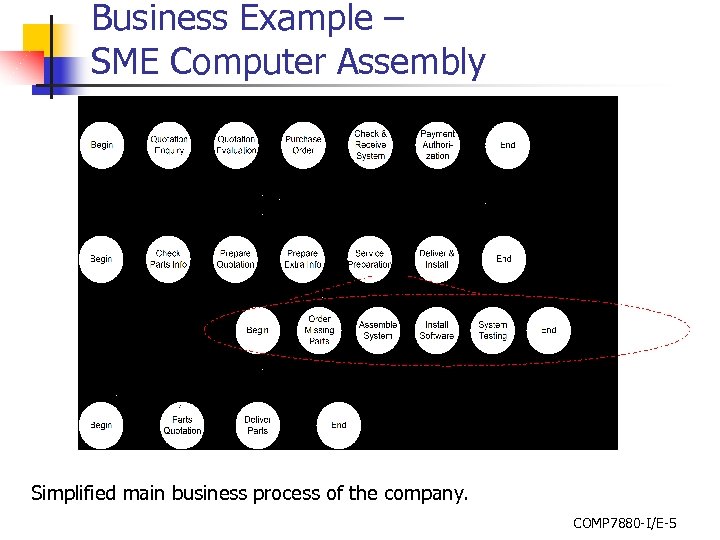
Business Example – SME Computer Assembly Sub-process Simplified main business process of the company. COMP 7880 -I/E-5
External Analysis Examine your opportunities & threats COMP 7880 -I/E-6
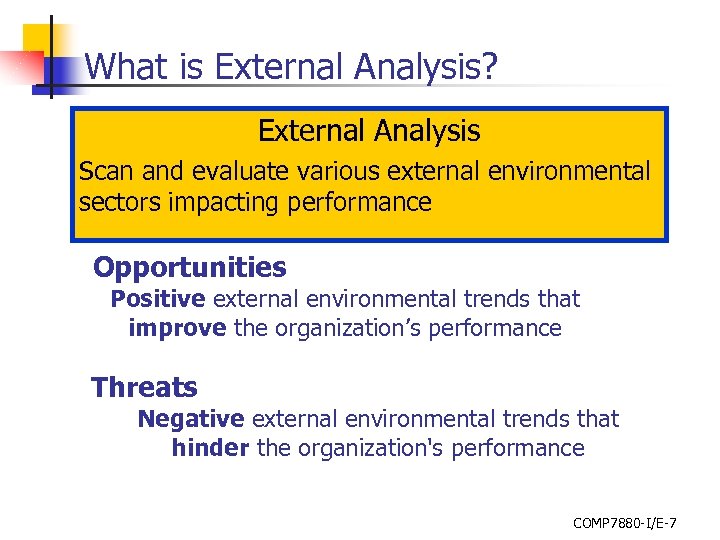
What is External Analysis? External Analysis Scan and evaluate various external environmental sectors impacting performance Opportunities Positive external environmental trends that improve the organization’s performance Threats Negative external environmental trends that hinder the organization's performance COMP 7880 -I/E-7
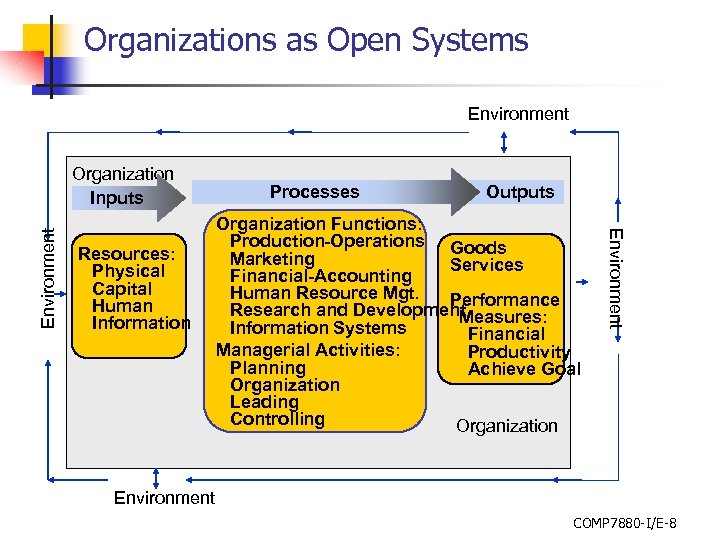
Organizations as Open Systems Environment Resources: Physical Capital Human Information Processes Outputs Organization Functions: Production-Operations Goods Marketing Services Financial-Accounting Human Resource Mgt. Performance Research and Development Measures: Information Systems Financial Managerial Activities: Productivity Planning Achieve Goal Organization Leading Controlling Organization Environment Organization Inputs Environment COMP 7880 -I/E-8
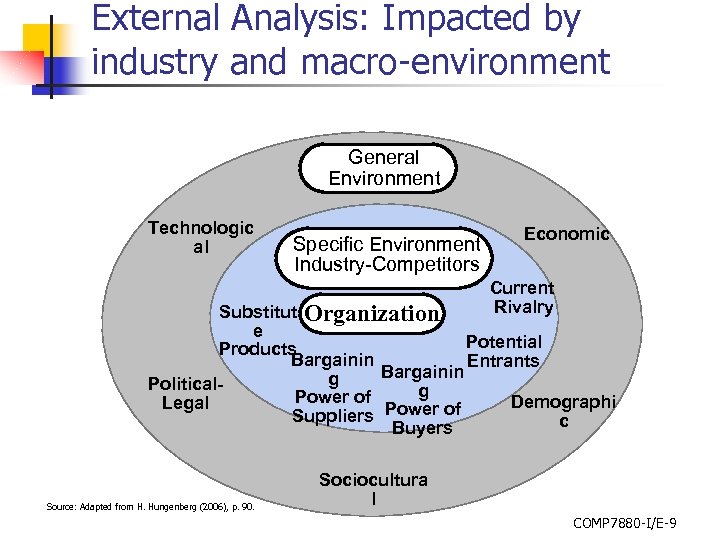
External Analysis: Impacted by industry and macro-environment General Environment Technologic al Specific Environment Industry-Competitors Economic Current Rivalry Substitut Organization e Potential Products Bargainin Entrants Bargainin g Politicalg Power of Demographi Legal Suppliers Power of c Buyers Source: Adapted from H. Hungenberg (2006), p. 90. Sociocultura l COMP 7880 -I/E-9
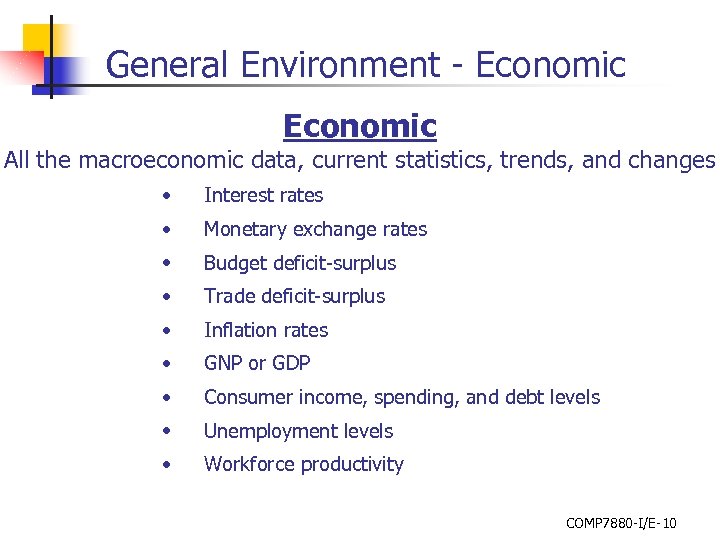
General Environment - Economic All the macroeconomic data, current statistics, trends, and changes • Interest rates • Monetary exchange rates • Budget deficit-surplus • Trade deficit-surplus • Inflation rates • GNP or GDP • Consumer income, spending, and debt levels • Unemployment levels • Workforce productivity COMP 7880 -I/E-10
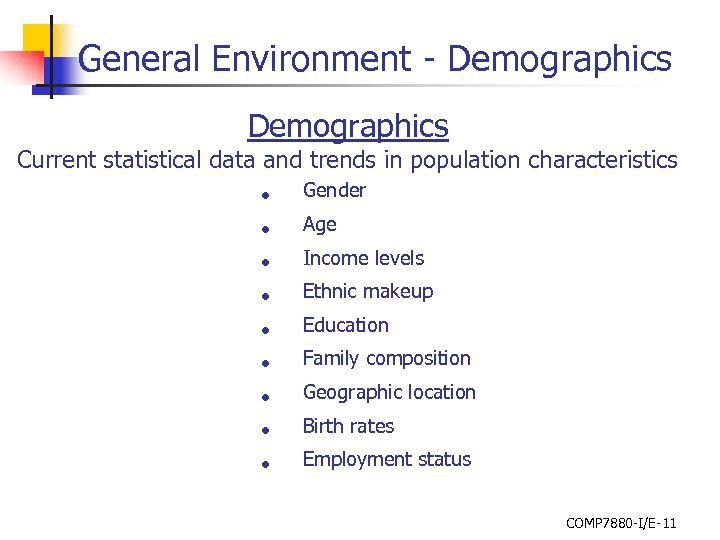
General Environment - Demographics Current statistical data and trends in population characteristics • Gender • Age • Income levels • Ethnic makeup • Education • Family composition • Geographic location • Birth rates • Employment status COMP 7880 -I/E-11
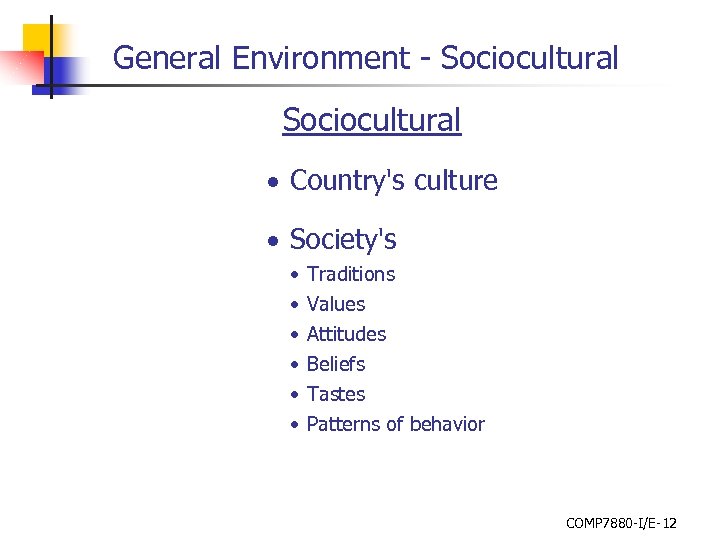
General Environment - Sociocultural • Country's culture • Society's • • • Traditions Values Attitudes Beliefs Tastes Patterns of behavior COMP 7880 -I/E-12
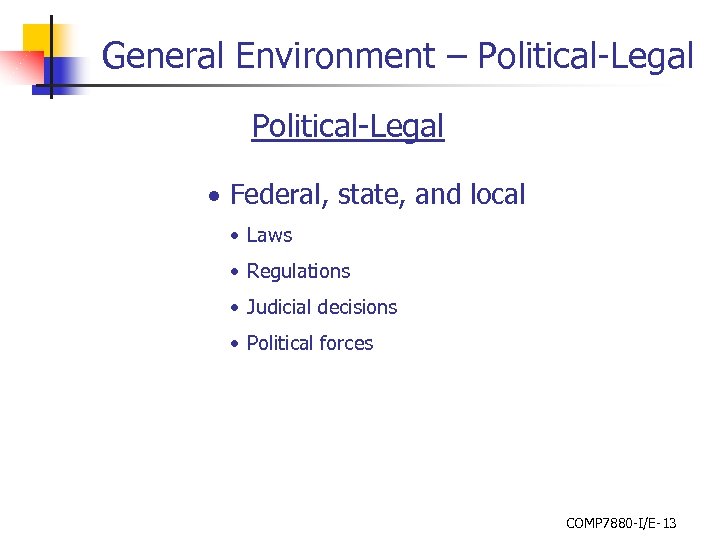
General Environment – Political-Legal • Federal, state, and local • Laws • Regulations • Judicial decisions • Political forces COMP 7880 -I/E-13
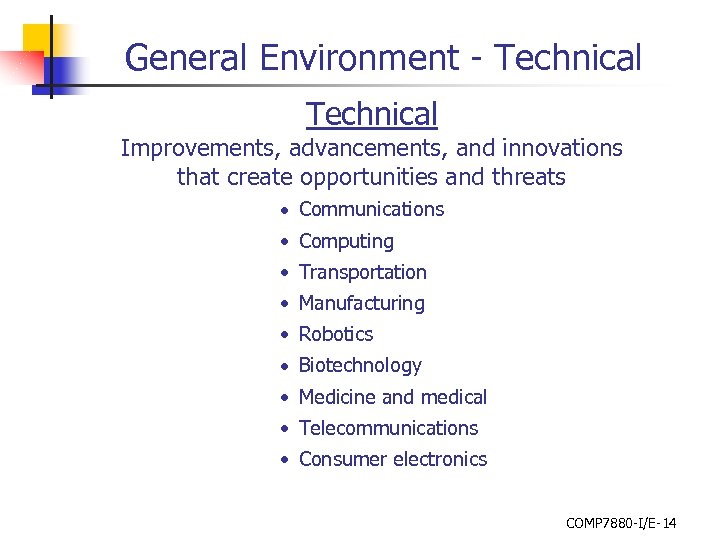
General Environment - Technical Improvements, advancements, and innovations that create opportunities and threats • Communications • Computing • Transportation • Manufacturing • Robotics • Biotechnology • Medicine and medical • Telecommunications • Consumer electronics COMP 7880 -I/E-14
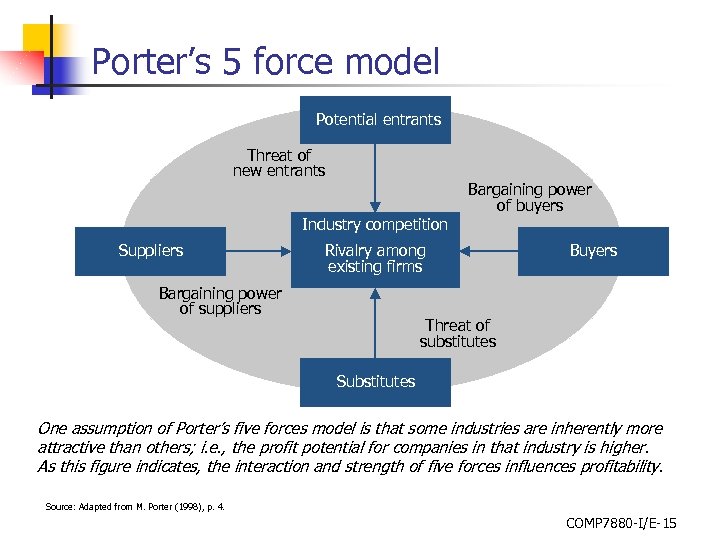
Porter’s 5 force model Potential entrants Threat of new entrants Industry competition Suppliers Bargaining power of buyers Rivalry among existing firms Bargaining power of suppliers Buyers Threat of substitutes Substitutes One assumption of Porter’s five forces model is that some industries are inherently more attractive than others; i. e. , the profit potential for companies in that industry is higher. As this figure indicates, the interaction and strength of five forces influences profitability. Source: Adapted from M. Porter (1998), p. 4. COMP 7880 -I/E-15
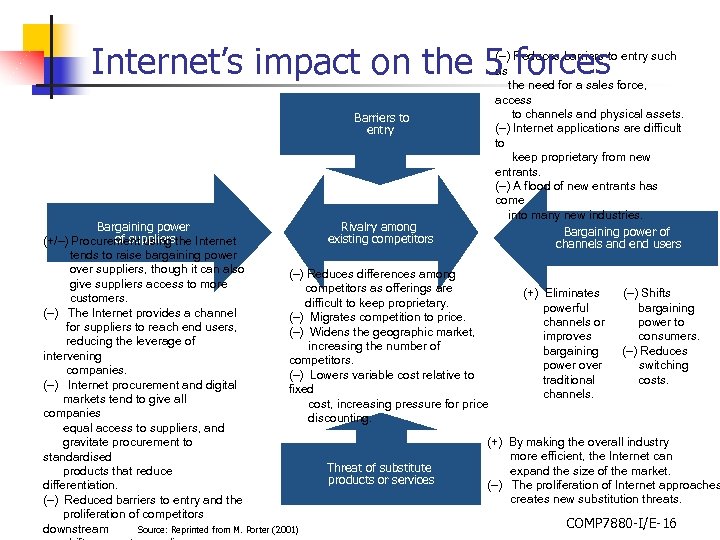
Internet’s impact on the 5 forces Barriers to entry (–) Reduces barriers to entry such as the need for a sales force, access to channels and physical assets. (–) Internet applications are difficult to keep proprietary from new entrants. (–) A flood of new entrants has come into many new industries. Bargaining power of channels and end users Bargaining power Rivalry among of suppliersthe Internet existing competitors (+/–) Procurement using tends to raise bargaining power over suppliers, though it can also (–) Reduces differences among give suppliers access to more competitors as offerings are customers. difficult to keep proprietary. (–) The Internet provides a channel (–) Migrates competition to price. for suppliers to reach end users, (–) Widens the geographic market, reducing the leverage of increasing the number of intervening competitors. companies. (–) Lowers variable cost relative to (–) Internet procurement and digital fixed markets tend to give all cost, increasing pressure for price companies discounting. equal access to suppliers, and (+) gravitate procurement to standardised Threat of substitute products that reduce products or services (–) differentiation. (–) Reduced barriers to entry and the proliferation of competitors downstream Source: Reprinted from M. Porter (2001) (+) Eliminates powerful channels or improves bargaining power over traditional channels. (–) Shifts bargaining power to consumers. (–) Reduces switching costs. By making the overall industry more efficient, the Internet can expand the size of the market. The proliferation of Internet approaches creates new substitution threats. COMP 7880 -I/E-16
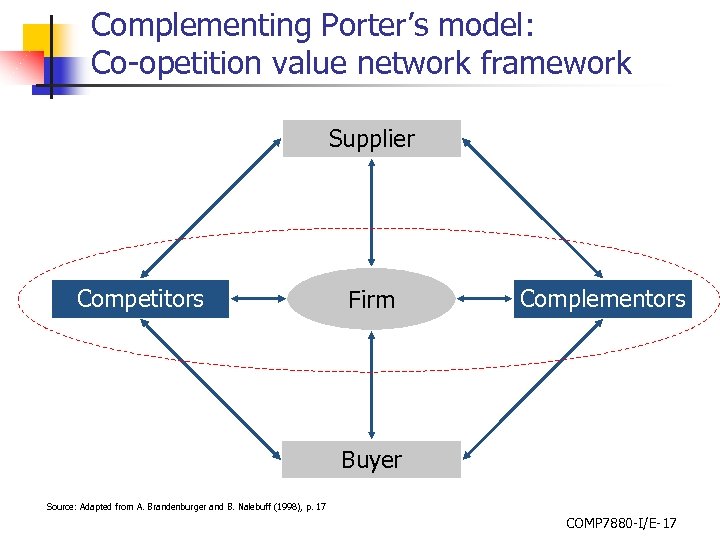
Complementing Porter’s model: Co-opetition value network framework Supplier Competitors Firm Complementors Buyer Source: Adapted from A. Brandenburger and B. Nalebuff (1998), p. 17 COMP 7880 -I/E-17
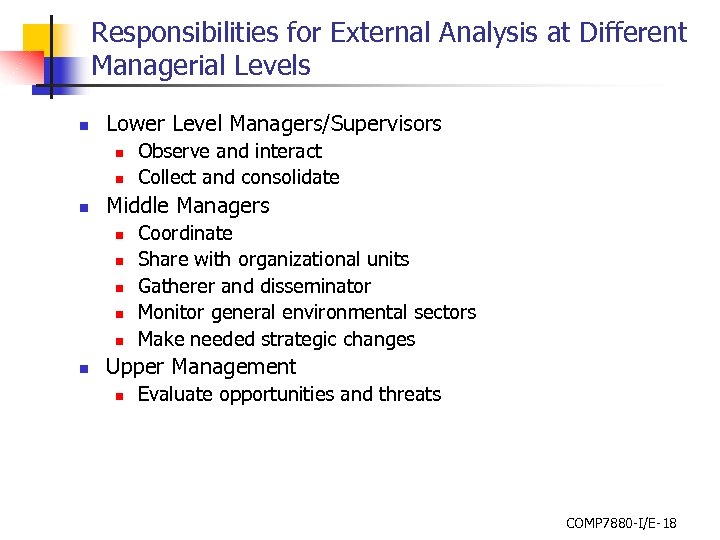
Responsibilities for External Analysis at Different Managerial Levels n Lower Level Managers/Supervisors n n n Middle Managers n n n Observe and interact Collect and consolidate Coordinate Share with organizational units Gatherer and disseminator Monitor general environmental sectors Make needed strategic changes Upper Management n Evaluate opportunities and threats COMP 7880 -I/E-18
Benefits of Doing An External Analysis n Proactive managers anticipate change and plan accordingly n Provide information for n n n Planning Decision making Strategy formulation Acquire and control needed resources Cope effectively with increasingly dynamic environment Make a difference with higher performance COMP 7880 -I/E-19
Challenges of Doing an External Analysis n n n Rapid environmental changes are difficult to keep up with => IT helps Amount of time that analysis can consume => IT helps Forecasts and trend analysis are not actual fact Discussion: How IT Helps? COMP 7880 -I/E-20
Internal Analysis Examine your strength & weakness COMP 7880 -I/E-21
What is an Internal Analysis? n Looks at the organization’s n n Vision Mission Strategic objectives Identifies and evaluates resources, capabilities, and core competencies COMP 7880 -I/E-22
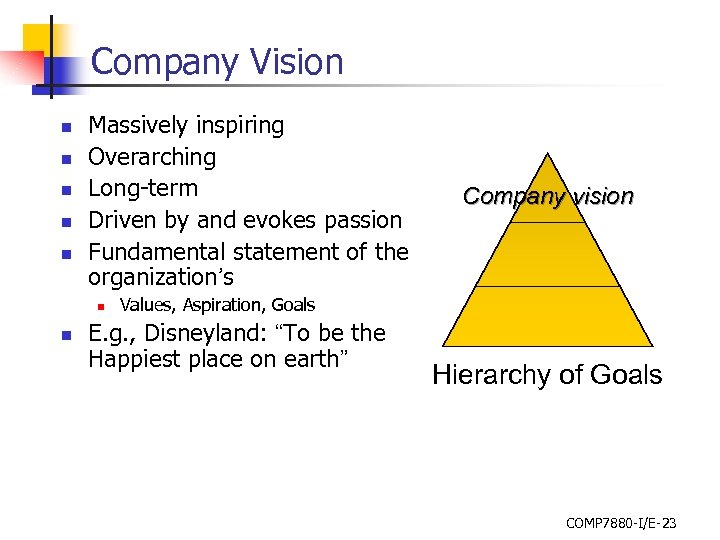
Company Vision n n Massively inspiring Overarching Long-term Driven by and evokes passion Fundamental statement of the organization’s n n Company vision Values, Aspiration, Goals E. g. , Disneyland: “To be the Happiest place on earth” Hierarchy of Goals COMP 7880 -I/E-23
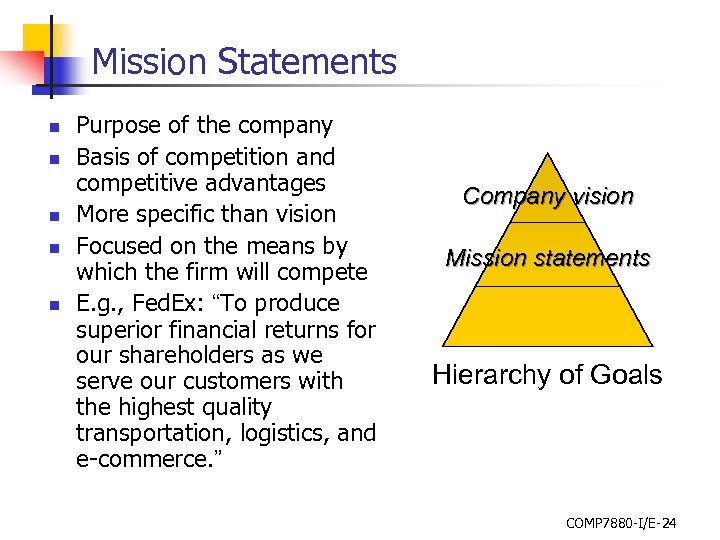
Mission Statements n n n Purpose of the company Basis of competition and competitive advantages More specific than vision Focused on the means by which the firm will compete E. g. , Fed. Ex: “To produce superior financial returns for our shareholders as we serve our customers with the highest quality transportation, logistics, and e-commerce. ” Company vision Mission statements Hierarchy of Goals COMP 7880 -I/E-24
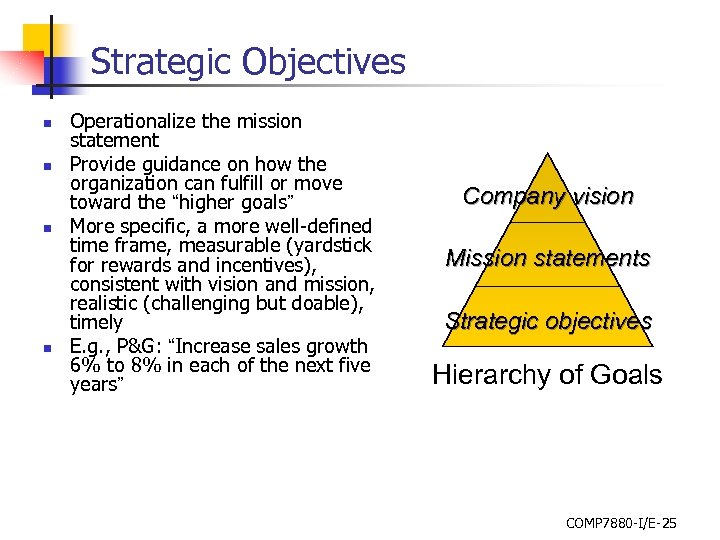
Strategic Objectives n n Operationalize the mission statement Provide guidance on how the organization can fulfill or move toward the “higher goals” More specific, a more well-defined time frame, measurable (yardstick for rewards and incentives), consistent with vision and mission, realistic (challenging but doable), timely E. g. , P&G: “Increase sales growth 6% to 8% in each of the next five years” Company vision Mission statements Strategic objectives Hierarchy of Goals COMP 7880 -I/E-25
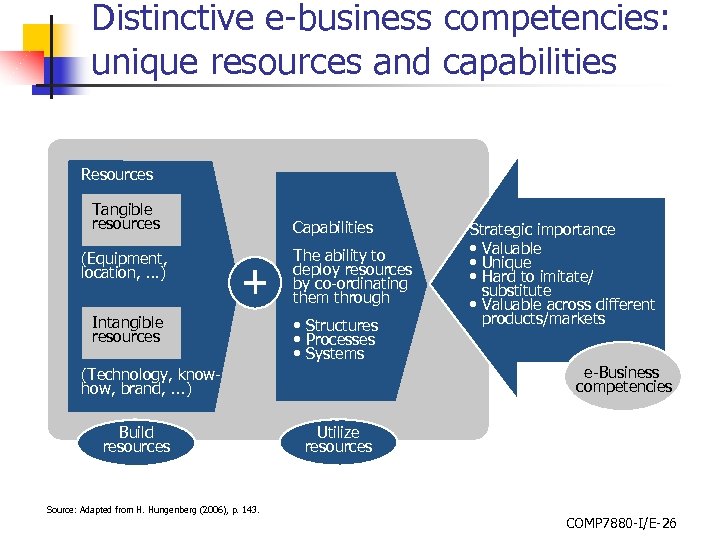
Distinctive e-business competencies: unique resources and capabilities Resources Tangible resources (Equipment, location, . . . ) Intangible resources Capabilities The ability to deploy resources by co-ordinating them through • Structures • Processes • Systems (Technology, knowhow, brand, . . . ) Build resources Source: Adapted from H. Hungenberg (2006), p. 143. Strategic importance • Valuable • Unique • Hard to imitate/ substitute • Valuable across different products/markets e-Business competencies Utilize resources COMP 7880 -I/E-26
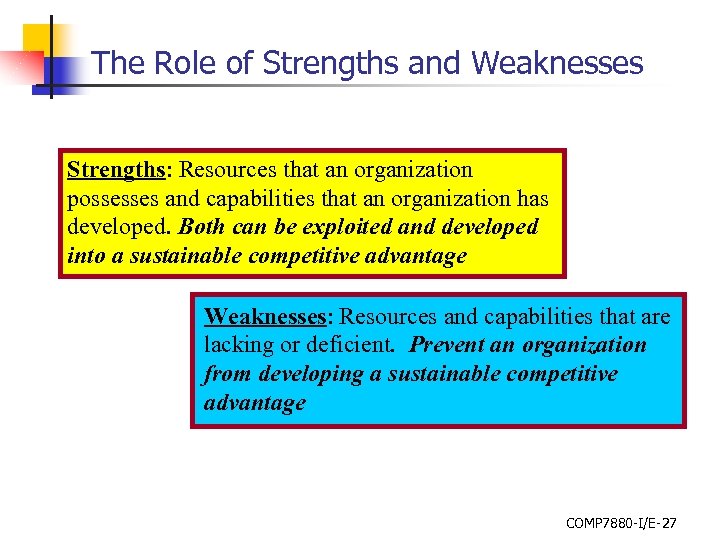
The Role of Strengths and Weaknesses Strengths: Resources that an organization possesses and capabilities that an organization has developed. Both can be exploited and developed into a sustainable competitive advantage Weaknesses: Resources and capabilities that are lacking or deficient. Prevent an organization from developing a sustainable competitive advantage COMP 7880 -I/E-27
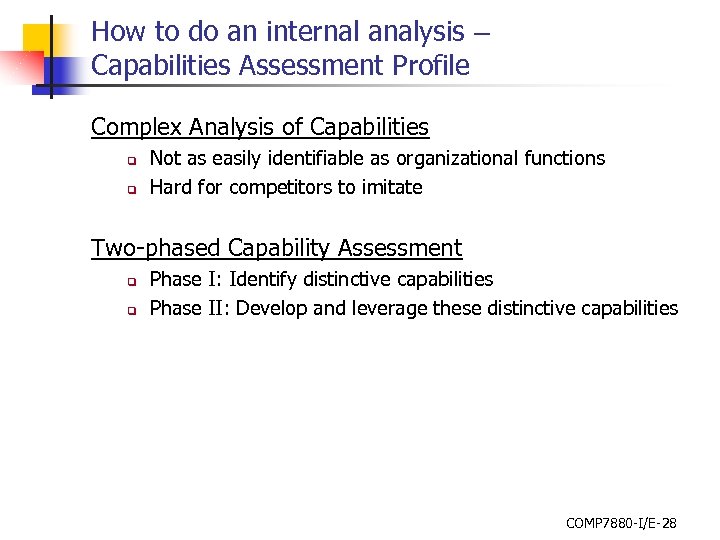
How to do an internal analysis – Capabilities Assessment Profile Complex Analysis of Capabilities q q Not as easily identifiable as organizational functions Hard for competitors to imitate Two-phased Capability Assessment q q Phase I: Identify distinctive capabilities Phase II: Develop and leverage these distinctive capabilities COMP 7880 -I/E-28
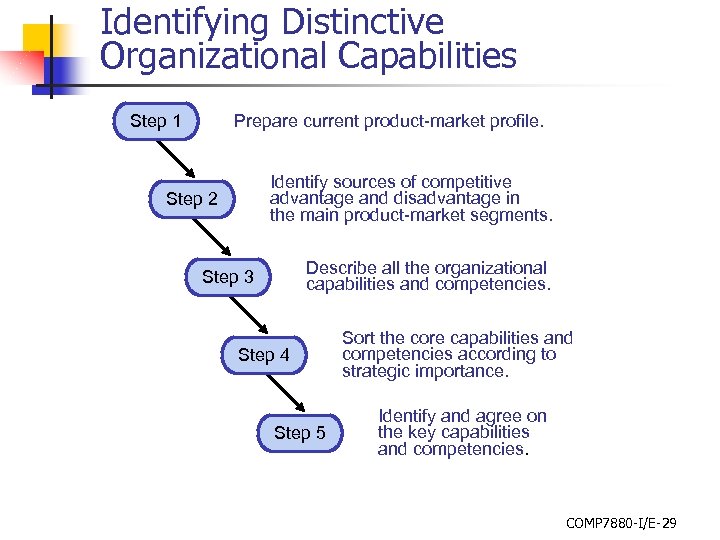
Identifying Distinctive Organizational Capabilities Step 1 Prepare current product-market profile. Identify sources of competitive advantage and disadvantage in the main product-market segments. Step 2 Describe all the organizational capabilities and competencies. Step 3 Step 4 Step 5 Sort the core capabilities and competencies according to strategic importance. Identify and agree on the key capabilities and competencies. COMP 7880 -I/E-29
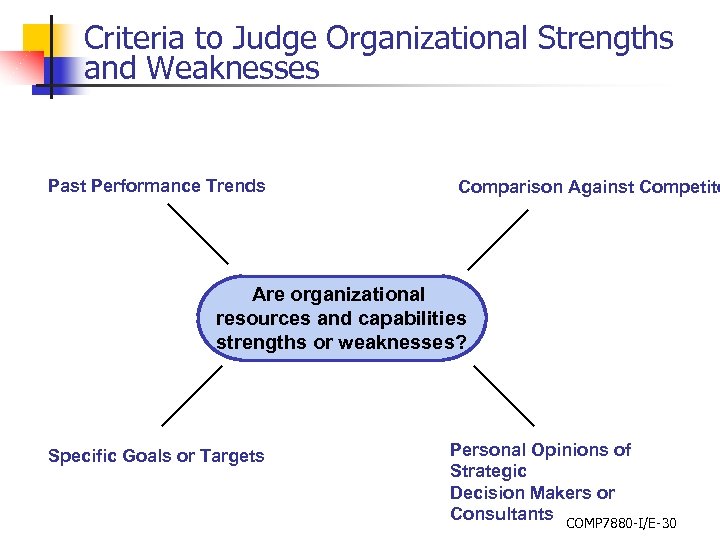
Criteria to Judge Organizational Strengths and Weaknesses Past Performance Trends Comparison Against Competito Are organizational resources and capabilities strengths or weaknesses? Specific Goals or Targets Personal Opinions of Strategic Decision Makers or Consultants COMP 7880 -I/E-30
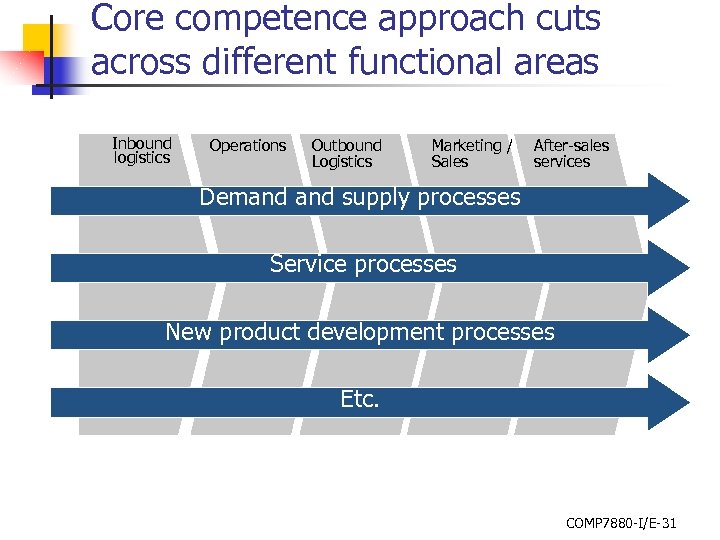
Core competence approach cuts across different functional areas Inbound logistics Operations Outbound Logistics Marketing / Sales After-sales services Demand supply processes Service processes New product development processes Etc. COMP 7880 -I/E-31
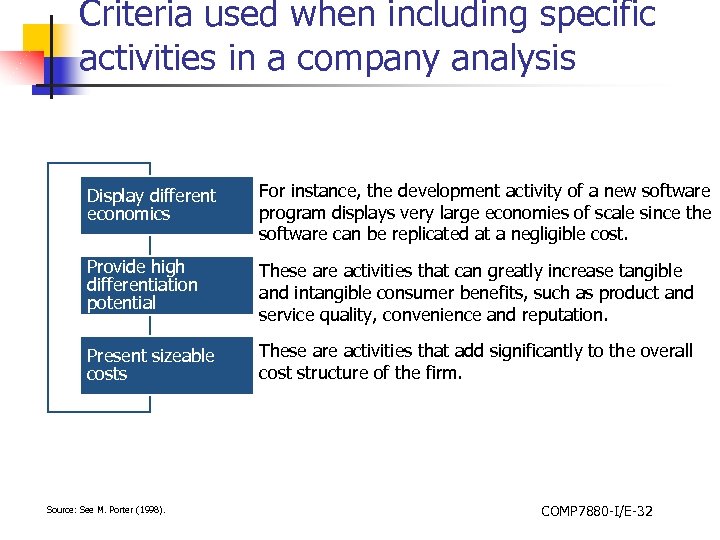
Criteria used when including specific activities in a company analysis Display different economics For instance, the development activity of a new software program displays very large economies of scale since the software can be replicated at a negligible cost. Provide high differentiation potential These are activities that can greatly increase tangible and intangible consumer benefits, such as product and service quality, convenience and reputation. Present sizeable costs These are activities that add significantly to the overall cost structure of the firm. Source: See M. Porter (1998). COMP 7880 -I/E-32
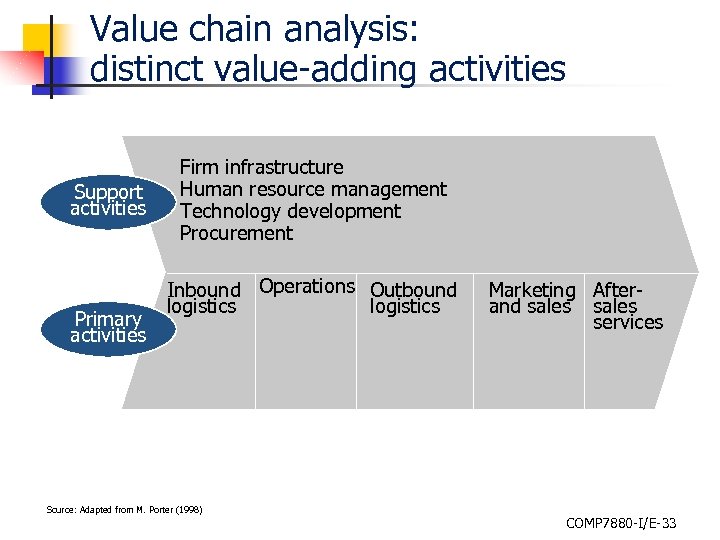
Value chain analysis: distinct value-adding activities Support activities Primary activities Firm infrastructure Human resource management Technology development Procurement Inbound Operations Outbound logistics Source: Adapted from M. Porter (1998) Marketing Afterand sales services COMP 7880 -I/E-33
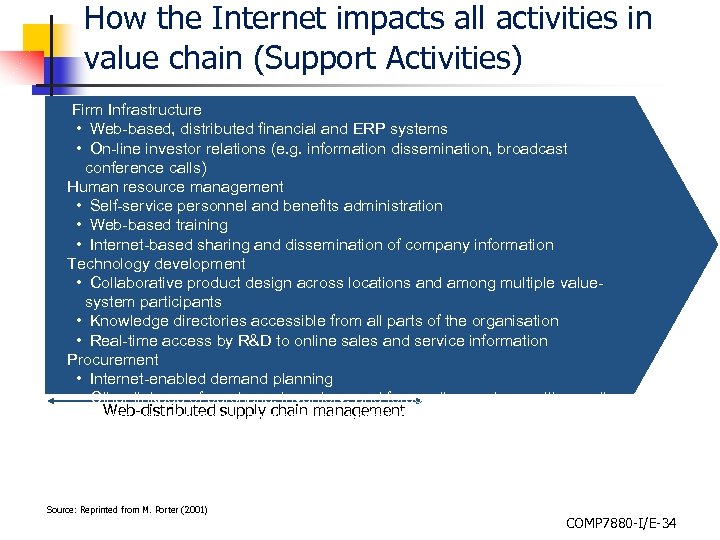
How the Internet impacts all activities in value chain (Support Activities) Firm Infrastructure • Web-based, distributed financial and ERP systems • On-line investor relations (e. g. information dissemination, broadcast conference calls) Human resource management • Self-service personnel and benefits administration • Web-based training • Internet-based sharing and dissemination of company information Technology development • Collaborative product design across locations and among multiple valuesystem participants • Knowledge directories accessible from all parts of the organisation • Real-time access by R&D to online sales and service information Procurement • Internet-enabled demand planning • Other linkage of purchase, inventory, and forecasting systems with suppliers Web-distributed procurement via marketplaces, auctions and buyer-seller • Direct and indirect supply chain management matching Source: Reprinted from M. Porter (2001) COMP 7880 -I/E-34
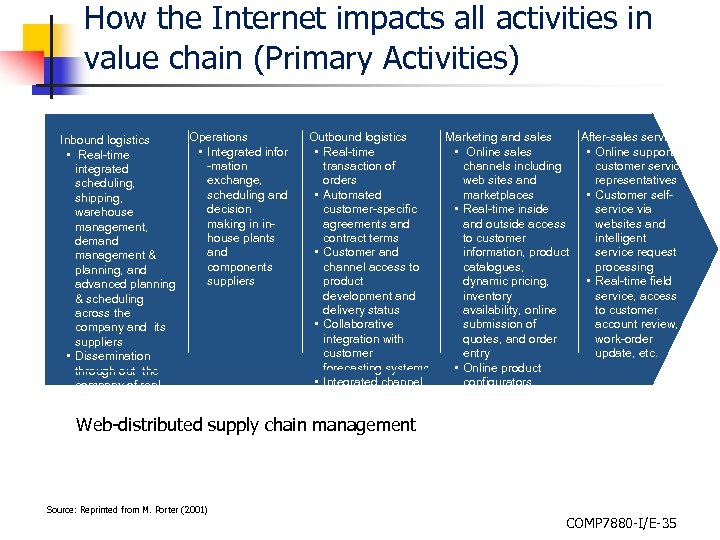
How the Internet impacts all activities in value chain (Primary Activities) Operations Outbound logistics Inbound logistics • Integrated infor • Real-time -mation transaction of integrated exchange, orders scheduling, scheduling and • Automated shipping, decision customer-specific warehouse making in inagreements and management, house plants contract terms demand • Customer and management & components channel access to planning, and suppliers product advanced planning development and & scheduling delivery status across the • Collaborative company and its integration with suppliers customer • Dissemination forecasting systems through out the • Integrated channel company of realmanagement time inbound and in-progress Web-distributed supply chain management inventory data Source: Reprinted from M. Porter (2001) Marketing and sales After-sales service • Online sales • Online support of channels including customer service web sites and representatives marketplaces • Customer self • Real-time inside service via and outside access websites and to customer intelligent information, product service request catalogues, processing dynamic pricing, • Real-time field inventory service, access availability, online to customer submission of account review, quotes, and order work-order entry update, etc. • Online product configurators • Customer-tailored marketing via customer profiling COMP 7880 -I/E-35
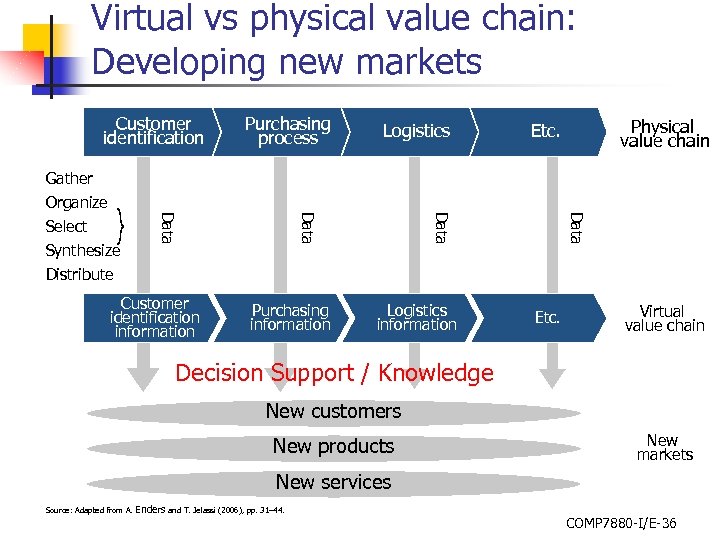
Virtual vs physical value chain: Developing new markets Customer identification Logistics information Data Purchasing information Physical value chain Etc. Data Customer identification information Logistics Data Gather Organize Select Synthesize Distribute Purchasing process Etc. Virtual value chain Decision Support / Knowledge New customers New products New markets New services Source: Adapted from A. Enders and T. Jelassi (2006), pp. 31– 44. COMP 7880 -I/E-36
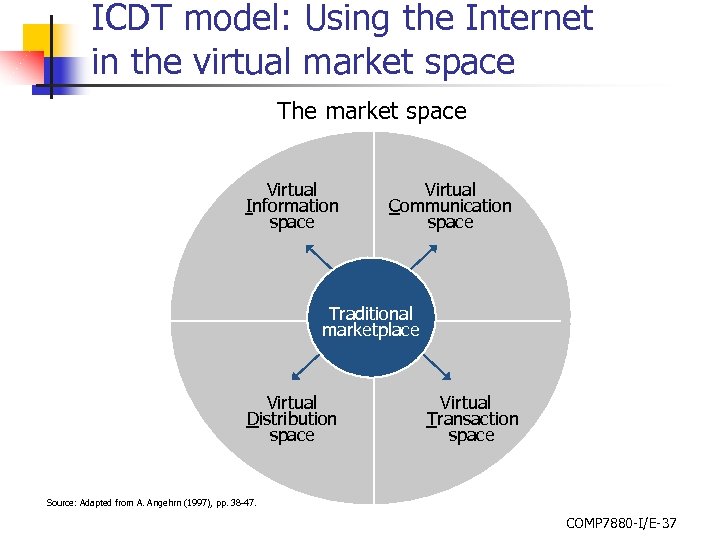
ICDT model: Using the Internet in the virtual market space The market space Virtual Information space Virtual Communication space Traditional marketplace Virtual Distribution space Virtual Transaction space Source: Adapted from A. Angehrn (1997), pp. 38 -47. COMP 7880 -I/E-37
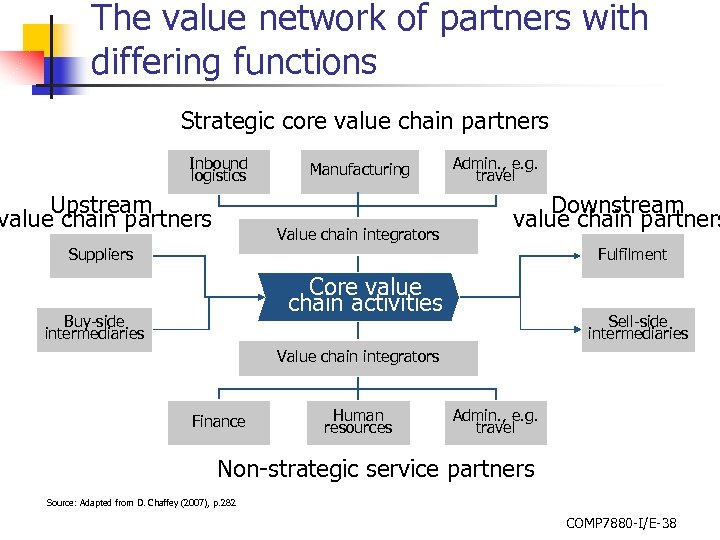
The value network of partners with differing functions Strategic core value chain partners Inbound logistics Upstream value chain partners Manufacturing Value chain integrators Admin. , e. g. travel Downstream value chain partners Suppliers Fulfilment Core value chain activities Buy-side intermediaries Sell-side intermediaries Value chain integrators Finance Human resources Admin. , e. g. travel Non-strategic service partners Source: Adapted from D. Chaffey (2007), p. 282 COMP 7880 -I/E-38
Segmentation Choose your favorable environment COMP 7880 -I/E-39
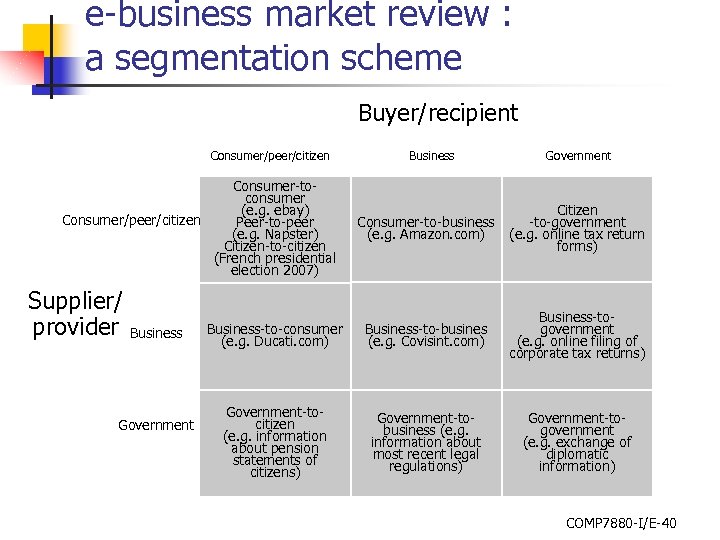
e-business market review : a segmentation scheme Buyer/recipient Consumer/peer/citizen Consumer-toconsumer (e. g. ebay) Consumer/peer/citizen Peer-to-peer (e. g. Napster) Citizen-to-citizen (French presidential election 2007) Supplier/ provider Business Government Consumer-to-business (e. g. Amazon. com) Citizen -to-government (e. g. online tax return forms) Business-to-consumer (e. g. Ducati. com) Business-to-busines (e. g. Covisint. com) Business-togovernment (e. g. online filing of corporate tax returns) Government-tocitizen (e. g. information about pension statements of citizens) Government-tobusiness (e. g. information about most recent legal regulations) Government-togovernment (e. g. exchange of diplomatic information) COMP 7880 -I/E-40
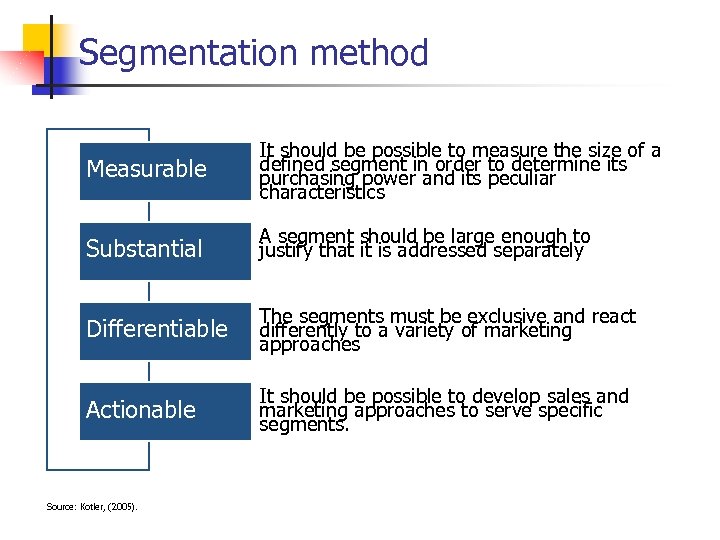
Segmentation method Measurable It should be possible to measure the size of a defined segment in order to determine its purchasing power and its peculiar characteristics Substantial A segment should be large enough to justify that it is addressed separately Differentiable The segments must be exclusive and react differently to a variety of marketing approaches Actionable It should be possible to develop sales and marketing approaches to serve specific segments. Source: Kotler, (2005).
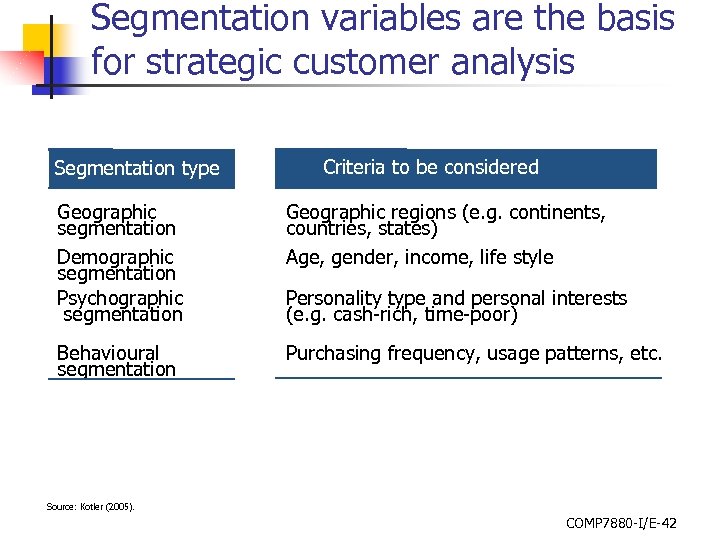
Segmentation variables are the basis for strategic customer analysis Segmentation type Criteria to be considered Geographic segmentation Demographic segmentation Psychographic segmentation Geographic regions (e. g. continents, countries, states) Age, gender, income, life style Behavioural segmentation Purchasing frequency, usage patterns, etc. Personality type and personal interests (e. g. cash-rich, time-poor) Source: Kotler (2005). COMP 7880 -I/E-42
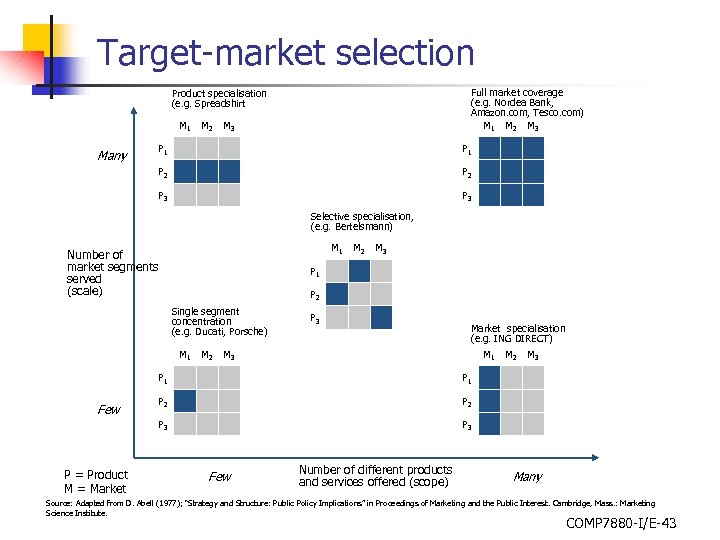
Target-market selection Full market coverage (e. g. Nordea Bank, Amazon. com, Tesco. com) M 1 M 2 M 3 Product specialisation (e. g. Spreadshirt M 1 M 2 M 3 P 1 P 2 P 3 Many P 3 Selective specialisation, (e. g. Bertelsmann) M 1 Number of market segments served (scale) M 2 M 3 P 1 P 2 Single segment concentration (e. g. Ducati, Porsche) M 1 M 2 P 3 Market specialisation (e. g. ING DIRECT) M 3 M 1 P = Product M = Market P 2 M 3 P 1 P 2 P 3 Few M 2 P 3 Few Number of different products and services offered (scope) Many Source: Adapted from D. Abell (1977); “Strategy and Structure: Public Policy Implications” in Proceedings of Marketing and the Public Interest. Cambridge, Mass. : Marketing Science Institute. COMP 7880 -I/E-43
Скачать презентацию COMP 7880 E-Business Strategies Internal and External Analysis
e79394ccff6fb0f1231fa1ec3091d42c.ppt