


 Скачать презентацию COMP 578 Discovering Classification Rules Keith C C
e2f828d9718141dd1f911e8899e9c802.ppt
- Количество слайдов: 64
 COMP 578 Discovering Classification Rules Keith C. C. Chan Department of Computing The Hong Kong Polytechnic University
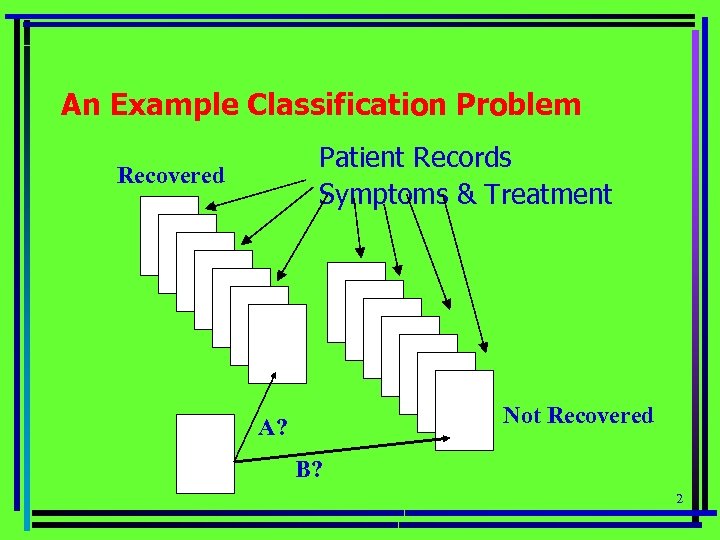 An Example Classification Problem Patient Records Symptoms & Treatment Recovered Not Recovered A? B? 2
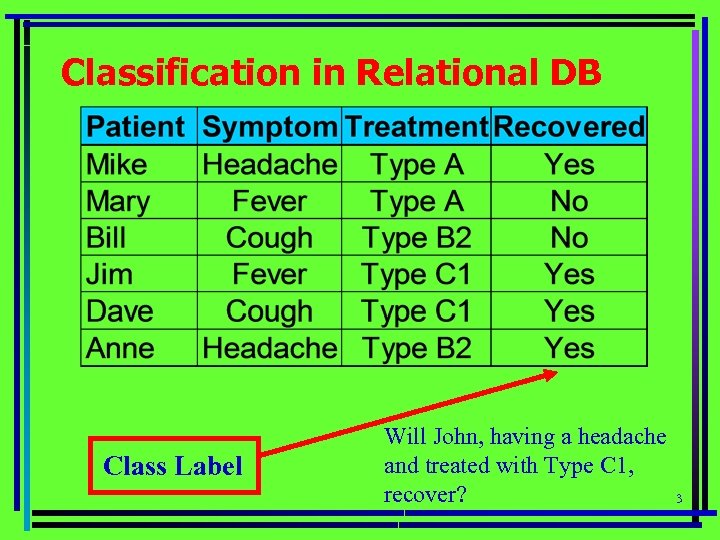 Classification in Relational DB Class Label Will John, having a headache and treated with Type C 1, recover? 3
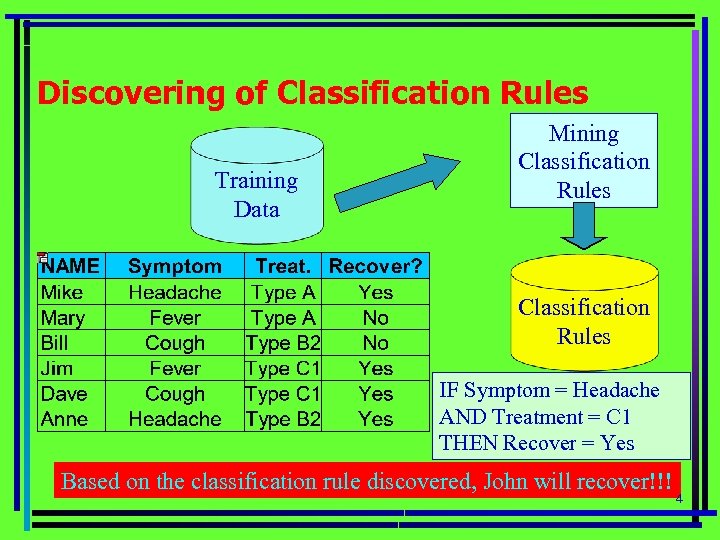 Discovering of Classification Rules Training Data Mining Classification Rules IF Symptom = Headache AND Treatment = C 1 THEN Recover = Yes Based on the classification rule discovered, John will recover!!! 4
 The Classification Problem Given: – A database consisting of n records. – Each record characterized by m attributes. – Each record pre-classified into p different classes. Find: – A set of classification rules (that constitutes a classification model) that characterizes the different classes – so that records not originally in the database can be accurately classified. – I. e “predicting” class labels. 5
 Typical Applications Credit approval. – Classes can be High Risk, Low Risk? Target marketing. – What are the classes? Medical diagnosis – Classes can be customers with different diseases. Treatment effectiveness analysis. – Classes can be patience with different degrees of recovery. 6
 Techniques for Discoveirng of Classification Rules The The The k-Nearest Neighbor Algorithm. Linear Discriminant Function. Bayesian Approach. Decision Tree approach. Neural Network approach. Genetic Algorithm approach. 7
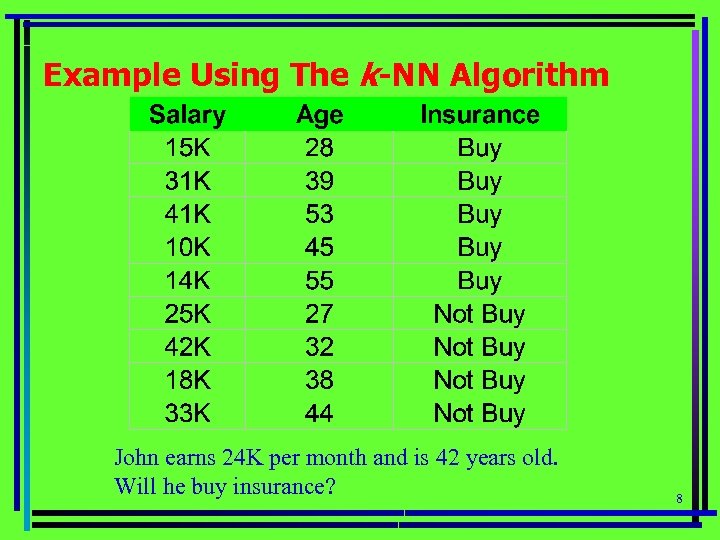 Example Using The k-NN Algorithm John earns 24 K per month and is 42 years old. Will he buy insurance? 8
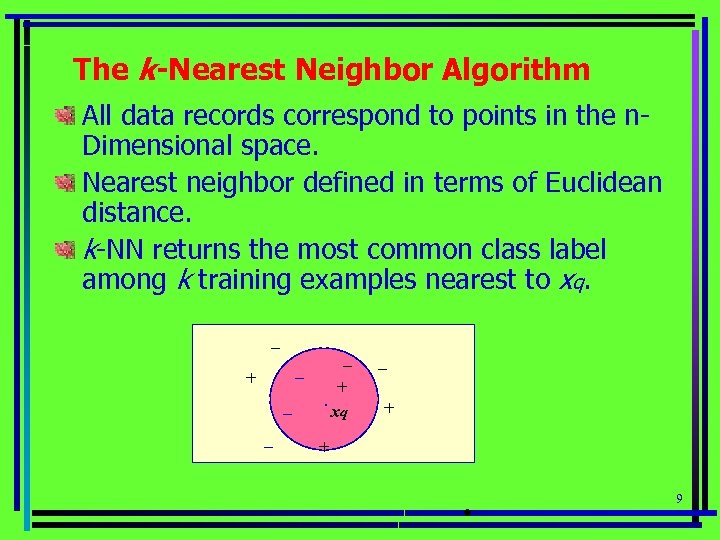 The k-Nearest Neighbor Algorithm All data records correspond to points in the n. Dimensional space. Nearest neighbor defined in terms of Euclidean distance. k-NN returns the most common class label among k training examples nearest to xq. _ _ _ + _ _ . + xq _ + + . 9
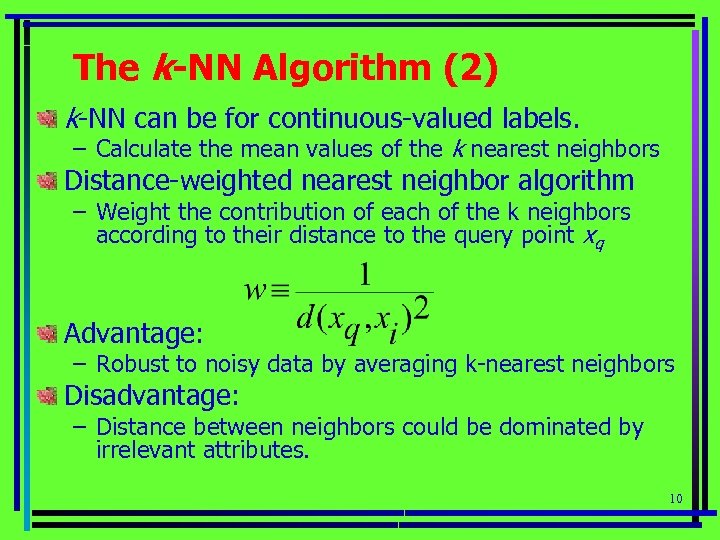 The k-NN Algorithm (2) k-NN can be for continuous-valued labels. – Calculate the mean values of the k nearest neighbors Distance-weighted nearest neighbor algorithm – Weight the contribution of each of the k neighbors according to their distance to the query point xq Advantage: – Robust to noisy data by averaging k-nearest neighbors Disadvantage: – Distance between neighbors could be dominated by irrelevant attributes. 10
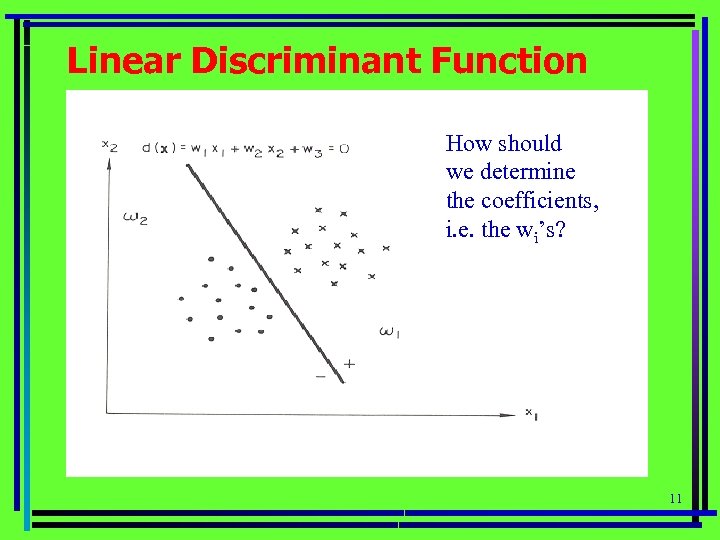 Linear Discriminant Function How should we determine the coefficients, i. e. the wi’s? 11
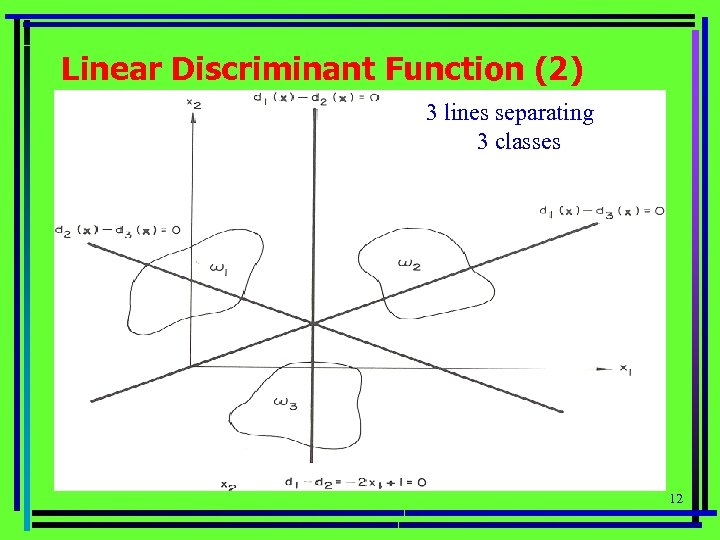 Linear Discriminant Function (2) 3 lines separating 3 classes 12
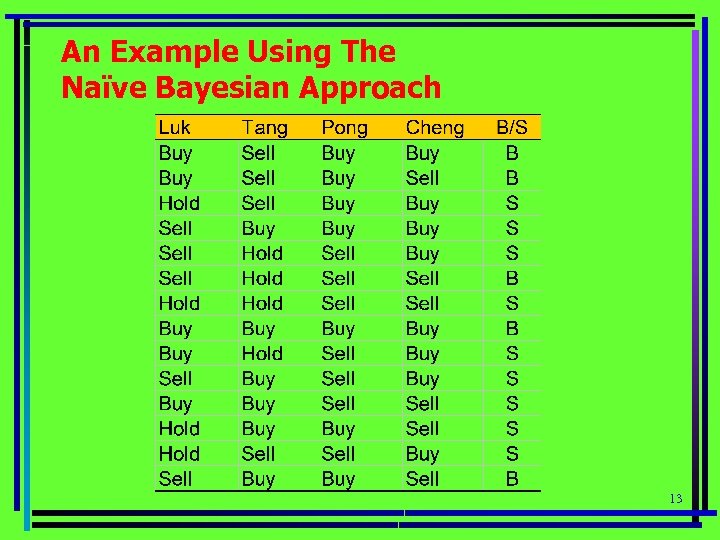 An Example Using The Naïve Bayesian Approach 13
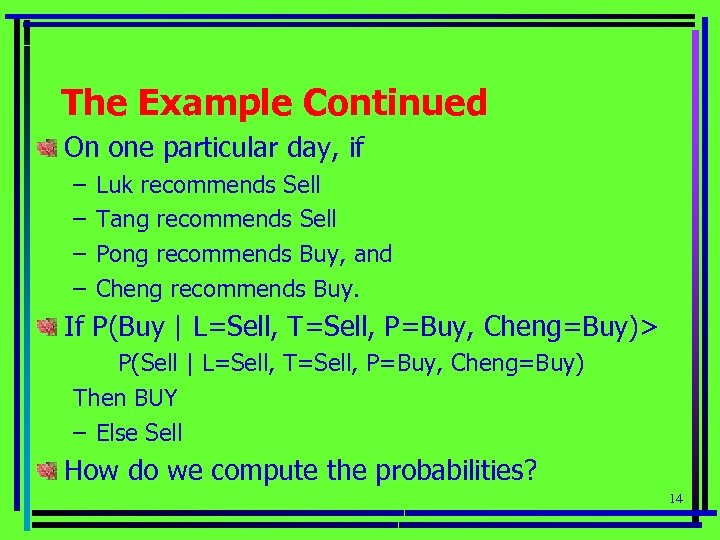 The Example Continued On one particular day, if – – Luk recommends Sell Tang recommends Sell Pong recommends Buy, and Cheng recommends Buy. If P(Buy | L=Sell, T=Sell, P=Buy, Cheng=Buy)> P(Sell | L=Sell, T=Sell, P=Buy, Cheng=Buy) Then BUY – Else Sell How do we compute the probabilities? 14
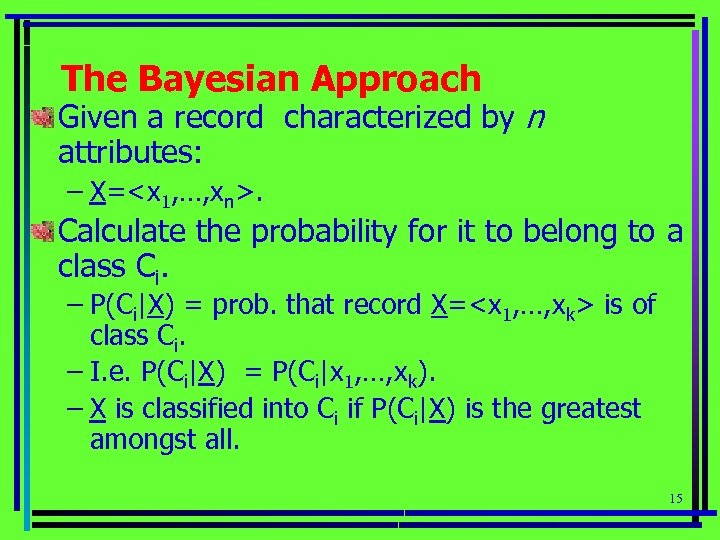 The Bayesian Approach Given a record characterized by n attributes: – X=
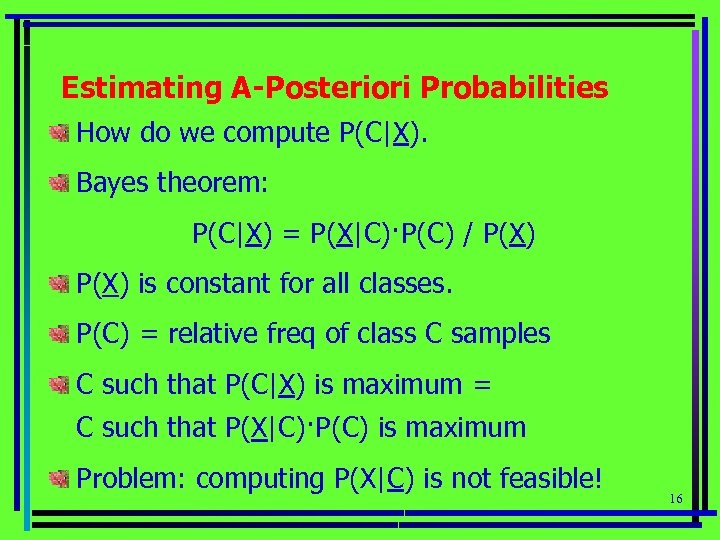 Estimating A-Posteriori Probabilities How do we compute P(C|X). Bayes theorem: P(C|X) = P(X|C)·P(C) / P(X) is constant for all classes. P(C) = relative freq of class C samples C such that P(C|X) is maximum = C such that P(X|C)·P(C) is maximum Problem: computing P(X|C) is not feasible! 16
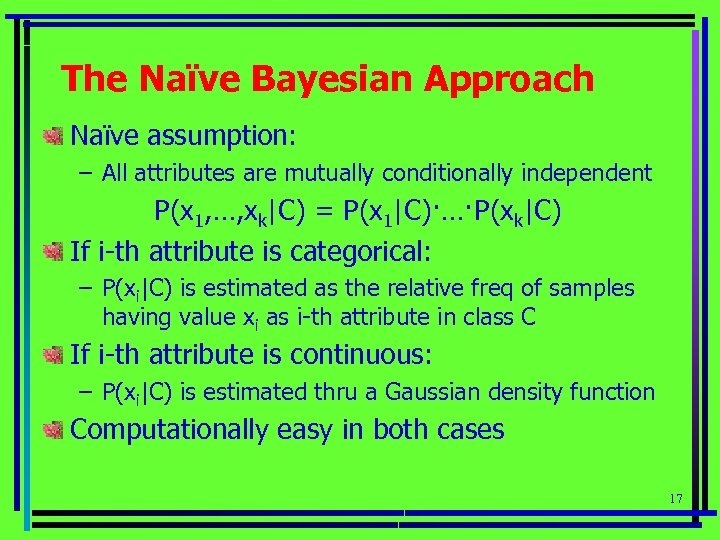 The Naïve Bayesian Approach Naïve assumption: – All attributes are mutually conditionally independent P(x 1, …, xk|C) = P(x 1|C)·…·P(xk|C) If i-th attribute is categorical: – P(xi|C) is estimated as the relative freq of samples having value xi as i-th attribute in class C If i-th attribute is continuous: – P(xi|C) is estimated thru a Gaussian density function Computationally easy in both cases 17
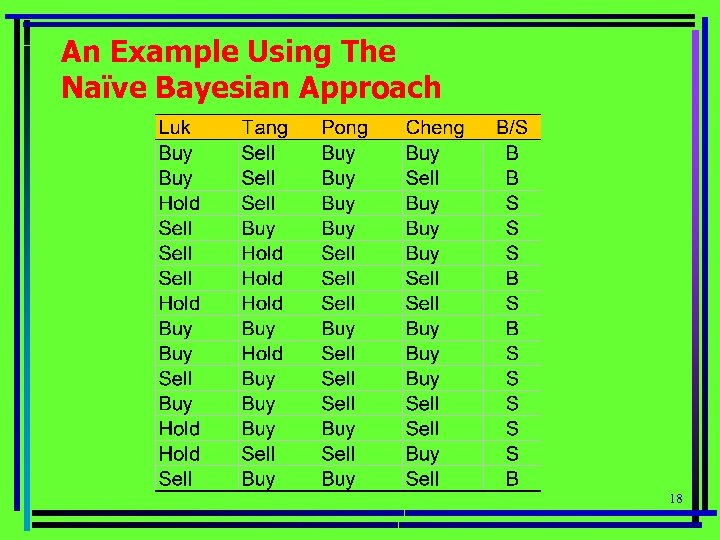 An Example Using The Naïve Bayesian Approach 18
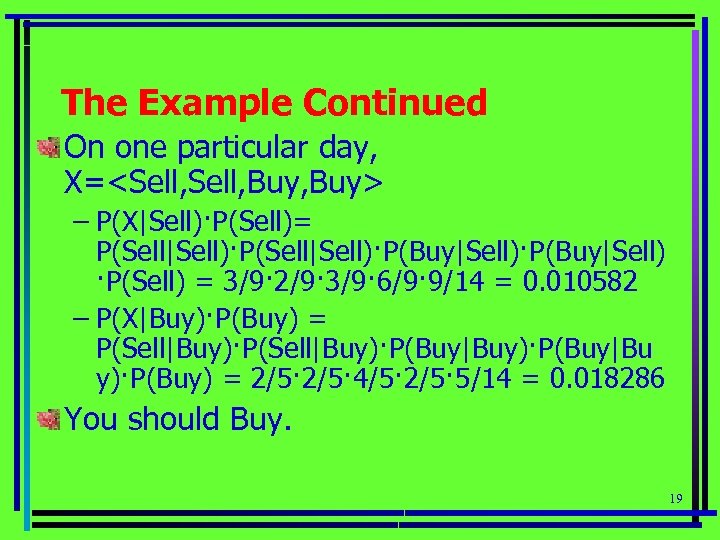 The Example Continued On one particular day, X=
 Advantages of The Bayesian Approach Probabilistic. – Calculate explicit probabilities. Incremental. – Additional example can incrementally increase/decrease a class probability. Probabilistic classification. – Classify into multiple classes weighted by their probabilities. Standard. – Though computationally intractable, the approach can provide a standard of optimal decision making. 20
 The independence hypothesis… … makes computation possible. … yields optimal classifiers when satisfied. … but is seldom satisfied in practice, as attributes (variables) are often correlated. Attempts to overcome this limitation: – Bayesian networks, that combine Bayesian reasoning with causal relationships between attributes – Decision trees, that reason on one attribute at the time, considering most important attributes first 21
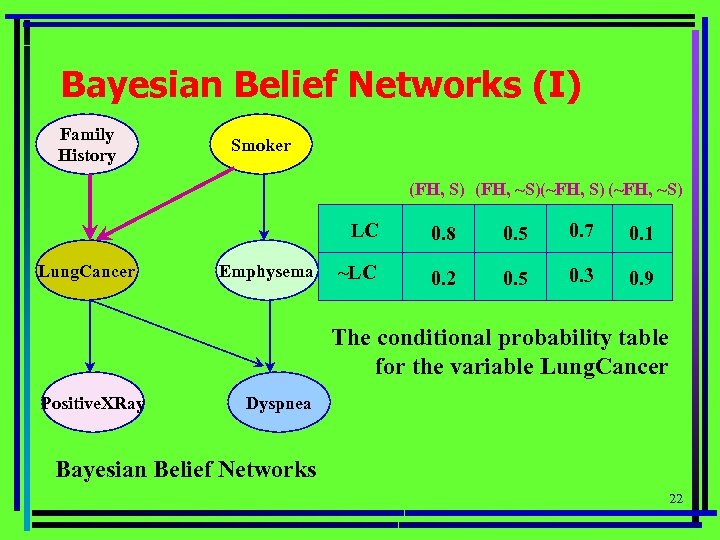 Bayesian Belief Networks (I) Family History Smoker (FH, S) (FH, ~S)(~FH, S) (~FH, ~S) LC Lung. Cancer Emphysema 0. 8 0. 5 0. 7 0. 1 ~LC 0. 2 0. 5 0. 3 0. 9 The conditional probability table for the variable Lung. Cancer Positive. XRay Dyspnea Bayesian Belief Networks 22
 Bayesian Belief Networks (II) Bayesian belief network allows a subset of the variables conditionally independent A graphical model of causal relationships Several cases of learning Bayesian belief networks – Given both network structure and all the variables: easy – Given network structure but only some variables – When the network structure is not known in advance 23
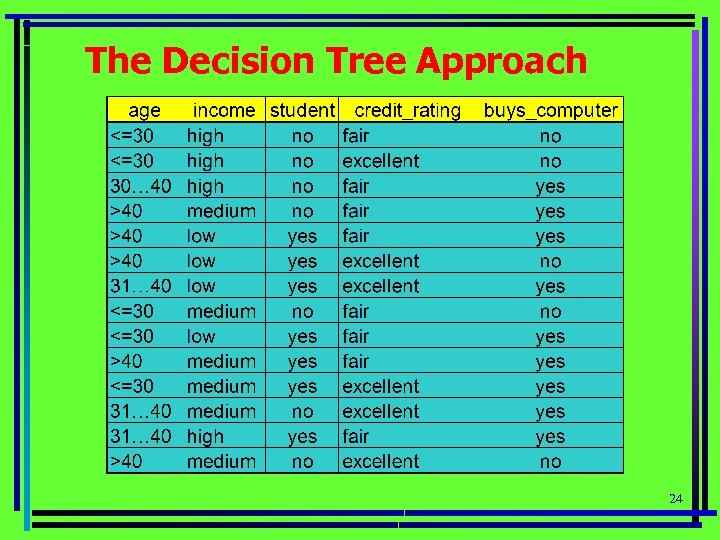 The Decision Tree Approach 24
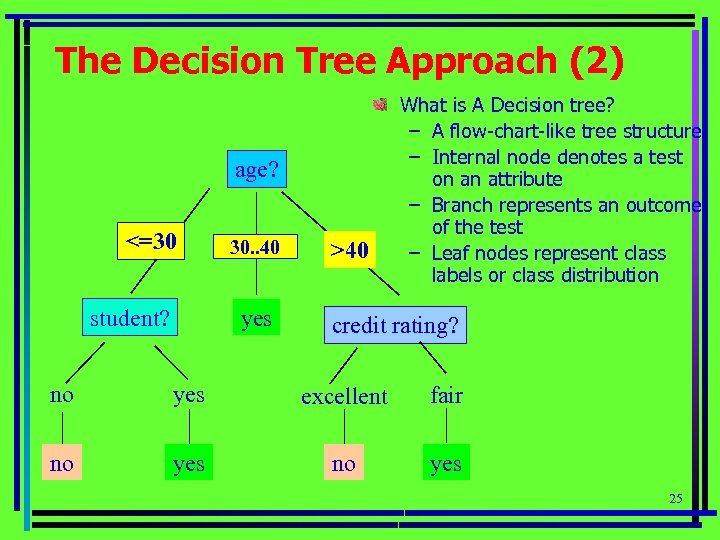 The Decision Tree Approach (2) age? <=30 student? overcast 30. . 40 yes >40 What is A Decision tree? – A flow-chart-like tree structure – Internal node denotes a test on an attribute – Branch represents an outcome of the test – Leaf nodes represent class labels or class distribution credit rating? no yes excellent fair no yes 25
 Constructing A Decision Tree Decision tree generation has 2 phases – At start, all the records are at the root – Partition examples recursively based on selected attributes Decision tree can be used to classify a record not originally in the example database. – Test the attribute values of the sample against the decision tree. 26
 Tree Construction Algorithm Basic algorithm (a greedy algorithm) – Tree is constructed in a top-down recursive divide-andconquer manner – At start, all the training examples are at the root – Attributes are categorical (if continuous-valued, they are discretized in advance) – Examples are partitioned recursively based on selected attributes – Test attributes are selected on the basis of a heuristic or statistical measure (e. g. , information gain) Conditions for stopping partitioning – All samples for a given node belong to the same class – There are no remaining attributes for further partitioning – majority voting is employed for classifying the leaf 27 – There are no samples left
 A Decision Tree Example 28
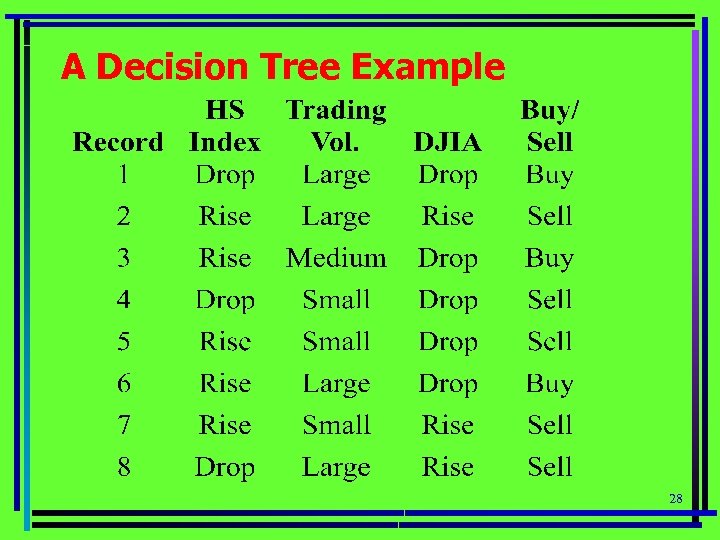
 A Decision Tree Example (2) Each record is described in terms of three attributes: – Hang Seng Index with values {rise, drop} – Trading volume with values {small, medium, large} – Dow Jones Industrial Average (DJIA) with values {rise, drop} – Records contain Buy (B) or Sell (S) to indicate the correct decision. – B or S can be considered a class label. 29
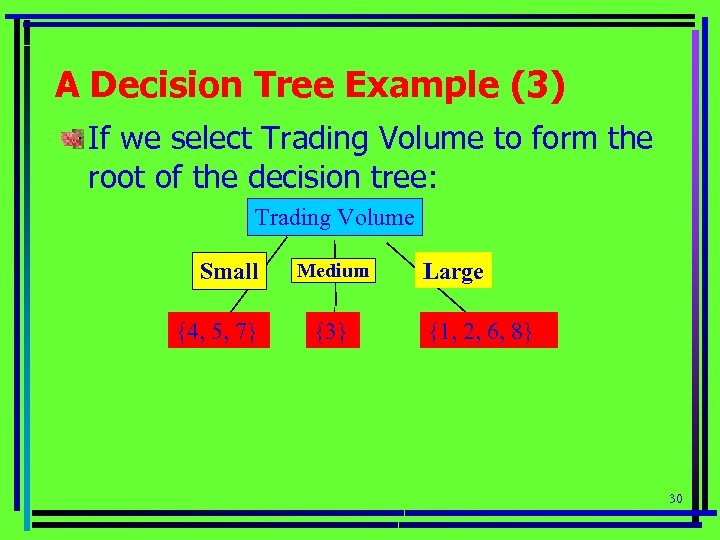 A Decision Tree Example (3) If we select Trading Volume to form the root of the decision tree: Trading Volume Small {4, 5, 7} Medium {3} Large {1, 2, 6, 8} 30
 A Decision Tree Example (4) The sub-collections corresponding to “Small” and “Medium” contain records of only a single class Further partitioning unnecessary. Select the DJIA attribute to test for the “Large” branch. Now all sub-collections contain records of one decision (class). We can replace each sub-collection by the decision/class name to obtain the decision tree. 31
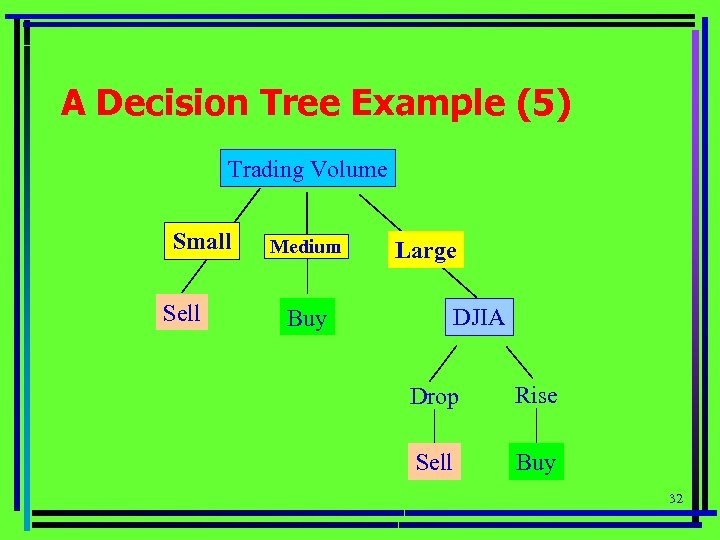 A Decision Tree Example (5) Trading Volume Small Sell overcast Medium Large DJIA Buy Drop Rise Sell Buy 32
 A Decision Tree Example (6) A record can be classified by: – Start at the root of the decision tree. – Find value of attribute being tested in the given record. – Taking the branch appropriate to that value. – Continue in the same fashion until a leaf is reached. – Two records having identical attribute values may belong to different classes. – The leaves corresponding to an empty set of examples should be kept to a minimum. Classifying a particular record may involve evaluating only a small number of the attributes depending on the length of the path. – We never need to consider the HSI. 33
 Simple Decision Trees The selection of each attribute in turn for different levels of the tree tend to lead to complex tree. A simple tree is easier to understand. Select attribute so as to make final tree as simple as possible. 34
 The ID 3 Algorithm Uses an information-theoretic approach for this. A decision tree considered an information source that, given a record, generates a message. The message is the classification of that record (say, Buy (B) or Sell (S)). ID 3 selects attributes by assuming that tree complexity is related to amount of information conveyed by this message. 35
 Information Theoretic Test Selection Each attribute of a record contributes a certain amount of information to its classification. E. g. , if our goal is to determine the credit risk of a customer, the discovery that it has many late-payment records may contribute a certain amount of information to that goal. ID 3 measures the information gained by making each attribute the root of the current sub-tree. It then picks the attribute that provides the greatest information gain. 36
 Information Gain Information theory proposed by Shannon in 1948. Provides a useful theoretic basis for measuring the information content of a message. A message considered an instance in a universe of possible messages. The information content of a message is dependent on: – Number of possible messages (size of the universe). – Frequency each possible message occurs. 37
 Information Gain (2) – The number of possible messages determines amount of information (e. g. gambling). • Roulette has many outcomes. • A message concerning its outcome is of more value. – The probability of each message determines the amount of information (e. g. a rigged coin). • If one already know enough about the coin to wager correctly ¾ of the time, a message telling me the outcome of a given toss is worth less to me than it would be for an honest coin. – Such intuition formalized in Information Theory. • Define the amount of information in a message as a function of the probability of occurrence of each possible message. 38
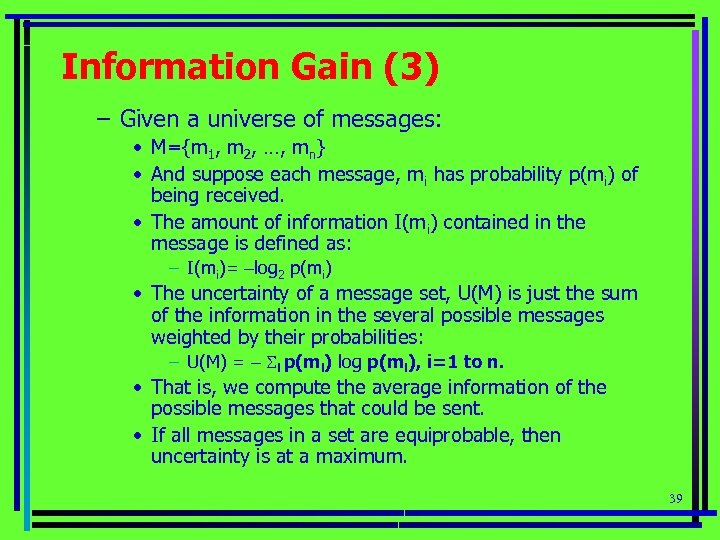 Information Gain (3) – Given a universe of messages: • M={m 1, m 2, …, mn} • And suppose each message, mi has probability p(mi) of being received. • The amount of information I(mi) contained in the message is defined as: – I(mi)= log 2 p(mi) • The uncertainty of a message set, U(M) is just the sum of the information in the several possible messages weighted by their probabilities: – U(M) = i p(mi) log p(mi), i=1 to n. • That is, we compute the average information of the possible messages that could be sent. • If all messages in a set are equiprobable, then uncertainty is at a maximum. 39
 DT Construction Using ID 3 If the probability of these messages is p. B and p. S respectively, the expected information content of the message is: With a known set C of records we can approximate these probabilities by relative frequencies. That is p. B becomes the proportion of records in C with class B. 40
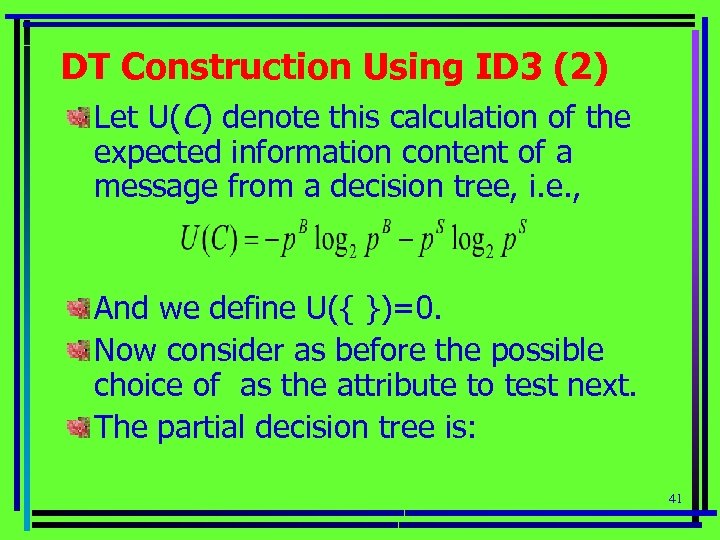 DT Construction Using ID 3 (2) Let U(C) denote this calculation of the expected information content of a message from a decision tree, i. e. , And we define U({ })=0. Now consider as before the possible choice of as the attribute to test next. The partial decision tree is: 41
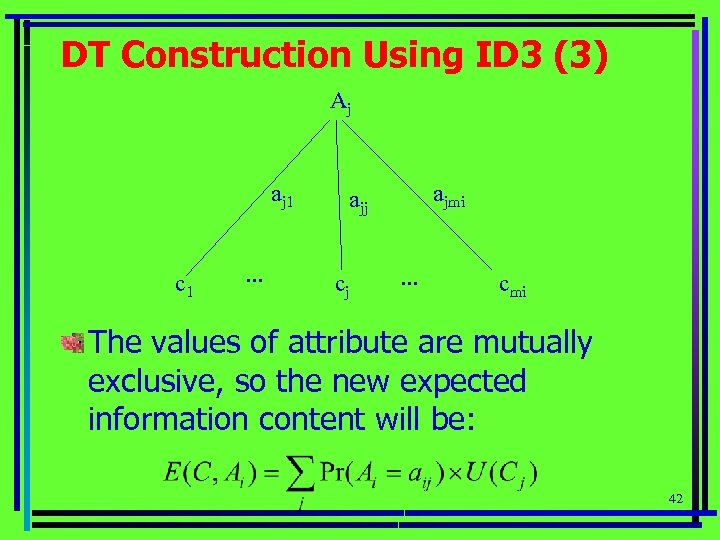 DT Construction Using ID 3 (3) Aj aj 1 c 1 . . . ajmi ajj cj . . . cmi The values of attribute are mutually exclusive, so the new expected information content will be: 42
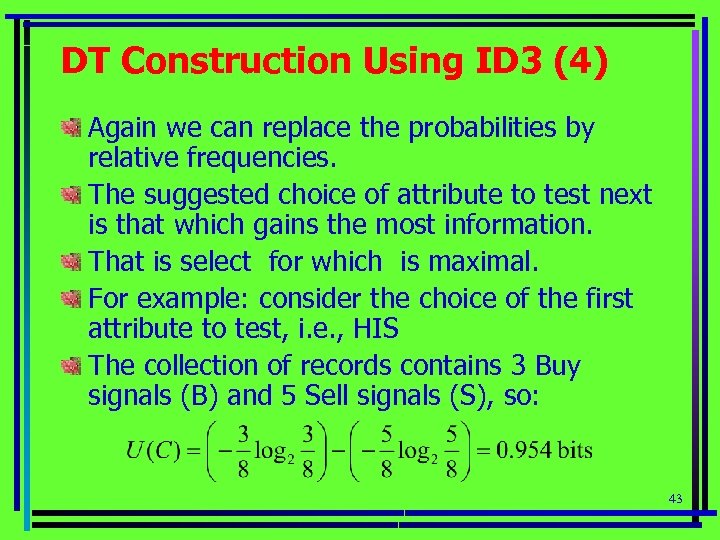 DT Construction Using ID 3 (4) Again we can replace the probabilities by relative frequencies. The suggested choice of attribute to test next is that which gains the most information. That is select for which is maximal. For example: consider the choice of the first attribute to test, i. e. , HIS The collection of records contains 3 Buy signals (B) and 5 Sell signals (S), so: 43
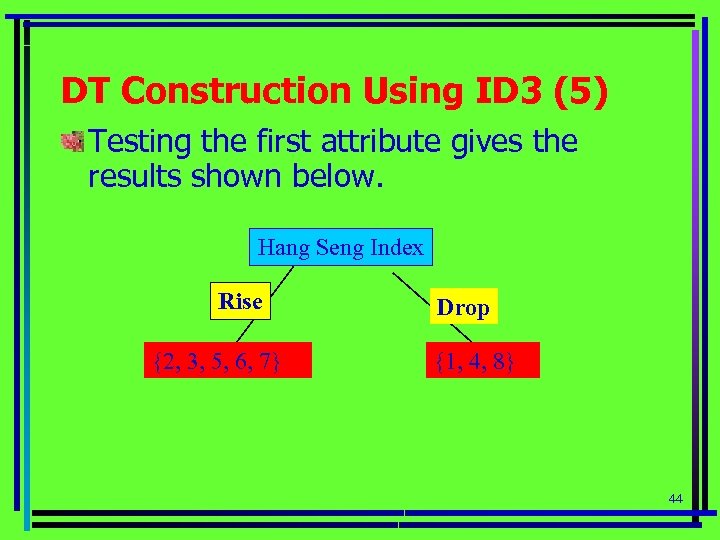 DT Construction Using ID 3 (5) Testing the first attribute gives the results shown below. Hang Seng Index Rise {2, 3, 5, 6, 7} Drop {1, 4, 8} 44
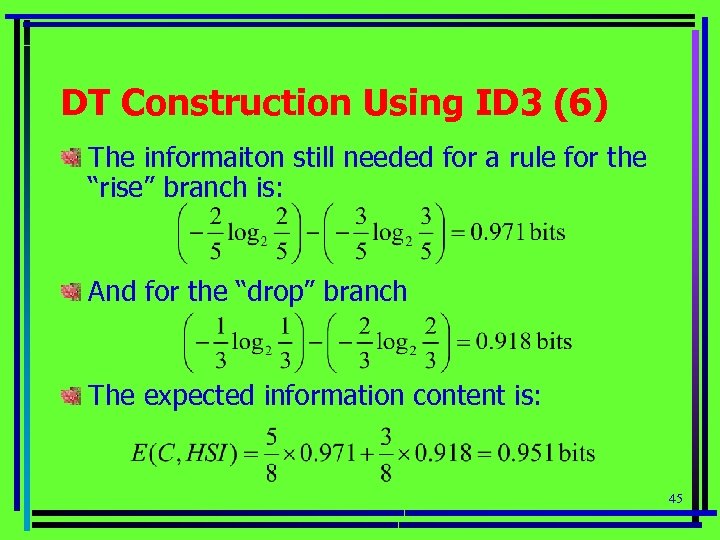 DT Construction Using ID 3 (6) The informaiton still needed for a rule for the “rise” branch is: And for the “drop” branch The expected information content is: 45
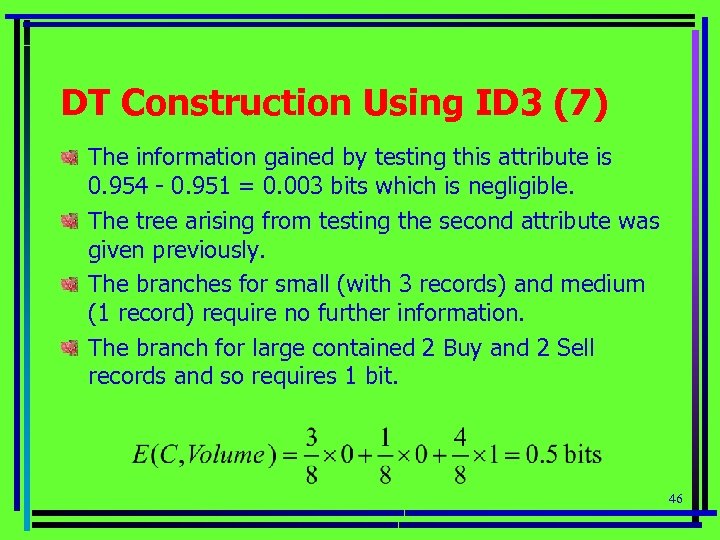 DT Construction Using ID 3 (7) The information gained by testing this attribute is 0. 954 - 0. 951 = 0. 003 bits which is negligible. The tree arising from testing the second attribute was given previously. The branches for small (with 3 records) and medium (1 record) require no further information. The branch for large contained 2 Buy and 2 Sell records and so requires 1 bit. 46
 DT Construction Using ID 3 (8) The information gained by testing Trading Volume is 0. 954 - 0. 5 = 0. 454 bits. In a similar way the information gained by testing DJIA comes to 0. 347 bits. The principle of maximizing expected information gain would lead ID 3 to select Trading Volume as the attribute to form the root of the decision tree. 47
 How to use a tree? Directly – test the attribute value of unknown sample against the tree. – A path is traced from root to a leaf which holds the label Indirectly – decision tree is converted to classification rules – one rule is created for each path from the root to a leaf – IF-THEN is easier for humans to understand 48
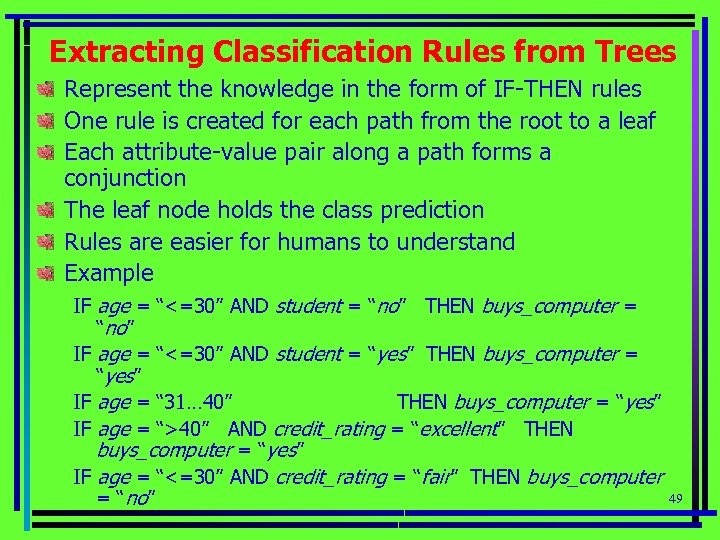 Extracting Classification Rules from Trees Represent the knowledge in the form of IF-THEN rules One rule is created for each path from the root to a leaf Each attribute-value pair along a path forms a conjunction The leaf node holds the class prediction Rules are easier for humans to understand Example IF age = “no” IF age = “yes” IF age = “<=30” AND student = “no” THEN buys_computer = “<=30” AND student = “yes” THEN buys_computer = “ 31… 40” THEN buys_computer = “yes” “>40” AND credit_rating = “excellent” THEN buys_computer = “yes” IF age = “<=30” AND credit_rating = “fair” THEN buys_computer = “no” 49
 Avoid Overfitting in Classification The generated tree may overfit the training data – Too many branches, some may reflect anomalies due to noise or outliers – Result is in poor accuracy for unseen samples Two approaches to avoid overfitting – Prepruning: Halt tree construction early—do not split a node if this would result in the goodness measure falling below a threshold • Difficult to choose an appropriate threshold – Postpruning: Remove branches from a “fully grown” tree—get a sequence of progressively pruned trees • Use a set of data different from the training data to decide which is the “best pruned tree” 50
 Improving the C 4. 5/ID 3 Algorithm Allow for continuous-valued attributes – Dynamically define new discrete-valued attributes that partition the continuous attribute value into a discrete set of intervals Handle missing attribute values – Assign the most common value of the attribute – Assign probability to each of the possible values Attribute construction – Create new attributes based on existing ones that are sparsely represented – This reduces fragmentation, repetition, and replication 51
 Classifying Large Datasets Advantages of the decision-tree approach – Computational efficient compared to other classification methods. – Convertible into simple and easy to understand classification rules. – Relatively good quality rules (comparable classification accuracy). 52
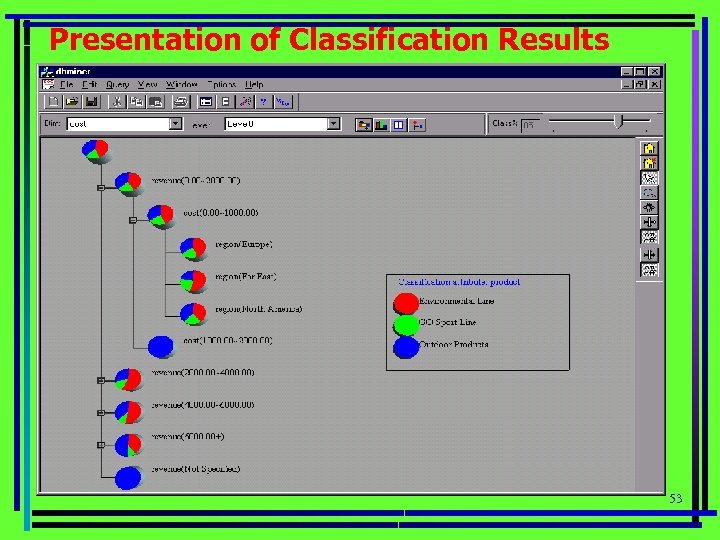 Presentation of Classification Results 53
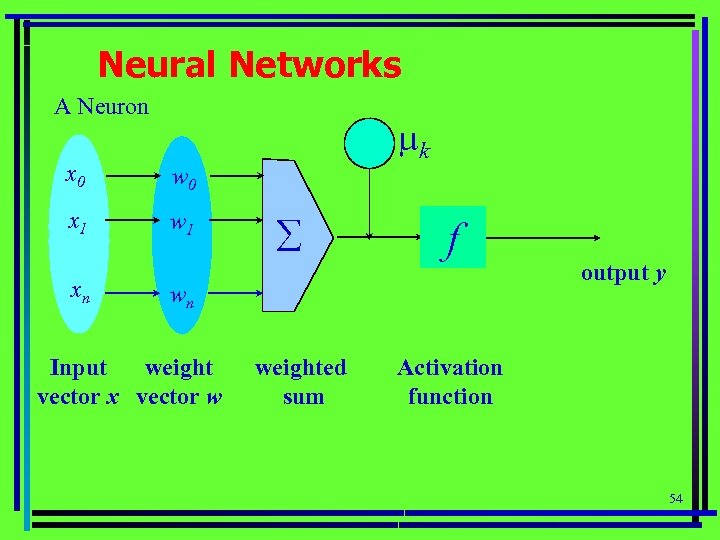 Neural Networks A Neuron x 0 w 0 x 1 w 1 - mk xn å f wn Input weight vector x vector w weighted sum output y Activation function 54
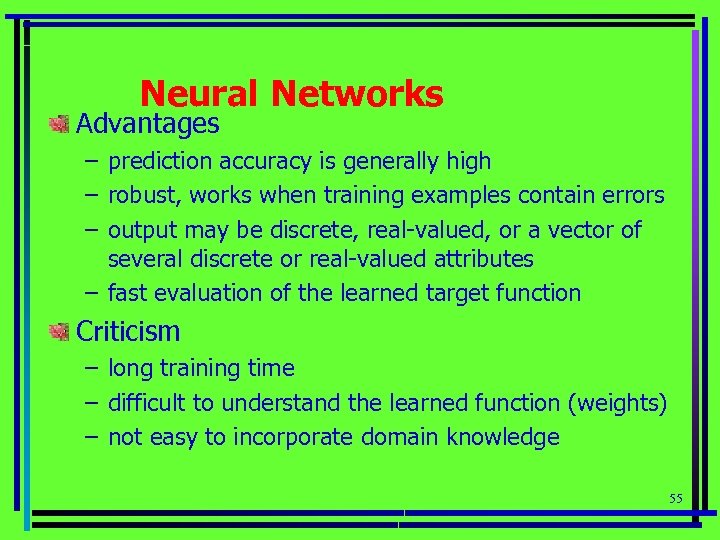 Neural Networks Advantages – prediction accuracy is generally high – robust, works when training examples contain errors – output may be discrete, real-valued, or a vector of several discrete or real-valued attributes – fast evaluation of the learned target function Criticism – long training time – difficult to understand the learned function (weights) – not easy to incorporate domain knowledge 55
 Genetic Algorithm (I) GA: based on an analogy to biological evolution. – A diverse population of competing hypotheses is maintained. – At each iteration, the most fit members are selected to produce new offspring that replace the least fit ones. – Hypotheses are encoded by strings that are combined by crossover operations, and subject to random mutation. Learning is viewed as a special case of optimization. – Finding optimal hypothesis according to the predefined fitness function.
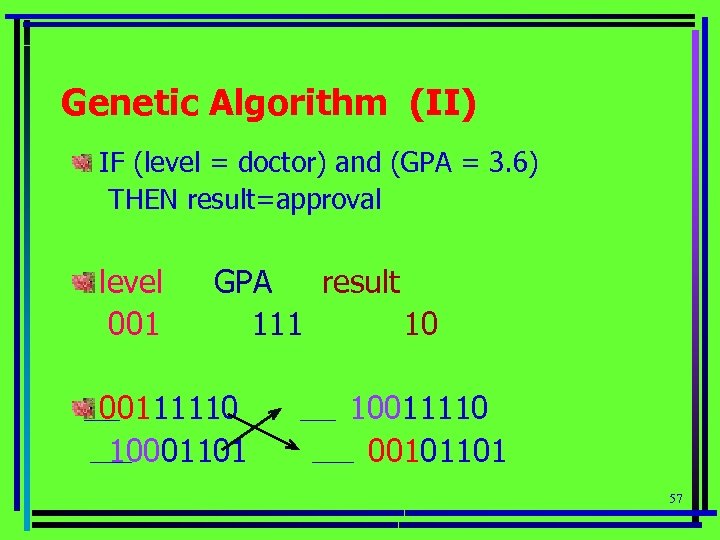 Genetic Algorithm (II) IF (level = doctor) and (GPA = 3. 6) THEN result=approval level 001 GPA result 111 10 00111110 10001101 10011110 00101101 57
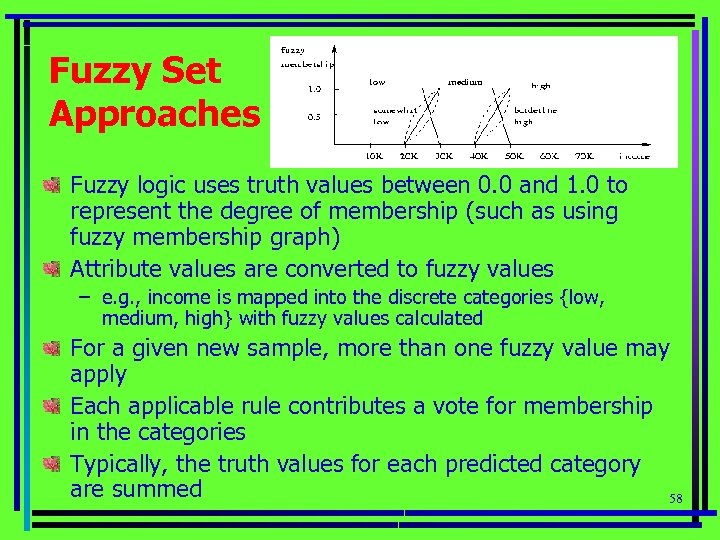 Fuzzy Set Approaches Fuzzy logic uses truth values between 0. 0 and 1. 0 to represent the degree of membership (such as using fuzzy membership graph) Attribute values are converted to fuzzy values – e. g. , income is mapped into the discrete categories {low, medium, high} with fuzzy values calculated For a given new sample, more than one fuzzy value may apply Each applicable rule contributes a vote for membership in the categories Typically, the truth values for each predicted category are summed 58
 Evaluating Classification Rules Constructing a classification model. – – In form of mathematical equations? Neural networks. Classification rules. Requires training set of pre-classified records. Evaluation of classification model. – – Estimate quality by testing classification model. Quality = accuracy of classification. Requires a testing set of records (known class labels). Accuracy is percentage of correctly classified test set. 59
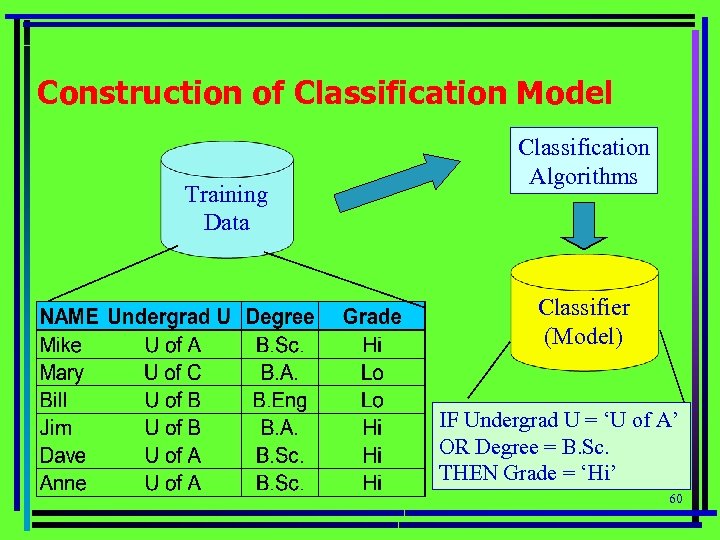 Construction of Classification Model Training Data Classification Algorithms Classifier (Model) IF Undergrad U = ‘U of A’ OR Degree = B. Sc. THEN Grade = ‘Hi’ 60
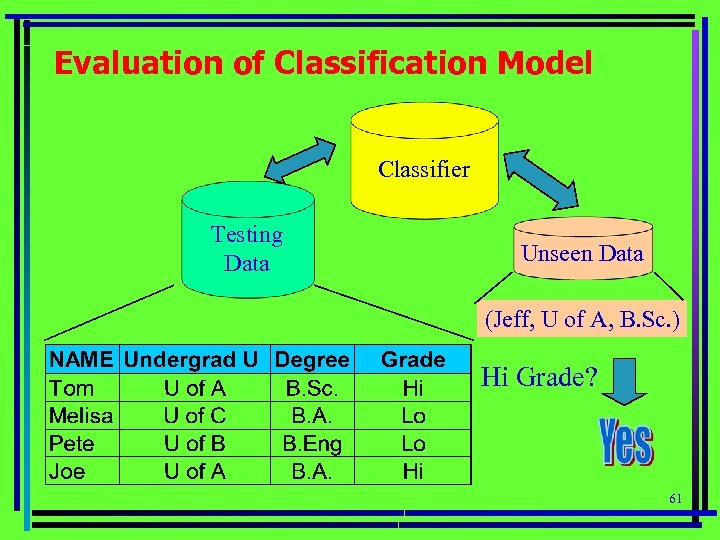 Evaluation of Classification Model Classifier Testing Data Unseen Data (Jeff, U of A, B. Sc. ) Hi Grade? 61
 Classification Accuracy: Estimating Error Rates Partition: Training-and-testing – use two independent data sets, e. g. , training set (2/3), test set(1/3) – used for data set with large number of samples Cross-validation – divide the data set into k subsamples – use k-1 subsamples as training data and one subsample as test data --- k-fold cross-validation – for data set with moderate size Bootstrapping (leave-one-out) – for small size data 62
 Issues Regarding classification: Data Preparation Data cleaning – Preprocess data in order to reduce noise and handle missing values Relevance analysis (feature selection) – Remove the irrelevant or redundant attributes Data transformation – Generalize and/or normalize data 63
 Issues regarding classification (2): Evaluating Classification Methods Predictive accuracy Speed and scalability – time to construct the model – time to use the model Robustness – handling noise and missing values Scalability – efficiency in disk-resident databases Interpretability: – understanding and insight provded by the model Goodness of rules – decision tree size – compactness of classification rules 64