 Скачать презентацию COMP 2122 Networks in Organisations Richard Henson February
57e8602c54c8feb1848c949de2ce084f.ppt
- Количество слайдов: 52



COMP 2122 Networks in Organisations Richard Henson February 2012
Week 4: Overview of Important Network Operating Systems • Objective: Ø Name significant network operating systems in developments towards today’s organisational networks Ø Briefly explain features of proprietary products that fulfil particular requirements of a network operating system Ø Explain a (network) operating system architecture in terms of a multi-layered model
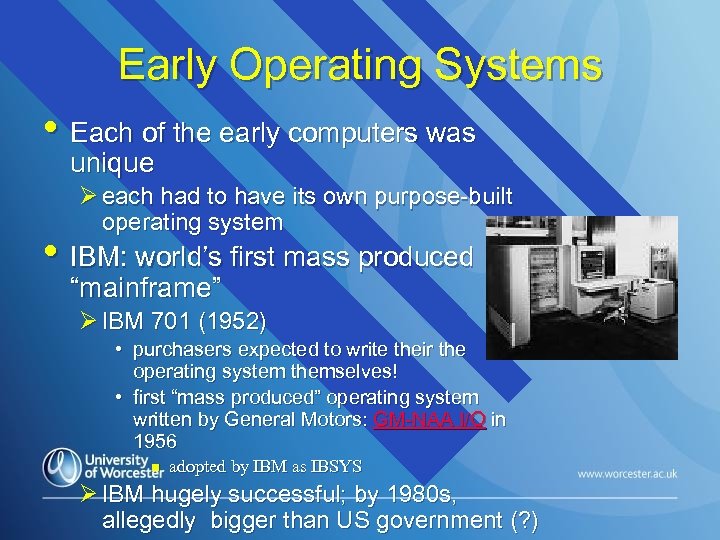
Early Operating Systems • Each of the early computers was unique Ø each had to have its own purpose-built operating system • IBM: world’s first mass produced “mainframe” Ø IBM 701 (1952) • purchasers expected to write their the operating system themselves! • first “mass produced” operating system written by General Motors: GM-NAA I/O in 1956 n adopted by IBM as IBSYS Ø IBM hugely successful; by 1980 s, allegedly bigger than US government (? )
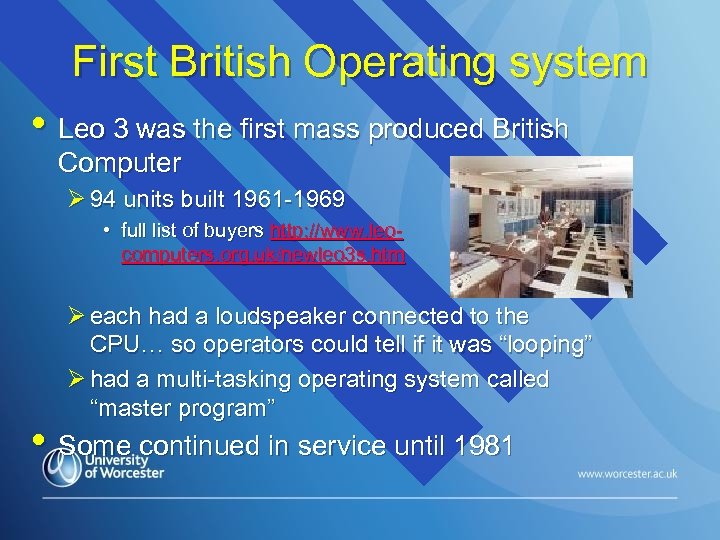
First British Operating system • Leo 3 was the first mass produced British Computer Ø 94 units built 1961 -1969 • full list of buyers http: //www. leocomputers. org. uk/newleo 3 s. htm Ø each had a loudspeaker connected to the CPU… so operators could tell if it was “looping” Ø had a multi-tasking operating system called “master program” • Some continued in service until 1981
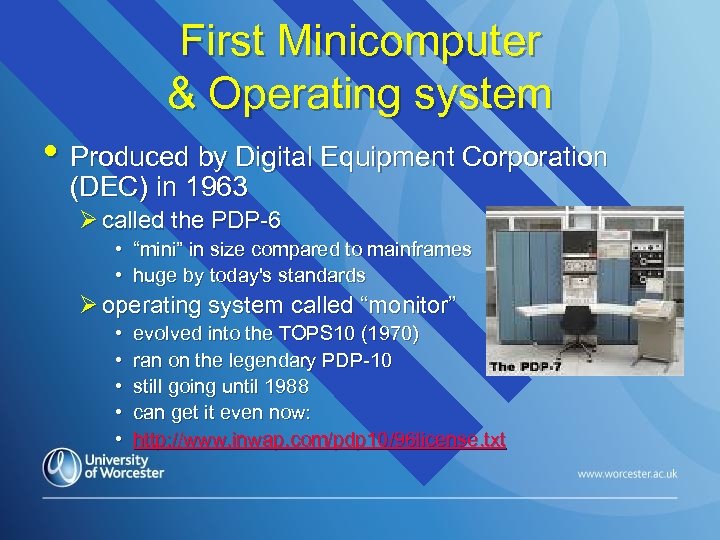
First Minicomputer & Operating system • Produced by Digital Equipment Corporation (DEC) in 1963 Ø called the PDP-6 • “mini” in size compared to mainframes • huge by today's standards Ø operating system called “monitor” • • • evolved into the TOPS 10 (1970) ran on the legendary PDP-10 still going until 1988 can get it even now: http: //www. inwap. com/pdp 10/96 license. txt
Unix • Spin-off (1969) from project MULTICS Ø First attempt at a multiuser operating system • Consortium including Bell Labs, AT&T, n US equivalent of BT at that time • FAILED! Too ambitious… Ø Bell Labs: cut down derivation called UNICS -> UNIX • written in assembly language by Ken Thompson • sharing of processes also being explored in The ARPAnet project • Commercial Challenge: • DEC PDP-7 minicomputer • needed a general purpose “time sharing” operating system for multiuser use… • their own os “monitor” had not yet matured into TOPS-10
Thompson, Ritchie, “B”, NB, “C” & Unix • Thompson looking for a high-level language to develop a time sharing os • briefly toyed with Fortran • worked with colleague Dennis Ritchie to create their own higher level language – “B”, based on BCPL • http: //cm. bell-labs. com/cm/cs/who/dmr/kbman. html • development of B = new. B (NB) • development of NB -> C • Unix kernel was rewritten in “C” (1973)
Development of Unix/C • “C” compiler completed by Ritchie in 1972 • Further commercial Unix versions (for • • Honeywell & IBM) released in 1973 “C” further developed during 1973 -7 Full definition of language as Kernighan & Ritchie “C” (1978) Ø rapidly gained universal acclaim • Unix still written in “C” to present day! Ø 32 -bit processing from the outset
Open Sourceness of Unix • AT&T not allowed to be a commercial company • could not sell Unix • gave a copy away free to any developer who wanted to use it! • many universities contributed to its development • Result (in 1979): Unix version 7 • still recognisable today!
Silicon Valley, TCP/IP and Unix • University of California created The ARPAnet • (1969) 1975 onwards: Berkeley, north of San Francisco • hub for its own unique brand of Unix developments • start of “Silicon Valley” (IT hot spot around SF) • ARPAnet team • • • developed TCP/IP 1980, gained approval through RFC operating system that would support TCP/IP arrived in 1983… • Berkeley Unix (v 4. 2) packaged with TCP/IP protocol stack • Sun Microsystems producing the hardware…
Bell Labs Unix becomes Commercial… • US Dept of Justice broke up AT&T in 1984 • Bell Labs then allowed to sell their Unix source code… • Fortunately for SCO (Santa Cruz Operations) they had ported Bell Unix to Intel hardware the previous year (!) • SCO Unix for PC became a lucrative business market • operating system provided security on a PC where DOS couldn’t…
Bad days for Unix… • Unix free by nature from outset Ønot so on an Intel PC, thanks to SCO!!! ØBell Labs jealously guarded the source code… Øuniversities lost interest • Unix became expensive to buy… and was still not user-friendly or easy to use so even more expensive to own!
Linux • From 1992 (Linus Torvalds, University of Helsinki) made free Unix possible again! Ø LINUX – based on his name… • Took… Ø Stallman’s GNU open source Unix • which Tanenbaum had developed into MINIX… Ø very stable Ø secure file system Ø very efficient, optimised code Ø earlier versions ran on an Intel 486! • Still Unix, still a server-end system Ø for client-server networking, need client-end software: • e. g. Banyan VINES
Linux • Still freely available via Internet! • Huge range of software tools for managing • UNIX networks available for download Problems (compared to Windows): Ø not as easy to manage Ø limited on-screen help Ø limited range of good application software Ø not all hardware has UNIX/LINUX driver software
Operating Systems for PC Ethernet Networks • Original Topology (1980 s, early 90 s): Øbus, coaxial cable & BNC connectors (!) • DOS? ØNo way! not designed for: • server end stuff • distributed communications • security…
Operating Systems for PC Ethernet Networks Øtwo popular client-server operating systems emerged: • Novell Netware n n IPX/SPX protocol not OSI compliant - proprietary & code secret • DEC (Digital) PCSA n n DECnet protocol OSI & TCP/IP compliant - code open source
Netware - late 1980 s • Novell’s proprietary IPX/SPX network protocol Ønetwork naming based on MAC address • hardwired into network card during manufacture • Also, MHS protocol for message- handling and email within the LAN
Novell Netware • Cool Server stuff… Øsecure file system based on user, groups, rights & inherited rights Øsupported mirroring, duplexing, RAID ØTTS to reverse incomplete transactions Ønetwork resource names, etc. stored as a separate bindery on each server
Other Features of Netware • I/O optimisation: Ødisk caching Øelevator seeking (disk accesses ordered according to position on disk) Ødirectory hashing
Strengths of Netware ØFast • MAC address not IP, fewer headers, less processing of packets ØSecure • awarded US gov Server Fault Tolerance (SFT) grade III n when used with server duplexing
Enduring Problems with Netware • Only ran on Intel Platform • Reliant on DOS/Windows at the client end • NDS (Directory Structure) not X 500 compliant • Not directly compatible with TCP/IP Ø interprocess communication based on IPX/SPX Ø used MAC addresses (fixed on network card) as unique identifiers, rather than IP addresses • Not suitable for peer-peer networking • Not pre-emptive in handling processes
What happened to Netware? • V. successful in early 1990 s Øbetter sales than DEC PCSA architecture, even though the latter was OSI compliant (!!) • SPX/IPX faster than TCP/IP… Ø 70% of the PC network market
What happened to Netware • Didn’t see what was coming (Microsoft!)… Ø DEC mini computers lost market share • everyone wanted a PC network • main LAN rival DEC was being sold off and “asset stripped” • future looked bright Ø BUT… • by 1998, Novell Netware sales were sunk • by 2000, even Oracle stopped supporting them • only kept in business by merging with Red Hat Linux
More on DEC (Digital Equipment) • World’s most innovative computer company for many years… Øas already stated - first minicomputer: • PDP-1 (Programmable Data Processor) Øfirst UNIX/C implementation • On PDP-5
DEC continued… • Most successful minicomputer: Ø VAX (Virtual Address e. Xtension) • First virtual memory operating system Ø VMS (virtual memory system) for VAX • First commercially successful RISC chip Ø alpha • First commercial Internet domain & website • First successful search engine: Alta. Vista
Organisational Networks in 1990 • Business/finance companies: Øusually IBM networks • Science/Technology/Engineering companies: Øusually DEC networks • Smaller companies (SME size. . . ) Øcouldn’t justify/afford networks!
Where did DEC go? • Second biggest computer company in the world in 1990! Ø over 100000 employees! Ø with early 90 s recession, went into decline… • New MD in 1992, only accelerated the decline Ø assets sold one by one… • unkindest cut – alpha chip to Intel in 1997 Ø what was left (VMS) went to Compaq in 1998 • sold on to HP…
What happened? • As with the downfall of IBM, Netscape and Novell… Øout-manoeuvred in business Øperhaps the name Microsoft might help…
Microsoft and VMS… • Now long enough ago to be of historical interest… ØDave Cutler, brains behind DEC’s VMS; • http: //en. wikipedia. org/wiki/Dave_Cutler Øwent to work at Microsoft in 1988 • to develop “a new operating system” (NT)… • DEC watching their mini-computers become “dinosaurs” (1990 -93) Øpinned hopes on new RISC chip (alpha) Økeen to get their alpha chip onto the original Windows NT…
A tale of intellectual copyright (and smart business) • DEC saw NT as their big opportunity to get into the PC server business Ø expected Alpha chip platform/Windows NT to be popular Ø signed away rights to Cutler & co’s code – code used in creating windows NT • • Microsoft effectively got the technologies behind VMS that they used for NT… for free!!!! • final insult… Intel platform preferred for servers (!) Thanks to HP, and enthusiastic users, VMS lives (!) Ø available for download at: • http: //www. openvms. compaq. com/openvms/freeware
Microsoft & Network Operating Systems • Whilst the US government was being defeated in the courts by IBM… Ø a deal that almost put them out of business was pulled off by the young Bill Gates! Ø story about IBM negotiations with Bill Gates (regarding his mate Tim Paterson’s os): • http: //inventors. about. com/library/weekly/aa 033099. htm Ø and the tragedy of Gary Kildall (creator of CP/M, main rival to DOS & one time business partner of Steve Jobs)… • http: //www. businessweek. com/magazine/content/04_43/b 3 905109_mz 063. htm
DOS (Desktop Operating System) • As was to be expected from a back-street deal… Ø DOS was an awful operating system… Ø no way it could be satisfactorily used for even multitasking, let alone networking… Ø no way of • logging in as an authenticated user… • restricting access to resources… Ø to the new (misguided? ) computer generation… • none of this mattered Ø by the late 1980 s Gates was the 4 th richest person in the world!
OS 2, Windows, and Windows NT • By late 1980 s, PCs being used for serious business purposes Ø IBM needed a serious operating system for the PC… Ø Microsoft worked them on OS 2 Ø still didn’t see Gates as a rival! • At about the same time… Ø Cutler left DEC… joined Microsoft Ø scope for a virtual memory operating system… • (Windows)
Windows • On the one hand ØMicrosoft were working with IBM on OS 2 • One the other hand: Øthey were working on developing Windows • and working with software developers to provide applications for Windows… n users want apps, not operating systems! • Guess which one won? ? ? Øyou’ve got it… Microsoft now bigger than IBM
Windows NT • Windows… based on DOS Ø virtual memory enabled multitasking Ø but architecture fundamentally flawed… • Stopgap while new “serious” operating system being developed… • using DEC technology… Ø “New Technology” operating system quietly released in 1993 Ø as a disguised front end enhancement to Windows 3. 1 Ø known as Windows 3. 11 (for workgroups)
NT Architecture • Industry experts soon noticed that many features were surprisingly similar to VMS… Ø oddity… VMS + 1 = WNT (!!) • But Microsoft’s customers were from a new generation. The commercial desktop product was still basically DOS, but Gates now offered Ø peer-peer networking and a simple network protocol (NETBEUI) Ø user-friendly graphical interface Ø sharing resources on apps Ø even TCP/IP compatibility…
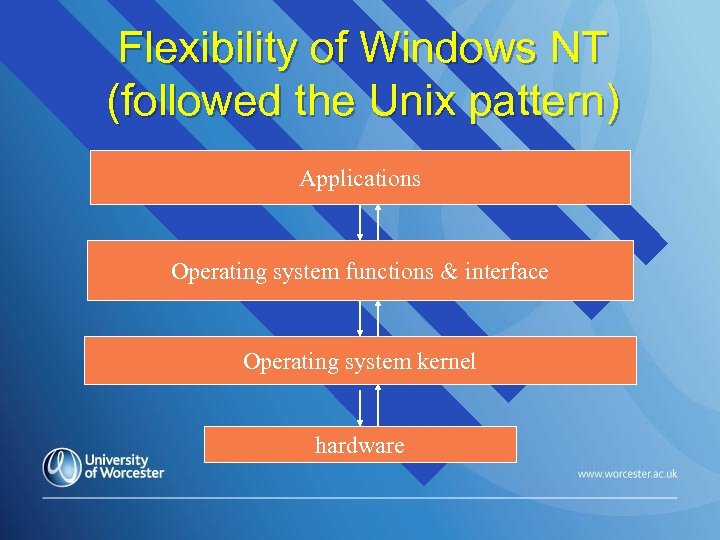
Flexibility of Windows NT (followed the Unix pattern) Applications Operating system functions & interface Operating system kernel hardware
Windows NT v Unix v Netware • By 1994, three possible network platforms: ØNovell: fast, proven, scalable, well established, but proprietary (NDS & IPX/SPX) ØUnix: robust, scalable, open source & Internet ready but complex, & limited apps ØWindows NT: neither robust nor scalable • but Gates by now a past master at exploiting weakness. . . (!)
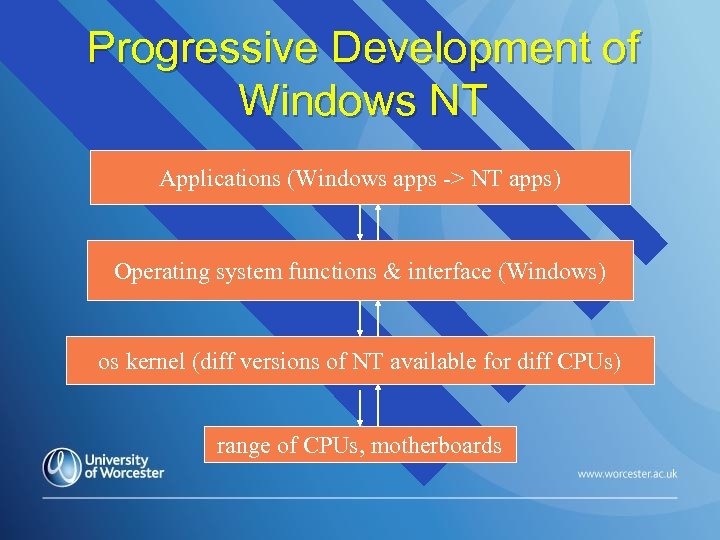
Progressive Development of Windows NT Applications (Windows apps -> NT apps) Operating system functions & interface (Windows) os kernel (diff versions of NT available for diff CPUs) range of CPUs, motherboards
NT version 4 • Released late 1996 ØWindows 95 interface & registry Ømany www features, incl. IIS (web server) • Server end: Ødesigned to support server applications • no theoretical limit to number of users Ønow became a major challenge to Netware (not TCP/IP compatible) & Unix (still not enough apps) Ømain problem: not scalable
The 32 -bit Windows NT architecture • Secure 32 -bit kernel based on VMS Øremains intact to present day Ønow enhanced to 64 -bit • (but this was supposed to happen originally with “Windows 5”, to support DECs 64 -bit alpha-chip • Separated kernel provided the capability for NT, like Unix, to run on multiple platforms Øguess who didn’t like that idea!
Windows NT Architecture • Supports pre-emptive multitasking & multithreading Øgood for centralised control • Secure file system (NTFS) • Applications have separate address spaces (unlike DOS/Windows… crash!) Øup to 4 Gb of memory Øup to 16 Eb of disk space (1 Eb = 260 bytes)
NT architecture (continued) • Server products have scope for huge additional functionality… Øoffered as services • Problems: Ømuch code outside the kernel was new; bugs had to be ironed out Øeach server had its own security database; considerable problems for scalability
Windows 2000 • The big one!!! ØDesigned to merge: • • • peer-peer networking capabilities of Windows client-server requirements of LANs Microsoft technologies with Internet technologies ØYet could still work with “DOS-based” i. e. Windows 3. x/95/98 clients • Microsoft’s own “history of Windows” (clientend/desktop versions): n http: //www. microsoft. com/windows/winhistorydesktop. mspx
Windows 2000 • Scalable ØActive Directory • • X 500 compliant directory service even developed with aid of RFCs multiple domains enterprise-wide security & resource-sharing Øarguably much better than NDS • finished off Novell Netware…
Windows 2000 • Secure… (!) Øsecure remote authentication • with help from Active Directory… ØKerberos (IETF, RFCs) ØPKI-ready (IETF, RFCs) Øterminal services • remote log on with minimal computing resources
More Recent OS Developments • Novell survived (as a company) by: Ø merging with developers of Linux Ø continuing to support “legacy” Netware systems • HP kept VMS customer base… Ø once DEC alpha chip was history, developed new Intel-based hardware platform (Integrity) to interface with VMS kernel • Linux (very) slowly gaining popularity…
Windows Server Developments since 2000 • 2003 Server Ø more improvements to active directory Ø 64 -bit version available! • 2008 Server Ø file system enhancements Ø active directory: • • directory tree extended • better management tools (larger networks) Although Bill Gates may have retired, Steve Cutler is still with them (helped with “Azure” and now…Xbox) Ø http: //www. amd. com/usen/assets/content_type/Downloadable. Assets/Micr osoft_Video_Statement. wmv
Client-side Developments… • Microsoft Domination… Ø XP: finished off the evolution from Windows 95/98 Ø Vista: mainly a desktop change • not universally appreciated! • mobile devices started to have: n n CPUs & operating systems (!) user interfaces & use apps… • Reaction to Vista… Ø Apple became popular Ø other “mobile” desktops became popular • Windows 7 stopped the rot… • Windows Mobile: good platform for apps Ø but Windows client-end dominance lost for good…
So, which Server operating system would the larger company use today? • • • IBM, or other “mainframe”? Ø why not? Windows 2008 very popular with finance industry & previous IBM customers! Unix (incl Linux) popular with previous DEC customers Ø still cheaper than Windows Ø still more complicated, but suits companies that value and develop technologies
And the small business? • Lot of contradictory advice Øuse Linux! Øuse Windows ØDon’t bother? • • • use virtualisation outsource use The Cloud • Who should they listen to? Why?
And tomorrow? • Important for people involved in procurement for and management of networks ØWindows 2012 due (much change? ) ØUnix/Linux? Øothers? • Time to do a little research. . .
Скачать презентацию COMP 2122 Networks in Organisations Richard Henson February
57e8602c54c8feb1848c949de2ce084f.ppt