


 Скачать презентацию COMMUNITY SOCIAL DATA STRATEGY TORONTO CONSORTIUM UPDATE Calgary
450b887e9df2fcc123afe2cedb9f37bc.ppt
- Количество слайдов: 10
 COMMUNITY SOCIAL DATA STRATEGY TORONTO CONSORTIUM UPDATE Calgary Meeting May 19, 2009 1
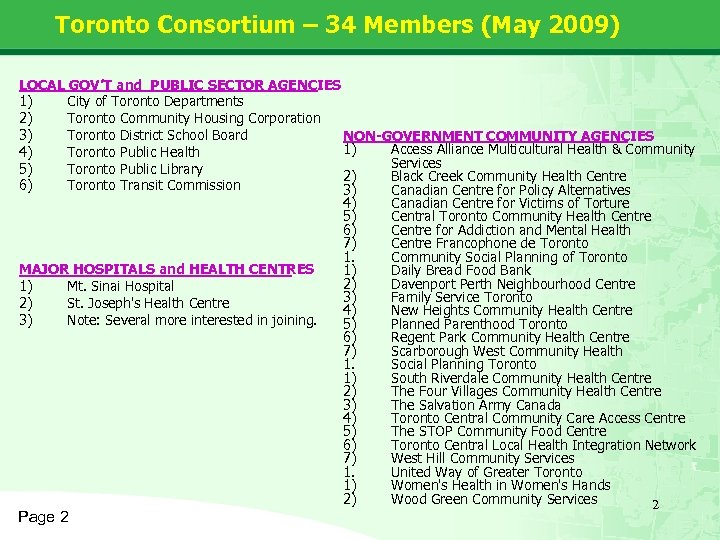 Toronto Consortium – 34 Members (May 2009) LOCAL GOV’T and PUBLIC SECTOR AGENCIES 1) City of Toronto Departments 2) Toronto Community Housing Corporation 3) Toronto District School Board NON-GOVERNMENT COMMUNITY AGENCIES 1) Access Alliance Multicultural Health & Community 4) Toronto Public Health Services 5) Toronto Public Library 2) Black Creek Community Health Centre 6) Toronto Transit Commission 3) Canadian Centre for Policy Alternatives 4) Canadian Centre for Victims of Torture 5) Central Toronto Community Health Centre 6) Centre for Addiction and Mental Health 7) Centre Francophone de Toronto 1. Community Social Planning of Toronto MAJOR HOSPITALS and HEALTH CENTRES 1) Daily Bread Food Bank 2) Davenport Perth Neighbourhood Centre 1) Mt. Sinai Hospital 3) Family Service Toronto 2) St. Joseph's Health Centre 4) New Heights Community Health Centre 3) Note: Several more interested in joining. 5) Planned Parenthood Toronto 6) Regent Park Community Health Centre 7) Scarborough West Community Health 1. Social Planning Toronto 1) South Riverdale Community Health Centre 2) The Four Villages Community Health Centre 3) The Salvation Army Canada 4) Toronto Central Community Care Access Centre 5) The STOP Community Food Centre 6) Toronto Central Local Health Integration Network 7) West Hill Community Services 1. United Way of Greater Toronto 1) Women's Health in Women's Hands 2) Wood Green Community Services 2 Page 2
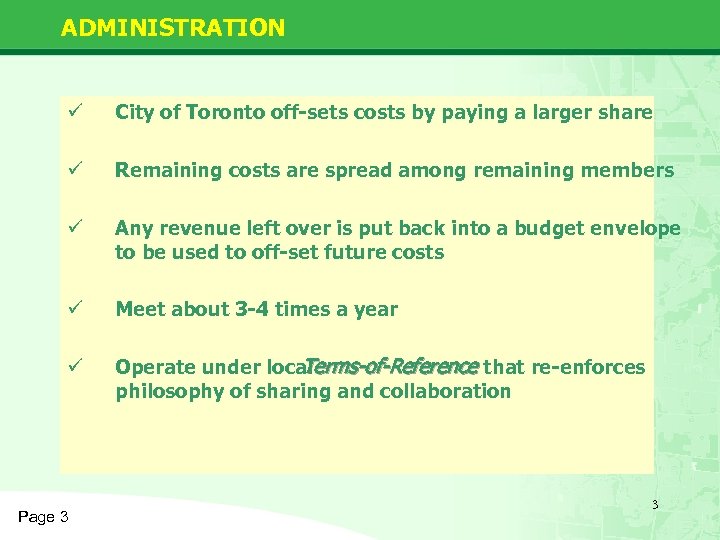 ADMINISTRATION ü City of Toronto off-sets costs by paying a larger share ü Remaining costs are spread among remaining members ü Any revenue left over is put back into a budget envelope to be used to off-set future costs ü Meet about 3 -4 times a year ü Operate under local Terms-of-Reference that re-enforces philosophy of sharing and collaboration Page 3 3
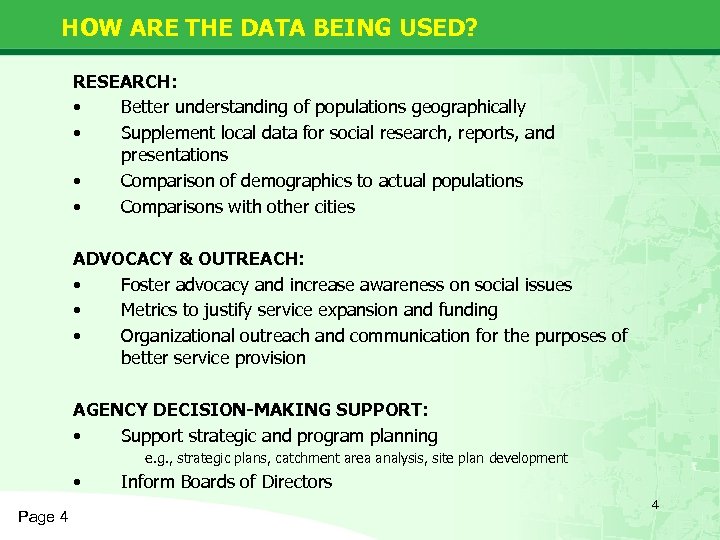 HOW ARE THE DATA BEING USED? RESEARCH: • Better understanding of populations geographically • Supplement local data for social research, reports, and presentations • Comparison of demographics to actual populations • Comparisons with other cities ADVOCACY & OUTREACH: • Foster advocacy and increase awareness on social issues • Metrics to justify service expansion and funding • Organizational outreach and communication for the purposes of better service provision AGENCY DECISION-MAKING SUPPORT: • Support strategic and program planning e. g. , strategic plans, catchment area analysis, site plan development • Page 4 Inform Boards of Directors 4
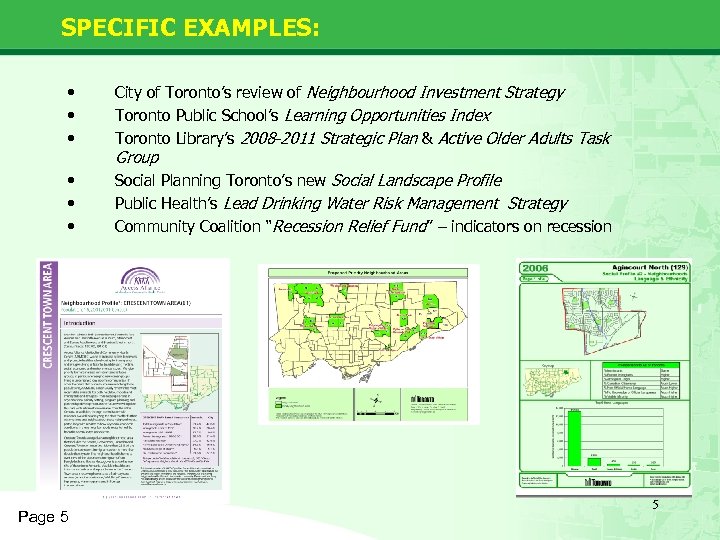 SPECIFIC EXAMPLES: • • • City of Toronto’s review of Neighbourhood Investment Strategy Toronto Public School’s Learning Opportunities Index Toronto Library’s 2008 -2011 Strategic Plan & Active Older Adults Task • • • Social Planning Toronto’s new Social Landscape Profile Public Health’s Lead Drinking Water Risk Management Strategy Community Coalition “Recession Relief Fund” – indicators on recession Page 5 Group 5
 ADVANTAGES OF THE CSDS • One-stop, cost-effective access • Searchable catalogue that is intuitive • Solid start on website with good information (e. g. , Q&A’s) • Consolidates sharing of member initiatives, resources etc. , that helps keep members up-to-date on latest research and social trends • Access to data that was hard to get in past (disabilities) Page 6 6
 SUGGESTIONS 1. 2. 3. 4. 5. 6. 7. 8. 9. 10. Page 7 A “What’s New? ” button or email. Listserv or emailing updates to users monthly. Common repository on the web for data sharing (data that is not in consortium) among partners. More data at lower levels of geography such as Census Tracts. Finer breakdown of language data. Other survey data such as EDI. Research ideas for future consideration. Linkages with other data liberation such as CIC-CERIS. More cross-tabs – particularly by single years of age. “Conversion files” to convert between geographies (need the Postal Code Conversion File!). 7
 Member Comments “An important initiative for the community sector that benefits greatly from the data and can’t afford to buy it. ” “The data has been put together very well. ” “Easy to manipulate and find data. ” “The open mapping function is our favourite – saving an investment in special software and presenting complex data much more simply. ” Page 8 8
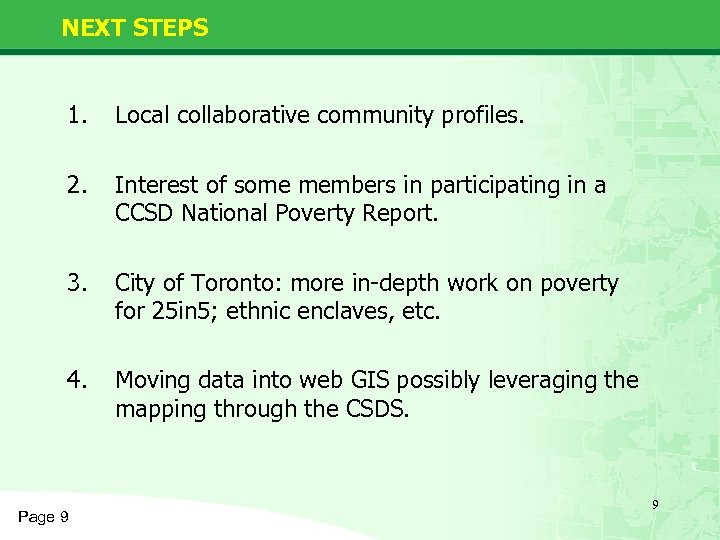 NEXT STEPS 1. Local collaborative community profiles. 2. Interest of some members in participating in a CCSD National Poverty Report. 3. City of Toronto: more in-depth work on poverty for 25 in 5; ethnic enclaves, etc. 4. Moving data into web GIS possibly leveraging the mapping through the CSDS. Page 9 9
 For more information contact: Harvey Low City of Toronto Social Development, Finance and Administration Social Policy, Analysis and Research Telephone: 416 -392 -8660 Fax: 416 -392 -4976 Email: hlow@toronto. ca 10