


 Скачать презентацию Community-Led Total Sanitation CLTS Plan Challenges Plan
fb62ff5b2771f9ab3ade25efe5bd81d2.ppt
- Количество слайдов: 25
 Community-Led Total Sanitation (CLTS) Plan & Challenges Plan Kenya Experiences, Achievements, Challenges Regional Water & Sanitation Workshop Fairview Hotel – Nairobi (18 th – 21 st Oct. 2010) Samuel. Musyoki@Plan-International. org www. communityledtotalsanitation. org © Plan
 Plan International: Who we are • Plan is an international humanitarian, child centered, development organization, without religious, political or governmental affiliation; • Plan’s vision is of a world in which all children realize their full potential in societies that respect people’s rights and dignity; • 75 Years of Existence; 48 Program Countries (13 in ESA Region) • In since Kenya 1982 (28 yrs) © Plan
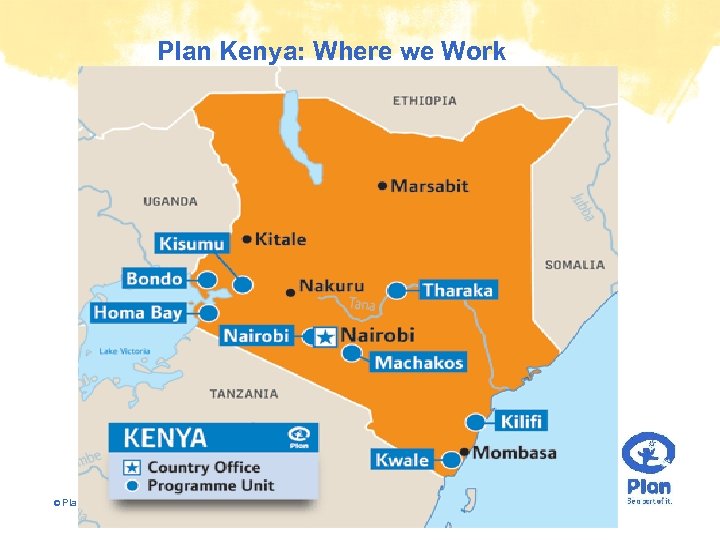 Plan Kenya: Where we Work © Plan
 © Plan Country Goal: Transformed Institutions & Societies That Respect and Fulfil Rights of All Children in Kenya. sdnoitatan. Led&i. Giogt. Wrdarmierand[nhnlacn • ]oohinivia. Sve oetacamorausc Byyiaiuau. Q ecle n r o rin atsec. Ed o Dniorstltso. C n fn cii ic so g elbatnitags. RH t D de c l P tt tu e S u t n P & o h li u J u • • : I Country Goal & Programs
 Plan Kenya & Others: Long History of Latrine Subsidies © Plan
 Let’s Talk About? © Plan
 What is CLTS? Community-Led Total Sanitation A “Participatory and Learning Action” approach based on stimulating a collective sense of disgust, shame and fear among community members as they confront the crude reality about mass open defecation [environmental contamination] and its negative effects on the entire community. © Plan
 Underlying Assumptions of CLTS • No one can stay unmoved once they discover they are ingesting other people’s or their own faeces; • High sense of shame and disgust hold the power to ignite people to take action and use their resources (not subsidy) to stop open defecation and be totally sanitised; © Plan
 CLTS is • Community-led: They lead and everyone in the community is involved; • Total: 100% elimination of open defecation & practice of good hygiene; • Sanitation: Beyond construction of toilet; • Collective action: Often locally decided and not dependent on external subsidies and prescriptions of solutions. © Plan
 CLTS: Sequence of Key Steps • Pre-triggering: buy-in, selection of sites, training, introduction and building rapport; • Triggering: Sanitation profile –mappingcalculation of quantities-transect walk- flowchannels-effects-costs-ignition moment-action planning; • Post-triggering: implementation of Action plans, follow-up, monitoring and documentation. © Plan
 Some Photos © Plan
 Triggering Responses Triggering produces different responses Damp match box Matchbox in a gas station Promising flames © Plan Scattered sparks
 Background to CLTS in Kenya • With previous pace and approaches, it would take >100 years and >$30 billion (@$100/HH) to achieve total sanitation in RESA; • Plan RESA ins searched of cost effective, fast and sustainable approaches for accelerating sanitation work; • Came across CLTS-Origins in Bangladesh and tried with documented positive results in South East Asia seemed promising; • Plan decided to adopt CLTS as the major approach for sanitation promotion. © Plan
 CLTS Timeline in Kenya • Feb 2007: RESA training for 38 participants in Tz-3 participants from Kenya • May 2007: Plan Kenya Management decides to pilot CLTS in Nyanza, Coast and Eastern regions • July 2007: CLTS training and triggering in (Arujo village Homa Bay and Jaribuni village Kilifi • Sept/Oct. 2007: Training and triggering Tharaka Machakos and Kisumu PUs • Oct. 2007: First village (Jaribuni) attains ODF status • Dec. 2007: Training and triggering of CLTS in © Plan
 CLTS Timeline cont’d • Feb. 08: UKNO/DFID CLTS grant (50, 000 US$ for Kenya)start-up; • Mar. 08: Plan/IDS Africa. San CLTS preconference workshop; • Apr. 08: Sharing UNICEF regional workshop • May 08: MOH/PH CLTS training and triggering in Kilifi; • June 08: Program conference parallel start-up workshop and the plenary session with Robert; • July 08: RESA CLTS training in Kilifi; © Plan
 CLTS Timeline continued • Aug. 08: ODF verification exercise of 20 villages of Siaya district (near Kogelo); • Oct. 08: UNICEF/Mo. PH&S Training in Kisumu • Nov. 08: World Toilet Week events including the training in Kwale; • Dec. 08: Africa. San Durban IDS/Plan preconference CLTS session; • Mar. 09: CLTS Africa sharing event in Kilifi; © Plan
 Achievements • Trained over 600 practitioners (Mo. PH&S, UNICEF, NGOs, CBOs, local leaders and youth); • Kilifi became the learning centre early ODF status; • Over 860 villages in various parts of the country have been triggered & are at different stages towards ODF ; • To date 146 villages have been declared ODF, in Coast (Kilifi) and Nyanza (Homabay); • Adoption of CLTS for Rural sanitation by Mo. PHS- annual targets/CLTS coordination; • Increased Interest and demand for CLTS-training and support © Plan
 Achievements • Change in mindsets & leading to collective action =Increased coverage & use: Kilifi from 30% to 48% between May 2008 -June 2010, Homa Bay- 66 triggered 29 ODF and Busia- 380 triggered 56 ODF • World Toilet Day celebrated to mark ODF for the past 3 years • Media buy-in and coverage e. g. partnership with KBC series of “Vitimbi”; • Networks and partnerships on CLTS have emerged; • Children and youth participation in CLTS-School-Led Total Sanitation; • Funding for CLTS, scaling-up, capacity building, advocacy research & documentation (e. g. DGIS/Plan Netherlands 8. 5 million Euro in 8 African Countries; • CLTS moving from Rural to Urban and to Schools; • Establishment of a CLTS unit within Plan Kenya- responding demands © Plan • Systematic documentation of CLTS experiences – PLA CLTS Issue, “Tales
 ODF © Plan
 Challenges • Uptake slow/not the same in the different regions Plan Kenya works; • Conflicting approaches by different agencies in the sanitation sector. • The allowance culture: Some are in it for the out of pocket-not passionate or committed; • Doubt and scepticism among sanitation professionals • Lack of willingness to let go our professionalism-wanting the communities to start at the top of the ladder; • Weak M&E and reporting within the mandated institutions; © Plan
 Challenges – cont’d • Dependency syndrome in some areas emanating from previous approaches; • Finding good facilitators: Not all trained find it easy and/or develop the passion to take up the CLTS challenges; • Triggering without adequate mechanisms for follow-up and support; • Inadequate support and mentoring of natural leaders; • Private sector inability to come-up with affordable technological innovations-dependency! • CLTS health outcomes/Impact research of CLTS intervention on diarrhea control and reduction in child mortality? © Plan
 Future • Citizen Led Total Sanitation –Urban CLTS • • Politics and governance of urban sanitation Land tenure City planning Tenancy standards • Harnessing ICT 4 D • Mobile/GIS mapping • Partnership with Map Kibera • Next Map Mathare • Sanitation Marketing/Sanitation Financing-what options for urban informal settlements and small towns © Plan
 Many Designs © Plan
 Achievements-Triggered plus spill over in Kilifi District (May -2008 June 2010 Division No. Villages No. ODF Villages Latrine Villages triggered villages below above coverage 50% Kikambala 86 9 0 5 4 51% Chonyi 57 7 0 0 7 71. 9% Bahari 108 18 0 5 13 63. 1% Jaribuni 34 18 1 8 9 51. 5% Ganze 57 4 0 2 2 60. 7% 181 70 17 0 53 60% 87 15 0 14% Vitengeni Bamba © Plan
 Kilifi District Latrine Coverage By Division Pop. HH HH with latrines Latrine HH with % Cov. as at 1 st July 10 coverage (1 st new latrines at For. Aug 201 July 10) latrines 31 st 0 … 2010) Chonyi 57234 8776 6366 72. 5 23 6406 73 Bahari 121198 17458 10686 61. 2 107 11016 63. 1 Kikambala 157365 20707 8942 43. 2 30 9024 43. 58 Ganze 21009 3047 1785 58. 6 34 1849 60. 7 Bamba 52752 13795 1881 13. 6 7 1930 14 Vitengeni 63998 7326 3687 50. 3 525 4216 57. 5 Jaribuni 18117 2497 1252 50. 1 9 1287 51. 5 © Plan