 Скачать презентацию Community-Driven Approaches to Digital Preservation Dr Martin Halbert
b8236a38bc3f7c52d7900d9b598b4b20.ppt
- Количество слайдов: 21



Community-Driven Approaches to Digital Preservation Dr. Martin Halbert Dr. Katherine Skinner Digital Preservation: What’s Now, What’s Next. Amigos Online Conference, August 12, 2011
Central topics Why do we need to collaborate? Who is collaborating and how? What are some core principles of collaborative preservation? What do they look like in practice? Meta. Archive Cooperative Collaboration ‐ Halbert and Skinner, 8/12/11
Why collaborate? Start with our historical missions Collections Acquiring and protecting books, journals, newspapers, unique items, etc. Services Building, disseminating, and preserving collections ▪ Once solitary activity; now defies such boundaries ▪ Competition vs. collaboration issue ▪ External competitors ▪ Viability at stake Collaboration ‐ Halbert and Skinner, 8/12/11
Findings, forthcoming ARL survey 80% of ARL respondents state that they are preserving digital content; 16% plan to soon Most are doing so in house 90% report they are engaged in or intend to engage in local activities 50% report they are already preserving their most important collections locally 24% report running collaborative digital preservation solutions with a local component Collaboration ‐ Halbert and Skinner, 8/12/11
Findings, forthcoming ARL survey In future projections, ARL respondents reported that they plan to continue turning to library‐managed and collaborative solutions above vendor‐based, hosted solutions for these core collections (64% library‐managed, 34% collaborative, and 29% vendor‐based). Source: ARL SPEC survey on preservation conducted by VA Tech and the Meta. Archive Cooperative, 2011. Survey summary forthcoming, Mc. Millan, Skinner, and Schultz 2011. Collaboration ‐ Halbert and Skinner, 8/12/11
Collaboration and preservation So what are collaborative digital preservation solutions, and why do they matter? Collaboration ‐ Halbert and Skinner, 8/12/11
Why does collaboration matter? Allows us to accomplish two preservation goals: 1. To preserve the digital collections we create ▪ Maintain integrity so that we can continue to access both “born digital” and digitized materials 2. To preserve our own institutional missions ▪ Outsourcing a core mission is a dangerous proposition Collaboration ‐ Halbert and Skinner, 8/12/11
Successful approach Especially when compared to other, non collaborative solutions, these collaborative offerings are Cost effective Scalable Transparent Controlled by libraries User responsive Standards based Collaboration ‐ Halbert and Skinner, 8/12/11
Blue Ribbon final report (2011) Key findings: “One‐time” funding models are inadequate Poor alignment between stakeholders & roles Lack of institutional, enterprise, and/or community incentives to support the collaboration needed to enforce sustainable economic models Complacency that the problem is not urgent Fear that digital access and preservation is too big to tackle Collaboration ‐ Halbert and Skinner, 8/12/11
So we know we should collaborate… Now how do we do it? Collaboration ‐ Halbert and Skinner, 8/12/11
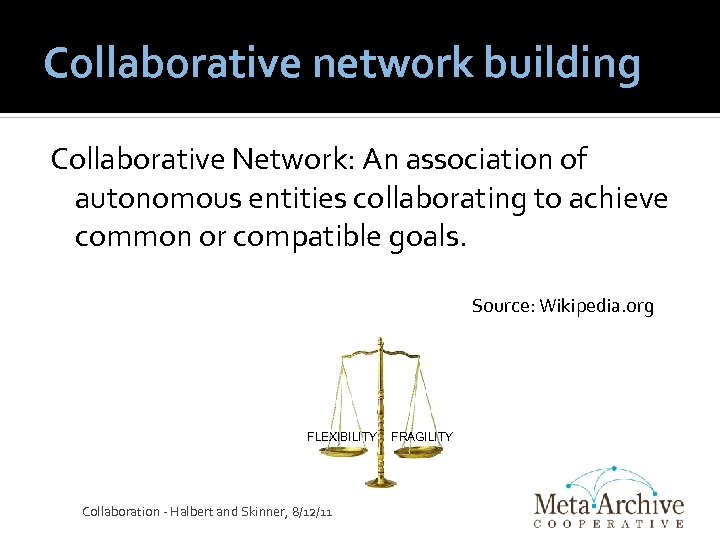
Collaborative network building Collaborative Network: An association of autonomous entities collaborating to achieve common or compatible goals. Source: Wikipedia. org FLEXIBILITY Collaboration ‐ Halbert and Skinner, 8/12/11 FRAGILITY
Collaborative network building Enables communities to work together on a common solution to a common problem Demands attention to organizational structure in order to work Requires three key elements: A common cause Solid institutional buy‐in Attention to the organizational arrangement that governs the partnerships Collaboration ‐ Halbert and Skinner, 8/12/11
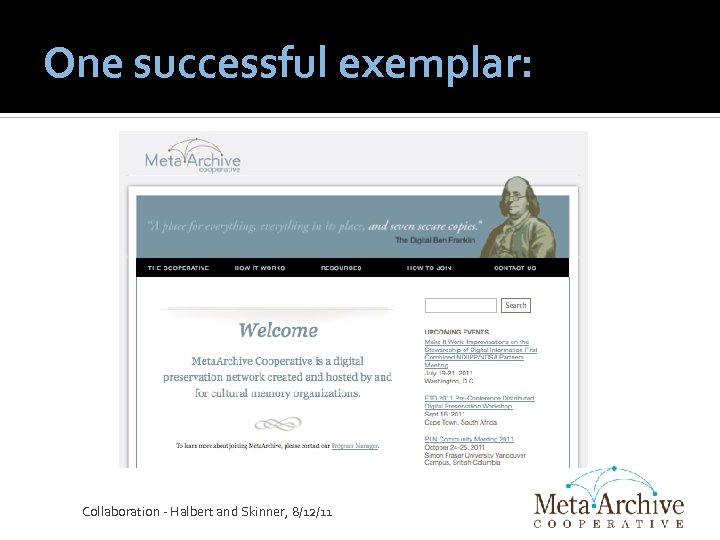
One successful exemplar: Collaboration ‐ Halbert and Skinner, 8/12/11
Meta. Archive Cooperative A distributed digital preservation cooperative for digital archives, based on LOCKSS 286 TB network with 24 secure caches Preserving collections for/with 18 members and 46 institutions in 4 countries Actively growing (outreach campaign in progress, aim to double membership) Provide preservation consulting and training Collaboration ‐ Halbert and Skinner, 8/12/11
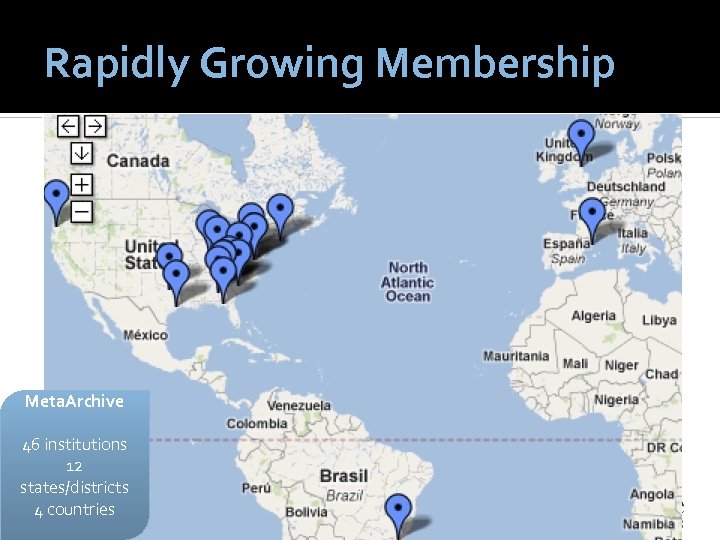
Rapidly Growing Membership Meta. Archive 46 institutions 12 states/districts 4 countries Collaboration ‐ Halbert and Skinner, 8/12/11
Meta. Archive Basics Compatible with any repository/content management system Three membership levels Preservation members: $3, 000 K/yr Sustaining members: $5, 500 K/yr Collaborative members: $2, 500/yr plus nominal fee/yr per participating institution Server cost: $4, 600/3 yrs Storage cost: $1/GB/yr Collaboration ‐ Halbert and Skinner, 8/12/11
Meta. Archive Services Data preparation Replication Geographical Distribution Bit Integrity Checking Versioning Security Restricted Viewing Content Restoration Collaboration ‐ Halbert and Skinner, 8/12/11
Trust and TRAC Completed self‐audit with external auditor in 2010 (see http: //metaarchive. org/documentation ) Meta. Archive successfully conforms in all 3 categories and 84 criteria “trustworthy digital repository”…ensures that processes and policies and workflows meet the standard for long‐term preservation Helped us identify places where we could improve our policies and documentation Collaboration ‐ Halbert and Skinner, 8/12/11
Sustainability Cooperative framework Strong organizational center Limited dependence on any one member Collaborative model for long‐term preservation Geographic diversity/distribution Expertise diffusion Maintain cost‐effective, in‐house options Collaboration ‐ Halbert and Skinner, 8/12/11
Preserving our missions Outsourcing core services = risky proposition Core missions: Building collections Disseminating collections Preserving collections Cannot focus on the collections at the expense of the services … need both in order to carry our missions and memory forward Collaboration ‐ Halbert and Skinner, 8/12/11
Contact Info Dr. Martin Halbert martin. halbert@unt. edu Dr. Katherine Skinner katherine@metaarchive. org Collaboration ‐ Halbert and Skinner, 8/12/11
Скачать презентацию Community-Driven Approaches to Digital Preservation Dr Martin Halbert
b8236a38bc3f7c52d7900d9b598b4b20.ppt