 Скачать презентацию Community Development Delivering bottom line results What
b9cd3791bc27ff20f7aea9b8667a9f38.ppt
- Количество слайдов: 20



Community Development Delivering bottom line results
What is Comm. Dev? The World Bank/IFC Oil, Gas & Mining Sustainable Community Development Fund • $12 million fund focused on helping communities receive sustainable benefits from Extractive Industry (EI) projects; • Supports IFC/World Bank clients who want to collaborate to go above and beyond social and environmental safeguards; • Provides public goods for all stakeholders on community development in extractive communities; • Offers capacity building, technical assistance, tool development and information sharing through on-line Clearinghouse (www. commdev. org); • Global, but emphasizes Africa (60 – 70%)
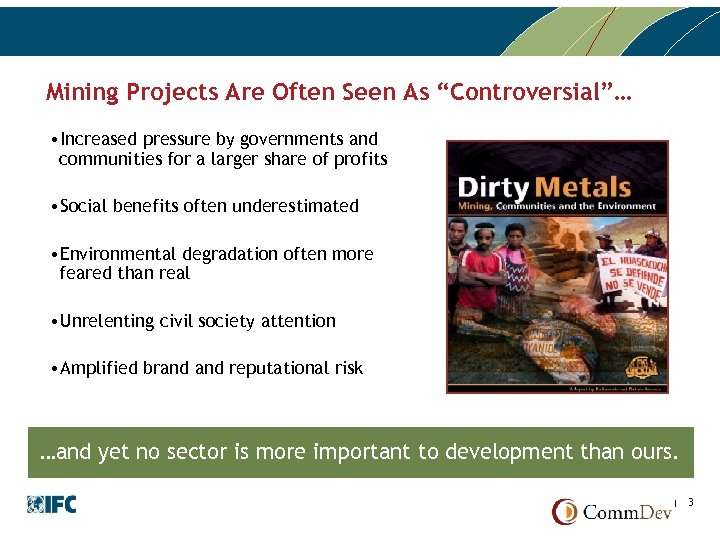
Mining Projects Are Often Seen As “Controversial”… • Increased pressure by governments and communities for a larger share of profits • Social benefits often underestimated • Environmental degradation often more feared than real • Unrelenting civil society attention • Amplified brand reputational risk …and yet no sector is more important to development than ours. 3 Industry context
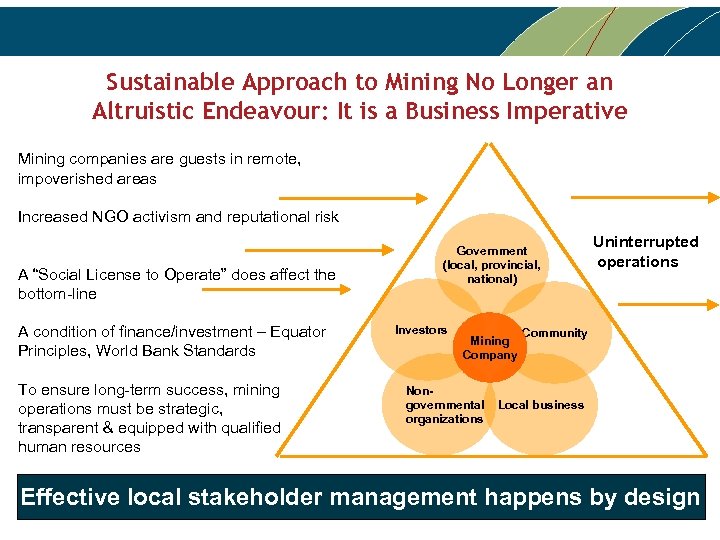
Sustainable Approach to Mining No Longer an Altruistic Endeavour: It is a Business Imperative Mining companies are guests in remote, impoverished areas Increased NGO activism and reputational risk A “Social License to Operate” does affect the bottom-line A condition of finance/investment – Equator Principles, World Bank Standards To ensure long-term success, mining operations must be strategic, transparent & equipped with qualified human resources Government (local, provincial, national) Investors Mining Company Nongovernmental organizations Uninterrupted operations Community Local business Effective local stakeholder management happens by design
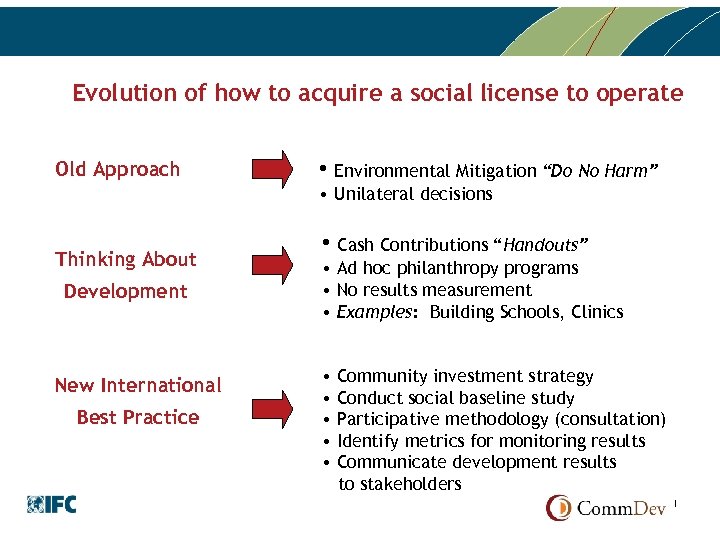
Evolution of how to acquire a social license to operate Old Approach • Environmental Mitigation “Do No Harm” • Unilateral decisions Thinking About Development New International Best Practice • Cash Contributions “Handouts” • Ad hoc philanthropy programs • No results measurement • Examples: Building Schools, Clinics • Community investment strategy • Conduct social baseline study • Participative methodology (consultation) • Identify metrics for monitoring results • Communicate development results to stakeholders
What Companies say about Community Investment Challenges • We spend lots of money on CI but relations with communities don’t improve (and sometimes even deteriorate)… • Our CI program itself becomes a source of conflict • Local stakeholders become dependent on us • Infrastructure projects we build lie abandoned and unused • In the end, we have little to show for all the resources spent • Endless requests from communities – difficult to say “no” • We get pulled in a hundred different directions • We end up having to take over the government’s role • Our CI program has little to do with our core business 6
What Causes these Problems? üLimited understanding of often complex local context üAd hoc approach – reactive to community requests üNotion of “giving” rather than “investing” (grants & donations) üNo exit strategy üFocus on bricks & mortar /short-term projects üCI isolated from operational side of business üLack of participation & ownership of local stakeholders üFailure to measure impact (no baseline /focus on outputs ) üLack of transparency and clear criteria üLack of alignment with business objectives/core competencies
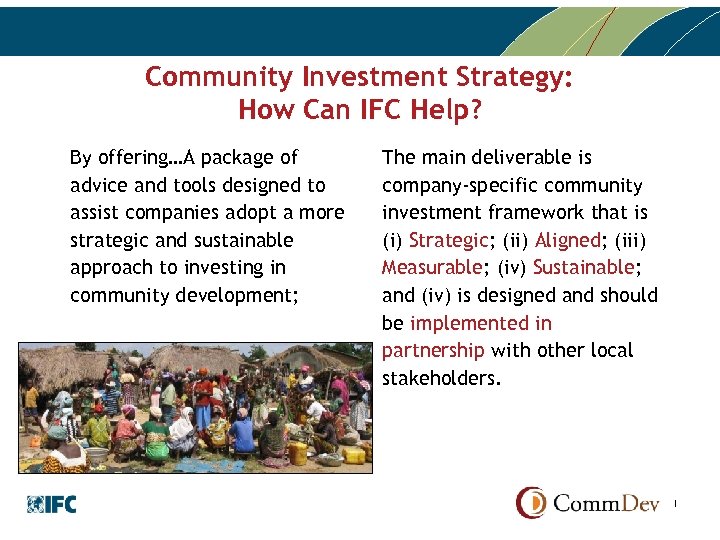
Community Investment Strategy: How Can IFC Help? By offering…A package of advice and tools designed to assist companies adopt a more strategic and sustainable approach to investing in community development; The main deliverable is company-specific community investment framework that is (i) Strategic; (ii) Aligned; (iii) Measurable; (iv) Sustainable; and (iv) is designed and should be implemented in partnership with other local stakeholders.
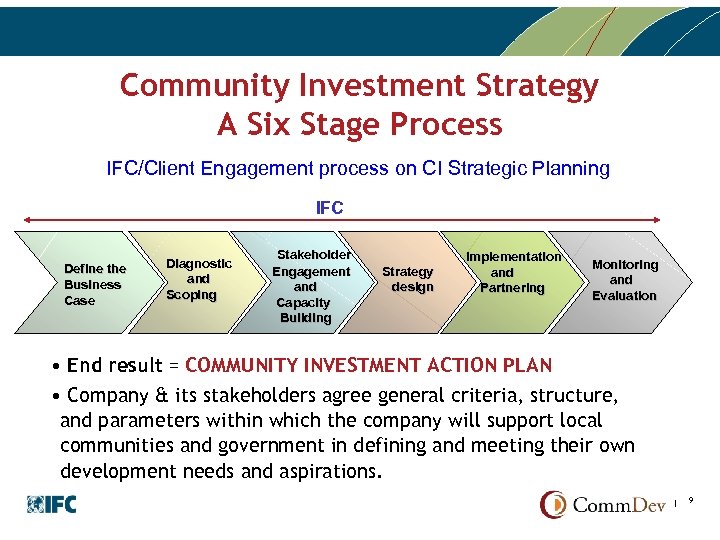
Community Investment Strategy A Six Stage Process IFC/Client Engagement process on CI Strategic Planning IFC Define the Business Case Diagnostic and Scoping Stakeholder Engagement and Capacity Building Strategy design Implementation and Partnering Monitoring and Evaluation • End result = COMMUNITY INVESTMENT ACTION PLAN • Company & its stakeholders agree general criteria, structure, and parameters within which the company will support local communities and government in defining and meeting their own development needs and aspirations. 9
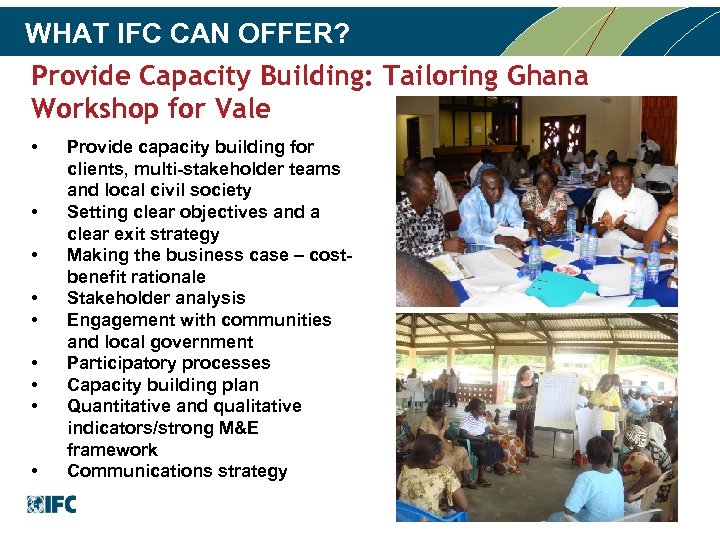
WHAT IFC CAN OFFER? Provide Capacity Building: Tailoring Ghana Workshop for Vale • • • Provide capacity building for clients, multi-stakeholder teams and local civil society Setting clear objectives and a clear exit strategy Making the business case – costbenefit rationale Stakeholder analysis Engagement with communities and local government Participatory processes Capacity building plan Quantitative and qualitative indicators/strong M&E framework Communications strategy
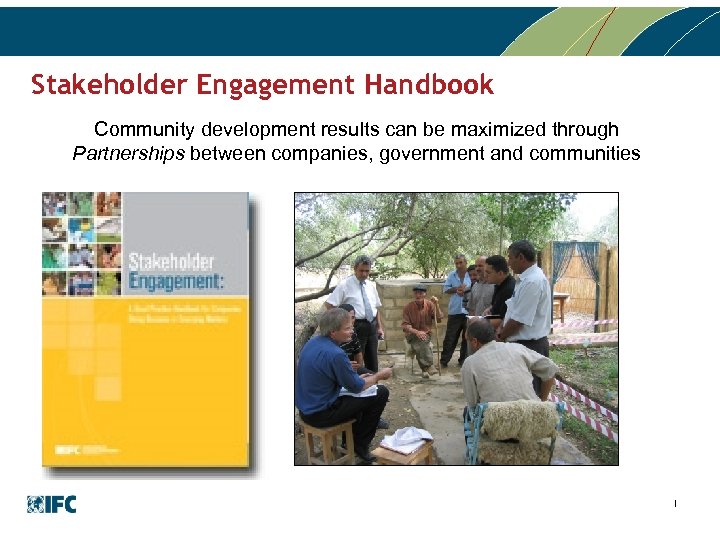
Stakeholder Engagement Handbook Community development results can be maximized through Partnerships between companies, government and communities
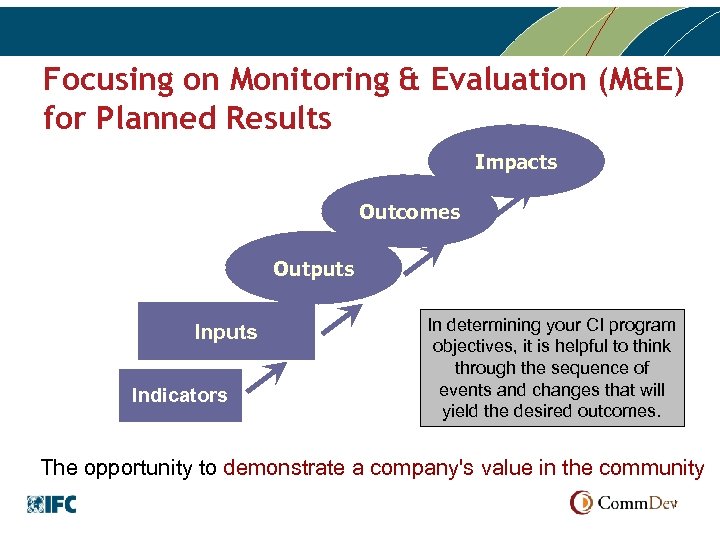
Focusing on Monitoring & Evaluation (M&E) for Planned Results Impacts Outcomes Outputs Indicators In determining your CI program objectives, it is helpful to think through the sequence of events and changes that will yield the desired outcomes. The opportunity to demonstrate a company's value in the community
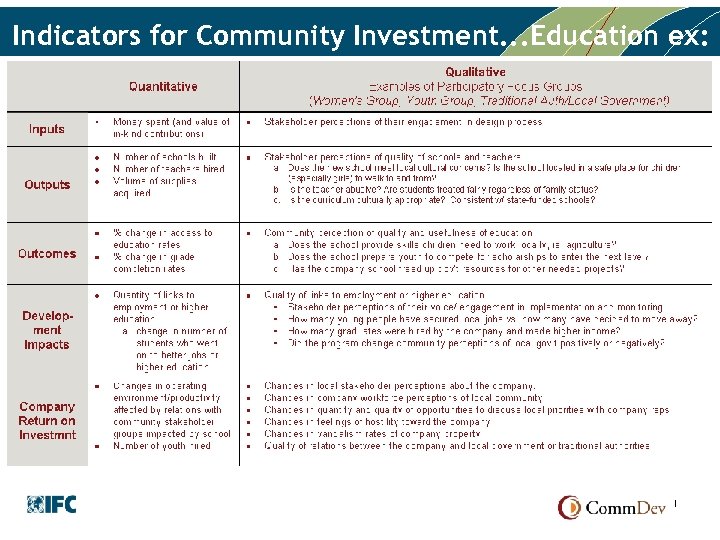
Indicators for Community Investment. . . Education ex:
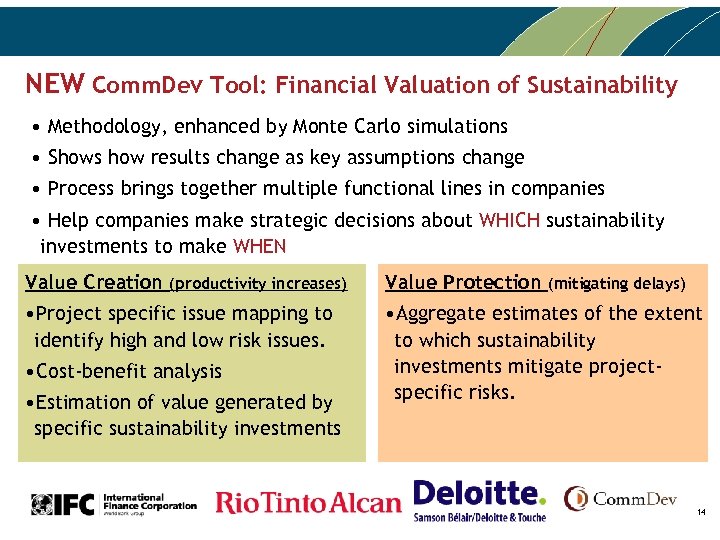
NEW Comm. Dev Tool: Financial Valuation of Sustainability • Methodology, enhanced by Monte Carlo simulations • Shows how results change as key assumptions change • Process brings together multiple functional lines in companies • Help companies make strategic decisions about WHICH sustainability investments to make WHEN Value Creation (productivity increases) • Project specific issue mapping to identify high and low risk issues. • Cost-benefit analysis • Estimation of value generated by specific sustainability investments Value Protection (mitigating delays) • Aggregate estimates of the extent to which sustainability investments mitigate projectspecific risks. 14
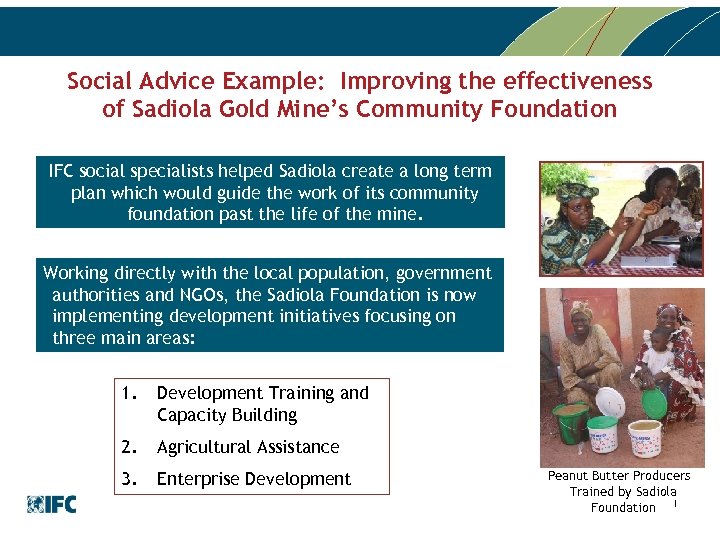
Social Advice Example: Improving the effectiveness of Sadiola Gold Mine’s Community Foundation IFC social specialists helped Sadiola create a long term plan which would guide the work of its community foundation past the life of the mine. Working directly with the local population, government authorities and NGOs, the Sadiola Foundation is now implementing development initiatives focusing on three main areas: 1. Development Training and Capacity Building 2. Agricultural Assistance 3. Enterprise Development Peanut Butter Producers Trained by Sadiola Foundation
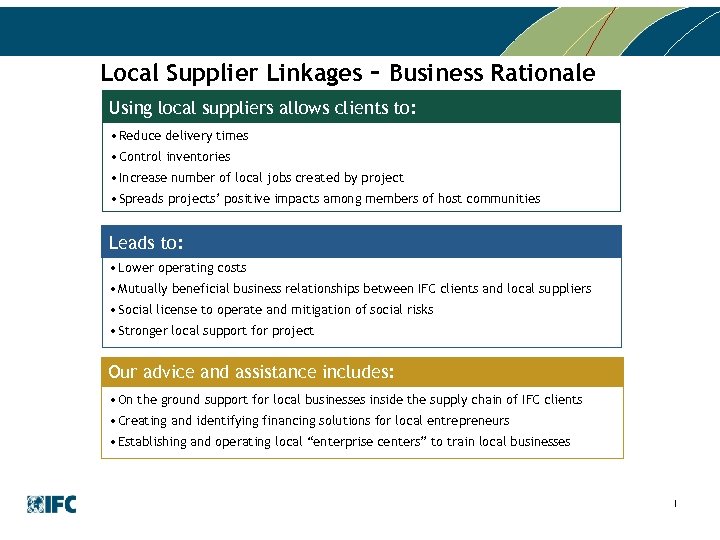
Local Supplier Linkages – Business Rationale Using local suppliers allows clients to: • Reduce delivery times • Control inventories • Increase number of local jobs created by project • Spreads projects’ positive impacts among members of host communities Leads to: • Lower operating costs • Mutually beneficial business relationships between IFC clients and local suppliers • Social license to operate and mitigation of social risks • Stronger local support for project Our advice and assistance includes: • On the ground support for local businesses inside the supply chain of IFC clients • Creating and identifying financing solutions for local entrepreneurs • Establishing and operating local “enterprise centers” to train local businesses
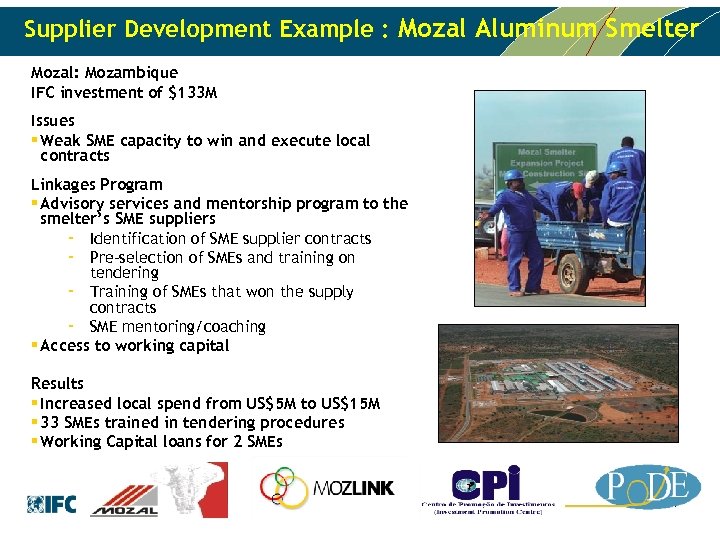
Supplier Development Example : Mozal Aluminum Smelter Mozal: Mozambique IFC investment of $133 M Issues § Weak SME capacity to win and execute local contracts Linkages Program § Advisory services and mentorship program to the smelter’s SME suppliers - Identification of SME supplier contracts - Pre-selection of SMEs and training on tendering - Training of SMEs that won the supply contracts - SME mentoring/coaching § Access to working capital Results § Increased local spend from US$5 M to US$15 M § 33 SMEs trained in tendering procedures § Working Capital loans for 2 SMEs
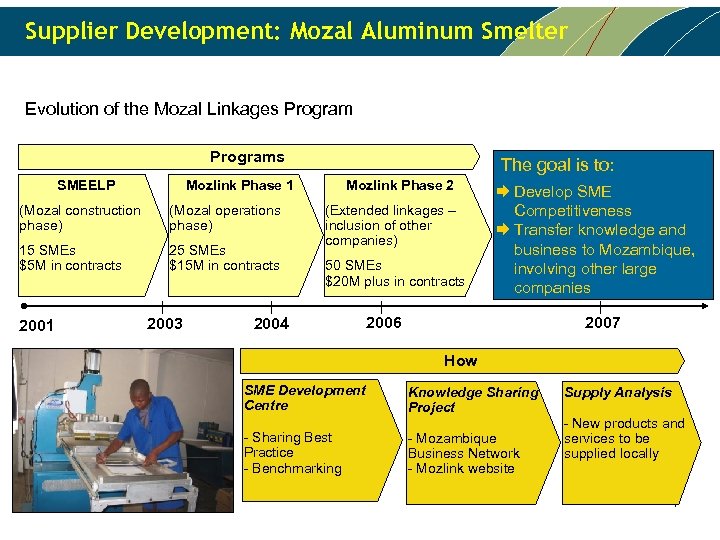
Supplier Development: Mozal Aluminum Smelter Evolution of the Mozal Linkages Programs SMEELP Mozlink Phase 1 (Mozal construction phase) (Mozal operations phase) 15 SMEs $5 M in contracts 25 SMEs $15 M in contracts 2001 The goal is to: 2003 Mozlink Phase 2 (Extended linkages – inclusion of other companies) 50 SMEs $20 M plus in contracts 2004 Æ Develop SME Competitiveness Æ Transfer knowledge and business to Mozambique, involving other large companies 2006 2007 How SME Development Centre - Sharing Best Practice - Benchmarking Knowledge Sharing Project - Mozambique Business Network - Mozlink website Supply Analysis - New products and services to be supplied locally
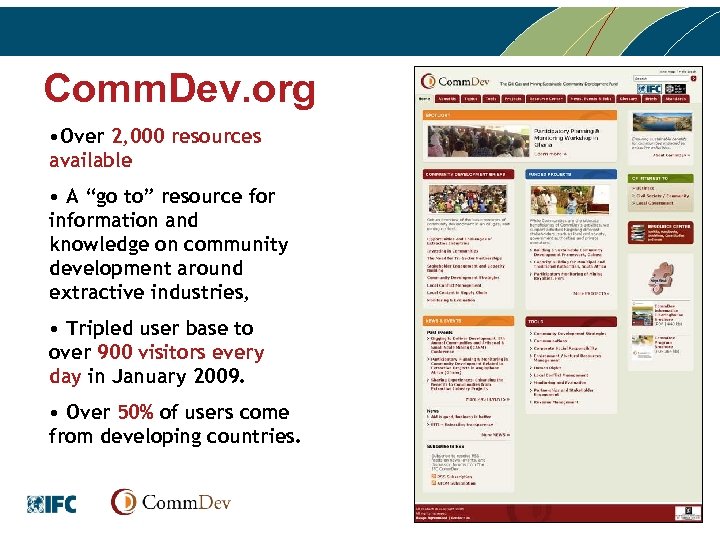
Comm. Dev. org • Over 2, 000 resources available • A “go to” resource for information and knowledge on community development around extractive industries, • Tripled user base to over 900 visitors every day in January 2009. • Over 50% of users come from developing countries.
Thank you! IFC Contact Information Arjun Bhalla Veronica Nyhan Jones IFC, Oil, Gas, Mining and Chemicals Department Phone: 1 (202) 458 -0984 Email: abhalla@ifc. org Fax: 1 (202) 473 -3839 IFC, Oil, Gas, Mining and Chemicals Department Phone: 1 (202) 473 -7940 Email: VNyhanjones@ifc. org Fax: 1 (202) 473 -3839
Скачать презентацию Community Development Delivering bottom line results What
b9cd3791bc27ff20f7aea9b8667a9f38.ppt