 Скачать презентацию Community Based Participatory Research The Role of Training
478500edddf77c4628b8e9f2618e25ac.ppt
- Количество слайдов: 27



Community Based Participatory Research: The Role of Training in Research Conduct Brenda Heaton, Ph. D, MPH Assistant Professor Dept. of Health Policy & Health Services Research Henry M. Goldman School of Dental Medicine
Outline Importance of training in research, but especially in CBPR Training as an ethical issue Training and recruitment and retention Introduce Tooth Smart Health Start (TSHS) TSHS Training Model “Job Aids” Training examples: Human subjects protection Informed consent BRFQ
Why invest in training? Scientific validity Standardization, reproducibility, reliability Basic study conduct Reporting requirements, investigator support CBPR: Limited to no field supervision Labor intensive Larger numbers of field staff with varied backgrounds More reporting requirements and less straightforward Study designs may require increased subject participation Staff need to be equipped to function as an extension of the investigators—their eyes and ears
Why invest in training? Ethical issues: Protection of human subjects: CBPR: The practice of protection can be more demanding Consent process Mandatory reporting Safety Confidentiality Benefits of study to society can be diminished if data has minimized validity, reduction in risk-to-benefit ratio Success (and benefit) of any study hinges on recruitment and retention
Why invest in training? Recruitment and Retention: Informed consent is a PROCESS Retention is often an exercise in trust and respect Compensation Time commitments Perceived incompetence CBPR: Word gets out!

Tooth Smart Healthy Start NIDCR-funded, cluster-randomized clinical trial investigating the effect of motivational interviewing conducted by Dental Health Advocates (DHA) on reducing dental caries among children 0 -5 living in Boston public housing 26 Housing Sites in Boston, Brookline and Cambridge 2 years of follow-up Control group activities: Dental assessments & Fluoride Varnish (FV) applications: every 3 months Behavioral Risk Factor Questionnaire (BRFQ): baseline, 1 yr, 2 yr Intervention group activities: Control group activities + MI visits from DHA every 3 months Satisfaction questionnaire @ baseline, 1 yr, 2 yr
Tooth Smart Healthy Start Study Team: Field Staff (17): Investigative Team (3) Research Dental Hygienists (2) Project Manager Research Project Assistants (10) Project Coordinators (2) Dental Health Advocates (5) Research Study Assistants (2) Data Clerk Compliance Officer
Tooth Smart Healthy Start Research Project Assistants (RPAs): Responsible for: Subject recruitment Administering the informed consent process Enrolling subjects Administering the 60 -minute BRFQ using interview format (data entry) Charting the clinical data during the dental health assessment Follow-up FV adverse event calls Administer the satisfaction questionnaire to intervention participants (data entry)
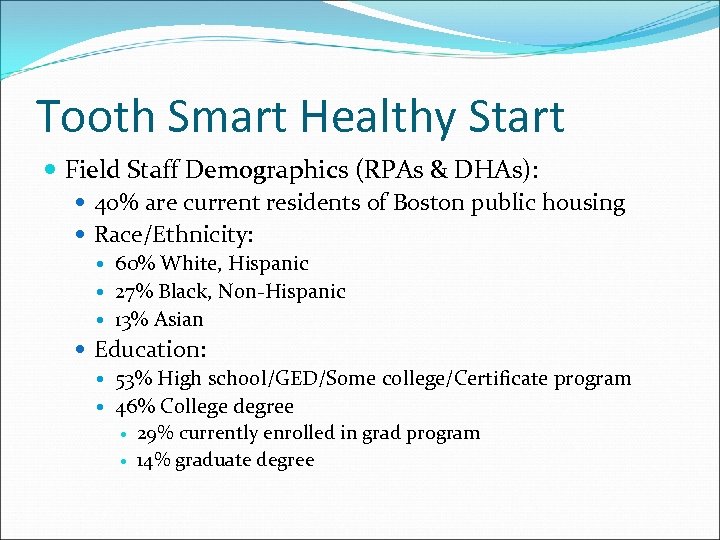
Tooth Smart Healthy Start Field Staff Demographics (RPAs & DHAs): 40% are current residents of Boston public housing Race/Ethnicity: 60% White, Hispanic 27% Black, Non-Hispanic 13% Asian Education: 53% High school/GED/Some college/Certificate program 46% College degree 29% currently enrolled in grad program 14% graduate degree
TSHS: Training Model Conducted primarily by the investigative team Standardized training protocols developed and used Training sessions use a variety of participatory methods, typically conducted in groups Where possible, “job aids” are designed and implemented Certification process requires demonstration and competence determination is standardized Quality assurance protocols are implemented and ongoing competency is reviewed and documented Required, annual refresher trainings
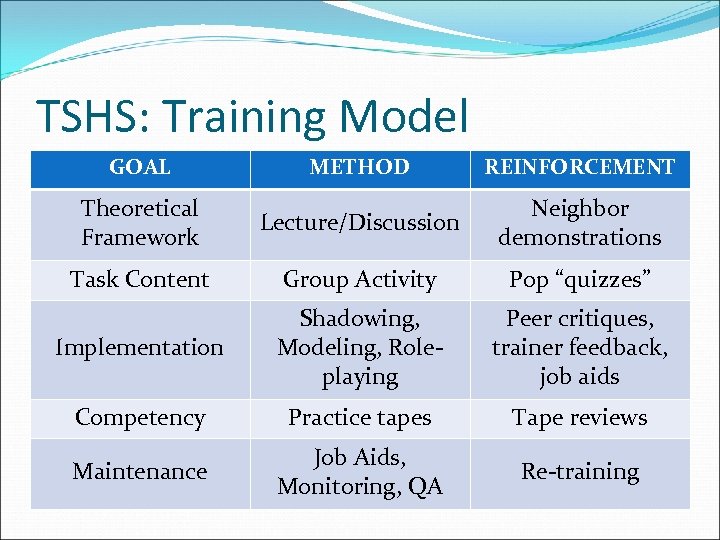
TSHS: Training Model GOAL METHOD REINFORCEMENT Theoretical Framework Lecture/Discussion Neighbor demonstrations Task Content Group Activity Pop “quizzes” Implementation Shadowing, Modeling, Roleplaying Peer critiques, trainer feedback, job aids Competency Practice tapes Tape reviews Maintenance Job Aids, Monitoring, QA Re-training
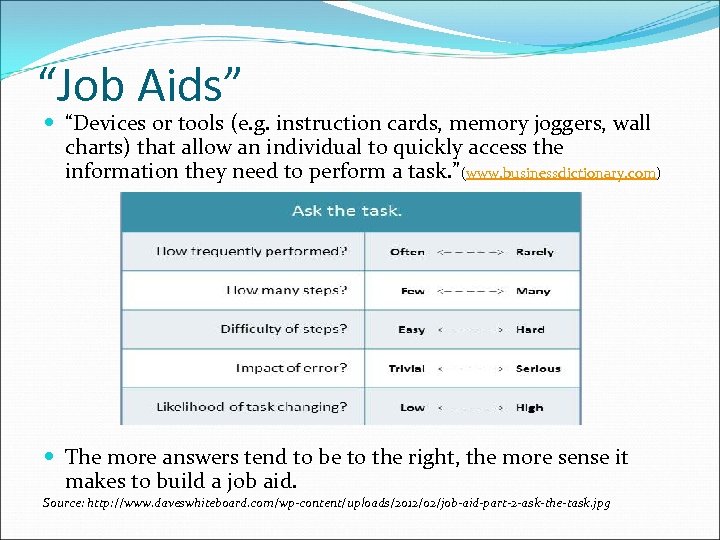
“Job Aids” “Devices or tools (e. g. instruction cards, memory joggers, wall charts) that allow an individual to quickly access the information they need to perform a task. ”(www. businessdictionary. com) The more answers tend to be to the right, the more sense it makes to build a job aid. Source: http: //www. daveswhiteboard. com/wp-content/uploads/2012/02/job-aid-part-2 -ask-the-task. jpg
“Job Aids” A way to insert investigator oversight or “investigator voice” into the field Extends the training environment into the field Eases anxiety related to job performance Faster transition times from training to field Relieve burden on employee who has multiple responsibilities Increase standardization in job performance Helps to keep large teams organized Manages drift Facilitates quality assurance
Quality Assurance Annual refreshers on everything 6 -month quality assurance monitoring QA tape in the field, randomly selected Competency checklist Triggers for retraining Changes to the instrument or protocol Problems identified through monitoring of forms and data QA tape doesn’t reach competency requirements
Training Examples RPA Trainings: Human Subjects Protection Informed Consent Process Behavioral Risk Factor Questionnaire (BRFQ)
Human Subjects Protection NIH/CITI training not easily translatable Format: Lecture/Discussion Content: What constitutes research, when and why it involves human subjects, and why and how participants need to be protected All content is catered to provide understanding of TSHS in the context of the Belmont principles Evaluation: Completion of a post-test Benefits: Most foundational training that is referenced throughout all other trainings Assists in understanding of how study design and conduct (future tasks) is with human subjects protection in mind Allows for additional focus on issues of importance in CBPR (e. g. confidentiality)
Informed Consent Process Session 1: Format: Group discussion/Activity Content: Review the ethical requirement for informed consent Develop strong knowledge and understanding of the study purpose, design, procedures and documentation Develop familiarity with task content (ICF, job aids) Discuss and model appropriate behavior and interaction during consent process including word choice, tone of voice, facial expressions and body language Model of consent process provided Homework: Practice consent materials out loud Get comfortable with content
Informed Consent Process Session 2: Format: Role-playing Content: Group role-playing exercises and peer critiquing Implementation of job aids Practice makes perfect Homework: Practice
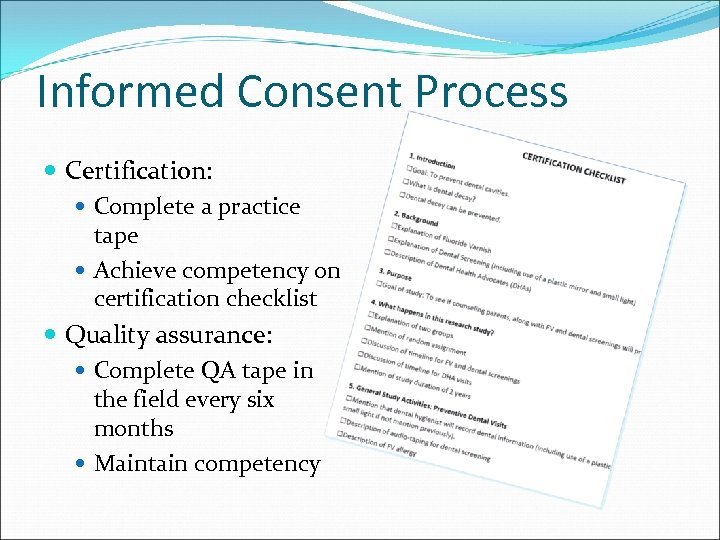
Informed Consent Process Certification: Complete a practice tape Achieve competency on certification checklist Quality assurance: Complete QA tape in the field every six months Maintain competency
Informed Consent Process Job Aids Tracking Card ICF Placards
Behavioral Risk Factor Questionnaire Session 1: Format: Group discussion/Activity Content: Review the study context for the BRFQ Interviewing techniques Importance of standardization Homework: Critical review of instrument: What do questions mean? Purpose? Words that might be confusing? Ways to reword without changing meaning?
Behavioral Risk Factor Questionnaire Session 2: Format: Role-plays/Pop “quizzes” Content: Review of Homework #1 Begin reinforcement of content through selected role-plays Introduce job aid Homework: “Stalk your neighbor”
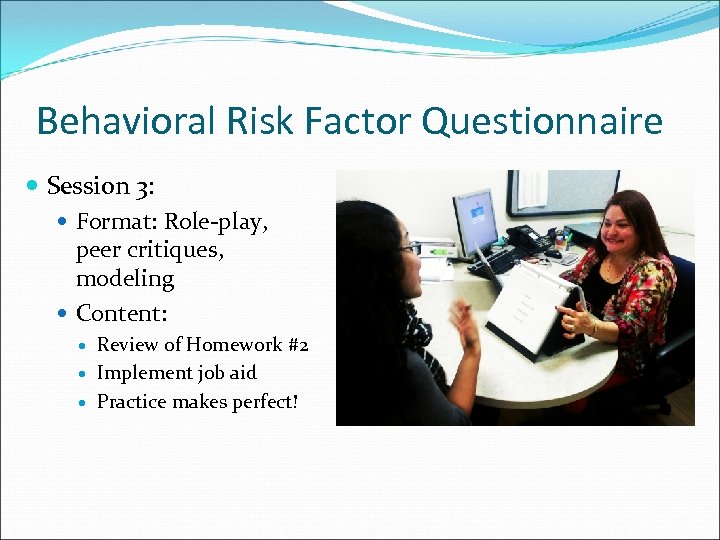
Behavioral Risk Factor Questionnaire Session 3: Format: Role-play, peer critiques, modeling Content: Review of Homework #2 Implement job aid Practice makes perfect!
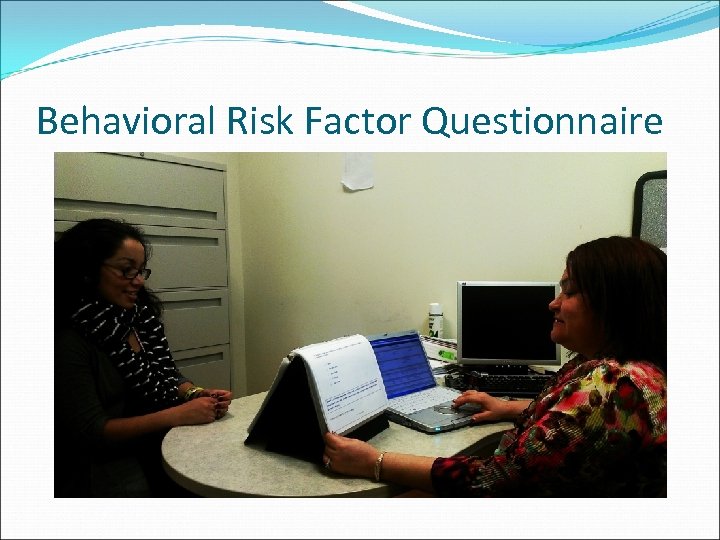
Behavioral Risk Factor Questionnaire
Behavioral Risk Factor Questionnaire Certification: Complete a practice tape Achieve competency on certification checklist Quality assurance: Complete QA tape in the field every six months Maintain competency

Questions?
Скачать презентацию Community Based Participatory Research The Role of Training
478500edddf77c4628b8e9f2618e25ac.ppt