


 Скачать презентацию Communism Karl Marx s Theory Communism is a
communism.ppt
- Количество слайдов: 18
 Communism
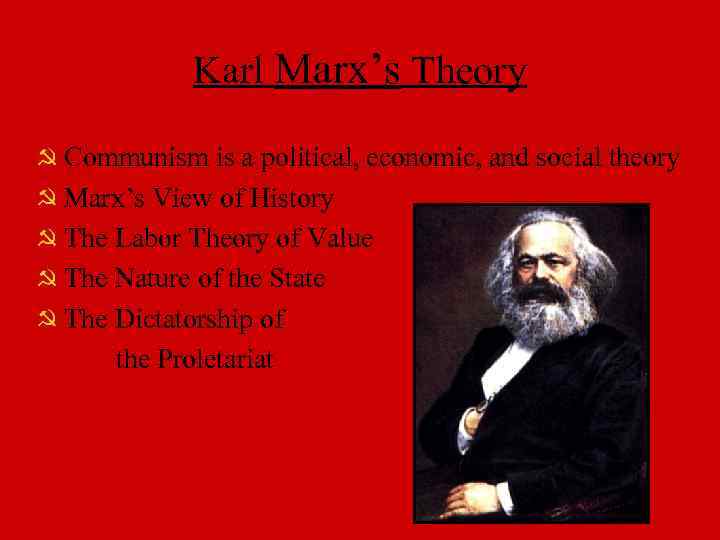 Karl Marx’s Theory Communism is a political, economic, and social theory Marx’s View of History The Labor Theory of Value The Nature of the State The Dictatorship of the Proletariat
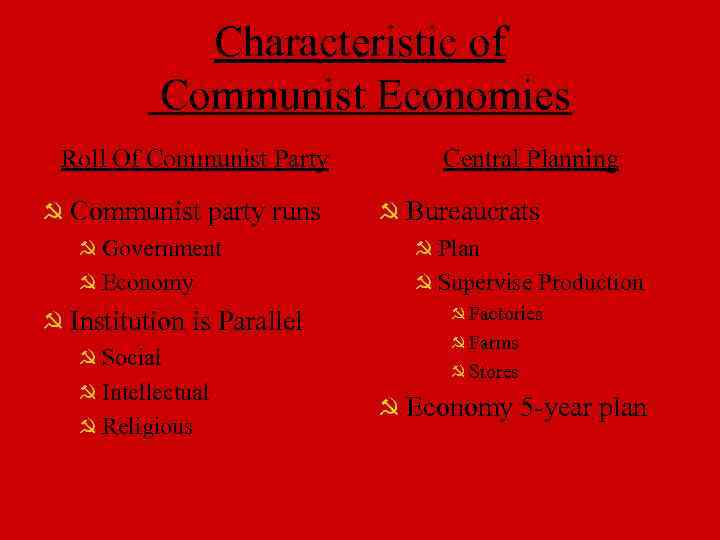 Characteristic of Communist Economies Roll Of Communist Party Communist party runs Government Economy Institution is Parallel Social Intellectual Religious Central Planning Bureaucrats Plan Supervise Production Factories Farms Stores Economy 5 -year plan
 Characteristic of Communist Economies Collectivization Communist Economy is a merger of small farms Goes to government owned agricultural enterprises State Ownership Industrial Enterprises Transportation Parts of Economy All would be State Owned
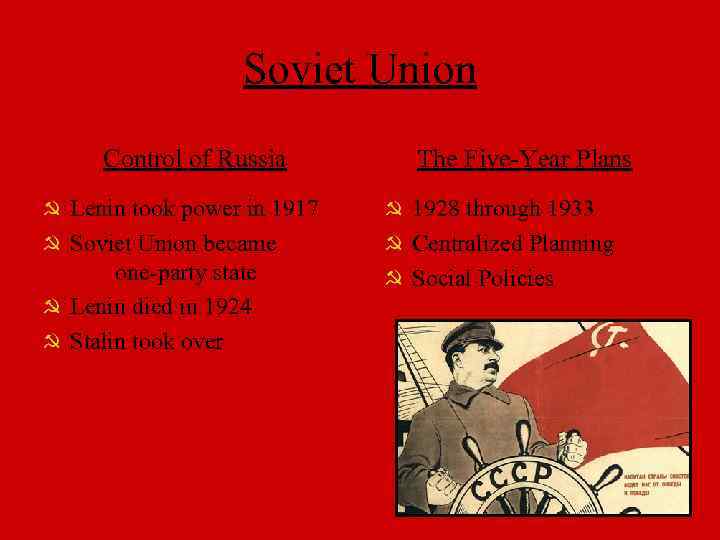 Soviet Union Control of Russia Lenin took power in 1917 Soviet Union became one-party state Lenin died in 1924 Stalin took over The Five-Year Plans 1928 through 1933 Centralized Planning Social Policies
 Soviet Union Gorbachev’s Reforms Perestroika (перестройка) Restructuring of Political and Economic Life Ruled by Mikhail Gorbachev Gave power to local farms Linked salaries to performance Allowed for some profit incentive Transition to a Free Market Began with Privatization of Government Enterprise Elite class of Entrepreneurs Russian suffered through High Inflation Money lost value State pensions were lost
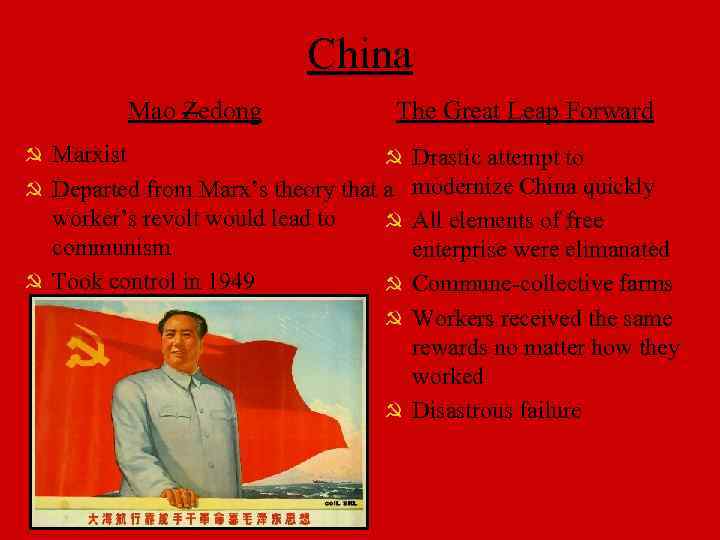 China Mao Zedong Marxist Departed from Marx’s theory that a worker’s revolt would lead to communism Took control in 1949 The Great Leap Forward Drastic attempt to modernize China quickly All elements of free enterprise were elimanated Commune-collective farms Workers received the same rewards no matter how they worked Disastrous failure
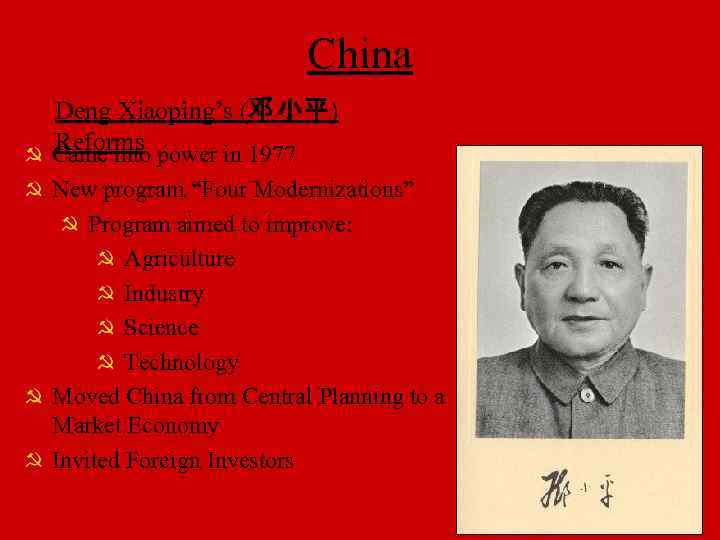 China Deng Xiaoping’s (邓 小平) Reforms Came into power in 1977 New program “Four Modernizations” Program aimed to improve: Agriculture Industry Science Technology Moved China from Central Planning to a Market Economy Invited Foreign Investors
 Other Communist Nations Cuba Fidel Castro Soviet Union supported after US broke ties Depended on Soviets Econ The fall of the Soviet Union caused economic crisis Southeast Asia Ho Chi Minh Fought for Vietnam’s government Vietnam Government Uses five-year plans to guide economy
 Other Communist Nations Laos and Cambodia Influence spilled from Vietnam Laos adopted Communism in 1975 Cambodia 1973– 1993 North Korea was split into two Soviet North American South Centrally Planned Economy Not much growth Agriculture collectivized in 1950 s Severe food shortage Lost foreign aid and trade from other communist countries
 Elements of Communism
 Economics of Communism was an important economic system in the world from 1917 -1991. In today’s world there are really only 2 remaining truly communist economies in the world today, that is North Korea and Cuba. With the fall of the Berlin Wall in 1989, Communism fell in Eastern Europe and Russia
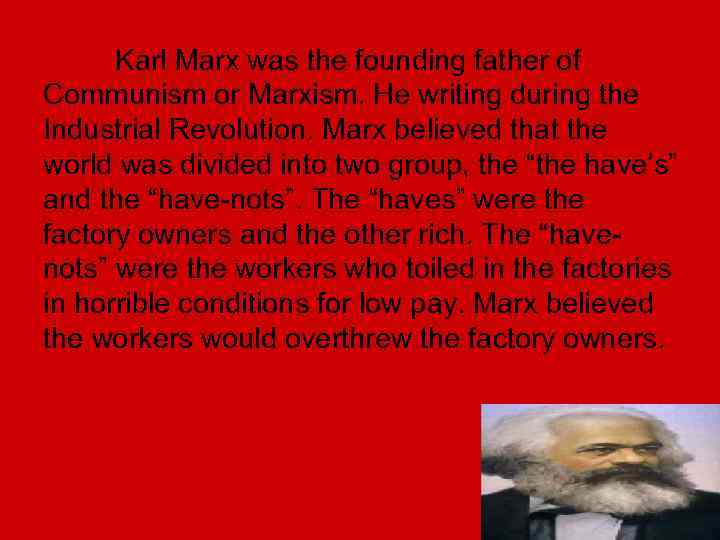 Karl Marx was the founding father of Communism or Marxism. He writing during the Industrial Revolution. Marx believed that the world was divided into two group, the “the have’s” and the “have-nots”. The “haves” were the factory owners and the other rich. The “havenots” were the workers who toiled in the factories in horrible conditions for low pay. Marx believed the workers would overthrew the factory owners.
 Karl Marx believed that everyone should be equal. That the workers would create a dictatorship of the workers. That government would be unnecessary, and would wither away. Remember that Marx was writing before the development of unions in Western Europe and the U. S. . Marx believed that people were rich or poor. Which made sense in his time, the 1840’s. He did not foresee the rise of the Middle Class, in the U. S. today the vast majority of us are Middle Class. • Economic • From an economic standpoint the Communist Party controls all economic activity in a Communist system. They decide what goods will be produced, how many goods will be produced, and at what price
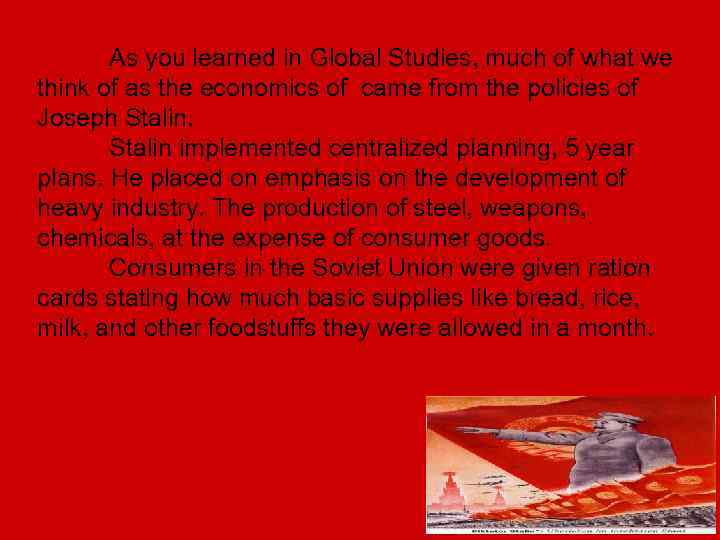 As you learned in Global Studies, much of what we think of as the economics of came from the policies of Joseph Stalin implemented centralized planning, 5 year plans. He placed on emphasis on the development of heavy industry. The production of steel, weapons, chemicals, at the expense of consumer goods. Consumers in the Soviet Union were given ration cards stating how much basic supplies like bread, rice, milk, and other foodstuffs they were allowed in a month.
 Elements of Soviet Communism • 1) The State provided housing for everyone. • 2) Housing was always in short supply- The state never constructed enough housing to meet demand. • 3) People did not own their own housing, the state owned it • 4) The state owned all the land, farmers worked on collective farms- Since all workers were paid the same, there was no incentive to work hard. Soviet agriculture struggled to produce enough food. • 5) Workers were guaranteed a job, no one was unemployed • 6) The state provided free medical care. • 7) The state provided free vacations to spas and beach resorts along the Black Sea.
 Elements of Soviet Communism • 7) The state provided free day care for women • 8) Women were not allowed to stay home and take care of their children, they had to work • 9) Since consumer goods were always in short supply, huge lines formed when people found out that was a shipment of shoes for example • 10) Money was not as important, as having access to scarce goods, important communist party members had the right to shop in special stores, or were given cars and houses by the state
 Elements of Soviet Communism • 11) It was almost impossible to fire workers from their jobs. Factories had to many workers, because the objective was to employ people rather than make money. • 12) You were paid the same whether you worked hard or came in late to work drunk. • 13) The state choose your job, whether you liked it or not. You needed special permission to change job. • 14) Soviet agriculture was very inefficient, and used 25% of the population as compared 2 -3% in the U. S. • 15) If Soviet citizen’s saw a line they entered, because they knew there had to be something good at the end of the line.