


 Скачать презентацию Communications Requirements for Smart Grids and Active Demand
e1b2955e0576c29f064499dd43379377.ppt
- Количество слайдов: 17
 Communications Requirements for Smart Grids and Active Demand ADDRESS INTERNATIONAL WORKSHOP ACTIVE DEMAND: THE FUTURE OF ELECTRICITY Andrew Paice, ABB Paris, June 9 th 2010 communication The research leading to these results has received funding from the European Community's Seventh Framework Programme (FP 7/2007 -2013) under grant agreement n° 207643
 Outline Goals & Methodology – Survey on Future requirements of Smart Grids – Architecture Design Methodology Survey Results – Key requirements – Service Oriented Architecture / Web Services Draft Architecture – Actor interactions – Service & Connectivity – Traffic Matrix ADDRESS INTERNATIONAL WORKSHOP Paris, June 9 th 2010 2
 Goals In the project, the Communications workpackage has the goal of providing – A guideline to designing a communications architecture that will enable active demand – A guide to testing that the implemented communications system is sufficient to operate a smart grid with active demand – Tested prototypes and a design for the field tests The aim of the first communication activity was to: “Identify, describe and specify the main requirements on the communication infrastructure – data transmission architecture, and data service requirements – in order to enable active demand” ADDRESS INTERNATIONAL WORKSHOP Paris, June 9 th 2010 3
 Methodology Survey – Partners and members of the GUS will be surveyed regarding: • Status of the current communications system • Expected developments • Specific Smart Grids requirements Use Case Analysis – Based on the Use Cases of Deliverable D 1. 1, the interactions between actors are analyzed down to the individual links to determine the communications requirements ADDRESS INTERNATIONAL WORKSHOP Paris, June 9 th 2010 4
 Survey on future Smart Grids Communications 19 entities answered the survey: – ABB, Alcatel-Lucent, Consentec, Current Technologies International (CTI), Elektrizitätswerke des Kantons Zürich (EKZ), ENEL Distribuzione, ENEL Produzione, Electric Power Research Institute (EPRI), Ericsson, Iberdrola, Instituto Tecnológico de la Energía (ITE), KEMA, Landis+Gyr, LABEIN Tecnalia, Vattenfall, Vlaamse Instelling voor Technologisch Onderzoek (VITO), VTT and ZIV They provided details regarding: – Interoperability, PHY Media, Scalability, Regulatory Issues, Standardisation, Performance: business / technical, Robustness/availability, Plug & Play, Management, Upgrades, Security, CAPEX & OPEX ADDRESS INTERNATIONAL WORKSHOP Paris, June 9 th 2010 5
 Key Results / Communications Requirements – Flexibility with respect to physical media • Last mile likely to be PLC, wireless, or re-routed via Public Tele. Com – Full interoperability for all network elements • To be guaranteed by XML based messaging & CIM standards – Secure remote access to all elements of the network – Implementation to be compatible with TCP/IP and Web Services • Technical & business performance requirements – Communication performance should be independent of grid state – At Aggregator & E-Box level the network should be self-configuring – Network management: Visualization & remote configuration ADDRESS INTERNATIONAL WORKSHOP Paris, June 9 th 2010 6
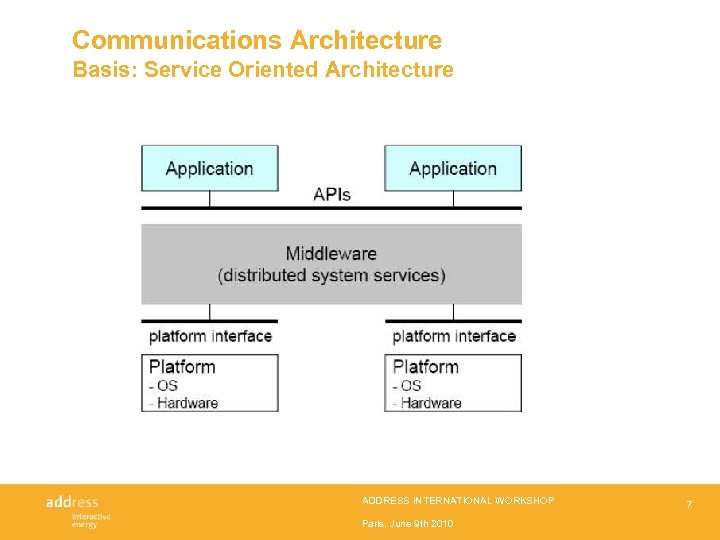 Communications Architecture Basis: Service Oriented Architecture ADDRESS INTERNATIONAL WORKSHOP Paris, June 9 th 2010 7
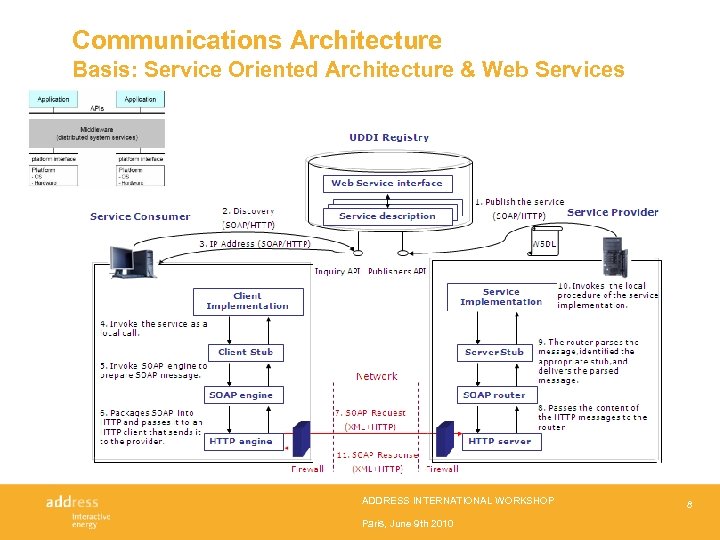 Communications Architecture Basis: Service Oriented Architecture & Web Services ADDRESS INTERNATIONAL WORKSHOP Paris, June 9 th 2010 8
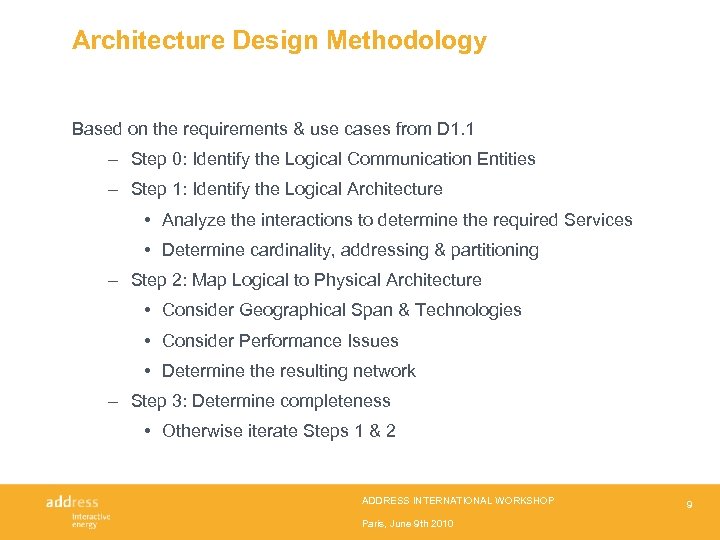 Architecture Design Methodology Based on the requirements & use cases from D 1. 1 – Step 0: Identify the Logical Communication Entities – Step 1: Identify the Logical Architecture • Analyze the interactions to determine the required Services • Determine cardinality, addressing & partitioning – Step 2: Map Logical to Physical Architecture • Consider Geographical Span & Technologies • Consider Performance Issues • Determine the resulting network – Step 3: Determine completeness • Otherwise iterate Steps 1 & 2 ADDRESS INTERNATIONAL WORKSHOP Paris, June 9 th 2010 9
 Abstract Communications Architecture ADDRESS INTERNATIONAL WORKSHOP Paris, June 9 th 2010 10
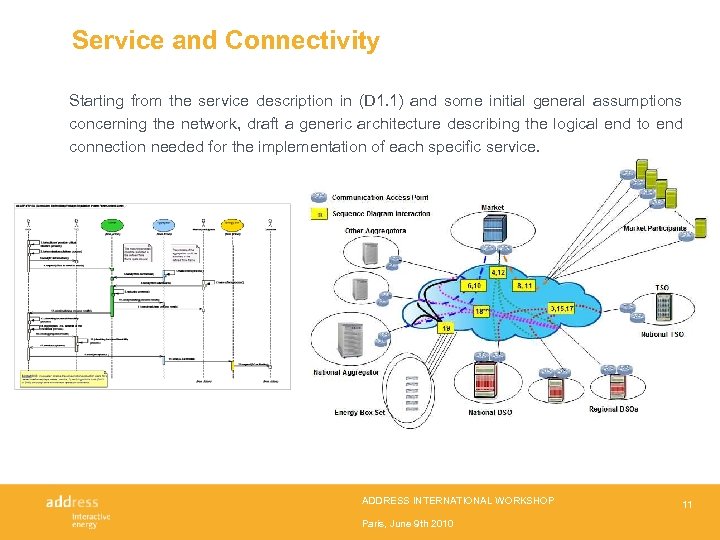 Service and Connectivity Starting from the service description in (D 1. 1) and some initial general assumptions concerning the network, draft a generic architecture describing the logical end to end connection needed for the implementation of each specific service. ADDRESS INTERNATIONAL WORKSHOP Paris, June 9 th 2010 11
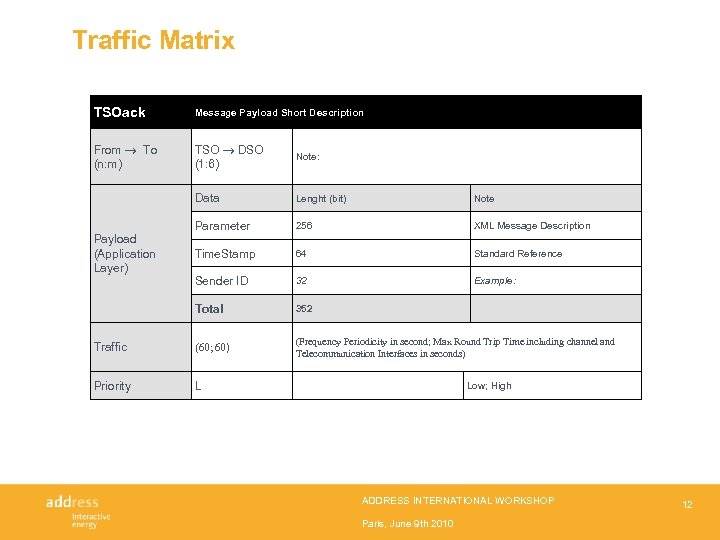 Traffic Matrix TSOack Message Payload Short Description From To (n: m) TSO DSO (1: 6) Note: Data Lenght (bit) Note Parameter 256 XML Message Description Time. Stamp 64 Standard Reference Sender ID 32 Example: Total 352 Traffic (60; 60) (Frequency Periodicity in second; Max Round Trip Time including channel and Telecommunication Interfaces in seconds) Priority L Payload (Application Layer) Low; High ADDRESS INTERNATIONAL WORKSHOP Paris, June 9 th 2010 12
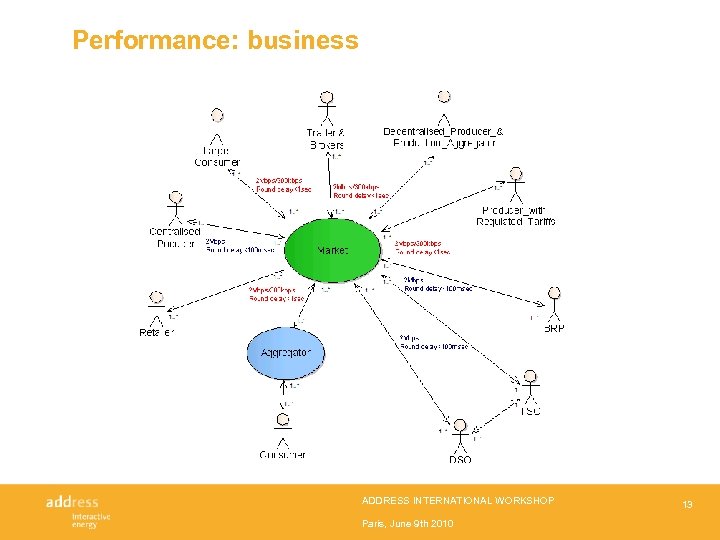 Performance: business ADDRESS INTERNATIONAL WORKSHOP Paris, June 9 th 2010 13
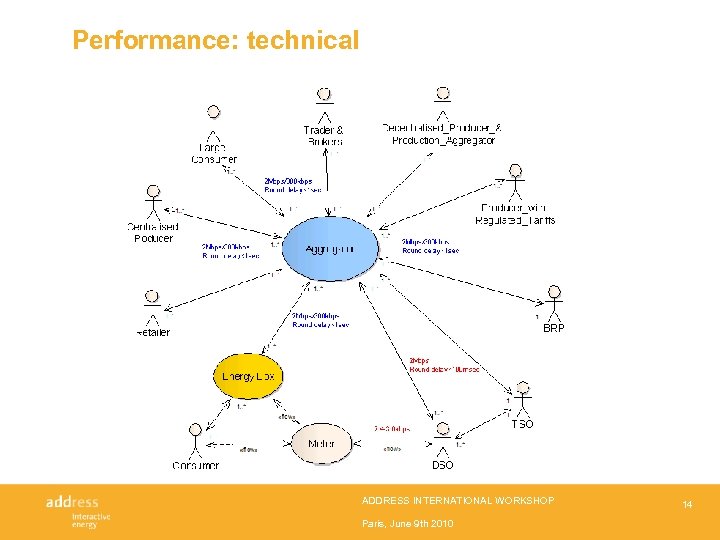 Performance: technical ADDRESS INTERNATIONAL WORKSHOP Paris, June 9 th 2010 14
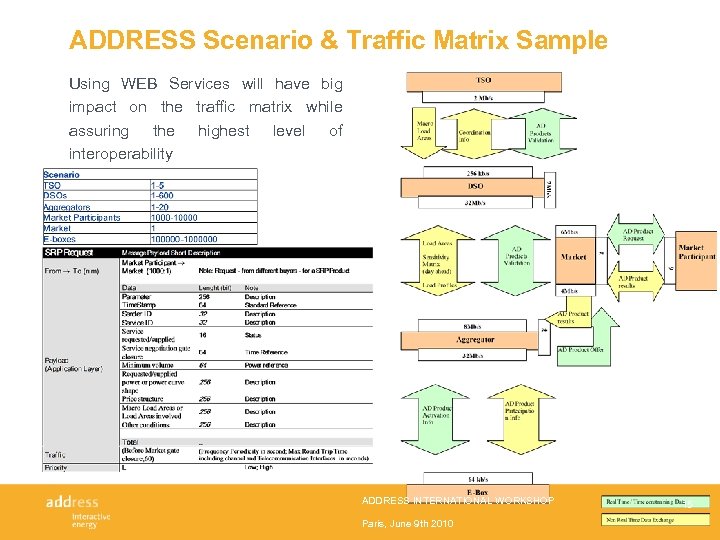 ADDRESS Scenario & Traffic Matrix Sample Using WEB Services will have big impact on the traffic matrix while assuring the highest level of interoperability ADDRESS INTERNATIONAL WORKSHOP Paris, June 9 th 2010 15
 Conclusions & next steps The requirements on the ADDRESS communications infrastructure have been identified by: – A survey on the needs of the communications infrastructure – An initial analysis of the use cases A service oriented architecture based on web services and standardized XML messages forms the basis for ADDRESS communications The Traffic matrix has been introduced as a tool for estimating & representing the overall performance requirements for a specific scenario Next steps: – Communications media will be identified – Specific solutions will be developed – The requirements and architecture will be refined – Communications architectures for the field tests will be developed ADDRESS INTERNATIONAL WORKSHOP Paris, June 9 th 2010 16
 THANK YOU The research leading to these results has received funding from the European Community's Seventh Framework Programme (FP 7/2007 -2013) under grant agreement n° 207643