 Скачать презентацию Communications On March 10 1876 in Boston
dc4b2a336da9501c6d56ab2b1f7459ad.ppt
- Количество слайдов: 101



Communications • On March 10, 1876, in Boston, Massachusetts, Alexander Graham Bell invented the telephone. • First telephone call ! "Mr. Watson, come here, I want you!"
Intercity / Long Distance • • Physical lines Overhead Carrier Coaxial Cables Microwaves Submarine Coaxial Cables Satellite communications Optical Fibers
Communications Satellites “All these problems can be solved by the use of a chain of spacestations with an orbital period of 24 hours, which would require them to be at a distance of 42, 000 Km from the center of the Earth. There a number of possible arrangements for such a chain. The stations would lie in the Earth’s equatorial plane and would thus always remain fixed in the same spots in the sky, from the point of view of terrestrial observers. Unlike all other heavenly bodies they would never rise nor set. This would greatly simplify the use of directive receivers installed on the Earth. ” science fiction author, Arthur C. Clarke "Wireless World" British Magazine May 1945
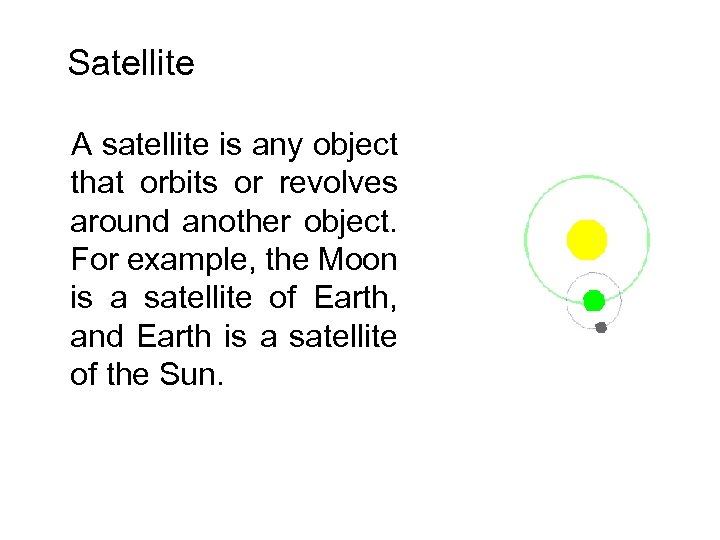
Satellite A satellite is any object that orbits or revolves around another object. For example, the Moon is a satellite of Earth, and Earth is a satellite of the Sun.
Artificial Satellites are man-made machines that orbit Earth and the Sun. These are highly specialized and complex machines and perform thousands of tasks. These satellites have many sub-systems. There are hundreds of satellites currently in operation.
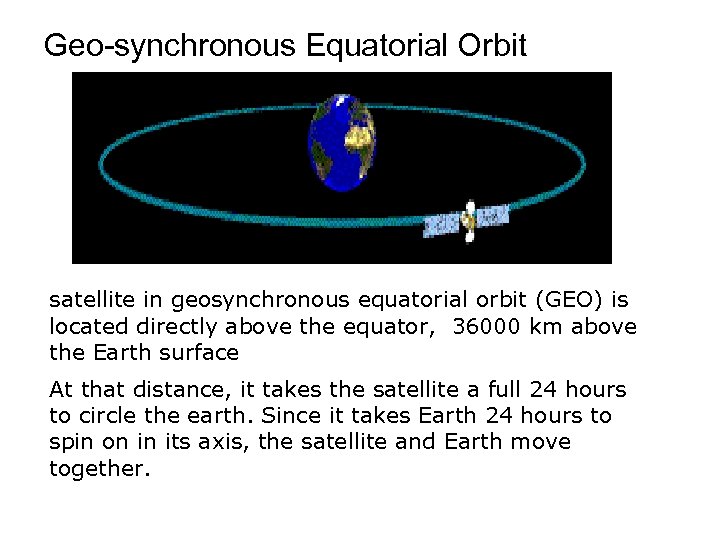
Geo-synchronous Equatorial Orbit satellite in geosynchronous equatorial orbit (GEO) is located directly above the equator, 36000 km above the Earth surface At that distance, it takes the satellite a full 24 hours to circle the earth. Since it takes Earth 24 hours to spin on in its axis, the satellite and Earth move together.
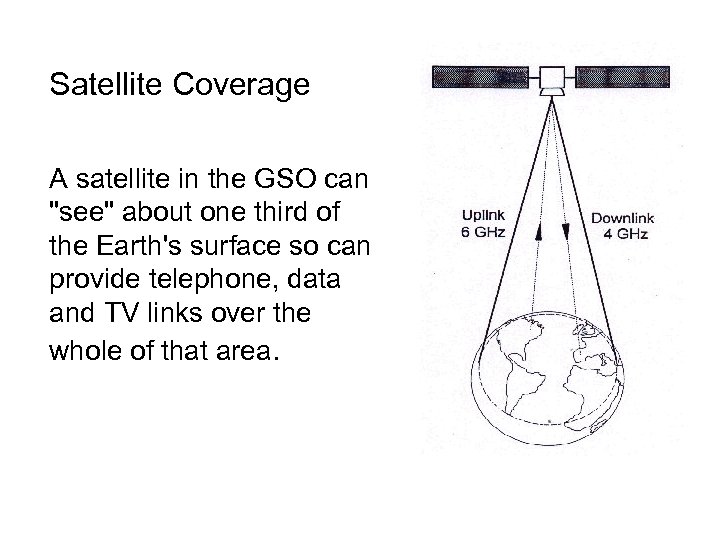
Satellite Coverage A satellite in the GSO can "see" about one third of the Earth's surface so can provide telephone, data and TV links over the whole of that area.
Elements of a Satellite • Payload • Bus
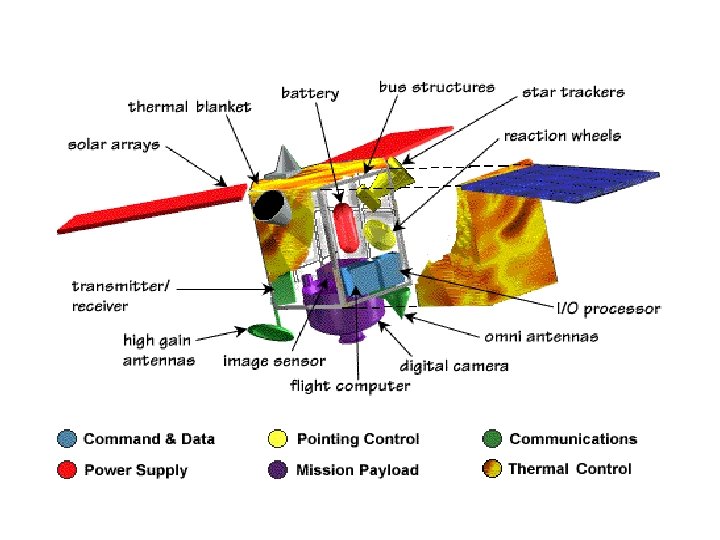
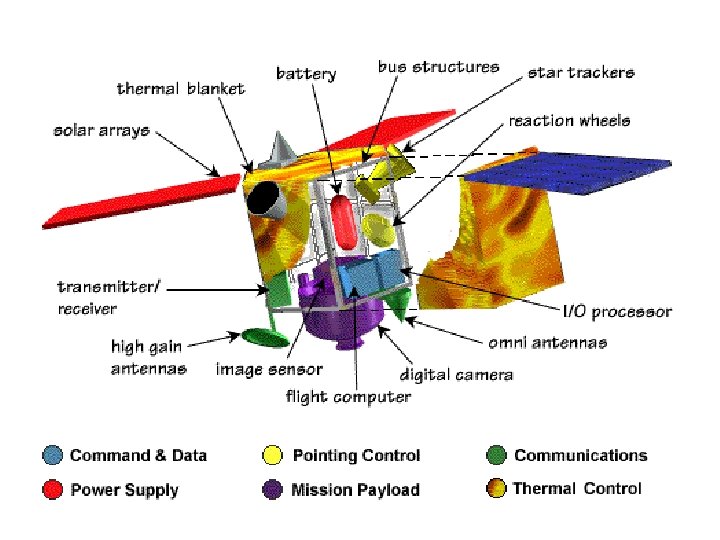
Payload • Antennas and electronics. • The payload is different for every satellite. • The payload for a weather satellite includes cameras to take pictures of cloud formations, while the payload for a communications satellite includes large antennas to transmit TV or telephone signals to Earth.
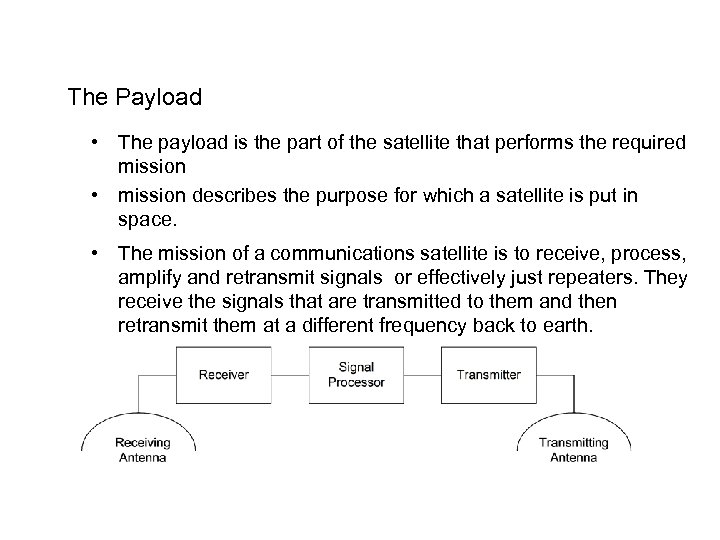
The Payload • The payload is the part of the satellite that performs the required mission • mission describes the purpose for which a satellite is put in space. • The mission of a communications satellite is to receive, process, amplify and retransmit signals or effectively just repeaters. They receive the signals that are transmitted to them and then retransmit them at a different frequency back to earth.
Bus • Carries the payload and all its equipment into space. • The bus also contains equipment that allows the satellite to communicate with Earth. • Holds all the satellite's parts together and provides electrical power, computers, and propulsion to the spacecraft.
Applications • Communications • • • Weather Global Positioning System Scientific Research Earth Observation Spying
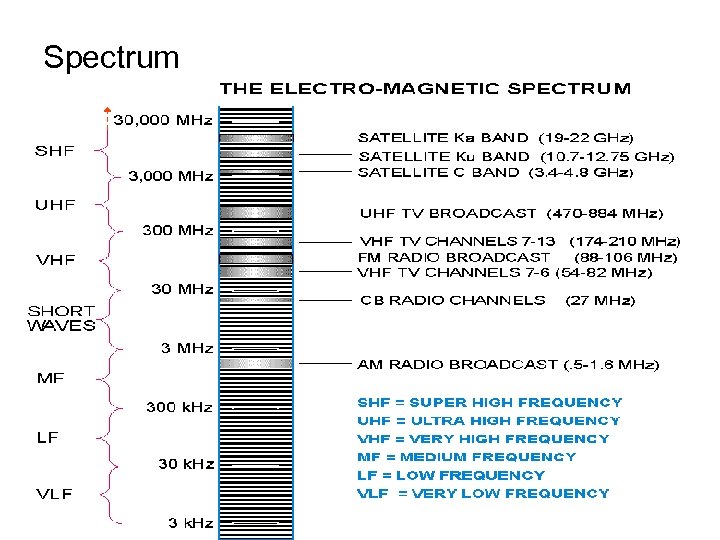
Spectrum
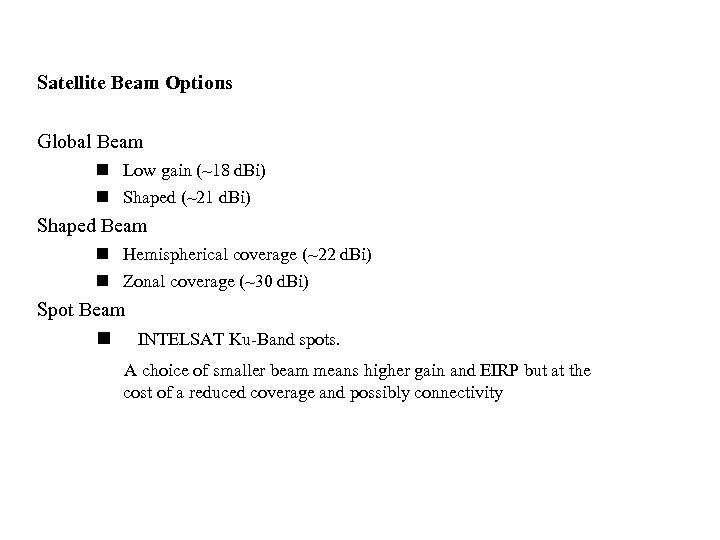
Satellite Beam Options Global Beam n Low gain (~18 d. Bi) n Shaped (~21 d. Bi) Shaped Beam n Hemispherical coverage (~22 d. Bi) n Zonal coverage (~30 d. Bi) Spot Beam n INTELSAT Ku-Band spots. A choice of smaller beam means higher gain and EIRP but at the cost of a reduced coverage and possibly connectivity
Launching • Satellites are sent into orbit using a rocket or by the Space Shuttle. • Several countries and businesses have rocket launch capabilities, and satellites as large as several tons make it safely into orbit on a regular basis. • The launch rocket is aimed straight up at first. This gets the rocket through the thickest part of the atmosphere most quickly and best minimizes fuel consumption. • After a rocket launches straight up, the rocket control mechanism adjust the rocket's nozzles to tilt the rocket to the course described in the flight plan. • The mechanism of rocket motion is complex but in principle , it uses natural forces like earth’s gravitation and rotation about its axis to reduce fuel and launching costs. As a result of Earth’s rotation , the rocket receives natural boost. The strength of this boost depends on the rotational velocity of Earth at the launch location. The boost is greatest at the equator, and launching is preferred on equatorial sites.
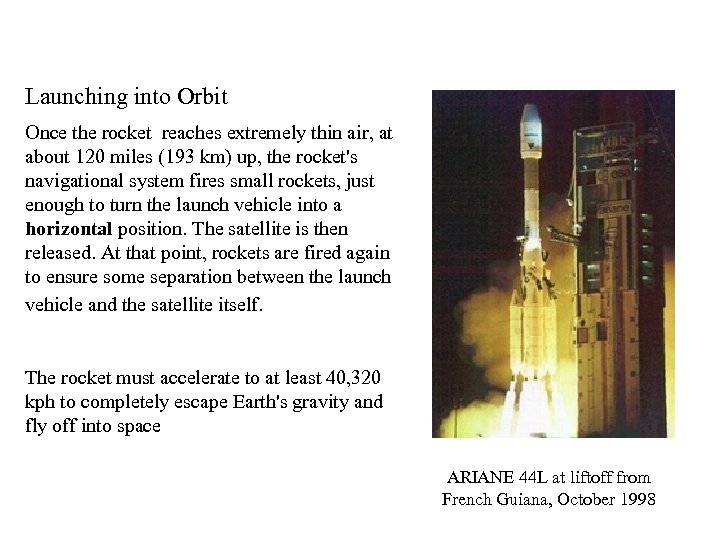
Launching into Orbit Once the rocket reaches extremely thin air, at about 120 miles (193 km) up, the rocket's navigational system fires small rockets, just enough to turn the launch vehicle into a horizontal position. The satellite is then released. At that point, rockets are fired again to ensure some separation between the launch vehicle and the satellite itself. The rocket must accelerate to at least 40, 320 kph to completely escape Earth's gravity and fly off into space ARIANE 44 L at liftoff from French Guiana, October 1998
Stabilizing into Orbit • Earth's escape velocity is much greater than what's required to place an Earth satellite in orbit. With satellites, the object is not to escape Earth's gravity, but to balance it. • Orbital velocity is the velocity needed to achieve balance between gravity's pull on the satellite and the inertia of the satellite's motion -- the satellite's tendency to keep going. • At the correct orbital velocity, gravity exactly balances the satellite's inertia, pulling down toward Earth's center just enough to keep the path of the satellite curving like Earth's curved surface, rather than flying off in a straight line • The orbital velocity of the satellite depends on its altitude above Earth. The nearer Earth, the faster the required orbital velocity. To maintain an orbit that is 35, 786 km) above Earth, the satellite must orbit at a speed of about 11, 300 kph. With this orbital speed and distance permits the satellite to make one revolution in 24 hours.
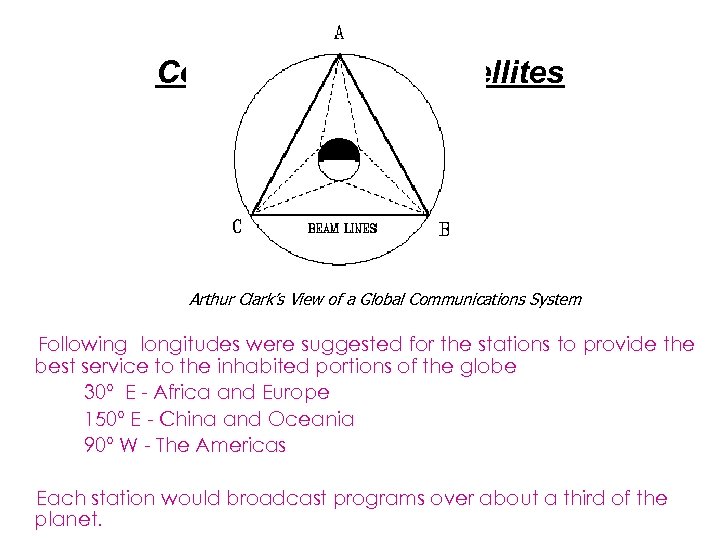
Communications Satellites Arthur Clark’s View of a Global Communications System Following longitudes were suggested for the stations to provide the best service to the inhabited portions of the globe 30° E - Africa and Europe 150° E - China and Oceania 90° W - The Americas Each station would broadcast programs over about a third of the planet.
Communications Satellite Communications: Chronology • 1945 RAF electronics officer Arthur C. Clarke, in a short article in Wireless World described the use of manned satellites in 24 -hour orbits high above the world's land masses to distribute television programs • 1957 launch of Sputnik I, the race between the Super Powers for the benefits, space-superiority, and prestige associated with satellite communications began • 1960 AT&T filed with the Federal Communications Commission (FCC) for permission to launch an experimental communications satellite. • 1962 TELSTAR and RELAY launched. provided glimpses of the Global Village idea. TELSTAR televised parts of the 1964 Tokyo Olympics · 1963 SYNCOM launched
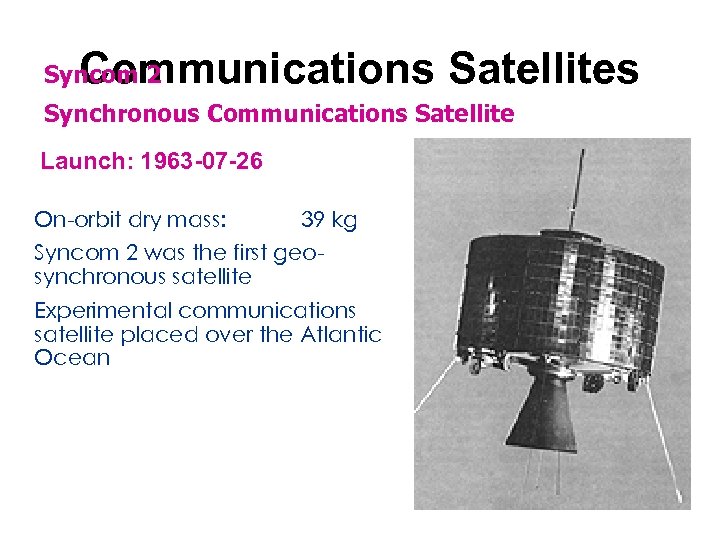
Communications Satellites Syncom 2 Synchronous Communications Satellite Launch: 1963 -07 -26 On-orbit dry mass: 39 kg Syncom 2 was the first geosynchronous satellite Experimental communications satellite placed over the Atlantic Ocean
Satellite Communications: Chronology • Communications Satellites 1964 INTELSAT formed to assume ownership of the satellites and responsibility for management of the global system • 1965 INTELSAT EARLY BIRD: 1 st commercial communications satellite was launched EARLY BIRD provided 150 telephone "half- circuits" and 80 hours of television service. • INTELSAT III series was the first to provide Indian Ocean coverage to complete the global network. This coverage was completed just days before one half billion people watched APOLLO 11 land on the moon on July 20, 1969 • From a few hundred telephone circuits and a handful of members in 1965, INTELSAT has grown to a present-day system with more members than the United Nations and the capability of providing hundreds of thousands of telephone circuits
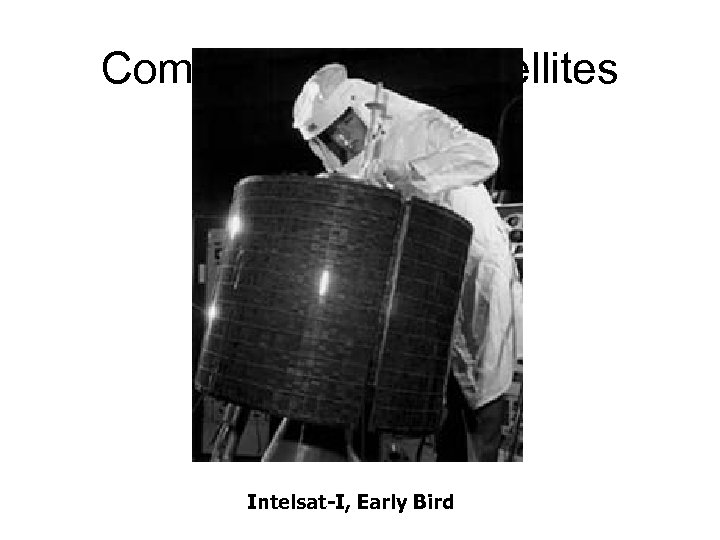
Communications Satellites Intelsat-I, Early Bird
Global to Domestic Communications Satellites • 1972 TELESAT CANADA launched the first domestic communications satellite, ANIK • April 13, 1974 The first U. S. domestic communications satellite was launched : Western Union's WESTAR I • In early 1976 AT&T and COMSAT launched the first of the COMSTAR series. These satellites were used for voice and data, but very quickly television became a major user. By the end of 1976 there were 120 transponders available over the U. S. , each capable of providing 1500 telephone channels or one TV channel • 1976 PALAPA: 3 rd country (Indonesia) to launch domestic comm. satellite
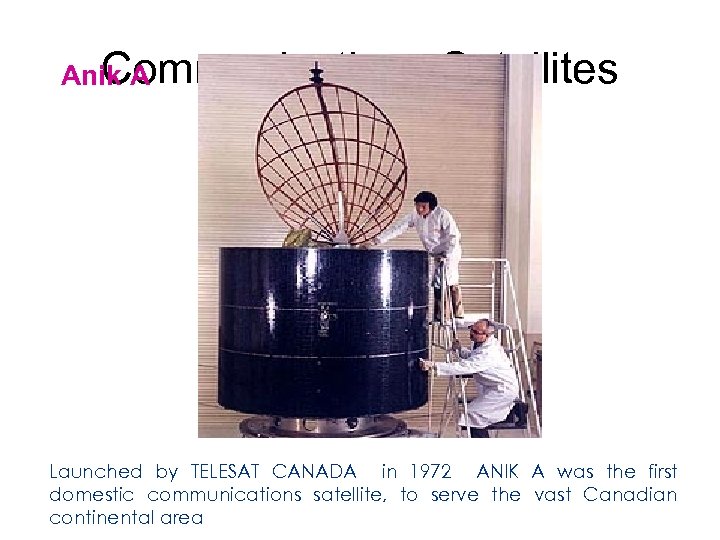
Communications Anik A Satellites Launched by TELESAT CANADA in 1972 ANIK A was the first domestic communications satellite, to serve the vast Canadian continental area
Communications Satellite Chronology Communications Satellites · 1975 INTELSAT-IVA: 1 st use of dual-polarization · 1976 MARISAT: 1 st mobile communications satellite · 1979 INMARSAT formed. · 1988 TAT-8: 1 st Fiber-Optic Trans-Atlantic telephone cable.
Decades of Evolution Communications Satellites New Technology • The ensuing decades have seen significant changes: Satellite is part of our every day life: Television still dominates satellite communications, but data has grown tremendously with the advent of very small aperture terminals (VSATs). • Small antennas, whether TV-Receive Only (TVRO) or VSAT are a commonplace sight all over the world.
Communications Satellites More applications of Satellite • Satellites found applications besides Telecommunication and Television. • Weather , spy and Earth Resource Satellite systems were developed. • These were mostly in smaller orbits, circling the Earth in North-South way. • They pass the Earth once or more times every day and remain available only for a shorter duration as compared to Geo Satellites • Commercial Earth Observation Satellites are available with a meter resolution while spy satellites have millimeter resolution.
Communications Satellites Expansion of Satellite Use: An Earth Observation Satellite • • Ocean Color and Temperature Scanner Advanced Visible and Near-Infrared Radiometer Total Ozone Mapping Spectrometer Monitor for Greenhouse Gasses Defense Meterological Satellite Program SSM/I (Special Sensor Microwave/Imager) Visible + SSM/T 1, SSM/T 2 Microwave temperature & moisture sounders * ERS-1 Earth Resources Satellite • Rainfall Measuring Mission (launch 1997, Japan)
Communications Satellites Mobile Satellite Communications • In 1976 Marisat was formed for military and civil marine communications • Three satellites were launched and provided coverage of Atlantic, Pacific and Indian Oceans • In 1979 Inmarsat was formed • Satellite resources were provided by Intelsat V Satellites for 10 Years – Marine payload was called “Marine Communications System” or MCS – Primarily used for Maritime communications – Analogue system was used for communication – Inmarsat A terminals became the primary means of Marine communications – Payload capacity was small
Communications Satellites Mobile Communications (cont. ) • Starting in 1990 Inmarsat launched 4 second generation satellites – Higher power than Inmarsat V MCS – Larger capacity • Smaller digital systems were developed – Inmarsat B – Inmarsat C – Inmarsat M and Mini-M • Land mobile systems became practical • Several Domestic mobile satellites were launched
Communications Satellites Mobile Satellite Communications : Constellations • 1991: Motorola's announced launching of Iridium a constellation of 77 (later 66) low orbit Satellites for providing global telephony services. A new concept of constellations of broadband satellites was born. • More novel ideas followed : Teledesic proposing a constellation of 288 satellite constellation to provide Internet and data services world-wide • Typically, broadband constellations offer high data rate connections in the range of hundreds of kb/s to Mb/s. • These connections are generally intended for use by very large numbers of low priced terminals.
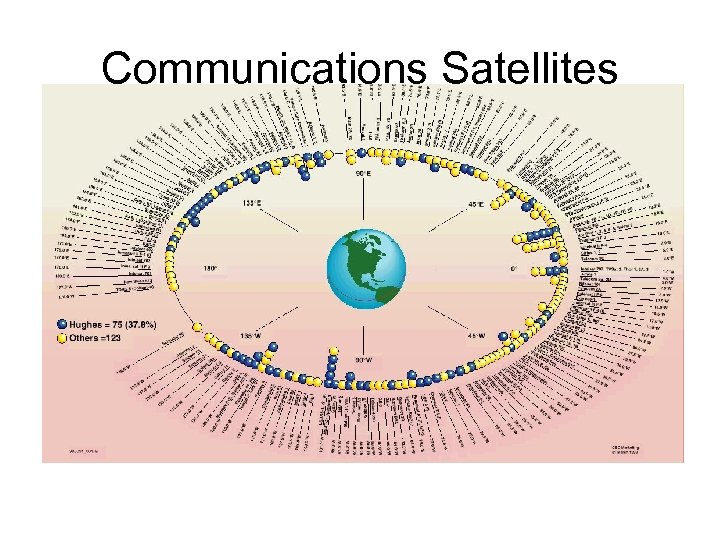
Communications Satellites
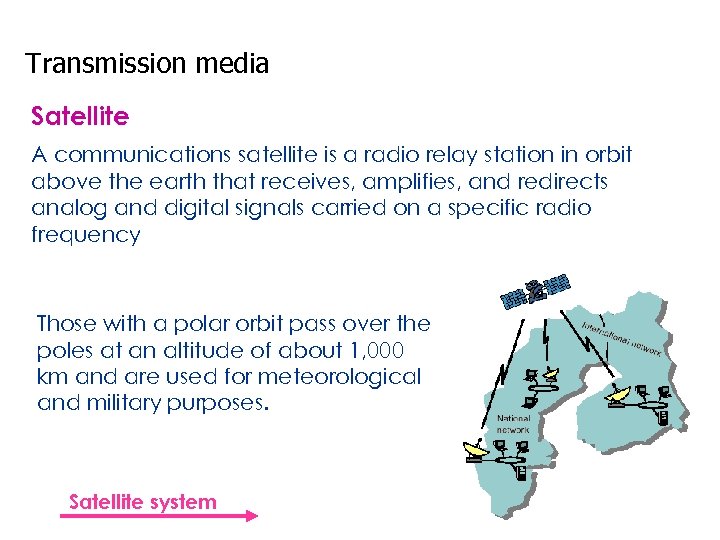
Transmission media Satellite A communications satellite is a radio relay station in orbit above the earth that receives, amplifies, and redirects analog and digital signals carried on a specific radio frequency Those with a polar orbit pass over the poles at an altitude of about 1, 000 km and are used for meteorological and military purposes. Satellite system
Transmission media Satellite In addition to communications satellites, there are other types of satellites: · Weather satellites: Provide meteorologists with scientific data to predict weather conditions and are equipped with advanced instruments · Earth observation satellites: These satellites allow scientists to gather valuable data about the earth's resources and ecosystem · Navigation satellites: Using GPS technology these satellites are able to provide a person's exact location on Earth to within a few meters.
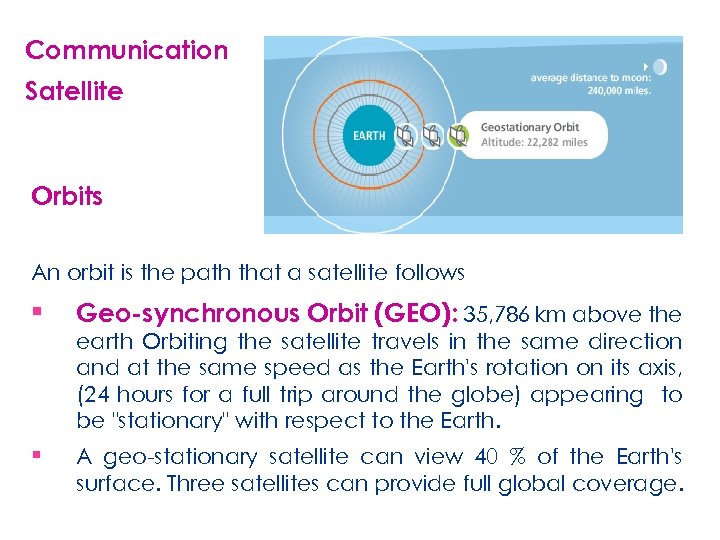
Communication Satellite Orbits An orbit is the path that a satellite follows ▪ Geo-synchronous Orbit (GEO): 35, 786 km above the ▪ A geo-stationary satellite can view 40 % of the Earth's surface. Three satellites can provide full global coverage. earth Orbiting the satellite travels in the same direction and at the same speed as the Earth's rotation on its axis, (24 hours for a full trip around the globe) appearing to be "stationary" with respect to the Earth.
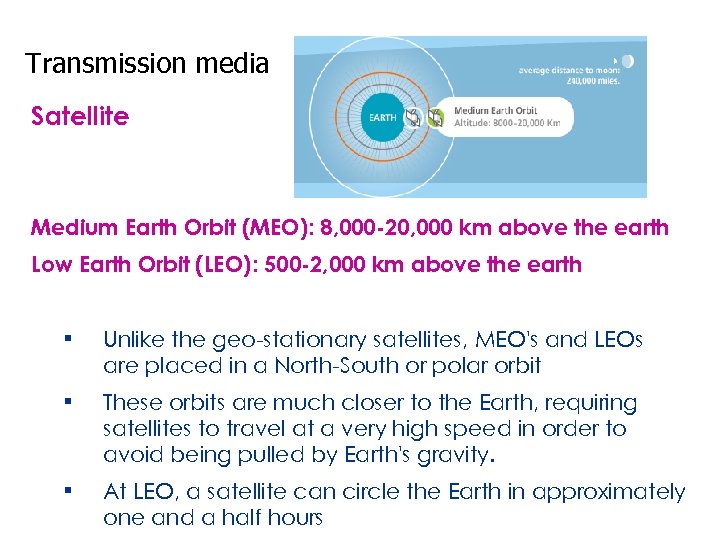
Transmission media Satellite Medium Earth Orbit (MEO): 8, 000 -20, 000 km above the earth Low Earth Orbit (LEO): 500 -2, 000 km above the earth ▪ Unlike the geo-stationary satellites, MEO's and LEOs are placed in a North-South or polar orbit ▪ These orbits are much closer to the Earth, requiring satellites to travel at a very high speed in order to avoid being pulled by Earth's gravity. ▪ At LEO, a satellite can circle the Earth in approximately one and a half hours
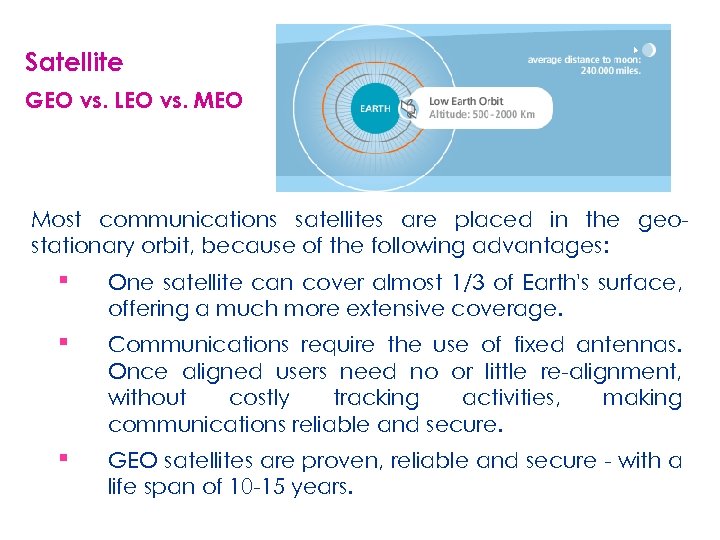
Satellite GEO vs. LEO vs. MEO Most communications satellites are placed in the geostationary orbit, because of the following advantages: ▪ One satellite can cover almost 1/3 of Earth's surface, offering a much more extensive coverage. ▪ Communications require the use of fixed antennas. Once aligned users need no or little re-alignment, without costly tracking activities, making communications reliable and secure. ▪ GEO satellites are proven, reliable and secure - with a life span of 10 -15 years.
Satellite architecture • The main structure of a satellite which houses all its functional elements is called a BUS. • The parts of the satellite which are required to carry out its specified performance (mission) are called PAY LOAD • Bus includes, body, power system, batteries, tracking and control electronics. Payload includes antennas, communication electronics particularly transponder • The bus is the same for almost all satellites. Payload varies according to the “purpose” of the satellites
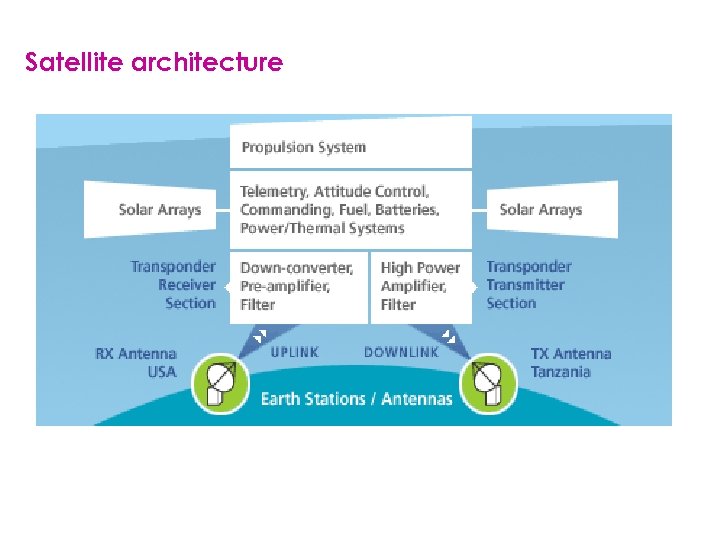
Satellite architecture
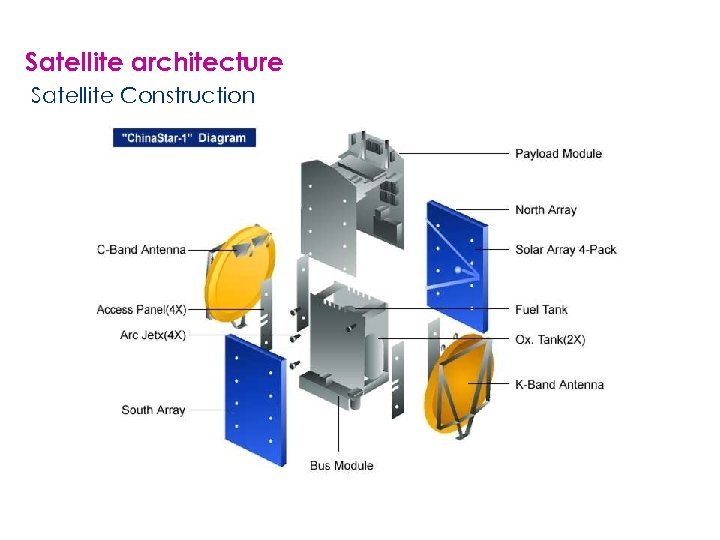
Satellite architecture Satellite Construction
Payload of a Communication Satellite • The most important part of a communication satellite payload is its transponder • Modern satellites have between 24 and 72 transponders. Transponders have 24 , 36, 72 Mhz bandwidths. • A single transponder is capable of handling up to 155 million bits of information per second. • With this immense capacity, communication satellites are an ideal medium for transmitting and receiving almost any kind of content - from simple voice or data to the most complex and bandwidth-intensive video, audio and Internet content .
Frequency bands and beams Satellite Transponder • Signals are received by the satellite at a very low power levels because of the long distance traversed by the radio waves. • The satellite needs to boost the power level of these signals before they are re-transmitted back to the earth to ensure that they are detectable by an earth-based receiver. • This is achieved using a set of high power amplifiers onboard the satellite, where each amplifier operates over a defined frequency range.
Frequency bands and beams Satellite Transponder The combination of equipment required to amplify carriers within a given frequency range is commonly referred to as a transponder. This equipment includes the high power amplifier (HPA) itself, as well as filters at the input and at the output of the amplifier to isolate the desired carriers from the carriers processed by other transponders. The frequency extent over which the amplifier operates is usually referred to as the transponder's usable bandwidth. Typical usable bandwidths are 33 MHz, 36 MHz and 72 MHz.
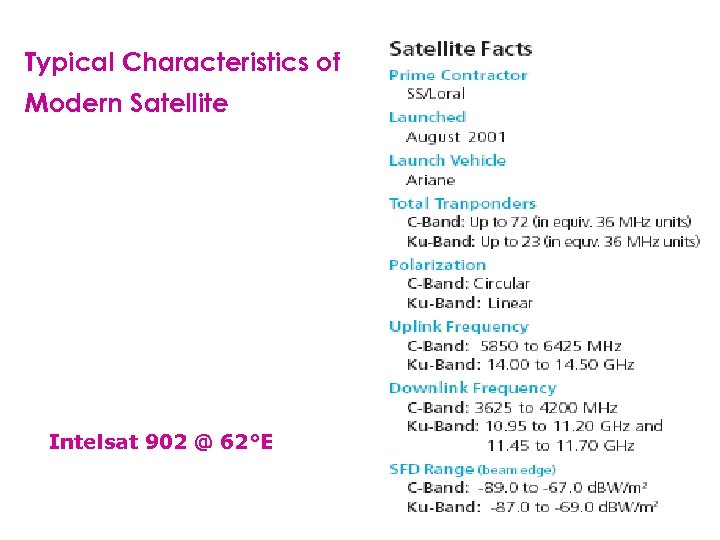
Typical Characteristics of Modern Satellite Intelsat 902 @ 62°E
Orbital location and footprint ▪ The location of a geo-stationary satellite is referred to as its orbital location. ▪ International satellites, are normally measured in terms of longitudinal degrees East (° E) from the Prime Meridian of 0° ▪ ▪ ▪ The geographic area of the Earth's surface over which a satellite can transmit to, or receive from, is called the satellite's "footprint. " The footprint can be tailored to include beams with different frequencies and power levels.
Satellite beams and foot prints The foot prints are designed to focus satellite power on desired parts of the earth. These focus areas are called beams. Every satellite has its own systems of satellite beams. Intelsat offers four beam types: · Global: covering almost 1/3 of Earth's surface · Hemi: covering almost 1/6 of Earth's surface · Zone: covering a large landmass area · Spot: covering a specific geographic area
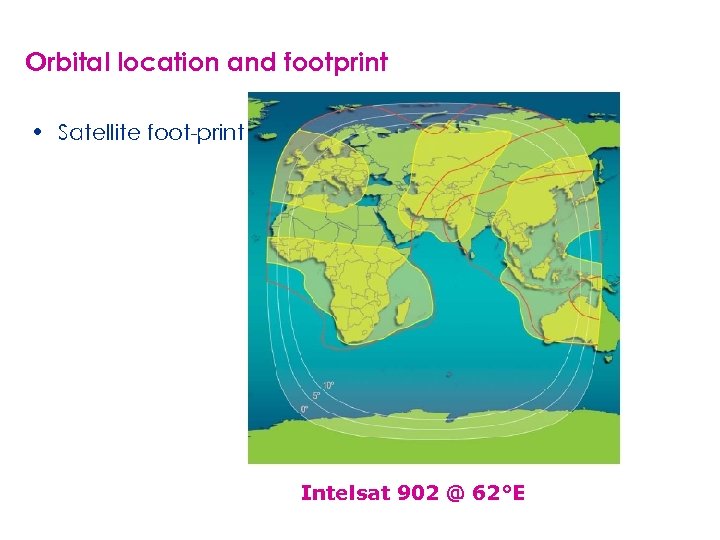
Orbital location and footprint • Satellite foot-print Intelsat 902 @ 62°E
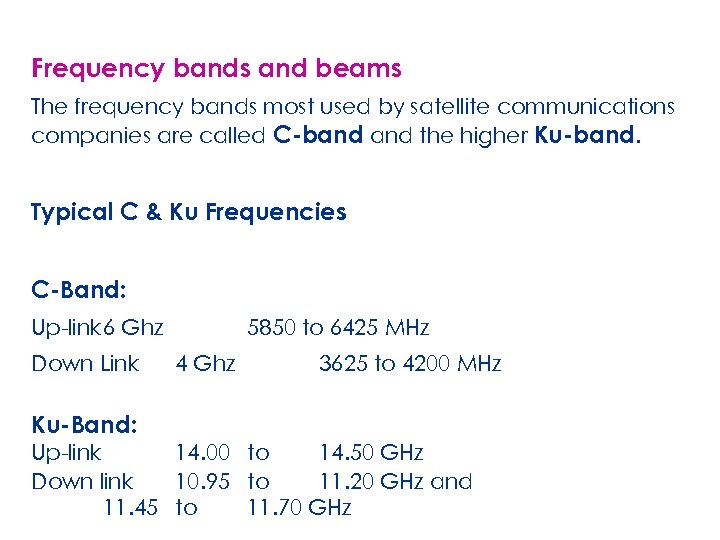
Frequency bands and beams The frequency bands most used by satellite communications companies are called C-band the higher Ku-band. Typical C & Ku Frequencies C-Band: Up-link 6 Ghz Down Link 5850 to 6425 MHz 4 Ghz 3625 to 4200 MHz Ku-Band: Up-link 14. 00 to 14. 50 GHz Down link 10. 95 to 11. 20 GHz and 11. 45 to 11. 70 GHz
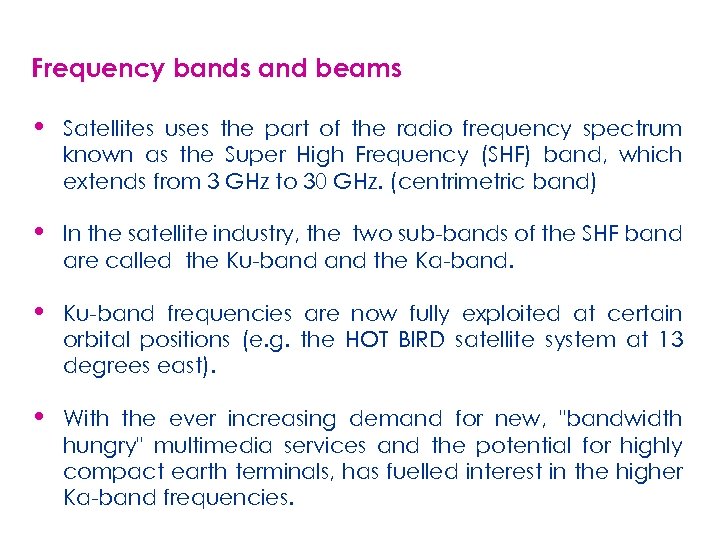
Frequency bands and beams • Satellites uses the part of the radio frequency spectrum known as the Super High Frequency (SHF) band, which extends from 3 GHz to 30 GHz. (centrimetric band) • In the satellite industry, the two sub-bands of the SHF band are called the Ku-band the Ka-band. • Ku-band frequencies are now fully exploited at certain orbital positions (e. g. the HOT BIRD satellite system at 13 degrees east). • With the ever increasing demand for new, "bandwidth hungry" multimedia services and the potential for highly compact earth terminals, has fuelled interest in the higher Ka-band frequencies.
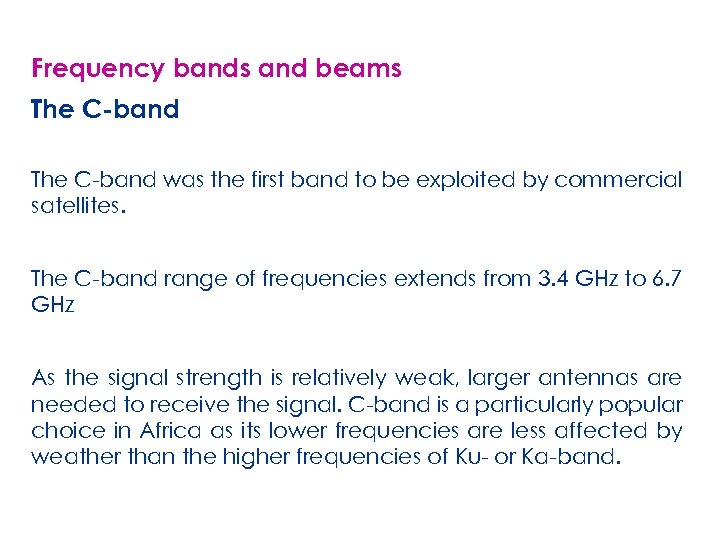
Frequency bands and beams The C-band was the first band to be exploited by commercial satellites. The C-band range of frequencies extends from 3. 4 GHz to 6. 7 GHz As the signal strength is relatively weak, larger antennas are needed to receive the signal. C-band is a particularly popular choice in Africa as its lower frequencies are less affected by weather than the higher frequencies of Ku- or Ka-band.
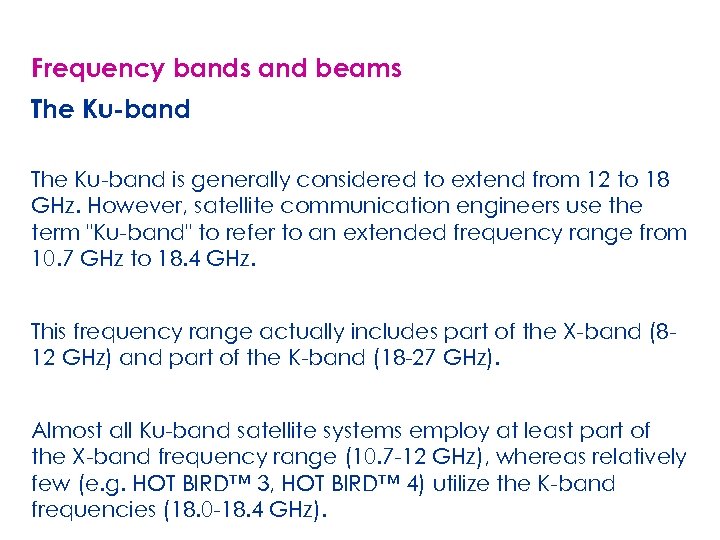
Frequency bands and beams The Ku-band is generally considered to extend from 12 to 18 GHz. However, satellite communication engineers use the term "Ku-band" to refer to an extended frequency range from 10. 7 GHz to 18. 4 GHz. This frequency range actually includes part of the X-band (812 GHz) and part of the K-band (18 -27 GHz). Almost all Ku-band satellite systems employ at least part of the X-band frequency range (10. 7 -12 GHz), whereas relatively few (e. g. HOT BIRD™ 3, HOT BIRD™ 4) utilize the K-band frequencies (18. 0 -18. 4 GHz).
Frequency bands and beams The Ka-band extends from 27 GHz to 40 GHz. It includes the upper part of the SHF band the lower part of the Extremely High Frequency (EHF) range, which extends from 30 to 300 GHz. Commercial Ka-band satellites systems typically employ the 27. 5 -30. 0 GHz SHF frequency range for up-link transmissions and the 17. 7 -20. 2 GHz range for down-link transmissions).
Frequency bands and beams What are the differences • There are two main differences between the C-band the Ka-band. • For a fixed antenna size, the beam becomes more concentrated at Ka-band, providing higher gain and a narrower beam-width. • • smaller earth terminals than possible in the Ku-band. However, due to the narrower beam-width, antenna pointing errors increases and the antennas on-board the satellite become more complex. • The second factor is the effects of the weather is severe at the higher frequencies.
Satellite Network topologies Satellites can be used with different ground network designs or network topologies. At its simplest, satellite can support one-direction or twodirection links between two earth stations More complex communications needs can also be addressed with more sophisticated network topologies, such as star and mesh.
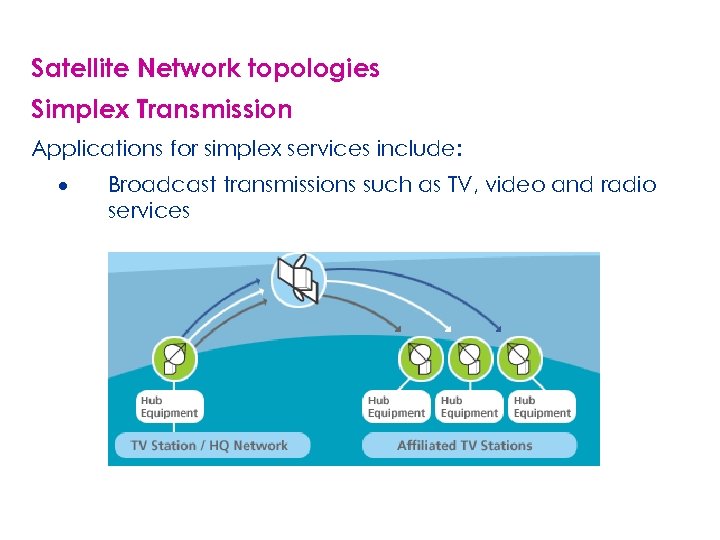
Satellite Network topologies Simplex Transmission Applications for simplex services include: · Broadcast transmissions such as TV, video and radio services
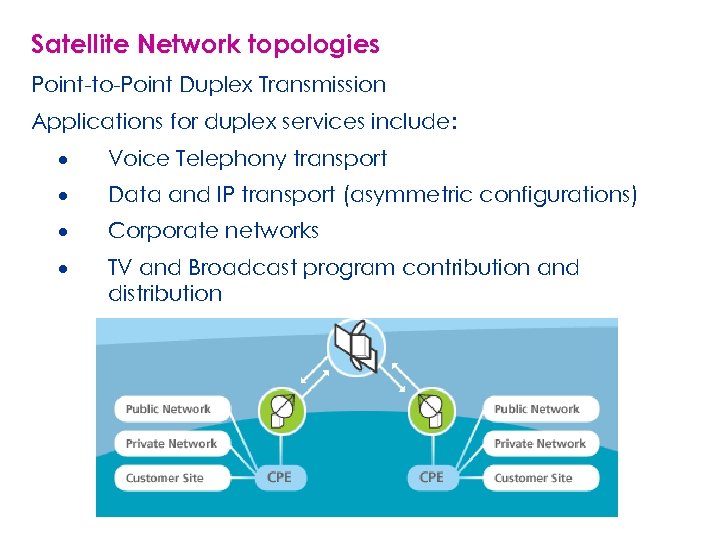
Satellite Network topologies Point-to-Point Duplex Transmission Applications for duplex services include: · Voice Telephony transport · Data and IP transport (asymmetric configurations) · Corporate networks · TV and Broadcast program contribution and distribution
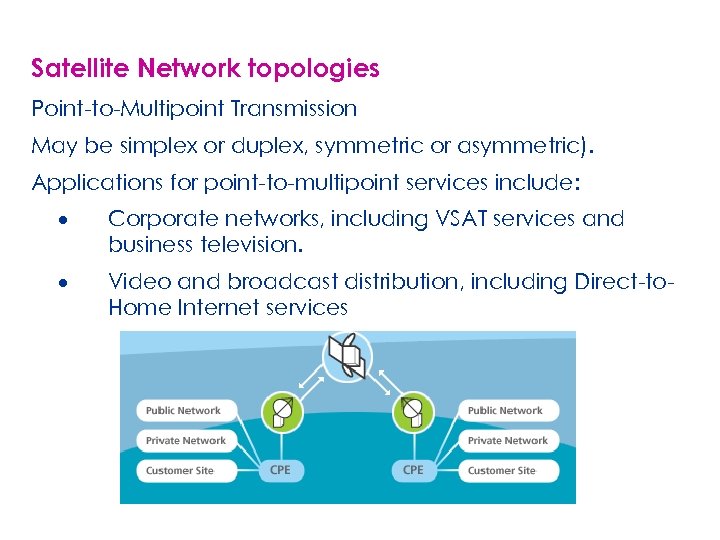
Satellite Network topologies Point-to-Multipoint Transmission May be simplex or duplex, symmetric or asymmetric). Applications for point-to-multipoint services include: · Corporate networks, including VSAT services and business television. · Video and broadcast distribution, including Direct-to. Home Internet services
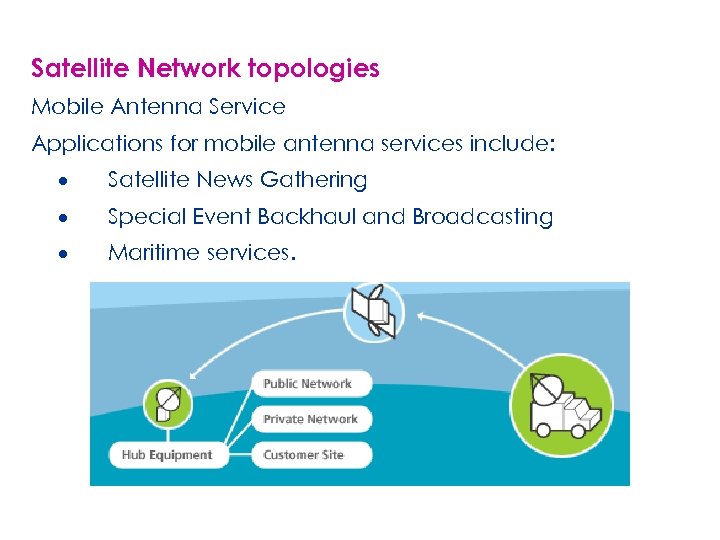
Satellite Network topologies Mobile Antenna Service Applications for mobile antenna services include: · Satellite News Gathering · Special Event Backhaul and Broadcasting · Maritime services.
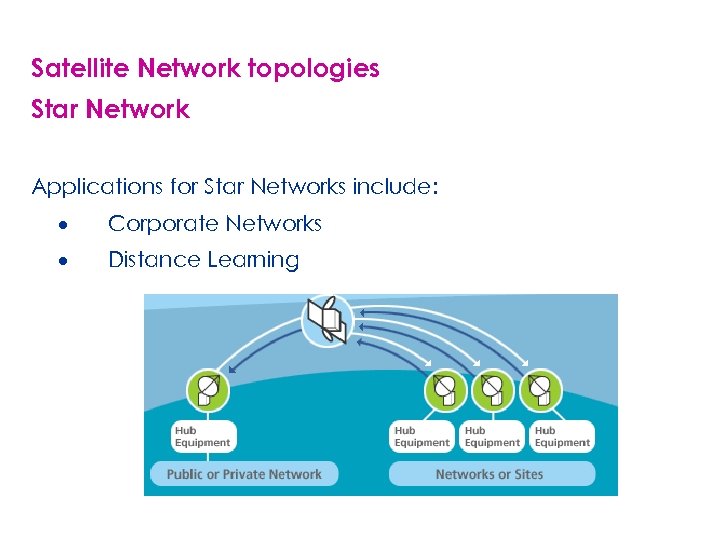
Satellite Network topologies Star Network Applications for Star Networks include: · Corporate Networks · Distance Learning
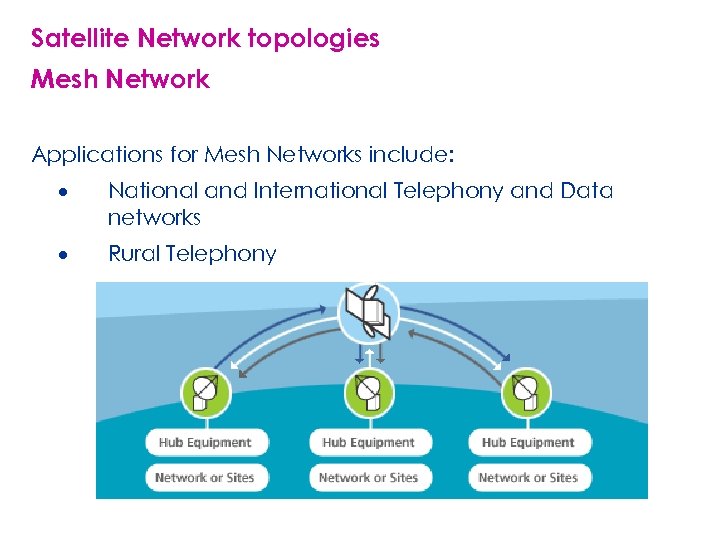
Satellite Network topologies Mesh Network Applications for Mesh Networks include: · National and International Telephony and Data networks · Rural Telephony
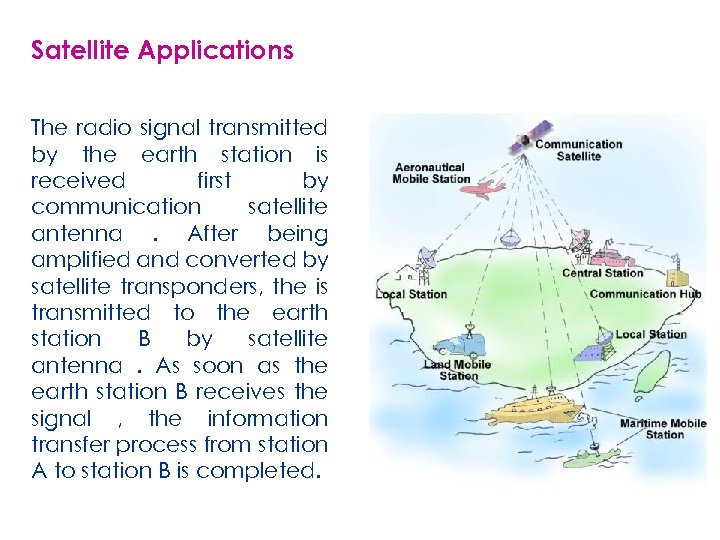
Satellite Applications The radio signal transmitted by the earth station is received first by communication satellite antenna. After being amplified and converted by satellite transponders, the is transmitted to the earth station B by satellite antenna. As soon as the earth station B receives the signal , the information transfer process from station A to station B is completed.
GROUND SEGMENT REQUIREMENTS The equipment installed on earth for a satellite communication link is called ground segment. Composition of ground segment varies with specific applications. All communications with a geo-stationary satellite require using an earth station or antenna. Earth Stations may be either fixed (installed at a specific location) or mobile for uses such as Satellite News Gathering (SNG) or maritime applications.
GROUND SEGMENT REQUIREMENTS Antennas range in size, from large telecommunications carrier dishes of 4. 5 to 15 meters in diameter, to VSAT antennas which can be as small as under one meter, designed to support services such as Direct to Home TV (DTH) and rural telephony. The antenna, itself, will generally be connected to equipment indoors called an indoor unit (IDU), which then connects either to the actual communications devices being used, to a Local Area Network (LAN), or to additional terrestrial network infrastructure Low Noise amplifiers, High Power amplifiers , Frequency converters, encoders, decoders, modems and routers are installed according to required application.
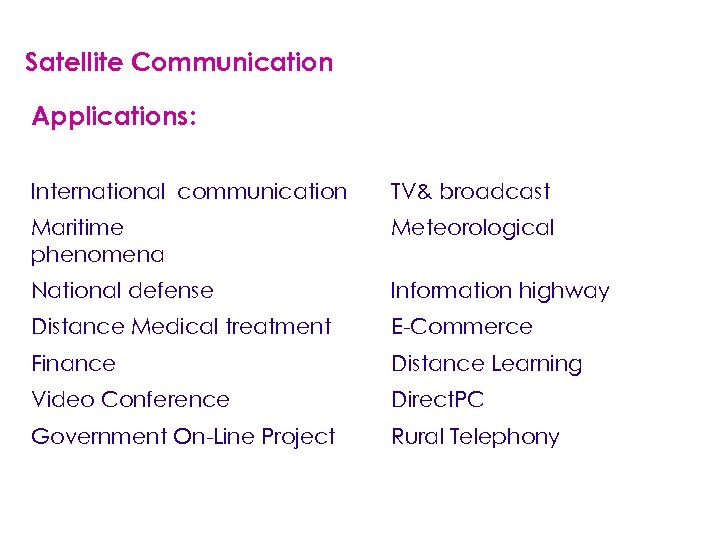
Satellite Communication Applications: International communication TV& broadcast Maritime phenomena Meteorological National defense Information highway Distance Medical treatment E-Commerce Finance Distance Learning Video Conference Direct. PC Government On-Line Project Rural Telephony
Satellite advantages Because of their universal and multi-point nature, satellitebased solutions can provide a flexible and cost-effective answer to support: · Fixed or wireless voice and data communications · Enterprise networking · Financial transactions · Internet linkages · Satellite video transmission and distribution networks Satellite solutions provide for the delivery of vital information, news, sports and entertainment to every corner of the globe, no matter how remote.
Satellite advantages Satellite communications have distinct benefits over terrestrial alternatives: · UNIVERSAL: available virtually everywhere, The reach of a single satellite is far more extensive than any terrestrial network can achieve. · VERSATILE: Can support all of today's communications needs - transactional and multimedia applications, video, voice, cellular networks, entertainment and breaking news. · Bring broadband to the last mile · Overcome regulatory issues that make alternative carriers dependent on incumbents. · Fast and inexpensive infrastructure to areas where terrestrial alternatives are unavailable, unreliable.
Satellite advantages · RELIABLE: proven medium with minimum points of failure , constant and uniform quality of service locations, regardless of geography. · BROADCAST CAPABILITY: Satellite's inherent strength as makes it ideal for the simultaneous distribution of bandwidth-intensive information to thousands of locations. · FAST: satellite networks can be rolled out quickly and hundreds or thousands of locations , · EXPANDABLE: Satellite networks are easily scalable, allowing users to expand their communications networks and bandwidth requirements according to real time needs. · FLEXIBLE: can be easily integrated or augment or extend any communications network
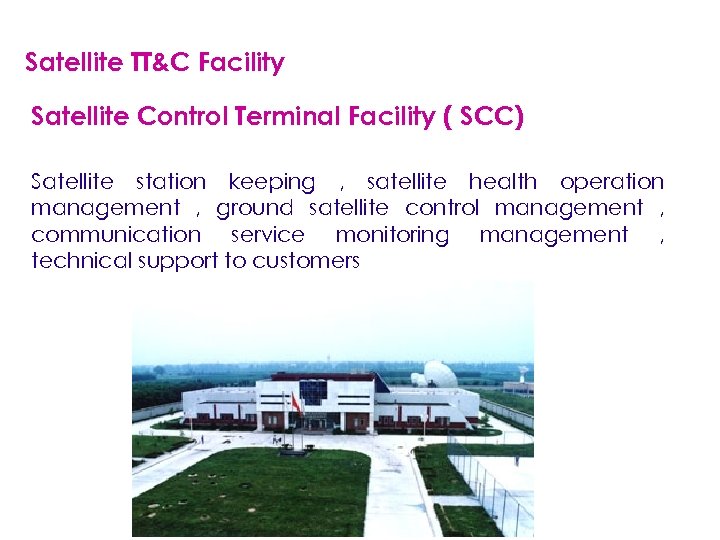
Satellite TT&C Facility Satellite Control Terminal Facility ( SCC) Satellite station keeping , satellite health operation management , ground satellite control management , communication service monitoring management , technical support to customers
Transmission media Satellite limitations Initially, satellite communication was economical as compared to analog submarine cables of those times. However when compared with today's high capacity optical communication cables, they have certain weaker points Limitations: • limited capacity • longer delays • Security • Interference • expensive

End of Lecture
Satellite Communication Brief History: • 1945, Arthur C Clark presented the idea of Satellite communication. • 1948, U. S Army Signal Corps had transmitted radar signals to the moon and bounced them back to earth. • 1954, the U. S. Navy transmitted voice messages to the moon then detected their reflection back on earth. • 1957, Sputnik 1 first man made Satellite (into LEO) launched. • 1958, the U. S. launched their first satellite, Explorer 1, it provided preliminary information on the environment and conditions in space outside earth's atmosphere. • 1958, NASA was established & launched SCORE into LEO; received messages at 150 MHz, taped them, then retransmitted to earth.
Cont. . . • December 19, 1958, The first broadcast from space to earth was on, by U. S. president Eisenhower - it was a Christmas greeting. • 1960, Echo 1, a passive 'satellite launched at very low altitude. It received & reflected back to earth, low power, duplex (two-way) telephone conversations. • April, 1960, NASA launched Tiros I, the first weather satellite. It carried low resolution television and infrared cameras and was in a circular polar orbit of about 600 km. • July 10, 1962 Telstar 1 a LEO satellite, (AT&T), linked Europe and North America, via satellite - live, on television. • 1963, first experimental geosynchronous communications satellites were launched in, Telstar 2. • 1964, Tokyo Olympics to the United States were relayed via satellite. • In 1965, USSR launched their Molnya twelve hour Satellite.
Cont. . . • 1965 the first international geo satellite, Intelsat 1 (Early Bird), was launched. • In 1969, Intelsat completed the first global geo network, i. e. satellite system that covered all the globe. • 1976, the first "military satellite" KH-11 was let into space & was equipped with large telescopes and video cameras to observe Earth and send the data to ground. " It's rumored that KH-11's can pick out objects six inches long, and perhaps as little as two inches long; it may be possible to read automobile plates" • 1979, INMARSAT was established to provide Int’l telephone & traffic-monitoring services on ships at sea. • 1969, Pakistan signed contract with RCA for the supply, installation of Satellite Earth Station at Dehmandro Karachi. The trail reception was started in 1971. The station was commissioned for regular telephone / TV traffic in 1972.
Why Satellite? • • Communication over a longer distance. Increased flexibility/reliable than other systems. Cost independent of distance. Price is becoming more affordable every year. Applications: • • • Telecommunications (Fixed, Mobile, Ships) Broadcasting (Radio and TV) Rapid deployment services. Observation and exploration. Military Strategic data & Navigational data for ship etc. Weather and Land Surveillance.
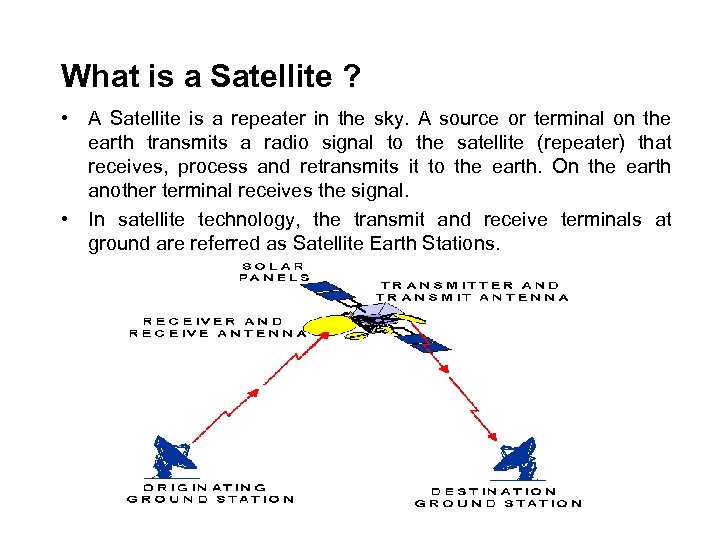
What is a Satellite ? • A Satellite is a repeater in the sky. A source or terminal on the earth transmits a radio signal to the satellite (repeater) that receives, process and retransmits it to the earth. On the earth another terminal receives the signal. • In satellite technology, the transmit and receive terminals at ground are referred as Satellite Earth Stations.
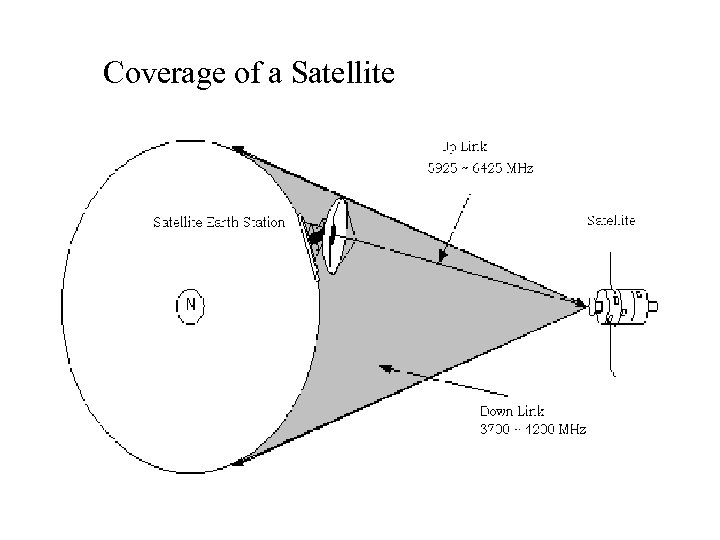
Coverage of a Satellite
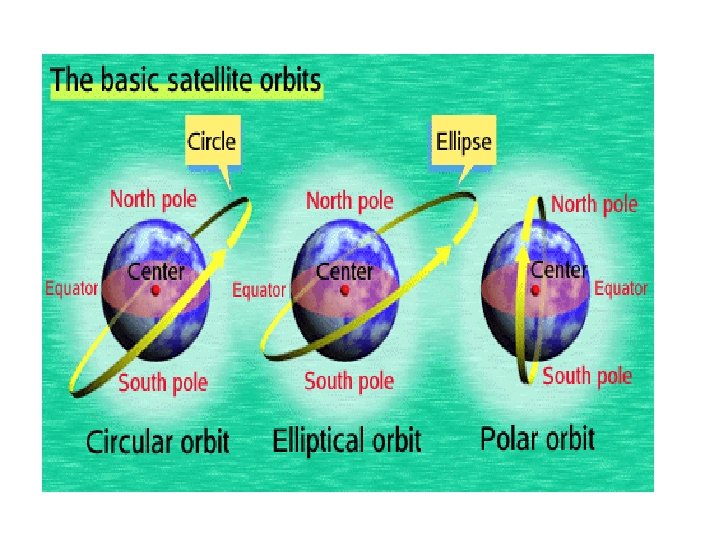
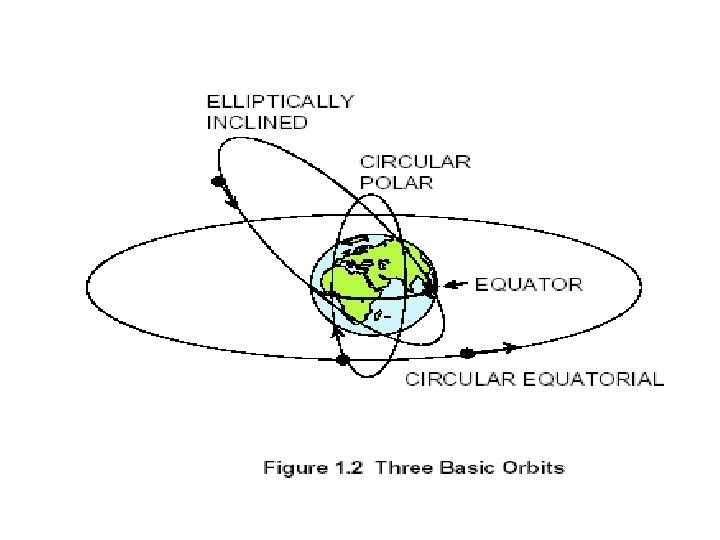
Cont. . • Circular Orbit This is the only orbit that can provide full global coverage by one satellite. In communications where the instantaneous transfer of information is required, full global coverage could be achieved with a series of satellites, separated in time and angle. Elliptically Inclined Orbit An orbit of this type has unique properties that have been successfully used by some communications satellite systems, For this system, the elliptical orbit has an angle of inclination of 63° and a 12 -hour orbit period. By using three satellites, suitably phased, continuous coverage of the polar region that would not be covered by other orbits can be provided. • Circular Equatorial orbit (Geostationary) A satellite in a circular orbit at 35, 800 km has a period of 24 hours, and consequently appears stationary over a fixed point on the Earth's surface.
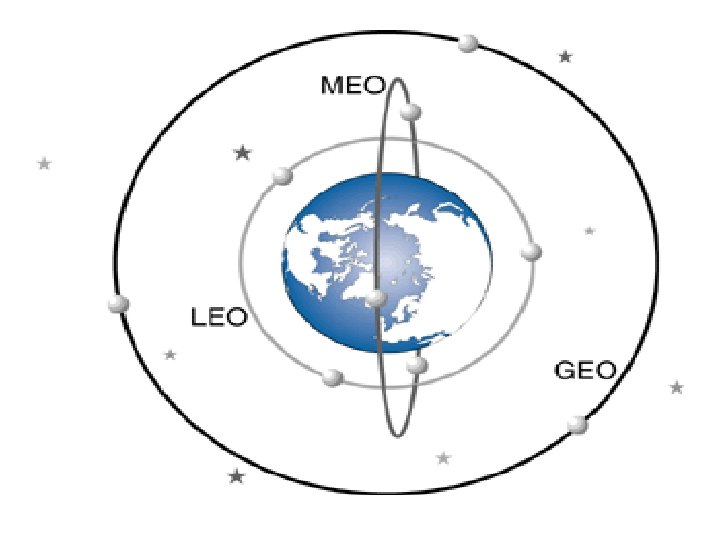
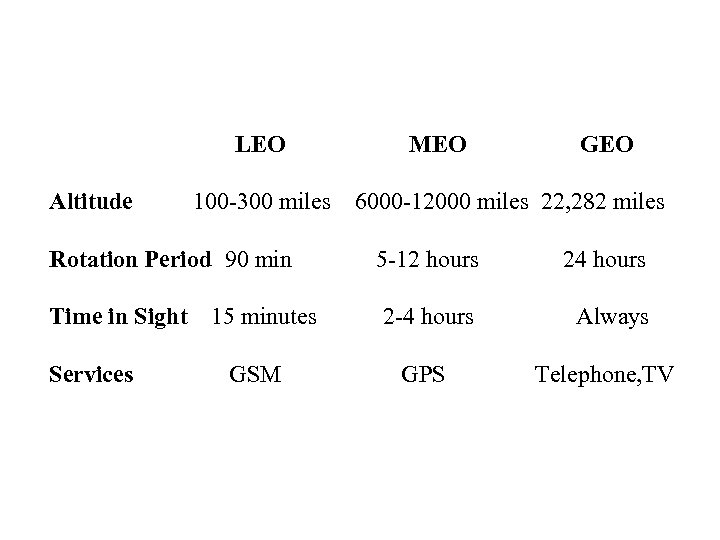
LEO Altitude 100 -300 miles Rotation Period 90 min Time in Sight 15 minutes Services GSM MEO GEO 6000 -12000 miles 22, 282 miles 5 -12 hours 24 hours 2 -4 hours Always GPS Telephone, TV
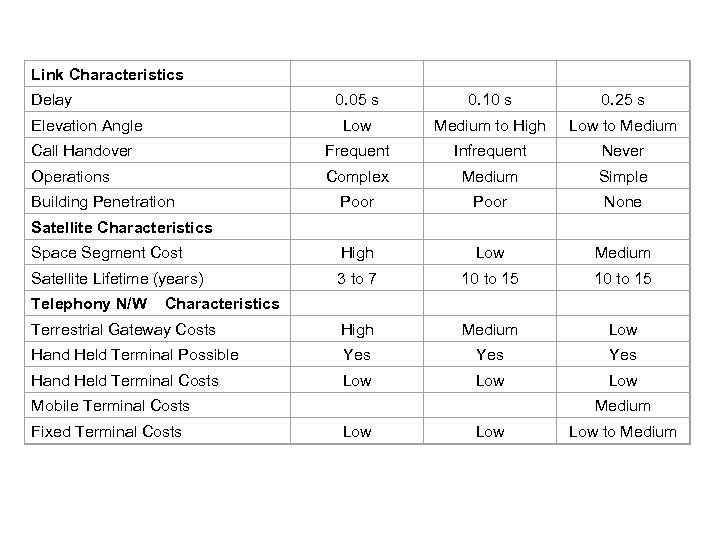
Link Characteristics 0. 05 s 0. 10 s 0. 25 s Low Medium to High Low to Medium Call Handover Frequent Infrequent Never Operations Complex Medium Simple Poor None Space Segment Cost High Low Medium Satellite Lifetime (years) 3 to 7 10 to 15 Terrestrial Gateway Costs High Medium Low Hand Held Terminal Possible Yes Yes Hand Held Terminal Costs Low Low Delay Elevation Angle Building Penetration Satellite Characteristics Telephony N/W Characteristics Medium Mobile Terminal Costs Fixed Terminal Costs Low Low to Medium
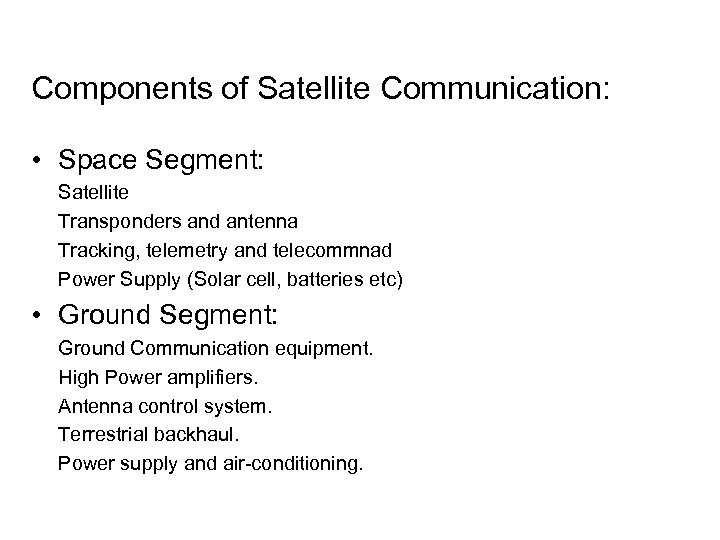
Components of Satellite Communication: • Space Segment: Satellite Transponders and antenna Tracking, telemetry and telecommnad Power Supply (Solar cell, batteries etc) • Ground Segment: Ground Communication equipment. High Power amplifiers. Antenna control system. Terrestrial backhaul. Power supply and air-conditioning.
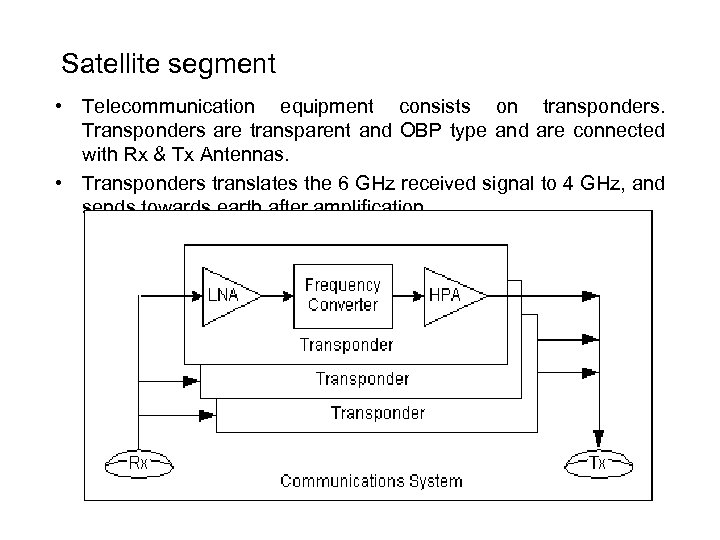
Satellite segment • Telecommunication equipment consists on transponders. Transponders are transparent and OBP type and are connected with Rx & Tx Antennas. • Transponders translates the 6 GHz received signal to 4 GHz, and sends towards earth after amplification.
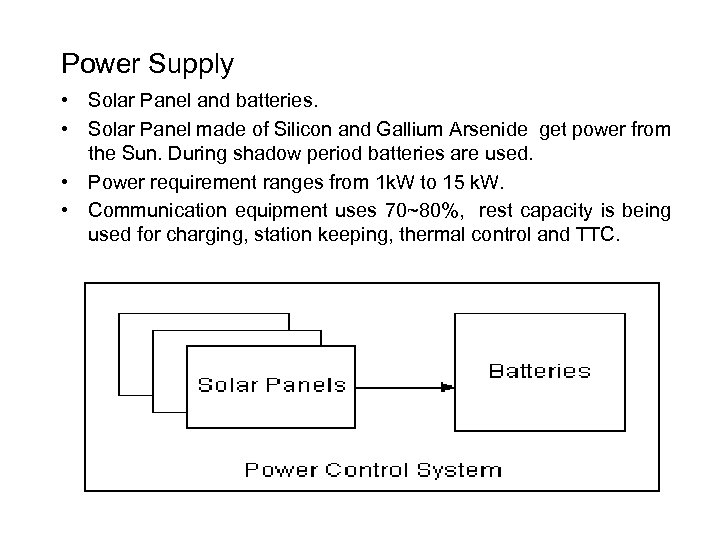
Power Supply • Solar Panel and batteries. • Solar Panel made of Silicon and Gallium Arsenide get power from the Sun. During shadow period batteries are used. • Power requirement ranges from 1 k. W to 15 k. W. • Communication equipment uses 70~80%, rest capacity is being used for charging, station keeping, thermal control and TTC.
Antenna: • It is the port through which Radio frequency is coupled from the transmitter to the outside world and on the reverse side from the outside world to receiver. • Gain of antenna is expressed in d. Bi. Gain relative to that of an isotropic antenna. • The gain of an antenna is the ratio (in d. B) of power radiated in the direction of interest to the power that would be radiated by an isotropic antenna. (particular direction and frequency) • For satellite dish antennas most of the power is concentrated in the main beam of the antenna radiation pattern. Typical values for beam width 2. 4 meter and 3. 8 meter are 1. 5 °& 1. 0° respectively. • Besides radiation in the main beam power is radiated in side lobes. Antenna gain and sides lobes is the function of antenna diameter and antenna geometry. Side lobes are minimized by alignment of sub reflector.
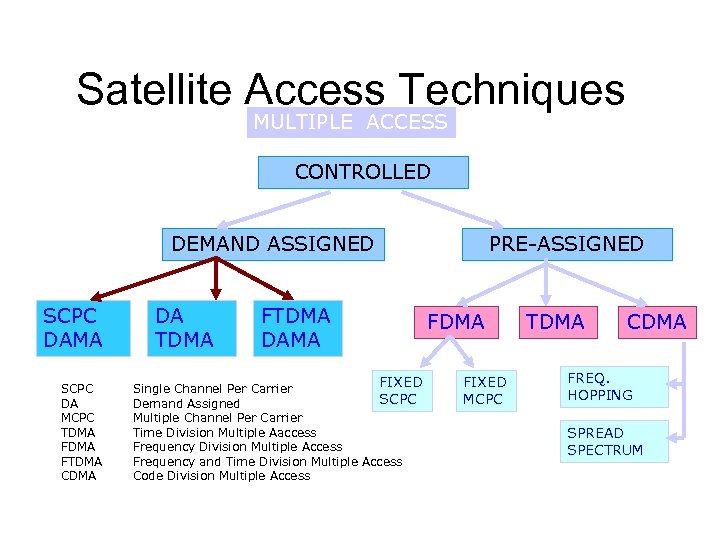
Satellite Access Techniques MULTIPLE ACCESS CONTROLLED DEMAND ASSIGNED SCPC DAMA SCPC DA MCPC TDMA FTDMA CDMA DA TDMA FTDMA DAMA FIXED Single Channel Per Carrier SCPC Demand Assigned Multiple Channel Per Carrier Time Division Multiple Aaccess Frequency Division Multiple Access Frequency and Time Division Multiple Access Code Division Multiple Access PRE-ASSIGNED FDMA FIXED MCPC TDMA CDMA FREQ. HOPPING SPREAD SPECTRUM
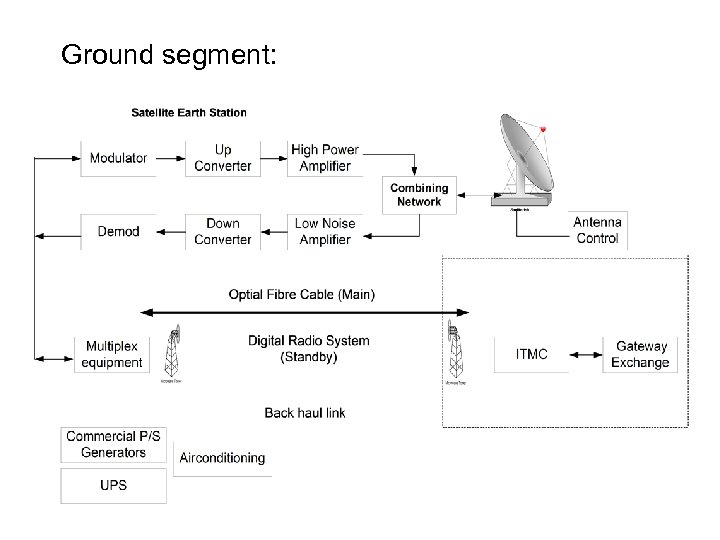
Ground segment:
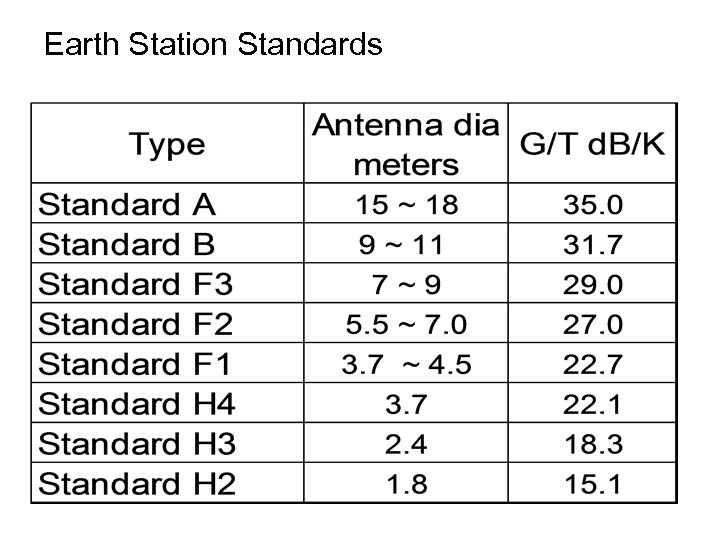
Earth Station Standards
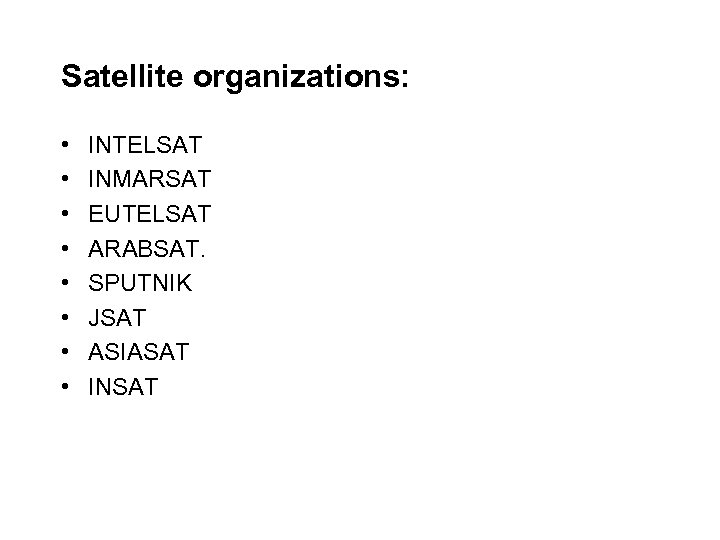
Satellite organizations: • • INTELSAT INMARSAT EUTELSAT ARABSAT. SPUTNIK JSAT ASIASAT INSAT
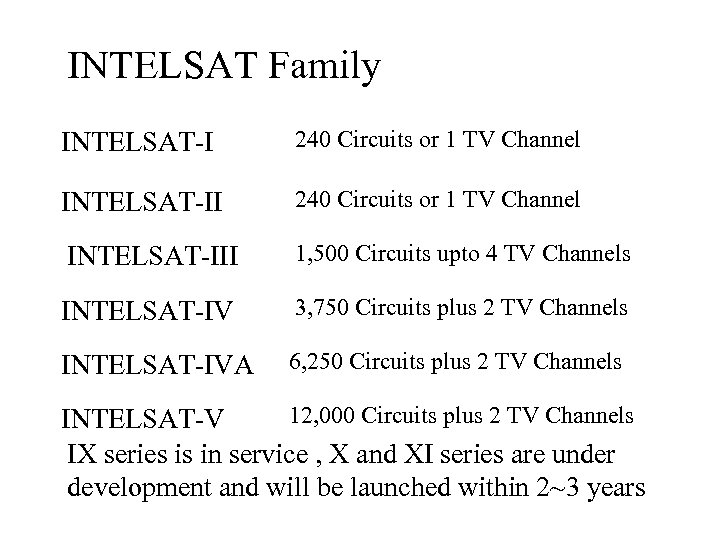
INTELSAT Family INTELSAT-I 240 Circuits or 1 TV Channel INTELSAT-III 1, 500 Circuits upto 4 TV Channels INTELSAT-IV 3, 750 Circuits plus 2 TV Channels INTELSAT-IVA 6, 250 Circuits plus 2 TV Channels 12, 000 Circuits plus 2 TV Channels INTELSAT-V IX series is in service , X and XI series are under development and will be launched within 2~3 years
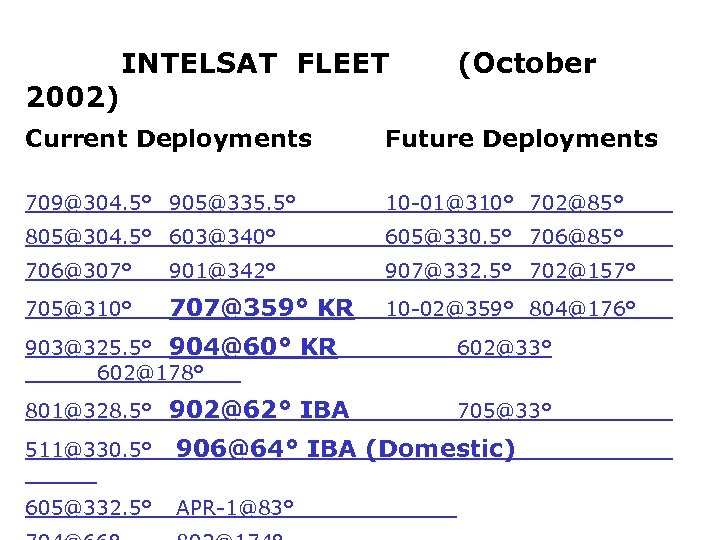
2002) INTELSAT FLEET (October Current Deployments Future Deployments 709@304. 5° 905@335. 5° 10 -01@310° 702@85° 805@304. 5° 603@340° 605@330. 5° 706@85° 706@307° 901@342° 907@332. 5° 702@157° 705@310° 707@359° KR 10 -02@359° 804@176° 903@325. 5° 904@60° 602@178° 801@328. 5° KR 902@62° IBA 602@33° 705@33° 511@330. 5° 906@64° IBA (Domestic) 605@332. 5° APR-1@83°
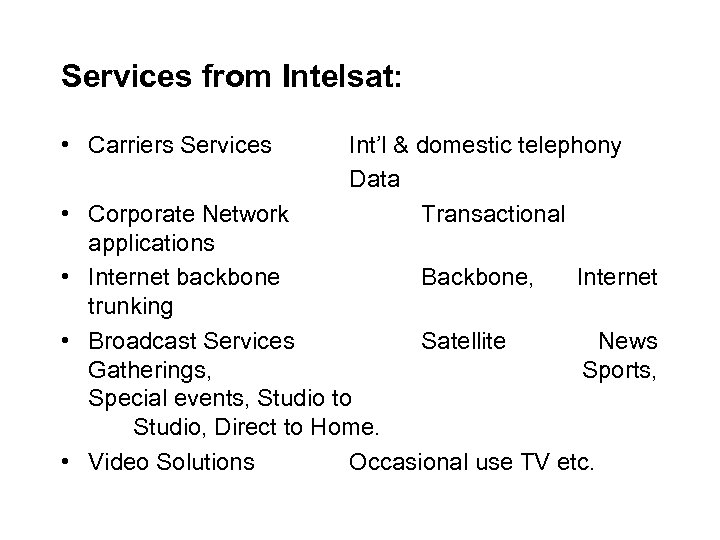
Services from Intelsat: • Carriers Services Int’l & domestic telephony Data Transactional • Corporate Network applications • Internet backbone Backbone, Internet trunking • Broadcast Services Satellite News Gatherings, Sports, Special events, Studio to Studio, Direct to Home. • Video Solutions Occasional use TV etc.
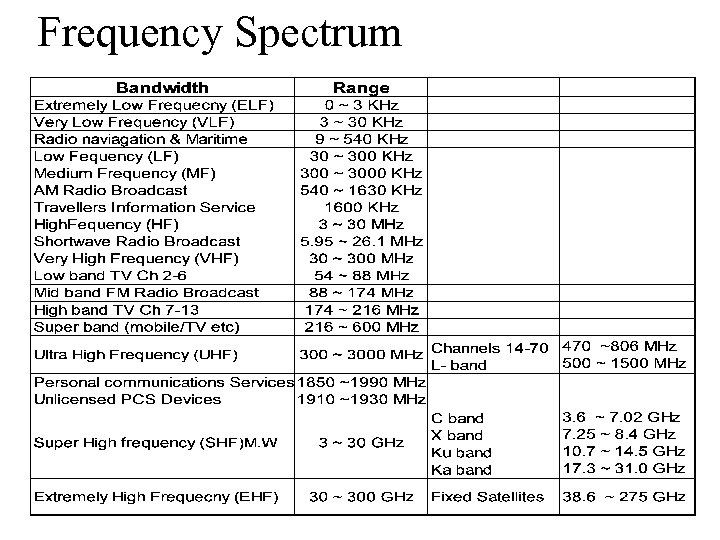
Frequency Spectrum
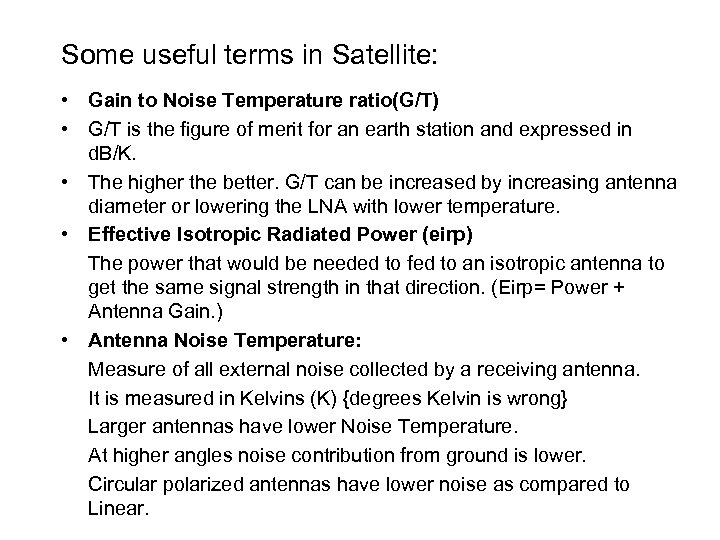
Some useful terms in Satellite: • Gain to Noise Temperature ratio(G/T) • G/T is the figure of merit for an earth station and expressed in d. B/K. • The higher the better. G/T can be increased by increasing antenna diameter or lowering the LNA with lower temperature. • Effective Isotropic Radiated Power (eirp) The power that would be needed to fed to an isotropic antenna to get the same signal strength in that direction. (Eirp= Power + Antenna Gain. ) • Antenna Noise Temperature: Measure of all external noise collected by a receiving antenna. It is measured in Kelvins (K) {degrees Kelvin is wrong} Larger antennas have lower Noise Temperature. At higher angles noise contribution from ground is lower. Circular polarized antennas have lower noise as compared to Linear.
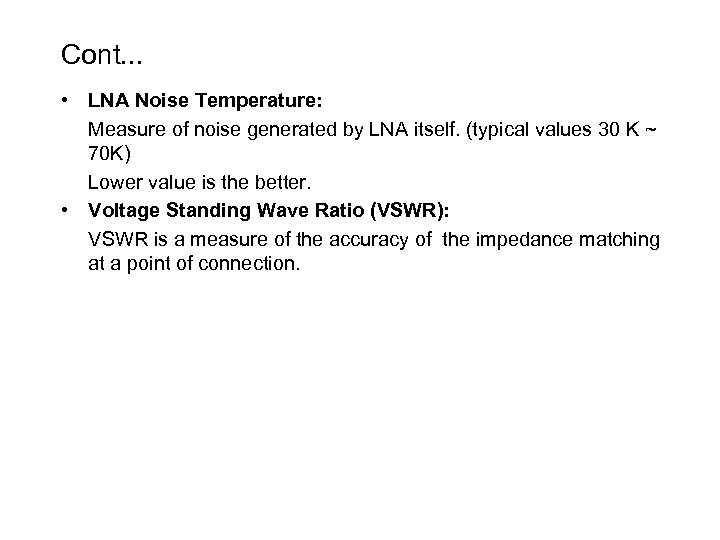
Cont. . . • LNA Noise Temperature: Measure of noise generated by LNA itself. (typical values 30 K ~ 70 K) Lower value is the better. • Voltage Standing Wave Ratio (VSWR): VSWR is a measure of the accuracy of the impedance matching at a point of connection.
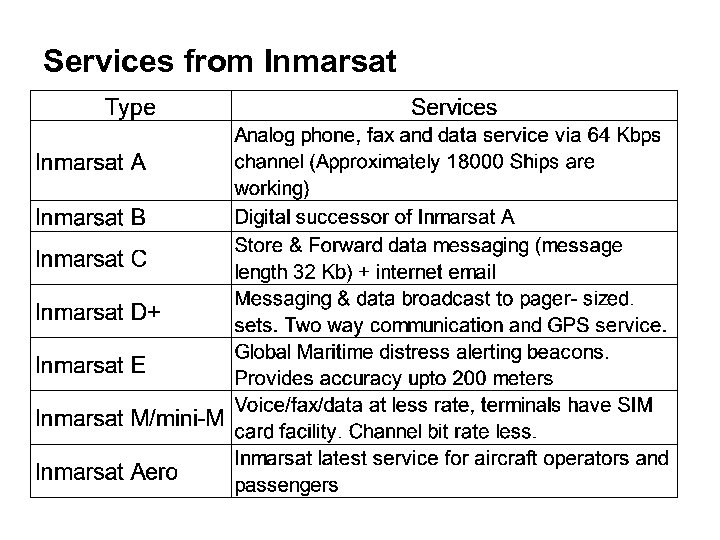
Services from Inmarsat
 Скачать презентацию Communications On March 10 1876 in Boston
dc4b2a336da9501c6d56ab2b1f7459ad.ppt