


 Скачать презентацию Communication Matters working with speech language and communication
9eafbdd5101b3d80fa8a5e571629285b.ppt
- Количество слайдов: 55
 Communication Matters: working with speech, language and communication difficulties Diz Minnitt and Karen Bryan March 2010
 Welcome The aims of today are to: • Explore the incidence of Speech, Language and Communication difficulties • Increase your understanding of the impact of such difficulties on young people • Consider ways to support such children within the youth justice system (YJS).
 Who Wants To Be Communication Aware?
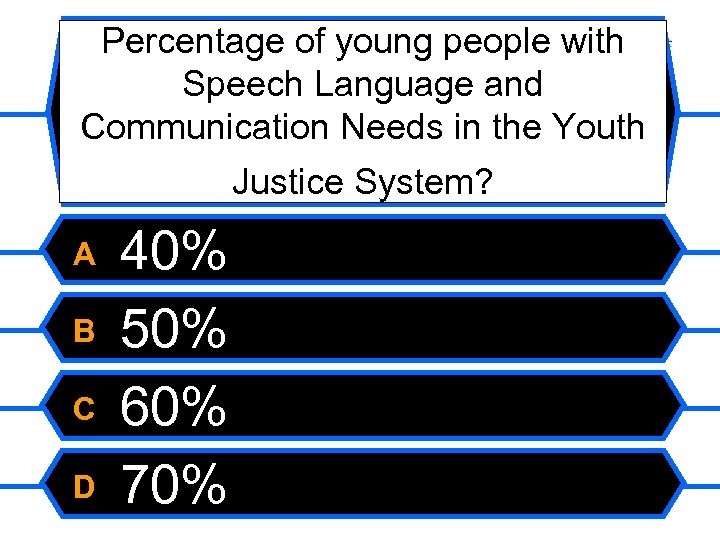 Percentage of young people with Speech Language and Communication Needs in the Youth Justice System? A B C D 40% 50% 60% 70%
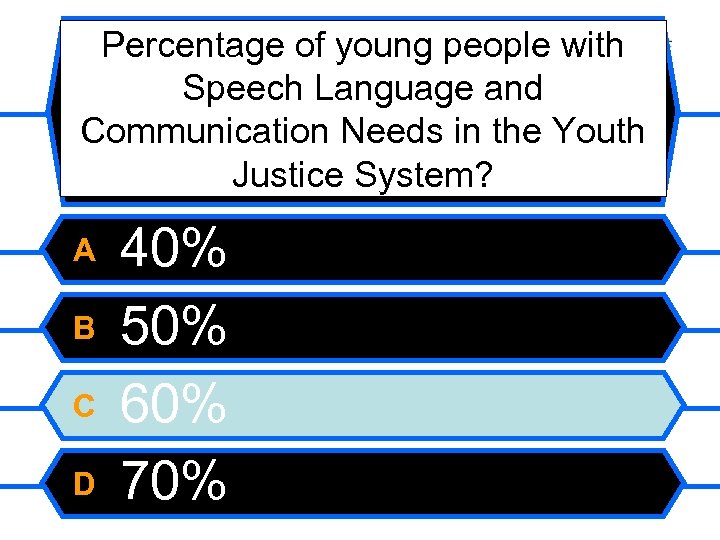 Percentage of young people with Speech Language and Communication Needs in the Youth Justice System? A B C D 40% 50% 60% 70%
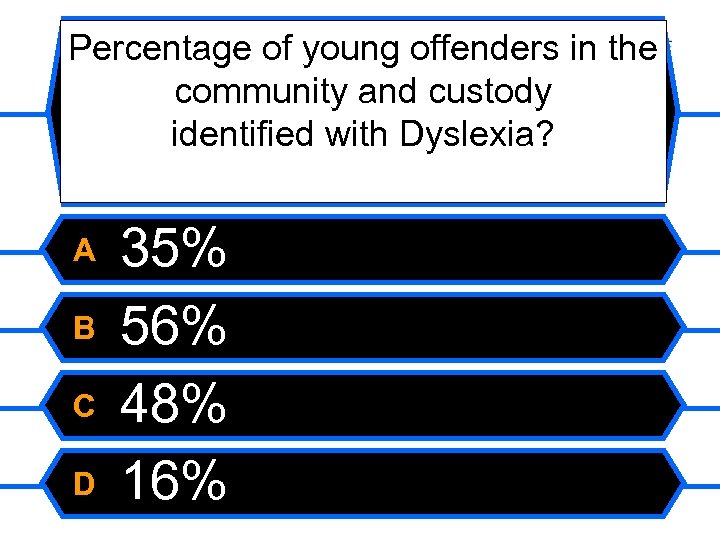 Percentage of young offenders in the community and custody identified with Dyslexia? A B C D 35% 56% 48% 16%
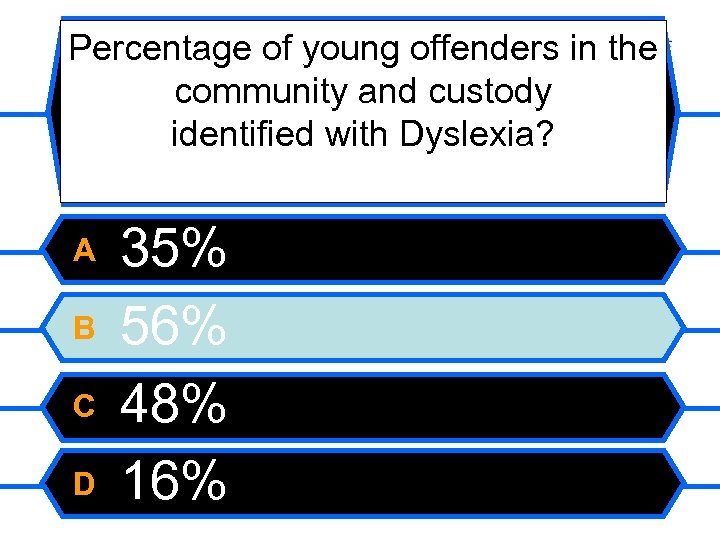 Percentage of young offenders in the community and custody identified with Dyslexia? A B C D 35% 56% 48% 16%
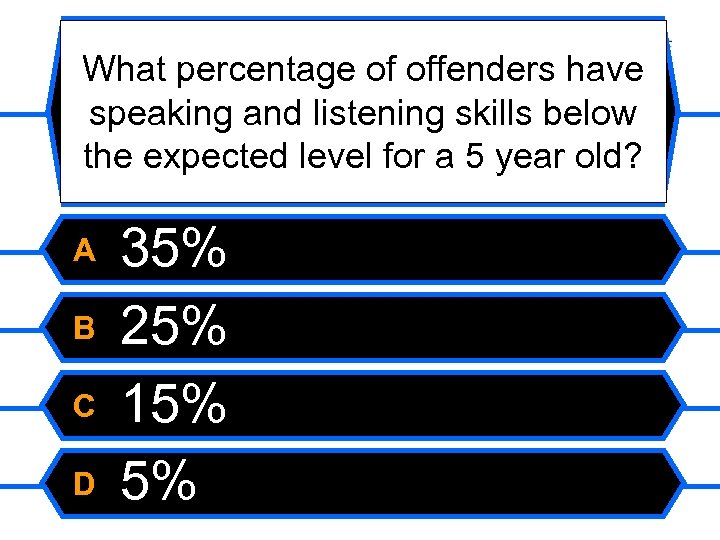 What percentage of offenders have speaking and listening skills below the expected level for a 5 year old? A B C D 35% 25% 15% 5%
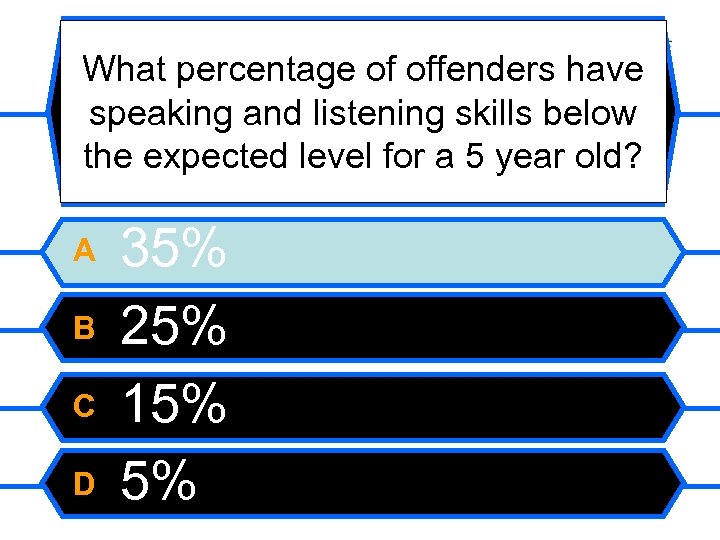 What percentage of offenders have speaking and listening skills below the expected level for a 5 year old? A B C D 35% 25% 15% 5%
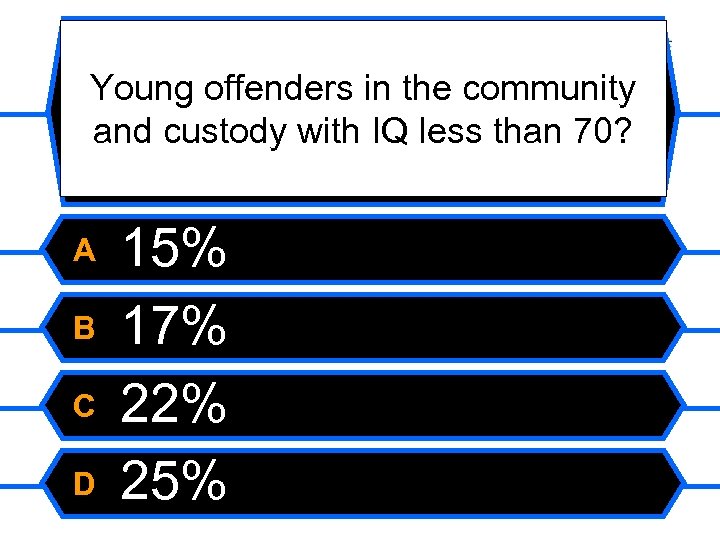 Young offenders in the community and custody with IQ less than 70? A B C D 15% 17% 22% 25%
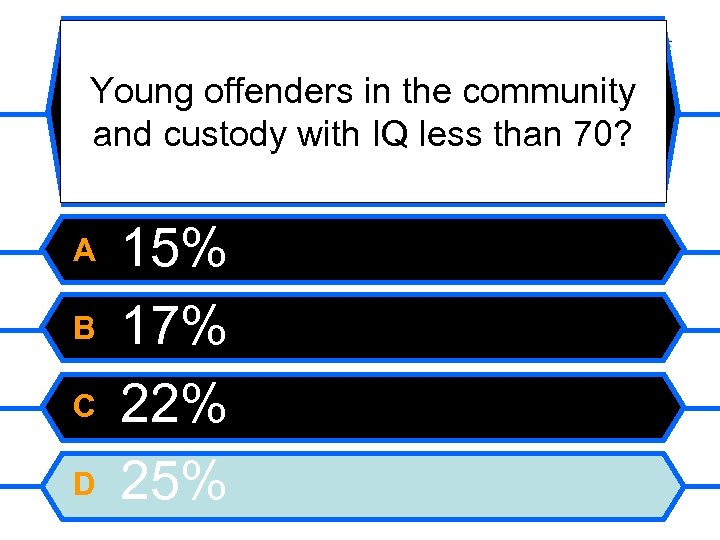 Young offenders in the community and custody with IQ less than 70? A B C D 15% 17% 22% 25%
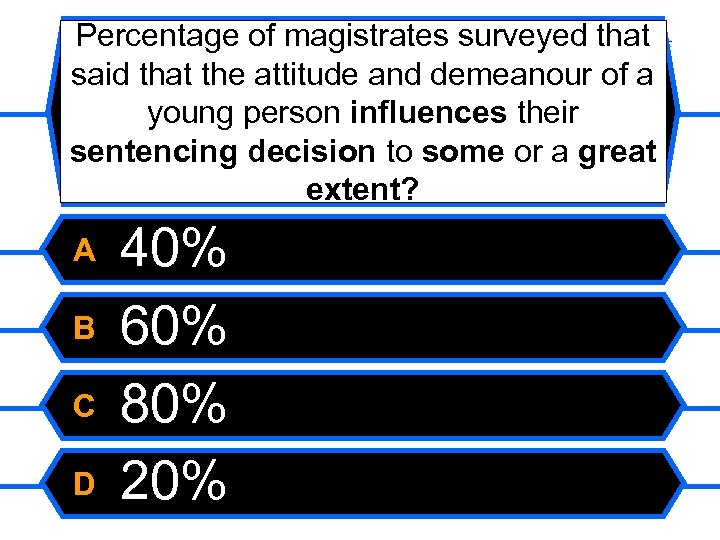 Percentage of magistrates surveyed that said that the attitude and demeanour of a young person influences their sentencing decision to some or a great extent? A B C D 40% 60% 80% 20%
 Percentage of magistrates surveyed that said that the attitude and demeanour of a young person influences their sentencing decision to some or a great extent? A B C D 40% 60% 80% 20%
 Who published an influential report on Speech, Language and Communication in 2008 A B C D John Redwood Iain Duncan-Smith Lord Ramsbotham John Bercow
 Who published an influential report on Speech, Language and Communication in 2008 A B C D John Redwood Iain Duncan-Smith Lord Ramsbotham John Bercow
 Which guidance now makes specific references to Speech, Language and Communication Needs of the young person? A Sentencing Guidelines Council B YJB National Standards C YJB Case Management Guidance D All of the above
 Which guidance now makes specific reference to Speech, Language and Communication Needs of the young person? A Sentencing Guidelines Council B YJB National Standards C YJB Case Management Guidance D All of the above
 The Sentencing Guidelines Council advises the court to consider the effect that speech and language difficulties might have on the ability of the young person (or any adult with them)…. A To communicate with the Court B To understand the sanction imposed C To fulfill the obligations resulting from the sanction D All of the above
 The Sentencing Guidelines Council advises the court to consider the effect that speech and language difficulties might have on the ability of the young person (or any adult with them)…. A To communicate with the Court B To understand the sanction imposed C To fulfill the obligations resulting from the sanction D All of the above
 Percentage of young people in Milton Keynes YOT assessed as having Speech, Language or Communication Needs? A B C D 66 77 88 99
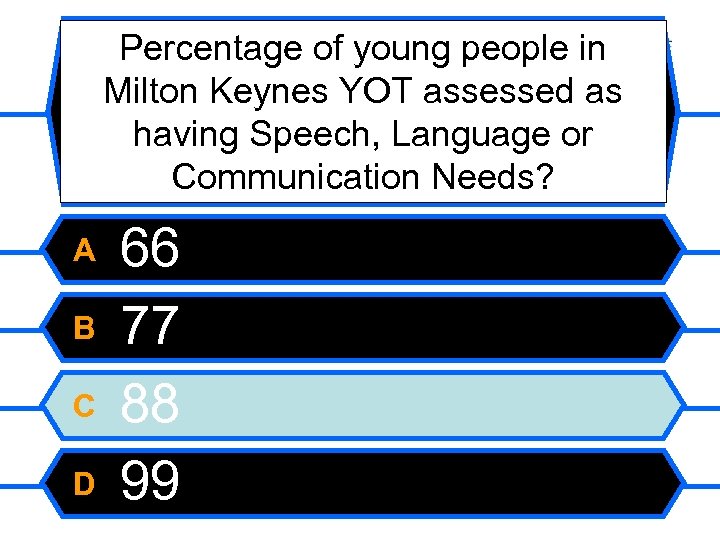 Percentage of young people in Milton Keynes YOT assessed as having Speech, Language or Communication Needs? A B C D 66 77 88 99
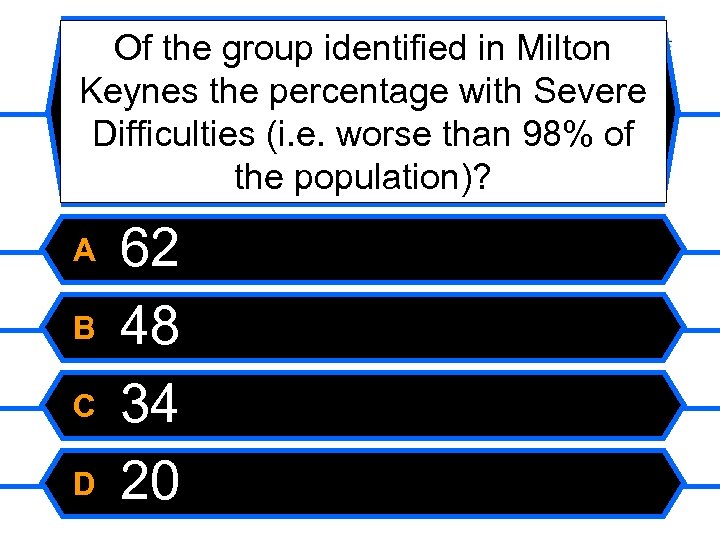 Of the group identified in Milton Keynes the percentage with Severe Difficulties (i. e. worse than 98% of the population)? A B C D 62 48 34 20
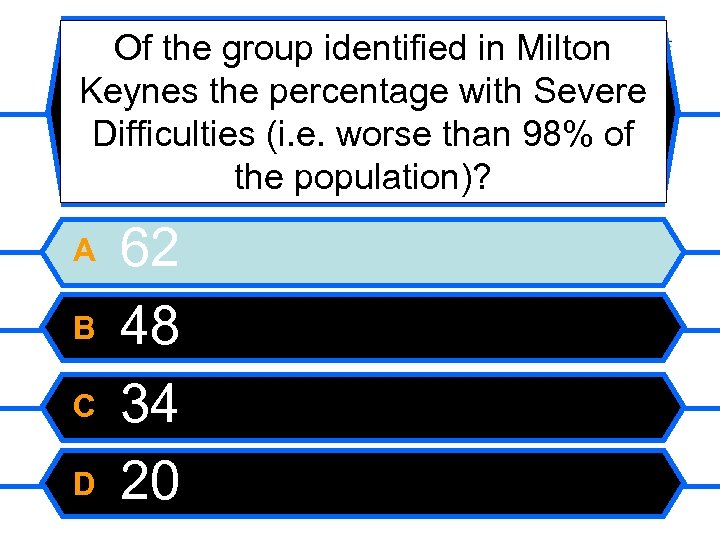 Of the group identified in Milton Keynes the percentage with Severe Difficulties (i. e. worse than 98% of the population)? A B C D 62 48 34 20
 Experiencing communication issues 1
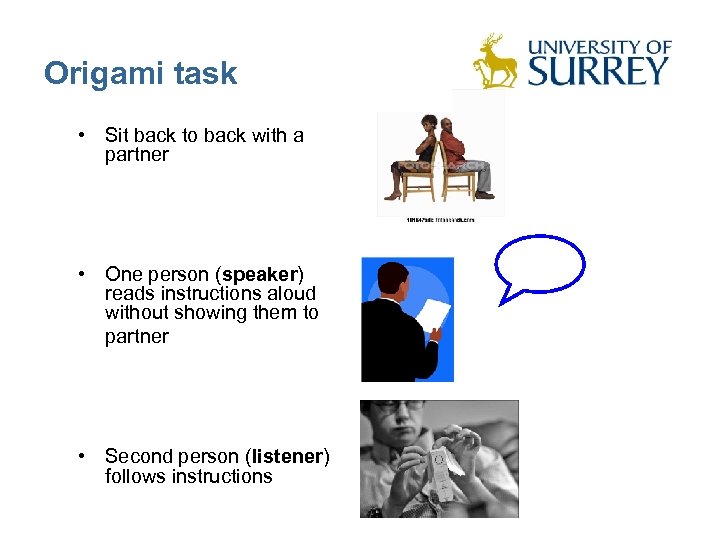 Origami task • Sit back to back with a partner • One person (speaker) reads instructions aloud without showing them to partner • Second person (listener) follows instructions
 Identification of Communication difficulties • What was easy/difficult? • How did you feel? • What did it make you want to do – speaker + listener?
 Evidence Base • A number of studies are providing a consensus figure of at least 60% of those young people in contact with youth justice services having speech, language and communication needs (SLCN). • Studies from four YOIs (Bryan 2004; Bryan et al 2007; Hamilton 2002), Leeds ISSP study, Milton Keynes YOT, smaller scoping studies in YOIs and the women’s prisons. • Very few known to SLT and almost none having on-going support.
 International evidence • All the studies are relatively small and use different populations, but the standardised assessments used are similar (BPVS and TOAL-3) with similar findings. • This is backed up by evidence from Australia (Snow), Canada (Cohen; Beitchman) and the USA (Sanger). Again, different populations but a similar consensus figure. • Recent reporting of longitudinal studies in Denmark (Mouridsen) where boys with severe expressive language problems were significantly more likely to be convicted of sexual offences.
 Evidence continued: • Brownlie’s longitudinal study showed that language impairment in boys is a significant risk factor for offending. • Recent reports on conduct disorder account for 40% of young offenders. • Bercow report on effects of failure to address SLCN. In particular failure to investigate language issues in older children with ‘behaviour’ problems. • Wider evidence e. g. , evidence base for speech and language therapy in relation to preventing and addressing social inclusion (ICAN 07).
 Why are levels of speech, language and communication difficulty high? • Association between speech and language disorders and behaviour difficulties is well established (Humber and Snow 2001). • Comprehension difficulties make children very vulnerable in relation to education (Hooper et al 2003). • Low education and speech and literacy difficulties are risk factors for offending (Tomblin 2000). • Over-representation of hearing impaired, learning difficulty, mental health problems within the prisoner population.
 Continued… • Issues in early life may have affected social opportunities, and developmental difficulties may not have been addressed. • Communication problems tend to be labelled as (bad) behaviour issues. • Danger that poor communication becomes the norm?
 Services show referrals included a range of communication difficulties including: – Language (developmental problems in understanding and using language to communicate) – Specific developmental syndromes e. g. , ADHD/Asperger’s Syndrome, Autistic Spectrum Disorders – Communication difficulties associated with mental illness – Speech (dyspraxia, delay, disorder) – Hearing Impairment – Dysfluency
 Experiencing communication issues 2 • Take a scenario • Adhere to the communication restrictions • Try and get your message across
 Identification of Communication difficulties • What did it feel like trying to convey information? • What did it feel like trying to understand? • Now imagine trying to tell your story in Court with those difficulties? ?
 What does this mean for staff? • • Staff are dealing with a large proportion of young people who lack speaking and listening skills. This affects day to day management e. g. , trainee with AS and difficulty coping in unit. This affects engagement with education and skills provision. Raises issues for staff training and support within and outside prisons.
 Intervention Issues • • • All staff need an awareness of speaking and listening issues including emotional issues. Specific measures to address speaking and listening difficulties (as for any other skill needs). Consideration around need for individual/small group input to address speaking and listening limitations. Language in e. g. , group interactions – indirect language, verbal memory loading etc. Are speaking and listening difficulties relevant to failure/ withdrawal from interventions?
 Managing this: • RCSLT model of service delivery (Bryan & Mackenzie 2008) – Includes SLT available to every YOI and YOT team • Pilot services are very successful: – Leeds, Bradford and Milton Keynes YOTs – Focus is on screening all young people, modifying their care intervention plan to work within their language level (this increases engagement and success) – SLT intervention for those with more severe language pathology.
 • Staff training universally appreciated even when at a distance (SLT at Werrington supported staff at nearby Stoke Heath and trained education staff for the whole North West region). • Leeds ISSP established that staff can deliver individually tailored communication plans within their work BUT they need back up and joint working with particularly difficult cases. • 88% of the YPs showed improvement on standardised language assessments.
 Range of impacts: • ‘pre-sentence reports manage to get the message across to courts’ (YJO) • ‘meeting diverse needs - we talk about it but don’t do it; she’s changed this’ (YJO) • ‘she (SLT) has changed culture’ (YJO) • ‘helped us to understand the young person better’ (YJO) • ‘a valuable part of working effectively with young people’ (YJO)
 What can you do: Signs and Symptoms of communication difficulties
 Areas of potential difficulty • Listening, remembering or understanding spoken language • Speaking/Expressive language – sentences, vocabulary, explaining • Non-verbal communication – eye-contact, body language • Written language
 Listening, remembering, understanding • Does he lose attention, get restless, become agitated? • Does he often seem to agree (e. g. nod head) • Does he ask for clarification? • Does he lack understanding of word meanings? (would we know? ) • Does he forget instructions? • Is he confused by non-literal language e. g. ’show you the ropes’, sarcasm, jokes
 Speaking / Expressive Language Does the person……… • Have difficulty thinking of words? • Talk in short, choppy sentences? • Have a limited vocabulary e. g. lots of ‘yes’, ‘no’ and no basic words • Have difficulties explaining, or providing details, or easily giving up? • Talking a lot but saying very little (no substance to content)? • Have difficulties asking questions? • Difficulty staying on topic?
 Social Communication Does the Young Person……. • Have difficulty using appropriate non-verbal communication e. g. , eye-contact, facial expression, body language? • Avoid or struggle to work in a group? • Get frustrated or upset for no obvious reason? • Have difficulties with conversational skills e. g. turntaking, initiating, staying on topic, listener awareness, adapting style of talking to be appropriate to situation (e. g. , being non-aggressive)?
 Language is key for Offending Behaviour programmes • Programmes to address offending are usually, if not totally, language based. • The language used includes terms that many young people do not understand (from formal SLT assessment), e. g. - Consequence Urge Even though Negotiation Temporary Punctual - Effective - Instead - However - Priority - Categorise
 Speaking and listening problems may not be obvious: • Social / stereotypical speech can mask lack of information • Negative behaviour can be used to detract from lack of abilities • Screening questions for all practitioners Ø Does he have a speech problem? Ø (e. g. , stammer or difficult to understand) Ø Does he have difficulty understanding what you say? Ø Are his responses minimal or limited?
 What Next? What can I do?
 How can we support these young People? • What could or do you do to ensure the young person is fully engaged, understands and can contribute effectively? • Think back to the signs and symptoms and the ‘origami task’: – What was difficult about the task? – What would have made it easier? – How did you feel and how could someone else have changed that? – What did it make you want to do – speaker + listener?
 Key strategies • Use visual / kinaesthetic approaches as much as possible e. g. google images, DVDs, photos, magazines, ‘stick men’/sketches, written bullet points • Allow plenty of time for breaks/change of activity • Avoid assuming that they understand words - check understanding and explain vocabulary • When talking to the YP, slow the rate of speech. Say something, then pause to allow them to process… then present more information. Use natural gesture. • Ask YP to summarise information in own words
 Strategies to support communication difficulties • Planning of YP’s Schedule – avoid consecutive verbally focused sessions. - consider session length. Incorporate ‘breaks’ if appropriate - incorporate visual and kinaesthetic activities. Vary location of session e. g. , outdoors /different rooms • Raise for discussion with YP –clarify communication difficulties/IQ distinction. Be open/explicit about issues. • Group programmes - Include a group rule – to ask if they do not understand a word /instruction (within context of mutual respect) e. g. , “If anyone is not certain it is OK to ask”.
 Examples of effective approaches and strategies – Milton Keynes • Regular recapping of information • Ask YP to summarise information in his own words • Adult to leave ‘gaps’ in sentences for YP to fill in • Use of photos e. g. photographs taken of rear of houses for discussion of burglary and consequences. • Small blocks of activities where listening is required, interspersed with ‘looking’/’doing’ activities • Awareness of ‘learning style’ (which will often be visual / kinaesthetic)
 • ‘Distraction’ techniques – to take focus away from ‘talking and listening’ e. g. , doodling whilst talking. N. B: this has theoretical basis, as it supports the learning style of kinaesthetic learners. • Use of different environments e. g. in car, walking in park to encourage communication • Use of board games e. g. ‘Trouble’ to address issues • DVDs and videos e. g. ‘Soaps’ / BT Betterworld - pausing frequently to discuss. • Images from Google • Sketches of ‘stick men’, houses etc
 Why does SLT help? • Communication focuses on issues staff are struggling with • Assessments reveal much about communication and behaviour • Team players, and able to work with ‘challenging’ behaviour • SLTs are trained to take a holistic stance centred on the individual and their SLCN • SLTs are trained to make information accessible to all and to enhance communication systems • Case management approach enhances YJS approaches • Able to operate in care, health and education environments
 References • Beitchman J H, Wilson B, Johnson C, Atkinson L, Young A, Adlaf E, Escobar M and Douglas L (2001) Fourteen year follow up of speech language impaired and control children: psychiatric outcome. J of the American Academy of Child and Adolescent Psychiatry 40, 75 -82. • Bercow, J (2008) Report. Df. ES. • Brownlie EB et al (2004) Early language Impairment and Young Adult Delinquent and aggressive behaviour. J of Abnormal Child Psychology, 32, 453 -467. • Bryan K, Freer J and Furlong C. (2007) Language and communication difficulties in juvenile offenders. International Journal of Language and Communication Disorders, 42, 505 -520. • Bryan, K. (2004) Prevalence of speech and language difficulties in young offenders. International Journal of Language and Communication Disorders, 391 -400. • Bryan, K and Mackenzie, J (2008) Meeting the speech, language and communication needs of vulnerable young people: Model of service delivery for those at risk of offending and re-offending. London: RCSLT.
 • • • Cohen N. J. , M. Davine, et al. (1993). Unsuspected language impairment in psychiatrically disturbed children: Prevalence and language and behavioral characteristics. Journal of the American Academy of Adolescent Psychiatry 32: 595603. Hamilton, J (2002) Incidence of Communication Difficulties 1999 -2002. Unpublished report from Polmont YOI. Hooper S J, Roberts J E, Zeisel SA, and Poe M. (2003). Core language predictors of behavioural functioning in early elementary school children: Concurrent and longitudinal findings. Behavioural Disorders, 29(1): 10 -21. Humber E, and Snow PC. (2001). The language processing and production skills of juvenile offenders: A pilot investigation. Psychiatry, Psychology and Law 8, 1 -11. ICAN (2007) language and Social Exclusion. Mouridsen S E and Hauschild K-M (2009) A long term study of offending in individuals diagnosed with a developmental language disorder as children. Int. J of Speech and Language Pathology, 11, 171 -179. Sanger D, Moore-Brown B, et al. (2001). Prevalence of language problems among adolescent delinquents. Communication Disorders Quarterly 23(1): 17 -26. Snow PC and Powell MB (2008) Oral language competence, social skills, and high risk boys: What juvenile offenders are trying to tell us? Children and Society 22, 16 -28. Tomblin J B, Zhang X, Buckwater, P, and Catts, H. (2000). The association of reading disability, behavioural disorders and language impairment among second-grade children. Journal of child psychology and psychiatry, 41(4), 473 -482.