


 Скачать презентацию COMMUNICATION IN FOREIGN LANGUAGES Presentation of the
5c635dfc82a0501c89efe15454824727.ppt
- Количество слайдов: 34
 COMMUNICATION IN FOREIGN LANGUAGES : Presentation of the project The National Education Institute - June 9, 2010 Katja Pavlič Škerjanc and mag. Katica Pevec Samec Operacijo delno financira Evropska unija iz Evropskega socialnega sklada ter Ministrstvo za šolstvo in šport. Operacija se izvaja v okviru Operativnega programa razvoja človeških virov v obdobju 2007 -2013, razvojne prioritete: Razvoj človeških virov in vseživljenjsko učenje; prednostne usmeritve: Izboljšanje kakovosti in učinkovitosti sistemov izobraževanja in usposabljanja.
 European Structural Funds Ministry of Education and Sport of the Republic of Slovenia COMMUNICATION IN FOREIGN LANGUAGES 1. 4. 2008 – 31. 8. 2010 Implementing early Katja Pavlič Škerjanc language foreign Foreign teachers’ learning and integration into the intercultural school curriculum as awareness into the an innovative first cycle of primary approach to foreign school language teaching
 Co-evolutionary approach to curriculum development and innovation Pilot projects are designed and implemented with three complementary goals in mind: • by aiming to improve the curricula as well as the teaching and learning process they address students, • at the same time motivating and supporting teachers in their continuous professional development and capacity building • and providing project managers (national education authorities and research & development agencies) with pragmatic knowledge and skills of the teachers and headteachers (ie. aligning beliefs about the potential for effective action with the lessons of past and present experience).
 Purpose and aims of innovative projects • to meet both deficiency and growth needs: – personalise the curriculum: increase school autonomy as well as curriculum flexibility and openness, ie. scope and number of options for schools and individual students (core – elective – optional → modular structure); – make the curriculum more authentic for the students: provide meaningful contexts – bring the real world into the classroom (and vice versa); – integrate the curriculum: increase its flexibility to overcome fragmentation of knowledge (set up curricular connections, eg. tranversal competences as cross-curricular goals); • to provide convincing proofs of concepts and ideas and, finally, a fully functioning prototype
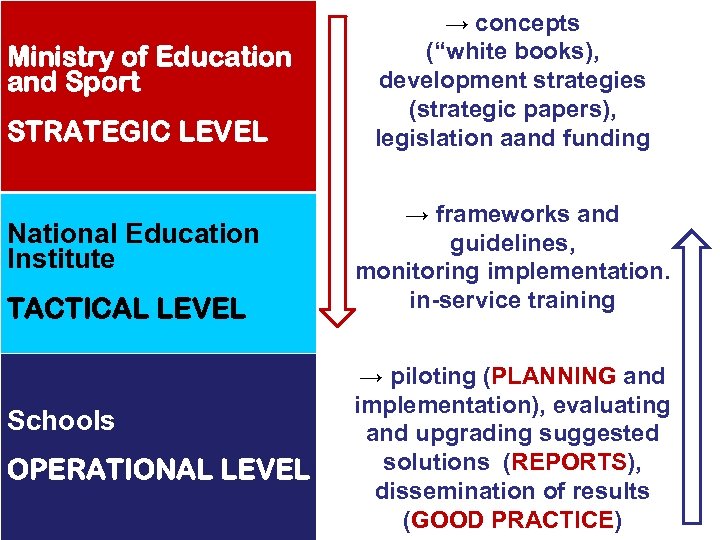 Ministry of Education and Sport STRATEGIC LEVEL National Education Institute TACTICAL LEVEL Schools OPERATIONAL LEVEL → concepts (“white books), development strategies (strategic papers), legislation aand funding → frameworks and guidelines, monitoring implementation. in-service training → piloting (PLANNING and implementation), evaluating and upgrading suggested solutions (REPORTS), dissemination of results (GOOD PRACTICE)
 COMMUNICATION IN FOREIGN LANGUAGES foreign teachers’ integration into the school curriculum as an innovative approach to foreign language teaching
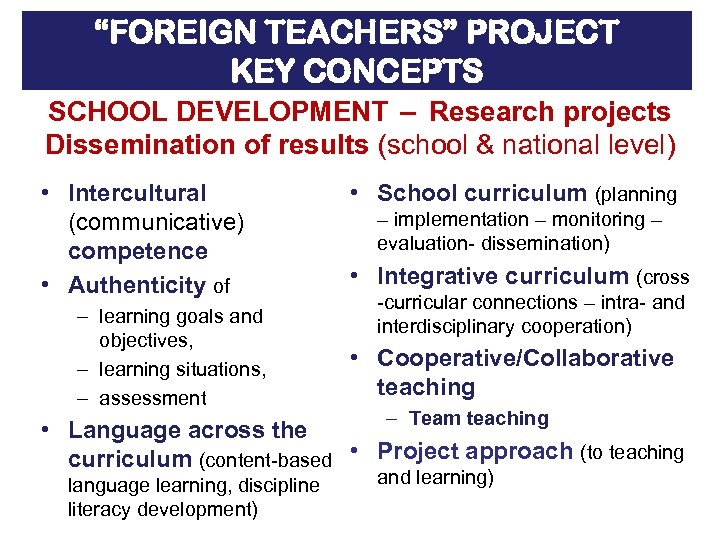 “FOREIGN TEACHERS” PROJECT KEY CONCEPTS SCHOOL DEVELOPMENT – Research projects Dissemination of results (school & national level) • Intercultural (communicative) competence • Authenticity of – learning goals and objectives, – learning situations, – assessment • School curriculum (planning – implementation – monitoring – evaluation- dissemination) • Integrative curriculum (cross -curricular connections – intra- and interdisciplinary cooperation) • Cooperative/Collaborative teaching – Team teaching • Language across the curriculum (content-based • Project approach (to teaching language learning, discipline literacy development) and learning)
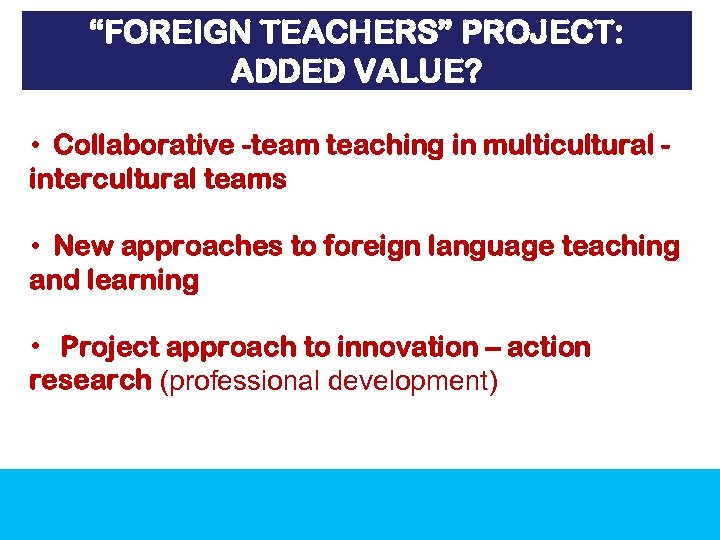 “FOREIGN TEACHERS” PROJECT: ADDED VALUE? • Collaborative -team teaching in multicultural intercultural teams • New approaches to foreign language teaching and learning • Project approach to innovation – action research (professional development)
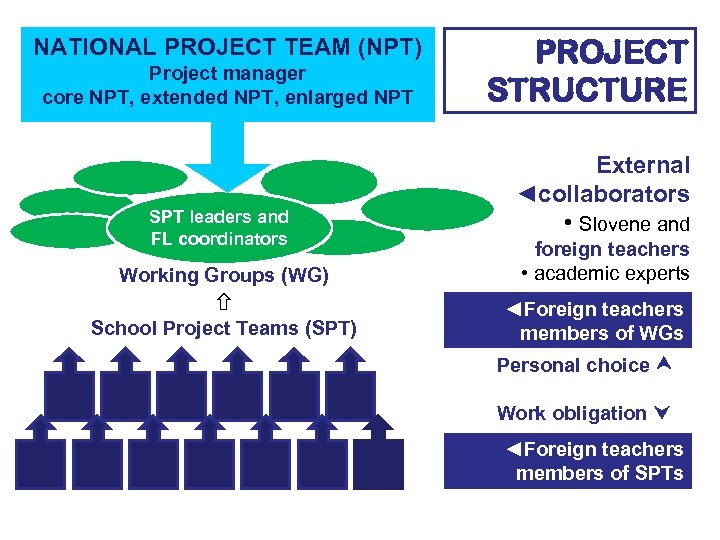 NATIONAL PROJECT TEAM (NPT) Project manager core NPT, extended NPT, enlarged NPT SPT leaders and FL coordinators Working Groups (WG) School Project Teams (SPT) PROJECT STRUCTURE External ◄collaborators • Slovene and foreign teachers • academic experts ◄Foreign teachers members of WGs Personal choice Work obligation ◄Foreign teachers members of SPTs
 Project structure and communication • close links and interdependence between the NEI project team and participating schools/project partners; • communication at and between all levels is constant and intense, both direct and indirect (via e-mail), aiming to secure not only an uninterrupted information flow on the progress of the project, but also ongoing exchanges - as well as reflection on and evaluation - of project products (lesson plans, teaching materials, etc. ) and examples of practice of all kinds considered illustrative and supportive: – best (tried and tested out several times by more teachers), – good (tried at least twice by one teacher) and – promising (still in the planning phase).
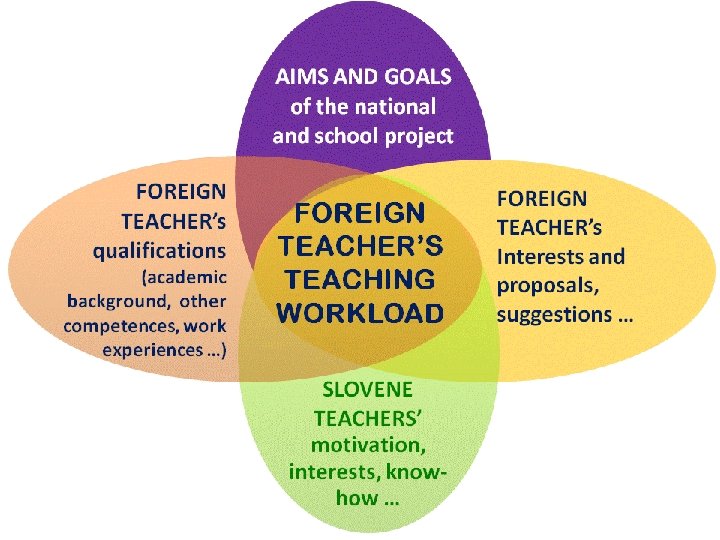
 PROJECT STRUCTURE • National Project Team (NPT) – core NPT (Katja Pavlič Škerjanc, project manager – NEI, Maja Celestina, NEI; Barbara Gregorič – financial matters, NEI; Domen Petelin – legal matters, NEI; Bronka Straus, MES) – extended NPT (core NPT + NEI foreign language advisers) – enlarged NPT (extended NPT + school project team leaders + school FL coordinators + selected foreign teachers/one per language) • School Project Teams (SPT) (3 – 5 members) – Project team leader – Foreign language coordinator – Foreign teacher – Other teachers according to the school project goals
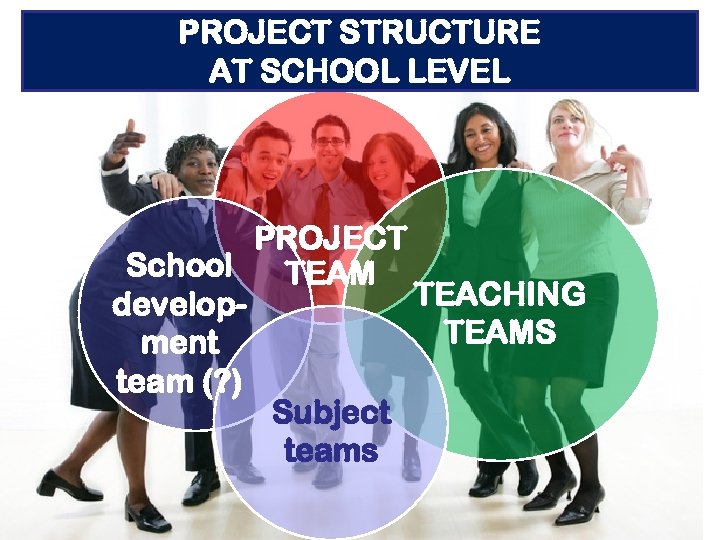 PROJECT STRUCTURE AT SCHOOL LEVEL PROJECT School TEAM TEACHING develop. TEAMS ment team (? ) Subject teams
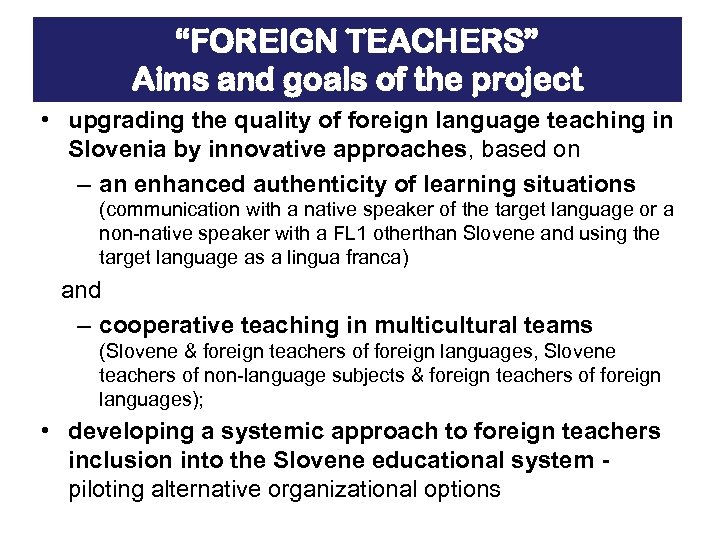 “FOREIGN TEACHERS” Aims and goals of the project • upgrading the quality of foreign language teaching in Slovenia by innovative approaches, based on – an enhanced authenticity of learning situations (communication with a native speaker of the target language or a non-native speaker with a FL 1 otherthan Slovene and using the target language as a lingua franca) and – cooperative teaching in multicultural teams (Slovene & foreign teachers of foreign languages, Slovene teachers of non-language subjects & foreign teachers of foreign languages); • developing a systemic approach to foreign teachers inclusion into the Slovene educational system - piloting alternative organizational options
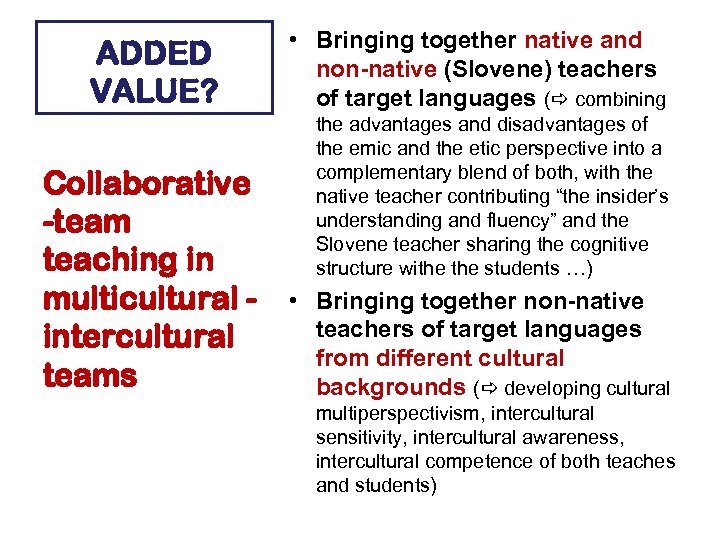 ADDED VALUE? Collaborative -team teaching in multicultural intercultural teams • Bringing together native and non-native (Slovene) teachers of target languages ( combining the advantages and disadvantages of the emic and the etic perspective into a complementary blend of both, with the native teacher contributing “the insider’s understanding and fluency” and the Slovene teacher sharing the cognitive structure withe students …) • Bringing together non-native teachers of target languages from different cultural backgrounds ( developing cultural multiperspectivism, intercultural sensitivity, intercultural awareness, intercultural competence of both teaches and students)
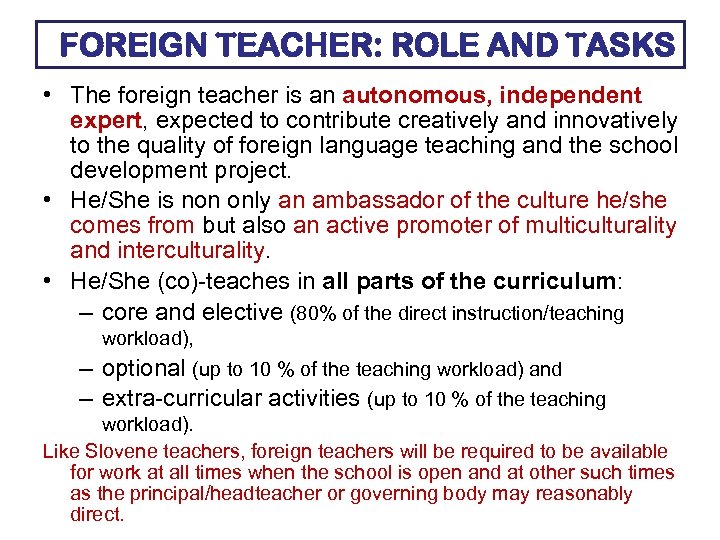 FOREIGN TEACHER: ROLE AND TASKS • The foreign teacher is an autonomous, independent expert, expected to contribute creatively and innovatively to the quality of foreign language teaching and the school development project. • He/She is non only an ambassador of the culture he/she comes from but also an active promoter of multiculturality and interculturality. • He/She (co)-teaches in all parts of the curriculum: – core and elective (80% of the direct instruction/teaching workload), – optional (up to 10 % of the teaching workload) and – extra-curricular activities (up to 10 % of the teaching workload). Like Slovene teachers, foreign teachers will be required to be available for work at all times when the school is open and at other such times as the principal/headteacher or governing body may reasonably direct.
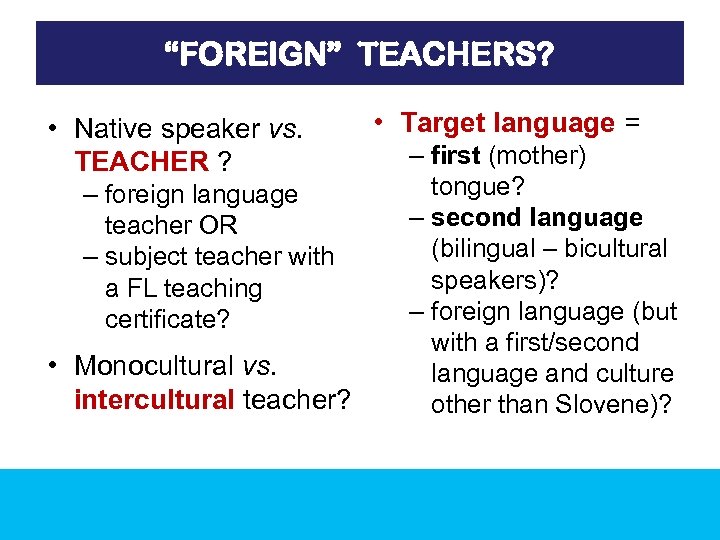 “FOREIGN” TEACHERS? • Native speaker vs. TEACHER ? – foreign language teacher OR – subject teacher with a FL teaching certificate? • Monocultural vs. intercultural teacher? • Target language = – first (mother) tongue? – second language (bilingual – bicultural speakers)? – foreign language (but with a first/second language and culture other than Slovene)?
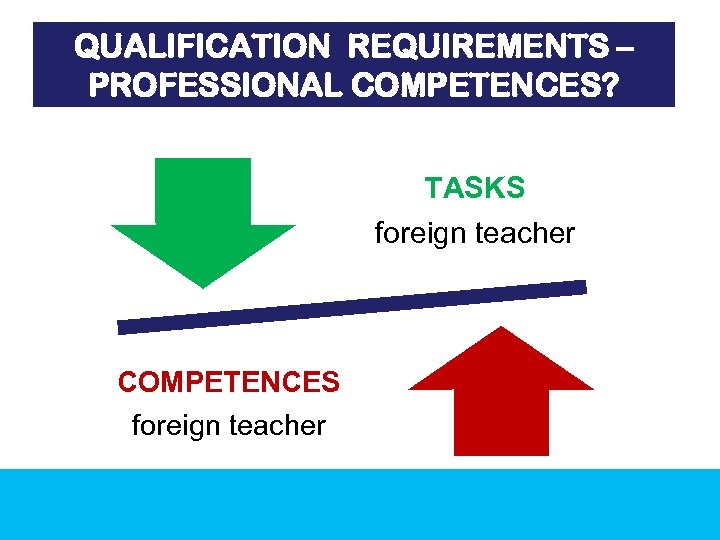 QUALIFICATION REQUIREMENTS – PROFESSIONAL COMPETENCES? TASKS foreign teacher COMPETENCES foreign teacher
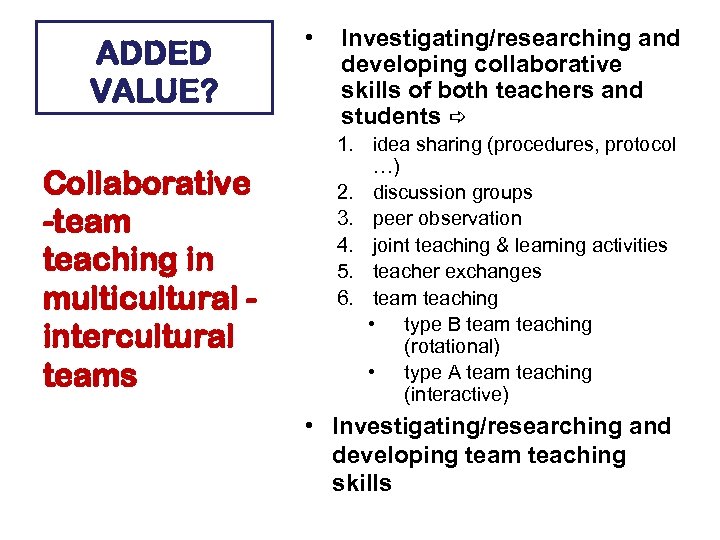 ADDED VALUE? Collaborative -team teaching in multicultural intercultural teams • Investigating/researching and developing collaborative skills of both teachers and students 1. idea sharing (procedures, protocol …) 2. discussion groups 3. peer observation 4. joint teaching & learning activities 5. teacher exchanges 6. team teaching • type B team teaching (rotational) • type A team teaching (interactive) • Investigating/researching and developing team teaching skills
 COLLABORATIVE TEACHING INTRA- AND INTER-DISCIPLINARY COLLABORATIVE TEACHING Teachers cooperate and collaborate: • to increase the authenticity of learning through interdisciplinary teaching and curriculum integration • to fight knowledge obsolescence and share the burden of keeping up with the knowledge explosion • to ensure/provide continuous professional development through peer learning
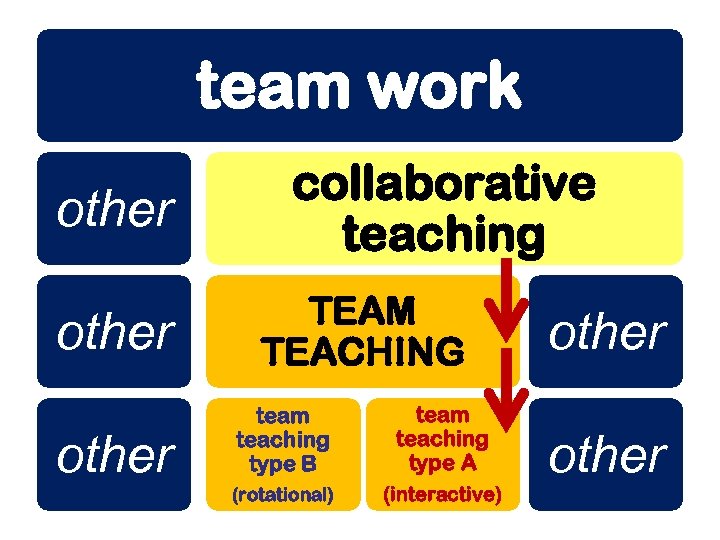 team work other collaborative teaching TEAM TEACHING team teaching type B team teaching type A (rotational) (interactive) other
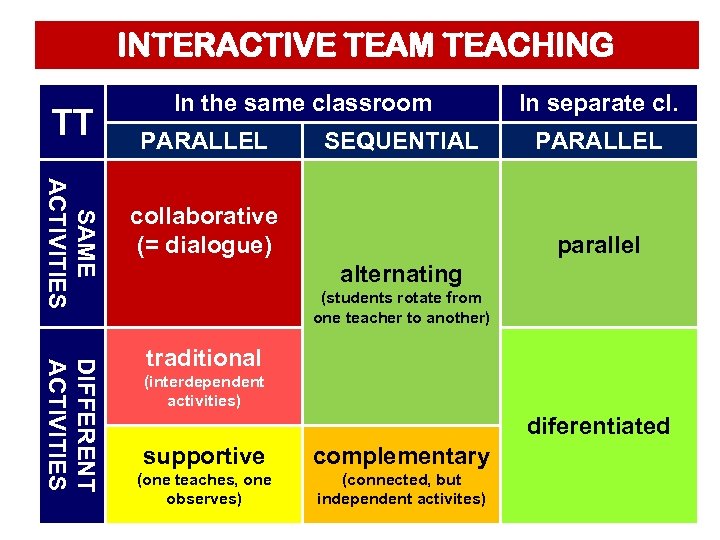 INTERACTIVE TEAM TEACHING TT In the same classroom PARALLEL SEQUENTIAL SAME ACTIVITIES collaborative (= dialogue) In separate cl. PARALLEL parallel alternating (students rotate from one teacher to another) DIFFERENT ACTIVITIES traditional (interdependent activities) diferentiated supportive complementary (one teaches, one observes) (connected, but independent activites)
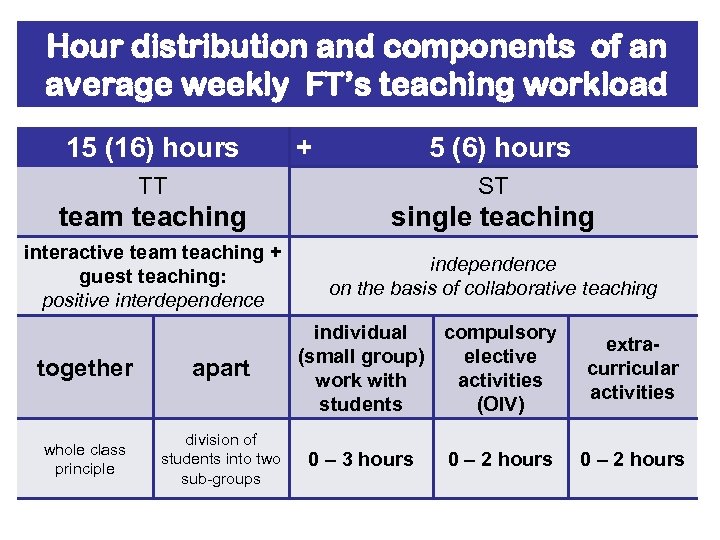 Hour distribution and components of an average weekly FT’s teaching workload 15 (16) hours + 5 (6) hours TT ST team teaching single teaching interactive team teaching + guest teaching: positive interdependence independence on the basis of collaborative teaching together apart whole class principle division of students into two sub-groups individual compulsory (small group) elective work with activities students (OIV) 0 – 3 hours 0 – 2 hours extracurricular activities 0 – 2 hours
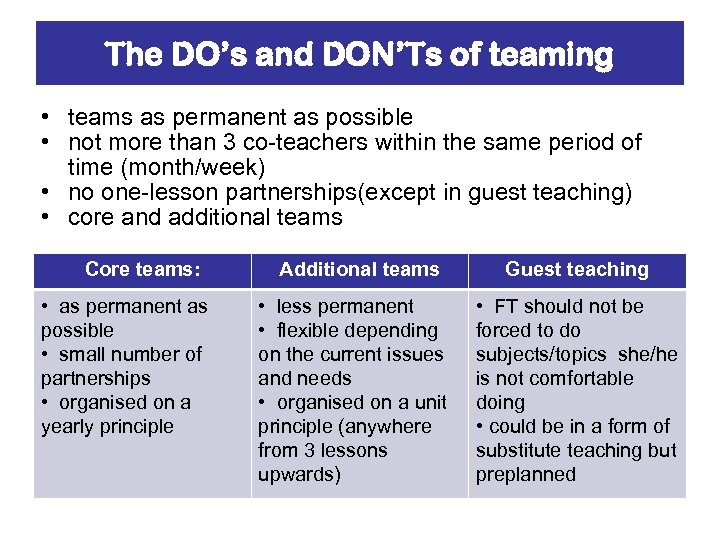 The DO’s and DON’Ts of teaming • teams as permanent as possible • not more than 3 co-teachers within the same period of time (month/week) • no one-lesson partnerships(except in guest teaching) • core and additional teams Core teams: Additional teams • as permanent as • less permanent possible • flexible depending • small number of on the current issues partnerships and needs Forms of collaboration: • organised on a unit yearly principle (anywhere from 3 lessons upwards) Guest teaching • FT should not be forced to do subjects/topics she/he is not comfortable doing • could be in a form of substitute teaching but preplanned
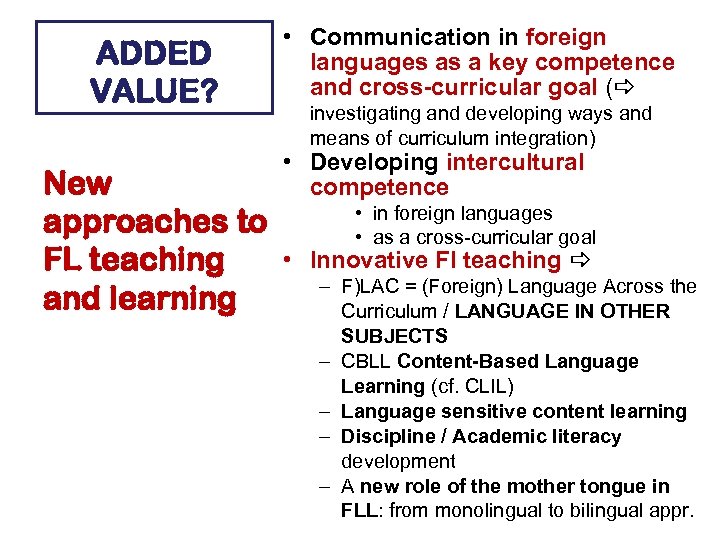 ADDED VALUE? New approaches to FL teaching and learning • Communication in foreign languages as a key competence and cross-curricular goal ( investigating and developing ways and means of curriculum integration) • Developing intercultural competence • in foreign languages • as a cross-curricular goal • Innovative Fl teaching – F)LAC = (Foreign) Language Across the Curriculum / LANGUAGE IN OTHER SUBJECTS – CBLL Content-Based Language Learning (cf. CLIL) – Language sensitive content learning – Discipline / Academic literacy development – A new role of the mother tongue in FLL: from monolingual to bilingual appr.
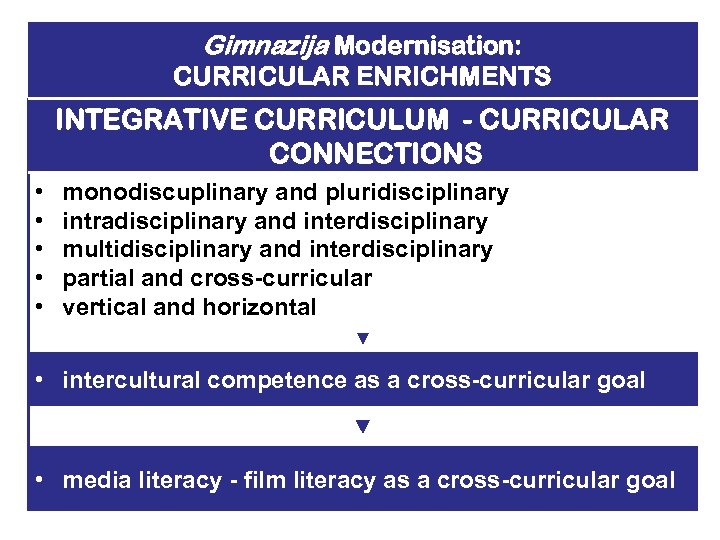 Gimnazija Modernisation: CURRICULAR ENRICHMENTS INTEGRATIVE CURRICULUM - CURRICULAR CONNECTIONS • • • monodiscuplinary and pluridisciplinary intradisciplinary and interdisciplinary multidisciplinary and interdisciplinary partial and cross-curricular vertical and horizontal ▼ • intercultural competence as a cross-curricular goal ▼ • media literacy - film literacy as a cross-curricular goal
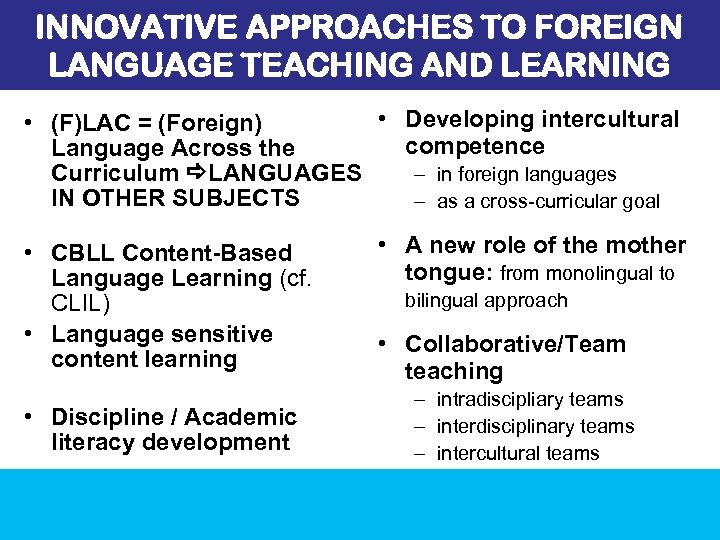 INNOVATIVE APPROACHES TO FOREIGN LANGUAGE TEACHING AND LEARNING • Developing intercultural • (F)LAC = (Foreign) competence Language Across the – in foreign languages Curriculum LANGUAGES IN OTHER SUBJECTS – as a cross-curricular goal • CBLL Content-Based Language Learning (cf. CLIL) • Language sensitive content learning • Discipline / Academic literacy development • A new role of the mother tongue: from monolingual to bilingual approach • Collaborative/Team teaching – intradiscipliary teams – interdisciplinary teams – intercultural teams
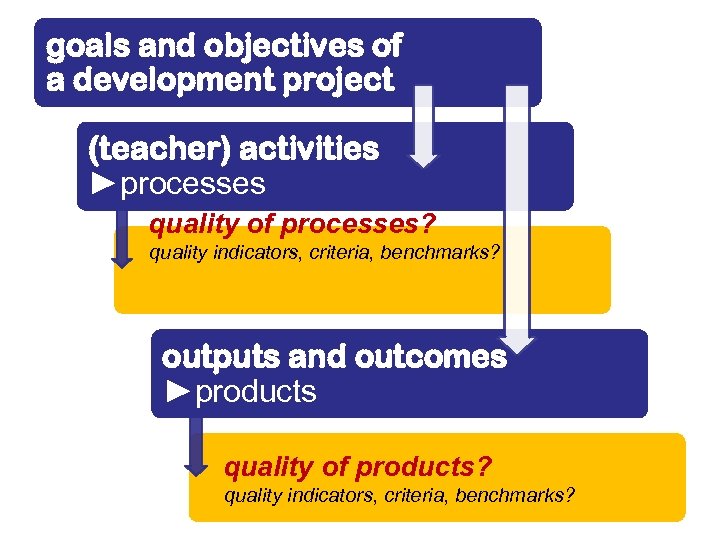
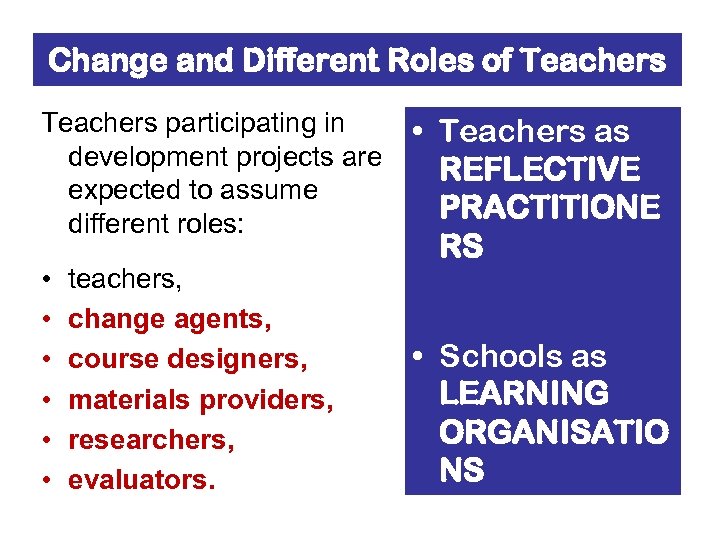
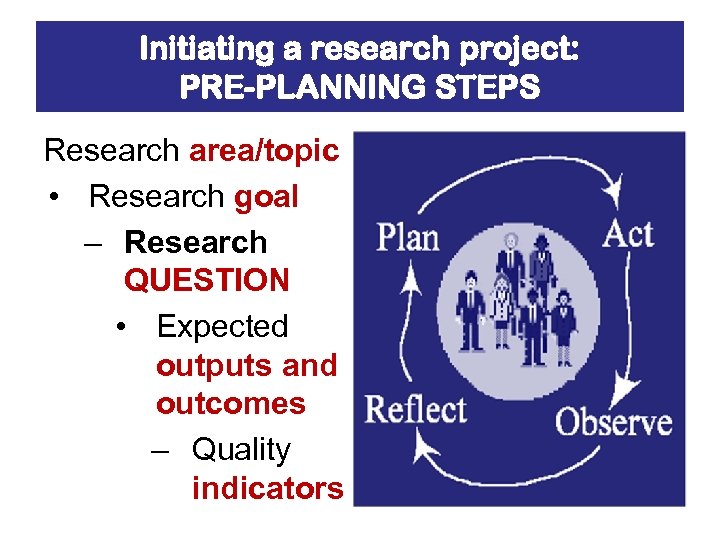
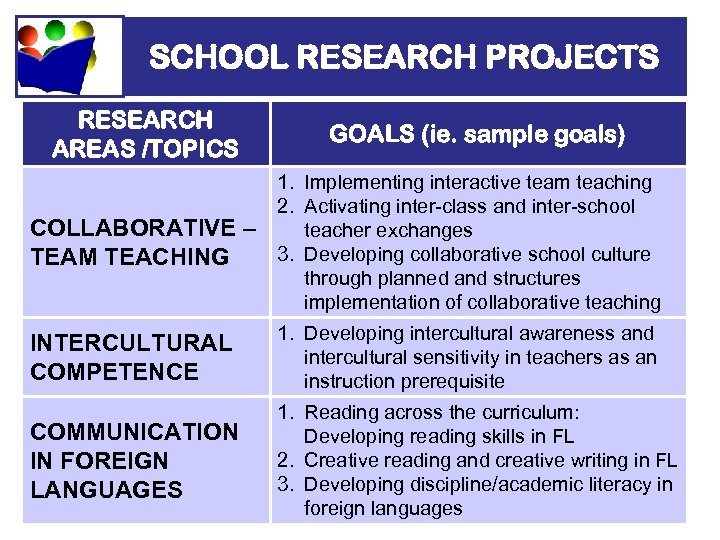
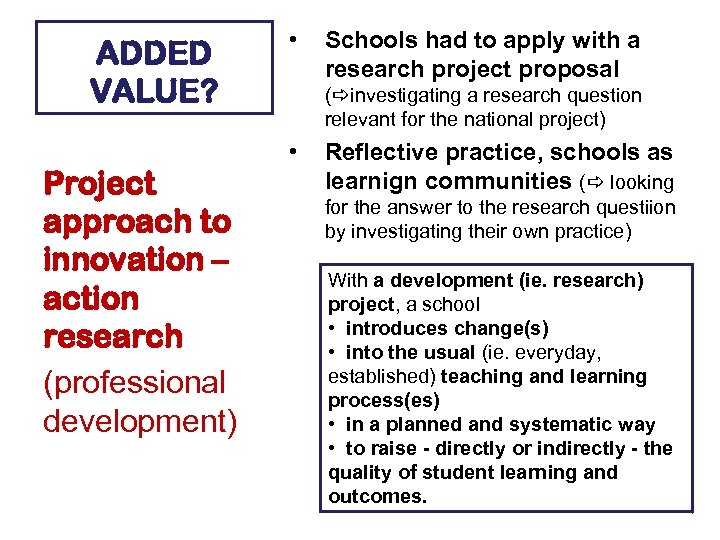 ADDED VALUE? Project approach to innovation – action research (professional development) • Schools had to apply with a research project proposal ( investigating a research question relevant for the national project) • Reflective practice, schools as learnign communities ( looking for the answer to the research questiion by investigating their own practice) With a development (ie. research) project, a school • introduces change(s) • into the usual (ie. everyday, established) teaching and learning process(es) • in a planned and systematic way • to raise - directly or indirectly - the quality of student learning and outcomes.
 goals and objectives of a development project (teacher) activities ►processes quality of processes? quality indicators, criteria, benchmarks? outputs and outcomes ►products quality of products? quality indicators, criteria, benchmarks?
 Change and Different Roles of Teachers participating in • Teachers as development projects are REFLECTIVE expected to assume PRACTITIONE different roles: • • • teachers, change agents, course designers, materials providers, researchers, evaluators. RS • Schools as LEARNING ORGANISATIO NS
 Initiating a research project: PRE-PLANNING STEPS Research area/topic • Research goal – Research QUESTION • Expected outputs and outcomes – Quality indicators
 SCHOOL RESEARCH PROJECTS RESEARCH AREAS /TOPICS GOALS (ie. sample goals) COLLABORATIVE – TEAM TEACHING 1. Implementing interactive team teaching 2. Activating inter-class and inter-school teacher exchanges 3. Developing collaborative school culture through planned and structures implementation of collaborative teaching INTERCULTURAL COMPETENCE 1. Developing intercultural awareness and intercultural sensitivity in teachers as an instruction prerequisite COMMUNICATION IN FOREIGN LANGUAGES 1. Reading across the curriculum: Developing reading skills in FL 2. Creative reading and creative writing in FL 3. Developing discipline/academic literacy in foreign languages
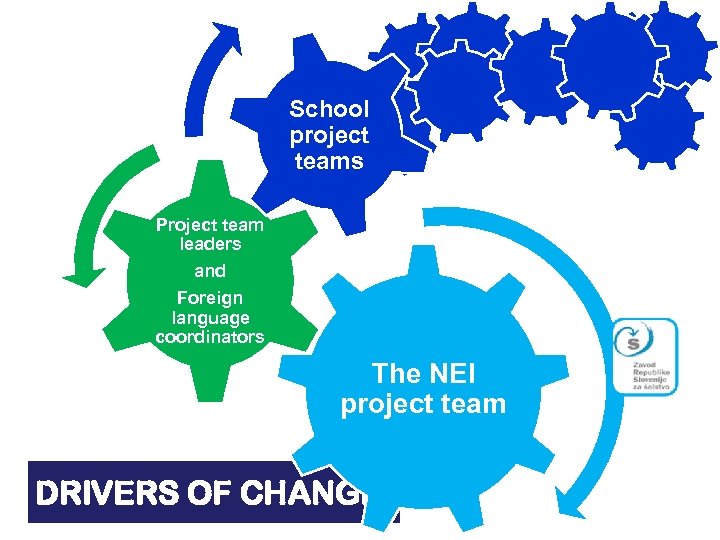 School project teams Project team leaders and Foreign language coordinators The NEI project team DRIVERS OF CHANGE
 Le sole risposte utili sono quelle che propongono nuove domande. Vittorio Foa • The only useful answers are those that pose new questions. • Les seules réponses utiles sont celles qui posent de nouvelles questions. • Die einzig nützlichen Antworten sind jene, die neue Fragen aufwerfen. • Las únicas respuestas útiles son las que plantean nuevas preguntas • Единственно полезными являются те ответы, что рождают новые вопросы. • Samo tisti odgovori so koristni, ki zastavljajo nova vprašanja.