


 Скачать презентацию Communication HINF 371 — Medical Methodologies Session 11
4c5a515831193f8c18448e30349e736a.ppt
- Количество слайдов: 9
 Communication HINF 371 - Medical Methodologies Session 11
 Objective n Understand the importance of communication in achieving better outcomes
 Reading n n Mar CD, Doust J, Glasziou (2006) Chapter 2: Communication in clinical care, health promotion and disease prevention, Blackwell Publishing and BMJ Books, USA Redelmeier, DA; Schull, MJ; Hux, JE; Tu, JV; Ferris, LE (2001) Problems for clinical judgment: 1. Eliciting an insightful history of present illness, Canadian Medical Association Journal, Vol: 164, Issue: 5, p: 647 -652 Redelmeier, DA; Tu, JV; Schull, MJ; Ferris, LE; Hux, JE (2001) Problems for clinical judgment: 1. Obtaining a reliable past medical history, Canadian Medical Association Journal, Vol: 164, Issue: 6, p: 809 -813 Rob Buckman (1999) Communication Skills in Clinical Practice (video recording): a video guide
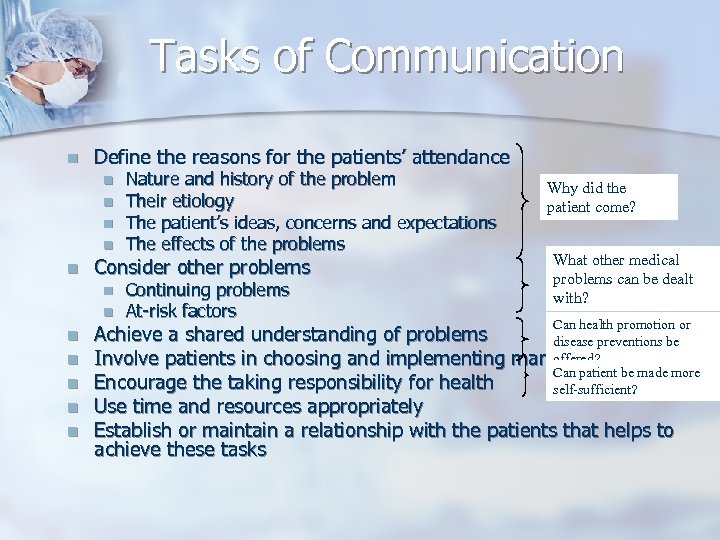 Tasks of Communication n Define the reasons for the patients’ attendance n n n Consider other problems n n n n Nature and history of the problem Their etiology The patient’s ideas, concerns and expectations The effects of the problems Continuing problems At-risk factors Why did the patient come? What other medical problems can be dealt with? Can health promotion or Achieve a shared understanding of problems disease preventions be offered? Involve patients in choosing and implementing management Can patient be made more Encourage the taking responsibility for health self-sufficient? Use time and resources appropriately Establish or maintain a relationship with the patients that helps to achieve these tasks
 Good Communication n = better two way understanding Patient centred vs disease centred Enablement= accepting patient preferences as face value n n n n Listing their problems Arranging them by priority Deciding which problems need adressing in this consultation Deciding if they had been met afterwards Motivational interviewing: understanding patients agenda, ensuring it is clearly foremost, ye providing enough information to alter that agenda Continuity Safety Net: formal follow-up, explicit invitation, informal blanket invitation, implicit invitation
 Communication Errors Comprehension PHYSICIAN DRIVEN n Ambigous language n n Libido, neoplasm, Leading questions Better= improved or normalized? Tacid Misunderstanding n n n How questions are asked – sequencing How cultural norms impact Context of the question based on the responders perception PATIENT DRIVEN n Telescopic effects n n Estimating the past Estimating event frequency in the past
 Communication Errors Recall PATIENT DRIVEN PHYSICIAN DRIVEN n Failure of Memory n n n Diary Recording devices Agree on questions for next visit Write down key points Automative Shortcuts n Complex question = estimated answer, gut feel False memories n Technical details fade faster than emotional Provide ways to improve memory n n n Events with strong memories remembered Embellishments Corroborate Inhibition of memory n n Weaker memories are suppressed by stronger ones Cues has the potential to cause distortions
 Communication Errors Evaluation PATIENT DRIVEN PHYSICIAN DRIVEN n Inconsistent Expectations n n n Halo effects n People express emotions when discrepancy between expectations and perceptions Expansion of context is necessary n n n Reflecting emotions to the whole person or event Subjective evaluations are influenced by extragenous factors Extremes of success or failure Persistence of beliefs
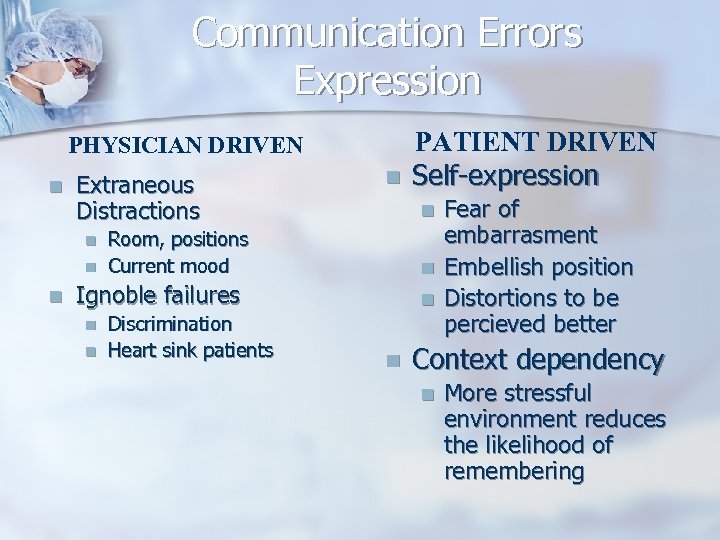 Communication Errors Expression PHYSICIAN DRIVEN n Extraneous Distractions n n n Room, positions Current mood n Ignoble failures n n Discrimination Heart sink patients PATIENT DRIVEN Self-expression n n Fear of embarrasment Embellish position Distortions to be percieved better Context dependency n More stressful environment reduces the likelihood of remembering