


 Скачать презентацию Communication Consumption and Civil Society Media and Politics
b288fa48d5b77041cdf958de64a92001.ppt
- Количество слайдов: 41
 Communication, Consumption, and Civil Society: Media and Politics at the Checkout Line Dhavan V. Shah Louis A. & Mary E. Maier-Bascom Professor Director, Mass Communication Research Center Scientific Director, Center for Health Enhancement System Studies School of Journalism and Mass Communication Department of Political Science (affiliated) Department of Industrial and Systems Engineering (affiliated)
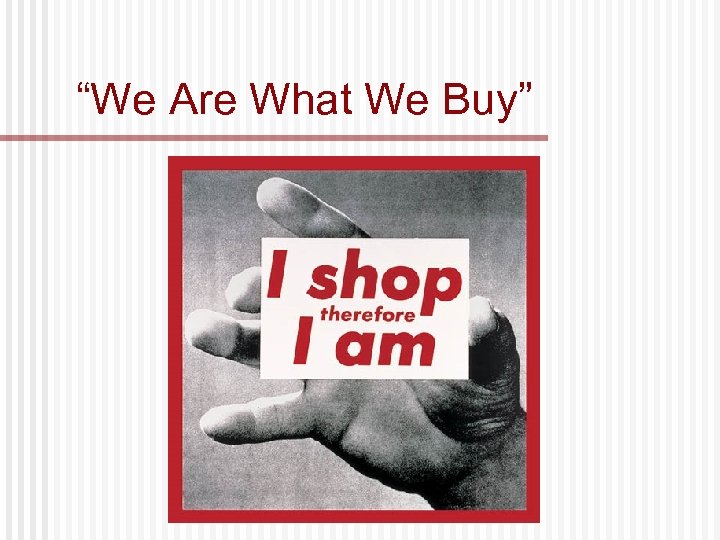 “We Are What We Buy”
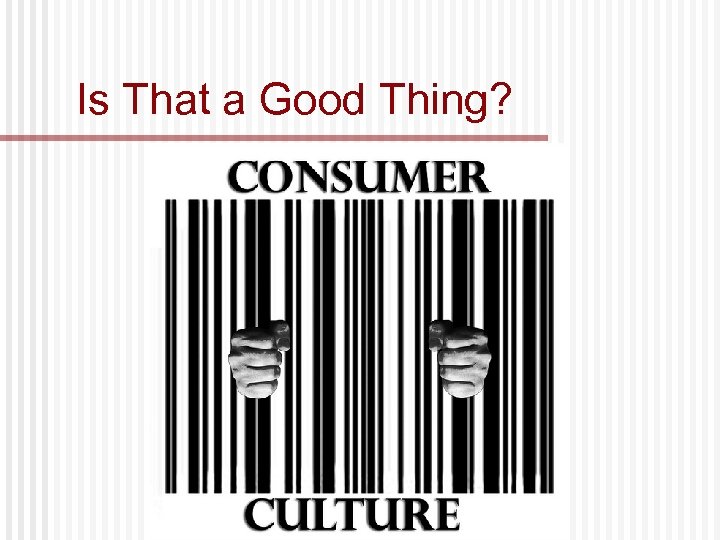 Is That a Good Thing?
 A Winding, Twisted Tale n “A line of research is rarely straight” n This one is characterized by corrections, extensions, reorientations, and revisions n The assumptions that began this work a decade ago have been fully inverted
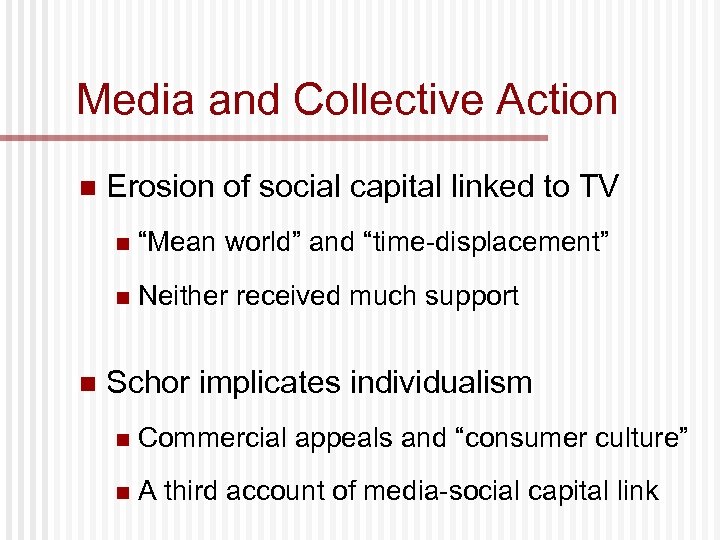 Media and Collective Action n Erosion of social capital linked to TV n n n “Mean world” and “time-displacement” Neither received much support Schor implicates individualism n Commercial appeals and “consumer culture” n A third account of media-social capital link
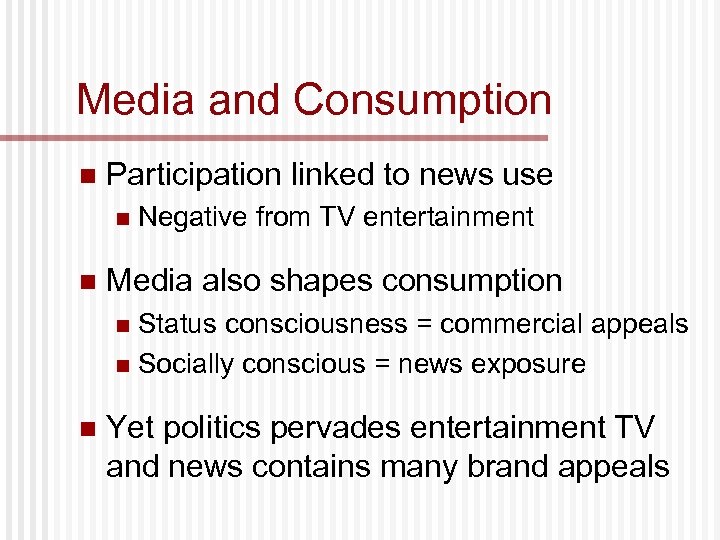 Media and Consumption n Participation linked to news use n n Negative from TV entertainment Media also shapes consumption Status consciousness = commercial appeals n Socially conscious = news exposure n n Yet politics pervades entertainment TV and news contains many brand appeals
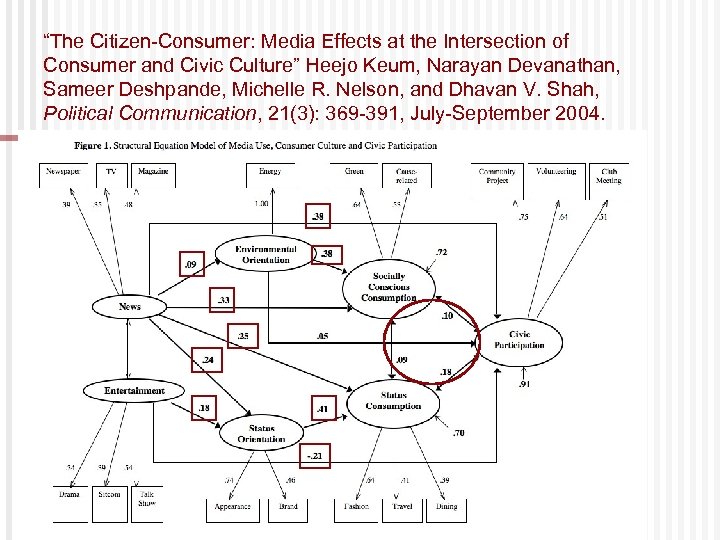 “The Citizen-Consumer: Media Effects at the Intersection of Consumer and Civic Culture” Heejo Keum, Narayan Devanathan, Sameer Deshpande, Michelle R. Nelson, and Dhavan V. Shah, Political Communication, 21(3): 369 -391, July-September 2004.
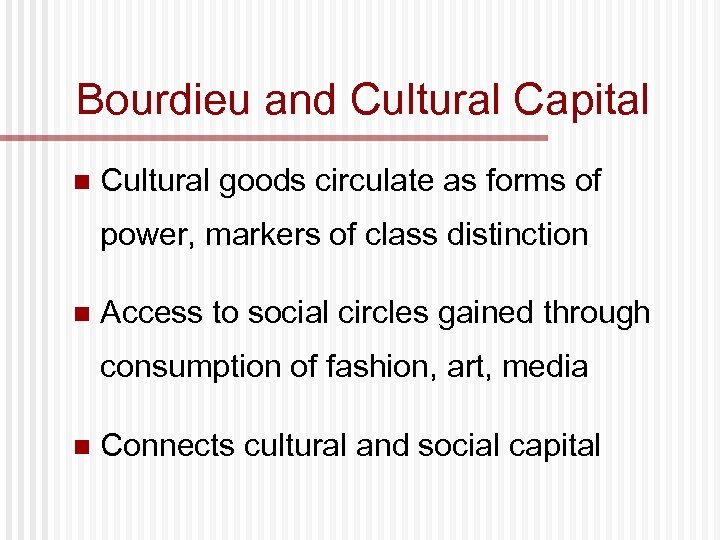 Bourdieu and Cultural Capital n Cultural goods circulate as forms of power, markers of class distinction n Access to social circles gained through consumption of fashion, art, media n Connects cultural and social capital
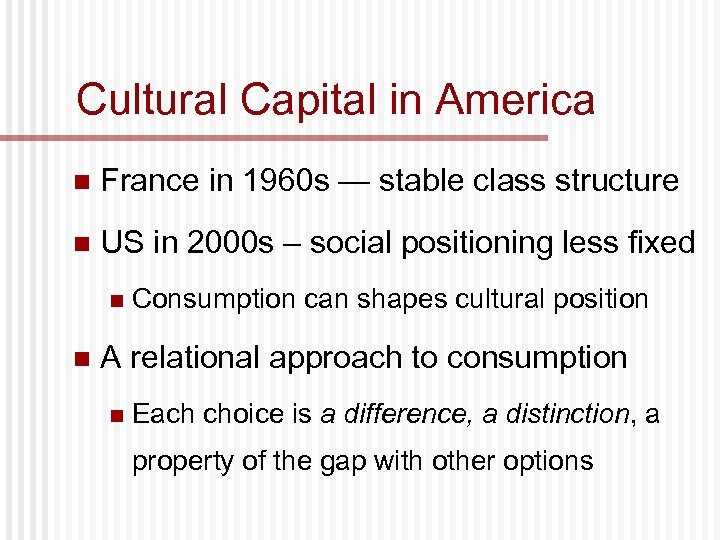 Cultural Capital in America n France in 1960 s — stable class structure n US in 2000 s – social positioning less fixed n n Consumption can shapes cultural position A relational approach to consumption n Each choice is a difference, a distinction, a property of the gap with other options
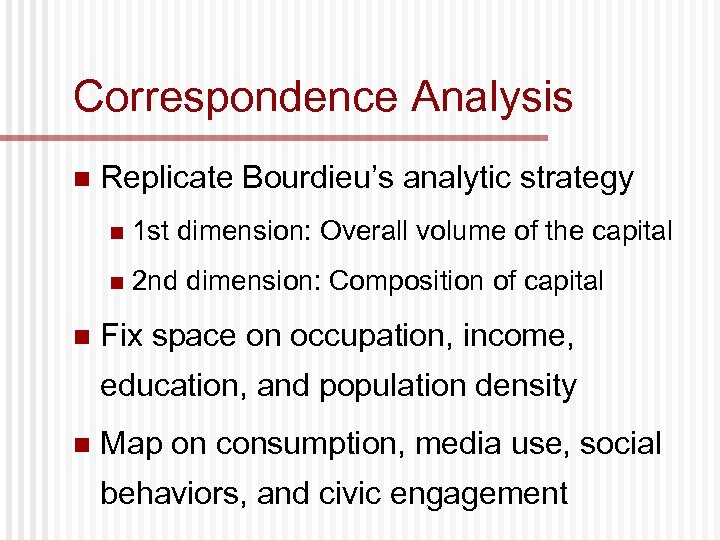 Correspondence Analysis n Replicate Bourdieu’s analytic strategy n n n 1 st dimension: Overall volume of the capital 2 nd dimension: Composition of capital Fix space on occupation, income, education, and population density n Map on consumption, media use, social behaviors, and civic engagement
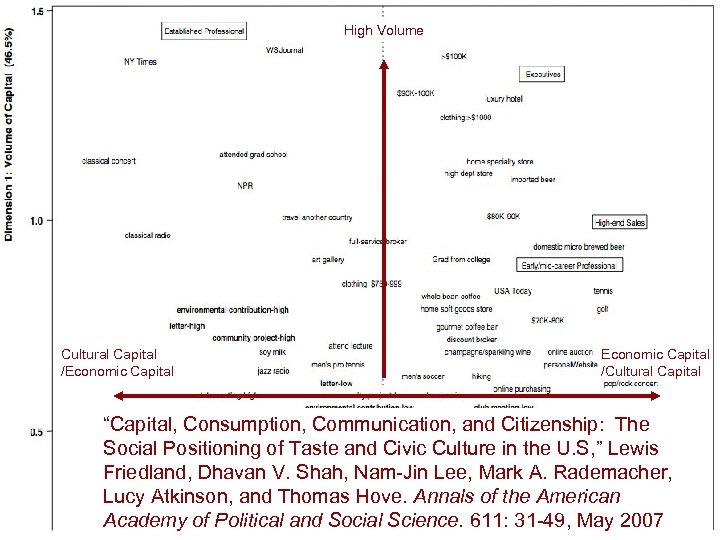 High Volume Cultural Capital /Economic Capital /Cultural Capital “Capital, Consumption, Communication, and Citizenship: The Social Positioning of Taste and Civic Culture in the U. S, ” Lewis Friedland, Dhavan V. Shah, Nam-Jin Lee, Mark A. Rademacher, Lucy Atkinson, and Thomas Hove. Annals of the American Academy of Political and Social Science. 611: 31 -49, May 2007
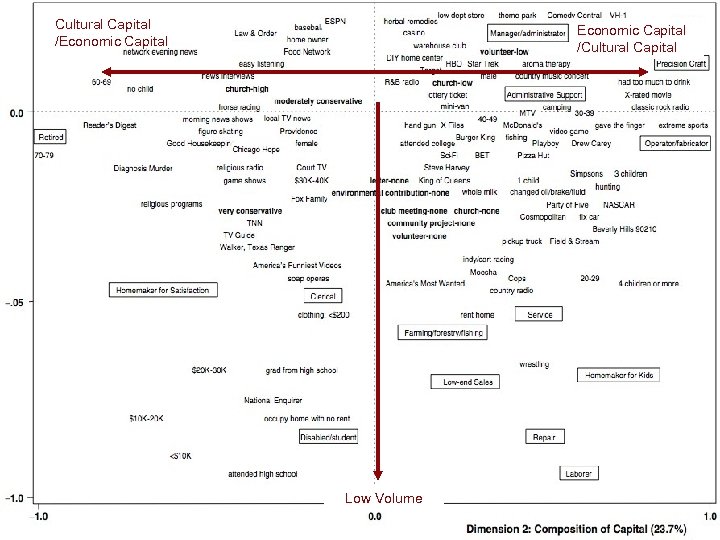 Cultural Capital /Economic Capital /Cultural Capital Low Volume
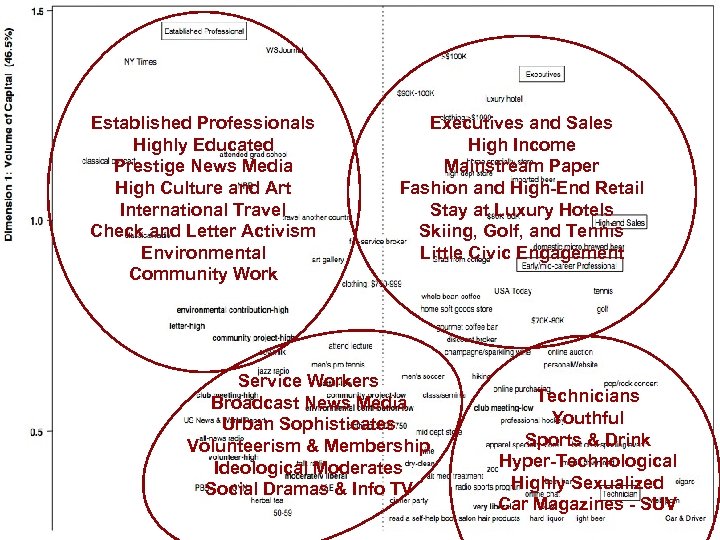 Established Professionals Highly Educated Prestige News Media High Culture and Art International Travel Check and Letter Activism Environmental Community Work Executives and Sales High Income Mainstream Paper Fashion and High-End Retail Stay at Luxury Hotels Skiing, Golf, and Tennis Little Civic Engagement Service Workers Broadcast News Media Urban Sophisticates Volunteerism & Membership Ideological Moderates Social Dramas & Info TV Technicians Youthful Sports & Drink Hyper-Technological Highly Sexualized Car Magazines - SUV
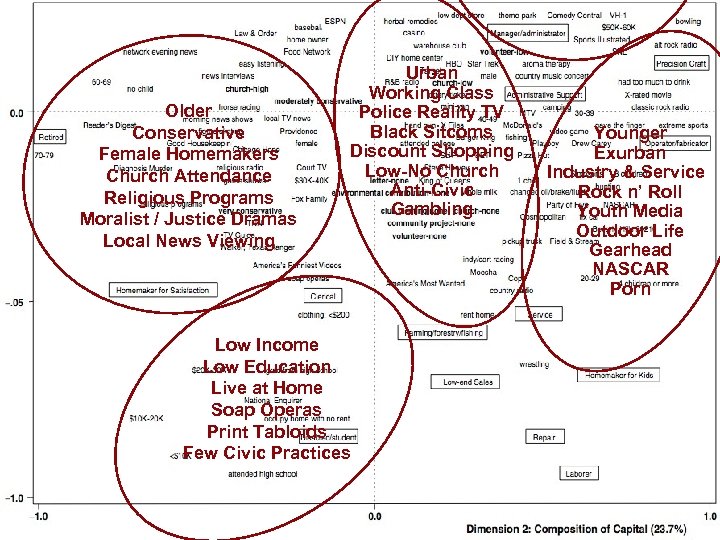 Older Conservative Female Homemakers Church Attendance Religious Programs Moralist / Justice Dramas Local News Viewing Urban Working Class Police Reality TV Black Sitcoms Discount Shopping Low-No Church Anti-Civic Gambling Low Income Low Education Live at Home Soap Operas Print Tabloids Few Civic Practices Younger Exurban Industry & Service Rock n’ Roll Youth Media Outdoor Life Gearhead NASCAR Porn
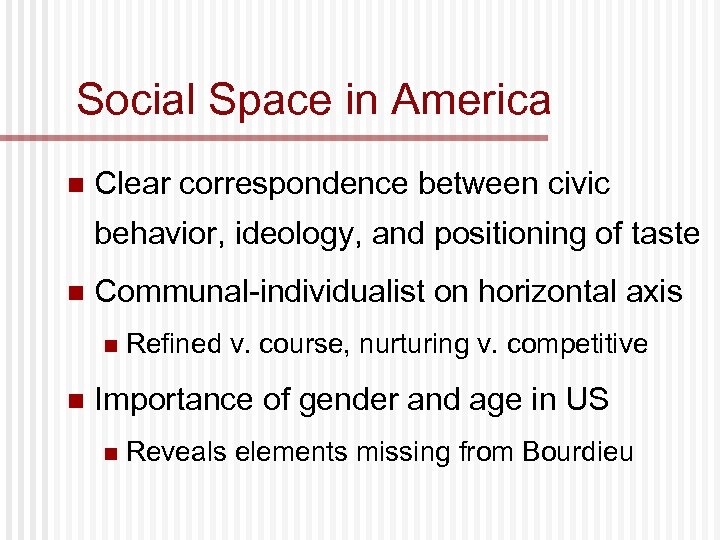 Social Space in America n Clear correspondence between civic behavior, ideology, and positioning of taste n Communal-individualist on horizontal axis n n Refined v. course, nurturing v. competitive Importance of gender and age in US n Reveals elements missing from Bourdieu
 Gender and Generation n Does gender structure a preference for a particular form of cultural capital n How does this differ across generational groups — Civic, Boomers, Gen X “Gender and Generation in the Social Positioning of Taste, ” Nam-jin Lee, Christine L. Garlough, Lewis Friedland, and Dhavan V. Shah. The ANNALS of the American Academy of Political and Social Science, 644, 134 -146, November 2012.
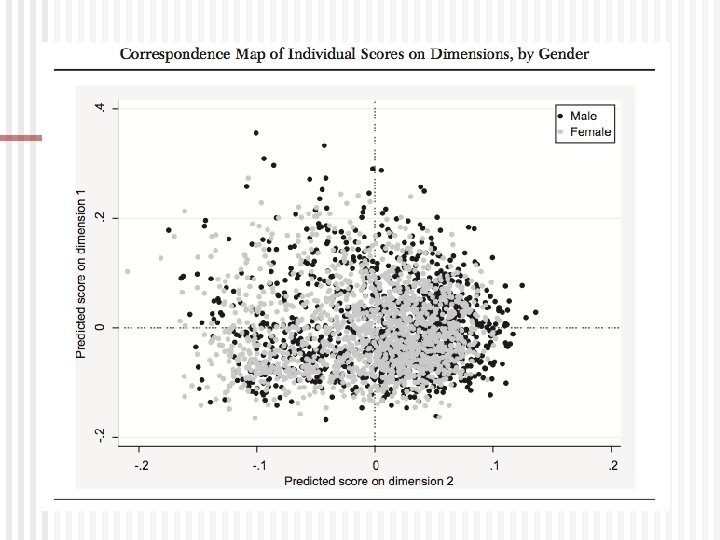
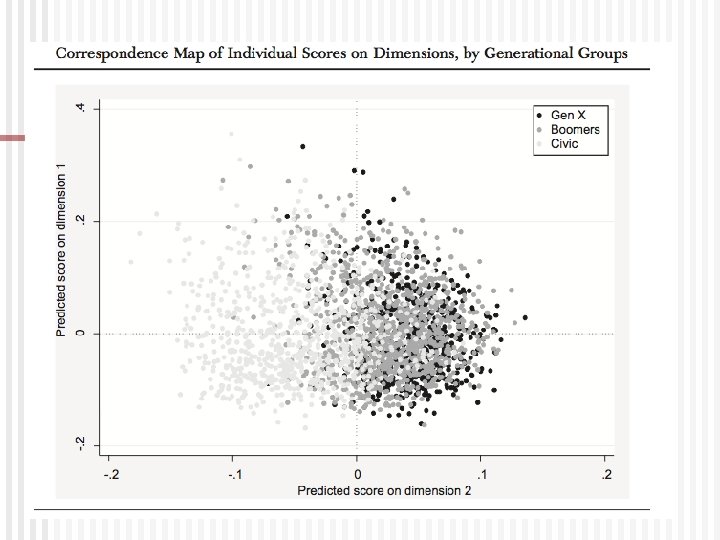
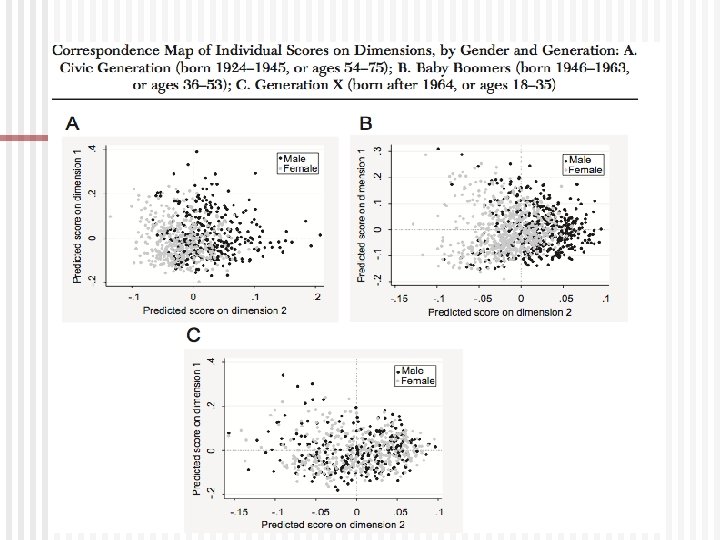
 Citizens and Consumers n Changing terrain by age and gender n Gender no longer structures preference for communal v. individual among younger n Refinement and nurturance less defining of femininity or masculinity for Gen. X. n Differences demand deeper attention
 Complicating Consumption n Mistake to “draw a sharp line” between consumption and citizenship n Consumer choices can be public-spirited • Cafes in 18 th c. Europe; Brand Communities • Boycotting Walmart, Heinz Ketchup • “Buycotting” and Conscious Consumption
 The Consumer-Citizen n Growing alignment of consumptive and civic n n n n Human Rights and anti-sweatshop Unfair labor practices and fair trade Environmentalism and eco-consumption Patriotism and nationalistic buying Localism and boycotting chain retailers Anti-globalism and multi-national QSR Global health and “Red” campaign New form of participation?
 Political Consumerism n Using the market as an arena for politics • Stolle, Hooghe & Micheletti, 2005 n Treat global markets as ethical systems ‘Positive buying’ - ethical products favored n ‘Boycotting’ – unethical products avoided n • Mc. Murtry, 1998, Bennett, 1998 n Related to socially conscious consumption, moral purchasing, ethical sourcing, green consumerism, sustainable production
 Political Consumerism n Using the market as an arena for politics • Stolle, Hooghe & Micheletti, 2005 n Treat global markets as ethical systems ‘Positive buying’ - ethical products favored n ‘Boycotting’ – unethical products avoided n • Mc. Murtry, 1998, Bennett, 1998 n Related to socially conscious consumption, moral purchasing, ethical sourcing, green consumerism, sustainable production
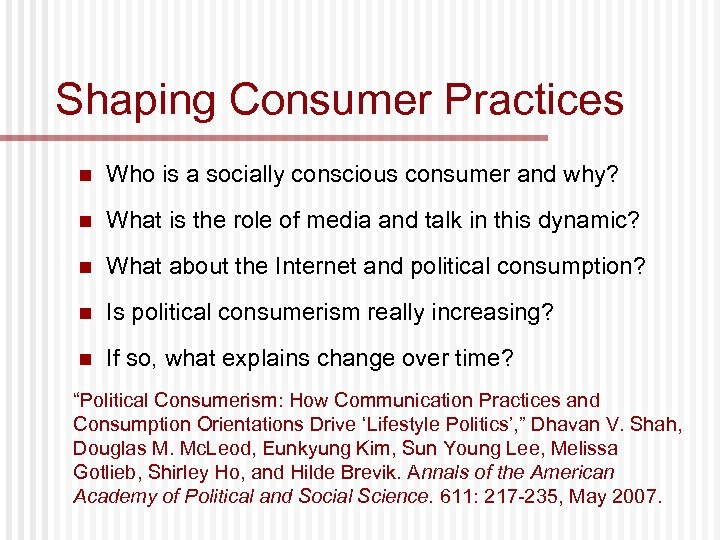 Shaping Consumer Practices n Who is a socially conscious consumer and why? n What is the role of media and talk in this dynamic? n What about the Internet and political consumption? n Is political consumerism really increasing? n If so, what explains change over time? “Political Consumerism: How Communication Practices and Consumption Orientations Drive ‘Lifestyle Politics’, ” Dhavan V. Shah, Douglas M. Mc. Leod, Eunkyung Kim, Sun Young Lee, Melissa Gotlieb, Shirley Ho, and Hilde Brevik. Annals of the American Academy of Political and Social Science. 611: 217 -235, May 2007.
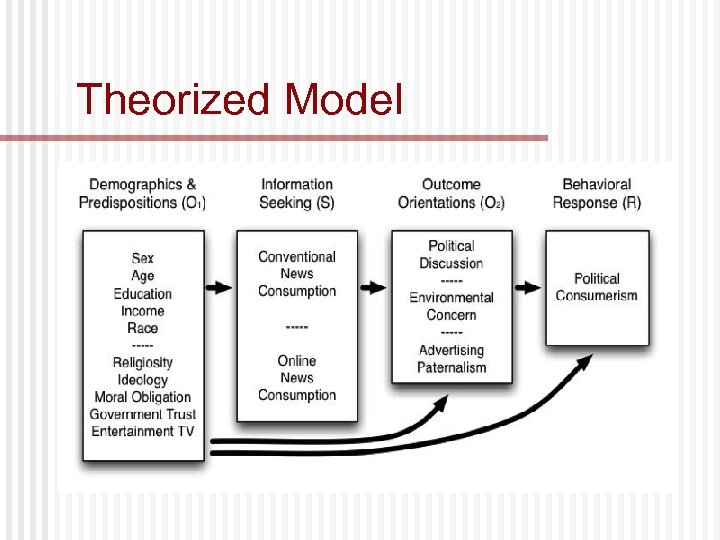 Theorized Model
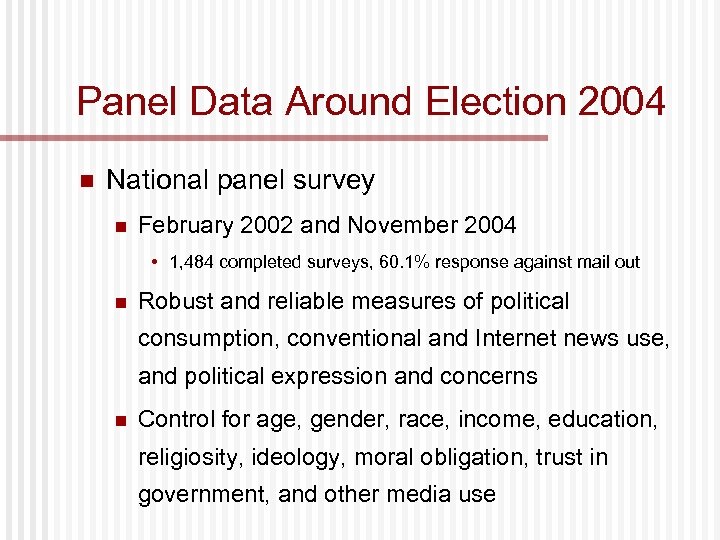 Panel Data Around Election 2004 n National panel survey n February 2002 and November 2004 • 1, 484 completed surveys, 60. 1% response against mail out n Robust and reliable measures of political consumption, conventional and Internet news use, and political expression and concerns n Control for age, gender, race, income, education, religiosity, ideology, moral obligation, trust in government, and other media use
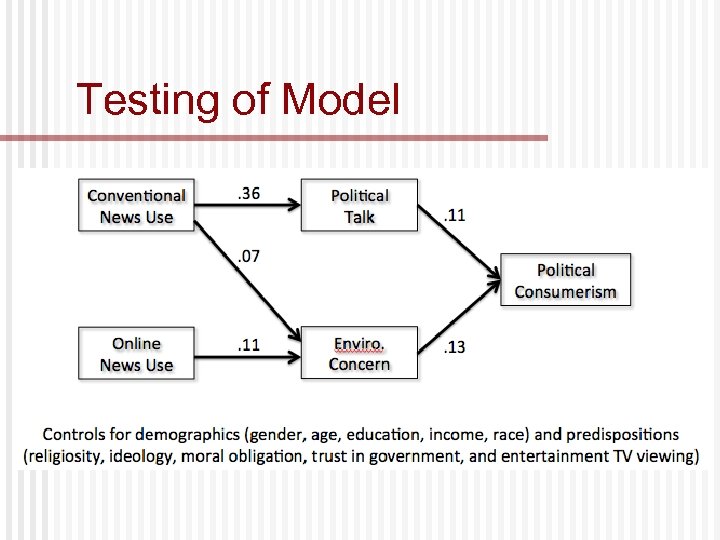 Testing of Model
 “Lifestyle” Politics n Observe associations of communication and consumption orientations on lifestyle politics n Conventional and online news to political consumption through expression and concerns n n n Political talk – communication mediation Environmental concerns – conscious consumption Replicated cross-sectional model with fixed effects model to examine over time change
 Born to Buy n The socialization of political consumption n The role of the Internet and negative ads n Merge datasets: n (1) content-coded ad-buy data on placement of campaign messages on a market-bymarket and program-by-program basis n (2) U. S. survey data of parent-child and “The Civic Consequences of “Going Negative”: Attack Ads dyads Adolescents’ Knowledge, Consumption, and Participation, ” Ming Wang, collected around 2008 election Itay Gabay, and Dhavan V. Shah, The ANNALS of the American Academy of Political and Social Science, 644, 256 -271, November 2012.
 Adolescents and Political Ads n Campaign ad placement and content data on every message in U. S. media markets n Algorithm of volume and negativity of exposure based on each respondents viewing patterns - individual propensity estimation • Vast majority of ads concentrated in local news programs, morning news programs, game shows, soap operas and daytime talk shows n Accounts for (a) localized nature of ad placement, (b) differences in potential for exposure based on individual’s viewing patterns, and (c) content of ads
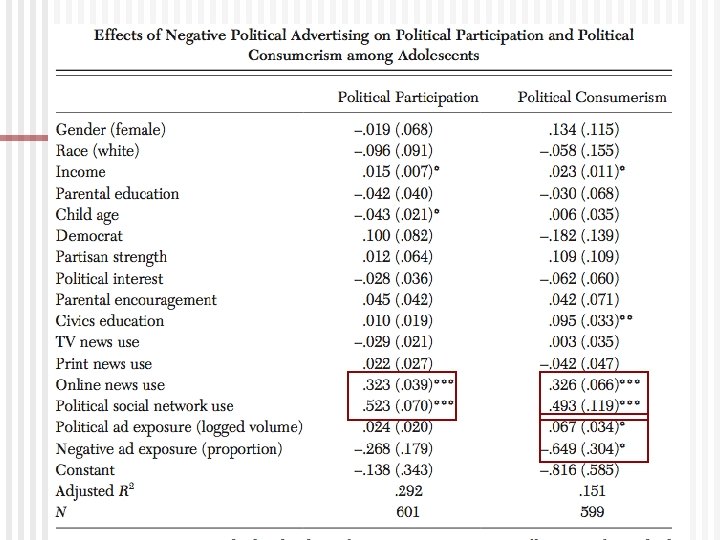
 Digital Natives During Elections n Online news and political social network use related to political engagement – participation and consumerism n Negativity of political ad exposure suppressed political consumerism, though volume of ads support such activism
 Reconfiguring Consumption n Communication central to politics of consumption, but in complex ways n n n The social positioning of taste The potential of political consumerism Began with simplistic concerns; arrive at serious reconsideration; new questions
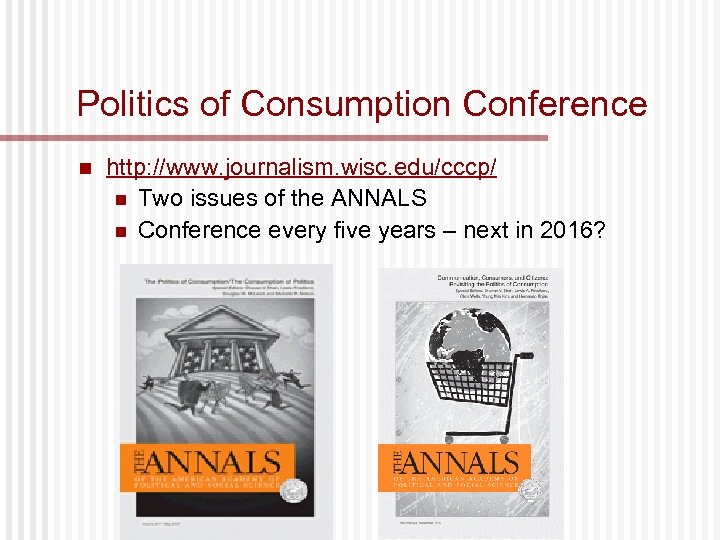 Politics of Consumption Conference n http: //www. journalism. wisc. edu/cccp/ n Two issues of the ANNALS n Conference every five years – next in 2016?
 Born to Buy (and Boycott) n The socialization of consumption n n … and political consumption? Role of family, school, peers, and media n Developmental differences from early to late adolescence in terms of influencers n Parental, peer, and school influences weaken while communication practices grow stronger among late adolescents.
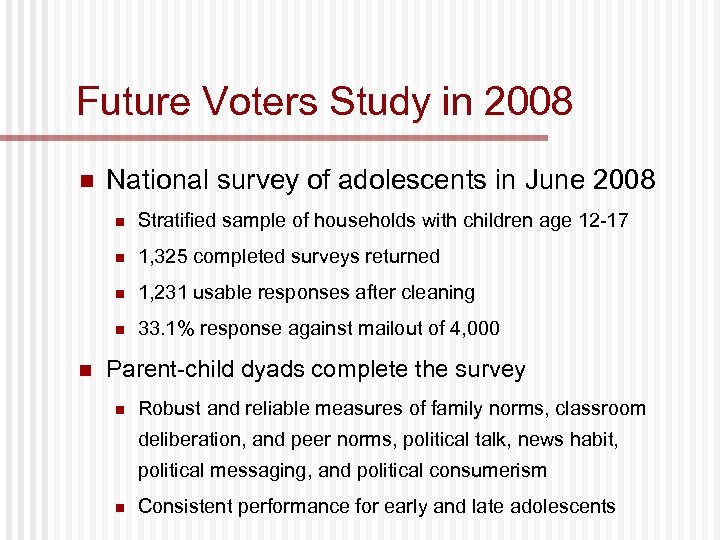 Future Voters Study in 2008 n National survey of adolescents in June 2008 n n 1, 325 completed surveys returned n 1, 231 usable responses after cleaning n n Stratified sample of households with children age 12 -17 33. 1% response against mailout of 4, 000 Parent-child dyads complete the survey n Robust and reliable measures of family norms, classroom deliberation, and peer norms, political talk, news habit, political messaging, and political consumerism n Consistent performance for early and late adolescents
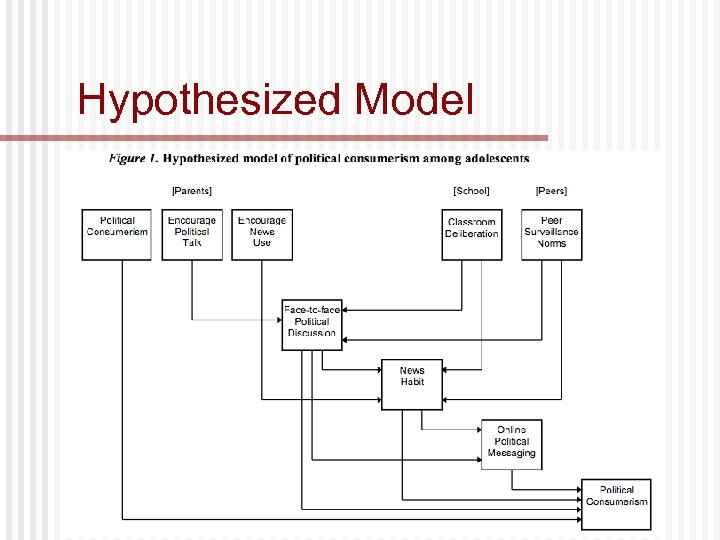 Hypothesized Model
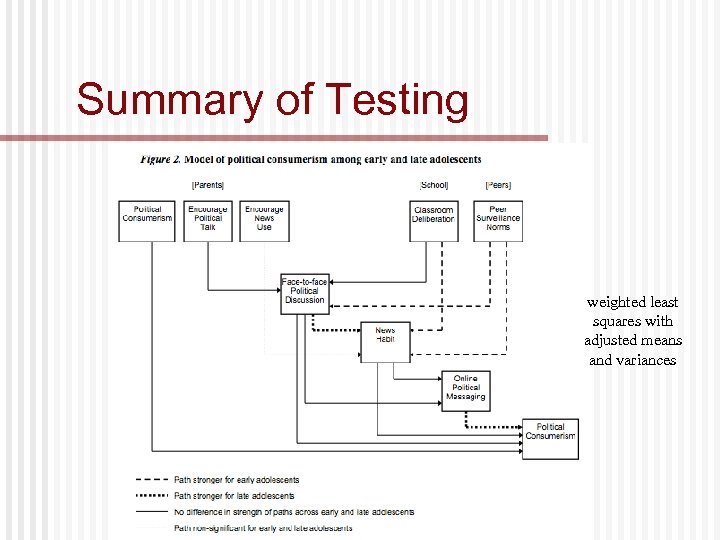 Summary of Testing weighted least squares with adjusted means and variances
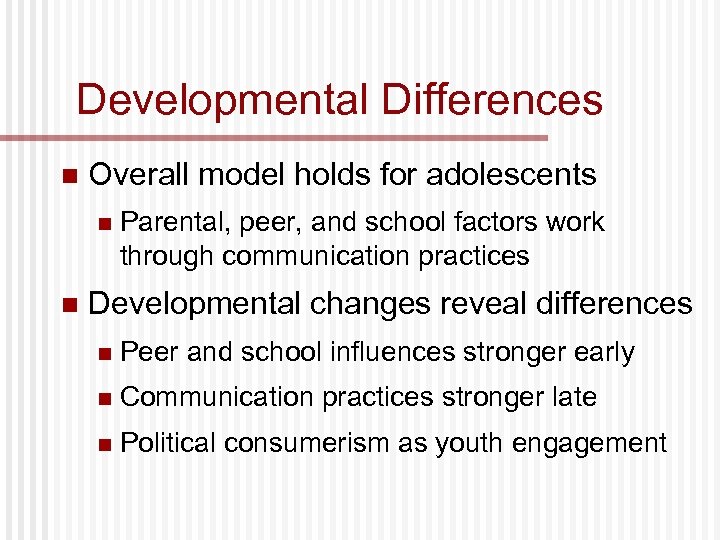 Developmental Differences n Overall model holds for adolescents n n Parental, peer, and school factors work through communication practices Developmental changes reveal differences n Peer and school influences stronger early n Communication practices stronger late n Political consumerism as youth engagement
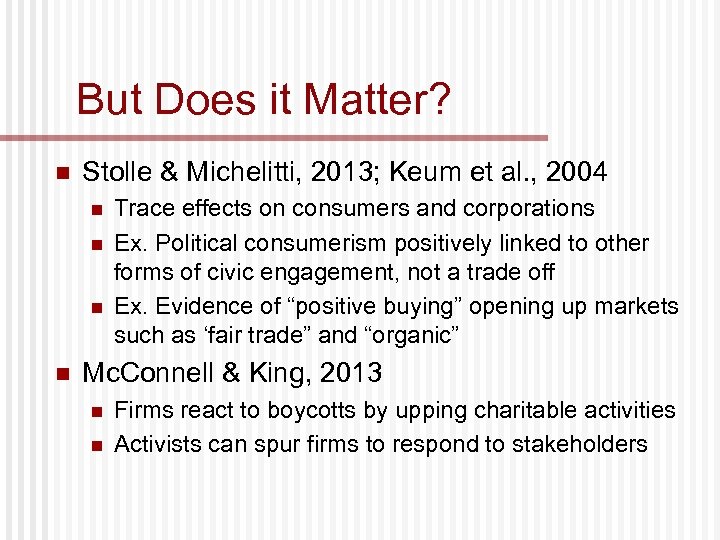 But Does it Matter? n Stolle & Michelitti, 2013; Keum et al. , 2004 n n Trace effects on consumers and corporations Ex. Political consumerism positively linked to other forms of civic engagement, not a trade off Ex. Evidence of “positive buying” opening up markets such as ‘fair trade” and “organic” Mc. Connell & King, 2013 n n Firms react to boycotts by upping charitable activities Activists can spur firms to respond to stakeholders