 Скачать презентацию Communication Between Peer Wireless Sensor Networks over 2
2c6cd6745b476ecd7598e583930a67ea.ppt
- Количество слайдов: 45



Communication Between Peer Wireless Sensor Networks over 2. 5 G/3 G Mobile Networks Srdjan Krco R&D Ericsson Ireland srdjan. krco@ericsson. com Rev PA 1 02/03/2004 1
About Ericsson Ireland • 3 G research and development; • Training center; • Applied Research Lab – – Network management; Wireless sensor networks; Ad-hoc networks; Distributed systems; Rev PA 1 02/03/2004 2
Acknowledgments • Skylark project team • David Cleary • Daryl Parker Rev PA 1 02/03/2004 3
Presentation outline • • Introduction; Wireless sensor networks gateway architecture; P 2 P sensor networks; Conclusion; Rev PA 1 02/03/2004 4
Introduction – Ericsson Interests • Ericsson fields of interest: – Mobile infrastructure; – Mobile services – design and development of new services that will increase number of mobile network subscribers; • Sensor networks in mobile networks context; • Potential source of new traffic and hence revenue; • Issues: – How to connect sensor networks to mobile networks; – How to enable easy access to sensor networks and information they provide; – Impact of numerous sensors connected to a mobile network; Rev PA 1 02/03/2004 5
Introduction – Wireless Sensor Networks • Number of small nodes with sensing, computing and wireless communication capability; • Data gathered in one node; • Hop-by-hop communication; • Redundant number of nodes; • Data fusion; • Querying and tasking; Rev PA 1 02/03/2004 6
Introduction – Wireless Sensor Networks • Gateway node – injects queries and tasks; – gathers responses; • User-gateway communication – using short-range wireless technology or – wide area networks (fixed and mobile); • Sensor networks deployed, maintained, operated and used by one organization; Rev PA 1 02/03/2004 7
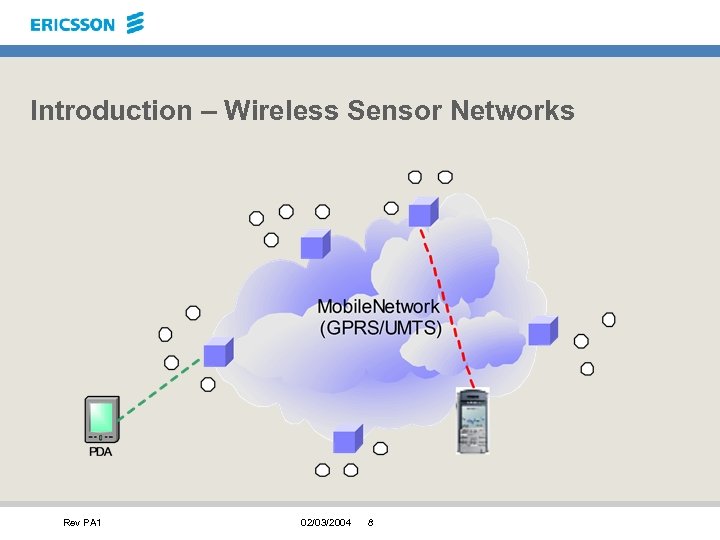
Introduction – Wireless Sensor Networks Rev PA 1 02/03/2004 8
Introduction – Resarch Focus • Popular research topics: – – – Routing; MAC layer issues; Data aggregation; Security; Middleware; • Less popular: – Interaction with external networks; – Interaction between wireless sensors networks; Rev PA 1 02/03/2004 9
Introduction – Standard Assumptions • Users have applications designed for a particular sensor network; • Available services known in advance (temperature monitoring, military vehicles tracking); • Means for establishing communication links with gateways (protocol, gateway address, etc. ) known in advance; Rev PA 1 02/03/2004 10
Focus of Our Research • Design and development of software and protocol architecture of a wireless sensor network gateway – Generic, supports various sensor types and data format; – Independent of underlying transmission technologies; • Creation of a peer-to-peer sensor network over a 2. 5/3 G mobile network, where each sensor network represents one peer node – Peers able to exchange data and provide more complex services; – Users also peers or have access to services provided by any peer via communication with one peer node only; Rev PA 1 02/03/2004 11
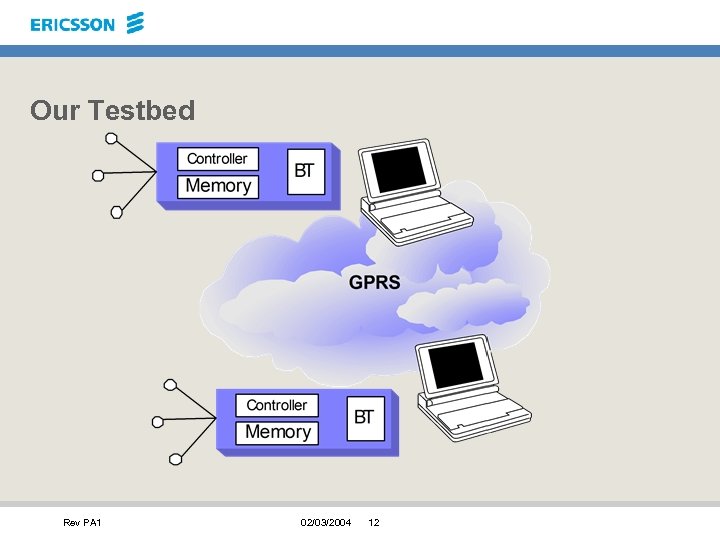
Our Testbed Rev PA 1 02/03/2004 12
Smart Sensor • Micro controller – Controls Bluetooth link; – Implements communication protocol for interaction with gateway; – Controls attached sensors; • Memory – Stores sensor data temporarily; • Sensors – One or more attached; – Described by attributes; Rev PA 1 02/03/2004 13
WSN Gateway Implementation • • Linux OS laptop; Java; Bluetooth PCMCIA card; GPRS PCMCIA card or infrared connection to a GPRS enabled mobile phone; Rev PA 1 02/03/2004 14
WSN Gateway • Entry point into a sensor network; • Short-range wireless communication – With sensors; – With users in the vicinity; • Wide area network access – Remote users; – Other gateways; Rev PA 1 02/03/2004 15
WSN Gateway • Hides internal organization of the sensor network; • Aware of all sensor types in the network and their characteristics – Sensor attributes (sensor type, location, data format, accuracy etc. ) described and transferred as XML string; – Sensor querying based on sensor attributes (XML based); – Describes supported functions (max, min, average); Rev PA 1 02/03/2004 16
WSN Gateway Functionality • • Discovers smart sensors; Gathers description of available sensors; Controls communication with and functionality of sensors; Creates an object for each available sensor – Has methods for communication with the sensor; – Keeps an up to date description of the sensor; • Provides API for access and control of the sensor network; Rev PA 1 02/03/2004 17
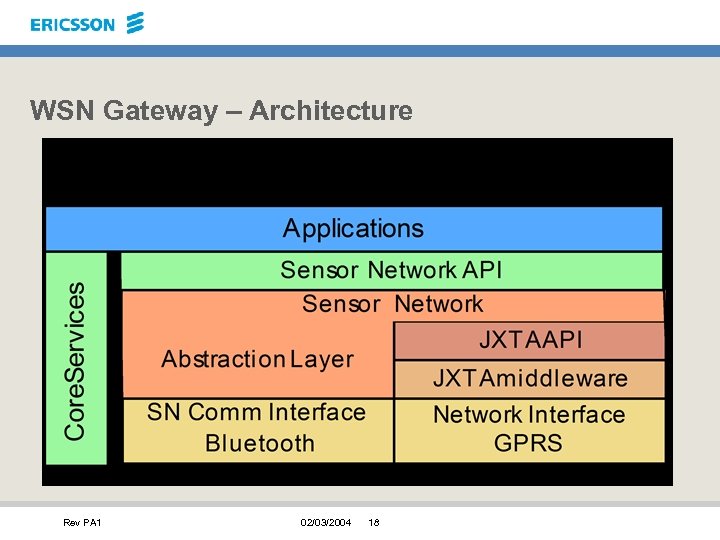
WSN Gateway – Architecture Rev PA 1 02/03/2004 18
Core Services • Common procedures and services required by all layers – – Logging; Scheduling; Event subscription; Services required for automatic application start and restart; Rev PA 1 02/03/2004 19
Sensor Network Communication Interface • Transmission technology specific; • Provides methods for data transfer to/from sensors over the chosen communication interface; • Provides additional, interface specific methods (Inquiry, Service Discovery); Rev PA 1 02/03/2004 20
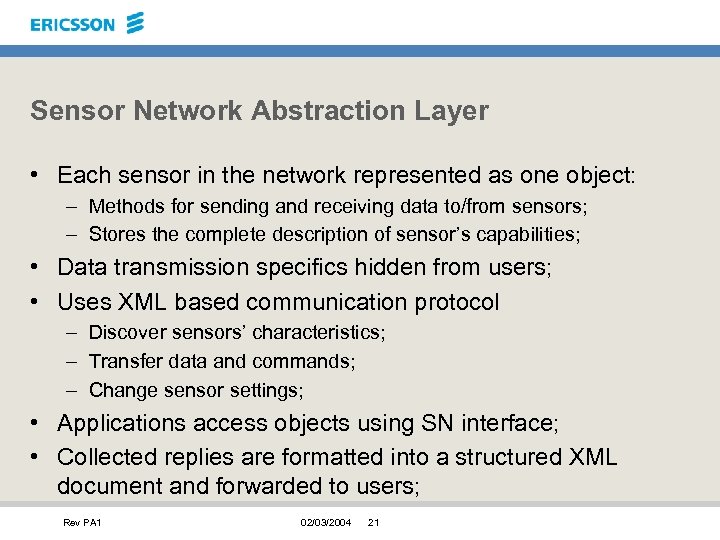
Sensor Network Abstraction Layer • Each sensor in the network represented as one object: – Methods for sending and receiving data to/from sensors; – Stores the complete description of sensor’s capabilities; • Data transmission specifics hidden from users; • Uses XML based communication protocol – Discover sensors’ characteristics; – Transfer data and commands; – Change sensor settings; • Applications access objects using SN interface; • Collected replies are formatted into a structured XML document and forwarded to users; Rev PA 1 02/03/2004 21
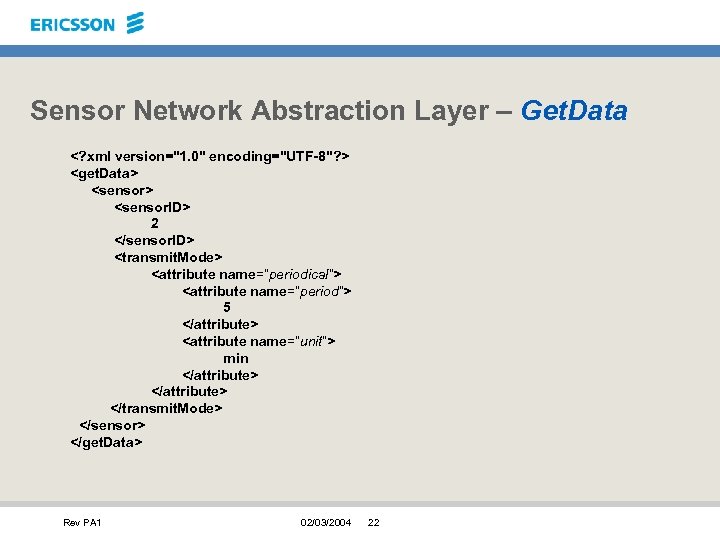
Sensor Network Abstraction Layer – Get. Data <? xml version="1. 0" encoding="UTF-8"? > <get. Data> <sensor. ID> 2 </sensor. ID> <transmit. Mode> <attribute name=”periodical”> <attribute name=”period”> 5 </attribute> <attribute name=”unit”> min </attribute> </transmit. Mode> </sensor> </get. Data> Rev PA 1 02/03/2004 22
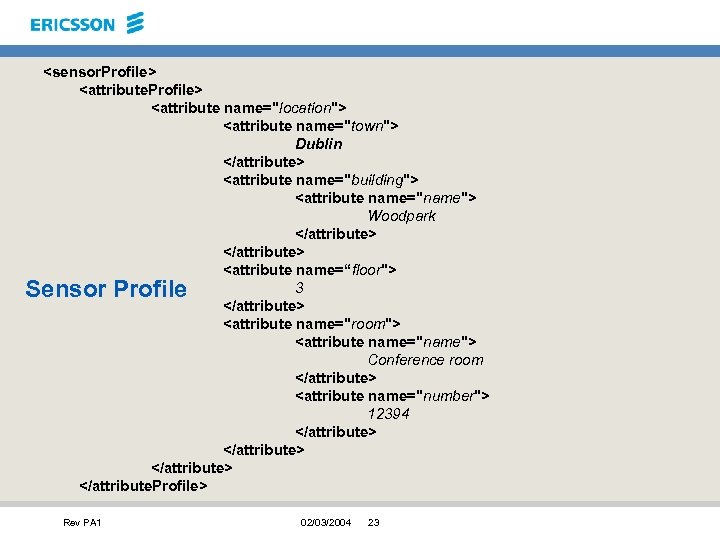
<sensor. Profile> <attribute name="location"> <attribute name="town"> Dublin </attribute> <attribute name="building"> <attribute name="name"> Woodpark </attribute> <attribute name=“floor"> 3 </attribute> <attribute name="room"> <attribute name="name"> Conference room </attribute> <attribute name="number"> 12394 </attribute> </attribute. Profile> Sensor Profile Rev PA 1 02/03/2004 23
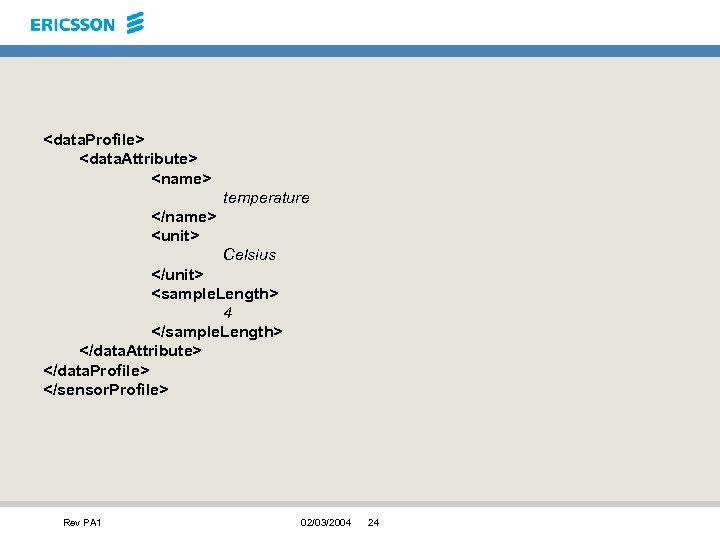
<data. Profile> <data. Attribute> <name> temperature </name> <unit> Celsius </unit> <sample. Length> 4 </sample. Length> </data. Attribute> </data. Profile> </sensor. Profile> Rev PA 1 02/03/2004 24
Sensor Network API • Generic methods, provide consistent interface regardless of sensor type and characteristics; • List of sensors in the network; • Description of available sensors (sensor attributes); • XML querying based on description of required data; • Listeners: – Sensor has been added/removed from the network; – New data available; Rev PA 1 02/03/2004 25
Sensor Network API – Query • Users define data they are interested in (for example: temperature on the first floor in the HQ building) instead of defining the network address of a particular sensor; • Query definition similar to the sensor attribute profile; • Constraints given in the query compared against characteristics (attributes) of available sensors and returns a list of sensor IDs that correspond to the query; Rev PA 1 02/03/2004 26
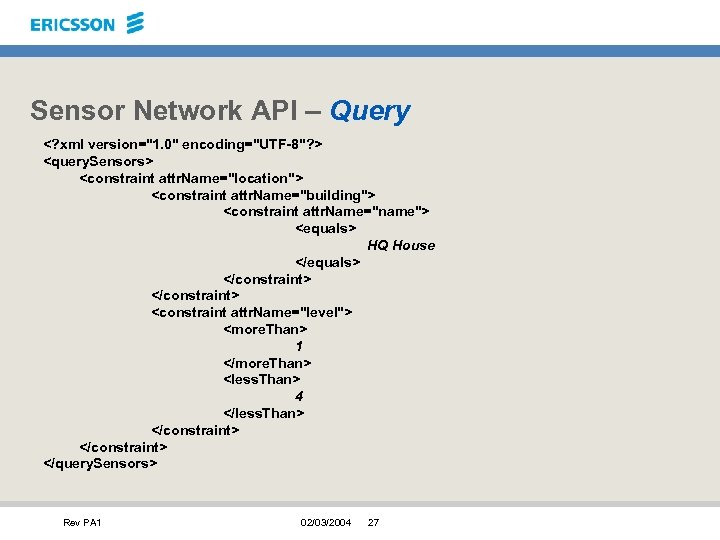
Sensor Network API – Query <? xml version="1. 0" encoding="UTF-8"? > <query. Sensors> <constraint attr. Name="location"> <constraint attr. Name="building"> <constraint attr. Name="name"> <equals> HQ House </equals> </constraint> <constraint attr. Name="level"> <more. Than> 1 </more. Than> <less. Than> 4 </less. Than> </constraint> </query. Sensors> Rev PA 1 02/03/2004 27
P 2 P Sensor Networks • Sensor networks – Deployed on ad-hoc basis by various entities; – Appear and disappear based on the operator needs, requirements and schedule; • Short-range (Bluetooth) and wide-range (UMTS) wireless interface for communication with users; • Users interact with networks in an ad-hoc manner based on theirs needs at a given moment and location; Rev PA 1 02/03/2004 28
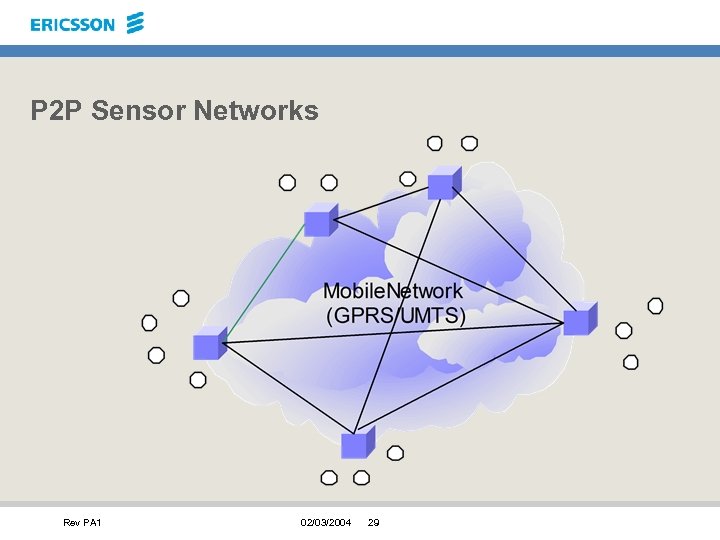
P 2 P Sensor Networks Rev PA 1 02/03/2004 29
P 2 P Sensor Networks • Users are external to the network – do not know about the existence of the network or services they provide; – Sensor network’s characteristics, type or format of data unknown; • Sensor network detection, service discovery and service provision mechanisms required; Rev PA 1 02/03/2004 30
P 2 P Sensor Networks • Numerous services – – – Traffic congestion info; Water pollution of a river; Weather info; Personal health care network; Free spaces in a car park; • Not feasible to have a central service listing server; Rev PA 1 02/03/2004 31
P 2 P Sensor Networks • Individual sensor networks – – Cooperate; Form groups; Provide more comprehensive service; Available to more users; • Users – Communicate with one sensor network gateway; – Able to get information about/from all other sensor networks in the group; Rev PA 1 02/03/2004 32
P 2 P Sensor Networks • Possible scenarios: – Users access sensor network over a short-range wireless interface (Bluetooth): • Bluetooth Inquiry; • Access to information from via the gateway; – Users access sensor network over a mobile network: • Join peer group; • Access to information using P 2 P protocols; Rev PA 1 02/03/2004 33
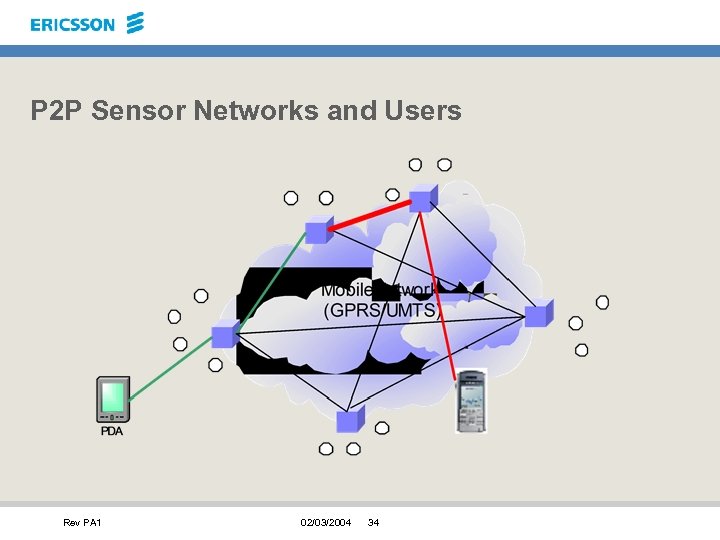
P 2 P Sensor Networks and Users Rev PA 1 02/03/2004 34
P 2 P Sensor Networks • Issues – – Detection of other sensor networks; Information exchange between sensor networks; Description of sensor network services; Forwarding users request and sensor network responses to/from proper sensor network; Rev PA 1 02/03/2004 35
JXTA • Network programming and computing platform for creating interoperable P 2 P applications and services; • Designed for ad-hoc, pervasive, multi-hop P 2 P networks; • Allows any connected heterogeneous device on the network (mobile phone, PDA, PC et. ) to communicate and collaborate with one another; Rev PA 1 02/03/2004 36
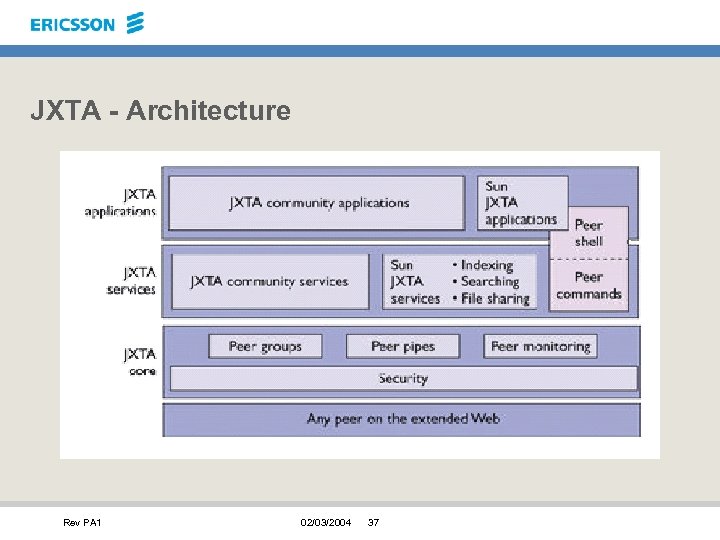
JXTA - Architecture Rev PA 1 02/03/2004 37
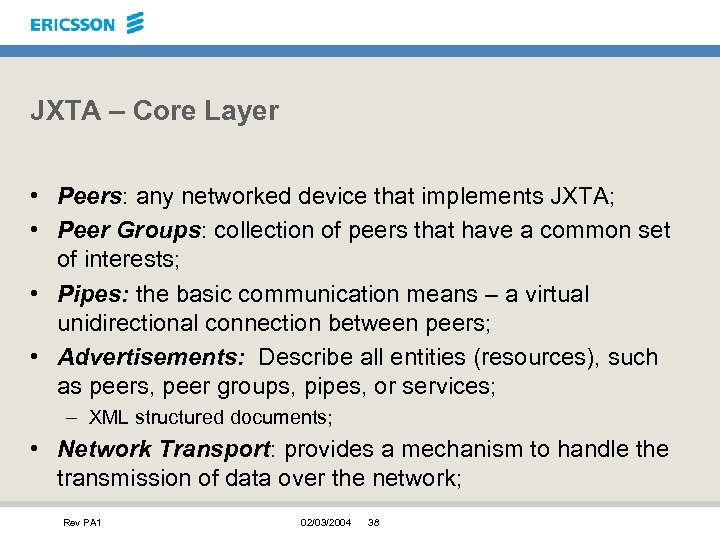
JXTA – Core Layer • Peers: any networked device that implements JXTA; • Peer Groups: collection of peers that have a common set of interests; • Pipes: the basic communication means – a virtual unidirectional connection between peers; • Advertisements: Describe all entities (resources), such as peers, peer groups, pipes, or services; – XML structured documents; • Network Transport: provides a mechanism to handle the transmission of data over the network; Rev PA 1 02/03/2004 38
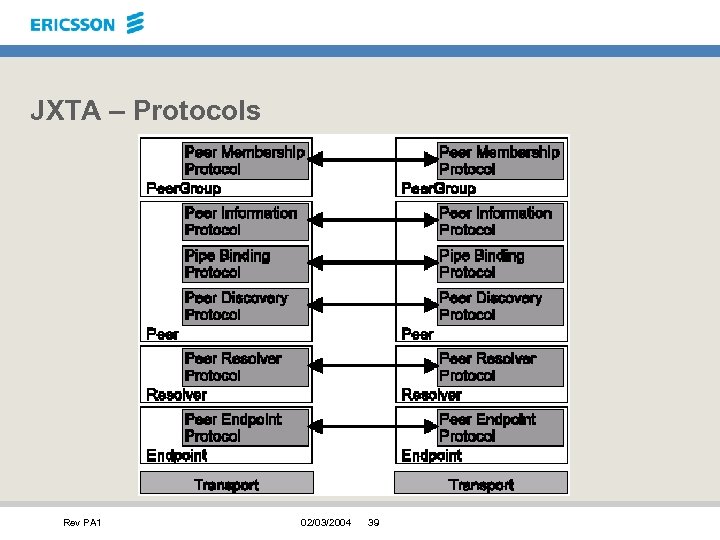
JXTA – Protocols Rev PA 1 02/03/2004 39
JXTA – Protocols • Peer Resolver Protocol – mechanism by which a peer can send a generic query to other peers; • Peer Discovery Protocol (PDP) – used to discover any published resources represented as advertisements. The PDP is based on the use of rendezvous peers; • Peer Membership Protocol – mechanism by which peers can organize themselves to form groups. Peer groups are discovered using the PDP; • Pipe Binding Protocol – used to establish pipe connections between peers; Rev PA 1 02/03/2004 40
JXTA - Protocols • Rendezvous Protocol – propagates messages within the specified group on behalf of peers from within the same group – primary purpose is to provide a service whereby peers can connect to a rendezvous peer to avail of a service that will propagate messages on their behalf; • Rendezvous Peers – Special type of peers with the ability to cache advertisements and forward requests to help peers discover resources; – Interact with different rendezvous peers; Rev PA 1 02/03/2004 41
JXTA Services • Discovery Service – Provides access to the PDP; – Limited to the context of the peer group; – Searches for JXTA resources; • Pipe Service – Manages and creates virtual channels of communication between peers in a peer group – Limited to the context of the peer group; • Resolver Service – Implements the resolver service to distribute queries among peers; Rev PA 1 02/03/2004 42
Platform Specific Services • Position Service – Provides peer-positioning services by querying the MPS (Mobile Positioning Service) for a given MSISDN embedded within a Peer. ID; • Scheduler service – Allows tasks to be remotely scheduled on peers within our network (scheduled code updates, scheduled migration of services between peers); • Sensor Service – JXTA wrapper service around the WSN Gateway functionality; – Communication between peer sensor networks over GPRS network; – Provides remote querying of sensor networks and individual sensors as well as providing sensor event subscription mechanisms; Rev PA 1 02/03/2004 43
Example • Gateway gathers sensor profiles, compiles a list of available services/sensors characteristics (type, location, accuracy, …) and structure it as its advertisement; • Rendevouz peer has information about all available sensor services in the peer group; • User interacts with a gateway over a short-range interface or becomes a mobile peer; • Gets information about all services in the peer group from the local gateway or a rendevouz peer; • Query network based on description of available services; Rev PA 1 02/03/2004 44
Conclusion • Gateway architecture: – – Supports various types of sensors; Easily adaptable to different communication technologies; XML structured sensor profiles and communication protocol; WSN API supports attribute based querying; • JXTA platform can be used as a P 2 P middleware layer, but: – Poor performance; – Slow, consumes large amount of memory, quite unreliable; • Prototype scaling-down required; Rev PA 1 02/03/2004 45
Скачать презентацию Communication Between Peer Wireless Sensor Networks over 2
2c6cd6745b476ecd7598e583930a67ea.ppt