 Скачать презентацию Communication and ATC Breaker Breaker One Nine we
ee68a6c8bfe4e61641ba0dd6bbba1681.ppt
- Количество слайдов: 32



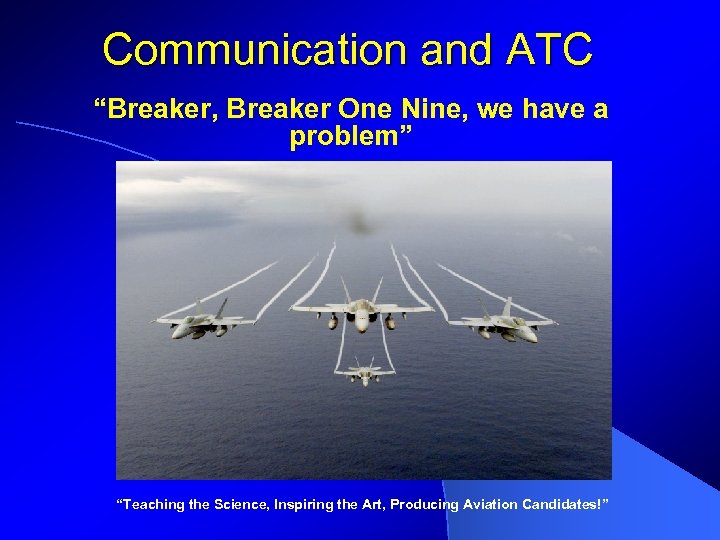
Communication and ATC “Breaker, Breaker One Nine, we have a problem” “Teaching the Science, Inspiring the Art, Producing Aviation Candidates!”
Roadmap ñVHF Communication Equipment ñRadio Operations at uncontrolled fields ñRadio Operations at controlled fields ñLost Communications Procedures
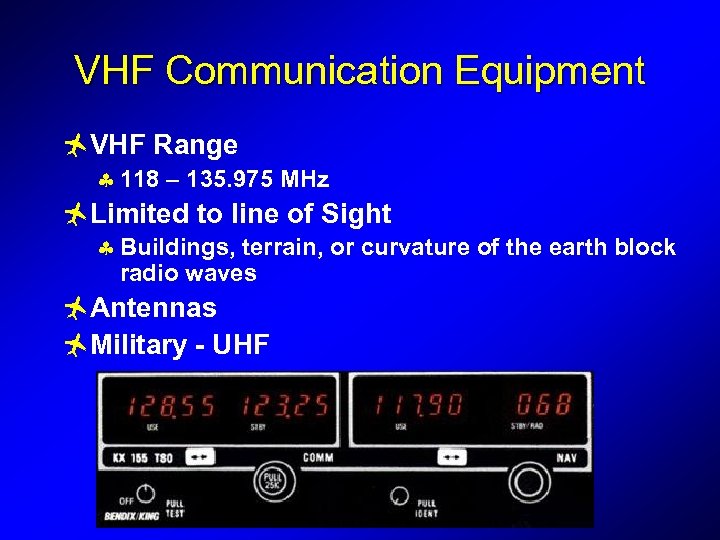
VHF Communication Equipment ñVHF Range § 118 – 135. 975 MHz ñLimited to line of Sight § Buildings, terrain, or curvature of the earth block radio waves ñAntennas ñMilitary - UHF
Using the Radio ñProfessional Phraseology (AIM Pilot Controller Glossary) § No Slang, CB Jargon, ETC. § Brief transmissions ñState who, where, and what ñEnglish recommended by ICAO (International Civil Aviation Organization) § If not official language – state must make it available ñPhonetic Alphabet
Using the Radio (cont’d) ñNumbers § “Niner” § Decimal point – (135. 4) ñN – Numbers § Combination of five letters and numbers § All registered U. S. aircraft begin with “N”
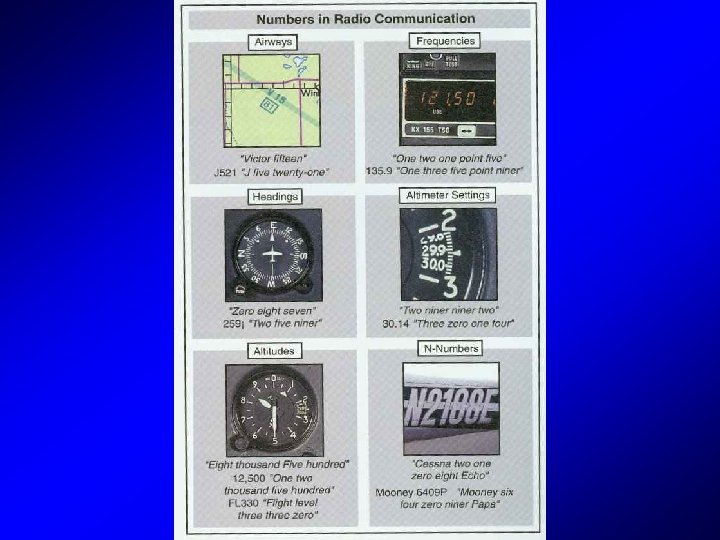
Numbers on Radio
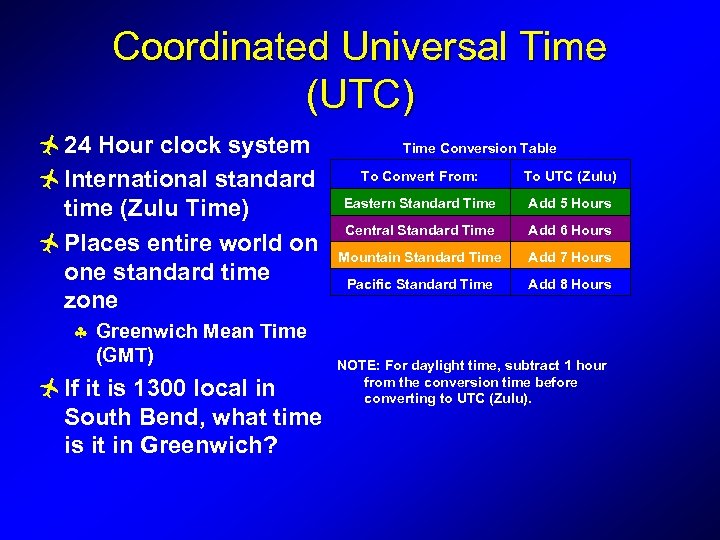
Coordinated Universal Time (UTC) ñ 24 Hour clock system ñ International standard time (Zulu Time) ñ Places entire world on one standard time zone § Greenwich Mean Time (GMT) ñ If it is 1300 local in South Bend, what time is it in Greenwich? Time Conversion Table To Convert From: To UTC (Zulu) Eastern Standard Time Add 5 Hours Central Standard Time Add 6 Hours Mountain Standard Time Add 7 Hours Pacific Standard Time Add 8 Hours NOTE: For daylight time, subtract 1 hour from the conversion time before converting to UTC (Zulu).
Radio Procedures at Uncontrolled Fields ñCTAF (Common Traffic Advisory Frequency) ñReceive Airport Advisories ñActivate Pilot Control Lighting ñFound in AF/D (Airport Facilities Directory) ñSelf – Announced Broadcasting of Intentions § Not required, but good practice
UNICOM ñPrivately Owned – not official ñCTAF will be designated Unicom ñRequest: § Airport Advisory § Winds / Active Runway § Known Traffic § Services (ex. Fueling, Cab, Pizza)
Airport Advisory Area ñFSS (Flight Service Station) on the Field ñExtends 10 sm ñFSS contacted on CTAF (123. 6) § Wind direction § Favored runway § Traffic pattern information
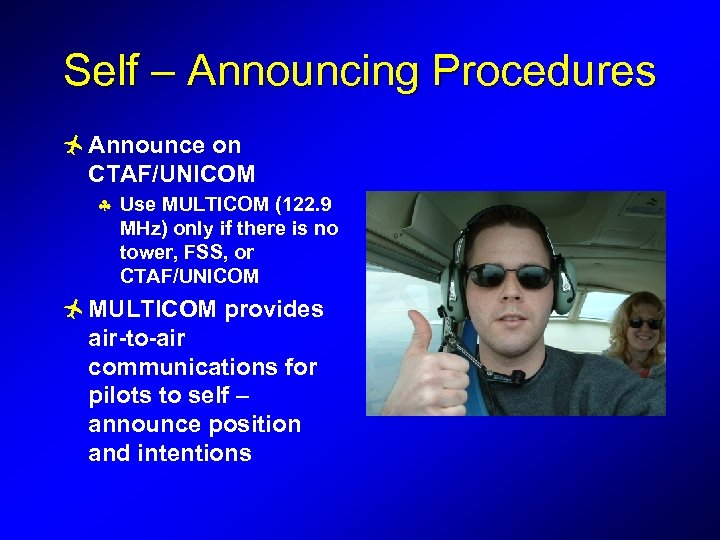
Self – Announcing Procedures ñ Announce on CTAF/UNICOM § Use MULTICOM (122. 9 MHz) only if there is no tower, FSS, or CTAF/UNICOM ñ MULTICOM provides air-to-air communications for pilots to self – announce position and intentions
CTAF Procedures ñInitial call made 10 miles from airport ñUse airport’s name at the beginning and end of transmission ñReport entering traffic pattern ñReport departing the traffic pattern § Communicate on CTAF taxi and departure intentions ñUse CTAF when maneuvering (in traffic pattern) ñEnroute / Overflight
Radio Procedure at Controlled Fields ñAirspace? ñATC Facilities § (1) - Clearance Delivery § 2 - Ground Control § 3 - Control Tower § (4) - Departure / Approach Control
Departure Procedures ñControlled Airports § Receive clearance to taxi, takeoff, and subsequently leave airspace ñAt large airports with heavy traffic departure procedures can be complex ñATIS (automated terminal information service)
Clearance Delivery ñAir Traffic Control Clearance § Authorization by ATC for you to proceed under specific traffic condition within controlled airspace ñPrevent collisions ñMust read back all clearances ñUsed for VFR flights in Class B and Class C. § Always for IFR flights
Ground Control ñATC function § Directing movement of aircraft and other vehicles on the airport surface ñMust have clearance to operate on surface ñProgressive Taxi § At unfamiliar airports the controller will, upon request, provide you with detailed taxi instructions to where you want to go § May be in stages
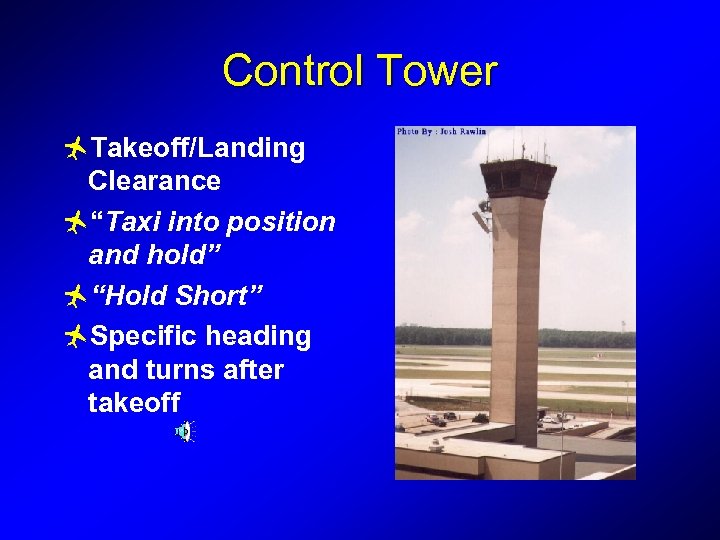
Control Tower ñTakeoff/Landing Clearance ñ“Taxi into position and hold” ñ“Hold Short” ñSpecific heading and turns after takeoff
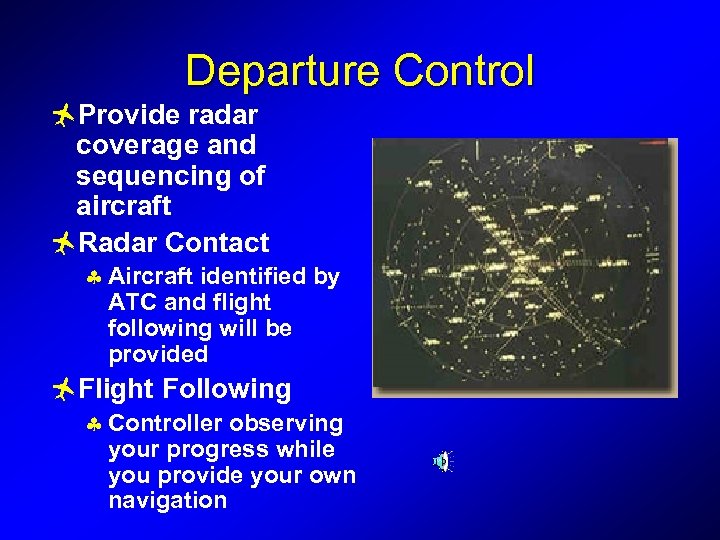
Departure Control ñProvide radar coverage and sequencing of aircraft ñRadar Contact § Aircraft identified by ATC and flight following will be provided ñFlight Following § Controller observing your progress while you provide your own navigation
Approach Control ñ ATC function which provides sequencing and separation services for inbound aircraft ñ Frequencies are published on sectionals and broadcasted over ATIS ñ Multiple freqs for large airports
Lost Comms Procedures ñCan lose communications and still land at an airport with operating control tower ñProcedures: § Squawk 7600 (transponder code) § Determine flow of traffic § Join the traffic pattern and maintain visual contact with control tower to receive light gun signals § Acknowledge tower transmission by rocking wings (daytime) or blinking your landing light (night)
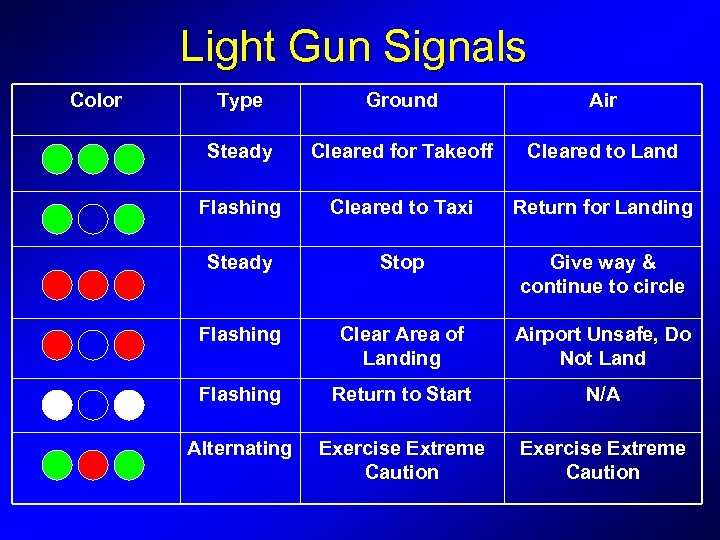
Light Gun Signals Color Type Ground Air Steady Cleared for Takeoff Cleared to Land Flashing Cleared to Taxi Return for Landing Steady Stop Give way & continue to circle Flashing Clear Area of Landing Airport Unsafe, Do Not Land Flashing Return to Start N/A Alternating Exercise Extreme Caution

Sequence of Events “Teaching the Science, Inspiring the Art, Producing Aviation Candidates!”
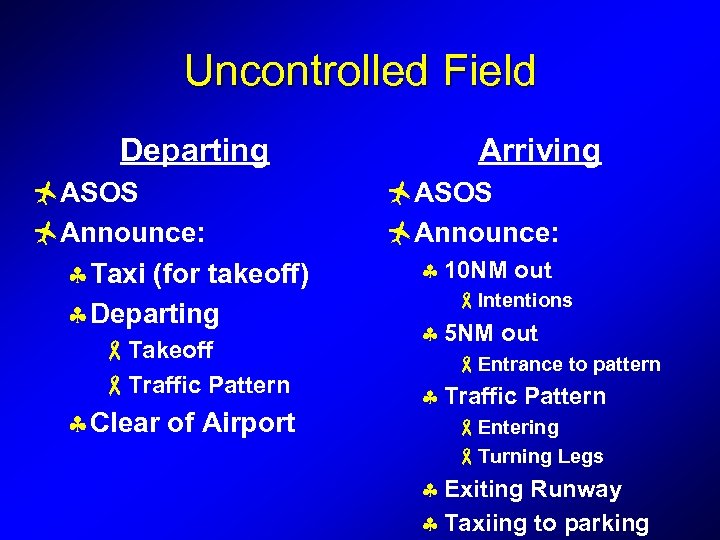
Uncontrolled Field Departing ñASOS ñAnnounce: § Taxi (for takeoff) § Departing -Takeoff -Traffic Pattern § Clear of Airport Arriving ñASOS ñAnnounce: § 10 NM out -Intentions § 5 NM out -Entrance to pattern § Traffic Pattern -Entering -Turning Legs § Exiting Runway § Taxiing to parking
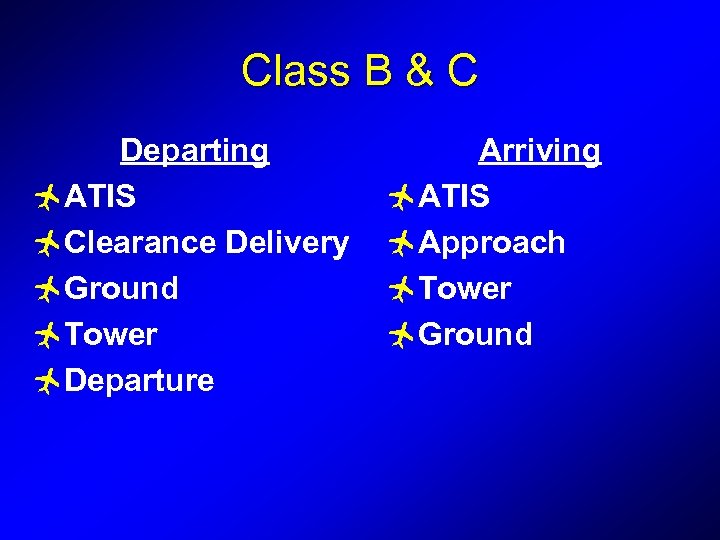
Class B & C Departing ñATIS ñClearance Delivery ñGround ñTower ñDeparture Arriving ñATIS ñApproach ñTower ñGround
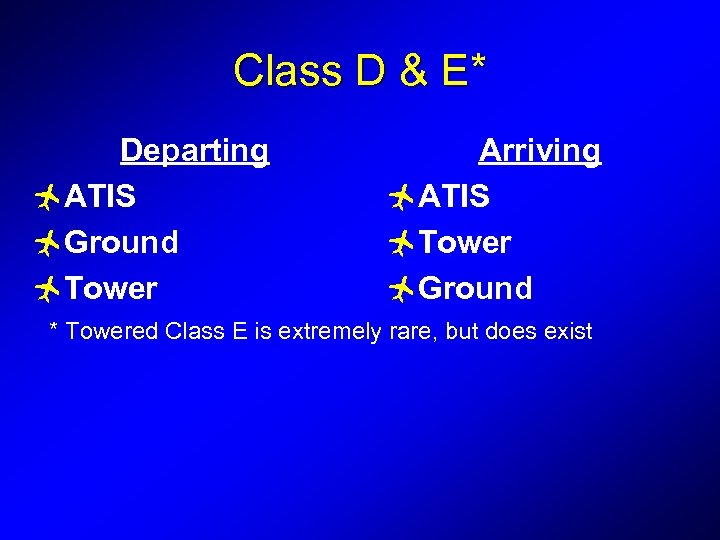
Class D & E* Departing ñATIS ñGround ñTower Arriving ñATIS ñTower ñGround * Towered Class E is extremely rare, but does exist

Example “Teaching the Science, Inspiring the Art, Producing Aviation Candidates!”
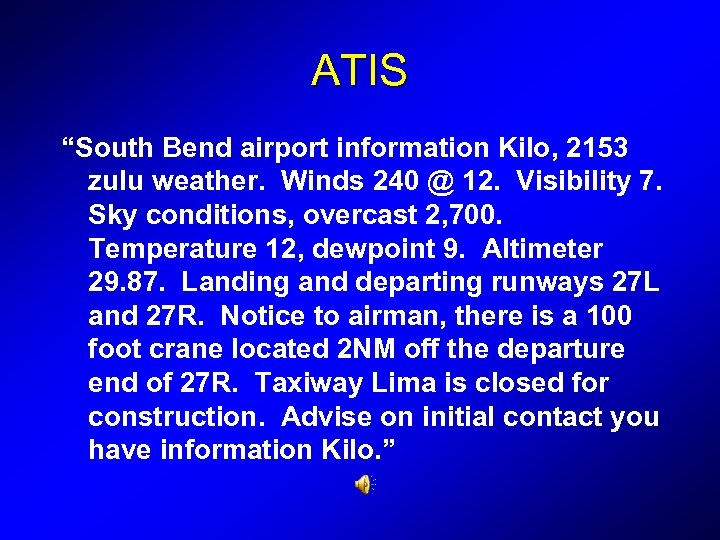
ATIS “South Bend airport information Kilo, 2153 zulu weather. Winds 240 @ 12. Visibility 7. Sky conditions, overcast 2, 700. Temperature 12, dewpoint 9. Altimeter 29. 87. Landing and departing runways 27 L and 27 R. Notice to airman, there is a 100 foot crane located 2 NM off the departure end of 27 R. Taxiway Lima is closed for construction. Advise on initial contact you have information Kilo. ”
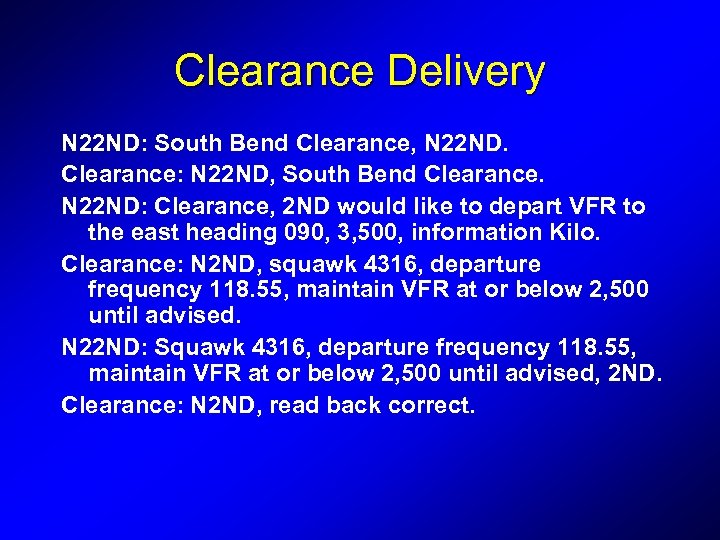
Clearance Delivery N 22 ND: South Bend Clearance, N 22 ND. Clearance: N 22 ND, South Bend Clearance. N 22 ND: Clearance, 2 ND would like to depart VFR to the east heading 090, 3, 500, information Kilo. Clearance: N 2 ND, squawk 4316, departure frequency 118. 55, maintain VFR at or below 2, 500 until advised. N 22 ND: Squawk 4316, departure frequency 118. 55, maintain VFR at or below 2, 500 until advised, 2 ND. Clearance: N 2 ND, read back correct.
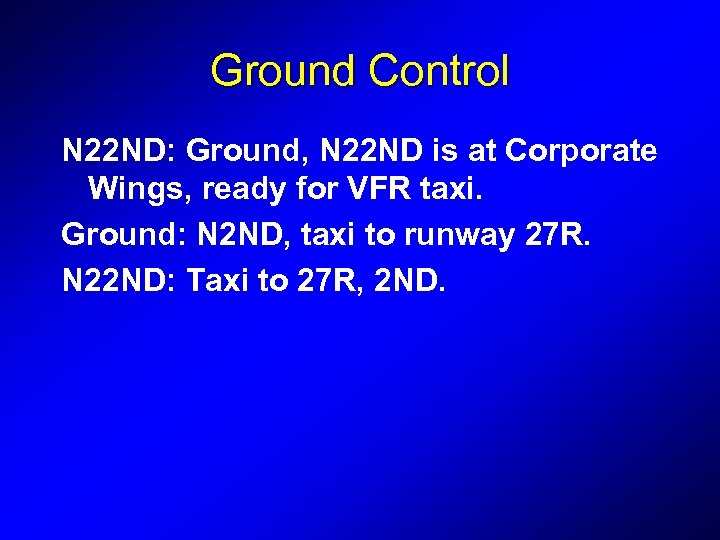
Ground Control N 22 ND: Ground, N 22 ND is at Corporate Wings, ready for VFR taxi. Ground: N 2 ND, taxi to runway 27 R. N 22 ND: Taxi to 27 R, 2 ND.
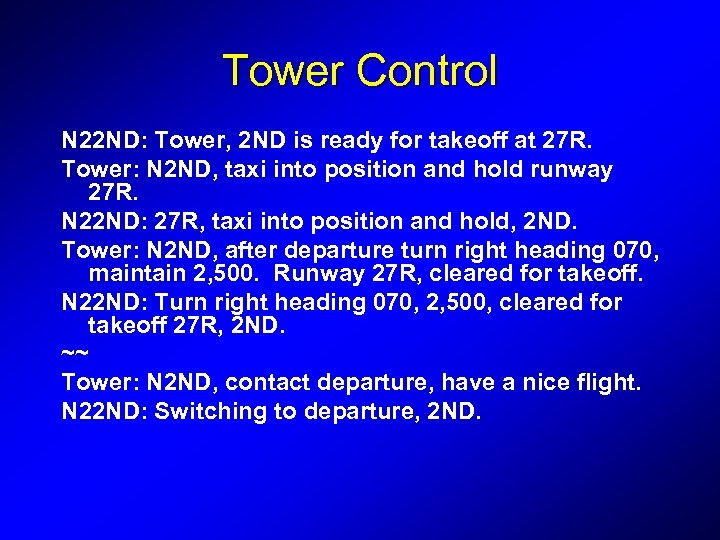
Tower Control N 22 ND: Tower, 2 ND is ready for takeoff at 27 R. Tower: N 2 ND, taxi into position and hold runway 27 R. N 22 ND: 27 R, taxi into position and hold, 2 ND. Tower: N 2 ND, after departure turn right heading 070, maintain 2, 500. Runway 27 R, cleared for takeoff. N 22 ND: Turn right heading 070, 2, 500, cleared for takeoff 27 R, 2 ND. ~~ Tower: N 2 ND, contact departure, have a nice flight. N 22 ND: Switching to departure, 2 ND.
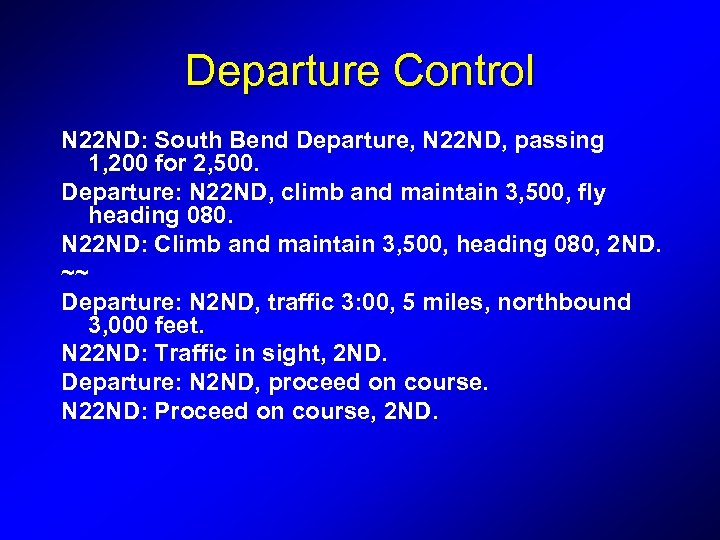
Departure Control N 22 ND: South Bend Departure, N 22 ND, passing 1, 200 for 2, 500. Departure: N 22 ND, climb and maintain 3, 500, fly heading 080. N 22 ND: Climb and maintain 3, 500, heading 080, 2 ND. ~~ Departure: N 2 ND, traffic 3: 00, 5 miles, northbound 3, 000 feet. N 22 ND: Traffic in sight, 2 ND. Departure: N 2 ND, proceed on course. N 22 ND: Proceed on course, 2 ND.
Any Questions?
Скачать презентацию Communication and ATC Breaker Breaker One Nine we
ee68a6c8bfe4e61641ba0dd6bbba1681.ppt