


 Скачать презентацию Communicating Health Care Quality To Consumers Partners Quality
a10bd2faa43a43d9c66945122f141327.ppt
- Количество слайдов: 47
 Communicating Health Care Quality To Consumers Partners Quality Measurement Committee May 11, 2004 Adapted from a talk given to the Managed Care Executive Group on March 25, 2004 by Brad Fluegel, CEO of Reden & Anders, and Jeff Levin-Scherz, CMO, Partners Community Health. Care, Inc Slide 1
 Introduction Goals • Describe pressures to increase information transparency on health care quality • Evaluate stakeholder implications • Describe implementation challenges • Examine incentives to promote information transparency in health care quality • Suggest future impact of availability of health care quality data Slide 2
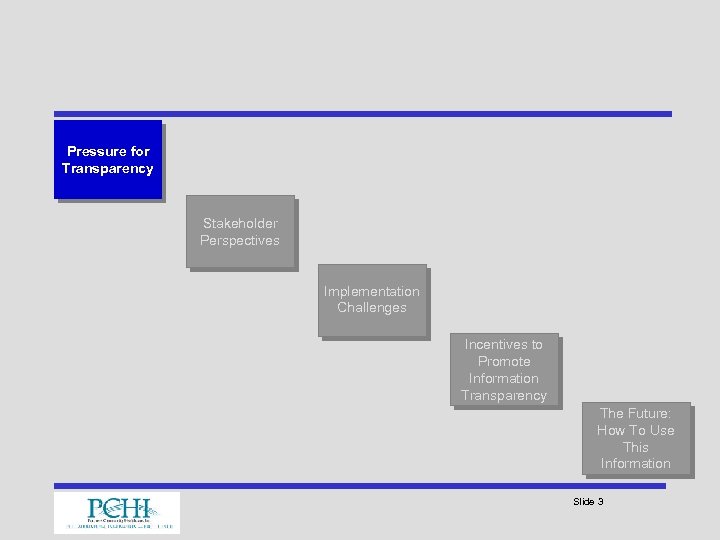 Pressure for Transparency Stakeholder Perspectives Implementation Challenges Incentives to Promote Information Transparency The Future: How To Use This Information Slide 3
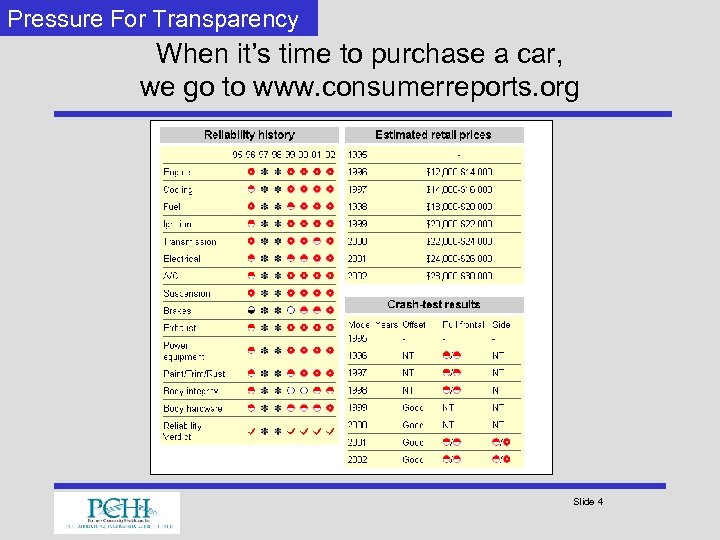 Pressure For Transparency When it’s time to purchase a car, we go to www. consumerreports. org Slide 4
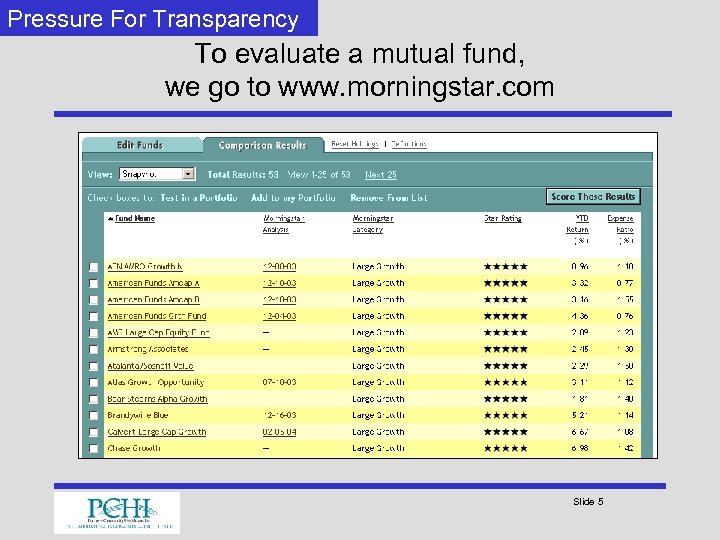 Pressure For Transparency To evaluate a mutual fund, we go to www. morningstar. com Slide 5
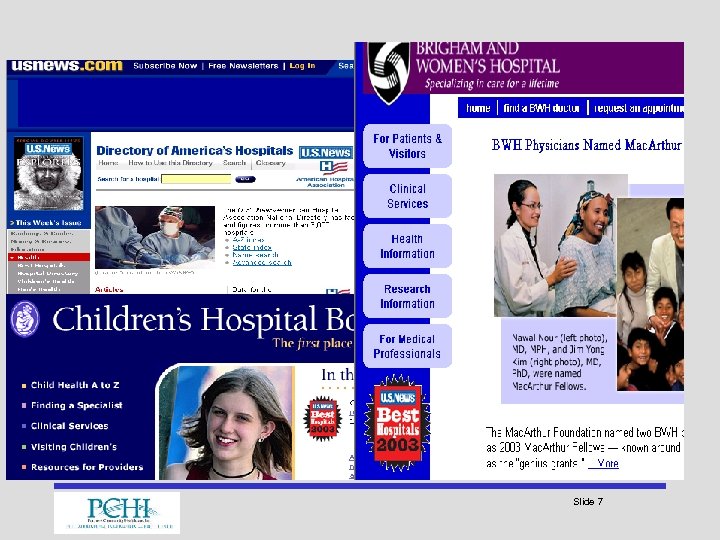
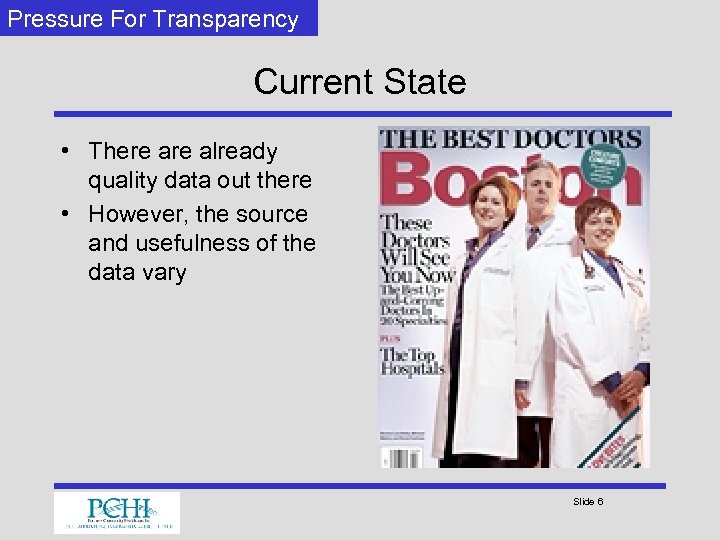 Pressure For Transparency Current State • There already quality data out there • However, the source and usefulness of the data vary Slide 6
 Slide 7
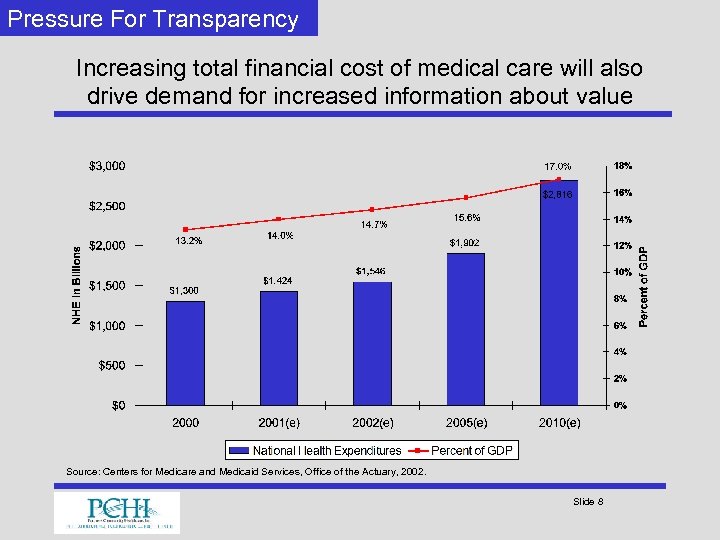 Pressure For Transparency Increasing total financial cost of medical care will also drive demand for increased information about value Source: Centers for Medicare and Medicaid Services, Office of the Actuary, 2002. Slide 8
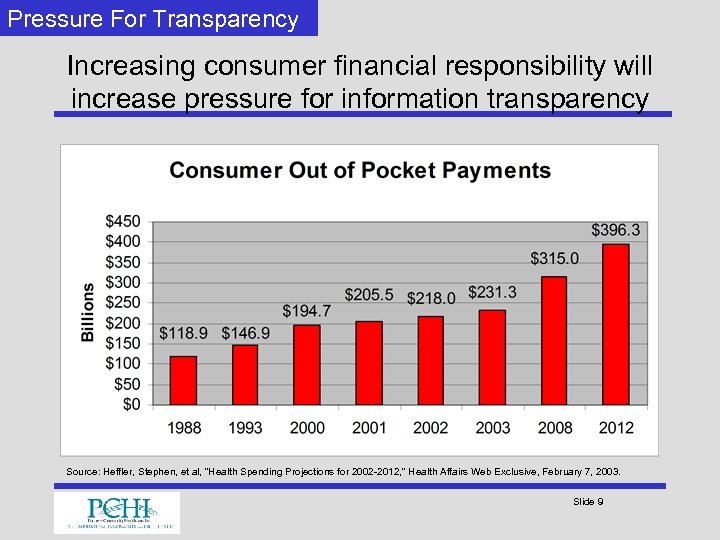 Pressure For Transparency Increasing consumer financial responsibility will increase pressure for information transparency Source: Heffler, Stephen, et al, “Health Spending Projections for 2002 -2012, ” Health Affairs Web Exclusive, February 7, 2003. Slide 9
 Pressure For Transparency Growing interest in consumer directed health care will also increase pressure for information transparency • Employers are looking to shift more responsibility in terms of health care selection, cost and utilization • Cost savings may have been squeezed out of managed care practices • Consumer directed health care presents several opportunities – Increased employee accountability – Enables consumerism and cost-effective use of services – Requires employee tools • Web-based health information • Health risk assessments • Provider pricing and quality information – Encourages provider competition in terms of price and quality Slide 10
 Pressure for Transparency Stakeholder Perspectives Implementation Challenges Incentives to Promote Information Transparency The Future: How To Use This Information Slide 11
 Stakeholder Perspectives Consumers demand (but often ignore) information on health care quality • When is information available? – Time of selecting care? – Time of enrollment in health plan? • Is information readily understandable? – Reading level – Implications • Is the information relevant to the consumer? – At the level of consumer decision-making? – Appropriate based on consumer demographics? • Are statistics appropriately conveyed graphically? Slide 12
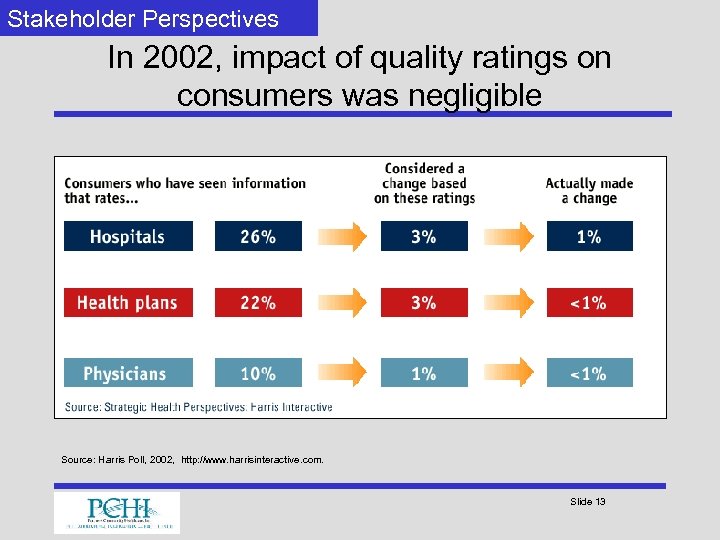 Stakeholder Perspectives In 2002, impact of quality ratings on consumers was negligible Source: Harris Poll, 2002, http: //www. harrisinteractive. com. Slide 13
 Stakeholder Perspectives Other consumer findings from Harris Poll • Quality is… – More $ and more treatment – Having choices – Being in a waiting room with people who earn more money than you – Evidence based medicine and community health applied systematically – The right to sue • A subsequent Forrester internet only poll is a bit more optimistic: – 11% used the internet to determine hospital or MD quality – 10% made choices based on this information – Demographics of this group are unusual (ie >50% broadband at home) Slide 14
 Stakeholder Perspectives Employers are pushing hard for information transparency (but not taking primary responsibility) • Many would like to move away from responsibility for health care, and see consumer information as a means to get there • Employer collaboratives are pushing health care parties to provide additional data – – Leapfrog Bridges to Excellence Mercer and Group Insurance Commission (Massachusetts) Niagara Business Group on Health (http: //www. myhealthfinder. com) – Many others Slide 15
 Stakeholder Perspectives Health Plans want to stake out their role as providers of consumer information • Although NCQA rates health plans, it is less and less relevant given that health plans increasingly have the same providers • Health plans, historically differentiated by provider networks and care delivery, are now about benefit design and administration • Fearful of loss of position on value chain Slide 16
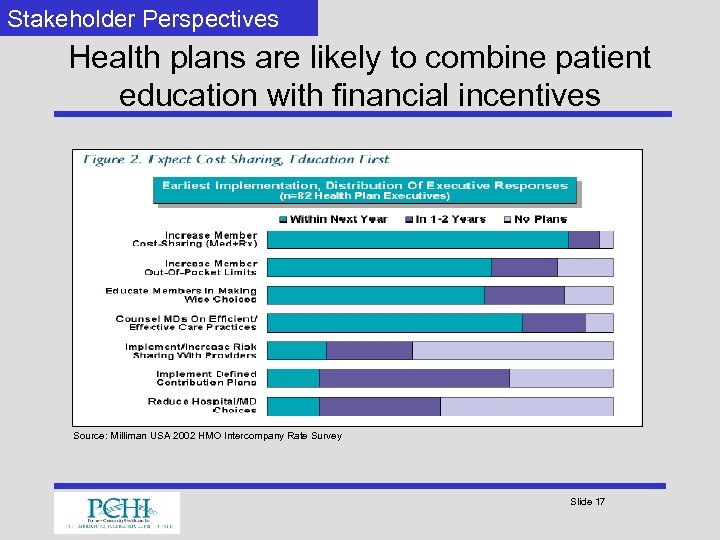 Stakeholder Perspectives Health plans are likely to combine patient education with financial incentives Source: Milliman USA 2002 HMO Intercompany Rate Survey Slide 17
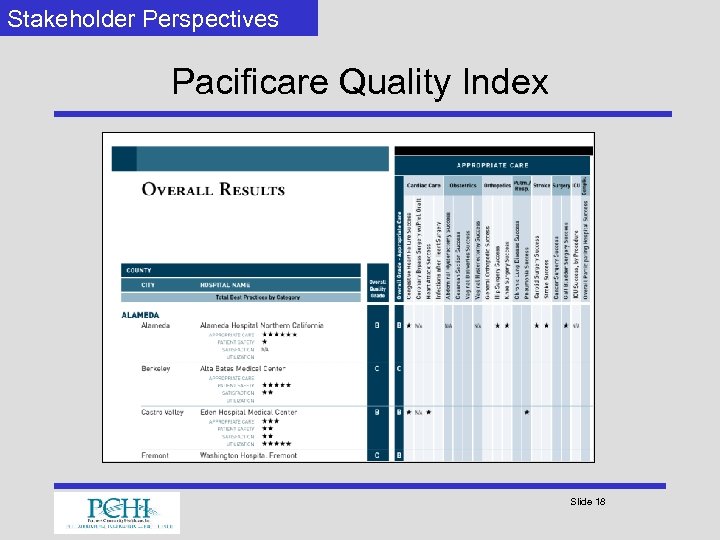 Stakeholder Perspectives Pacificare Quality Index Slide 18
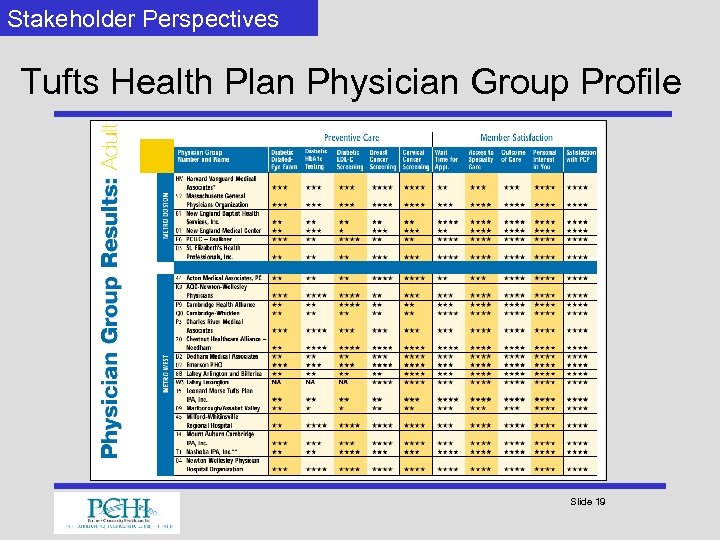 Stakeholder Perspectives Tufts Health Plan Physician Group Profile Slide 19
 Stakeholder Perspectives Health plans and providers are increasingly adding quality measures to “pay for performance” contracts • Discharge management • Outpatient management • Engagement with case and disease management programs • Risk assessment • Generic utilization • Access to care How much is enough? Should the “pay for performance” measures be self-financing? Slide 20
 Stakeholder Perspectives Government has led the way in providing health care quality information • HCFA produced hospital quality data in late 1980 s – Criticized for lack of severity adjustment • Pennsylvania Cost Containment Council – Hospital specific cardiac mortality and complication rates • New York State – Cardiac surgery mortality and complications by facility and individual surgeon • Massachusetts – 1999: Law directed the Department of Public Health to produce data comparing cardiac surgery outcomes – 2002: Debate about HIPAA implications of data request – 2004: Public report still not available Slide 21
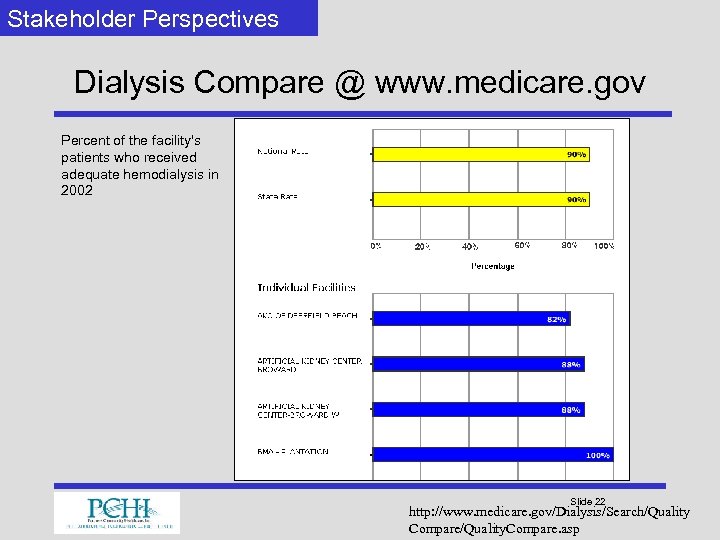 Stakeholder Perspectives Dialysis Compare @ www. medicare. gov Percent of the facility's patients who received adequate hemodialysis in 2002 Slide 22 http: //www. medicare. gov/Dialysis/Search/Quality Compare/Quality. Compare. asp
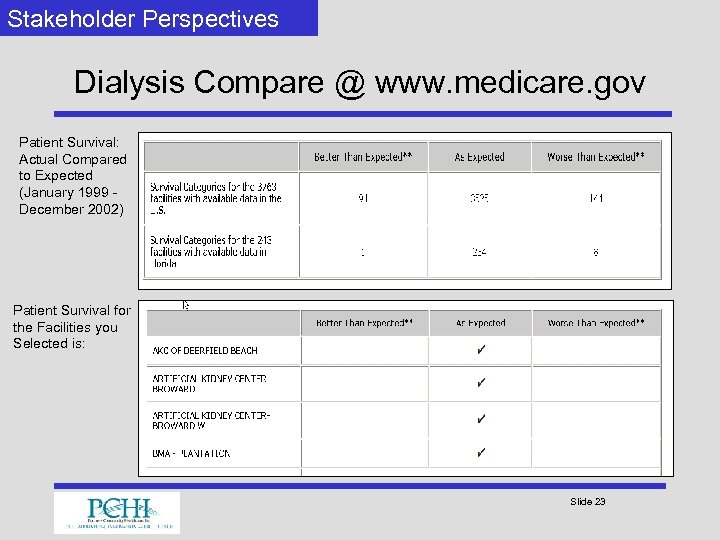 Stakeholder Perspectives Dialysis Compare @ www. medicare. gov Patient Survival: Actual Compared to Expected (January 1999 December 2002) Patient Survival for the Facilities you Selected is: Slide 23
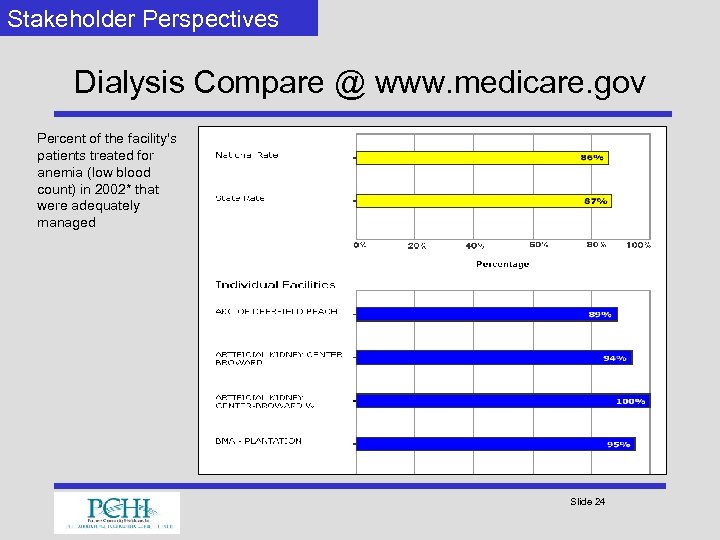 Stakeholder Perspectives Dialysis Compare @ www. medicare. gov Percent of the facility's patients treated for anemia (low blood count) in 2002* that were adequately managed Slide 24
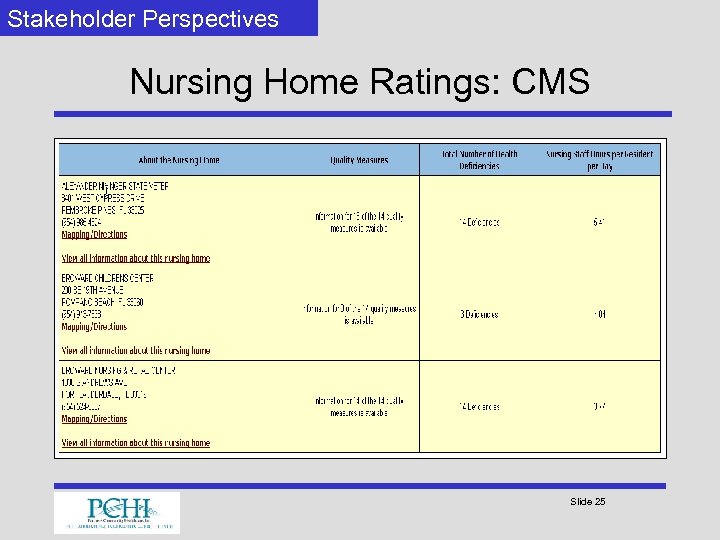 Stakeholder Perspectives Nursing Home Ratings: CMS Slide 25
 Stakeholder Perspectives Physicians believe that they are all (far) above average in quality • …and will generally quarrel with any data set that suggests otherwise. • Questions raised on true intent of profiling • Administrative data is often • Inconsistent or just plain wrong • Less than timely • Difficult to appropriately risk adjust • Dilemma about profiling larger groups (more statistically valid but more heterogeneous and less useful to patients) or individual doctors (less valid but more useful to patients) • Providers will devote considerable effort to those measures that will be disclosed…and might neglect other, more important clinical issues Slide 26
 Stakeholder Perspectives Hospitals also believe they are above average in quality • Longer history of regulation and reporting • Leapfrog acceptance rate up – 59% of queried hospitals in 22 regions responded – 410 additional hospitals responded voluntarily • JCAHO core measures • Claims data are inaccurate and unreliable, but the most readily available source of information The Wisconsin Hospital Association recently initiated the http: //www. wicheckpoint. org/ web site where quality indices (JCAHO Core Measures) of 122 hospitals are listed Slide 27
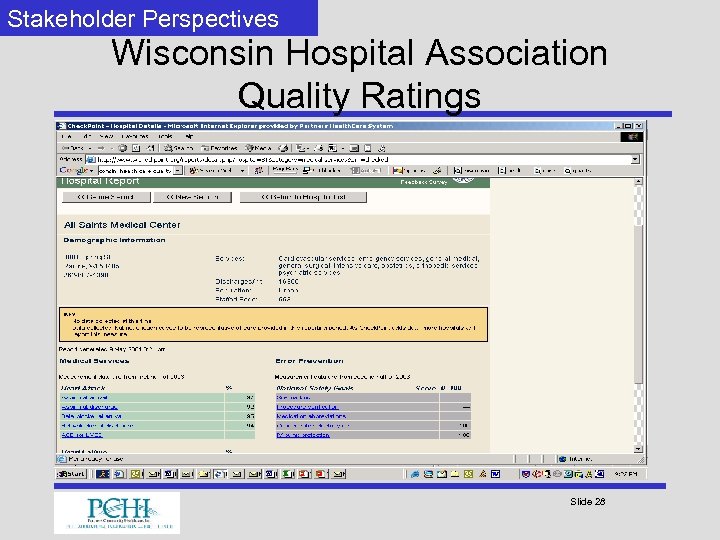 Stakeholder Perspectives Wisconsin Hospital Association Quality Ratings Slide 28
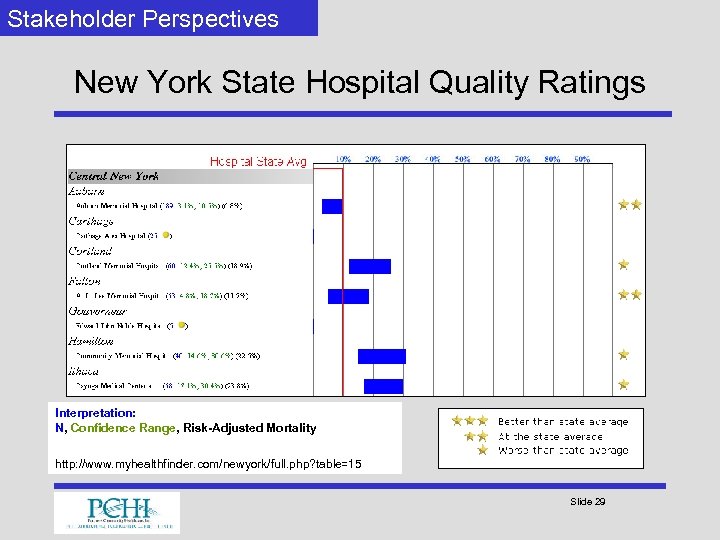 Stakeholder Perspectives New York State Hospital Quality Ratings Interpretation: N, Confidence Range, Risk-Adjusted Mortality http: //www. myhealthfinder. com/newyork/full. php? table=15 Slide 29
 Pressure for Transparency Stakeholder Perspectives Implementation Challenges Incentives to Promote Information Transparency The Future: How To Use This Information Slide 31
 Implementation Challenges Implementation challenges • Metrics • Opportunity to educate often not proximate to decision point • Public transparency can discourage complete reporting of complications • Difficult to get “winners” to play • Presentation Slide 32
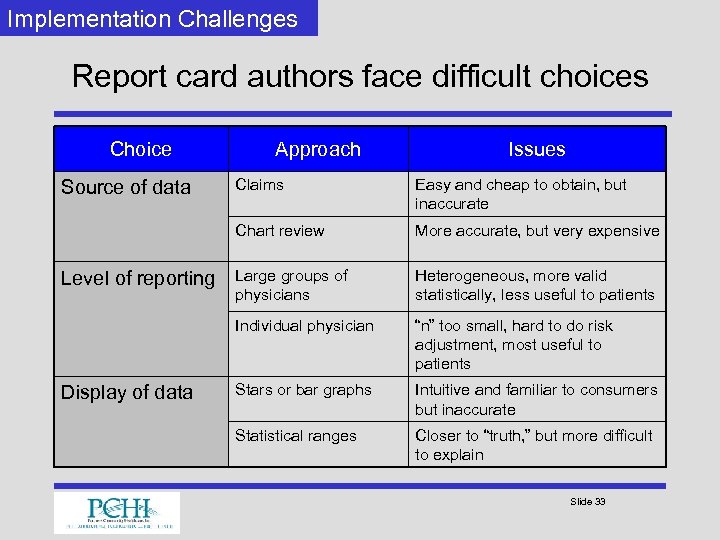 Implementation Challenges Report card authors face difficult choices Choice Approach Issues Display of data Easy and cheap to obtain, but inaccurate More accurate, but very expensive Large groups of physicians Heterogeneous, more valid statistically, less useful to patients Individual physician Level of reporting Claims Chart review Source of data “n” too small, hard to do risk adjustment, most useful to patients Stars or bar graphs Intuitive and familiar to consumers but inaccurate Statistical ranges Closer to “truth, ” but more difficult to explain Slide 33
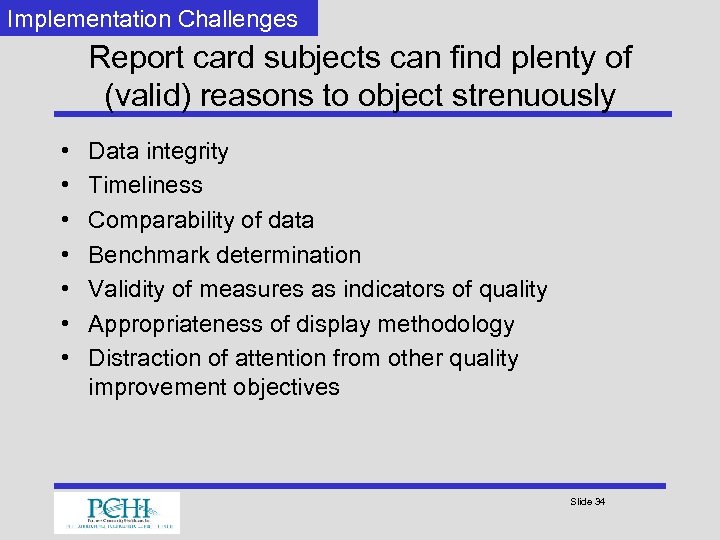 Implementation Challenges Report card subjects can find plenty of (valid) reasons to object strenuously • • Data integrity Timeliness Comparability of data Benchmark determination Validity of measures as indicators of quality Appropriateness of display methodology Distraction of attention from other quality improvement objectives Slide 34
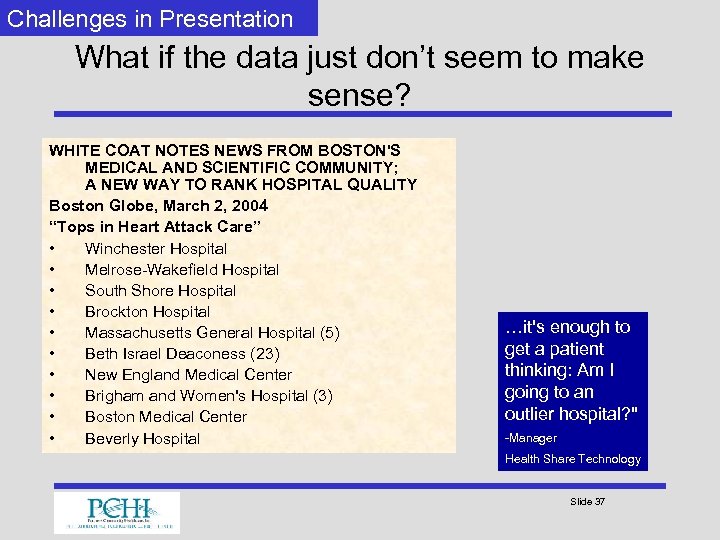 Challenges in Presentation What if the data just don’t seem to make sense? WHITE COAT NOTES NEWS FROM BOSTON'S MEDICAL AND SCIENTIFIC COMMUNITY; A NEW WAY TO RANK HOSPITAL QUALITY Boston Globe, March 2, 2004 “Tops in Heart Attack Care” • Winchester Hospital • Melrose-Wakefield Hospital • South Shore Hospital • Brockton Hospital • Massachusetts General Hospital (5) • Beth Israel Deaconess (23) • New England Medical Center • Brigham and Women's Hospital (3) • Boston Medical Center • Beverly Hospital …it's enough to get a patient thinking: Am I going to an outlier hospital? " -Manager Health Share Technology Slide 37
 Pressure for Transparency Stakeholder Perspectives Implementation Challenges Incentives to Promote Information Transparency The Future: How To Use This Information Slide 38
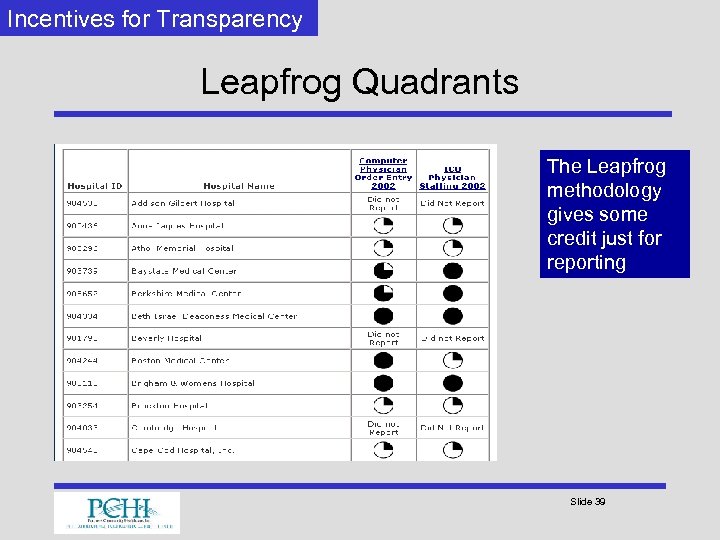 Incentives for Transparency Leapfrog Quadrants The Leapfrog methodology gives some credit just for reporting Slide 39
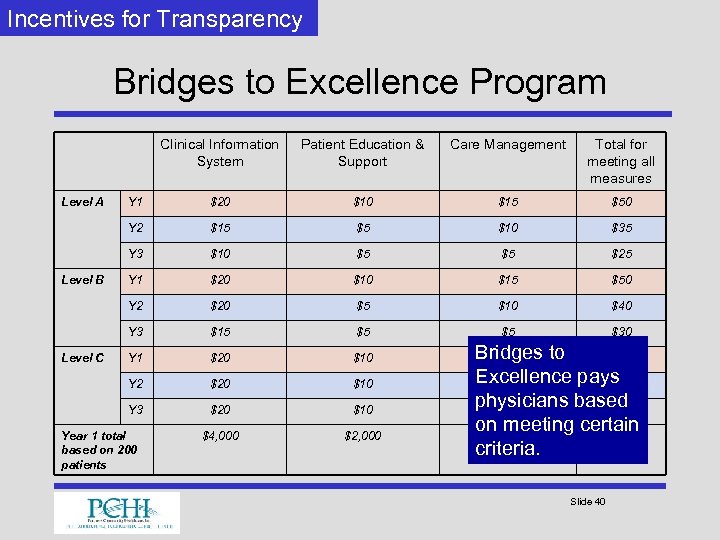 Incentives for Transparency Bridges to Excellence Program Clinical Information System Y 1 $20 $15 $50 $15 $5 $10 $35 $10 $5 $5 $25 Y 1 $20 $15 $50 Y 2 $20 $5 $10 $40 Y 3 $15 $5 $5 $30 Y 1 $20 $10 Y 2 $20 $10 Y 3 Level C Total for meeting all measures Y 3 Level B Care Management Y 2 Level A Patient Education & Support $20 $10 $4, 000 $2, 000 Year 1 total based on 200 patients Bridges to $15 $50 Excellence pays $15 $50 physicians based $15 $50 on meeting certain $3, 000 $10, 000 criteria. Slide 40
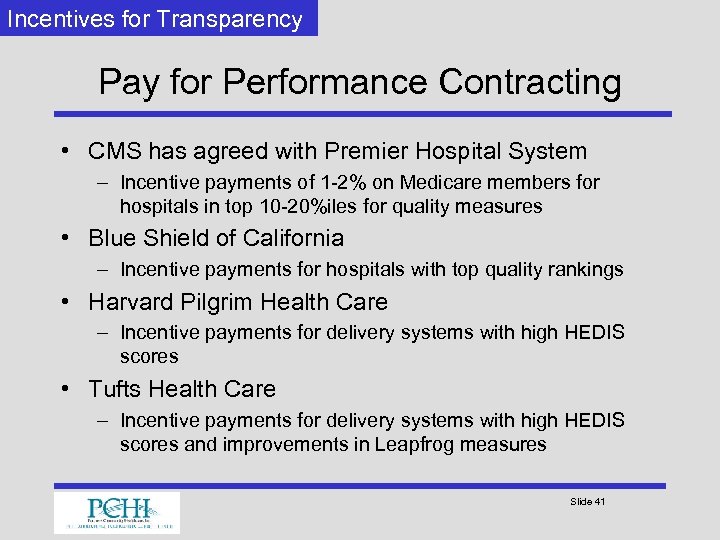 Incentives for Transparency Pay for Performance Contracting • CMS has agreed with Premier Hospital System – Incentive payments of 1 -2% on Medicare members for hospitals in top 10 -20%iles for quality measures • Blue Shield of California – Incentive payments for hospitals with top quality rankings • Harvard Pilgrim Health Care – Incentive payments for delivery systems with high HEDIS scores • Tufts Health Care – Incentive payments for delivery systems with high HEDIS scores and improvements in Leapfrog measures Slide 41
 Pressure for Transparency Stakeholder Perspectives Implementation Challenges Incentives to Promote Information Transparency The Future: How To Use This Information Slide 42
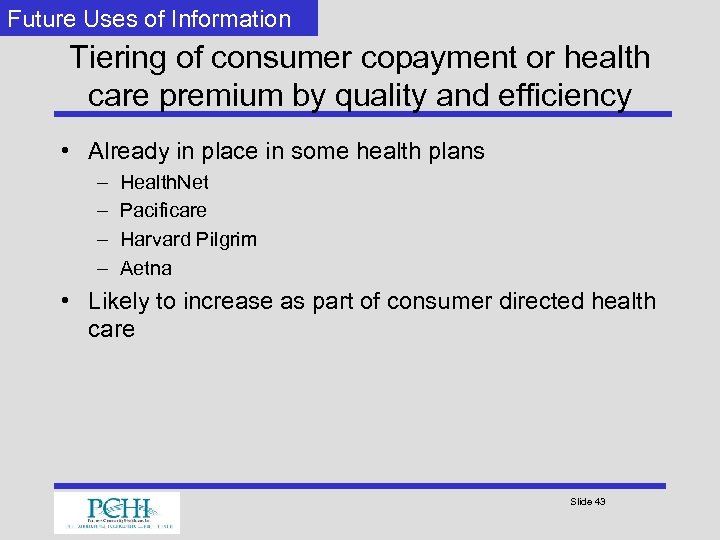 Future Uses of Information Tiering of consumer copayment or health care premium by quality and efficiency • Already in place in some health plans – – Health. Net Pacificare Harvard Pilgrim Aetna • Likely to increase as part of consumer directed health care Slide 43
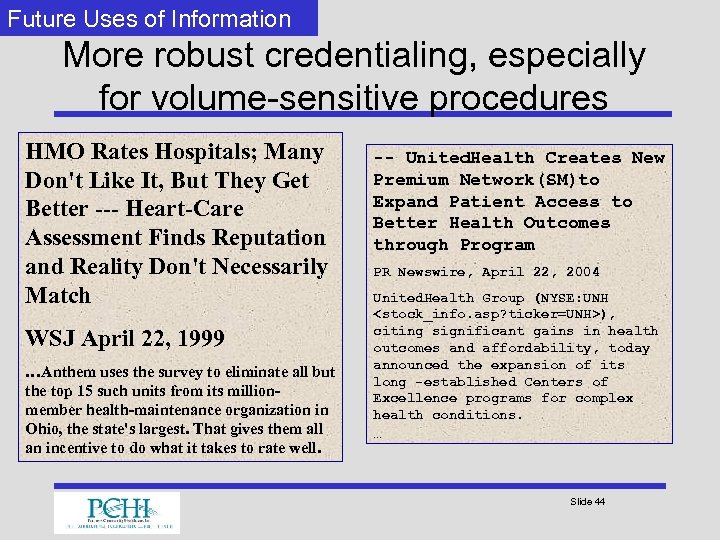 Future Uses of Information More robust credentialing, especially for volume-sensitive procedures HMO Rates Hospitals; Many Don't Like It, But They Get Better --- Heart-Care Assessment Finds Reputation and Reality Don't Necessarily Match WSJ April 22, 1999 …Anthem uses the survey to eliminate all but the top 15 such units from its millionmember health-maintenance organization in Ohio, the state's largest. That gives them all an incentive to do what it takes to rate well. -- United. Health Creates New Premium Network(SM)to Expand Patient Access to Better Health Outcomes through Program PR Newswire, April 22, 2004 United. Health Group (NYSE: UNH
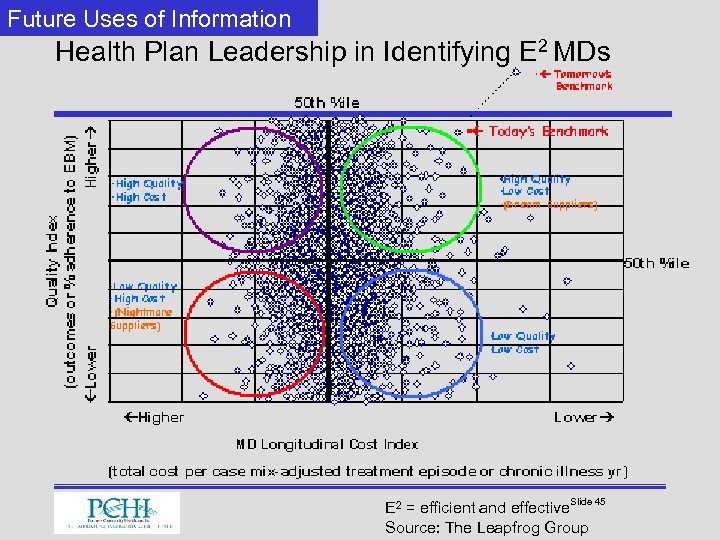 Future Uses of Information Health Plan Leadership in Identifying E 2 MDs Slide 45 E 2 = efficient and effective Source: The Leapfrog Group
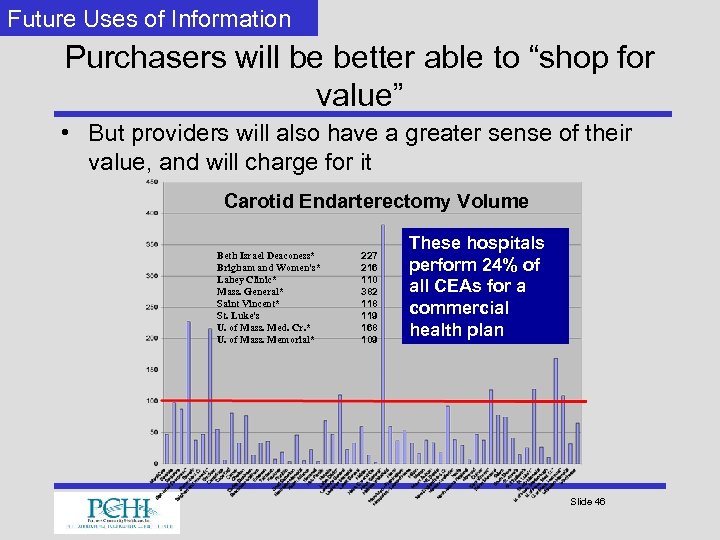 Future Uses of Information Purchasers will be better able to “shop for value” • But providers will also have a greater sense of their value, and will charge for it Carotid Endarterectomy Volume Beth Israel Deaconess* Brigham and Women's* Lahey Clinic* Mass. General* Saint Vincent* St. Luke's U. of Mass. Med. Cr. * U. of Mass. Memorial* 227 216 110 382 118 119 168 109 These hospitals perform 24% of all CEAs for a commercial health plan Slide 46
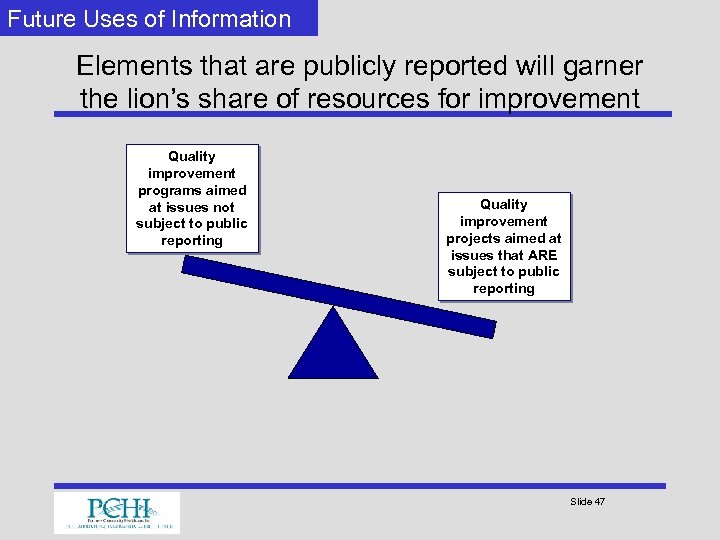 Future Uses of Information Elements that are publicly reported will garner the lion’s share of resources for improvement Quality improvement programs aimed at issues not subject to public reporting Quality improvement projects aimed at issues that ARE subject to public reporting Slide 47
 Doctor 'Scorecards' Are Proposed In a Health-Care Quality Drive March 25, 2004; Page A 1 In one of the most ambitious efforts yet to provide health-care quality ratings for consumers, 28 large employers, including Sprint Corp. , Lowe's Cos. , Bell. South Corp. , J. C. Penney Co. and Morgan Stanley are teaming up to develop "scorecards" to help employees choose doctors based on how well they care for patients -- and how costefficient they are. Slide 48
 …. claims data remains the only reliable source to verify the treatments doctors use and the drugs they prescribe. "It's imperfect, but it's better than being totally blind…" Arnold Millstein Mercer Consulting Quoted in Landro, L “Doctor 'Scorecards' Are Proposed In a Health-Care Quality Drive” Wall Street Journal March 25, 2004 "This is a very hard issue…The more quality measures, the better, but we don't want the information to be misleading. Without the appropriate statistical models, every time you start ranking doctors or putting a number of stars next to their name people are going to be misclassified…” Bruce Landon MD MBA Harvard Medical School Slide 49
 Resources • • www. talkingquality. gov www. ncqa. org www. medicare. gov/Dialysis/Home. asp www. medicare. gov/NHCompare/Home. asp www. myhealthfinder. com http: //www. wicheckpoint. org/ Rosenstein, AH “Hospital Report Cards, Friend or Foe? ” JCOM 11: 98 (2004) • Krumholz, HM et al “Evaluation of a Consumer-Oriented Internet Health Care Report Care” JAMA 278: 10 (2002) • Landro, L “Doctor 'Scorecards' Are Proposed In a Health-Care Quality Drive” Wall Street Journal March 25, 2004 Slide 50